




Advertising on ChatGPT isn’t something you can just switch on today. It’s more about laying the groundwork for what’s coming: a completely new way to advertise within a conversation. The real trick is to get inside the user’s mindset and figure out how your brand can helpfully join their conversation, rather than just crashing the party.
The New Frontier of Advertising on ChatGPT
Before you even think about launching a campaign, it’s crucial to understand why ChatGPT is such a massive shift for UK advertisers. This isn’t just another spot to slap a banner ad. It’s a conversational space where the old rules of engagement are being completely thrown out.
Forget the interruptive ads you see on social media feeds or the reactive, keyword-based nature of search. Here, the aim is to become part of the solution the user is actively seeking.
The real value is in connecting with a highly focused, tech-savvy audience that is there for a reason—to find information, solve problems, or create something new. These aren’t people passively scrolling through content; they’re professionals, researchers, and curious minds deep in a task.
Understanding the UK ChatGPT Audience
User growth in the UK has been nothing short of explosive, carving out a valuable and very distinct audience. By early 2025, it’s estimated that roughly one in five UK internet users will be on the platform.
The adoption is particularly dense in the capital. A staggering 30% of Londoners—that’s nearly 3 million people—have used the service. This opens up a huge opportunity to reach a younger, switched-on demographic, with 57% of Londoners aged 15-25 already using ChatGPT.
This audience isn’t just big; it’s influential. The user base skews towards mid-to-high income brackets and individuals in management roles, pointing to some serious purchasing power. What’s more, 61% of interactions are happening on mobile, a clear signal that any ad creative needs to be mobile-first.
The big mental shift for advertisers is moving from a “push” to a “pull” strategy. Instead of shouting your message from the rooftops, you need to offer genuine value that a user actually wants to engage with as they solve their problem.
New Ad Formats for a New Medium (Advertising on ChatGPT)
Advertising on ChatGPT will demand a completely different creative playbook. The ad formats we expect to see are designed to be less intrusive and feel more native to the user’s experience. This means your messaging has to blend seamlessly into the conversational flow.
The platform’s very structure opens up fresh possibilities that go way beyond static images, moving towards dynamic, genuinely helpful content. For brands that can adapt, this is a powerful way to build trust and establish authority. You can get a better sense of this by reading up on ChatGPT’s shopping layer and its implications for AI-driven commerce.
Here’s a look at the kinds of ad formats we’re anticipating, which will help you get your head around the creative options.
Potential ChatGPT Ad Formats
| Ad Format | Description | Best Use Case |
|---|---|---|
| Sponsored Links | Similar to search ads, these links would appear contextually within an answer, pointing users to a relevant product, service, or resource. | Driving high-intent traffic for specific product or service queries, like “best project management software for small teams.” |
| Branded Answers | A brand could sponsor the definitive answer for certain queries in their niche, positioning themselves as the go-to expert. | Building brand authority and trust, ideal for industries where expertise is a key differentiator, like finance or healthcare. |
| Conversational Ads | Interactive ad units that let users ask follow-up questions or explore different options directly within the ad itself. | Engaging users in a deeper, more personalised way; perfect for complex products or services that require more explanation, like insurance or travel planning. |
As you can see, the focus is squarely on integration and value. The brands that succeed here will be the ones that understand they’re not just buying ad space; they’re earning a place in a conversation.
Advertising on ChatGPT:; Laying the Groundwork for Your ChatGPT Advertising Strategy
A winning campaign kicks off long before you spend a single penny. To get any real traction on ChatGPT, you need a strategy that actually respects the conversational nature of the platform. Just jumping in with vague goals like “increase brand awareness” is a surefire way to burn through your budget; what you need are sharp, measurable objectives.
Your primary goal is the compass for every other decision you make. Are you a B2B software company trying to pull in qualified leads? Or are you an e-commerce brand looking to shift a new product line? Each path demands a completely different approach to your messaging and targeting.
For instance, a SaaS company could use conversational ads to gently nurture potential leads, answering their specific questions about features or pricing right there in the chat. A local retailer, on the other hand, might promote a new collection by showing up in conversations about fashion trends happening in their city.
Define Your Conversational Audience
You absolutely have to get into the user’s mindset here. People on ChatGPT aren’t just hammering in keywords; they’re exploring ideas, trying to solve tricky problems, and looking for detailed explanations. They are in discovery mode, which is a world away from the direct, purchase-intent mindset of someone on Google.
Your strategy has to work with this exploratory behaviour, not against it. The key is to pinpoint the conversations where your brand can genuinely add value.
- Map Out User Journeys: Brainstorm the kinds of problems your ideal customer would be trying to solve on ChatGPT. A user researching “best accounting software for freelancers,” for example, is a prime target for a fintech company.
- Identify Contextual Triggers: Think bigger. What are the wider topics and discussions that surround your product? A brand selling sustainable travel gear could cleverly target conversations about eco-friendly holidays or packing lists for backpacking trips.
This kind of detailed prep work is the bedrock of effective audience targeting. If you want to go deeper on this, our complete guide on what audience targeting is and how it works offers some brilliant, practical context.
The goal isn’t to interrupt their research but to become a helpful part of it. Your ad should feel less like a commercial break and more like a useful suggestion from a knowledgeable assistant.
Crafting a Message That Fits the Conversation (Advertising on ChatGPT)
Once you know who you’re talking to and where you’ll find them, you can start thinking about your message. Unlike traditional ads that scream for attention, your copy here needs to be subtle, helpful, and, above all, conversational.
Think of it as joining a discussion that’s already in full swing. Your message should be framed as a solution or a logical next step, not a hard sell. For example, instead of a blunt “Buy Now!”, a much better call to action might be something like “Want to see how it works?” or “Here’s a guide to help you decide.” This approach builds trust and encourages people to actually engage by respecting their intelligence and what they came here to do.
Advertising on ChatGPT: Crafting and Launching Your First Campaign
Alright, this is where the theory ends and the real work begins. Moving from the drawing board to launching your first campaign on a new platform can feel daunting, but if you break it down into smaller, manageable chunks, it becomes a lot less intimidating. The trick is to start smart, keep your focus squarely on the user’s conversation, and be ready to learn and adapt on the fly.
When you first get into the ad interface, it’s likely going to be built for simplicity. This is where you’ll take all that audience research and turn it into actual targeting parameters. Try to think less about broad demographics and more about the specific conversational context where your brand can genuinely help. It’s your opportunity to pinpoint the exact problems you solve for people.
This simple workflow breaks down the core process of getting your strategy ready for the real world.
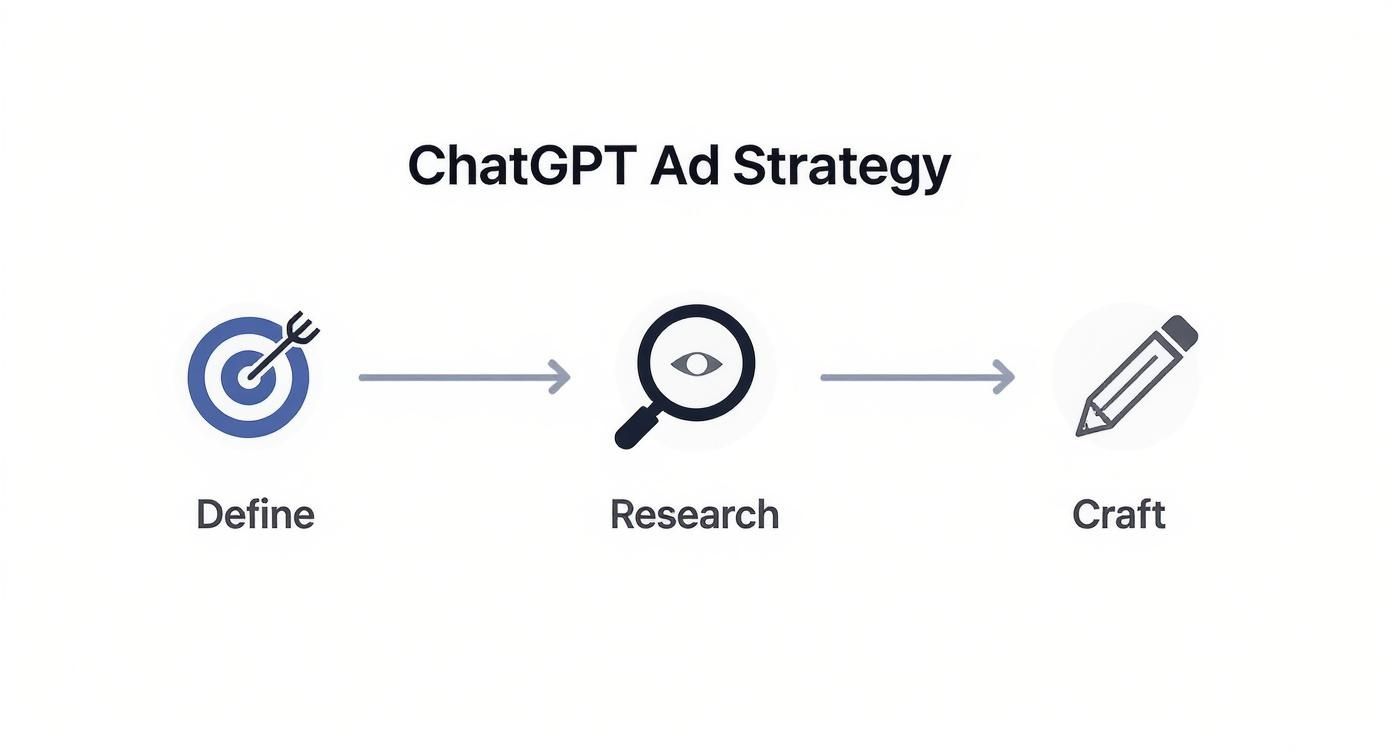
Following this straightforward flow—Define, Research, Craft—makes sure every part of your campaign is built on a solid foundation of knowing your audience and having clear goals.
Writing Ad Copy That Connects
Let’s be honest: your ad copy is everything here. Your traditional, punchy ad slogans are going to fall flat. Success on ChatGPT is all about writing in a way that feels completely natural to the platform—helpful, clear, and conversational.
- Lead with value, not a sales pitch: Instead of a blunt “Shop Our Sale,” try something like, “Here’s a guide to choosing the right option for you.”
- Use natural language: Write like you’re personally helping someone out. Ditch the corporate jargon and stiff, formal language.
- Anticipate the next question: Great conversational copy doesn’t just answer the immediate query; it smoothly guides the user to the next logical step in their journey.
Nailing this tone takes practice. A great starting point is to study existing interactions and see what works. Our guide full of ChatGPT ad examples offers some brilliant, practical insights into what effective conversational creative actually looks like.
Setting Your Budget and Bidding Strategy (Advertising on ChatGPT)
While we’re all waiting for the official launch, it’s a good time to get your finances in order. The platform is expected to roll out in 2026, which is set to be a massive moment for digital marketing in the UK. With a huge user base and an estimated £834 billion impact on retail-CPG purchasing decisions already, the opportunity for advertisers is gigantic. Getting ready now puts you ahead of the game, especially when you consider that UK social media ad spend has already shot past £9 billion.
For your first campaign, you need to think of your budget as an investment in learning and data collection.
Don’t chase immediate profitability from day one. Your primary goal is to gather enough performance data to figure out what actually works. Treat that initial budget as an investment in pure market intelligence.
Start with a modest, controlled budget you’re comfortable experimenting with. When it comes to bidding, your strategy should be tied directly to what you want to achieve:
- Cost-per-Click (CPC): Perfect for driving traffic to a specific landing page or a helpful resource.
- Cost-per-Acquisition (CPA): The best choice for campaigns laser-focused on generating leads or sales.
- Cost-per-Meaningful-Interaction (CPMI): This could be a future metric focused on the quality of engagement within the ad itself.
Pick the bidding model that most accurately reflects the action you want users to take. That way, you’re only paying for the outcomes that truly matter to your business.
Advertising on ChatGPT: How to Measure and Optimise Your Campaigns
Getting your campaign live is a great feeling, but the real work starts now. Success on a platform like ChatGPT isn’t about just getting clicks and impressions; it’s about smart, continuous optimisation driven by the right data.
True growth comes from digging into the numbers and turning them into actionable insights. It’s about figuring out why a user engaged, not just that they clicked, and what that conversation actually meant for your bottom line.
Setting Up Your Measurement Framework
Before you can tweak a single thing, you need your tracking sorted. Measuring success in a conversational environment demands a slightly different mindset. Of course, traditional conversions like sales or form fills are still the ultimate goal. But you also have to track the quality of the conversation itself.
You need to define what a “meaningful interaction” actually looks like for your brand. Maybe it’s a user asking a specific follow-up question. Or perhaps it’s them requesting a resource you mentioned. These are the crucial top-of-funnel signals that tell you if your message is landing, long before a credit card comes out.
The sheer scale of engagement on the platform makes this essential. As of summer 2025, ChatGPT’s monthly site visits rocketed past 5.6 billion, with people spending nearly 14 minutes on the site per session. In the UK alone, where digital ad spend hit a massive £38.07 billion in 2025, ChatGPT is already a top-tier website. This just highlights the enormous opportunity for advertisers who get their measurement right. You can explore the latest ChatGPT trends and statistics to see the full picture.
Your goal is to map the entire customer journey, from that first chat interaction right through to the final conversion on your website. It’s all about connecting the dots between conversational engagement and real business results.
Core Metrics to Monitor (Advertising on ChatGPT)
Once the data starts to flow, you need to know what you’re looking for. The ad platform will have its own dashboard, but you should zero in on the metrics that truly reflect conversational success.
Below is a breakdown of the key performance indicators (KPIs) you should have your eye on. These go beyond the standard vanity metrics and get to the heart of what’s working.
Essential KPIs for ChatGPT Ad Campaigns
A summary of the most important metrics for measuring the success of your advertising efforts on the platform.
| Metric (KPI) | What It Measures | Why It Matters for Conversational Ads |
|---|---|---|
| Engagement Rate | Active interactions like user responses, questions asked, or specific commands followed. | A high rate is a strong signal your copy is compelling and genuinely conversational, not just a one-way broadcast. |
| Cost Per Meaningful Interaction (CPMI) | The cost to generate a high-quality interaction (as defined by you). | This is a far better gauge of ROI than a simple cost-per-click. It tells you how efficiently you’re starting valuable conversations. |
| Conversion Rate | The percentage of meaningful interactions that lead to a final business goal (e.g., a sale). | This classic KPI connects your chat activity directly to revenue, proving the commercial value of your campaigns. |
| Lead Quality Score | An assessment of the leads generated, especially for B2B campaigns. | Are you attracting decision-makers from your target industries? This metric tells you if you’re reaching the right people. |
Watching these numbers is the first step. The real magic happens when you use them to make your campaigns better. For a deeper dive, our guide on how to measure advertising effectiveness offers some brilliant foundational knowledge that applies here too.
Your Optimisation Checklist (Advertising on ChatGPT)
Constant improvement is the name of the game. Don’t fall into the “set it and forget it” trap. Use your data to methodically refine your campaigns.
- A/B Test Your Messaging: Are you getting better engagement with a direct question or a surprising fact? Continuously test different conversational hooks, value props, and calls-to-action to find what sparks the best interactions.
- Refine Audience Targeting: Dig into your analytics. Which conversational contexts are bringing in the highest-quality leads? Double down on what’s delivering results and pull back from areas that are just burning through your budget.
- Adjust Bidding Strategy: If you’re seeing plenty of chat engagement but very few final conversions, your bidding strategy might be off. You could be telling the algorithm to optimise for the wrong action. Try shifting your focus to bid for those more valuable, bottom-of-funnel results instead.
Advertising on ChatGPT: Future-Proofing Your AI Advertising Skills
Getting to grips with today’s advertising tools is one thing, but it’s only half the battle. If you really want to succeed, you need to be looking at where conversational advertising is headed. Staying ahead of the curve is what will keep your skills and strategies sharp long after the initial novelty of AI ads wears off.
Things are going to move fast. We’re already looking beyond simple text-based ads towards a much more integrated and intelligent future. For any UK brand, preparing for this next wave isn’t just a good idea—it’s absolutely essential for long-term growth.
Integrating Data for Hyper-Personalisation
The real game-changer is going to be connecting your own customer data with the conversational context inside ChatGPT. Just imagine being able to plug in your Customer Relationship Management (CRM) system to inform the ads you’re serving.
This completely blows the doors open for hyper-personalisation.
- For an e-commerce brand: You could pop up with an ad for a complementary product right when a recent customer is asking the AI how to get the most out of their new purchase.
- For a SaaS business: A user from a company you’re trying to land could get a tailored message about a specific feature that solves the exact problem they’re describing to the AI.
This level of relevance transforms an ad into a genuinely useful piece of advice. The impact is huge, and it’s how you’ll build real customer loyalty. It’s all about creating a seamless experience where your brand appears at the perfect moment with the perfect solution.
The future of advertising on ChatGPT isn’t about just reaching more people; it’s about reaching the right person with an incredibly relevant message at the exact moment of need. This shift from broad targeting to precision assistance is fundamental.
Embracing AI-Driven Creative and Commerce (Advertising on ChatGPT)
Beyond just data, the creative process itself is in for a massive shake-up. AI will soon be dynamically optimising your ad creative on the fly. In practice, this means the system will learn which combinations of headlines, descriptions, and calls-to-action work best in different conversations, constantly refining your campaigns for peak performance.
We’re also witnessing the dawn of AI-driven commerce, where the line between a chat and a transaction completely vanishes. Users won’t just get recommendations; they’ll be able to browse products, compare different options, and even complete a purchase, all without ever leaving the chat interface.
This trend is blurring the old distinctions between content and advertising. Brands that can create genuinely useful, interactive ad formats are going to have a massive advantage. Your focus should be on preparing for this shift now. Start thinking about how your products and services can be presented conversationally. Build the content and frameworks today, so you’re ready to plug them into these new formats the second they become available. It’s this kind of proactive thinking that will separate the winners from the losers in the new era of AI advertising.
Common Questions About ChatGPT Ads
Stepping into a new advertising platform always brings up a few questions. That’s completely normal—this is new territory for all of us. To help you navigate it with confidence, we’ve pulled together some of the most common queries UK marketers are asking, along with some straight-talking answers.
Is Advertising on ChatGPT Available Now in the UK?
Not just yet. Direct, self-serve advertising on ChatGPT isn’t widely available in the UK right now. The platform is expected to start with a testing phase involving a handful of select partners first.
So, what should you be doing? Prepare. The smartest move is to get ahead of the curve. Spend time using the platform yourself to get a feel for how people interact with it. Start thinking about content that naturally fits into a conversational format and build out a solid conversational marketing plan. All this groundwork will put you miles ahead when the ad platform finally does launch.
What Budget Should I Plan for My First Campaign?
While the official pricing models are still under wraps, a good rule of thumb is to set aside an experimental budget. Think of it like testing any other new channel, whether that was TikTok or LinkedIn Ads back in the day.
For a UK business, a sensible starting point would be somewhere between £500 and £2,000. That’s enough to gather some meaningful initial data, see what’s working, and make informed tweaks. The goal here isn’t a massive immediate return; it’s about learning what this unique audience responds to before you start scaling up your spend.
Think of your initial budget as an investment in market intelligence, not just ad clicks. The primary objective is to learn what works so you can scale effectively later.
How Is This Different From Google Search Ads?
The biggest difference comes down to user intent. Google Ads are brilliant for capturing someone with a direct, specific need—classic ‘pull’ marketing. Someone types “buy waterproof hiking boots,” and your ad pops up with the perfect solution.
Advertising on ChatGPT is a different beast entirely. It’s about joining an ongoing, often exploratory, conversation. Your ad can’t just be a transactional answer; it needs to be contextually relevant and genuinely add value to their dialogue. It’s less like a billboard on the motorway and more like being a helpful expert in the room.
What Are the Main Brand Safety Risks?
The main risk is your ad appearing next to AI-generated content that’s inaccurate, irrelevant, or just completely off-brand. As with any new platform, protecting your brand’s integrity is job number one.
It’s widely expected that OpenAI will roll out robust brand safety controls, much like the ones we’re used to on other major ad platforms. We’re talking about tools like negative keywords, topic exclusions, and placement controls. Marketers will need to get familiar with these features and use them diligently from day one to ensure their ads are always shown in a brand-appropriate context.
Ready to get your advertising strategy in shape for the next wave of digital marketing? The expert team at PPC Geeks can help you build data-driven campaigns that deliver real results. Explore our services and get a free, in-depth audit today at https://ppcgeeks.co.uk/.