




Click Through Rate, or CTR, is one of those core marketing metrics you just can’t ignore. It tells you what percentage of people who see your ad or link actually click on it.
So, what’s a ‘good’ CTR? Well, it varies wildly. But for a quick benchmark here in the UK, if you’re running Google Search Ads, anything around 4-5% is a solid starting point. For Display Ads, which are much more passive, you’re looking at a far lower figure, typically about 0.5%.
What Click Through Rate Actually Tells You
Picture a shop window on a bustling high street. Everyone who walks past is an impression. But the people who stop, like what they see, and actually push the door open to come inside? Those are your clicks.
CTR is simply the percentage of window shoppers who were curious enough to step into your store. It’s much more than a number to brag about; it’s a direct pulse check on how well your message is landing with your audience. It answers the big question: is my advert, email subject line, or search result snappy enough to actually earn that click?
The Simple Formula Behind CTR (What Is a Good Average Click Through Rate)
Working out your CTR is dead simple. You just take the total number of clicks your ad got and divide it by the number of times it was shown (your impressions). Then, multiply by 100 to get a percentage.
Formula: (Total Clicks ÷ Total Impressions) x 100 = Click Through Rate (%)
Let’s say your Google Ad was shown 1,000 times and got 50 clicks. That gives you a 5% CTR. It’s a straightforward calculation that gives you a powerful glimpse into how relevant your campaign is. If you want to get into the nitty-gritty, you can learn more about what is click-through rate and how it applies to different campaigns.
A healthy CTR is also a massive green flag for platforms like Google. It signals that users find your content genuinely useful, and they’ll often reward you for it. This can lead to some brilliant knock-on effects:
- Better Ad Placements: Google’s algorithm loves ads that people engage with. A high CTR can push your ads into more prominent, higher-converting spots on the results page.
- Lower Costs: Your CTR is a huge factor in your Quality Score. A better score can directly lead to a lower cost-per-click (CPC), making your budget stretch much further.
- Increased Traffic: At the end of the day, a higher CTR means more potential customers landing on your website, giving you more shots at making a sale or getting a lead.
Getting your head around your average click through rate is the first real step towards building sharper, more profitable marketing campaigns that actually grow your business.
UK Click Through Rate Benchmarks by Channel
To get a real feel for your campaign’s performance, you need to know what you’re measuring against. Setting realistic expectations is everything, and the truth is, not all channels are built the same. A ‘good’ CTR for a high-intent search ad is a completely different beast to what you’d expect from a display banner.
These UK benchmarks will give you the context you need to figure out if you’re hitting the mark or if there’s room to grow.
This visual breaks down the simple but crucial relationship between the number of people who see your ad (impressions), how many of them click, and the resulting CTR.
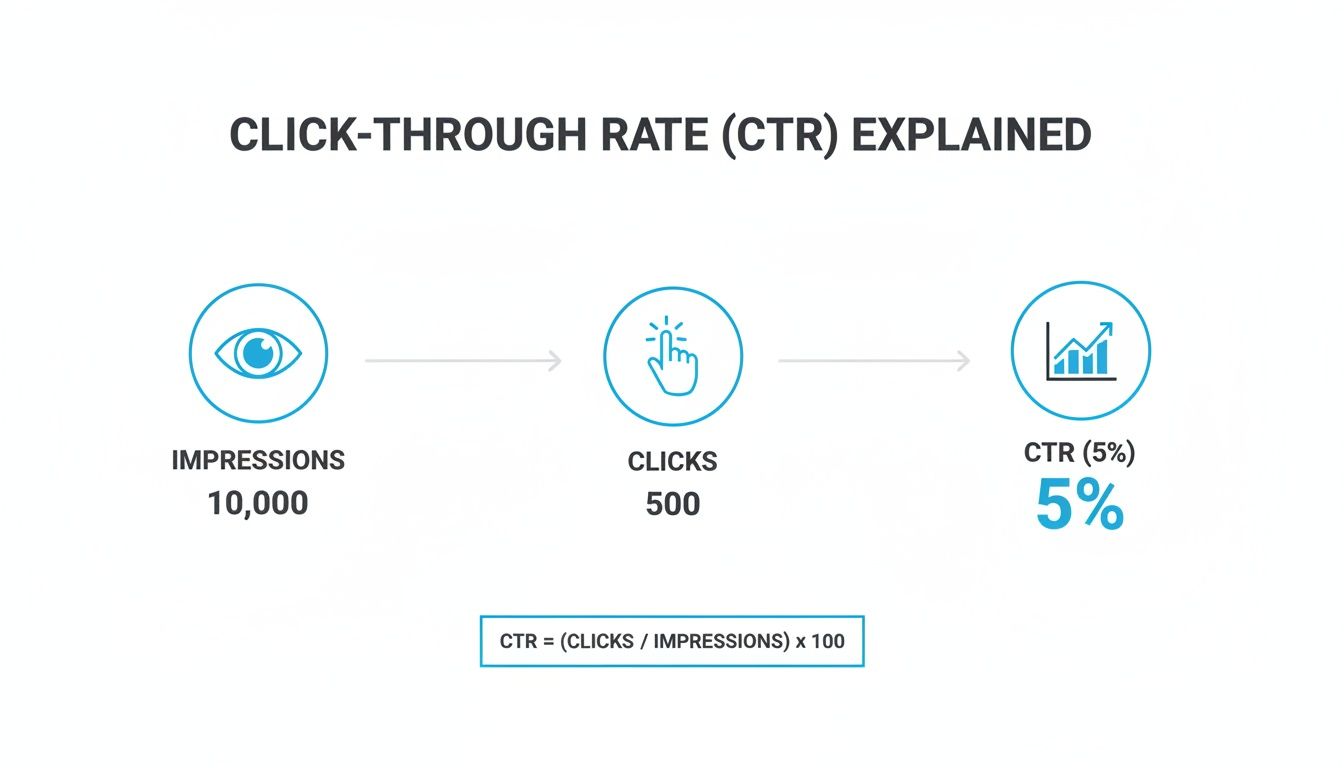
As you can see, CTR is the vital link that turns eyeballs into actual engagement. It’s the foundation of almost all performance analysis.
Google Search Ad Benchmarks
For advertisers here in the UK, Google Search Ads are a powerhouse for capturing intent. When someone is actively typing a search query for something you sell, they are practically telling you they’re ready to click. This is why the performance metrics are so strong across the board.
Recent UK data shows the average Google Ads click-through rate for Search campaigns is 4.7% across all industries. This figure is a solid baseline for most PPC advertisers. It also throws the difference between active and passive advertising into sharp relief—Display ads average a tiny 0.58% and Shopping ads sit at 0.82%.
A strong performance on search is a clear signal that your ad copy, keywords, and offer are hitting the bullseye. You’re meeting your audience right where they are, in the moments that matter most.
Display and Shopping Ad Averages (What Is a Good Average Click Through Rate)
Unlike search, display and shopping ads often pop up when users aren’t actively on a mission to buy something. This naturally means you’re going to see a lower average click-through rate.
- Display Ads: These are the visual banners you see on websites all over the Google Display Network. Often, their main job is to build brand awareness rather than get a direct click, which explains the much lower average CTR of around 0.5% to 0.6%. An impression alone can have value here, even without a click.
- Shopping Ads: These product-first ads show up at the top of search results and in the Shopping tab. While they are still triggered by search queries, their visual nature means people can get a lot of info—like price and appearance—at a glance. This often results in a more considered click and a modest CTR of about 0.8%.
Email Marketing CTR Standards
Email marketing is still a cornerstone for UK businesses, particularly in the ecommerce and lead-nurturing worlds. Your click-through rate here is a direct measure of how well your subject line and preview text grab attention, and just how interested your subscriber list is.
The average email CTR in the UK tends to float around 2.5% to 3%. This number can swing wildly, though, depending on your industry and how engaged your audience is. A highly targeted email sent to a small segment of loyal customers will nearly always blow a generic promotional blast out of the water.
Figuring out what makes a good CTR for your specific campaigns is key to refining your strategy and getting better results.
Decoding Your CTR: What the Numbers Really Mean
Knowing your click-through rate is one thing. Actually understanding the story it’s telling you? That’s where the real marketing insight begins. A single percentage point can be a powerful diagnostic tool, revealing some uncomfortable (but useful) truths about your campaigns.
It’s time to look beyond the surface-level number.
Think of your CTR less like a final grade and more like a compass. It points you directly towards what’s working and, more importantly, what’s falling flat. By interpreting it correctly, you can start asking much smarter questions. Why did one ad get double the clicks of another? Is our messaging hitting the mark? Are we even talking to the right people?
Reading Between the Lines of Campaign Data (What Is a Good Average Click Through Rate)
Your CTR rarely works in isolation; its true value shines when you pair it with other key metrics. This context is what separates basic reporting from genuine performance analysis. For a deeper dive, our guide on how to calculate CTR lays the perfect groundwork for this kind of analysis.
Let’s look at a couple of common scenarios and what they’re probably telling you:
- High CTR, Low Conversions: This classic mismatch is a massive red flag. It often signals a huge disconnect between your ad and your landing page. Your advert is making a promise so compelling that people are rushing to click, but the destination page just isn’t delivering. The cause could be anything from a confusing layout or slow loading times to a message that doesn’t align with the ad’s claims.
- Low CTR, High Conversions: While it seems counterintuitive, this situation suggests you have a fantastic, high-converting offer, but your ad isn’t doing it justice. The few people who do click are clearly the perfect audience, but your ad copy or creative is failing to grab wider attention. This is a clear signal to go back to the drawing board with your headlines and targeting to broaden your appeal.
Using CTR as a Diagnostic Tool
When you start viewing your CTR through a diagnostic lens, it transforms into an actionable tool. Instead of just shrugging at a low average click through rate, you can begin to pinpoint the cause. Is it a problem with your audience targeting? The relevance of your keywords? Or is it just a really uninspired advert?
A low CTR isn’t a failure—it’s feedback. It’s the market telling you that your message isn’t resonating or your targeting is off. Listen to this feedback, and you have a clear path to improvement.
For instance, if a specific keyword has thousands of impressions but a rock-bottom CTR, it’s a huge indicator that users searching that term don’t find your ad relevant. On the flip side, an ad group with a brilliant CTR but very few impressions might contain your best-performing creative. That’s a golden opportunity to increase your budget or bids for that segment.
This is the level of analysis that lets you stop guessing, fix what’s broken, and double down on what truly works.
What Is a Good Average Click Through Rate: The Key Elements That Influence Your CTR

A high click-through rate never just happens by accident. It’s the result of several critical elements all firing in perfect sync. Getting your head around these factors is the first step in moving from just hoping for clicks to actually engineering them.
Think of it like building a high-performance engine. Every single part has a job to do, and when they’re all finely tuned, the machine purrs. But if just one component is off, the whole system can stall out.
Your average click-through rate depends on a similar set of crucial parts. Let’s break down the big ones.
Ad Copy and Creative
Your ad copy is your pitch on the front line. It’s the words and headlines you use to grab someone’s attention and convince them to act, usually in just a handful of characters. It has to be sharp, compelling, and speak directly to what the user wants or needs.
For instance, a headline like “Shoes for Sale” is completely forgettable. But what about “Durable Kids’ School Shoes | Next-Day Delivery”? That’s specific, it’s packed with benefits, and it creates a bit of urgency. It’s far more likely to get that click.
At its heart, effective ad copy is all about relevance. It has to perfectly match what the searcher is looking for and give them a crystal-clear reason why your link is the best answer.
On more visual channels like the Display Network or social media, the creative is just as important. A thumb-stopping image or a quick, engaging video can jolt a user out of their endless scrolling and make them pay attention. On the flip side, poor-quality visuals can instantly tank your credibility and send your CTR into a nosedive.
Keyword Targeting and Relevance (What Is a Good Average Click Through Rate)
The keywords you choose to bid on are the absolute foundation of your Search campaign’s CTR. If your keywords are too broad, your ad will show up in front of all the wrong people, leading to a pile of wasted impressions and a truly dismal click-through rate.
Precision is everything here. Targeting long-tail keywords—those more specific, multi-word phrases—almost always delivers a much higher CTR. Someone searching for “buy vegan leather doc martens size 6” is miles ahead in buying intent compared to someone just typing “boots.”
The alignment between these three things is absolutely critical:
- The Search Query: What the person actually typed into the search bar.
- Your Ad Copy: The headline and description they see in the results.
- Your Landing Page: The page they land on after they click.
When all three of these are perfectly in sync, Google sees it as a fantastic user experience. This alignment is a massive piece of your Quality Score, which directly impacts your ad position and cost-per-click, ultimately pushing your CTR up. A high Quality Score is Google’s way of telling you you’ve nailed it, rewarding you with better visibility.
What Is a Good Average Click Through Rate: Proven Strategies to Increase Your Click Through Rate

Alright, enough with the theory. It’s time to roll up our sleeves and put this knowledge into practice. Boosting your average click through rate isn’t some dark art; it’s about using a playbook of tried-and-tested tactics for each specific channel.
Think of this section as your actionable guide to getting more clicks, whether you’re battling it out on Google or trying to stand out in a crowded inbox. Let’s get to it.
Fine-Tuning Your Google Search Campaigns
When someone types a query into Google, their intent is sky-high. This makes Google Search an absolute goldmine for clicks, but only if you play your cards right. Even tiny tweaks here can lead to massive gains in your CTR.
The game is simple: be the most compelling and relevant answer to what the searcher is asking for. This isn’t just about throwing money at the right keywords; it’s a much more nuanced approach.
Here’s how to sharpen your ads:
- Craft Irresistible Ad Copy: Ditch the generic descriptions. Use powerful, emotional words that grab attention, shout about your unique benefits (like “Free Next-Day Delivery“), and nail the landing with a strong call-to-action (CTA) like “Shop Now & Save 20%“.
- Master Negative Keywords: This is non-negotiable. By adding negative keywords, you stop your ads from showing up for irrelevant searches. It means you’re not wasting impressions on people who will never click, saving your budget for the ones who will.
- Use Ad Extensions Wisely: Sitelinks, callouts, and structured snippets literally make your ad bigger and more useful on the results page. This extra SERP real estate naturally catches the eye and can give your CTR a serious lift by offering more value before anyone even clicks.
Optimising Your Google Shopping Ads (What Is a Good Average Click Through Rate)
For any ecommerce brand, Google Shopping is the main event. Here, it’s all about the visuals. Your product feed is your shop window, and optimising it is the only way you’ll stand out.
A shopper sees your product, its price, and what it looks like all in a split second. Your job is to make their decision to click an instant “yes”.
Think of each product listing as its own mini-advertisement. Every single element needs to be on point to stop the scroll and make someone want to know more. A blurry image or a vague title is a surefire way to lose that click to a competitor.
Here’s how to get your listings looking sharp:
- Prioritise High-Quality Images: Use crisp, professional photos on a clean background. Show the product from different angles or in use – help the customer imagine it in their own life.
- Optimise Product Titles: Your title is your headline, so make it count. Pack in the brand, colour, size, and key features right at the beginning, because titles often get cut short on mobile.
- Implement Strategic Pricing: Let’s be honest, price is a huge click driver. Use Google’s own benchmark data to see how you stack up against the competition, and don’t be afraid to run promotions to create a bit of urgency.
Secrets to High-CTR Email Marketing
Don’t let anyone tell you email is dead. It’s still a powerhouse for UK businesses, giving you a direct line to your audience. The problem? The inbox is a battlefield, and your subject line is your only weapon to win that first crucial engagement.
The data backs this up. In Great Britain, email marketing’s average click-through rate jumped to 2.74% in 2023, a massive leap from 1.84% in 2022. It just goes to show how powerful a good email strategy is for SMEs. Discover more UK email marketing insights on statista.com.
To earn that click, your subject line needs to spark curiosity, create urgency, or scream value. Forget the boring, generic stuff and get straight to the point with a hook that people can’t ignore.
Frequently Asked Questions About CTR
Even after you’ve got your head around the basics, a few common questions about click-through rate always seem to crop up. So, we’ve put together some quick, straight-to-the-point answers to the queries we hear most often from business owners and marketers just like you.
Think of this as your go-to cheat sheet for clearing up any final confusion and really cementing what a good average click through rate means for your bottom line.
Is a High CTR Always a Good Thing?
Not always, no. While a sky-high CTR feels great—it means your ad copy and creative are definitely doing their job of grabbing attention—it’s only one part of a much bigger story. The real test is what happens after someone clicks.
Imagine you’re getting a massive 10% CTR, but none of those clicks ever lead to a sale or even a simple enquiry. That’s a huge red flag. It usually points to a major disconnect somewhere: either your ad is pulling in the wrong crowd entirely, or your landing page isn’t delivering what the ad promised.
At the end of the day, the goal isn’t just getting clicks; it’s getting profitable actions from the right customers. A lower CTR that consistently brings in valuable conversions will always beat a high CTR that brings in nothing.
How Does Quality Score Affect My Google Ads CTR?
In the world of Google Ads, your Quality Score and CTR are locked in a constant dance—they directly influence each other in a loop that can either make or break your campaigns.
A strong CTR is one of the main ingredients Google looks for when calculating your Quality Score. When lots of users click your ad, it sends a powerful signal to Google that your message is spot-on and highly relevant to what they were searching for.
And Google loves to reward relevance. A high Quality Score usually comes with two massive perks:
- Better Ad Positions: Your ads get bumped up the search results page, often appearing in more prominent spots.
- Lower Costs: You can end up paying less per click than competitors who have a lower Quality Score.
This boost in visibility at a lower cost naturally helps you achieve an even better CTR. It’s a virtuous cycle: improving your ad’s relevance kicks off a positive feedback loop that lifts your whole campaign’s performance, making every single pound you spend work that much harder.
How Often Should I Check and Optimise My CTR?
Staying on top of your numbers is the bedrock of good budget management and long-term growth. If you’re running active pay-per-click (PPC) campaigns, you should be diving into your CTR and other key metrics at least once a week.
This rhythm lets you catch any underperforming ads or keywords early on, so you can make smart tweaks before you’ve wasted a chunk of your budget. For email marketing, you should be analysing the CTR of every campaign you send. That’s how you learn, adapt, and make the next one even better. Don’t let good data go to waste.
At PPC Geeks, we turn data into growth. Our expert team manages every detail of your PPC campaigns, from deep-dive audits to continuous optimisation, so you can focus on running your business. Discover how we can boost your ROI today.