




So, what exactly is ecommerce digital marketing?Think of it as the engine that drives traffic to your online store and, more importantly, turns those casual browsers into loyal customers. It’s much more than just throwing a few quid at some ads. A proper strategy weaves together search visibility, social media engagement, and email marketing to build a genuinely profitable online business.
Build Your Ecommerce Digital Marketing Blueprint

Jumping straight into ad spend without a solid plan is like setting sail without a map—you’ll get lost, fast. A successful ecommerce marketing strategy starts with a carefully constructed blueprint. This plan guides every single decision, making sure your time and budget are spent where they’ll have the biggest impact. Honestly, this planning phase is non-negotiable if you’re serious about sustainable growth.
First things first: you need to become almost obsessed with understanding your ideal customer. And I don’t just mean basic demographics. You need to dig deep into their pain points, what actually motivates them to buy, and where they hang out online. Are they doom-scrolling TikTok for inspiration, heading to Google for specific solutions, or asking for recommendations in niche Facebook groups?
Knowing this helps you pick your marketing channels intelligently, rather than spreading yourself thin trying to be everywhere at once. A brand selling bespoke handcrafted furniture is going to find its audience in a completely different online space than one flogging the latest trainers.
Setting Meaningful Goals and KPIs (Ecommerce Digital Marketing)
Once you’ve got a handle on who you’re talking to, you need to define what success actually looks like. Forget vague goals like “increase sales.” Your objectives have to be specific, measurable, and, crucially, realistic.
“Your marketing goals should move beyond vanity metrics. Instead of just tracking ‘likes’ or ‘traffic,’ focus on Key Performance Indicators (KPIs) that directly impact your bottom line, such as Customer Acquisition Cost (CAC), Conversion Rate, and Customer Lifetime Value (CLV).”
For example, a clear, actionable goal might be: “Achieve a 2% conversion rate on all website traffic within the next quarter” or “Reduce CAC by 15% through organic channels over the next six months.” These targets give you a solid benchmark to measure your performance against.
Sizing Up the Competition
No business exists in a vacuum. A thorough competitor analysis is vital for carving out your unique spot in the market. Pick your top three competitors and start dissecting their strategies.
- What channels are they most active on? See where they’re putting their ad spend and content efforts.
- What’s their messaging and value proposition? Get a feel for how they communicate their brand’s benefits.
- Where are the gaps? Look for underserved customer groups or marketing channels they might be ignoring.
This isn’t about copying what they do; it’s about finding opportunities to do things better or differently. Maybe their mobile site is a clunky nightmare, or their email marketing is totally uninspired. These are your openings.
Speaking of a competitive market, it’s worth knowing the bigger picture. The UK ecommerce sector hit sales of around £95 billion, but growth is slowing to a forecasted 3.6% as the market matures. This makes having a sharp, effective strategy more critical than ever. You can dig into the UK ecommerce forecast over on eMarketer.
Getting this foundational work done sets you up perfectly for the next phases, like building out your paid campaigns. For those needing to accelerate results, understanding how an ecommerce PPC agency can supercharge UK sales is a great next step. With your blueprint sorted, you’re ready to build a marketing machine that doesn’t just attract clicks, but consistently drives revenue.
Ecommerce Digital Marketing: Acquire Customers with PPC and Google Shopping
Paid advertising is your most direct route to getting products in front of buyers the very moment they’re ready to pull out their wallets. While building up your organic presence is a crucial long-game, a solid ecommerce marketing plan needs Pay-Per-Click (PPC) and Google Shopping to light the fire now. It’s how you drive immediate traffic, ring the till, and gather priceless data on what your customers actually want.
This isn’t about just switching on some ads and hoping for the best. It’s about building campaigns that are profitable from day one.
Successfully launching your paid ads means ignoring the default settings and thinking like a strategist. If you’re a startup selling eco-friendly cleaning supplies, you might start small, focusing your budget on one or two of your absolute hero products. An established brand, on the other hand, could build out separate campaigns for every product category, pouring more fuel on proven bestsellers while testing the waters with new lines.
Get this initial structure right, and you’ll have a solid foundation. It directly impacts your ability to control bids, spend your budget wisely, and actually understand what’s working.
Uncovering High-Intent Keywords
The heart of any decent Google Ads search campaign is targeting keywords that scream “I want to buy this.” Broad terms like “running shoes” are a money pit—they’re expensive and attract window shoppers. The real gold is buried in the long-tail keywords that tell you exactly what a searcher is after.
Put yourself in your customer’s shoes. They aren’t just typing “running shoes.” They’re searching for “best waterproof trail running shoes for wide feet UK.” That’s not someone just browsing; they’ve done their homework and are incredibly close to making a purchase. Your job is to dig up these super-specific, less competitive phrases.
- Spy on Your Rivals: Use competitor analysis tools to see which paid keywords your competition is betting on. You’ll often uncover profitable terms you’ve completely missed.
- Use Google’s Brain: Start typing your product names into the Google search bar and pay close attention to the autofill suggestions. These are real searches from real people.
- Check “People Also Ask”: This little section on the search results page is a goldmine for understanding the exact questions and problems your customers need solving.
When you focus on these high-intent keywords, you attract a much more qualified audience. That means higher conversion rates and a much healthier Return on Ad Spend (ROAS).
The Unsung Hero: Your Product Feed (Ecommerce Digital Marketing)
When it comes to Google Shopping, your success lives and dies by the quality of your product feed. This is the data file that pipes all your product info—titles, images, prices, descriptions—straight to Google. A messy, poorly optimised feed means disapproved products, terrible visibility, and money down the drain. A brilliant feed is your secret weapon.
Optimising your product feed isn’t a set-it-and-forget-it job; it’s an ongoing process of refinement. Think of it like merchandising your digital shelf. The more compelling and accurate your product data is, the more likely Google is to show your ads to the right people.
Start by rewriting your product titles. Don’t just stick with the manufacturer’s name. A killer title follows a simple formula: Brand + Product Type + Key Attributes (Colour, Size, Material). So, “Nike Trainers” becomes “Nike Air Zoom Pegasus 40 Men’s Road Running Shoes Blue Size 10.” This simple tweak gives Google so much more context, instantly making your ad more relevant. To get into the nitty-gritty of paid advertising, our complete guide to PPC for ecommerce covers more advanced strategies.
The path from that first bit of research to a successful campaign launch is pretty straightforward. This simple flow chart shows the foundational steps that underpin both great SEO and PPC.
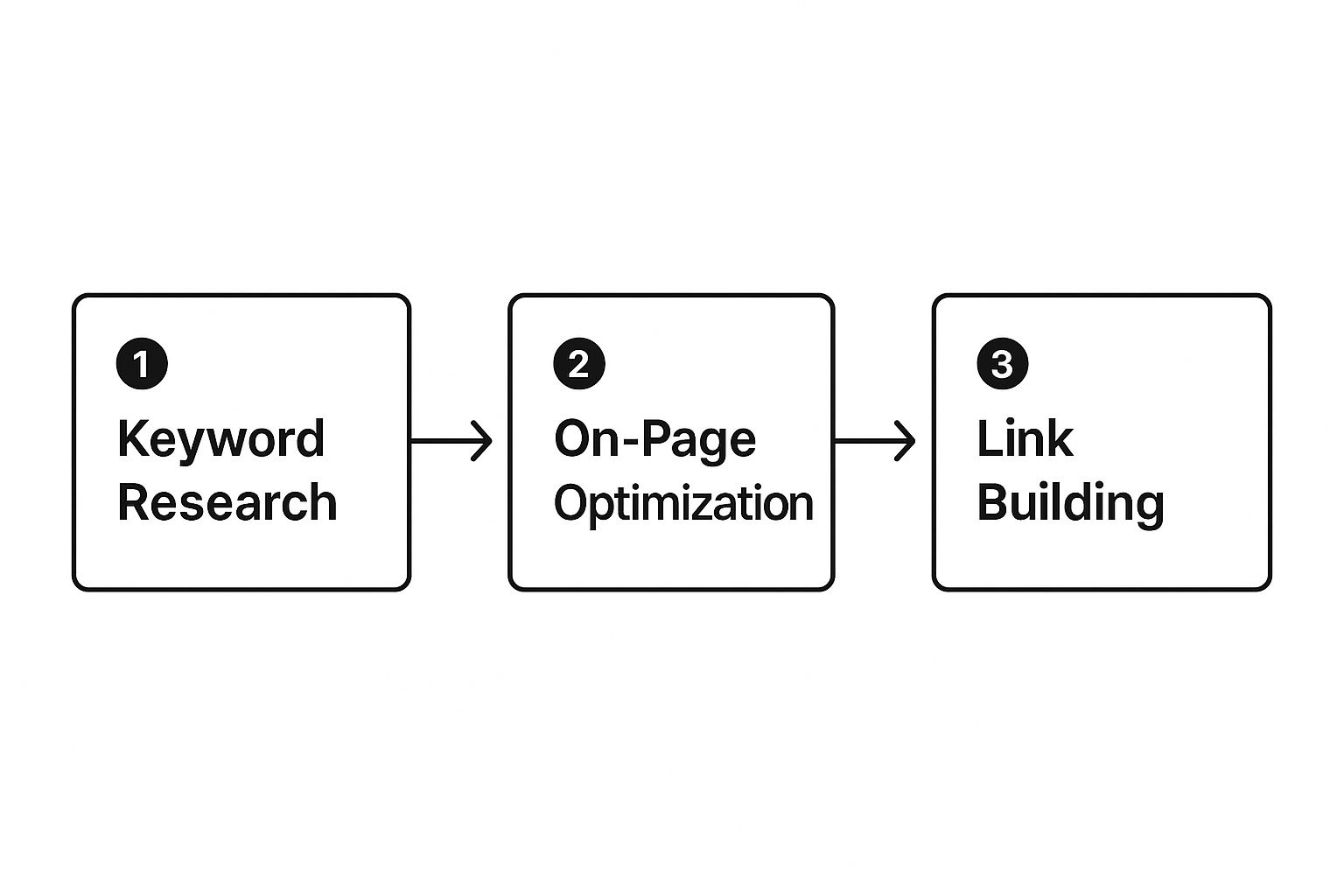
As you can see, everything kicks off with deep keyword research. This then informs how you optimise your on-site content and go about attracting valuable links.
Writing Ad Copy That Gets Clicked
Your ad copy is your three-second elevator pitch. On a crowded search results page, it has to jump out and give people a compelling reason to click on your link instead of someone else’s. Good ad copy is clear, punchy, and speaks directly to what the user needs.
Don’t just list features; sell the benefits. Instead of “Waterproof Jacket,” try “Stay Bone Dry on Your Next Hike. 100% Waterproof Guarantee.” See the difference?
Here are a few quick tips for writing ads that work:
- Use Numbers: Phrases like “Over 10,000 sold” or “48-hour delivery” build trust and a sense of urgency.
- Have a Strong Call-to-Action (CTA): Be direct. Tell people exactly what you want them to do next: “Shop Now,” “Order Today,” or “Explore the Collection.”
- Match Your Landing Page: Whatever you promise in the ad needs to be front and centre on the page they land on. If there’s a disconnect, you’ll create a jarring experience and lose the sale.
Combine meticulous keyword research with a razor-sharp product feed and compelling ad copy, and your paid campaigns will quickly become a powerful engine for finding new customers and driving profitable growth.
Ecommerce Digital Marketing: Drive Sustainable Growth with Ecommerce SEO
While paid ads give you that instant traffic hit, SEO is the real engine for long-term, profitable growth. It’s the hard graft that happens in the background, pulling in genuinely interested customers without you having to fork out for every single click. Think of it as building a valuable asset that keeps generating organic revenue, month in, month out.
Let’s put it this way: paid ads are like renting an audience. A strong SEO presence means you own your traffic. You’re earning your spot at the top of Google’s search results, building the kind of trust and authority that paid placements just can’t buy.
Mastering On-Page SEO Essentials
Your SEO journey starts right on your own website—specifically, your product and category pages. These are your digital shopfronts, and they need to be perfectly tuned to tell both customers and search engines exactly what you’re selling.
Your page titles and meta descriptions are the first impression you make in the search results. They have to be compelling enough to actually earn the click. A great product page title isn’t just the product name; it needs to pack in the key details that match what people are actually searching for.
A generic title like “Brown Boots” is pretty weak, right? A much stronger, optimised title would be something like “Barbour Farsley Leather Chelsea Boots in Dark Tan | Free UK Delivery“. This version is packed with the brand, model, material, style, and colour, plus a tempting offer. That’s exactly the kind of detail a motivated buyer is looking for.
The Technical Foundation You Cannot Ignore (Ecommerce Digital Marketing)
Technical SEO can sound a bit daunting, but it’s really just about making sure your website is a piece of cake for search engines to crawl and understand. A technically solid site isn’t a “nice-to-have”; it’s a non-negotiable part of any serious ecommerce digital marketing strategy. If Google can’t figure your site out, it simply won’t rank it.
Here are a few technical bits and pieces every online store needs to get right:
- Site Speed: A slow-loading website is a conversion killer. We’ve seen even a one-second delay send bounce rates through the roof. Get your images optimised, use decent hosting, and keep your site’s code lean.
- Mobile-Friendliness: The vast majority of online shopping now happens on a phone. Your site absolutely must deliver a slick, intuitive experience on a smartphone, otherwise you’re just handing sales over to your competitors.
- Schema Markup: This is a little snippet of code that gives search engines extra context about what’s on your page. For e-commerce, it’s gold dust. Adding product schema can unlock “rich snippets” in search results—those eye-catching extras like star ratings, price, and stock levels that can dramatically boost your click-through rates.
Getting the technical basics right is like making sure your physical shop has clear signs and an easy-to-navigate layout. It just removes friction, making it effortless for both search engines and customers to find what they need.
Another crucial technical aspect is your product data itself. Just like with Google Shopping, the quality of your data has a huge impact on your organic visibility. For a deeper dive, check out our guide on https://ppcgeeks.co.uk/marketing/boost-your-ecommerce-success-mastering-your-shopping-feed/, as the benefits apply to both paid and organic search.
Attracting Customers with Content Marketing
Beyond your core product pages, content marketing is your best friend for grabbing customers who are still in the research phase. People often search for solutions or advice long before they’re ready to buy a specific product. This is your chance to get on their radar early.
Creating valuable, relevant content positions your brand as a helpful expert. A solid buying guide or a problem-solving blog post can attract high-quality traffic and, crucially, earn valuable backlinks from other websites—a massive ranking signal for Google.
Imagine you sell high-performance blenders. A potential customer might be searching for “best blender for green smoothies” or “how to clean a blender properly.” By creating blog posts that answer those questions, you connect with them right at the start of their journey.
Within that post, you can then naturally feature your blenders as the perfect solution. It’s a much softer sell that builds trust and guides the user toward a purchase, making your e-commerce digital marketing efforts far more effective than just targeting bottom-of-funnel buyers. This approach transforms your website from a simple catalogue into a genuinely useful resource.
Ecommerce Digital Marketing: Turn Shoppers Into Fans with Social and Email
That first sale is a brilliant feeling, but it’s just the beginning. The real, long-term profit in any ecommerce strategy comes from turning one-time buyers into repeat customers and genuine fans of your brand. This is where social media and email marketing shift from being nice-to-haves to your most powerful retention tools.
Paid ads are fantastic for getting new customers in the door, but they’re an expensive tap to leave running. Building a community and opening a direct line of communication with your customers is how you boost lifetime value and create a much more resilient business.
Creating Powerful Social Ad Campaigns
Platforms like Instagram and Facebook are so much more than a place to post pretty pictures; they’re incredibly sophisticated customer acquisition engines. Their real power is in the granular targeting options, letting you put your products right in front of the people most likely to buy them.
Forget just boosting a post and hoping for the best—you need to think like a strategist. Let’s say you sell sustainable, organic cotton baby clothes. You can go way beyond basic age and gender targeting. You can build an audience of users who’ve shown interest in “eco-friendly products,” follow specific parenting influencers, and have recently engaged with other children’s clothing brands. That level of precision is what makes social ads so potent.
A classic real-world tactic is setting up a dynamic product ad campaign. This automatically shows products to people who’ve already viewed them on your website. It’s a simple retargeting strategy that keeps your brand top-of-mind, gently nudging them back to finish their purchase. Think of it as an automated way to recover potentially lost sales.
The goal of social ads isn’t just to land one sale. It’s to find your next best customer—the person who will buy again, leave a glowing review, and tell their friends about you. Every campaign is an investment in building that loyal base.
The UK ecommerce market can be a rollercoaster, with monthly revenues showing both growth and seasonal dips. July figures, for example, can hover around £10.83 billion, but the market is always shifting. You can dig into more UK ecommerce market data from ecdb.com. This volatility is exactly why a strong retention strategy is so vital—it helps smooth out the revenue peaks and troughs when acquisition costs get unpredictable.
Setting Up Essential Automated Email Flows (Ecommerce Digital Marketing)
While social media is great for discovery, email marketing is still the undisputed champion of profitability for online shops. It’s your most direct and personal channel, a way to speak straight to your customers without an algorithm getting in the way.
The foundation of any solid email strategy is automation. By setting up key email flows, you have a system working for you 24/7, nurturing leads and driving sales completely on autopilot. These aren’t just spammy promotional blasts; they’re timely, relevant messages triggered by specific things your customers do.
Here are the three automated flows that every single ecommerce store needs, no exceptions:
- The Welcome Series: This is your first impression, so make it count. When someone signs up for your newsletter, a series of three or four emails can introduce your brand’s story, highlight best-sellers, and maybe offer a small incentive for their first purchase. It builds trust right from day one.
- The Abandoned Cart Reminder: An incredible number of online shopping carts are abandoned before checkout. An automated email, sent just a few hours after they leave, can gently remind them about what they left behind. A simple “Did you forget something?” email can claw back a huge chunk of that lost revenue.
- The Post-Purchase Sequence: Your job isn’t over when the customer buys. A post-purchase flow should include a thank you message, shipping updates, a request for a review, and even recommendations for related products. This sequence validates their decision to buy from you and paves the way for the next purchase.
Writing Emails People Actually Want to Open
The biggest hurdle with email is simply cutting through the noise. Your customers’ inboxes are overflowing, so your emails need to deliver genuine value and have a bit of personality. Boring, corporate-speak emails are deleted without a second thought.
Think about the emails you actually look forward to getting. They probably have a distinct voice, offer useful tips, or give you exclusive access to sales. That’s what you need to aim for.
- Subject Lines are Everything: Your subject line is the gatekeeper. It has to be intriguing, specific, and personal. Instead of “Our New Collection is Here,” try something like “Your Summer Wardrobe Upgrade Just Landed.”
- Focus on a Single Goal: Every email should have one clear job. Is it to announce a sale? Send people to a new blog post? Ask for a review? Don’t try to cram everything in at once.
- Write Like a Human: Ditch the jargon. Write in a natural, conversational tone. Use “you” and “I” to make a personal connection. Share behind-the-scenes stories or a note from the founder to build a stronger brand narrative.
By combining precision-targeted social ads with a thoughtful, automated email strategy, you build a powerful system. You acquire new customers efficiently and then systematically turn them into repeat buyers and advocates for your brand. This two-pronged approach is fundamental to scaling an ecommerce business profitably.
Ecommerce Digital Marketing: Use Data to Optimise and Scale Your Store
Getting your marketing campaigns live is just the starting whistle, not the finish line. The real magic in ecommerce marketing happens next, in the constant cycle of optimising and scaling based on what the data is telling you. This is where you shift your ad spend from being just another cost into a proper, strategic investment.
It means going deeper than a quick glance at your daily sales figures. You need to get your hands dirty in the analytics to figure out the why behind your results. Without that crucial feedback loop, you’re basically flying blind, guessing at what works instead of building a repeatable, winning strategy.
Navigating Google Analytics for Ecommerce Insights
Google Analytics 4 (GA4) is your command centre for understanding how people actually behave on your site. It can look a bit intimidating at first, but if you focus on a few key reports, you’ll pull out the actionable insights you need to make much smarter marketing decisions.
A great place to start is the Traffic acquisition report. This is where you see exactly which channels are driving traffic that actually matters. Don’t just get fixated on the raw visitor numbers; keep a close eye on the Engaged sessions and Conversions columns for each source.
For example, you might see that your Instagram ads are sending thousands of visitors your way, which looks great on the surface. But then you notice your Google Shopping campaigns, while driving less traffic overall, have a conversion rate that’s three times higher. That’s a massive signal to rethink your budget, funnelling more cash into the channel that’s actually delivering sales. Digging into this data is also fundamental for improving your Google Shopping product feed performance, as it directly validates your optimisation efforts.
Uncovering Conversion Bottlenecks (Ecommerce Digital Marketing)
Once you know where your best customers are coming from, the next job is to figure out what happens when they land on your site. You’re looking for the leaks in your sales funnel—those specific points where potential buyers give up and leave.
The Funnel exploration report in GA4 is built for precisely this task. You can map out the exact steps users take, from viewing a product page and adding it to their basket, right through to completing the purchase.
Let’s say you spot a huge drop-off between the “add to basket” and “begin checkout” stages. That’s a red flag pointing to a problem on your cart page. Are you surprising them with high shipping costs? Is the “checkout” button buried somewhere they can’t see it? This data points you directly to the friction spots you need to fix.
Data tells a story about your customer’s journey. Your job is to listen for the friction points—the confusing navigation, the unexpected costs, the slow-loading pages—and smooth them out to create a seamless path to purchase.
This whole process is becoming even more critical as technology improves. The rollout of 5G networks is expected to slash webpage load times by around 70%, which could cut shopping cart abandonment by an estimated 15%. Making sure your site is technically sound now prepares you to take full advantage of these improvements as they happen.
A Simple Framework for A/B Testing
When you’ve identified a potential problem, A/B testing is how you prove your theory and roll out a fix that you know works. It’s all about creating two versions of something—an ‘A’ version (the control) and a ‘B’ version (the variation)—and showing them to different groups of your audience to see which one performs better.
Over time, you can and should test almost everything.
- PPC Ad Headlines: Pit a benefit-led headline against one that hones in on a specific product feature.
- Email Subject Lines: Try a straightforward, descriptive subject line versus something more intriguing or mysterious.
- Product Page Calls-to-Action: Test the colour of your “Add to Basket” button, or even just the wording (e.g., “Buy Now” vs. “Add to Cart”).
By testing one thing at a time and measuring the impact on a single, specific metric (like click-through rate or conversion rate), you can make small, incremental improvements. These little wins really stack up, leading to significant gains and giving you the confidence to scale your ecommerce marketing knowing it’s built on solid ground.
Ecommerce Digital Marketing FAQ
Running an ecommerce business throws up a lot of questions, especially when you’re trying to make every penny of your marketing budget count. Let’s get straight to the point and answer some of the most common queries we hear from store owners.
How Much Should a New Store Spend on Marketing?
There’s no magic number here, but a good starting point for a new ecommerce brand is to set aside 10-20% of your projected revenue for marketing. In the early days, you can expect a decent chunk of that to go into paid channels like Google Shopping. Why? Because you need to get traffic through the door fast and, just as importantly, start gathering data on who your customers actually are.
The real key is to begin with a test budget you’re comfortable with. Watch your Return on Ad Spend (ROAS) like a hawk from day one. As soon as you see a channel working, be ready to pour the profits right back in to scale up. Don’t be afraid to prove the concept with one product line before going all in.
What Is the Most Important Channel for Ecommerce?
For most new online shops, you’ll get the best bang for your buck by focusing on Google Shopping and Email Marketing. This duo gives you a powerful one-two punch, covering both customer acquisition and retention right from the get-go.
- Google Shopping: This is your secret weapon for finding customers who are ready to buy. They’re literally searching for the products you sell, which means they’re already halfway to the checkout.
- Email Marketing: This is absolutely essential for getting the most value out of every customer you win. It lets you build a real relationship, drive repeat purchases with targeted offers, and create brand fans without paying for every single click.
While SEO is the foundation for long-term, free traffic, it’s a slow burn. The smartest approach is to use paid ads for those immediate sales while you build up your SEO and email marketing for sustainable, long-term growth. That’s the core of a solid ecommerce digital marketing plan.
How Long Until I See Results from My Marketing?
This is the million-pound question, and the answer completely depends on the channel you’re using. You have to set realistic expectations for each part of your strategy, or you’ll get frustrated quickly.
With paid advertising like Google Shopping or Meta Ads, you can see traffic and even sales within a few hours of launching a well-built campaign. The feedback is almost instant. Automated email flows, like your abandoned cart reminders, can also start bringing in sales within a few days.
SEO, however, is a marathon, not a sprint. You’re looking at 4-6 months of consistent work before you start seeing any real movement in organic traffic and rankings. To see truly game-changing results? That can often take a year or more. Patience isn’t just a virtue with SEO; it’s a business requirement.
Ready to stop guessing and start growing? The team at PPC Geeks builds data-driven strategies that increase traffic, boost sales, and maximise your marketing budget. Get in touch with us today to see how our expertise can drive real results for your business.