
Google Ads for Building Supplies: What Actually Works in 2026 – Quick Wins

For building suppliers in 2026, a winning Google Ads strategy isn't about outspending the competition—it's about outsmarting them. The secret sauce is a powerful mix of AI-driven campaigns like Performance Max, a laser-focused local strategy, and a product feed so clean and detailed it practically sells itself.
Forget just bidding on keywords. We're talking about building a smart, automated system that hunts down high-intent trade customers and keen DIYers across every corner of Google's network. It’s about letting real data do the heavy lifting, not guesswork.
Your 2026 Blueprint for Google Ads Success
Let's be honest, the digital marketplace for building materials is a crowded one. You've got the big national chains with deep pockets on one side and nimble local rivals on the other, all fighting for the same eyeballs. In this environment, a scattergun approach is the fastest way to burn through your budget with nothing to show for it.
The old playbook just doesn't cut it anymore. While traditional Search campaigns still have their place, they're no longer the star player. The game has moved on.
Today’s strategy is all about integration and automation. Think of it less like manually placing individual ads and more like designing an intelligent, interconnected machine that learns and gets better over time. The brain of this machine is Google's AI, powering campaigns that find customers not just when they type a search query, but when they're watching videos on YouTube, browsing websites, or checking their emails.
The Shift from Manual Bidding to an Automated Engine
This new reality requires a total shift in mindset. Instead of obsessing over individual keywords like "buy timber online," the real goal is to build a complete advertising engine. This engine needs to understand the entire customer journey, from initial research to the final purchase.
And what fuels this engine? High-quality data from your website and, most importantly, your product catalogue.
The biggest change for merchants and distributors in 2026 is the move away from reactive keyword bidding towards proactive, system-based advertising. Your success is no longer defined by the keywords you pick. It's now determined by the quality of the data signals you feed into Google's AI. A pristine product feed is officially more valuable than a perfect keyword list.
Core Pillars of a Winning Strategy
To really thrive, your strategy needs to be built on a few core pillars that all work in harmony. If one is weak, the others will suffer, and your return on investment will take a hit. For UK building product distributors, this means nailing several key elements.
We've put together a quick table to summarise the absolute essentials for a high-performing Google Ads setup in today's landscape.
Core Pillars of a Winning 2026 Google Ads Strategy
| Strategy Pillar | Why It's Critical in 2026 | Key Action |
|---|---|---|
| AI-Driven Campaigns | Automates ad placement across all of Google's channels, finding customers you'd otherwise miss. | Prioritise Performance Max, feeding it strong creative assets and audience signals. |
| Product Feed Optimisation | Your feed is the foundation. It tells Google exactly what you sell and who should see it. | Treat your product feed like your most important asset. Optimise titles, descriptions, and images for maximum impact. |
| Hyper-Local Targeting | Drives high-value foot traffic from trade professionals who need supplies now. | Use Local Inventory Ads to connect your online presence with your physical branch network. |
| Data-First Measurement | Flawless tracking is non-negotiable. The AI can't learn and improve with bad data. | Ensure your conversion tracking is perfect to give the system accurate signals for smarter bidding. |
Getting these pillars right isn't just best practice; it's the only way to build a Google Ads machine that delivers consistent, profitable growth. You can learn more about this in our practical guide to PPC for UK building product distributors and merchants.
This guide will break down each of these components in detail, giving you a proper blueprint to get ahead of the competition.
Mastering the AI-Powered Campaign Mix
Let's move past the theory. Your Google Ads structure for 2026 needs an AI-powered core, and I mean that literally. It's time to stop thinking about Search, Display, and YouTube as separate, siloed campaigns. The smart money is on treating them as interconnected channels, all managed by one intelligent system.
At the heart of all this is Performance Max (PMax). Don't think of it as just another campaign type; see it as your automated project manager. Its entire job is to use Google's AI to find your ideal customers—whether that's a contractor researching on YouTube or a DIYer browsing a blog—and hit them with the perfect ad at just the right moment.
PMax acts as the master coordinator, taking the creative assets and audience signals you give it and strategically placing your ads across Google's entire network. This is a fundamental shift, especially for building supplies companies, because your customer's journey is rarely a straight line. A roofer might watch a video about your tiles, search for a specific brand a week later, and finally click a Shopping ad. PMax is built to connect all those dots for you.
Structuring PMax for Maximum Impact
One of the biggest mistakes I see is businesses lumping all their products into a single PMax campaign. That’s like telling a master carpenter to build a house but giving them one giant, jumbled pile of timber, pipes, and wires. To get the best results, you've got to give the AI clear instructions.
This is where asset groups come into play. You need to structure your asset groups logically around your main product categories. Doing this feeds the AI clean, relevant signals about what you're selling and, crucially, who you're selling it to.
Here’s what a practical structure could look like:
- Asset Group 1: Timber & Sheet Materials – All your creative (images, videos, headlines) and audience signals would be laser-focused on products like C24 treated timber, MDF sheets, and plywood.
- Asset Group 2: Plumbing & Heating – This group would feature assets for copper pipes, boilers, and bathroom fixtures, with signals pointing directly towards plumbing professionals.
- Asset Group 3: Electrical & Lighting – Here, you’d load up assets for wiring, sockets, and LED lighting, specifically targeting electricians and contractors.
When you segment like this, you ensure the ad copy shown for "4×2 treated timber" is actually relevant and compelling, not some generic message about your entire store. You can also point each asset group to a tailored landing page, creating a seamless journey for the user that pushes up conversion rates. For a deeper dive into this, you can explore how AI-Max for Search campaigns unlocks new potential and builds on these core principles.
This diagram shows how these key components slot together in your advertising blueprint.
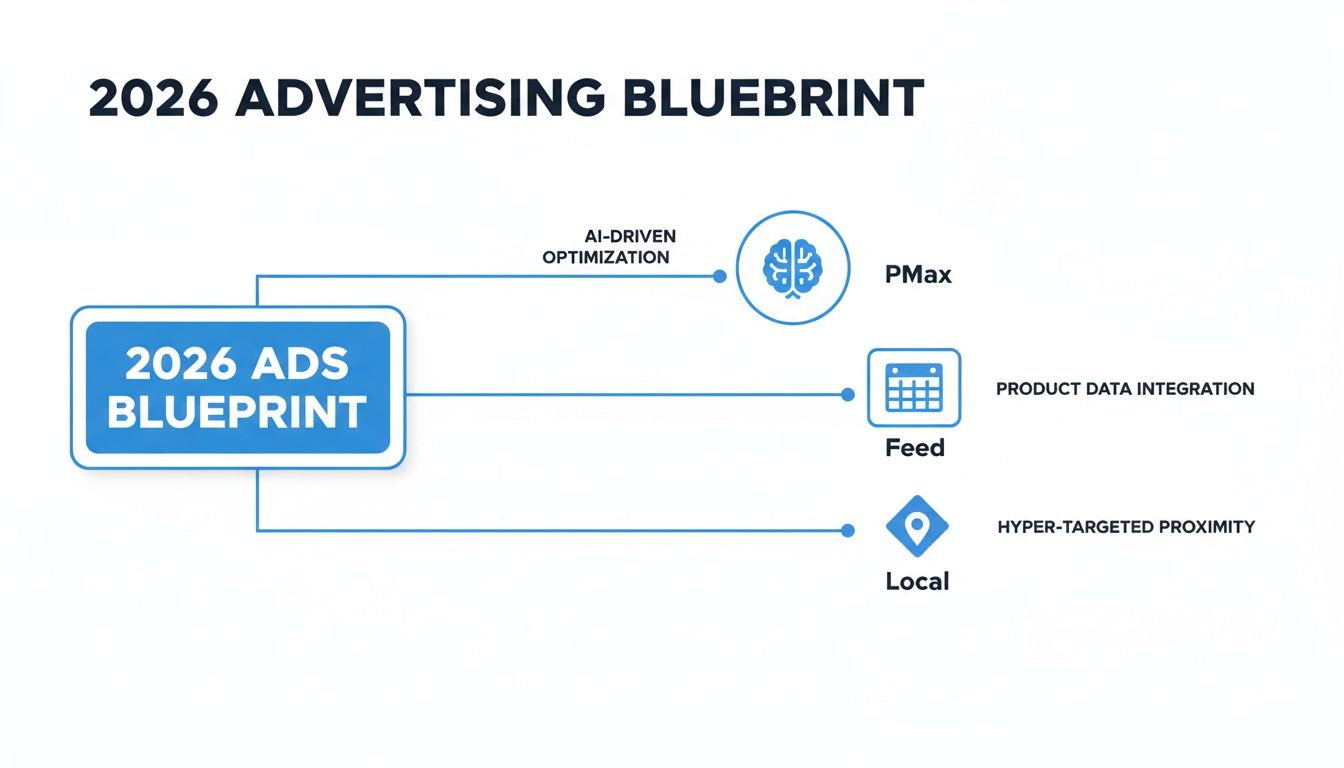
As you can see, PMax acts as the AI brain. It's powered by a detailed product feed and grounded by local targeting to drive both online sales and in-store footfall.
Making Shopping and Local Ads Non-Negotiable
While PMax is the engine driving everything, two other components are absolutely non-negotiable for building suppliers: Google Shopping and Local Inventory Ads. They come into play at the critical final stages of the buying journey, right when purchasing intent is at its peak.
In the building supplies game, 70% of trade customers know the exact product they need before they even start searching online. Standard Shopping and Local ads are your direct line to capturing this red-hot demand at the moment of decision.
Google Shopping ads are those product-focused listings with images and prices you see right at the top of the search results. For a customer typing in "Makita combi drill," seeing your product, price, and brand instantly is incredibly powerful. It’s the digital equivalent of having your best products perfectly displayed right at the front of your store.
Turning Clicks into Foot Traffic
For merchants with physical branches, Local Inventory Ads (LIAs) are a complete game-changer. They perfectly bridge the gap between your online advertising and your trade counter. When a local builder searches for "bags of postcrete near me," LIAs can show them you have it in stock at a branch just a few miles away.
This is vital for two reasons:
- Immediacy: It caters directly to the urgent needs of trade professionals who simply can't wait for delivery.
- Increased Order Value: Getting a customer into your branch for one item often leads to them grabbing other essentials while they're there, massively increasing the final transaction value.
By integrating PMax with robust Shopping campaigns and hyper-targeted Local Inventory Ads, you build a truly comprehensive advertising structure. This mix doesn't just find customers; it engages them at every single stage of their journey, supporting your business whether your goal is to drive e-commerce revenue or boost sales at the trade counter.
Why Your Product Feed Is the Unsung Hero of Profitability
Let's be blunt. Your Google Ads campaigns, especially the AI-powered ones like Performance Max, are incredibly clever. But they can only ever be as clever as the information you feed them. And the single most important dataset you have complete control over is your product feed.
Don't think of it as just another spreadsheet. It’s the architectural blueprint for your entire advertising structure. If that blueprint is vague, fuzzy, or missing crucial details, every single campaign you build on top of it will be shaky and destined to underperform.
A weak feed tells Google you sell "timber." A powerful, optimised feed explains you sell "2.4m C24 Treated Sawn Timber 47x100mm." That tiny difference is what separates you from the competition, attracting qualified trade buyers and stopping you from wasting clicks. This is where you stop bleeding money and start building a real profit-generating machine.
Crafting Product Titles That Builders Actually Search For
The product title is, without a doubt, the most critical part of your feed. It's the first thing your potential customer sees, and it’s the main signal Google's algorithm uses to match your product to what someone is searching for. Generic titles are the absolute enemy of profitability.
You have to structure your titles around how your customers think and search. A professional tradesperson isn’t tapping "wood" into Google. They search with purpose, using specific attributes, materials, and precise dimensions.
A winning formula we see time and again for building supply product titles follows this simple pattern:
- Key Attribute + Product Type + Material + Dimensions
For example, a poor title might just say "Sawn Timber." A high-performance title transforms this into "Kiln Dried C24 Graded Regularised Treated Sawn Timber 47mm x 100mm x 2.4m." This level of detail ensures your ad pops up for those hyper-specific, high-intent searches, which massively improves your click-through rate and your chance of making a sale.
Going Beyond the Title with Rich Data
While the title is the headline act, the other attributes in your feed are the crucial supporting details that get the deal over the line. Every single field is another chance to give Google—and your customers—more reasons to choose you over a competitor.
Essential Feed Optimisations:
- High-Quality Images: Don't just upload one generic product shot. We're talking multi-angle photos, pictures of the product in use, and close-ups of textures or key fittings. Show the quality, don't just talk about it.
- Compelling Descriptions: Use this space to really sell the product. Mention key benefits, typical applications ("ideal for roofing joists and timber framing"), and what other products it works well with. You want to answer their questions before they even have a chance to ask them.
- Accurate Stock & Pricing: This one is completely non-negotiable. Mismatched pricing or advertising out-of-stock items is the fastest way to get your ads disapproved and frustrate potential customers. Your feed needs to sync with your inventory system in near real-time.
A meticulously optimised product feed acts as your best salesperson, working 24/7 within Google's algorithm. It pre-qualifies customers, answers their specific needs, and ensures your budget is only spent on clicks that have a genuine chance of converting.
Unlocking Advanced Segmentation with Custom Labels
To really take your strategy to the next level, you need to go beyond the standard feed attributes. This is where custom labels become your secret weapon. They let you slice and dice your product catalogue based on business data that Google knows nothing about, like profitability or seasonality.
Think of custom labels as invisible tags you can stick on your products. You then use these tags to create laser-focused product groups for your reporting and bidding, giving you granular control over your ad spend.
Practical Uses for Custom Labels:
- Profit Margin: Tag products as
High_Margin,Medium_Margin, orLow_Margin. This allows you to tell Google's AI to bid much more aggressively on the items that actually make you the most money. - Seasonality: Use labels like
Summer_Seller(for things like decking or fencing) orWinter_Essential(for insulation or rock salt) to ramp budgets up or down throughout the year. - Best-Sellers: Create a
Top_Performerlabel to make sure your most popular, in-demand products always have maximum visibility. - Promotion: Apply a
Sale_Itemlabel to easily group discounted stock together and push it hard.
By putting custom labels to work, you transform your feed from a simple product list into a powerful strategic tool. You can tell Google exactly which products drive your business forward, allowing its AI to focus your budget where it will generate the highest possible return. For a deeper dive, you can learn more about optimising your Google Shopping product feed in our complete guide. This is the level of detail it takes to win in Google Ads for building supplies in 2026.
Smarter Bidding and Budgeting Strategies
In 2026, the old way of managing a Google Ads budget—setting a fixed daily number and just hoping for the best—is a surefire way to burn through cash. If you want to see real results, you need a far more fluid, demand-driven approach. This isn't about throwing more money at your campaigns; it's about being much, much smarter with every pound you spend, letting data and AI steer the ship.
Think of it like being a sharp investor. You wouldn't leave your money in a poorly performing stock, would you? The same logic applies here. It’s all about actively reallocating your budget from campaigns that are just ticking over to the ones that are consistently pulling in high-value trade customers and profitable online orders. This hands-on management is what separates the winners from everyone else.
Aligning Bids with Real Profit Margins
The best tool for the job? Value-based bidding. More specifically, you need to build your campaigns around the Maximise Conversion Value bid strategy, and then give it a target Return On Ad Spend (tROAS) to aim for. For building suppliers, this combination is a total game-changer.
Instead of just telling Google to get you as many sales as possible (Maximise Conversions), you’re giving it a much smarter instruction: get me the most valuable sales. That’s a crucial difference. A £2,000 order for high-margin decking is worlds apart from a £50 sale of low-margin screws, and this strategy teaches Google’s AI to spot and prioritise those bigger, more profitable opportunities.
The trick is setting your tROAS correctly. It can't be a number you just pluck out of thin air; it has to be grounded in your actual business metrics. Work out your break-even point first, then set a target that guarantees a healthy profit margin after you’ve accounted for ad spend, the cost of your goods, and other overheads.
What Does Good Look Like in 2026?
You can’t know if your campaigns are genuinely performing well or just spinning their wheels without looking at industry benchmarks. While every business is different, having a baseline gives you a realistic sense of what’s possible and helps you pinpoint where you need to improve.
Recent Google research backs this up, showing that UK advertisers who use flexible, demand-led budgeting can see 20% more conversions in their Search campaigns. The surprising part? A tiny 17% are actually doing it effectively. That gap is a massive opportunity for building suppliers who are ready to get ahead. You can read the full research about demand-led marketing on business.google.com to see the data for yourself.
This is especially true in the building supplies sector. To give you a clearer picture, let's look at some key performance indicators to help you measure your own success.
2026 Google Ads Benchmarks for UK Building Supplies
These numbers are a great starting point for seeing how your campaigns stack up against the competition. We've included the general industry average and what we at PPC Geeks would be aiming for as a minimum target.
| Metric | Industry Benchmark (Home & Garden/Related) | PPC Geeks Target |
|---|---|---|
| Average Cost Per Acquisition (CPA) | £45 | < £40 |
| Average Return On Ad Spend (ROAS) | 400% (4:1) | > 600% (6:1) |
| Average Click-Through Rate (CTR) | 4.5% – 5.5% | > 6% |
| Average Conversion Rate | 2.5% – 3.5% | > 4% |
If you're looking at your own data and seeing a CPA creeping towards £50 or a ROAS that's stuck around the 3:1 mark, it’s a clear sign that something needs a closer look. It could be your bidding, your product feed, or even your landing page experience that’s holding you back.
A Practical Example of Budget Reallocation
Let’s make this real. Imagine you have two campaigns running:
- Campaign A (General Building Materials): Spending £100/day, generating a ROAS of 300% (3:1).
- Campaign B (High-Margin Power Tools): Spending £50/day, but pulling in a fantastic ROAS of 800% (8:1).
The old-school approach would be to just let them run. The smarter, 2026-ready approach is to shift your funds.
By taking £50 from the underperforming Campaign A and pushing it into the high-flying Campaign B, you’re immediately doubling down on what’s proven to work. A simple move like this can massively lift your account's overall profitability without you having to spend a single extra penny.
This is what modern budget management is all about. It means constantly watching your performance, knowing which product lines are your most profitable, and having the confidence to move your budget around to capitalise on those golden opportunities. This active, data-first strategy is how you make sure every pound you spend works as hard as it possibly can for your bottom line.
Creating Landing Pages and Ads That Actually Convert
Getting that click from your Google Ad is just the starting whistle. The real game is played the moment a potential customer hits your landing page. If that page isn’t perfectly engineered to seal the deal, all the smart bidding and feed optimisation in the world won’t save the sale.
The journey from click to conversion has to be seamless, especially for busy trade professionals and serious DIYers who don't have time to waste.
For building supplies merchants, a high-converting landing page is all about clarity. It needs to answer the big questions straight away. Your customers are practical and time-poor; they need information, not fluff. Key details like delivery costs and lead times for bulky items like timber or aggregates can be the ultimate deal-breaker. Sticking this information front and centre, right "above the fold," builds instant trust.
Your page also needs to scream credibility. We're talking about showcasing trade accreditations, displaying genuine customer reviews, and having crystal-clear calls-to-action (CTAs). A button that says ‘Get a Trade Quote’ is infinitely more effective than a generic ‘Contact Us’.

Crafting Ad Copy That Solves a Problem
Once your landing page is solid, it's time to sharpen the ad copy that gets people there in the first place. Your headlines and descriptions need to do more than just list a product; they must solve an immediate problem for the person searching.
Let’s be honest, generic ads get ignored. But benefit-driven copy? That stops the scroll.
Think about the user’s intent. A contractor searching for "C24 treated timber" isn't just buying wood; they're in the middle of building a roof, framing a wall, or kicking off a time-sensitive project. Your ad has to speak directly to that need.
The most effective ad copy in 2026 directly addresses the customer’s end goal. It shifts the focus from what the product is to what the product does for them, building an instant connection between their problem and your solution.
Let's look at how a simple shift in language can make a huge difference.
- Before (Generic): "Buy C24 Treated Timber – Low Prices – We Deliver"
- After (Benefit-Driven): "Job-Ready C24 Timber – Guaranteed In Stock – Fast Site Delivery"
The "After" version just hits different, doesn't it? "Job-Ready" speaks to professionals, "Guaranteed In Stock" removes painful uncertainty, and "Fast Site Delivery" solves a massive logistical headache. To dig deeper into this, you can check out our guide on creating a high-performance lead generation landing page for more actionable tips.
Using Audience Signals to Guide Google's AI
With AI-driven campaigns like Performance Max now running the show, your creative assets are more important than ever. You’re essentially giving Google a library of headlines, descriptions, images, and videos, and its algorithm figures out the winning combination for each user.
Your job is to feed the machine the highest quality ingredients.
This is where audience signals come into play. Instead of letting the AI guess, you can give it a serious nudge in the right direction by telling it what your most valuable customers look like.
Key Audience Signals to Provide:
- Your Customer Lists: Upload lists of past purchasers, trade account holders, or high-value clients. Google’s AI is brilliant at finding "lookalike" users with similar characteristics.
- Custom Segments: Build audiences based on people who have searched for specific competitor names or niche technical product terms. It’s a great way to intercept motivated buyers.
- Website Visitors: Target users who have browsed specific product categories but haven't bought yet. This is your bread and butter for powerful remarketing.
By providing these signals, you're not leaving things to chance. You're actively teaching Google's AI who your ideal customer is, making sure your best ads are shown to the people most likely to convert. This combo of compelling copy and intelligent targeting is what really drives results in 2026.
Your Action Plan for Immediate Implementation
Strategy is one thing, but execution is everything. Let's boil all this theory down into a clear, step-by-step checklist that takes you from where you are now to where you need to be. Each point is designed for immediate impact, turning the insights from this guide into real, measurable growth for your building supplies business.
Think of this as your roadmap. You can use it to make confident changes yourself, or to properly understand the value an expert agency should be delivering. It’s time to turn these ideas into concrete actions that build a stronger, more profitable Google Ads account, starting today.
Your Five-Point Implementation Checklist
This isn't about ripping everything out and starting again all at once. It's about taking logical, prioritised steps. Follow this sequence to get your foundations solid before you even think about the more advanced stuff. Each step builds on the last, creating a stable and powerful advertising structure.
1. Audit Your Current Account Structure
Before you build anything new, you need to know exactly what you're working with. Get under the bonnet of your existing campaigns, ad groups, and keyword performance. Your mission is to find out where your budget is being wasted on dead-end clicks and, just as importantly, which products or categories are already making you money. This first look is absolutely critical for making smart decisions later on.
2. Rebuild Around a Performance Max Core
It's time to fully embrace the AI. Consolidate your fragmented Search, Display, and Shopping campaigns into one core Performance Max (PMax) campaign. The key is to structure your asset groups logically around your main product categories—think timber, plumbing, electrical, and so on. This feeds the algorithm clean, relevant signals and lets Google's machine learning find your customers across its entire network.
By making Performance Max the engine of your account, you stop chasing individual clicks and start building an automated system that finds high-intent buyers wherever they are online. This is the single most important structural change you can make in 2026.
3. Overhaul Your Product Feed Data
Your product feed is the fuel for your PMax engine, and it needs to be premium grade. Go way beyond basic titles and descriptions. You need to enrich your product data with SEO-rich, specific titles that builders actually search for (e.g., "2.4m C24 Treated Sawn Timber 47x100mm"). Add multi-angle images and fill out every possible attribute. Crucially, start using custom labels to segment products by profit margin or seasonality—this gives you a massive amount of control over your bidding.
4. Implement Value-Based Bidding
Stop bidding for clicks and start bidding for profit. It's that simple. Switch your main bidding strategy over to Maximise Conversion Value and give it a target ROAS (Return On Ad Spend). This tells Google's AI to stop chasing any conversion and start hunting for the most profitable ones. When you set a tROAS based on your actual business margins, you're directly tying your ad spend to your bottom line.
5. Verify Your Conversion Tracking
Finally, none of this works if your data is dodgy. Double-check, and then triple-check, that your conversion tracking is set up perfectly. It must capture every valuable action, from online sales right through to trade quote submissions. Accurate tracking isn't a "nice-to-have"; it's the essential feedback loop that teaches the AI how to get better and allows you to measure what's actually driving growth.
Got Questions? We’ve Got Answers
Diving into Google Ads can throw up a lot of questions, especially when you’re a building supplier trying to hold your own against some serious competition. We get it. You need to know if the investment will actually pay off and how on earth you can stand up to the huge national chains with what feel like bottomless marketing budgets.
Let's cut through the noise and get straight to the practical answers.
How Much Should I Actually Be Spending on Google Ads?
There’s no magic number here, but for a local or regional building supplier, a sensible starting point is usually somewhere between £1,500 and £5,000 per month. This isn't a random figure; it’s the sweet spot that gives the AI enough data to learn and start optimising properly, especially for powerhouse campaigns like Performance Max.
Think of your budget as fuel for the AI engine. If you put too little in, the engine never really warms up. It can't spot the patterns or figure out who your best customers are. A more solid budget lets you test properly across different product lines and gives the system the data it needs to start delivering a positive return much, much faster.
What’s a Realistic Return on Ad Spend (ROAS)?
For building supplies, a solid ROAS target to aim for is between 500% and 800%. That’s a 5:1 to 8:1 return. Put simply, for every £1 you put into your ads, you should be getting £5 to £8 back in revenue.
In the early days, your ROAS might sit a bit lower while the campaigns are in their "learning phase." But once your product feed is singing and your value-based bidding is dialled in, hitting this range consistently is a clear sign of a healthy, profitable account. If you’re seeing anything below 400% (4:1), it’s a red flag that something needs fixing—be it your targeting, your ad copy, or your website experience.
Can We Genuinely Compete with the National Chains?
Absolutely. Your biggest advantage isn't your budget; it’s your agility and local know-how. The national chains are fighting a war on a massive scale. You can win by being laser-focused on your local turf and specific customer niches, like the roofers in Reading or the landscapers across Surrey.
Your secret weapon against the giants? Local Inventory Ads. These let you show local trade customers that you have the exact product they need in stock, right now, just down the road. That immediacy is something the big players with their centralised warehouses often can't match, giving you a massive edge.
When you combine that local focus with a perfectly tuned product feed and smart, AI-driven campaigns, you don’t just compete—you carve out a seriously profitable space that the larger players simply can't touch.
Ready to build a Google Ads strategy that drives real growth for your building supplies business? The expert team at PPC Geeks creates data-driven campaigns that increase leads and sales while maximising your return on investment. Book your free, in-depth PPC audit today.
Author

Search Blog
Free PPC Audit
Subscribe to our Newsletter

The Voices of Our Success: Your Words, Our Pride
Don't just take our word for it. With over 100+ five-star reviews, we let our work-and our satisfied clients-speak for us.

"We have been working with PPC Geeks for around 6 months and have found Mark and the team to be very impressive. Having worked with a few companies in this and similar sectors, I rate PPC Geeks as the strongest I have come across. They have taken time to understand our business, our market and competitors and supported us to devise a strategy to generate business. I value the expertise Mark and his team provide and trust them to make the best recommendations for the long-term."
~ Just Go, Alasdair Anderson