




Power D2C PPC Success for UK Brands: Before you even think about launching a new campaign or funnelling more budget into your D2C brand, you have to start with a proper health check of your existing account. It’s not about doing more; it’s about making sure the foundation you’re building on—especially your conversion tracking and account structure—is solid and accurate. You can’t scale a leaky bucket.
D2C PPC Success for UK Brands: Building Your Foundation for Profitable PPC
The very first step, before any fancy strategies come into play, is a meticulous audit of your Google Ads account. I’ve seen countless D2C brands pour cash down the drain because of tiny, overlooked issues like tracking glitches or clunky campaign structures. An upfront audit isn’t just a nice-to-have; it’s the single most important thing you can do to pave the way for real, scalable growth.
This all starts with one simple question: can you trust your data? Are your conversion actions actually firing when they should? Does the data in Google Ads even remotely match up with what you see in Google Analytics 4? A small mistake here can have massive consequences, causing you to scale the wrong campaigns and kill off potential winners, all based on a flawed picture of reality.
Verify Your Tracking and Data Integrity
Accurate conversion tracking is the absolute bedrock of a profitable PPC account. Without it, you’re just guessing. Your first job is to become a detective and make sure every sale, lead, and micro-conversion is being captured correctly.
- Audit Your Google Tag: Pop open Google Tag Assistant and run through your site. Make sure your tags are implemented correctly on every page, especially the crucial thank-you and confirmation pages after a purchase.
- Cross-Reference Your Data: Pull up your Google Ads conversion data and put it side-by-side with your Google Analytics 4 reports. More importantly, compare both to your actual sales data from your ecommerce platform (like Shopify or WooCommerce). Minor differences are expected, but big gaps are a red flag.
- Hunt for Duplicate Conversions: Check that your setup isn’t accidentally firing the conversion tag twice for a single purchase. This is a common culprit that can seriously inflate your performance metrics and throw your bidding strategies way off course.
We often see brands chasing a Target ROAS goal, completely unaware that their tracking is double-counting revenue. This fools them into thinking their campaigns are twice as profitable as they really are, leading them to waste money on channels that aren’t actually performing.
To give you a head start, here’s a quick checklist we use to make sure the basics are covered.
D2C PPC Account Audit Checklist (D2C PPC Success for UK Brands)
Before you spend another pound, running through these checkpoints is non-negotiable. It ensures you’re not building your strategy on a shaky foundation.
| Audit Area | Key Checkpoint | Success Indicator |
|---|---|---|
| Conversion Tracking | Are all key conversions (purchases, add to carts) tracked accurately? | Data in Google Ads aligns closely with your ecommerce platform’s sales data. |
| Data Integrity | Is Enhanced Ecommerce or GA4 Ecommerce tracking set up correctly? | Revenue and transaction values are being passed correctly and match your backend. |
| Account Structure | Is the structure logical and simple, or overly complex? | Campaigns are grouped thematically (e.g., by product category, brand vs. non-brand). |
| Keyword Targeting | Are you wasting budget on irrelevant search terms? | The Search Term Report shows high relevance; a robust negative keyword list is in place. |
| Ad Copy & CTR | Does your ad copy resonate with your target audience? | Click-Through Rate (CTR) is at or above the UK D2C industry benchmark of 6.4%. |
| Landing Pages | Do your landing pages align with your ad messaging and offer a good UX? | Conversion rates are healthy and bounce rates are low for key landing pages. |
Getting these elements right from the start prevents countless headaches and wasted ad spend down the road.
Simplify Your Account Structure
Overly complicated account structures are a hangover from an older era of PPC. With today’s machine learning-powered campaigns, a tangled mess of single-keyword ad groups just gets in the way. It fragments your data, starving the algorithm of the information it needs to learn and optimise effectively. If you need a map to navigate your own account, it’s time for a clean-up.
This is all about grouping keywords thematically and consolidating campaigns where it makes sense. A cleaner, simpler structure allows for much better budget control, makes performance analysis a breeze, and—most importantly—gives automated bidding the data volume it needs to really work its magic. For a refresher on the fundamentals, our guide on what is PPC advertising is a great place to start.
Assess Keyword Relevance and Ad Copy (D2C PPC Success for UK Brands)
Finally, any solid audit needs to look at what your customers are actually seeing and searching for. Get stuck into your search term reports. This is where the truth lies. Where is your money really going? Are you haemorrhaging budget on completely irrelevant searches that have zero to do with your products? This is one of the most common budget drains, but luckily, a well-curated negative keyword list can plug that leak fast.
At the same time, take a hard look at your ad copy. Is it just generic fluff, or does it actually speak to your audience’s problems and what they want? A poor click-through rate (CTR) is a huge signal that your message just isn’t hitting the mark. Ultimately, making sure your PPC efforts are actually driving profit comes down to knowing how to measure marketing ROI effectively. This isn’t just theory; with UK average search ad CTRs hitting around 6.4%, you have a clear benchmark to aim for.
D2C PPC Success for UK Brands: Designing Your High-Performance Campaign Architecture
Once your account’s foundations are solid, it’s time to build the campaign architecture. This isn’t just about organising keywords; it’s about creating a structure that genuinely works for a modern D2C brand. Generic setups just don’t cut it anymore. You need a multi-channel framework that gives you granular control where you need it, and lets machine learning thrive across Search, Shopping, and Performance Max.
The big challenge for most UK D2C brands is the ever-rising competition and cost. Paid search is still a massive channel – 22% of UK marketing professionals rely on it. But the numbers don’t lie: 39% are reporting higher CPCs, while 33% have seen their click-through rates drop. It’s a volatile market where an efficient structure is non-negotiable. You can dig into more of these UK digital marketing statistics to get the full picture.
This whole process starts with a proper audit. Think of it as drawing up the blueprints before you start building.
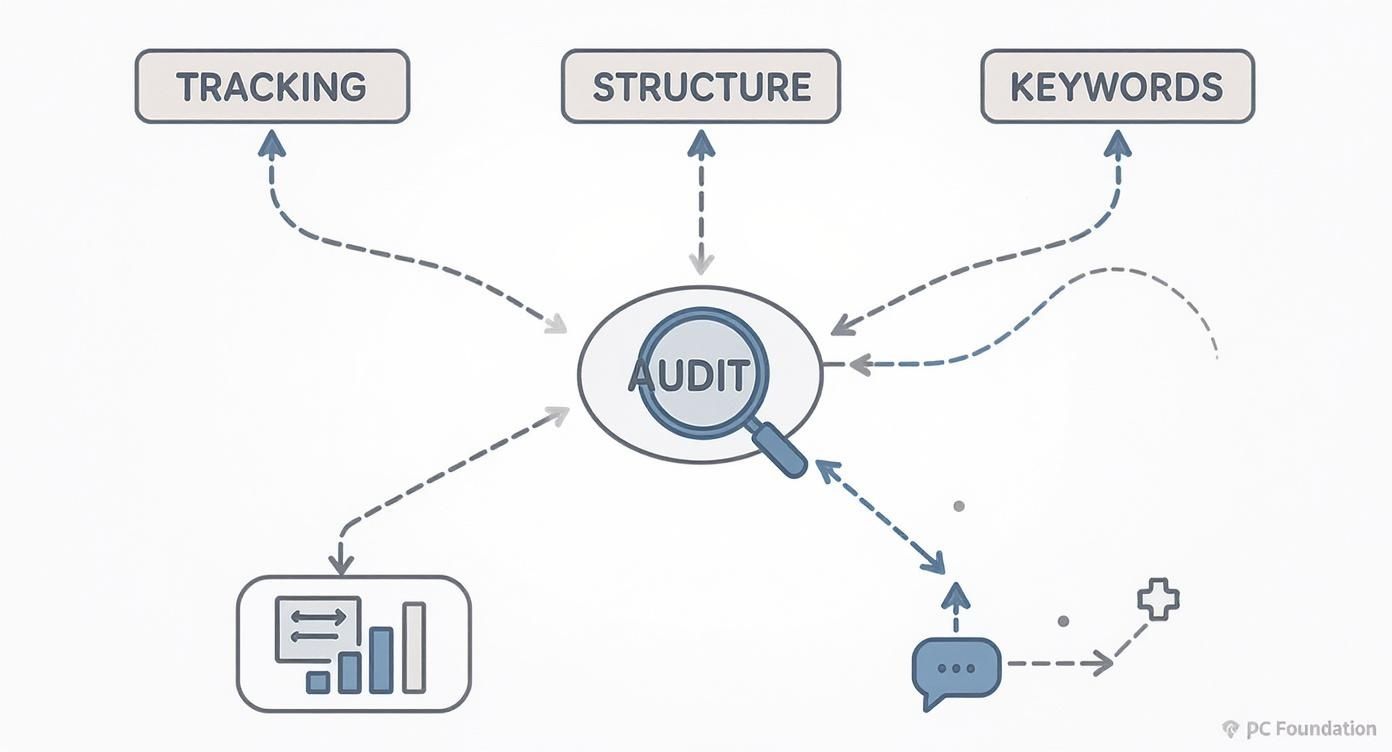
As you can see, a high-performance campaign structure isn’t built in a vacuum. It’s the direct result of a thorough initial deep-dive.
Structuring Your Search Campaigns
When it comes to Search, there’s a lot of noise about the “right” way to do things. The old-school versus new-school debate often causes more confusion than it solves. Let’s clear it up.
You might have heard of the Single Keyword Ad Group (SKAG) model, where every single keyword gets its own ad group. It gives you incredible control, sure. But it’s a management nightmare and it fragments your data, starving Google’s algorithm of the volume it needs to learn effectively. It’s just not practical in today’s world.
A much smarter, more modern approach is building theme-based ad groups. You simply group closely related keywords together. For instance, a D2C brand selling sustainable trainers might set up ad groups like:
- “Vegan Leather Trainers”
- “Recycled Material Running Shoes”
- “Ethical Casual Footwear UK”
This consolidates your data, makes your account infinitely easier to manage, and gives automated bidding the fuel it needs to find those pockets of performance. You still keep your keywords, ads, and landing pages tightly aligned, but without the administrative headache of SKAGs.
Optimising Your Shopping Campaign Framework (D2C PPC Success for UK Brands)
Standard Shopping campaigns are an absolute goldmine for ecommerce, but a flat, one-size-fits-all structure leaves a lot of money on the table. The trick is to segment your products based on what actually matters to your business goals.
Go beyond just the product category. You can structure your Shopping campaigns by:
- Profit Margin: Create separate campaigns for your high-margin heroes and lower-margin items. This lets you set much more aggressive ROAS targets for the products that actually make you the most money.
- Best-Sellers vs. New Arrivals: Isolate your proven winners to give them maximum visibility and budget. At the same time, give new products their own sandpit and budget to gather performance data without messing with your core performers.
- Seasonality: If you’re a fashion brand, segmenting campaigns into “Summer Dresses” and “Winter Coats” allows for strategic, nimble budget allocation as the seasons change.
Using custom labels in your product feed makes this easy. You can apply these segments and build a structure that lines up perfectly with your commercial objectives.
A well-structured Shopping campaign acts like a finely tuned engine. By separating products based on margin, you’re ensuring your highest-octane fuel (budget) is powering the parts of the engine that deliver the most speed (profit).
Guiding Performance Max with Strategic Asset Groups
Performance Max (PMax) isn’t a “set it and forget it” campaign type, no matter what you might hear. To get the best out of it, you have to guide it carefully. Your real control comes from your asset groups and audience signals. Please, don’t just dump all your products and creative into one giant PMax campaign and hope for the best.
Instead, create themed asset groups that mirror your business structure. A skincare brand, for example, could have separate asset groups for:
- Anti-Ageing Serums: With creative and copy laser-focused on reducing fine lines, paired with audience signals of users interested in luxury skincare.
- Acne Treatment Bundles: Featuring user-generated content of before-and-afters, targeting younger demographics and custom segments built from competitor URLs.
- SPF Moisturisers: With messaging built around sun protection and daily care, aimed at in-market audiences searching for “daily sunscreen”.
By providing these distinct, highly relevant inputs, you’re not just feeding the PMax algorithm—you’re teaching it exactly who your ideal customer is for each product line. This strategic approach is what turns PMax from a black box into your most powerful engine for profitable growth.
D2C PPC Success for UK Brands: Getting Your Audience Signals and Product Feed Dialled In
Anyone can get clicks. The real art is getting the right clicks. For D2C brands, this is where you leave the competition in the dust. It’s time to get beyond the basics and really master two crucial areas: advanced audience signals and razor-sharp product feed management.
Success isn’t just about picking an audience; it’s about how you layer them to give the ad platforms the clues they need to find your next customer. At the same time, your product feed is probably your most overlooked asset. It’s your direct line to Google’s brain, and getting it right can completely transform your Shopping and Performance Max results.
Layering Audiences for a Knockout Punch
Think about your audience strategy like ripples in a pond. You start with the hot-hot-hot prospects—the people who’ve already checked you out—and you work outwards from there, finding new customers who share the same DNA as your best ones.
Your first-party data is gold dust. We’re talking about lists of past buyers, your VIP customers, and even those who got cold feet at the checkout. These lists are the foundation for your remarketing and the perfect source for creating powerful lookalike audiences. Google’s machine learning is brilliant at taking your customer list and finding clones of them across the web.
Once you’ve got that solid base, you can start hunting for new customers within Google Ads.
- Custom Intent Segments: This is where you can get really specific. Build audiences based on what people are actively searching for. If you sell high-end running gear, you could target people looking for “carbon plate running shoes” or “best trail running socks UK”.
- In-Market Audiences: Let Google do some of the heavy lifting. You can target users who Google has already identified as being on the hunt for products just like yours. It’s a great way to catch people right at the moment they’re ready to buy.
Stacking these signals on top of each other gives campaigns like Performance Max the rich data it craves to really fly. If you want to go deeper on this, check out our guide on what is audience targeting.
Your Product Feed is Your Secret Weapon (D2C PPC Success for UK Brands)
So many D2C brands just upload their product feed and forget it. Huge mistake. Your feed isn’t a “set and forget” file; it’s a living, breathing tool that drives performance. Honestly, optimising it is one of the most impactful things you can do to power D2C PPC success.
A tidy, detailed feed has a massive impact on your visibility and click-through rates on Google Shopping. The info you provide is literally what Google uses to match your products to what people are searching for.
Think of your product feed as the script you give to an actor. A bland, generic script gets you a forgettable performance. But a rich, detailed script with sharp titles, compelling descriptions, and smart labels lets the actor—Google’s algorithm—deliver an award-winning, profitable show.
Actionable Feed Optimisation Tactics
Let’s get practical. Start with the tweaks that will give you the biggest bang for your buck. Don’t just accept the defaults your ecommerce platform spits out.
- Rewrite Product Titles: This is your number one priority. Instead of “Brand T-Shirt”, think like a search engine. Try “Brand Name | Organic Cotton Crew Neck T-Shirt | Blue | Size L“. Pack it with the attributes your customers are actually searching for.
- Beef Up Product Descriptions: Go beyond the one-liner. Use this space to answer common questions, shout about your USPs, and weave in relevant keywords. Focus on the benefits, not just the features.
- Master Custom Labels: These are absolute game-changers for segmenting campaigns. You can create labels like
margin_high,bestseller,clearance, orseason_summer25. This lets you build campaigns around your business goals, like bidding much more aggressively on your most profitable items.
Finally, treat your Google Merchant Centre like your own back garden—keep it tidy. Jump into the ‘Diagnostics’ tab regularly to fix any errors or warnings. Disapproved products are dead money, and they can bring your campaigns to a shuddering halt. A clean, optimised feed isn’t a nice-to-have; it’s essential for growth.
D2C PPC Success for UK Brands: Creating Ads and Landing Pages That Convert

A perfectly structured campaign and a flawless product feed will get customers to your digital doorstep, but it’s your ad creative and landing page that actually convince them to come inside. This is the crucial one-two punch of conversion. It’s where your brand’s story meets the customer’s needs head-on, and getting it right is fundamental to power D2C PPC success.
We’ve moved way beyond just listing features and benefits. Effective ads tap into the real pain points and desires of your audience, creating a connection that feels genuine, not just transactional.
Crafting Ad Copy That Connects
Let’s be honest, generic and bland ad copy gets ignored. To stop the scroll, your messaging needs to resonate on an emotional level. You need to understand the “why” behind your customer’s search. Are they looking for a quick fix to a frustrating problem? Or are they treating themselves to a little bit of luxury they feel they’ve earned?
Using a few psychological triggers can make your copy far more compelling, but the key is a light touch.
- Social Proof: Don’t just say your product is popular. Use direct quotes from reviews or mention specific numbers. “Join 20,000+ happy customers” is miles more powerful than a vague “Best-selling product”.
- Scarcity and Urgency: Phrases like “Limited stock remaining” or “Offer ends Sunday” create a gentle nudge to act now, not later. This works wonders for seasonal items or special promotions.
- Address the Objection: What’s the main reason someone might hesitate to buy? Is it the price? The quality? Tackle it head-on in your copy: “Luxury quality without the luxury price tag.”
Think of your ad copy as the first promise you make to a potential customer. The next step is making sure your landing page delivers on that promise seamlessly.
Producing Thumb-Stopping Creative (D2C PPC Success for UK Brands)
For channels like Performance Max, YouTube, and social media, your visual creative is everything. Static images need to be high-quality and aspirational, clearly showing the product in a real-life context. Don’t just show your product on a white background; show it being used and enjoyed by someone your target customer can relate to.
Video has quickly become a non-negotiable asset for any serious D2C brand. The magic of video is its ability to tell a deeper story and build trust almost instantly.
A well-crafted video ad can communicate a product’s value in 15 seconds more effectively than paragraphs of text ever could. It’s about showing, not just telling, and creating that immediate emotional connection.
Focus on creating short, punchy videos (6-30 seconds) with clear branding in the first few seconds. Get creative and test different formats, from polished product demos to authentic, raw user-generated content (UGC). Platforms like YouTube and Pinterest are also brilliant for housing more in-depth video content that educates your audience and builds a loyal following.
Building Landing Pages for Action
Your landing page has one job: to convert the click. That’s it. The user experience must be frictionless, fast, and completely focused on guiding the visitor towards a single, clear action. Every single element should reinforce the message from the ad that brought them there in the first place.
A high-converting landing page is built on clarity and simplicity, especially on mobile, where the vast majority of your traffic will land. To get this right, our complete guide covers all the essential landing page best practices you’ll need.
Here are the absolute must-haves for a winning landing page:
- A Clear, Compelling Headline: It should instantly confirm the user is in the right place and echo the promise of your ad.
- A Singular Call-to-Action (CTA): Don’t confuse visitors with multiple options. Have one primary button—like “Add to Basket” or “Shop Now”—that stands out visually.
- Frictionless Design: Your page needs to load lightning-fast. Simplify your forms, always offer guest checkout, and provide multiple payment options like Apple Pay or Klarna to make buying as easy as humanly possible.
D2C PPC Success for UK Brands: Getting Smart with Bidding and Budgeting
Gone are the days of setting a daily budget and just hoping for the best. Modern PPC is all about steering powerful algorithms to make the smartest possible decisions for your D2C brand. This means getting to grips with automated bidding strategies and allocating your budget with surgical precision. The goal? Make sure every single pound you spend is pulling its weight, whether you’re chasing sheer sales volume or hardcore profitability.
Picking the right bidding strategy is your first, and arguably most important, move. It’s how you tell Google Ads what you actually care about, which in turn lets its machine learning algorithms hunt down the outcomes you want. Get this wrong, and you could end up chasing vanity metrics while your profit margins quietly disappear.
Choosing the Right Automated Bid Strategy
Google gives us a whole suite of powerful automated bidding options, but they’re not all created equal, especially in the D2C world. The secret is to match the strategy to what your business needs right now.
- Maximise Conversions: This one does exactly what it says on the tin—it aims to get you the most conversions possible within your set budget. It’s perfect for new product launches or when you’re focused on rapid customer acquisition and gathering data, even if the initial return isn’t stellar.
- Maximise Conversion Value: Think of this as the grown-up version of the above. It tells Google to find customers who are likely to spend more. This is a brilliant choice for brands with a wide range of product prices, as it prioritises driving the highest possible revenue.
- Target CPA (Cost Per Acquisition): With this strategy, you tell Google exactly what you’re willing to pay for a new customer. It’s a great fit for businesses with a crystal-clear understanding of their customer lifetime value and what they can afford to spend on acquisition.
- Target ROAS (Return On Ad Spend): This is the holy grail for most established D2C brands focused on profit. You set a target return for every pound spent (say, £5 in revenue for every £1 of ad spend), and Google’s algorithm will work to hit that average across your campaign.
Selecting a bidding strategy is like giving your campaign a mission objective. ‘Maximise Conversions’ is a land grab—take as much territory as possible. ‘Target ROAS’ is a surgical strike—hit high-value targets while minimising collateral cost.
If you want to get into the nitty-gritty, our guide on https://ppcgeeks.co.uk/ppc/google-ads-smart-bidding/ breaks down exactly how these strategies tick. For now, here’s a handy table to help you make a quick decision.
Automated Bid Strategy Selector for D2C Brands (D2C PPC Success for UK Brands)
Picking the right bid strategy is crucial for telling Google’s algorithm what you value most. Are you after pure volume to feed the machine learning, or is strict profitability your main KPI? This table breaks down the most common automated strategies to help you align your campaigns with your core D2C business objectives.
| Bid Strategy | Primary Objective | Best Used When… | Key Consideration |
|---|---|---|---|
| Maximise Conversions | Volume of sales | You need to gather conversion data quickly for a new campaign or product. | Ignores revenue per sale; can lead to low-value orders. |
| Maximise Conv. Value | Total revenue | Your focus is on top-line revenue growth, not strict profitability per sale. | Prioritises high-value orders, which might not be your most profitable. |
| Target CPA | Cost control per sale | You have a fixed acquisition cost target based on product margins. | Requires stable conversion rates to work effectively. |
| Target ROAS | Profitability | You have enough conversion data (at least 30-50 conversions a month) and need to ensure campaigns are profitable. | Can limit volume if the target is set too aggressively. |
Ultimately, the choice depends on your current business goals. Don’t be afraid to switch strategies as your brand grows and your objectives evolve. What works for a product launch won’t necessarily be the right fit for a mature, profitable campaign.
Smart Budget Allocation and Forecasting
Your bidding strategy is only one half of the equation; how you slice up your budget is the other. Whatever you do, don’t spread your budget thinly and evenly across every single campaign. That’s a recipe for mediocrity.
Instead, find your winners and fund them. Dig into your data to identify the campaigns, products, and channels delivering the best ROAS, and then double down on them. It sounds simple, but it’s a discipline many brands fail to maintain.
When you’re ready to test new channels, make sure you ring-fence a specific test budget so it doesn’t eat into the funds for your proven performers. For D2C brands looking to grow beyond Google, understanding how to scale Facebook Ads effectively is a common next step, and it requires its own careful budget management.
Finally, get into the habit of forecasting. You don’t need a complex financial model—a simple spreadsheet will do. Use your historical data, like your conversion rate and average order value, to project what could happen if you increased your spend. Showing how a bigger budget translates into more sales and revenue is a powerful way to make the case for scaling your investment and truly power D2C PPC success.
Common D2C PPC Questions Answered
Running D2C PPC campaigns can feel a lot like spinning plates. You’re constantly trying to keep everything balanced, putting out small fires while trying to push the brand forward. Even with a solid strategy, you’re always going to bump into specific, niggling questions.
So, let’s get into some of the most common ones we hear from UK D2C brands. These are the straightforward, no-fluff answers you need to make smarter decisions, faster. This isn’t high-level theory; it’s about the real-world headaches you’re dealing with, from budget worries to campaigns that just won’t perform.
How Much Should My D2C Brand Spend on PPC?
This is the big one, isn’t it? The million-dollar question. But honestly, the answer isn’t a magic number. Instead of plucking a figure from thin air, your budget needs to be welded to your business objectives and, crucially, your unit economics. You absolutely have to know your Customer Lifetime Value (LTV) and what you can afford as a Customer Acquisition Cost (CAC).
For example, let’s say a new customer is worth £150 to your business over time. If your margins allow you to spend up to £30 to get that customer, then that’s your Target CPA. From there, you just work backwards. If you want 100 new customers this month, your starting budget is £3,000. Simple.
Stop asking, “How much should I spend?” and start asking, “How many customers do I want, and what am I willing to pay for each one?” This simple shift changes your mindset from seeing PPC as an expense to seeing it as a direct investment in growth.
If you’re brand new and just need a rough starting point, somewhere between 10-20% of your total revenue is a decent benchmark. But the real goal is to get to a point where you’re scaling spend based on profitable returns, not getting stuck on a fixed percentage.
Why Is My Performance Max Campaign Not Spending? (D2C PPC Success for UK Brands)
It’s one of the most frustrating things in PPC. You’ve painstakingly built a beautiful Performance Max campaign, fed it all your best assets, and then… nothing. It just sits there, barely spending a penny. Nine times out of ten, it’s one of a few common culprits.
- Your Bidding Strategy is Too Restrictive: Slapping a 1000% Target ROAS on a brand-new campaign is like trying to make a baby run a marathon. You’re strangling it before it even has a chance to learn. Kick things off with a less restrictive strategy like Maximise Conversion Value to let it gather some data. Once you’ve got a baseline, then you can switch to Target ROAS.
- Your Audience Signals are Too Narrow: Specificity is good, but if your audience is tiny, you’re giving the algorithm nowhere to go. Make sure your remarketing lists are a decent size and your custom segments aren’t so niche that you’re targeting three people in a shed somewhere.
- Your Feed or Assets are Disapproved: It’s amazing how often this is the problem. A single disapproved product or a rejected ad creative can bring the whole thing to a grinding halt. Pop into your Google Merchant Centre to check for feed errors and have a quick scan of your asset groups for any policy red flags.
Seriously, troubleshooting these three areas will fix a non-spending PMax campaign 90% of the time.
How Long Does It Take to See PPC Results?
While patience is definitely a virtue in PPC, you shouldn’t be waiting forever. You won’t be printing money overnight, but you should be able to see which way the wind is blowing within the first month.
Here’s a realistic timeline to keep in mind:
- Weeks 1-2: The Data Gathering Phase. Don’t obsess over sales just yet. Focus on leading indicators like CTR, CPC, and impression share. At this stage, you’re just teaching the algorithm and finding out if your message is hitting the mark.
- Weeks 3-4: The Initial Optimisation Phase. You should see conversions starting to trickle in now. You’ll have just enough data to start making your first meaningful tweaks, like pruning wasted spend with negative keywords and refining your ad copy.
- Months 2-3: The Profitability Push. Now we’re talking. With a solid month or two of data under your belt, you can really start steering the ship towards profitability. This is when you refine bid strategies and shift budget towards your winning campaigns, products, and ad groups.
Achieving stable, predictable profitability often takes a full quarter. The secret is to look for positive trends and forward momentum along the way, not to expect a miracle in the first week.
Ready to stop guessing and start growing? The team at PPC Geeks offers a free, in-depth PPC audit to uncover hidden opportunities and eliminate wasted spend in your account. Let our UK-based experts build a data-driven strategy that delivers real results. Get your free PPC audit today!