




Manual CPC is a Google Ads bidding strategy where you set the maximum cost-per-click bid you are willing to pay for ad clicks. Unlike automated bidding, Manual CPC bidding does not ask Google to optimise every auction towards conversions, CPA or conversion value; you choose the bids and review performance yourself.
That control can be useful when you are launching a new campaign, working with limited conversion data, testing niche keywords or managing bids where human judgement matters. It also means more hands-on work: budgets, auction competition, Quality Score, ad relevance and search demand still affect what you spend and where your ads appear.
This guide explains what Manual CPC is, how it works in Google Ads, how it compares with Enhanced CPC, Maximise Clicks and Smart Bidding, and when it is still a sensible option in 2025.
Key Takeaways
- Manual CPC lets you set maximum CPC bids at keyword or ad group level.
- It gives more bidding control, but it requires more monitoring than automated strategies.
- It can suit new, low-data, niche or tightly controlled tests.
- Enhanced CPC adds automation to manual bids when available for the relevant campaign type.
- Smart Bidding strategies such as Target CPA or Maximise Conversions can be stronger once conversion tracking is reliable and there is enough useful data.
What is Manual CPC?
Manual CPC, short for Manual Cost Per Click, is a Google Ads bid strategy where you set the maximum amount you are prepared to pay for a click. Google can charge less than your maximum bid, but you are responsible for deciding the bid level and adjusting it as performance changes.
In practical terms, Manual CPC bidding gives you direct control over keyword or ad group bids. If a keyword is commercially valuable, you can bid more. If a keyword attracts clicks but few enquiries or sales, you can reduce the bid or pause it. This makes Manual CPC easy to understand, but not effortless to manage.
How Manual CPC works in Google Ads
- You choose a maximum CPC bid for an ad group or individual keyword.
- Your bid enters the ad auction alongside factors such as ad relevance, expected click-through rate, landing page experience and competitor bids.
- Your actual cost per click may be lower than your maximum bid.
- You review performance and change bids manually based on clicks, conversions, CPA, impression share and search terms.
For example, a bakery might bid more on “custom birthday cakes near me” than on “easy cake recipes” because the first search is more likely to come from someone ready to buy. Manual CPC lets the advertiser make that judgement rather than leaving all bidding decisions to automation.
Manual CPC vs automated bidding at a glance
| Area | Manual CPC | Automated bidding |
|---|---|---|
| Who sets bids? | The advertiser | Google’s bidding system |
| Main strength | Direct bid control | Auction-time optimisation at scale |
| Data requirement | Can work with limited conversion data | Works best with reliable conversion tracking and useful data volume |
| Management effort | Higher | Lower day-to-day bid editing, but still needs strategic review |
| Typical use | New campaigns, niche terms, tests, control-focused accounts | Established campaigns with clear conversion goals |
Benefits of Manual CPC for Advertisers

Complete Control Over Bids
With manual CPC, you’re the boss. You decide exactly how much to bid for each click. This is a big deal because it means you’re not leaving important decisions to an algorithm. You can set different bid amounts at the ad group level or even for individual keywords. This gives you really precise control over where your budget goes. It’s about strategically allocating your budget where it matters most. When you know certain keywords drive better results, you can prioritise them.
Flexibility in Budget Allocation
Manual CPC gives you the flexibility to adjust your budget as needed. If you see a keyword performing well, you can increase the bid to get more traffic. If a keyword isn’t performing, you can lower the bid or pause it altogether. This level of control is really useful when you’re working with a limited budget. You won’t suddenly blow through your funds because an algorithm decided a click was worth more than you can afford.
Ideal for Niche Markets and New Campaigns
Manual CPC is often the best choice for niche markets with low search volume. Automated systems struggle to optimise effectively when keywords don’t generate much data. They simply don’t have enough information to make smart decisions. It’s also great for new campaigns. Automated strategies need at least 30-50 conversions per month to work effectively. Without that history, they’re essentially guessing, which can lead to wasted spend. Manual CPC provides a stable foundation. According to Search Engine Land, for campaigns targeting your own brand or competitors’ names, consider using Manual CPC based on competitive dynamics. https://www.searchengineland.com
Manual CPC is particularly useful when you have specific knowledge about your target audience or market that an algorithm might miss. This could include seasonal trends, local events, or changes in consumer behaviour. By manually adjusting your bids, you can react quickly to these changes and maximise your ROI.
How to set up Manual CPC in Google Ads
Use these steps when creating a new Search campaign or changing the bidding approach on an existing one. The exact interface wording can change, but the core process is consistent.
- Open Google Ads and choose the campaign you want to edit, or create a new campaign.
- Go to Settings, then find the Bidding section.
- Select a bidding strategy that allows manual cost-per-click bidding. If Google prompts you towards automated recommendations, choose the option that lets you select a bid strategy directly.
- Choose Manual CPC where it is available for your campaign type.
- Set your default ad group bid, then refine bids at keyword level for your most important terms.
- Check whether Enhanced CPC or other automation options are enabled before saving, so you know whether bids will remain fully manual or have automated adjustments applied.
- Save the change, then monitor impressions, average CPC, click-through rate, conversion rate and cost per conversion before making further bid edits.
How to change Manual CPC bids without overreacting
Manual CPC works best when bid changes are deliberate rather than reactive. Avoid increasing or decreasing bids after one expensive click or one quiet day. Look for patterns across enough clicks, search terms and conversion data to make the change meaningful.
- Raise bids where a keyword converts profitably but is limited by low impression share or low ad position.
- Lower bids where a keyword gets clicks but cannot meet your target CPA or lead quality expectations.
- Split bids by intent so commercial phrases receive different bids from research-led or broad discovery terms.
- Use negatives before simply lowering bids if irrelevant searches are the real problem.
Using bid adjustments with Manual CPC
Manual CPC can work with bid adjustments for factors such as location, device, audience and ad schedule, depending on the campaign settings available in your account. These adjustments let you increase or reduce bids where performance differs by segment.
Be careful not to treat bid adjustments like Smart Bidding. Manual adjustments are rules you set yourself; Smart Bidding uses auction-time signals and machine learning to adjust bids dynamically. If you need full automation across many signals, a Smart Bidding strategy may be more appropriate than trying to recreate that behaviour manually.
What to do when Google suggests “raise bids to first page CPC”
A first-page CPC estimate is a visibility signal, not a profitability target. If Google suggests raising bids to first-page CPC, check the keyword’s commercial intent, expected conversion value and past performance before increasing the bid.
- If the keyword has strong intent and profitable conversions, test a controlled bid increase.
- If the keyword is broad or informational, improve match types, ad copy and negatives before paying more.
- If Quality Score or ad relevance is weak, work on the ad and landing page rather than relying only on a higher bid.
- If the first-page estimate is above your profitable CPC, do not chase it for visibility alone.
Comparing Manual CPC with Other Bidding Strategies
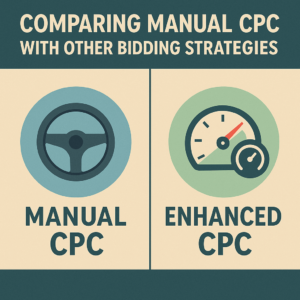
Enhanced CPC vs Manual CPC
Manual CPC means you set the maximum CPC bid yourself. Enhanced CPC, where available for the relevant campaign type and account, starts from your manual bid but can adjust bids when Google predicts a click is more or less likely to convert. In other words, Enhanced CPC is not the same as fully manual bidding; it adds an automated conversion-focused layer.
Before planning around Enhanced CPC in 2025, check the current Google Ads bidding settings in your account and Google’s official documentation for the campaign type you are using, as bidding options can differ by campaign type and may change over time.
Manual CPC vs Maximise Clicks, Target CPA and Maximise Conversions
| Bidding strategy | How bids are set | Best suited to | Watch-outs |
|---|---|---|---|
| Manual CPC | You set maximum CPC bids manually at ad group or keyword level. | New campaigns, low-data accounts, niche keywords, controlled tests and advertisers who want direct bid control. | Requires regular monitoring and does not automatically optimise towards conversions. |
| Enhanced CPC | You set manual bids, then Google may adjust them based on predicted conversion likelihood where the option is available. | Advertisers who want a middle ground between manual control and some conversion-focused automation. | It is not purely manual, and availability should be checked against current Google Ads settings and documentation. |
| Maximise Clicks | Google automatically sets bids to get as many clicks as possible within the budget. | Traffic generation, early data gathering and campaigns where click volume is the main goal. | More clicks do not automatically mean better leads or sales; use conversion tracking and search term reviews. |
| Target CPA | Google uses Smart Bidding to try to get conversions at or around a target cost per acquisition. | Established campaigns with reliable conversion tracking and a clear CPA target. | Weak tracking, thin data or unrealistic targets can limit performance. |
| Maximise Conversions | Google uses Smart Bidding to try to generate the most conversions within the campaign budget. | Campaigns where conversion volume is the priority and the account has meaningful conversion data. | Budgets and conversion definitions need careful control, especially if not all conversions have equal business value. |
When to choose each bidding strategy
- Choose Manual CPC when you need direct control, have limited data or want to test specific keywords with clear bid limits.
- Consider Enhanced CPC if you want to keep manual bid inputs but allow some automated adjustment for conversion likelihood, subject to availability.
- Use Maximise Clicks when the immediate goal is traffic or early data, not necessarily profitable conversions.
- Use Target CPA when you know what a lead or sale is worth and your conversion tracking is trustworthy.
- Use Maximise Conversions when conversion volume matters most and you are comfortable letting Google optimise bids auction by auction.
Should you use Manual CPC bidding in 2025?
Manual CPC bidding is still appropriate in 2025 when control, testing or limited data matter more than automation. It is not the default answer for every Google Ads account, but it remains useful in specific situations.
Manual CPC is a good fit when
- You are launching a new campaign and do not yet have reliable conversion data.
- You advertise in a niche market with low search volume.
- You need to test a small set of keywords, offers or landing pages with controlled bids.
- You want to protect budget while you diagnose tracking, search terms or lead quality.
- You have high-cost keywords where every bid increase needs a clear commercial reason.
Automation may be better when
- Your conversion tracking is accurate and has enough useful data.
- You manage many campaigns, products, locations or audiences and manual bid changes take too much time.
- Your goal is conversion volume, target CPA or conversion value rather than strict keyword-level bid control.
- You want Google to use auction-time signals that are difficult to manage manually.
A sensible approach is to use Manual CPC where it gives you clarity, then move suitable campaigns towards Smart Bidding once the account has enough clean data and the conversion goals are reliable. The decision should be based on campaign maturity, tracking quality, commercial intent and your tolerance for hands-on management.
Challenges of Manual CPC Bidding
Time Investment and Management
Manual CPC bidding, while offering great control, demands a significant time investment. Unlike automated systems that operate in the background, manual bidding requires constant attention. You’ll need to individually set and adjust bids for each keyword, regularly analyse performance, and manage bid adjustments across devices and locations. This can quickly become a full-time job, especially as your account expands. It’s easy to start with good intentions, planning to review bids weekly, but other tasks often take priority, leading to a ‘set and forget’ approach. As one PPC expert put it, ‘who the heck wants to adjust bids all the time?
Potential for Human Error
With manual CPC, the potential for human error is always present. Mistakes in bid adjustments can lead to wasted budget or missed opportunities. It’s easy to miscalculate or overlook important data, leading to suboptimal bidding decisions. For example, forgetting to adjust bids for mobile devices or specific locations can significantly impact campaign performance. It’s a hands-on approach, and hands can slip up.
Lack of Automated Insights
Choosing manual bidding means missing out on the benefits of Google’s machine learning capabilities. Automated strategies can analyse vast amounts of data to identify patterns and optimise bids in real-time. Manual CPC relies on your own analysis and insights, which may not be as comprehensive or accurate. While tools like Google’s Bid Simulator can help, they don’t replace the power of automated insights. You are essentially saying ‘no thanks’ to sophisticated machine learning.
Real-World Applications of Manual CPC
Manual CPC is most useful when the advertiser can make better bid decisions than a broad automated strategy because they understand margin, lead quality, geography or keyword intent. Rather than treating it as a generic “better control” feature, use it where that control changes the action you take.
Practical scenarios for Manual CPC
- Local service areas: a business may bid more aggressively in profitable postcodes or close-to-office locations, while reducing bids in areas with weaker lead quality or higher fulfilment costs.
- High-intent keywords: keywords that include “quote”, “near me”, “emergency”, “buy” or specific product/service terms may justify different bids from research-led searches.
- Early-stage testing: Manual CPC can help isolate whether a new keyword set, advert message or landing page is worth scaling before handing bidding decisions to automation.
- Low-volume niches: when there are not many conversions for machine learning to interpret, manual judgement can help prevent overreaction to small data samples.
- Expensive auction environments: sectors with high CPCs may use Manual CPC to stop exploratory keywords from consuming budget too quickly.
How PPC Geeks review Manual CPC opportunities
When PPC Geeks review whether Manual CPC is appropriate, we look beyond average CPC. We check search term quality, conversion tracking reliability, device and location performance, impression share, budget constraints and whether the account has enough clean conversion data for Smart Bidding to make informed decisions.
That review often reveals whether the issue is really the bid strategy or something more fundamental: poor keyword intent, weak negatives, unclear conversion actions, landing page friction or unrealistic CPA expectations. Manual CPC can help with control, but it cannot fix a campaign structure or tracking problem on its own.
Adapting Manual CPC to business goals
The best Manual CPC setup starts with the business goal. If the goal is profitable enquiries, bids should reflect lead quality and close rate. If the goal is visibility for a small group of priority searches, bids should be managed around impression share and cost control. If the goal is testing, bids should be stable enough to produce a fair read before major changes are made.
Future Trends in Manual CPC Bidding
Manual CPC in a Smart Bidding-first world
Google Ads has continued to push advertisers towards automation, especially Smart Bidding strategies that optimise for conversions or conversion value. That does not make Manual CPC dead, but it does make its role more specific. In 2025, Manual CPC is usually strongest when an advertiser needs control, a clean test, or a cautious starting point before there is enough conversion data to automate confidently.
For established campaigns with accurate conversion tracking, Smart Bidding can use auction-time signals that are difficult to manage manually. For new, niche or low-data campaigns, Manual CPC can still provide useful control while the account builds evidence.
Enhanced CPC availability should be checked before you plan around it
Do not assume Enhanced CPC is available, unavailable or unchanged for every Google Ads campaign type. Google’s bidding options vary by campaign type and can change over time, so any migration or testing plan should be checked against the bidding settings in your account and Google’s current documentation.
Useful official references include Google Ads Help on determining a bid strategy based on your goals and Google Ads Help on Enhanced CPC within Google’s bid strategy guidance.
How to use Manual CPC alongside automation
- Use Manual CPC to launch tightly controlled tests where you need stable bids and clear learning.
- Move suitable campaigns to Smart Bidding when conversion tracking is reliable and there is enough meaningful data.
- Keep reviewing search terms, conversion quality and budget constraints after switching to automation.
- Do not judge a bidding strategy in isolation; review campaign structure, match types, negatives, creative and landing pages at the same time.
Manual CPC remains a valid Google Ads option for the right use case. In 2025, the strategic choice is not a permanent split between manual and automated bidding, but the method that best fits the campaign’s current data, risk and commercial goal.
Final Thoughts on Manual CPC
Manual CPC bidding remains useful when you need direct bid control, clearer testing or a cautious start for low-data campaigns. It is not a replacement for good tracking, strong keyword structure or commercial judgement, and it is not always the best long-term choice once an account has enough reliable conversion data.
If you are deciding whether to keep Manual CPC, test Enhanced CPC where available, or move towards Smart Bidding, review the decision against your campaign goal, data quality and tolerance for manual management. For wider context on changing bid strategies, see our guide to target bidding changes in Google Ads.
Frequently Asked Questions about Manual CPC Bidding
What is Manual CPC Bidding?
Manual CPC bidding is a Google Ads bid strategy where you set the maximum cost per click you are willing to pay. You control the bid amount, while your actual cost and ad position still depend on the auction, Quality Score, competition, budget and ad relevance.
How is Manual CPC different from automated bidding?
With Manual CPC, you choose and edit bids yourself. With automated bidding, Google sets bids using signals and machine learning to work towards a goal such as clicks, conversions, target CPA or conversion value.
Enhanced CPC vs Manual CPC: what is the difference?
Manual CPC uses the bids you set. Enhanced CPC starts from manual bids but can adjust them when Google predicts a click is more or less likely to convert, where that option is available for your campaign type and account.
How do I set up Manual CPC in Google Ads?
Open the campaign in Google Ads, go to Settings, find Bidding, choose a bid strategy that allows Manual CPC, set your default ad group bid, then refine bids at keyword level. Check whether any automated options are enabled before saving.
When should I use Manual CPC instead of automated bidding?
Manual CPC can be useful for new campaigns, low-data accounts, niche keywords, controlled tests and high-cost keywords where you want close bid control. Automated bidding can be better once conversion tracking is reliable and the campaign has enough useful data.
What are the advantages of Manual CPC for advertisers?
The main advantages are direct bid control, transparency and the ability to prioritise bids using your own business knowledge. It is especially useful when the value of a click differs sharply by keyword, location, device or search intent.
What challenges might I face with Manual CPC bidding?
Manual CPC takes more time to manage, can be affected by human error and does not use all auction-time signals in the way Smart Bidding does. It also requires disciplined reporting so bid changes are based on meaningful data, not one-off clicks.
How can I effectively manage my Manual CPC bidding strategy?
Start with researched bids, review search terms and conversion data regularly, use negatives, adjust bids by performance and avoid changing bids too often. Focus on profitable clicks rather than simply chasing more traffic.
Should I raise bids to first page CPC?
Only raise bids to first-page CPC if the keyword has clear commercial value and can still be profitable at the higher bid. First-page CPC is a visibility estimate, not a guarantee of conversions or a target you must follow.