
A/B Tests for PPC: a d tests to Boost Your ROI

Running paid ads without a solid testing plan is a bit like driving blindfolded. You're moving, sure, but you’re probably burning through fuel and definitely not taking the best route. This is where structured A/D tests (you might know them as A/B or split tests) come in. They give you a data-backed roadmap to systematically make your ads better. Simply put, you're pitting two or more versions of an ad against each other to see which one wins.
Why Guess When You Can Test Your Ad Spend

Every single pound you put into advertising has an opportunity cost. If you spend it on a weak ad creative or a headline that doesn't land, you're not just losing that money—you're missing out on all the conversions a stronger ad could have pulled in. Shifting from marketing based on assumptions to making decisions based on data isn't just a good idea; it's essential for growth.
In a crowded market, going with your gut or banking on past wins is a risky game. Your audience’s tastes shift, your competitors are constantly upping their game, and the platform algorithms are always changing. Systematic A/D testing gives you the hard evidence you need to make smart choices, ensuring every penny of your budget is working as hard as possible.
The Rising Cost of Clicks Demands Efficiency
The pressure to make every click count is getting more intense as ad costs climb. The UK Google Ads scene, for example, has seen some serious cost inflation, making it vital to squeeze every last drop of value out of your spend. The average cost-per-click (CPC) across all industries has hit £1.72, which is a hefty 28% jump year-on-year. For many small and medium businesses, clicks can range anywhere from £0.50 to over £15.00. You can dig deeper into the real ROI of Google Ads and learn how to make it work for you.
This trend hammers home a crucial point: you simply can't afford to waste impressions on ads that don't perform. A proper testing framework is the answer. It helps you:
- Pinpoint the Winners: Find out exactly which headlines, images, calls-to-action (CTAs), or ad copy truly connect with your audience.
- Slash Acquisition Costs: Better click-through rates (CTR) and higher conversion rates from your tests naturally lead to a lower cost-per-acquisition (CPA).
- Boost Your ROAS: At the end of the day, it's all about improving your return on ad spend (ROAS). Small, consistent wins from ongoing tests add up over time, making a massive difference to your bottom line.
A well-run ad test isn't just a side project; it's a direct investment in the long-term health and profitability of your account. It swaps guesswork for certainty and turns your ad spend from a simple expense into a high-performing asset.
By building a culture of continuous testing, you create a powerful feedback loop. Every test—whether it finds a clear winner or proves inconclusive—teaches you something valuable about what makes your audience tick. This knowledge doesn't just inform your next test; it shapes your entire marketing strategy, giving you a real, sustainable edge over competitors who are still just guessing.
Building a Powerful Hypothesis for Your Ad Test

Before you even think about touching a single setting in your ad account, let’s talk about the one thing that will make or break your test: the hypothesis. This is where most marketers stumble. They dive straight in, testing random elements, hoping for a lucky break. The result? A mess of noisy data that doesn't actually teach you anything.
A strong hypothesis is your guiding star. It gives your A/D tests a clear purpose. It's your educated guess about what will happen, why it will happen, and how you’re going to measure it. It’s the difference between asking, "Will a new headline work better?" and running a proper scientific experiment.
The Simple Framework for a Winning Hypothesis
To cut through the ambiguity, we lean on a simple but incredibly effective framework. It forces you to think through every part of the test before it goes live, ensuring the results you get are clean, clear, and actionable.
Here it is: If I change [X], then [Y] will [increase/decrease], because [reasoning].
Let’s quickly break that down:
- [X] The Independent Variable: This is the one specific thing you're changing. It might be the headline, the call-to-action (CTA), the main image, or the offer itself.
- [Y] The Dependent Variable: This is the key metric you expect to see a change in. Usually, this will be your Click-Through Rate (CTR), Conversion Rate, or Cost Per Acquisition (CPA).
- [Reasoning]: This is your "because" statement, and honestly, it’s the most important part. It’s where your knowledge of your customers comes into play, explaining the psychological or behavioural principle behind your prediction.
This structure is the bedrock of a clean test. It makes sure you isolate a single variable and link it directly to a measurable outcome.
A great hypothesis is specific, measurable, and rooted in an understanding of your audience. It's not just a guess; it's a strategic assumption based on what you believe motivates your customers to act.
Putting the Hypothesis Framework into Action
Theory is great, but let's see how this actually works with some real-world UK business scenarios. A well-crafted hypothesis gives you a clear roadmap for your A/D tests.
Scenario 1: A UK E-commerce Retailer
Imagine you run an online clothing store. You’ve noticed a lot of people are abandoning their baskets, and you have a hunch that worries about delivery costs are putting UK shoppers off.
- Weak Idea: Let's try some different headlines about delivery.
- Powerful Hypothesis: If I change the headline from "Stylish Autumn Collection" to "Free UK Delivery On All Orders," then the Click-Through Rate (CTR) will increase, because explicitly mentioning a free delivery offer tackles a major purchase barrier for cost-conscious online shoppers head-on.
See the difference? Here, the variable is the core message of the headline (style vs. value). The metric is CTR, and the reasoning is built on a common pain point in e-commerce.
Scenario 2: A B2B Service Provider
Now, let's say you're a consultancy firm targeting UK-based SMEs. Your main goal is to get more qualified leads from your Google Ads campaigns, but you’re not sure if your CTA is hitting the mark with busy decision-makers.
- Weak Idea: We should test a new button text.
- Powerful Hypothesis: If I change the call-to-action from "Get a Free Quote" to "Book a 15-Min Consultation," then the lead-to-customer conversion rate will increase, because "Book a Consultation" implies a higher-value, more direct engagement that will better pre-qualify leads and filter out those who are just price-shopping.
In this case, the test is all about the perceived commitment of the CTA. The key metric isn't just the number of leads, but the quality of those leads, measured by the final conversion rate. You're acknowledging that fewer initial leads might actually be better if they're more likely to become paying clients.
When you start every single test with a hypothesis this sharp, you stop just running random A/D tests. You start systematically learning what your audience truly responds to. Every result, whether it’s a win or a loss, helps you build a smarter, more effective marketing strategy.
Getting Your Hands Dirty: How to Run A/B Tests on Google and Facebook
Right, you’ve got a solid hypothesis. Now it’s time to stop theorising and start testing. Setting up A/B tests on the big platforms like Google and Facebook isn't rocket science, but they each have their own quirks and best practices. Knowing which tools to use and how to get the settings right is the difference between clean, reliable data and a complete waste of ad spend.
The goal isn't just to launch a test; it's to launch a fair test. This means making sure every variation gets an equal shot to perform, without any accidental bias from the platform’s settings. Let’s walk through the practical setup for both of these advertising giants.
Setting Up Your Experiment in Google Ads
Google Ads gives you a couple of ways to run A/B tests. For a straightforward ad copy test inside a single ad group, you can often just drop in a new ad variation and let Google's rotation do its thing. But for anything more structured or complex, the built-in 'Experiments' feature is a much better tool for the job.
The Experiments feature lets you create a proper 'test' version of an existing campaign, which Google calls a 'trial.' This is perfect when you want to test bigger changes than just ad copy—things like bidding strategies, landing pages, or targeting settings. It cleanly splits your traffic between the original campaign and the trial, creating a controlled environment where you can actually measure the impact of your changes.
To get an experiment up and running, you'll need to:
- Head over to the 'Experiments' section in your Google Ads account.
- Create a new 'Custom experiment' and pick your base campaign.
- Define the changes you want to test in your trial campaign, like adding new ad copy.
- Set your traffic split—usually 50/50—to give both versions an equal share of the impressions.
- Define the experiment's goals and how long you want it to run.
This structured approach is invaluable for making sure your tests produce statistically sound results you can actually trust.
Don't forget one of the most crucial settings: ad rotation. Buried in your campaign settings, you'll find options for 'Optimise' or 'Do not optimise.' For a true A/B test, you have to select 'Do not optimise: Rotate ads indefinitely'. This stops Google from jumping the gun and favouring the ad it thinks will win, ensuring both variations get a fair run.
Using Dynamic Creative and A/B Tests on Facebook
Facebook's ad platform has some seriously powerful, built-in tools for running proper A/B tests. The main way to do this is with the A/B Test feature, which you can switch on directly when you're setting up a new campaign in Ads Manager. This tool lets you test different variables like creative, audience, or placements against each other in a controlled experiment.
When you create an A/B test, Facebook automatically duplicates your ad set and changes only the single variable you want to test. It then splits your audience to make sure there's no overlap, meaning the same person won't see both versions of your ad. This is absolutely critical for getting clean data. You can learn more about how crucial precise targeting is by checking out our guide on targeting audiences on Facebook.
Here is a visual from Google's own support docs showing how an experiment is set up with a clear split between the base and trial campaigns.
This image really drives home the core concept of a controlled split, where your budget and traffic are divided to allow for a fair comparison.
Another brilliant option on Facebook is Dynamic Creative. Now, this isn't a traditional A/B test but more of an automated way to run multivariate tests. You simply give Facebook a library of different assets:
- Multiple headlines
- Several images or videos
- Different descriptions
- Various calls-to-action
Facebook's algorithm then gets to work, mixing and matching all these components to find the highest-performing combinations for different segments of your audience. While it doesn't give you that clean "A vs. B" result of a standard test, it’s fantastic for quickly figuring out which individual creative elements are really hitting the mark.
Platform-Specific Tips for Success
Beyond the basic setup, a few platform-specific details can make or break your test. Getting these small things right ensures the data you collect is trustworthy and your conclusions are sound.
On Google Ads, if you’re not using the Experiments feature and are just adding new ads to an ad group, be mindful of existing ad performance. A brand new ad will always be at a disadvantage against an ad that has a long history and a high-Quality Score. It can take a bit of time for the new ad to gain traction, so be patient before you declare a winner.
For Facebook Ads, budget and duration are everything. The platform needs enough time and money to serve your ads to enough people to reach statistical significance. If your budget is too low or your test is too short, Facebook might end the test early with an inconclusive result. A good starting point is a minimum of 4 days, but you’ll get much better data if you can let it run for 1-2 weeks.
Analysing Results to Find a Clear Winner
So, your ad test has run its course, and the data is flooding in. Great! But raw numbers on a screen don't tell you what to do next. This is where the real work begins—turning that data into a decisive action plan. Declaring a winner isn't just about picking the ad with the most clicks; it’s about doing so with genuine statistical confidence.
A costly mistake many marketers make is calling a test too early. They see one variation pull ahead after a couple of days and immediately hit the pause button on the loser. Frankly, that's just a gamble. Early trends can, and often do, reverse. You've got to let the test run its course to gather enough data for a reliable conclusion.
Understanding Statistical Significance
The key to confidently calling a winner is statistical significance. In plain English, this tells you whether your result is due to the changes you made or just random chance. The industry gold standard we all work towards is a 95% confidence level.
Hitting this level means there's only a 5% probability that the difference you're seeing happened by chance. Most ad platforms, like Google Ads and Facebook Ads, will calculate this for you and often flag a winner once this threshold is met. Waiting for that confirmation is what separates data-driven decisions from hopeful guesses.
An inconclusive test isn't a failure; it’s a valuable insight. It tells you that the element you changed didn't have a meaningful impact on your audience's behaviour. This knowledge is just as important, as it stops you from wasting time on minor tweaks and pushes you to test a bolder, more impactful hypothesis next time.
Focusing on the Right Metrics
When you dive into the analysis, you must anchor everything back to your original hypothesis. If you bet that a new headline would drive up click-through rates (CTR), then CTR is your number one Key Performance Indicator (KPI).
However, you can't look at your primary KPI in isolation. A higher CTR is fantastic, but not if it comes from a flood of unqualified clicks that never convert. It's absolutely essential to check the impact on your secondary, bottom-line metrics too—think conversion rate and cost per acquisition (CPA). For a deeper dive on this, check out our ultimate guide to understanding and improving click-through rates.
Imagine you tested an ad with "50% Off Sale" against one with "Luxury Winter Coats". The sale ad might pull in a massive CTR, but if those clicks don't turn into profitable sales, the "Luxury" ad with a lower CTR but a much higher conversion rate could be the true winner for your business's bottom line.
Your Final Analysis Checklist
Before you pop the champagne and roll out a winner across your account, run through this quick checklist. It ensures your decision is sound and based on solid evidence from your ad test.
- Has the test run long enough? I always aim for at least one full buying cycle, or a minimum of two weeks, to smooth out any daily performance wobbles.
- Is the data volume sufficient? Each ad variation needs a significant number of impressions and clicks. A few dozen clicks just isn't enough to make a call.
- Is the result statistically sound? Check your ad platform. Have you hit that critical 95% confidence level?
Answering 'yes' to all three gives you the green light to act. It's also worth remembering the broader context. UK conversion rates in Google Ads, for instance, can vary wildly; Search ads average 3.75%, while Display is much lower at 0.77%. Knowing these benchmarks, which you can explore in these 2025 Google Ads benchmarks, helps you assess the real impact of your results. Even a small lift from a winning ad can dramatically boost profitability when you know how you stack up. By rigorously analysing your results, you move from guessing to knowing, making sure every decision genuinely improves your account's performance.
Scaling Success and Creating an Optimisation Cycle
Declaring a winner in your A/B test is a fantastic moment, but it’s the starting line, not the finish. The real value comes from what you do next. A successful test is a single data point; a robust optimisation cycle is the engine that drives continuous growth.
This is where you translate your findings into tangible performance gains and build a system that keeps your account evolving. The process is straightforward but it demands discipline. Once you have a statistically significant winner, the immediate next step is to act on it. Decisively.
Implementing Your Test Winner
First things first: pause the losing ad variations. This is simple but absolutely critical. Don't delete them just yet—they're a valuable part of your testing history—but you need to stop them from spending another penny of your budget. This immediately funnels all traffic to your proven, higher-performing ad.
Next, you need to roll out that winning ad across all other relevant ad groups or campaigns. If you tested a headline in one ad group for a specific product, it’s highly likely that the same winning message will resonate in similar ad groups targeting related products. This scaling process is what amplifies the impact of your win, lifting performance across a much wider slice of your account.
This simple workflow shows the journey from running the ad test to finding a clear winner.
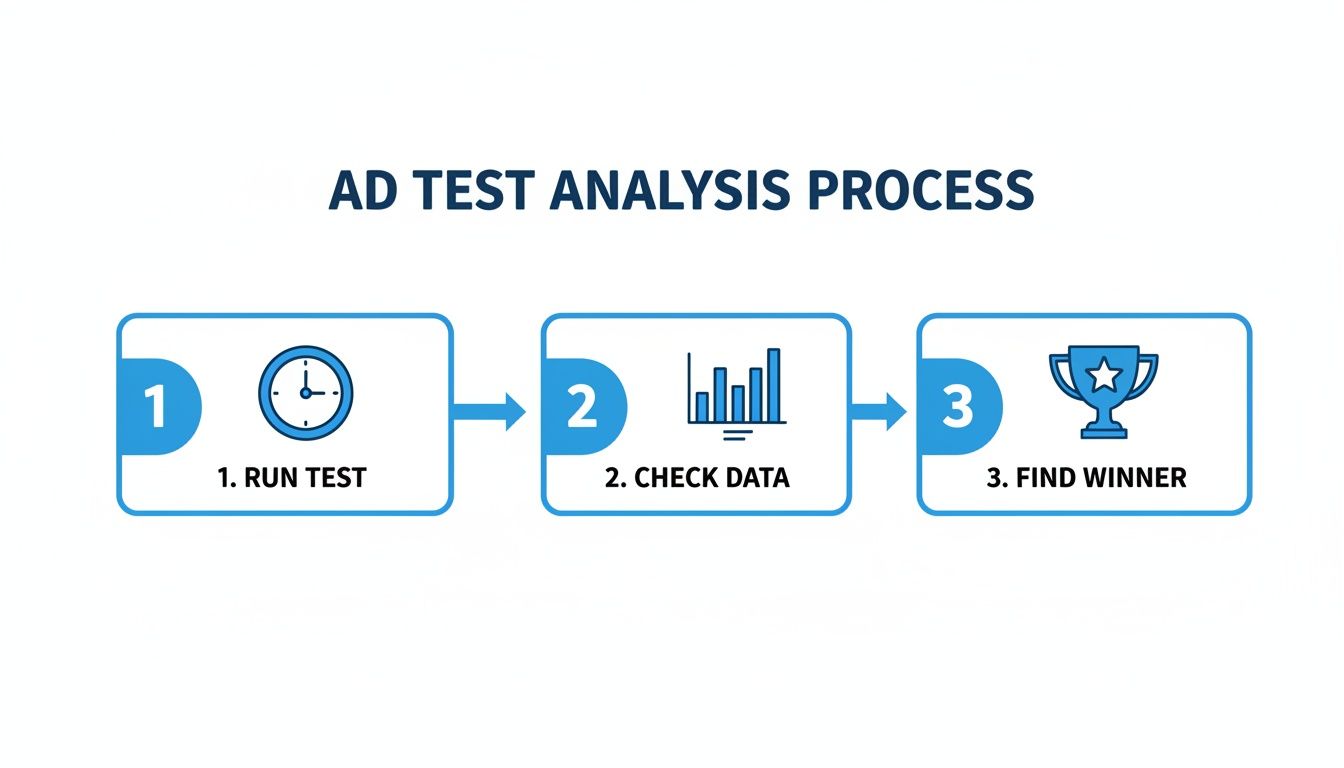
The visual really hammers home a core principle of successful ad tests: it’s a structured process, not a random guess. You move methodically from execution to analysis and, finally, to a confident decision.
Building Your Next Hypothesis from Learnings
With the winner now live and kicking, the most important step is to log what you've learned. This is what transforms a one-off test into a true optimisation cycle. You have to ask yourself: why did this ad win?
The answer to 'why' is the raw material for your next great hypothesis. Don’t just record what won; document the insight you've gained about your audience.
For example, imagine a headline focused on "Next-Day UK Delivery" smashed one about "Affordable Prices." Your learning isn't just that one headline is better. The real insight is that your audience values speed and convenience more than cost.
This insight then fuels your next round of ad tests:
- Hypothesis Idea 1: Can we push the speed message further? Let's test variations like "Order by 9 pm for Tomorrow's Delivery."
- Hypothesis Idea 2: Could a visual that communicates speed work? Let’s try an image of a delivery van or a clock against our current best.
- Hypothesis Idea 3: Let's test this "speed" angle on our landing page copy and see if it lifts the conversion rate there too.
This iterative process of learning and reapplying insights is what creates serious momentum. Each test builds on the knowledge of the last, leading to progressively smarter and more effective advertising.
Avoiding Local Maxima with Radical Tests
While this iterative approach is powerful for making consistent, incremental gains, it does come with a hidden danger: the local maxima. This is a point where you've optimised your current ad concept so much that you just can't squeeze any more performance out of it. You might be winning by 5% here and there, but you’re stuck on a small hill, completely unaware that a much bigger mountain of performance is just over the horizon.
To break out of this, you have to periodically introduce a radically different 'challenger' ad. This isn't just a small tweak to your current winner; it's a completely different concept, value proposition, or creative angle.
Imagine you've spent months optimising ads around product features. A radical challenger might ignore features entirely and focus on the emotional benefit of using the product instead. It might feel risky, but these are the tests that can unlock breakthrough performance and find a whole new level of growth.
Ultimately, this entire approach contributes to improving your return on ad spend (ROAS). A healthy ROAS target is 4:1, meaning you generate £4 for every £1 spent. For most UK ecommerce businesses, a 2-4x ROAS is a solid benchmark to aim for.
By combining methodical, iterative improvements with occasional bold, creative leaps, you build a truly resilient and dynamic testing programme. You refine what works while constantly searching for the next big thing, ensuring your account never stagnates. For those looking to go even further, check out our guide on enhanced incrementality testing for deeper ROI insights to explore more advanced techniques.
Common PPC Ad Testing Questions
Even with a solid plan, it’s natural to have a few nagging questions when you dive into the world of PPC ad testing. Everyone wonders if they're doing things right, especially at the start. To help you test with confidence, we’ve put together some straightforward answers to the most common queries we hear from marketers.
Think of this as your go-to reference for clearing those final hurdles. Getting these details right is the difference between clean, reliable data and a complete waste of ad spend.
How Long Should I Run an Ad Test?
There's no single magic number here, but a good rule of thumb is to run a test for at least two to four weeks. Why? Because this window is usually long enough to smooth out the natural ups and downs of user behaviour, like the difference between a quiet Tuesday morning and a busy Saturday afternoon.
More importantly, you have to wait until your test has enough data to be statistically significant. If you're running a high-traffic account, you might get there in a few days. For smaller accounts, it could easily take a month or more. The key is not to jump the gun and call the test early based on initial trends.
Patience is everything. Most ad platforms will tell you when a result is statistically significant. Ending a test prematurely because one ad is slightly ahead after 48 hours is one of the most common—and costly—mistakes you can make in PPC.
What Should I Test First in My Ads?
If you're new to A/B testing, always start with the elements that can deliver the biggest impact. Don't get bogged down testing tiny changes like swapping a single word in your description. Go for the big swings first to get meaningful results, faster.
Here's a quick priority list to get you started:
- For Search Ads: The headline is, without a doubt, the most critical part. It’s the first thing people see and has the biggest impact on your click-through rate. Start by testing a completely different value proposition or a much stronger call-to-action.
- For Display or Social Ads: Your image or video creative is where the power lies. Test a bold new visual style, a completely different product shot, or a video with a stronger hook in the first three seconds.
Once you’ve tested these high-impact elements and found some clear winners, then you can move on to testing things like descriptions, display paths, landing pages, or different offers. Always start with the change you believe will produce the most significant result.
How Many Ad Variations Should I Run at Once?
For most businesses, a simple A/B test with just two or three ad variations per ad group is the most effective way to go. This approach lets you gather data and find a winner relatively quickly without spreading your impressions too thin.
When you run too many variations at once, you seriously dilute your traffic. If you have ten different ads competing in one ad group, it will take an eternity for any single ad to get enough impressions to prove its worth. This can drag your tests out for months and completely stall your optimisation efforts.
Stick to a simple ‘champion vs. challenger’ model to start. Pit your current best-performing ad (the champion) against one new idea (the challenger). As you get more advanced and your traffic volumes increase, you can explore multivariate testing. But for most advertisers, simplicity wins. If you want to dive deeper into testing frameworks, you can learn more about how to measure advertising effectiveness.
What if My Ad Test Result is Inconclusive?
It happens all the time—a test finishes without a clear, statistically significant winner. This isn’t a failure; it’s a learning opportunity. An inconclusive result tells you something valuable: the element you tested didn't have a big enough impact on user behaviour to matter.
For example, let's say you tested two very similar headlines—"Shop Our New Collection" versus "Browse Our New Collection." Your audience probably didn't see a meaningful difference between them, so the test rightly came back as inconclusive.
When this happens, document the outcome and go back to the drawing board with a more dramatic change. Don't just tweak a verb; test a completely different angle. An inconclusive test shows you what your audience doesn't care about, which is crucial information that helps you focus future tests on things that actually move the needle.
Feeling a bit overwhelmed by the idea of setting all this up yourself? The team at PPC Geeks lives and breathes this stuff. We can take the entire testing process off your plate, from building data-driven hypotheses to scaling the winners for maximum impact. Let us handle the experiments so you can focus on running your business. Get your free, no-obligation PPC audit today.
Author

Search Blog
Free PPC Audit
Subscribe to our Newsletter

The Voices of Our Success: Your Words, Our Pride
Don't just take our word for it. With over 100+ five-star reviews, we let our work-and our satisfied clients-speak for us.

"We have been working with PPC Geeks for around 6 months and have found Mark and the team to be very impressive. Having worked with a few companies in this and similar sectors, I rate PPC Geeks as the strongest I have come across. They have taken time to understand our business, our market and competitors and supported us to devise a strategy to generate business. I value the expertise Mark and his team provide and trust them to make the best recommendations for the long-term."
~ Just Go, Alasdair Anderson