




The Amazon marketplace is more competitive than ever, especially for UK SMEs and e-commerce brands. Simply running ads is no longer enough; success now demands a sophisticated, data-driven approach to your campaigns. Generic advice often leads to wasted ad spend and missed opportunities, a luxury most growing businesses cannot afford.
This guide cuts through the noise. We will deliver powerful and actionable Amazon PPC tips designed to refine your strategy, lower your Advertising Cost of Sales (ACoS), and drive measurable growth. We move beyond the basics, exploring advanced techniques that make a real difference.
You will learn about strategic keyword harvesting, surgical negative keyword implementation, nuanced bid management, and insightful performance analytics. These concepts are crucial because they transform your advertising from a simple expense into a powerful engine for scalable profit. Whether you’re a hands-on entrepreneur or a marketing manager seeking to maximise ROI, these insights provide a clear framework. This article will equip you with the practical knowledge needed to turn your ad spend into a sustainable competitive advantage on the world’s largest online retail platform.
1. Master Advanced Keyword Research and Match Type Strategy
Effective Amazon PPC begins not with bids or budgets, but with a deep understanding of customer search behaviour. Mastering advanced keyword research and strategically deploying match types is the foundational pillar of any profitable campaign. This approach involves more than just picking obvious terms; it’s about uncovering the precise language your target audience uses when they are ready to buy.

The core principle is to use different match types for distinct phases of your campaign. Broad match acts as your research tool, phrase match provides a balance of reach and relevance, and exact match delivers precision and control for your proven, high-converting keywords. This structured method ensures you capture new customer searches while maximising return on your best-performing terms.
How to Implement This Strategy
A phased approach is crucial for success. Start by casting a wide net to gather data, then systematically refine your targeting to improve efficiency and profitability.
- Launch a Discovery Campaign: Create a Sponsored Products campaign using broad match keywords. For a fitness equipment seller, this could be ‘home gym’. The goal here isn’t immediate profit, but to harvest valuable customer search term data from Amazon’s reports.
- Analyse and Harvest: After one to two weeks, dive into your Search Term Report. Look for longer, more specific customer queries that generated clicks and sales, such as ‘compact home gym for small flat’ or ‘foldable workout bench’.
- Create a Performance Campaign: Move these high-performing search terms into a new, separate campaign using phrase and exact match types. For example, add
[compact home gym for small flat]as an exact match to bid more aggressively and capture highly qualified traffic. - Add Negative Keywords: Simultaneously, add the harvested term (e.g., ‘compact home gym for small flat’) as a negative exact match in your original broad match campaign. This prevents the campaigns from competing and ensures your budget is spent efficiently.
This structured keyword migration is one of the most powerful Amazon PPC tips for scaling your advertising. It turns speculative ad spend into a predictable, data-driven system for growth. By continuously analysing search term data and migrating keywords, you build a powerful advertising engine that consistently drives sales.
2. Implement a Robust Negative Keyword Strategy
Just as important as choosing which keywords to bid on is deciding which ones to avoid. Implementing a robust negative keyword strategy is about proactively telling Amazon which search terms are irrelevant to your product. This prevents your ads from showing to shoppers with no intention of buying, drastically reducing wasted ad spend and improving your campaign’s overall efficiency.

The core principle is to protect your budget from costly, non-converting clicks. By filtering out irrelevant traffic, you ensure your ads are displayed to a more qualified audience, which in turn improves your click-through rate (CTR) and conversion rate. This is one of the most direct Amazon PPC tips for immediately boosting profitability.
How to Implement This Strategy
A systematic and continuous approach to managing negative keywords is essential. This isn’t a one-time task but an ongoing optimisation process based on real customer data.
- Analyse Your Search Term Report: On at least a weekly basis, review your search term report. Identify terms that are generating clicks but have zero sales. For example, a seller of premium leather watches might find clicks coming from the search term ‘cheap kids watch’.
- Apply Negative Match Types: Add these irrelevant terms as negative keywords. Use negative phrase match to block broader variations (e.g., adding “cheap” as a negative phrase will block ‘cheap watches’ and ‘very cheap watches’). Use negative exact match for highly specific, low-performing terms you want to exclude without affecting similar queries.
- Build a Master Negative List: Create a shared negative keyword list in your advertising portfolio that applies to multiple campaigns. This is perfect for universal negative terms like ‘free’, ‘used’, ‘review’, or competitor brand names that you want to exclude across your entire account.
- Be Data-Driven: Avoid adding negative keywords too hastily. A term might need more data before you can confidently judge its performance. Allow a search term to accumulate enough clicks (e.g., 10-15) without a sale before you decide to add it as a negative.
By diligently pruning your campaigns of irrelevant search terms, you funnel your budget towards the queries that actually drive revenue. This strategic defence is fundamental for maximising your return on ad spend (ROAS) and achieving long-term, scalable success on the platform. You can find more details in this complete guide to Negative Keywords on ppcgeeks.co.uk/.
3. Strategic Bid Management and Optimisation
Beyond selecting the right keywords, your bidding strategy determines whether your campaigns are profitable or a drain on your budget. Strategic bid management is the ongoing process of setting and adjusting your bids to meet your advertising cost of sales (ACoS) targets and maximise your return on ad spend (ROAS). It requires a firm grasp of Amazon’s auction dynamics and a proactive approach to optimisation.
This infographic outlines the core components of a modern Amazon PPC bid strategy, showing how manual, automated, and placement-based controls work together.
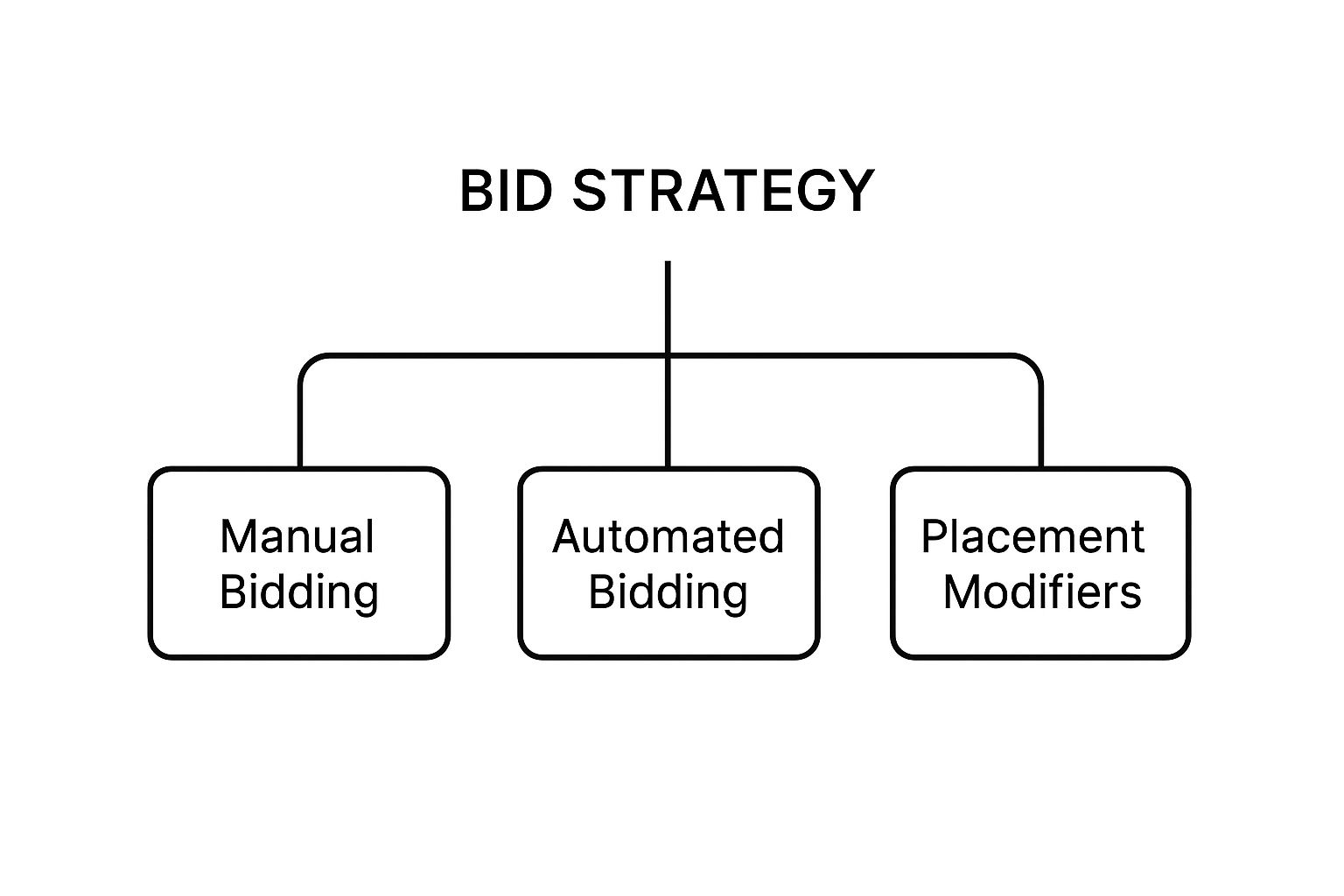
The key takeaway is that a comprehensive approach combines different bidding levers to achieve specific goals, rather than relying on a single method.
How to Implement This Strategy
Effective bid management isn’t about setting and forgetting; it’s a dynamic process based on performance data. Your goal is to allocate budget towards what works and reduce spend on what doesn’t.
- Calculate Your Target ACoS: Before you bid, know your break-even point. Calculate your profit margin per product before ad spend. Your target ACoS should be below this margin to ensure profitability. For example, if your margin is 35%, a target ACoS of 25% ensures each sale is profitable.
- Use Dynamic Bidding Strategically: For new or broad match campaigns where you are gathering data, use Amazon’s ‘Dynamic bids – down only’ setting. This allows Amazon to lower your bid in real-time for auctions less likely to convert, protecting your budget while you explore new search terms.
- Apply Placement Modifiers: Analyse your campaign placement reports. If you find that ‘Top of search’ placements generate a significantly higher conversion rate, apply a positive bid modifier (e.g., +30%). This tells Amazon you are willing to bid more for that valuable ad real estate.
- Optimise Manually for Top Performers: For your proven, high-converting exact match keywords, take manual control. Increase bids gradually (10-20% at a time) to maintain a dominant position and maximise sales velocity, while closely monitoring your ACoS.
This blend of automated and manual controls is one of the most effective Amazon PPC tips for maintaining both efficiency and competitive advantage. By actively managing your bids based on profitability data and strategic goals, you can significantly improve your campaign performance. Learn more about the nuances of these PPC bidding strategies on ppcgeeks.co.uk/.
4. Campaign Structure and Organisation
A disorganised Amazon PPC account is a recipe for wasted ad spend and missed opportunities. Proper campaign structure involves organising your campaigns in a logical, scalable way that allows for efficient management, optimisation, and budget allocation. This is more than just tidiness; it’s a strategic framework for growth.

The core principle is to create a clear hierarchy that reflects your business goals. By separating campaigns by product lines, match types, and strategic objectives (like brand defence or competitor targeting), you gain granular control over bids and budgets. This organised approach allows you to make informed, data-driven decisions rather than managing a chaotic mess of ad groups.
How to Implement This Strategy
Start by mapping out your product catalogue and advertising goals. A logical structure will make scaling and reporting significantly easier down the line.
- Define a Naming Convention: A consistent naming system is the foundation. Use a clear format that tells you everything you need to know at a glance. A great example is:
SP_ProductLine_MatchType_Targeting_Date. For instance,SP_YogaMats_Exact_Brand_Jan24. - Separate Branded and Non-Branded Traffic: Create entirely separate campaigns for your own brand terms (e.g., ‘YourBrand yoga mat’). Brand searches have high intent and convert cheaply. Mixing them with more expensive, generic keyword campaigns (e.g., ‘eco-friendly yoga mat’) will distort your overall ACoS and hide the true performance of each strategy.
- Isolate Top-Performing Products: Your best-selling ASINs deserve their own dedicated campaigns. This allows you to allocate a specific budget to them and control bidding with maximum precision, ensuring they are always visible for the most valuable search terms.
- Structure Ad Groups Tightly: Within each campaign, limit ad groups to a small number of very closely related keywords (ideally 5-10). For a clothing brand, one ad group might contain ‘men’s black cotton t-shirt’ and ‘black cotton tee for men’, but not ‘men’s blue polo shirt’. This ensures your ad copy is highly relevant to every keyword in the group, boosting click-through rates.
This methodical approach to campaign organisation is one of the most impactful Amazon PPC tips for long-term success. It transforms your account from a reactive expense into a proactive, finely-tuned engine for driving profitable growth. A well-organised structure provides the clarity needed to scale effectively and maximise your return on investment.
5. Implement Strategic Budget Allocation and Dayparting
Your advertising budget is a finite resource; spending it wisely is as crucial as choosing the right keywords. Strategic budget allocation and dayparting involve directing your funds towards your most profitable campaigns and scheduling your ads to appear only when your target audience is most likely to purchase. This prevents wasted spend during low-traffic, low-conversion hours and maximises your visibility during peak buying times.
The core principle is data-driven efficiency. By analysing performance by the hour and by campaign, you can make informed decisions to shift budget away from underperforming areas and double down on what works. This transforms your budget from a blunt instrument into a precision tool, ensuring every pound spent has the highest possible chance of generating a return.
How to Implement This Strategy
A successful approach requires careful analysis of historical data, followed by methodical adjustments using Amazon’s campaign management tools. It’s not about guessing, but about letting customer behaviour guide your spending.
- Analyse Your Hourly Data: Before making changes, review your performance data over at least 30 days. Navigate to your campaign, select “Placements,” and then adjust the reporting range to see performance “by hour of day.” Identify consistent patterns of high and low ACoS or conversion rates.
- Apply Campaign Budget Rules: Create rules within the Amazon Advertising console to automate budget changes. For example, a kitchen appliance brand might set a rule to increase its daily budget by 40% between 6 PM and 9 PM, when data shows shoppers are most active.
- Prioritise Top Performers: Follow a tiered budget allocation model. Dedicate the majority of your budget (around 70-80%) to your proven, high-performing “Performance” campaigns. Allocate the remaining 20-30% to “Discovery” or test campaigns to ensure you continue to find new opportunities.
- Pause During Off-Peak Hours: If your reports show consistently poor performance and zero sales during specific times, such as 2 AM to 5 AM, use budget rules to pause the campaigns during these hours. This simple action can immediately improve your overall ACoS.
Mastering this is one of the most effective Amazon PPC tips for enhancing profitability without increasing your overall ad spend. It ensures your products are front-and-centre when customers are ready to buy, turning your advertising from a constant expense into a highly efficient, 24/7 sales driver.
6. Align Your Product Listing with Your PPC Strategy
Your Amazon PPC campaigns do not operate in a vacuum; they lead customers directly to your product detail page. Failing to optimise this destination is like paying for a premium billboard that points to a messy, uninvincing shop. Aligning your product listing with your advertising strategy is crucial for creating a seamless journey from ad click to conversion, directly impacting your ad relevance, click-through rates (CTR), and ultimately, your profitability.
The core principle is to ensure message match between your ad and your listing. When a shopper clicks an ad for a ‘compact home gym’, they expect the product page to immediately reinforce that specific benefit. This alignment reassures the customer, reduces friction, and significantly boosts your conversion rate, making every ad pound spent more effective. This is one of the most fundamental Amazon PPC tips for maximising return on investment.
How to Implement This Strategy
A systematic review of your product listing through the lens of your top-performing PPC keywords can reveal powerful optimisation opportunities. This process bridges the gap between your advertising and your digital storefront.
- Integrate Keywords into Your Title: Identify your highest-volume, most relevant keywords from your PPC campaigns. Weave these terms naturally into your product title. For a skincare brand, if ‘hydrating serum for dry skin’ is a top-performing keyword, the title should reflect this, such as: “Pro-Hydrate Serum – Deeply Hydrating Formula for Dry, Sensitive Skin”.
- Optimise Visuals for Ad Relevance: Your main image is your first impression. Ensure it strongly represents the product and angle you are advertising. If your ad highlights a specific feature, make sure your images, especially the main one, showcase it clearly. Beyond basic visuals, leveraging AI tools can significantly elevate your product photos; this practical guide to AI image enhancement offers excellent techniques to make your listings more appealing.
- Align Bullet Points and A+ Content: Use your bullet points and A+ Content to expand on the promises made in your ads. If your campaign targets customers searching for ‘quiet blender’, your bullet points should explicitly mention its low-noise motor and decibel level. This addresses the customer’s primary concern head-on.
- Test and Refine: Use Amazon’s ‘Manage Your Experiments’ tool to A/B test different main images or product titles. Analysing how these changes affect the CTR and conversion rate of your associated PPC campaigns will provide clear data on what resonates most with your target audience.
By treating your product page as the ultimate landing page for your ads, you create a powerful, cohesive customer experience. This synergy not only improves campaign performance but also builds brand trust and drives sustainable sales growth. For a deeper dive into this concept, you can learn more about landing page optimisation.
7. Performance Tracking and Analytics
To truly optimise your Amazon PPC, you must move beyond surface-level metrics like clicks and spend. Comprehensive performance tracking involves a deep dive into the data, understanding how advertising influences the entire customer journey, and making informed decisions that boost both paid and organic sales. It’s about connecting your ad spend to real business growth, not just immediate campaign results.
The core principle is to use data to tell a story about your performance. By monitoring a curated set of key metrics, you can understand not only which ads are working but also why they are working. This allows you to justify higher acquisition costs for certain products, understand customer lifetime value, and see the halo effect your PPC campaigns have on your brand’s organic visibility.
How to Implement This Strategy
A systematic approach to analytics turns raw data into a powerful decision-making tool. Instead of getting lost in spreadsheets, focus on the metrics that matter most and build a rhythm for reviewing and acting on them.
- Define Your Core Metrics: Avoid “analysis paralysis” by focusing on 5-7 key performance indicators (KPIs). These should include ACoS (Advertising Cost of Sale), TACoS (Total Advertising Cost of Sale), Conversion Rate, Cost-Per-Click (CPC), and Impressions. For a supplement brand, this might also include tracking customer lifetime value to justify higher initial ad spend.
- Establish a Reporting Cadence: Create a weekly or bi-weekly routine to review your campaign performance. Look for trends, anomalies, and opportunities. For instance, a home goods seller might notice a spike in conversions for “outdoor string lights” and decide to increase the budget for that campaign ahead of a bank holiday weekend.
- Analyse Total Impact (TACoS): Go beyond ACoS to calculate your Total Advertising Cost of Sale (Ad Spend ÷ Total Revenue). This metric shows the relationship between your advertising and overall sales (both paid and organic). A declining TACoS, even with a stable ACoS, indicates your PPC efforts are successfully boosting organic rank and sales.
- Set Up Automated Alerts: Use third-party tools or set up rules within Seller Central to notify you of significant performance changes. An alert for a sudden drop in impressions on a top-performing campaign can help you identify and fix issues like a lost Buy Box before they cause major damage.
This data-centric approach is one of the most crucial Amazon PPC tips for sustainable growth. By consistently tracking performance and using those insights to refine your strategy, you create a feedback loop that continually improves efficiency and maximises your return on investment across the entire Amazon ecosystem.
8. Competitor Analysis and Market Intelligence
Operating in a vacuum is a recipe for missed opportunities on Amazon. Effective competitor analysis involves systematically monitoring your rivals’ advertising strategies, keyword targeting, pricing, and overall market positioning. This intelligence is crucial for making informed, proactive decisions about your own campaigns, helping you identify threats and capitalise on openings in the market.
The core principle is to use competitor data not to copy, but to strategise. By understanding where your rivals are winning (and where they are vulnerable), you can refine your keyword bidding, adjust your product positioning, and find new avenues for growth. It’s about turning market noise into a clear competitive advantage.
How to Implement This Strategy
A consistent approach to market intelligence allows you to stay one step ahead. It transforms reactive adjustments into a forward-thinking strategy that protects and grows your market share.
- Identify Key Competitors: Compile a list of your top 3-5 direct competitors on Amazon. These are brands selling similar products to a similar audience. Don’t just focus on the biggest names; include emerging brands that are gaining traction.
- Conduct Keyword Gap Analysis: Use PPC software (like Helium 10, Jungle Scout, or SEMrush) to see which valuable keywords your competitors are ranking for, but you are not. A tech accessory seller might discover a rival is successfully targeting “ergonomic laptop stand for standing desk,” a term they had overlooked.
- Monitor Bidding and Ad Placement: Regularly check the search results for your most important keywords. Note which competitors consistently appear in the top-of-search placements. A coffee brand noticing rivals bidding aggressively on ‘organic coffee beans’ in Q4 should consider increasing their own bids to remain visible during the peak holiday season.
- Analyse and Adapt: Track competitor pricing, review sentiment, and new product launches. If a competitor stops advertising on a high-value keyword, it creates a golden opportunity for you to capture that traffic at a potentially lower cost.
Integrating these observations into your strategy is one of the most powerful Amazon PPC tips you can implement. For an even deeper understanding of this process, you can explore detailed guides on PPC competitor research. This ongoing intelligence work ensures your advertising remains agile, responsive, and highly effective in a dynamic marketplace.
Amazon PPC Tips Strategy Comparison
| Strategy | Implementation Complexity 🔄 | Resource Requirements ⚡ | Expected Outcomes 📊 | Ideal Use Cases 💡 | Key Advantages ⭐ |
|---|---|---|---|---|---|
| Keyword Research and Match Types Strategy | Moderate – requires ongoing monitoring and analysis | Medium – uses research tools and analytics | High relevance, improved CTR, better targeting control | New keyword discovery, refining campaigns | Discovers high-converting keywords, reduces wasted spend |
| Negative Keywords Implementation | Low to Moderate – needs continual updates | Low to Medium – analysis of search term reports | Reduced wasted spend, improved CTR and conversion | Filtering irrelevant traffic, budget efficiency | Significantly cuts irrelevant clicks, improves ad quality |
| Strategic Bid Management and Optimisation | High – complex metrics, manual and automated bids | High – requires deep metric understanding | Maximised ROAS, improved ad placement and profitability | Optimising bids for profitability, seasonal adjustments | Fine-tunes ad spend, automates bid adjustments |
| Campaign Structure and Organisation | Moderate – initial setup can be complex | Medium – requires management and clear planning | Easier performance tracking, better budget control | Managing multiple products, scaling campaigns | Simplifies reporting, improves data quality |
| Budget Allocation and Dayparting | Moderate to High – needs strong data analysis | Medium to High – data-driven budget management | Optimised spend timings, reduced budget waste | Time-sensitive campaigns, inventory management | Focuses budget on peak periods, improves campaign efficiency |
| Product Listing Optimisation for PPC | Moderate – ongoing content optimisation | Medium – content creation and testing effort | Increased ad relevance, higher conversion rates | Enhancing PPC conversion, improving customer experience | Boosts Quality Score, enhances organic rankings |
| Performance Tracking and Analytics | High – requires multiple metrics and tools | High – analytical skills and tools needed | Data-driven decisions, improved ROI measurement | Comprehensive campaign management and forecasting | Enables quick trend identification, improves accountability |
| Competitor Analysis and Market Intelligence | Moderate to High – manual and tool-based research | Medium to High – subscription to competitive tools | Identification of keyword gaps and market trends | Market expansion, strategic bidding decisions | Reveals competitor strategies, uncovers new opportunities |
From Tips to Triumph: Implementing Your Advanced PPC Plan
Navigating the complexities of Amazon’s advertising platform can feel overwhelming, but mastering it is a journey of continuous improvement, not a single destination. The eight core pillars we have explored in this guide – from granular keyword research and strategic bid management to meticulous campaign structuring and insightful analytics – are not just isolated tasks. They are interconnected components of a powerful, unified advertising engine. By moving beyond a simple “set it and forget it” mindset, you can transform your PPC campaigns from a necessary expense into a primary driver of scalable growth and brand dominance.
The true power of these Amazon PPC tips is realised through consistent application and a commitment to data-driven refinement. Each element builds upon the others. For example, robust negative keyword implementation (Tip #2) is only possible with diligent performance tracking (Tip #7). Likewise, effective budget allocation (Tip #5) depends entirely on a well-organised campaign structure (Tip #4) that allows you to direct funds towards your most profitable targets. This holistic approach ensures your advertising spend works smarter, not just harder, delivering a compounding return on investment over time.
Weaving Theory into Action
To truly make these concepts work for your business, you must translate them into a repeatable process. We recommend establishing a regular optimisation cycle. Set aside dedicated time each week to:
- Review Search Term Reports: This is your primary source for identifying new high-performing keywords and, just as importantly, irrelevant search terms to add as negative keywords.
- Analyse Campaign Performance: Scrutinise your ACoS, TACOS, and conversion rates. Are your bids aligned with your profitability goals? Are certain campaigns or ad groups underperforming?
- Assess Budget Pacing: Check if your daily and monthly budgets are on track. Use dayparting insights to reallocate funds to peak conversion times, ensuring you don’t miss out on valuable sales.
This disciplined routine is the bridge between knowing these tips and seeing tangible results. As you become more proficient, you can explore other top Amazon PPC strategies to further enhance your campaigns and stay ahead of the competition.
Ultimately, your success on Amazon is a direct reflection of your ability to adapt and optimise. The marketplace is dynamic, with consumer behaviour and competitor tactics constantly evolving. By implementing these advanced strategies, you are not just launching ads; you are building a resilient, intelligent system that can navigate market shifts and consistently capture profitable demand. This proactive stance is what separates stagnant sellers from market leaders.
Feeling overwhelmed by the complexity or short on time? The team at PPC Geeks specialises in transforming complex advertising data into clear, profitable growth strategies for UK brands. Contact us for a free, in-depth PPC audit to uncover your biggest opportunities.