




So, what is a good CTR rate? The short answer is it’s usually above 2% for organic search, while for paid ads it can be anything from 2% to 5% or even higher, depending on your industry and the platform you’re using. But the real, honest answer is always: “it depends.” What’s ‘good’ is completely contextual.
What Is a Good CTR Rate? Understanding Your Click-Through Rate
Before we get bogged down in benchmarks, let’s get clear on what Click-Through Rate (CTR) is actually telling you.
Imagine your business is a shop on a busy high street. The number of people who walk past your shop window are your impressions. The ones who stop, look at your display, and decide to pop inside are your clicks. Simple as that.
CTR is the percentage of people who were intrigued enough by your window display to come in for a proper look. It’s a direct measure of how well your message is landing with a specific audience. A high CTR suggests your ad, email subject line, or search result is hitting the mark. A low one tells you there’s a disconnect somewhere.
The formula itself is dead simple: (Total Clicks ÷ Total Impressions) x 100 = Click-Through Rate. So, if 1,000 people see your ad (impressions) and 50 click on it, your CTR is a solid 5%.
This metric is a vital sign for your content’s health. For a more detailed look, you can learn more about what click-through rate is and why we see it as a cornerstone of PPC campaign analysis. Nailing this concept is the first step to figuring out what’s working and making smarter, data-driven improvements.
Why CTR is More Than Just a Number
It’s easy to get obsessed with chasing the highest CTR possible, but that number doesn’t mean much on its own. Instead, think of it as a crucial early warning sign for several key business outcomes:
- Audience Engagement: It’s one of the purest ways to see if your creative, copy, and targeting are actually working. A strong CTR means you’ve grabbed their attention.
- Ad Quality and Relevance: Platforms like Google Ads use CTR as a massive part of their Quality Score. A higher CTR can actually earn you better ad positions and lower your costs.
- Message Effectiveness: It gives you instant feedback. You’ll see right away which headlines, descriptions, and calls-to-action get people clicking and which ones fall flat.
What a Good CTR Rate Looks like Across Channels
Pinning down a “good” CTR is a bit like asking for the perfect temperature; it all depends on where you are. A fantastic 4% CTR on a Google Search ad would be a huge red flag for an email campaign. Every digital marketing channel is its own little world, complete with unique audience expectations and performance standards.
Getting your head around these differences is the key to setting goals you can actually hit. Think about it: someone typing a question into Google is actively looking for an answer. They want to click on a result that solves their problem. On the other hand, someone scrolling through their Facebook feed is in discovery mode, not shopping mode. An ad there is an interruption, so you’re naturally going to see lower CTRs.
To give you a clearer picture, here’s a look at some typical CTR benchmarks.
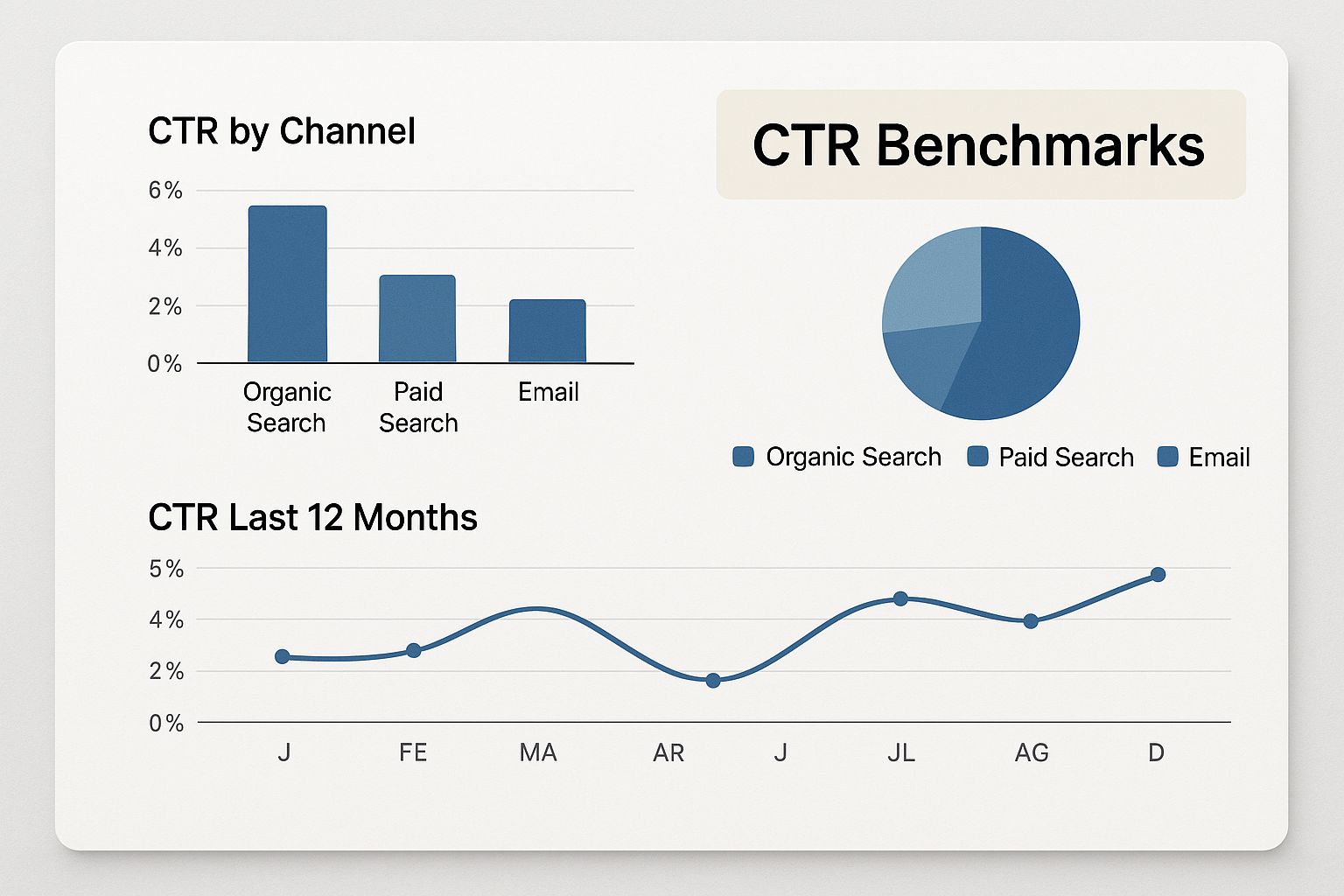
As you can see, channels where users are on a mission, like search, pull in much higher click-through rates than channels where they’re just passively browsing, like display networks.
Let’s break down what these benchmarks mean for you.
Average UK CTR Benchmarks by Digital Marketing Channel (What Is a Good CTR Rate?)
The table below offers a snapshot of typical Click-Through Rate percentages across various digital marketing channels in the UK. This data can help you set more realistic performance expectations for your own campaigns.
| Channel | Average UK CTR (%) | Key Influencing Factor |
|---|---|---|
| Search Advertising (PPC) | 3.17% | User Intent: People are actively searching for a solution. |
| Email Marketing | 2.5-3% | Audience Relationship: Clicks come from an opted-in, engaged list. |
| Social Media Ads | 1.3% | Audience Mindset: Users are in discovery/entertainment mode, not buying mode. |
| Display Advertising | <0.5% | Ad Format: Often used for brand awareness; susceptible to “banner blindness”. |
Ultimately, these numbers are a starting point. Your industry, offer, and creative will all play a huge role in your final results.
Search Advertising CTR Benchmarks
When it comes to paid search, user intent is your best friend. People hit up search engines to find solutions, making them incredibly receptive to ads that nail their query. A high CTR here tells you one thing loud and clear: your ad copy and keywords are perfectly in sync with what the searcher needs.
Across UK industries, the average CTR for search ads is around 3.17%, but that figure can swing wildly. In super-competitive sectors, you might see averages closer to 2%, whereas niche industries with laser-focused keywords can easily cruise past 5%.
For Google Ads, a good rule of thumb is to aim for anything over 2%. If you’re consistently hitting 5% or more, give yourself a pat on the back. You’re almost certainly outperforming your competitors by mastering the art of matching ads to intent.
Social Media Advertising CTRs (What Is a Good CTR Rate?)
Social media is a completely different ball game. People are there to connect with friends, watch cat videos, and catch up on news—not necessarily to buy your product. This means the average CTR for social ads is much lower, sitting around 1.3%. Your ad is interrupting their scroll, so it needs to be seriously compelling to earn that click.
The platform itself also makes a massive difference. For example:
- Facebook: With its broad, entertainment-focused audience, the average CTR is about 0.9%.
- LinkedIn: The professional context here means users are in a career mindset. As a result, sponsored content can often achieve a CTR closer to 0.6%.
Understanding the nuances between platforms is crucial when you’re judging performance. To get a better feel for how user intent shapes these benchmarks, a deep dive into Google Ads vs Facebook Ads can provide some invaluable context.
Email and Display Advertising Norms
Email and display advertising sit at opposite ends of the CTR spectrum. An email campaign sent to a warm, engaged list can boast some of the highest click-through rates going, often averaging 2.5-3% in the UK. That’s because you’re talking to people who have already given you permission to be in their inbox.
Display ads, on the flip side, have the lowest average CTR, often struggling to get above 0.5%. These are the visual banners you see across websites and apps. Their main job is often brand awareness rather than driving direct clicks, and they have to contend with “banner blindness,” where users have learned to subconsciously ignore them.
What Is a Good CTR Rate? UK Email Marketing CTR Benchmarks
When it comes to marketing channels, email is still one of the most direct and powerful tools a UK business can have. Unlike shouting into the void on social media, you’re talking to people who’ve actually asked to hear from you. That’s a massive advantage.
But getting someone to open your email is only the first step. The real win? Getting them to click.
It helps to know what you’re aiming for. The latest data shows a promising trend, with the average click-through rate for email campaigns in Great Britain hitting 2.74% in 2023. That’s a healthy jump from previous years, which tells us that UK marketers are getting much cleverer with their personalisation and content. You can dig into these UK email marketing trends to see the bigger picture.
If your own campaigns are hovering below that number, it’s a good sign that it might be time to take a look under the bonnet of your strategy.
What Separates Good from Great
Hitting the average is fine, but nobody aims to be just average. So, what are the top-performers doing differently? Simple: they’ve stopped blasting generic promotions and started delivering real value. They treat every email like a conversation, not a megaphone.
The best email strategies are always built on knowing your audience inside and out. That understanding then fuels the tactics that actually get people to click.
A great email CTR isn’t just about a clever subject line. It’s about making a promise in that subject line and then delivering on it with valuable, clickable content inside. That click is the ultimate signal of trust and relevance.
Getting there isn’t magic; it’s a mix of smart setup and creative thinking. Let’s break down the key elements that turn a simple ‘open’ into a meaningful ‘click’ and help you figure out what a good CTR really looks like for your business.
Key Levers for a Higher Email CTR
If you want to push your click-through rates beyond the 2.74% benchmark, you need to pull the right levers. Each of these focuses on a different part of your reader’s journey, from the moment the email lands in their inbox to the final action you want them to take.
Here’s where to focus your energy to boost engagement:
- Powerful Subject Lines and Pre-headers: Think of these as a one-two punch. The subject line grabs their attention, and the pre-header gives them a compelling reason to open the email right now. They have to work together to sell the click before the email is even opened.
- Hyper-Personalisation: This is way more than just using someone’s first name. True personalisation means segmenting your audience based on their past purchases, what they’ve looked at on your site, or even their location. It’s about sending content that feels like it was written just for them.
- Clear and Compelling Calls-to-Action (CTAs): Don’t make people guess what you want them to do. Every email should guide the reader toward one obvious next step. A vague or hidden CTA is one of the biggest reasons for a low CTR. Use punchy, action-focused language and make your buttons impossible to miss.
- Mobile-First Design: Let’s be honest, most people are reading your emails on their phones. If your email is a pain to read or navigate on a small screen, you’ve already lost. Your CTR will plummet. Make sure your buttons are big enough for a thumb to tap and your text is easy on the eyes without pinching and zooming.
What Is a Good CTR Rate? Why Display Ad CTRs Tell a Different Story
If you’ve ever looked at a 0.1% CTR on a display campaign and felt your heart sink, you’re not alone. It’s natural to compare that number to the much healthier figures you see from search or email and think the whole thing is a flop. But when it comes to display ads, the click is just a tiny piece of a much bigger puzzle.
Unlike search ads, where people are actively looking for something, display ads are more like billboards on the digital motorway. Their main job isn’t to get someone to pull over right away. It’s to build brand recognition, so when they do need what you offer, your name is the first one that pops into their head. This is a game of awareness, not instant action.

Beyond the Click: Brand Awareness Metrics
Because their purpose is so different, we have to measure the success of display ads differently. We need to look past the click and focus on the metrics that show their real impact on brand visibility and how your audience perceives you.
A big part of this is banner blindness, a phenomenon where we’ve all become conditioned to subconsciously ignore anything that looks like an advert. The ad’s true value, then, lies in the impression itself—that split-second recognition of your logo, brand colours, or key message. This is exactly why a low CTR is often the norm, not a red flag. You can get a deeper dive into these nuances in our complete guide on what is display advertising.
In the UK, the average CTR for display ads hovers around 0.10%. That’s roughly one click for every 1,000 times your ad is shown. That tiny number doesn’t even filter out accidental clicks or bot activity, which really puts the challenge into perspective. For many UK brands, linking offline sales back to online ad exposure is a massive headache, proving we need a smarter way to measure success.
To truly gauge a display campaign’s value, you must shift your focus from direct clicks to softer, yet equally important, metrics. Success is found in impressions, reach, and post-impression actions, not a simple click count.
Instead of obsessing over CTR, consider these alternative metrics for a more accurate picture:
- View-Through Conversions: This tracks people who saw your ad, didn’t click, but later came to your site and converted. It proves the ad planted a seed.
- Brand Lift: Measured through surveys, this shows how your campaign has actually affected things like brand awareness, recall, and purchase intent.
- Reach and Frequency: How many unique people saw your ad, and how many times did they see it? Repetition is key to building memory.
By properly understanding the unique role display advertising plays, you can set realistic expectations and measure its true contribution to your overall marketing strategy.
How Your Industry Shapes Target CTRs
Trying to define a good CTR without looking at your industry is a bit like asking for the best outfit to wear without knowing if it’s snowing or sunny. A click-through rate that would have you popping champagne in one sector could be a massive red flag in another. Context is king.
For instance, an amazing CTR for a B2B tech company selling complex software would look tiny next to the numbers an e-commerce fashion brand pulls during a flash sale. This gap isn’t because one is better at marketing; it’s down to fundamental differences in how their audiences behave and what the buying journey looks like.
Purchase Intent and Sales Cycles Make a Huge Difference (What Is a Good CTR Rate?)
What you’re selling has a massive impact on your click-through rates. Industries that deal with high-emotion, low-commitment purchases nearly always see much higher engagement. Think about retail or travel – a click is a simple, low-risk way for someone to check out an exciting offer.
On the other hand, sectors like finance or enterprise software are all about long sales cycles and deeply considered, logical decisions. A user isn’t going to click an ad and immediately sign up for a mortgage or a new CRM system. They’re in research mode, so a click is just one deliberate step in a much longer process. As a result, the CTRs are just naturally lower.
A “good” CTR is really just a reflection of your specific audience’s buying habits. Success in a high-stakes B2B industry is about landing a few, highly qualified clicks. For an e-commerce brand, it’s about driving a high volume of exploratory clicks.
A Look at Key UK Industry Benchmarks
When you look at UK-specific data, these differences become incredibly clear. For email marketing, some industries consistently knock it out of the park, simply because their offers are built for immediate, clickable action.
Recent UK email benchmarking data shows this perfectly. While the average click rate across all sectors hit a record high of 2.8%, retail was out in front with an average of 3.5%. This is often because retail brands are lightning-fast at adopting engaging email tech and slick personalisation that just makes you want to click. You can dig into more of these insights by checking out the UK email marketing benchmarks on DMA.org.uk.
Here’s a quick rundown of how different sectors usually perform:
- Retail and E-commerce: Often score the highest CTRs. They have visually appealing products, frequent sales, and a very direct path to purchase.
- Hobbies and Leisure: These are also strong performers because the content taps directly into people’s passions, making a click an easy “yes.”
- Finance and Insurance: Typically have lower CTRs. The decisions are complex and require a ton of research and trust-building over time.
- B2B Professional Services: Much like finance, the journey from interest to purchase is long, and a single click is just one small step on that path.
Once you understand these nuances, you can start setting goals for your campaigns that actually make sense. Instead of chasing some generic, pie-in-the-sky number, focus on outperforming the benchmarks for your market. That’s how you define a good CTR that is both ambitious and realistic.
What Is a Good CTR Rate? Practical Strategies to Improve Your Ctr
Knowing what a good CTR is for your industry gives you a target to aim for. Now, let’s get you kitted out with the right strategies to not just hit that benchmark, but smash right through it. Nudging your CTR upwards isn’t about guesswork; it’s a methodical process of tweaking every part of your ad or search listing to make it absolutely irresistible.
Think of it like this: an impression is your chance to start a conversation. A click is them pulling up a chair to listen. To earn that click, every word, image, and offer has to work in harmony to grab their attention.
Fine-Tune Your Headlines and Copy
The headline is your first—and often your only—shot at grabbing someone’s attention. A bland, generic title will get scrolled past every single time, no matter how amazing your offer is. The goal here is to be magnetic.
Start by having a good look at the search engine results page (SERP) for your target keywords. What are your competitors saying? You need to do something that stands out from the noise and speaks directly to what the searcher is looking for.
- Bring in the Numbers: Titles with numbers just naturally draw the eye. “7 Ways to Boost Your Savings” is far more specific and clickable than a vague “How to Boost Your Savings.”
- Use Brackets for a Sneak Peek: Adding context in brackets, like
[Free Template]or[2024 Guide], can boost clicks by up to 40%. It gives users a quick snapshot of the value waiting for them. - Ask a Question They Can’t Ignore: A headline like “Is Your Website Costing You Customers?” speaks directly to a user’s pain point, practically daring them to click and find the answer.
Optimise Your Calls-to-Action and Visuals (What Is a Good CTR Rate?)
Once your headline has hooked them, your call-to-action (CTA) needs to reel them in. Vague CTAs like “Click Here” are a massive missed opportunity. Instead, use strong, benefit-driven command verbs that tell the user exactly what they stand to gain.
Try phrases like “Get Your Free Quote,” “Download the Guide Now,” or “Shop the Sale.” This simple switch moves the focus from the action (clicking) to the outcome (the benefit), which is a much more powerful motivator. For a deeper dive into what works, check out our guide covering 8 ways to improve your click-through rate.
Your CTA shouldn’t just be a button; it should be the logical and satisfying conclusion to the promise your headline made. It’s the final nudge that turns a passive viewer into an active participant.
And let’s not forget the visuals. Compelling imagery is non-negotiable, especially on social media and display networks. Your visuals need to be high-quality, relevant, and powerful enough to stop someone in their tracks mid-scroll. A/B test different images to see what resonates with your audience—sometimes a picture of a person works better than a product shot, or vice versa.
By systematically testing and refining these core elements, you create a clear, compelling path to turn more impressions into valuable clicks.
Have Questions About CTR? We’ve Got Answers
Still have a few questions floating around about click-through rate? You’re not alone. Let’s tackle some of the most common queries we hear from clients to help you get a better handle on this metric.
Is a High CTR Always a Good Thing?
Not always, and this is a big one. A super-high CTR with a rock-bottom conversion rate often means you’re attracting the wrong crowd. Your ad or email is grabbing attention, sure, but it’s not pulling in people who are actually interested in what you offer.
The real goal isn’t just to get any click; it’s to attract qualified clicks that turn into customers. Always look at your CTR next to your conversion metrics. That’s how you get the full story of your campaign’s health.
How Often Should I Check My CTR? (What Is a Good CTR Rate?)
It really depends on what you’re running and how much you’re spending. For a high-stakes PPC campaign where you’re putting down serious money, checking in daily is just smart business.
For things like email campaigns or your organic social media posts, you can relax a bit. Give it a few days after launch to gather some real data, and then a weekly check-in is usually enough. Whatever you do, don’t make knee-jerk changes after just a few hours. Let the data settle.
A good CTR is a sign of relevance, but a good conversion rate is a sign of business success. Never forget that the click is the means to an end, not the end itself.
What Tools Can Improve My CTR?
You probably already have what you need. Most marketing platforms come with their own analytics suites built right in. Google Ads and Google Analytics are your go-to essentials for tracking anything on search and display.
If you’re running social ads, the native tools like Facebook Ads Manager or LinkedIn Campaign Manager will have everything you need. And for your email marketing, your provider (like Mailchimp or Klaviyo) will give you detailed reports on who clicked what.
Ready to turn those clicks into customers? The team at PPC Geeks builds data-driven strategies that don’t just increase traffic—they grow your sales and make your budget work harder.
Get your free, in-depth PPC audit today and see what’s possible. Find out more at https://ppcgeeks.co.uk/.