
A Guide to Amazon Search Optimisation That Actually Works

A Guide to Amazon Search Optimisation That Actually Works: If you’re trying to get your products noticed on Amazon, you need to forget almost everything you know about Google SEO. Amazon is a completely different beast, running on its own powerful search engine – first known as A9, now evolved into A10.
While Amazon keeps the exact recipe under lock and key, its main goal is glaringly obvious: maximise revenue per customer.
That singular focus actually makes your job simpler. Instead of getting bogged down in complex ranking theories, a winning Amazon search optimisation strategy really just comes down to nailing two things:
- Discoverability: Can shoppers actually find your product when they type in relevant search terms? This is all about smart keyword optimisation.
- Conversions: Once they land on your page, do they buy? This is where your sales history, pricing, reviews, and top-notch images seal the deal.
Amazon Search Optimisation: What the A10 Algorithm Really Cares About
Think of the A10 algorithm as a ruthless, data-obsessed salesperson. It’s constantly watching customer behaviour to figure out which products are most likely to make a sale, and it prioritises those that show the most potential for profit and customer happiness.
For example, let’s say your product gets a lot of clicks from the search results page (a high click-through rate, or CTR), but very few of those clicks turn into sales. That’s a massive red flag for the algorithm. It tells Amazon your title might be catchy, but something on your product page—maybe the price is too high or the photos are blurry—is putting people off. A10 learns from this and will likely start pushing your product down the rankings.
You can see a similar evolution in how AI is changing search engines across the board, which puts this kind of data-driven ranking into a broader context.
The bottom line is this: Amazon’s algorithm rewards products that make Amazon money. A listing that consistently turns browsers into buyers will almost always outperform a perfectly keyword-stuffed listing that just doesn’t sell.
It’s More Than Just Keywords
This simple truth means you have to move beyond basic keyword tactics. You need a complete framework that drives real, measurable growth. Your aim is to build a listing that not only signals to the algorithm what your product is but also proves that customers genuinely want it.
Every single element on your page works together to create this effect.
A strong sales history shows Amazon your product is in demand. A flood of positive reviews builds the trust needed to nudge a customer over the finish line. Competitive pricing helps you win the Buy Box against similar items. And high-quality images and A+ Content answer questions before they’re even asked, smoothing the path to purchase.
When you get all these pieces working in harmony, you create a powerful flywheel that propels your product up the rankings and, more importantly, keeps it there.
Amazon Search Optimisation: Mastering Keyword Research for Amazon
Let’s be honest, effective keyword research is the absolute bedrock of a successful Amazon search optimisation strategy. It’s about ditching the guesswork and building a solid workflow to find the exact phrases your customers are typing in when they’re ready to pull out their wallets. This isn’t just about finding broad, obvious terms; it’s about getting inside a shopper’s head.
The goal here is to think like your customer. You might call your product an “ergonomic non-slip yoga mat,” but a real person might be searching for “thick yoga mat for bad knees” or “eco-friendly TPE mat UK.” Nailing these high-intent, long-tail keywords is where the magic really happens.
This process is the foundation for everything that follows: your product title, your bullet points, your backend search terms, and even your PPC campaigns. Get it right, and your product appears at the perfect moment. Get it wrong, and you’re basically invisible.
Uncovering Competitor Keywords with Reverse-ASIN Tools
One of the smartest moves you can make is to peek at your competitors’ playbooks. Why start from scratch when you can use reverse-ASIN tools to see which keywords are already driving traffic and sales for the top sellers in your niche?
Imagine you’re launching a new brand of wireless earbuds in the UK. Just grab the ASIN (Amazon Standard Identification Number) of the current bestseller, plug it into a tool, and you’ll get a list of all the keywords that product is ranking for. It often comes with search volume and ranking data, too. It’s like being handed a treasure map.
You’ll instantly uncover valuable search terms you might have missed, like:
- “noise cancelling earbuds for gym”
- “sweatproof earbuds for running”
- “wireless earphones with long battery life”
This approach gives you a data-backed starting point, saving you hours of brainstorming and ensuring you’re targeting phrases with proven demand. If you’re looking to build out your toolkit, checking out the best free keyword research tools can give you some great options without breaking the bank.
A critical insight from reverse-ASIN analysis is identifying keyword gaps. Look for relevant, high-volume keywords your top three competitors rank for, but you don’t. This is low-hanging fruit and should be your top priority.
Mapping Keywords Across Your Listing (Amazon Search Optimisation)
Once you’ve got a solid list of keywords, it’s all about strategic placement. Amazon’s A10 algorithm weighs different parts of your listing differently. A common mistake is just cramming every keyword you can find into your bullet points – this not only reads terribly but can also hurt your ranking potential. A structured approach is non-negotiable.
Your most important, high-volume keyword phrase has one home: your title. This is the single most valuable piece of real estate on your entire product page. From there, you can start weaving secondary keywords and long-tail variations naturally into your bullet points and product description.
Don’t forget about the backend search term fields. They are invaluable. This is your chance to add keywords you couldn’t fit into the customer-facing copy. Think about synonyms, common misspellings, or different regional terms (e.g., “power bank” vs. “portable charger”).
This simple diagram breaks down how a solid keyword strategy fuels the entire process, from getting discovered to making a sale.
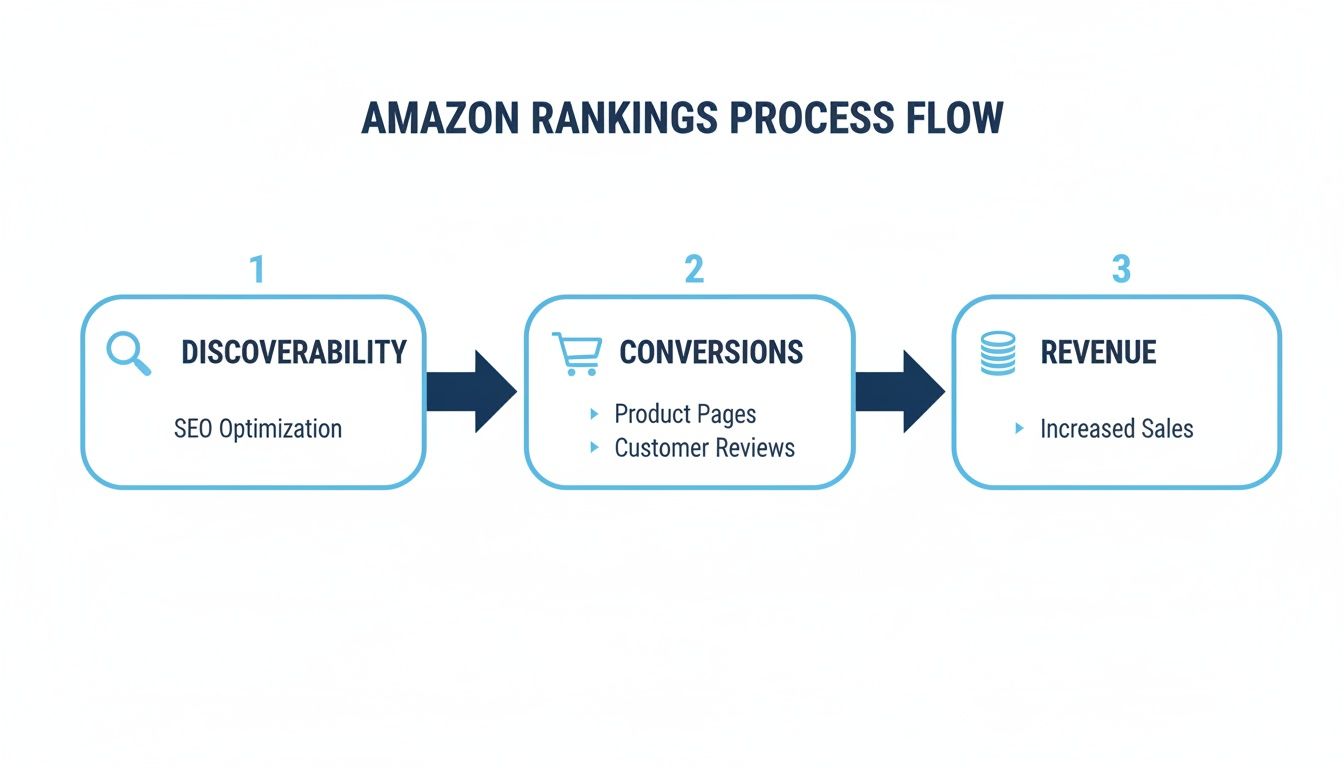
As you can see, discoverability—powered by smart keyword research—is the first domino to fall. It’s what makes conversions and revenue possible.
Prioritising Keywords by Intent and Volume
Not all keywords are created equal. Your research will spit out a mix of broad, high-volume terms and super-specific, lower-volume long-tail keywords. A balanced strategy needs both.
- High-Volume (Broad Keywords): Think “yoga mat.” These get tons of searches but are fiercely competitive. The shopper’s intent is also quite vague, which often leads to lower conversion rates.
- Medium-Volume (Specific Keywords): Now we’re talking “black yoga mat” or “travel yoga mat.” The intent is clearer, and the competition is a bit more manageable.
- Low-Volume (Long-Tail Keywords): This is where you find the gold. Phrases like “extra long cork yoga mat for tall men” might not get many searches, but the person typing it knows exactly what they want. The purchase intent is sky-high.
Your keyword list needs a healthy mix of all three types. Broad terms get you indexed and boost general visibility, but it’s the long-tail keywords that will drive your highest conversion rates and form the backbone of a profitable Amazon PPC strategy. This foundational research is what separates the listings that just exist from the ones that truly dominate their category.
Right then, you’ve done the hard graft with your keyword research. Now for the fun part: turning all that data into a product listing that actually sells. It’s time to create a listing that doesn’t just get clicks but convinces shoppers to hit that “Add to Basket” button.
Think of your listing as your best salesperson, working 24/7. It needs to be sharp, persuasive, and look the part. Every single element, from the title down to the last image, has a job to do. Too many sellers just dump keywords into their listing and hope for the best. That’s a huge mistake. You need to craft each section to answer customer questions and build trust, which is exactly what tells Amazon’s A10 algorithm that your product is worth showing.

Craft a Title That Wins the Click
Let’s be clear: your product title is the most important bit of text on your entire listing. It’s the first thing anyone sees in the search results and it carries the most weight for keyword rankings. The real skill is packing it with relevant keywords without it sounding like a robot wrote it.
And this is more critical than ever. In the UK, over 80% of Amazon shoppers are now browsing on their phones. This means you have to think mobile-first. Keep your titles under 80 characters so they don’t get cut off on small screens. Get this right, and you can see your click-through rates (CTR) jump by up to 30%.
A solid title formula usually looks something like this:
- Brand Name: Always lead with your brand. Build that recognition from day one.
- Main Keyword: Get your most important search term in straight away.
- Key Benefit/Feature: What’s the number one reason someone should buy your product?
- Important Spec: Add a key detail like size, quantity, or what it’s made of.
For example, don’t just write:
Before: Yoga Mat
Instead, make it work for you:
After: ZenGrip Pro Non-Slip TPE Yoga Mat | 6mm Thick for Extra Cushioning | Eco-Friendly with Carry Strap
See the difference? The second one is packed with info, hits multiple keywords naturally, and answers questions before the shopper even has to click.
Write Bullet Points That Sell Benefits, Not Features (Amazon Search Optimisation)
Those five bullet points are your sales pitch. Shoppers scan them to figure out if your product is what they’re looking for. The biggest mistake I see sellers make is just listing features. Nobody cares about features; they care about what those features do for them.
A feature is what your product is (e.g., “10,000mAh battery”). A benefit is what it does for the customer (e.g., “Charge your phone three times on a single charge, so you’re never caught out with a dead battery again.”).
Structure each bullet to answer a question or tackle a potential doubt. A great tip is to start each point with an all-caps, benefit-focused phrase. It makes them super scannable. This simple tweak is a brilliant tactic for improving ecommerce conversion rates.
Let’s say you’re selling a waterproof jacket:
- DON’T: Made with HydroGuard fabric.
- DO: STAY COMPLETELY DRY: Features advanced HydroGuard technology with taped seams, guaranteeing you stay protected and comfortable even in the heaviest downpour.
Leverage Backend Search Terms for Hidden Visibility
Your backend search term field is your secret weapon for Amazon search optimisation. You get a 250-byte field that’s totally invisible to customers but fully indexed by Amazon. It’s the perfect spot to put all those keywords that you couldn’t squeeze into your title or bullet points.
Make sure you use this space properly:
- No commas: Just use a single space between words.
- No repeats: Don’t waste space on keywords already in your title or bullets.
- Add synonyms: Chuck in alternative terms like “power bank” and “portable charger”.
- Include common misspellings: People make typos! Capture that traffic.
- Use Spanish terms: If you’re selling in a market like the US, adding Spanish keywords can be a game-changer.
This little field helps you cast a much wider net without making your customer-facing copy look spammy.
Make Your Visuals Your Top Conversion Tool (Amazon Search Optimisation)
Online, your product images are everything. Simple as that. People can’t pick up your product, so your photos and videos have to do all the work. High-quality visuals aren’t a ‘nice-to-have’; they directly impact your sales.
Data shows that listings using Mobile Ready Hero Images (MRHI) get 25% higher CTRs. An MRHI is designed to be crystal clear and compelling on a tiny phone screen, often using minimal text to highlight a key benefit. It’s a must.
Your image set should tell a story:
- Main/Hero Image: A perfect, clean shot of your product on a pure white background. No exceptions.
- Infographics: Use text and icons to call out key features and, more importantly, benefits.
- Lifestyle Shots: Show real people using and enjoying your product. Help the customer picture it in their own life.
- Comparison Chart: How does your product stack up against competitors or other models you sell?
- Instructional Image: Show how to use it or include a diagram with dimensions.
- Product Video: A short, punchy video showing the product in action is one of the most powerful conversion tools you have.
When you nail every part of your listing—from a mobile-friendly title to benefit-driven images—you create a powerful, persuasive page that works for both the A10 algorithm and your customers.
Amazon Search Optimisation: Driving Sales Velocity to Boost Your Ranking
If keywords get your product seen, it’s your sales velocity that convinces Amazon’s algorithm it deserves to stay at the top. Think of it as the speed and volume of your sales over time—it’s arguably the single most powerful factor in your organic ranking.
It all boils down to a simple, powerful feedback loop: consistent sales lead to better rankings, and better rankings lead to even more sales.
Your mission is to kickstart this cycle. A product that sells well signals to Amazon that it’s a winner. It’s satisfying customers and, crucially, making Amazon money. That’s a product the algorithm wants to show to more people. The strategies that follow are all designed to get this sales momentum building from day one.

The Power of Competitive Pricing
Price is a massive lever for conversions and, by extension, your sales velocity. It’s not about a race to the bottom, but about being priced competitively within your product’s perceived value range. Price it too high, and your conversion rate will die a slow death. Price it too low, and you’ll not only kill your profit margins but might also signal poor quality to shoppers.
Here’s how to find that sweet spot:
- Analyse the Competition: Take a hard look at the top 5-10 sellers for your main keyword. What’s their price range? Where does your product’s quality and feature set fit into that spectrum? Be honest with yourself.
- Test and Measure: Don’t be afraid to experiment. A small price adjustment, even just 50p, can have a surprising impact on your conversion rate. Run a new price for a week, track your unit session percentage like a hawk, and then adjust again.
- Use Coupons and Promotions: A limited-time deal or a small coupon is a fantastic way to engineer a surge in sales. This quick burst of velocity can give your listing a significant, albeit temporary, ranking boost.
Harnessing Social Proof with Customer Reviews (Amazon Search Optimisation)
Reviews are the digital equivalent of word-of-mouth, and they are absolutely critical for building the trust needed to close a sale. A listing with zero or very few reviews just feels risky to a potential buyer. For any new product, your first goal should be to secure those initial, crucial reviews as ethically and quickly as possible.
Amazon’s A10 algorithm in the UK heavily prioritises sales velocity and conversion rates. We’ve seen that listings with strong sales momentum climb rankings faster, with recent seller stats showing top UK performers gaining a 35% organic traffic uplift from velocity alone. It’s also worth noting that UK sellers who include video reviews report 28% better engagement—proof of the power of authentic social proof. You can dig deeper into these insights on Amazon’s ranking factors.
Getting your first 5-10 reviews is a critical milestone. This is often the tipping point where shoppers start seeing your product as a credible option, dramatically improving your conversion rate and fuelling that all-important sales velocity.
To get the ball rolling, consider enrolling in the Amazon Vine programme. It allows you to give free units of your product to a select group of trusted reviewers, helping you build a base of credible feedback right out of the gate.
Generating Recurring Revenue with Subscribe and Save
For any consumable product, Amazon’s Subscribe & Save (S&S) programme is an absolute goldmine for building consistent, predictable sales velocity. By offering a small discount for repeat purchases, you lock in future sales, creating a stable revenue stream that the algorithm absolutely loves.
This strategy is especially powerful because it builds a loyal customer base. For many consumable goods, S&S has been shown to drive 30% repeat buys. Each subscriber is a guaranteed sale every month or two, which smooths out your sales data and provides a consistent signal to Amazon that your product is in demand. For any replenishable item, it’s a foundational piece of a long-term amazon search optimisation plan.
Amazon Search Optimisation: Integrating PPC to Amplify Your Organic Reach
Thinking of Amazon Pay-Per-Click (PPC) as just another advertising cost is a massive mistake in modern Amazon search optimisation. The truth is, it’s one of the most powerful data-gathering tools you have and a direct feedback loop to the A10 algorithm. It’s the accelerator for your entire organic strategy.
The relationship between paid and organic results on Amazon is incredibly symbiotic. Every time you make a sale through a sponsored ad, it’s not just logged as a paid conversion. That sale feeds directly into your product’s overall sales history and velocity—two of the most critical factors for organic ranking.
In short, you’re paying to give the algorithm the exact proof it’s looking for. You’re showing it that your listing converts for specific keywords, which gives Amazon the confidence to start ranking you higher organically for those same terms.
Kickstart Sales Velocity for New Launches
Launching a new product presents a classic chicken-and-egg scenario. You need sales to rank organically, but you need to rank to get sales. This is exactly where a well-aimed PPC campaign becomes your best friend.
For a product with zero sales history, an aggressive sponsored ad campaign is the quickest way to get those first vital sales in the door. This initial burst of paid sales builds the foundation of your sales velocity, proving to the A10 algorithm that your product is a serious contender right from day one.
Think of your launch PPC budget not just as ad spend, but as an investment in your organic ranking. The initial sales it generates are the fuel that ignites the organic flywheel, creating momentum that can last for months.
This approach is especially effective for breaking out of the dreaded “sales sandbox” where new products often get stuck. It’s about manufacturing momentum until your organic visibility can take over. If you’re just starting out, getting your head around a foundational guide on Amazon Pay-Per-Click advertising will give you the essential knowledge to get going.
Uncover Keywords That Actually Convert (Amazon Search Optimisation)
Keyword research is a fantastic starting point, but it’s all theory. A PPC campaign gives you undeniable proof of what actually works in the real world. By running automatic and manual campaigns, you can harvest real-world search term data directly from your target customers.
The “Search Term Report” inside your advertising console is an absolute goldmine. It shows you the exact phrases shoppers typed before they clicked and, more importantly, bought your product.
You’ll often discover:
- High-converting long-tail keywords you completely missed in your initial research.
- Unexpected customer phrasing and regional slang you’d never have thought of.
- Competitor brand names that shoppers are using to find products just like yours.
Once you spot a search term that consistently brings in sales via PPC, you should immediately work it into your listing’s title, bullet points, or backend search terms. This data-driven tactic refines your listing with keywords proven to convert, directly boosting your organic relevance and sales potential.
Protecting Your Brand and Conquering Competitors
A solid Amazon search optimisation plan isn’t just about attacking; it’s also about defence. If you aren’t running ads on your own brand name, you can bet your competitors are. A simple branded campaign is a cheap, high-reward strategy to protect your digital shelf space and make sure customers looking for you actually find you first.
Beyond defence, you can go on the offensive with Product Targeting Ads to show up directly on your competitors’ listings. This is a brilliant way to capture market share from shoppers who are just about to buy from a rival. You can target specific ASINs, categories, or even entire brands, putting your product in front of highly qualified buyers at the perfect moment.
This is more important than ever. AI-driven changes in Amazon UK advertising are pushing costs up for sellers who aren’t prepared, with CPCs rising by 25%. However, UK brands that cleverly blend PPC with strong organic SEO can fight back. A properly optimised listing can bring your Advertising Cost of Sales (ACoS) down to under 20%, while backend terms discovered from ad reports can recapture 18% of lost traffic. In stark contrast, unoptimised titles that ignore new AI chat features like Rufus risk a visibility drop of as much as 40%.
Got Questions About Amazon Search Optimisation?
Diving into Amazon SEO always brings up a few common sticking points. Let’s tackle some of the most frequent questions sellers have, cutting through the noise to give you some straight answers.
How Long Does It Take to See Results From Amazon SEO?
This is the big one, isn’t it? The short answer: it’s not overnight. While you might see some early glimmers of movement in your keyword rankings within a few weeks, don’t expect the floodgates to open immediately.
Real, stable improvements usually take around 2-3 months to properly bed in. Why the wait? Because Amazon’s A10 algorithm doesn’t just care about your keywords; it heavily weights your sales history and conversion data, which obviously takes time to build up.
Consistency is your best friend here. A solid product launch—one that combines a fully optimised listing with a smart PPC push and a few early reviews—is the best way to kickstart that positive momentum. From there, it’s all about letting that snowball build on itself.
Should I Use the Same Keywords Everywhere in My Listing?
Absolutely not. In fact, you should actively avoid it. Repeating the same keyword over and over again is an old-school tactic that just doesn’t work anymore.
Amazon’s algorithm is clever; it indexes your listing for a keyword the first time it sees it in a relevant field. Stuffing it in multiple times gives you zero extra credit and, worse, it makes your listing read like it was written by a robot. That’s a massive turn-off for actual human shoppers.
A much better way to think about it is “keyword mapping”:
- Title: This is prime real estate. Put your single most important, highest-volume keyword phrase right here.
- Bullet Points & Description: Naturally weave in your secondary keywords, synonyms, and important long-tail variations. Focus on benefits, not just features.
- Backend Search Terms: This is your secret weapon. Use this space for anything you couldn’t fit in the front-end, like common misspellings, competitor brand names, or related terms that would sound clunky in your customer-facing copy.
Does Product Price Affect My Amazon Search Ranking?
Yes, massively. Price is a huge ranking factor because it has a direct, unavoidable impact on your conversion rate—and Amazon obsesses over conversion rates.
Think about it from a shopper’s perspective. If your product is priced way above similar, well-reviewed competitors, they’re just not going to buy it. A low conversion rate sends a powerful signal to the A10 algorithm that your offer isn’t compelling, and your rankings will take a hit.
A competitive price, especially when paired with strong reviews and the promise of fast FBA shipping, is a potent formula for winning the Buy Box. Securing the Buy Box is a direct driver of sales velocity, which in turn fuels your organic ranking. It’s all connected.
What Is the Biggest Mistake Sellers Make With Amazon SEO?
Without a doubt, the single biggest mistake is having a ‘set it and forget it’ attitude. Amazon search optimisation is not a one-and-done task you can just tick off your to-do list. The marketplace is a living, breathing thing.
Your competitors are constantly tweaking their prices and keyword strategies. Customer search habits change. New trends emerge. And most importantly, Amazon is always tinkering with its algorithm.
To win, you have to stay in the game. That means regular listing audits, keeping a close eye on your keyword rankings, and, crucially, using the data from your PPC campaigns to inform and refine your organic strategy. Success on Amazon is a marathon, not a sprint.
Ready to stop guessing and start winning with a data-driven approach to your advertising? The team at PPC Geeks offers a free, in-depth audit to uncover hidden opportunities in your campaigns. Get your tailored strategy by visiting https://ppcgeeks.co.uk.
Author

Search Blog
Free PPC Audit
Subscribe to our Newsletter

The Voices of Our Success: Your Words, Our Pride
Don't just take our word for it. With over 100+ five-star reviews, we let our work-and our satisfied clients-speak for us.

"We have been working with PPC Geeks for around 6 months and have found Mark and the team to be very impressive. Having worked with a few companies in this and similar sectors, I rate PPC Geeks as the strongest I have come across. They have taken time to understand our business, our market and competitors and supported us to devise a strategy to generate business. I value the expertise Mark and his team provide and trust them to make the best recommendations for the long-term."
~ Just Go, Alasdair Anderson