




It’s a phrase I hear all the time in building supplies marketing: “just get us more leads.” On the surface, it makes perfect sense. More leads should mean more sales, and more sales mean more growth. Simple, right?
The problem is, this mindset mistakes activity for achievement. Chasing volume often means you end up attracting low-quality enquiries from price shoppers and DIYers. You burn through your marketing budget, deliver minimal return, and completely exhaust your sales team.
True growth comes from attracting high-value trade accounts, not just filling a spreadsheet with names.
Building Supplies Marketing: The Hidden Cost of Chasing More Leads in Construction

This whole “more leads” philosophy is a dangerous oversimplification, especially in the construction industry. It’s like casting a massive, wide-meshed net into the ocean. Sure, you’ll haul in a huge amount of something, but you’ll quickly find it’s mostly filled with debris and tiny fish you have to throw back.
The valuable, profitable catches—the ones that actually sustain your business—are few and far between. You’re working harder, but you’re not catching more of what matters.
The Volume Fallacy in a Competitive Market
The UK building supplies sector is a tough place to be right now. With intense competition and the number of wholesalers shrinking by 0.6% each year between 2020 and 2025, every marketing pound has to count. Yet, the “more leads” approach encourages the exact opposite: indiscriminate, wasteful spending.
When businesses flood platforms like Google Ads with broad, generic keywords, they inevitably attract the wrong crowd. This creates a domino effect of problems:
- Wasted Ad Spend: A huge chunk of the budget gets burned on clicks from people with zero commercial intent. Our own audits consistently show that up to 70% of ad spend can be wasted on these irrelevant searches.
- Strained Sales Teams: Your sales pros end up wasting their time chasing down enquiries from tyre-kickers and one-off price shoppers. That’s time they could have spent nurturing relationships with high-potential trade accounts.
- Stagnant Growth: The sales pipeline looks busy, but conversion rates are flat and average order values aren’t growing. The business is spinning its wheels, working harder but not smarter.
To really nail this down, let’s compare the two mindsets. The table below breaks down the common ‘volume’ approach versus a more strategic, quality-focused reality.
The Volume Fallacy vs The Quality Reality (Building Supplies Marketing)
| Metric | The ‘More Leads’ Fallacy (Common Approach) | The Quality Reality (Strategic Approach) |
|---|---|---|
| Primary Goal | Maximise the number of enquiries, regardless of source. | Attract high-value, pre-qualified trade leads. |
| Audience Targeting | Broad and generic to capture the largest possible audience. | Niche and specific, focused on contractors and businesses. |
| Typical Outcome | High volume of low-quality leads, low conversion rates. | Lower volume of high-quality leads, higher conversion rates. |
| Sales Team Impact | Overwhelmed with unqualified leads, low morale. | Empowered with promising prospects, higher morale. |
| Budget Efficiency | High ad spend with poor ROI, significant waste. | Efficient ad spend with strong ROI, minimal waste. |
| Business Growth | Busy but stagnant, struggles to build repeat business. | Sustainable growth driven by valuable, long-term customers. |
Seeing it laid out like this really highlights the difference. One path leads to a hamster wheel of activity, while the other builds a real foundation for growth.
The real objective isn’t merely to fill the top of your sales funnel. It’s to attract high-intent, high-value customers who convert into profitable, long-term trade relationships.
This basic misunderstanding of marketing’s role creates a frustrating cycle of high costs and poor results. By focusing on volume, you’re not just spending money inefficiently; you’re actively undermining your ability to land the very customers who will drive sustainable growth. If you want to dig deeper into the numbers, you can explore our guide on how trade suppliers should track PPC ROI.
In the next sections, we’ll diagnose exactly where this strategy goes wrong and give you a clear, profitable path forward.
Building Supplies Marketing: Why Your Lead Funnel Is Leaking Profit
Chasing more leads is like trying to fill a bucket with a massive hole in the bottom. You can pour water in all day, but you’ll never fill it up. The problem isn’t the amount of water; it’s the bucket itself. Your marketing funnel works the same way, and the relentless pursuit of “more leads” often means ignoring the gaping holes where your profit is draining away.
To fix this, you first need to find the leaks. In the world of building supplies, these leaks almost always fall into four distinct categories. Each one is a classic symptom of the volume-first approach, turning your marketing budget into wasted spend instead of a growth engine.
Leak 1: You Are Attracting The Wrong Audience
The most common and costly leak? Attracting the wrong type of customer. A timber merchant, for example, builds their business on bulk orders from contractors and developers, not on selling a few fence posts to a weekend DIY enthusiast. Yet, broad, untargeted PPC campaigns often attract exactly that—the general public.
This mismatch creates a cascade of problems:
- Wasted Sales Time: Your team ends up spending hours fielding calls and preparing quotes for small, one-off projects with razor-thin margins.
- Inefficient Ad Spend: Every click from a DIYer is a click that should have come from a high-value trade account. You’re literally paying to speak to the wrong people.
- Brand Misalignment: Constantly dealing with retail enquiries can dilute your brand positioning as a serious, trade-focused supplier.
Spotting this leak is the first step toward plugging it. Your marketing should be a magnet for professionals, not a catch-all net for anyone with a passing interest in construction.
Leak 2: Your Lead Quality Is Catastrophically Low (Building Supplies Marketing)
Even when you attract people who seem like potential customers, a volume-based strategy often delivers leads with zero genuine intent to buy. These are the price-shoppers, the information-gatherers, and the time-wasters who clog up your sales pipeline. This issue has become particularly severe in the current economic climate.
Since 2020, building material prices have shot up by 38%, with some materials like insulators climbing over 63%. This price sensitivity means that campaigns promising sheer volume often attract prospects who immediately ghost you the second they see a quote. Our own internal audits show that 50-65% of ‘leads’ from poorly managed, broad-match ad campaigns have no real intention of buying, inflating your costs while projects are delayed by high interest rates. You can find out more about how material prices are impacting the industry on cladco.co.uk.
A lead isn’t a lead until they have a genuine need, the budget to fulfil it, and the authority to make a purchase. Anything less is just noise.
This low-quality traffic is a direct result of casting the net too wide. You end up with a full inbox but an empty order book—a classic symptom of a broken lead generation process.
Leak 3: You Cannot Attribute Sales To Marketing
Another critical leak is the inability to connect a sale back to the specific marketing effort that generated it. A builders’ merchant might run ads on Google, Facebook, and a trade publication, but if a new customer calls, how do you know which channel actually worked?
Without proper attribution, you’re flying blind. You could be pouring money into a campaign that generates hundreds of clicks but zero actual sales, while cutting the budget on a less flashy channel that consistently delivers your best customers. This lack of data makes optimising your marketing spend impossible. It’s a huge reason why many Google Ads campaigns fail for building suppliers.
Leak 4: Your Sales Process Is Broken (Building Supplies Marketing)
Finally, even a high-quality, perfectly attributed lead is worthless if your internal process fails to convert it. This is where marketing and sales must work in perfect harmony, but it’s often where the baton gets dropped.
Some of the most common failures we see in the sales process include:
- Slow Follow-Up Times: In the fast-paced construction world, a contractor needing an urgent quote will go to the supplier who responds first. Simple as that.
- Lack of Lead Nurturing: Not every lead is ready to buy today. Without a system to follow up and build a relationship, promising future customers are simply forgotten.
- Inconsistent Communication: If your sales team doesn’t have the right information from marketing, they can’t tailor their approach effectively and the whole thing falls apart.
A leaky sales process means you’re losing customers you’ve already paid good money to attract. It’s the final, and often most frustrating, hole in the bucket.
Building Supplies Marketing: Shifting From Vanity Metrics To KPIs That Matter
Once you’ve identified where your funnel is leaking, the fix becomes obvious. It’s not about just pouring more leads into a broken system; it’s about plugging the holes and focusing on what you actually keep. This means a fundamental shift away from feel-good “vanity metrics” and towards Key Performance Indicators (KPIs) that are directly wired to your bottom line.
For far too long, the building supplies industry has been obsessed with numbers like total leads or Cost Per Lead (CPL). While these figures might look impressive on a report, they don’t tell you a thing about the actual health of your business. A rock-bottom CPL is completely worthless if none of those leads ever turn into paying customers.
Real success is measured in outcomes, not just activity. This is where many businesses go wrong, funnelling good money after bad leads, which inevitably drains their profits.
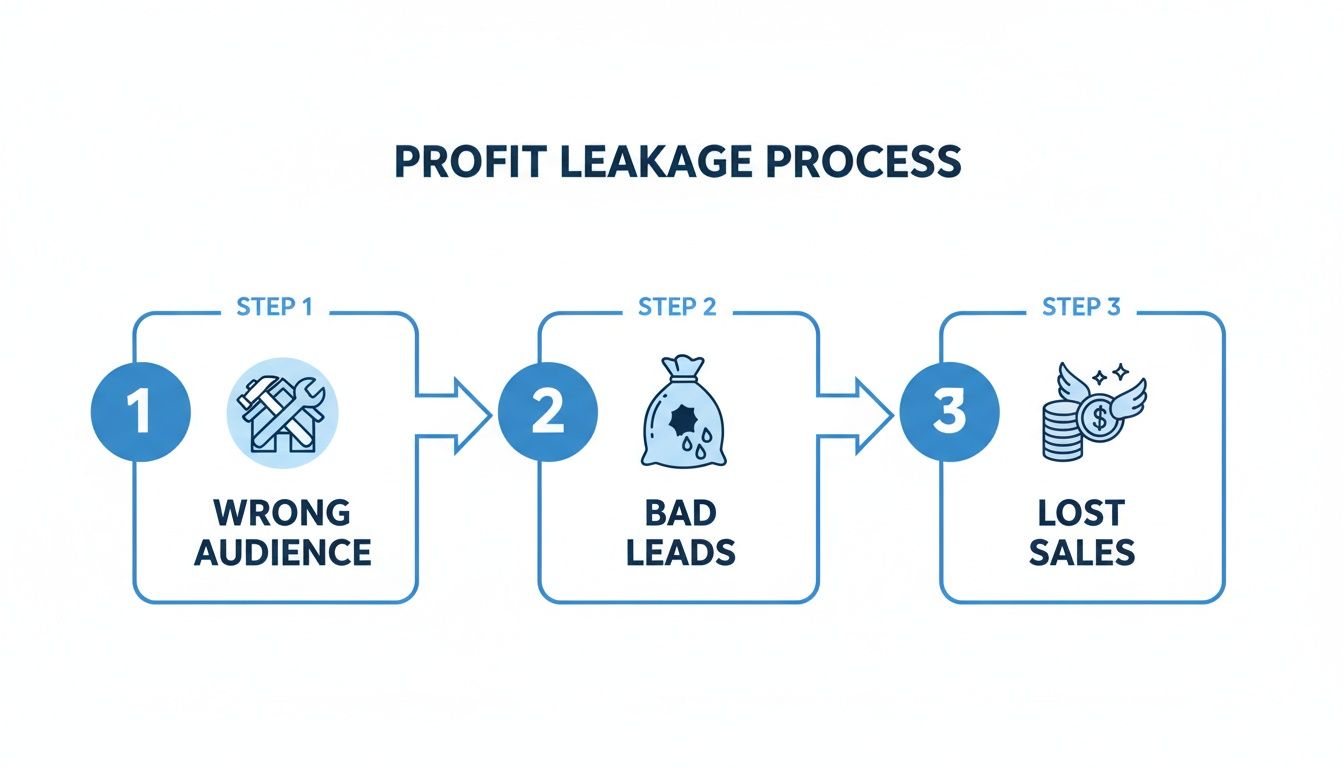
As you can see, casting too wide a net inevitably pulls in bad leads. That waste of time and resources translates directly into lost sales and a blown marketing budget.
From MQLs To SQLs
The first step in making this change is to get serious about qualifying your leads. Not all enquiries are created equal, and your marketing needs to reflect that reality. We have to draw a clear line between someone just browsing and someone with genuine buying intent.
This is where the distinction between Marketing Qualified Leads (MQLs) and Sales Qualified Leads (SQLs) becomes critical.
-
Marketing Qualified Lead (MQL): Think of an MQL as someone who’s raised their hand to show interest but isn’t ready for a sales call just yet. They might have downloaded a product guide or signed up for your newsletter. They’re curious, but still kicking tyres.
-
Sales Qualified Lead (SQL): An SQL is a different beast entirely. This is a lead that’s been properly vetted and is ready for a direct follow-up from your sales team. They’ve filled out a detailed project quote form or applied for a trade account, signalling a clear, immediate need.
By tracking the conversion rate from MQL to SQL, you get a powerful, unfiltered look at the quality of your campaigns. A huge pile of MQLs that produces only a trickle of SQLs is a massive red flag; it tells you your message is attracting the wrong crowd.
The True Cost of a Customer: CPA (Building Supplies Marketing)
With a qualified lead in hand, the next metric to obsess over is Cost Per Acquisition (CPA), not Cost Per Lead. CPA tells you the total cost to win a new paying customer, giving you a much truer picture of your marketing’s efficiency.
Imagine you spend £1,000 on a Google Ads campaign and get 100 leads. Your CPL is a lovely £10. Fantastic, right? But what if only two of those leads actually become customers? Suddenly, your CPA is a far more sobering £500.
Focusing on CPA forces you to connect marketing spend directly to revenue. It answers the most important question: “How much did we pay to win this new account?” This shift is fundamental to solving the problem with “more leads” in building supplies marketing.
This one metric can completely re-engineer your strategy, forcing you to optimise for quality conversions, not just cheap clicks and form fills.
Measuring Long-Term Profit with LTV
The final piece of the puzzle, and arguably the most important, is Customer Lifetime Value (LTV). In the building supplies trade, success isn’t built on one-off sales; it’s built on repeat business and long-term relationships. LTV calculates the total profit you can expect from a single customer account over its entire lifespan with you.
Just think about these two different customers:
- A one-off DIYer who spends £200 on decking for a garden project and you never see them again. Their LTV is £200.
- A local contractor who opens a trade account and spends an average of £5,000 a year for the next ten years. Their LTV is a whopping £50,000.
It’s a no-brainer which customer is more valuable. By calculating and focusing on LTV, you can justify spending more to acquire those high-value trade accounts, because you know the long-term payoff is monumental. It aligns your marketing goals with your business’s core objective: creating sustainable, long-term profit.
Building Supplies Marketing: Actionable PPC Strategies to Attract High-Quality Trade Leads

Making the leap from chasing more leads to attracting better leads isn’t just a change in mindset. It demands a real tactical shift in your paid advertising. Pouring money into broad, untargeted campaigns is the fastest way to fill your pipeline with low-value enquiries that go nowhere.
To pull in those profitable trade accounts, your Pay-Per-Click (PPC) strategy needs to be sharp, deliberate, and built for quality from the very beginning.
These aren’t just theories; they’re practical, hands-on adjustments you can make to your campaigns right now. The goal is simple: make every click count by ensuring the person on the other end is your ideal customer.
Build a Rock-Solid Negative Keyword List
Your negative keyword list is probably the most powerful tool you have for filtering out unwanted traffic. Think of it as your first line of defence against wasting your ad spend on clicks from DIY enthusiasts, students, and pure bargain hunters. Your list acts as a bouncer for your ads, turning away anyone who doesn’t fit the bill.
Start thinking about the search terms that scream “non-commercial” or “retail”. Your initial list should definitely include terms like:
- DIY-related queries: “-how to”, “-DIY”, “-guide”, “-tutorial”, “-cheap”
- Job-seeking terms: “-jobs”, “-careers”, “-salary”, “-hiring”
- Small-scale projects: “-garden fence”, “-small project”, “-for home”
A well-maintained negative keyword list isn’t a “set it and forget it” job; it’s an ongoing process. You need to be regularly digging into your search term reports to find and exclude new, irrelevant queries that are triggering your ads. This single action can dramatically improve your lead quality by funnelling your budget towards searches with genuine commercial intent.
Write Ad Copy That Speaks to the Trade (Building Supplies Marketing)
Your ad copy is your digital shopfront sign. It needs to instantly signal to trade professionals that you’re their dedicated supplier, while actively putting off the general public. Generic messaging gets you a generic audience. It’s as simple as that.
Fix this by tailoring your headlines and descriptions to the specific needs and priorities of contractors, developers, and builders.
Your ad copy should function as a qualification tool. Use language that resonates with a professional audience and highlights value propositions that a DIYer wouldn’t care about, instantly filtering your clicks.
Weave in offers and language that speak directly to how they run their business:
- “Bulk Discounts on Timber & Aggregates”
- “Apply for a Trade Credit Account Today”
- “Guaranteed Next-Day Site Delivery”
- “Dedicated Account Managers for Your Projects”
This kind of trade-specific language doesn’t just attract the right people; it pre-qualifies them before they even click. A weekend DIYer has no need for a trade credit account, so they’re far less likely to click, saving you money and boosting your click-through rate among genuine prospects. You can find more ideas in our guide to driving higher order values for building suppliers.
Use Geotargeting and Audience Signals
Stop wasting money advertising to people you can’t even serve. Get precise with your geotargeting to focus your budget exclusively on the postcodes, cities, or regions that are most profitable for your business. Layer this with radius targeting around your physical branches to capture local, high-intent customers who are ready to buy.
If you’re running more advanced campaigns like Performance Max, you need to feed the algorithm high-quality audience signals. Don’t let it guess who your customers are. Give it lists of your best past customers or website visitors who have looked at trade-specific pages. This tells the system exactly what a high-value lead looks like, so it can go out and find more people just like them.
Nailing these targeting methods is crucial, especially in a volatile market. UK building supplies firms often get stuck on the ‘more leads’ treadmill and ignore how fragile the sector can be. Market fluctuations can make most of your enquiries worthless overnight. For instance, even with the odd surge in new orders, a drop in construction output like the 12.7% decrease seen in September 2025 versus the previous year means high-intent searches can dry up fast.
A generic approach typically wastes around 60% of its traffic on unqualified users, whereas targeted campaigns can deliver 35% higher conversions. This kind of data-driven strategy gives managers clear reporting and keeps the focus squarely on real ROI. You can learn more about UK construction and building materials statistics on GOV.UK.
Building Supplies Marketing: Optimising Your Website To Convert Better Leads
Driving high-quality traffic to your website is a great start, but it’s only half the battle. If your site isn’t actually built to turn that traffic into qualified enquiries, then all that effort and ad spend is going straight down the drain. Your website needs to be an efficient lead qualification machine, not just a digital brochure.
This is where Conversion Rate Optimisation (CRO) comes in. Think of it as the art and science of turning more of your website visitors into valuable leads. For building suppliers, this means creating a user experience that actively filters out the noise and guides genuine trade professionals towards taking that next step.
Create Dedicated Landing Pages for the Trade
One of the most common mistakes we see is sending all traffic—whether it’s from a trade-focused ad or a generic search—straight to the homepage. Your homepage has to serve everyone, which means it serves no one perfectly. A contractor after bulk pricing and credit terms has completely different needs to a DIYer looking for a single bag of cement.
A dedicated trade landing page cuts through all that clutter. It should speak directly to the professional, featuring things like:
- Trade-Specific Language: Use the terms they use every day, like “site delivery,” “bulk discounts,” and “project pricing.”
- Clear Value Propositions: Shout about the benefits that actually matter to them, such as dedicated account managers and next-day delivery.
- Targeted Calls-to-Action: Make the next step obvious and directly relevant to their needs.
This targeted approach immediately signals that you understand their business, making them far more likely to engage. For a deeper dive, check out our guide on creating a high-converting lead generation landing page.
Use Clear and Compelling Calls-to-Action (Building Supplies Marketing)
Your calls-to-action (CTAs) are the signposts on your website telling visitors what to do next. Vague, generic buttons like “Contact Us” or “Learn More” are massive missed opportunities. They lack any urgency and fail to communicate any real value.
Your CTAs should be direct, benefit-driven, and tailored to a trade audience. Ditch the weak CTAs and replace them with powerful alternatives:
- Instead of “Contact Us,” try “Request a Trade Quote.”
- Instead of “Submit,” use “Open a Trade Account.”
- Instead of “Learn More,” go with “Download Our Product Catalogue.”
Each of these examples clearly tells the user what they’ll get by clicking, which makes the action feel much more valuable and less of a commitment.
Build Trust and Pre-Qualify with Smart Forms
Trust is everything in the B2B world. Your website needs to establish credibility with professional buyers, and fast. Displaying logos of trade associations you belong to (like the Builders Merchants Federation) and showcasing testimonials from established construction firms are powerful trust signals.
Beyond just building trust, your lead capture forms are a critical tool for pre-qualifying enquiries. A simple form asking only for a name and email is an open invitation for spam and low-quality leads. An intelligent form, on the other hand, filters out the time-wasters.
For example, our own contact form asks specific questions to help us understand a prospect’s needs before we even pick up the phone.
Including fields like “Company Name” or “What service are you interested in?” immediately helps segment and qualify every single lead that comes in.
For a building supplier, you could add fields that only a legitimate business could answer, such as:
- Company Registration Number
- Project Type (e.g., New Build, Refurbishment)
- Estimated Project Value
These small changes transform your website from a passive brochure into an active part of your sales process, ensuring your team only spends time on the leads that truly matter.
Building Supplies Marketing: Your Quality-Over-Quantity Marketing Audit
Right, let’s get down to brass tacks. Moving from a “more leads is better” mindset to a quality-first strategy means taking an honest look at what you’re actually doing. This isn’t about ticking boxes; it’s a practical tool to help you spot exactly where the old habits are quietly costing you money.
Use this checklist to give your marketing and sales process a frank once-over. The simple yes/no questions will quickly shine a light on your biggest opportunities for improvement. It’s time to start building a lead generation engine that’s efficient and, most importantly, profitable.
PPC Campaign Audit
Your paid ads are often the number one culprit for a flood of low-quality leads. This is the first and most important place to look. A few smart tweaks here can make an immediate, noticeable difference to the quality of enquiries hitting your inbox.
- Negative Keywords: Do we have a robust, regularly updated negative keyword list? This is crucial for filtering out DIYers, job seekers, and tyre-kickers using terms like “-cheap,” “-how to,” or “-jobs”.
- Ad Copy: Is our ad copy speaking the right language? We should be using trade-specific terms and offers like “Trade Accounts,” “Bulk Discounts,” and “Site Delivery” to attract professionals and put off the general public.
- Geotargeting: Are our campaigns laser-focused on the specific postcodes and regions we can actually serve profitably? Or are we just throwing money away on vague, national targeting?
- Audience Signals: For automated campaigns like Performance Max, are we feeding the machine high-quality signals based on our best existing trade customers? Or are we letting it guess?
Website and Landing Page Audit (Building Supplies Marketing)
Once a potential trade customer clicks your ad, your website has to seal the deal. A generic, unfocused website experience will leak high-value leads just as fast as a badly targeted ad campaign.
Your website isn’t just a digital brochure; it’s an active qualification tool. Every element, from your forms to your CTAs, should work to separate the high-value trade leads from the low-value noise.
- Dedicated Pages: Are we sending all our trade-focused PPC traffic to a generic homepage, or do we have dedicated landing pages built specifically for them?
- Calls-to-Action (CTAs): Are our main buttons specific and action-oriented, like “Request a Trade Quote”? Or are they vague and uninspiring, like “Contact Us”?
- Lead Forms: Do our contact forms include fields that help us pre-qualify leads from the get-go? Think “Company Name” or “Project Type.”
Lead Management and Reporting Audit
Finally, how you handle and measure your leads is what makes or breaks the entire strategy. If your reports are still shouting about volume, that’s what your team will focus on.
- Reporting Focus: Do our marketing reports prioritise profit-driven KPIs like Cost Per Acquisition (CPA) and Customer Lifetime Value (LTV)? Or are we still obsessed with vanity metrics like Cost Per Lead (CPL)?
- Lead Routing: Is there a lightning-fast, crystal-clear process for getting qualified trade leads to the right salesperson for immediate follow-up? Or are they left to go cold?
Got Questions? We’ve Got Answers.
Switching from a ‘more is more’ mindset to a quality-first approach naturally brings up a few questions. We get it. Here are some of the most common ones we hear from building supplies businesses ready to make the change.
How Long Does It Take to See Better Quality Leads?
This isn’t an overnight fix, but you’ll see progress faster than you might think. Simple, sharp PPC changes—like building out a robust negative keyword list and tightening up your ad copy—can bring a noticeable improvement in lead quality within the first 30-60 days.
The bigger, more sustainable results come from things like improving your website’s conversion flow and tracking long-term metrics like LTV. These deeper changes typically bear fruit over 3-6 months. The key is consistency; this is a strategic shift, not a one-off campaign.
Is This Approach More Expensive?
At first glance, it might seem like focusing on quality will drive up your Cost Per Lead (CPL). After all, you’re narrowing your focus to a smaller, more specific audience. But that’s missing the forest for the trees. The real goal is to slash your Cost Per Acquisition (CPA)—what it actually costs you to land a new, paying customer.
Chasing cheap, low-quality leads always leads to a sky-high CPA because almost none of them ever convert. Investing a bit more to attract a high-intent trade lead almost always results in a much lower overall CPA and a far better return on your investment.
Put it this way: would you rather pay £10 for 10 leads that waste your sales team’s time, or £50 for one lead that turns into a £10,000 trade account? The maths speaks for itself.
Won’t I Miss Out on Potential Customers?
That’s a common fear, but it’s mostly unfounded. A quality-focused strategy isn’t about shutting the door on customers; it’s about prioritising the right customers for your business. The “more leads” approach often forces you to serve everyone poorly, stretching your sales team thin and watering down your brand.
By zeroing in on high-value trade accounts, you actually improve your ability to serve them brilliantly. This focus builds a rock-solid reputation in your target market, which in turn attracts more of the right kind of customers through referrals and word-of-mouth—the best leads you can possibly get.
Ready to stop wasting your budget on tyre-kickers and start attracting profitable trade accounts? The team at PPC Geeks builds high-performance PPC campaigns that deliver real-world results. Find out how we can help your building supplies business grow by visiting us at https://ppcgeeks.co.uk/.