
9 B2B PPC Metrics That Actually Matter for Growth in 2026

9 B2B PPC Metrics That Actually Matter for Growth in 2026: In the complex world of B2B marketing, a successful PPC campaign isn’t measured by surface-level stats like clicks or impressions alone. The typically long sales cycles, multiple decision-makers, and high-value contracts demand a far more sophisticated approach to measurement. Focusing on these vanity metrics can lead to wasted budgets, misaligned sales and marketing efforts, and fundamentally missed opportunities for scalable growth.
Instead, savvy B2B marketers must look deeper, tracking the performance indicators that directly connect advertising spend to genuine pipeline growth and tangible revenue. This requires a shift in mindset from simply generating traffic to generating high-quality leads that your sales team can convert into valuable, long-term customers. Understanding and optimising for the right metrics is the key to unlocking a truly profitable PPC strategy.
This guide is designed to cut through the noise. We will reveal the essential B2B PPC metrics that actually matter, moving beyond basic platform data to focus on what drives your business forward. For each metric, we’ll explore not just what it is, but how to calculate, track, and optimise it effectively. Whether you’re a marketing manager juggling complex campaigns or a business owner aiming to maximise your digital advertising ROI, mastering these metrics will empower you to make data-driven decisions that deliver a measurable and significant return on your investment.
1. B2B PPC Metrics: Cost Per Lead (CPL)
Cost Per Lead (CPL) is a foundational B2B PPC metric that measures the average cost to generate a single new lead from your paid campaigns. For businesses with long, complex sales cycles, CPL provides a clear, early indicator of campaign efficiency long before a final sale is made. It directly connects your advertising spend to tangible pipeline growth, making it an essential metric for justifying marketing budgets and assessing profitability.
Calculating CPL is straightforward: divide your total ad spend by the total number of leads generated within the same period. This simple formula provides a powerful snapshot of whether your campaigns are economically sustainable.
Why CPL is a Critical B2B Metric
In B2B, not every click translates into an immediate purchase. CPL acts as the primary gauge of your top-of-funnel performance. A high CPL might signal issues with ad copy, landing page experience, or audience targeting, allowing you to optimise before significant budget is wasted. Conversely, a low CPL indicates you are efficiently attracting potential customers, a key first step in a multi-touch sales journey. This makes CPL one of the most important B2B PPC metrics that actually matter for campaign health.
Real-World Example: A UK-based SaaS company was generating leads at a CPL of £45, which was eroding their profit margins. By refining their keyword strategy to focus on long-tail, high-intent terms and improving their landing page conversion flow, they successfully reduced their CPL to £28, significantly boosting their marketing ROI.
Actionable Tips for Managing CPL
- Establish a Baseline: Before launching, work with your sales team to define a maximum acceptable CPL based on your average deal value and lead-to-customer conversion rates.
- Segment Your Analysis: Don’t just track a single CPL. Break it down by campaign, ad group, and keyword to identify top performers and underachievers.
- Integrate with Your CRM: Connect your ad platforms to your CRM (like HubSpot or Salesforce). This allows you to track not just the initial lead, but also which leads become Marketing Qualified Leads (MQLs) and Sales Qualified Leads (SQLs), adding crucial quality context to your CPL data.
For a deeper dive into the specifics, you can explore this detailed guide on the cost per lead calculation. Monitoring and optimising your CPL is the first step towards building a truly profitable and scalable B2B advertising engine.
2. Quality Score
Quality Score is Google Ads’ diagnostic rating of the quality and relevance of your keywords and PPC ads, scored on a scale from 1 to 10. This metric directly influences your ad placement, cost per click (CPC), and overall campaign efficiency. For B2B advertisers, a higher Quality Score means you are rewarded with lower CPCs and better ad positions, making it a fundamental lever for maximising your advertising budget.
The score is a composite evaluation based on three key components: expected click-through rate (CTR), ad relevance, and landing page experience. In essence, it measures how well your entire user journey, from keyword to landing page, aligns with a searcher’s intent.

Why Quality Score is a Critical B2B Metric
In the competitive B2B landscape, every pound of ad spend must work as hard as possible. Quality Score is the key to unlocking cost efficiency and visibility. A low score forces you to pay a premium for ad placements, draining your budget, while a high score acts as a discount, allowing you to secure more impressions and clicks for less. This makes Quality Score one of the most impactful B2B PPC metrics that actually matter for achieving a sustainable ROI.
Real-World Example: A UK-based B2B technology firm saw its average Quality Score languishing at 5/10. By creating highly-specific ad groups and aligning landing page messaging precisely with ad copy, they lifted their average score to 9/10. This single focus reduced their average CPC by 35% and increased their lead volume by 20% without raising the budget.
Actionable Tips for Managing Quality Score (B2B PPC Metrics)
- Create Tightly-Themed Ad Groups: Avoid broad ad groups. Instead, group 10-15 closely related keywords into a single-theme ad group so you can write highly relevant ad copy.
- Match Your Messaging: Ensure the promise made in your ad copy is immediately fulfilled by the headline and content on your landing page. This direct alignment is crucial for ad relevance and landing page experience.
- Prioritise Page Speed: A slow-loading landing page is a primary cause of a poor user experience and a low Quality Score. Aim for a load time of under two seconds to keep both users and Google happy.
- Audit and Refresh Ad Copy: Continuously test and refine your ad copy to maintain a high expected CTR. What works today might not work tomorrow, so regular optimisation is key.
For a more comprehensive look, you can get more details on the Google Ads Quality Score. Proactively managing your Quality Score is essential for building an efficient, high-performing B2B PPC programme.
3. B2B PPC Metrics: Return on Ad Spend (ROAS) and Return on Investment (ROI) & Profit Margin Analysis
While CPL measures top-of-funnel efficiency, Return on Ad Spend (ROAS) and Return on Investment (ROI) connect your ad spend directly to revenue and profitability. ROAS measures the gross revenue generated for every pound spent on advertising, offering a clear view of campaign efficiency. However, a deeper analysis through ROI and profit margins is essential to understand true business impact, accounting for all costs beyond just ad spend.
These metrics move beyond lead generation to answer the ultimate question: is your advertising driving sustainable, profitable growth? For B2B companies, where the value of a customer is high but so are the costs of acquisition and service, this level of financial scrutiny is non-negotiable.

Why ROAS and ROI are Critical B2B Metrics
ROAS provides a direct measure of revenue generation from ad campaigns, making it a powerful metric for optimisation. However, B2B success is defined by profit, not just revenue. A 2.5:1 ROAS might seem positive, but if your total customer acquisition costs (including sales commissions and onboarding) and cost of goods sold are high, your ROI could be negative. Analysing ROAS, ROI, and profit margins together ensures your PPC campaigns are not just generating sales, but are fundamentally contributing to the company’s bottom line. This makes them crucial B2B PPC metrics that actually matter for long-term viability.
Real-World Example: A UK manufacturing supplier was allocating 60% of its PPC budget to high-volume, low-margin products. After conducting a profit margin analysis, they shifted the budget to focus on their high-margin product lines. This strategic change improved their overall campaign ROI from 3.2x to 4.1x without increasing ad spend.
Actionable Tips for Managing ROAS and ROI
- Set Margin-Based Targets: Define your target ROAS and minimum ROI thresholds based on your specific product margins and overall business profitability goals, not on industry averages.
- Implement Value Tracking: Use dynamic conversion value tracking in your ad platforms. This ensures your ROAS calculations are based on actual revenue data, not just conversion counts, allowing for more accurate optimisation.
- Calculate True ROI: Go beyond ad spend. Work with your finance and sales teams to include all customer acquisition costs, such as sales commissions, support, and fulfillment, in your ROI calculations. This gives you a complete picture of profitability.
Understanding the nuances of profitability is key to scaling effectively. For a comprehensive guide, you can learn more about how to calculate return on investment. This holistic financial view empowers you to make smarter budget allocation decisions that drive real business growth.
4. Click-Through Rate (CTR)
Click-Through Rate (CTR) is a fundamental PPC metric that measures the percentage of people who see your ad (impressions) and proceed to click on it. It’s calculated simply as (Total Clicks ÷ Total Impressions) × 100. While not a direct measure of profitability, CTR is a crucial diagnostic tool that indicates how compelling and relevant your ad messaging is to your target audience.
In B2B advertising, where the path to conversion is often long, CTR serves as a vital early warning system. It provides immediate feedback on ad relevance, creative effectiveness, and audience targeting quality, long before lead or sales data becomes available.
Why CTR is a Critical B2B Metric
CTR is a primary indicator of your ad’s resonance with your intended audience. A low CTR suggests a disconnect: your ad copy may not be addressing the right pain points, your offer might be unclear, or you could be targeting the wrong audience segment altogether. A high CTR, conversely, validates that your messaging is hitting the mark. This makes CTR one of the most important B2B PPC metrics that actually matter for diagnosing and optimising top-of-funnel campaign performance.
Real-World Example: An industrial manufacturing firm noticed their CTR was consistently below 1.5%. By systematically A/B testing ad headlines that focused on different value propositions, such as “ISO 9001 Certified” versus “24-Hour UK Support”, they identified the messaging that resonated most with procurement managers and improved their campaign CTR by over 40%.
Actionable Tips for Managing CTR (B2B PPC Metrics)
- Benchmark Realistically: Don’t compare your CTR to consumer-focused industries. Research B2B-specific benchmarks for your sector to set realistic performance expectations for platforms like Google Ads and LinkedIn.
- Systematic A/B Testing: Consistently test different elements of your ad copy. Pit benefit-focused headlines against feature-focused ones, test different Calls-To-Action (CTAs), and experiment with ad copy length to identify winning combinations.
- Leverage Ad Extensions: Maximise your ad’s screen real estate by using all relevant ad extensions. Sitelinks, callouts, and structured snippets provide more information and additional clickable elements, which naturally boosts CTR.
- Monitor Keyword Relevance: Ensure the keywords in your ad group are tightly themed. Including the primary keyword in your headline and description path improves relevance signals for both users and search engines, which is a key factor in improving your CTR.
5. B2B PPC Metrics: Conversion Rate (CR)
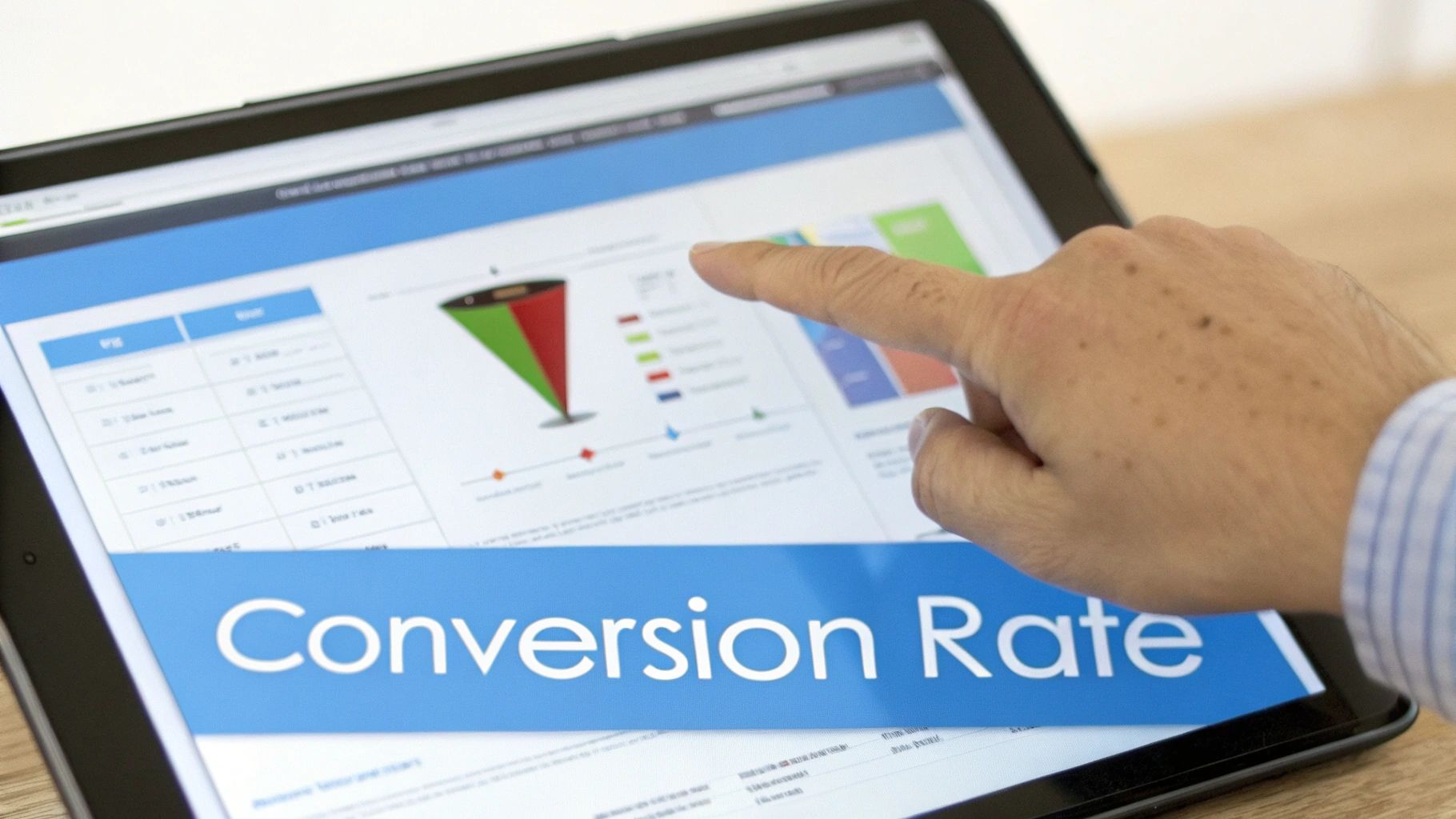
Conversion Rate (CR) measures the percentage of users who complete a desired action after clicking your ad, such as filling out a demo request, downloading a whitepaper, or signing up for a webinar. It is a direct indicator of how effectively your ad creative and landing pages persuade valuable prospects to take the next step. For B2B advertisers, CR is the engine that drives lead generation and is a critical component in calculating other vital metrics like CPL.
Calculating Conversion Rate is simple: divide the number of conversions by the total number of clicks and multiply by 100. This percentage reveals the efficiency of your funnel from click to conversion, providing a clear measure of your website’s performance.
Why CR is a Critical B2B Metric
In the B2B world, traffic is expensive and hard-won. A strong Conversion Rate ensures you are making the most of every click. A low CR can signal a disconnect between your ad message and your landing page, a poor user experience, or an unclear value proposition. Improving your CR is one of the most powerful levers you can pull to increase lead volume without increasing your ad spend, making it one of the most impactful B2B PPC metrics that actually matter.
Real-World Example: A professional services firm noticed their overall CR was healthy, but a deeper analysis revealed their mobile conversion rate was only 1.7%, compared to 4.1% on desktop. By implementing negative bid adjustments for mobile devices and creating a mobile-optimised landing page, they focused their budget on higher-converting desktop traffic, boosting lead quality and overall campaign ROI.
Actionable Tips for Managing CR
- Audit Your User Experience: Regularly review your landing pages for speed, mobile-friendliness, and clarity. Use heat mapping tools to identify where users are dropping off.
- Simplify Your Forms: Only ask for the essential information needed to qualify a lead. Test reducing the number of form fields to see if it reduces friction and lifts conversions.
- A/B Test Systematically: Continuously test elements like headlines, calls-to-action (CTAs), imagery, and page layouts. Small, incremental improvements can lead to significant gains over time.
- Align Ad and Landing Page Copy: Ensure your landing page headline and value proposition directly mirror the promise made in your ad copy. This creates a seamless and trustworthy user journey.
6. Cost Per Acquisition (CPA)
Cost Per Acquisition (CPA) measures the aggregate cost to acquire one new paying customer through your paid campaigns. While Cost Per Lead (CPL) is a crucial top-of-funnel indicator, CPA represents the ultimate bottom-line metric. It tells you exactly how much ad spend it takes to generate a closed deal, providing a definitive measure of campaign profitability.
The calculation is straightforward: divide your total advertising spend by the number of new customers acquired from those campaigns in a specific period. This figure directly ties your marketing budget to revenue generation, answering the critical question, “Are our PPC efforts profitable?”
Why CPA is a Critical B2B Metric
In the B2B world, generating a lead is only the beginning. The journey from lead to paying customer can be long and complex. CPA is the metric that validates your entire PPC and sales funnel, confirming that your investment is producing real business growth, not just a pipeline of unqualified leads. Tracking CPA is essential for making strategic decisions about budget allocation and scaling your most profitable campaigns, making it one of the most important B2B PPC metrics that actually matter.
Real-World Example: A UK-based managed services provider used CPA targets to guide their Google Ads bid strategy. By focusing on campaigns that consistently delivered a CPA below their £350 target and reallocating budget away from higher-CPA channels, they improved overall campaign profitability by 18% within a single quarter.
Actionable Tips for Managing CPA (B2B PPC Metrics)
- Implement Robust CRM Integration: A seamless connection between your ad platforms and CRM (like Salesforce or HubSpot) is non-negotiable. This is the only way to accurately track a user from their initial ad click all the way through to a closed-won deal.
- Account for Your Sales Cycle: B2B sales cycles can last months. When evaluating CPA, ensure your attribution window is long enough to capture conversions that occur 60, 90, or even 120 days after the initial click.
- Utilise Target CPA Bidding: Leverage automated bidding strategies in platforms like Google Ads. Setting a Target CPA tells the algorithm your desired cost per new customer, allowing it to optimise bids in real-time to achieve your profitability goal.
7. B2B PPC Metrics: Impression Share
Impression Share measures the percentage of total available impressions your ads received, calculated as your impressions divided by the total available impressions. In B2B, where niche audiences and specific keywords define the battleground, this metric reveals how often your brand appears relative to your total market opportunity. It provides a crucial lens on your visibility and competitive standing.
A low impression share can signal that your budget is too restrictive or your bids are not competitive enough, meaning you are missing out on valuable brand exposure to potential clients. Conversely, a high impression share indicates market dominance for your chosen keywords, putting your brand front and centre during the buyer’s research phase.
Why Impression Share is a Critical B2B Metric
While metrics like CPL and ROAS focus on efficiency, Impression Share is about market presence and growth potential. It answers the question: “How much of the conversation are we capturing?” Losing impression share on high-intent, branded, or bottom-of-funnel keywords means competitors are reaching your most valuable prospects before you do. Tracking this is essential for defending your brand and identifying opportunities to scale, making it one of the B2B PPC metrics that actually matter for strategic growth.
Real-World Example: A UK professional services firm noticed a declining lead volume despite a stable CPL. Upon analysis, they discovered their Impression Share on core service keywords had dropped from 80% to 55% over three months due to a new competitor aggressively bidding. By strategically increasing bids and adjusting their budget, they reclaimed their lost share and restored lead flow.
Actionable Tips for Managing Impression Share
- Segment Your Targets: Don’t aim for 100% everywhere. Prioritise a high impression share (90%+) on branded keywords, a competitive share (60-80%) on high-intent service keywords, and a more modest share on broader, top-of-funnel terms.
- Analyse “Lost IS (Budget)” vs. “Lost IS (Rank)”: Google Ads tells you why you’re losing impressions. If it’s due to budget, you have a clear case for increasing investment. If it’s due to rank, you need to improve your Quality Score or increase your bids.
- Monitor Competitor Performance: Use auction insights reports to see how your impression share stacks up against key competitors. This helps you understand the competitive landscape and react quickly to changes in their strategy.
Balancing Impression Share with profitability is key. It’s not about being seen everywhere, but about being seen where it counts most to protect and grow your market position.
8. Cost Per Click (CPC)
Cost Per Click (CPC) is the average amount you pay each time someone clicks your ad. While it may seem like a basic vanity metric, it is fundamental to budget management and efficiency in B2B PPC, directly impacting how many potential customers you can reach with a fixed budget. It provides an immediate pulse-check on the competitiveness of your target market and the efficiency of your ad setup.
Calculating CPC is simple: divide your total ad spend by the total number of clicks received in the same period. This figure helps you understand the cost of driving traffic and serves as a foundational component for more complex metrics like CPL and ROAS.
Why CPC is a Critical B2B Metric
In the B2B world, where keywords can be highly competitive and expensive, monitoring CPC is essential for maintaining profitability. A sudden spike in CPC can drain your budget without a corresponding increase in leads, signalling new competitor activity or a drop in your ad quality. Understanding and managing CPC allows you to control costs at the very top of the funnel, ensuring your budget is allocated effectively. This makes CPC one of the core B2B PPC metrics that actually matter for sustainable campaign performance.
Real-World Example: A UK-based professional services firm noticed their average CPC for key terms had climbed from £12 to over £18 in a single quarter, squeezing their lead volume. An audit revealed a declining Quality Score due to a slow landing page. By optimising page speed and mobile experience, they improved their Quality Score from 5/10 to 8/10, reducing their average CPC back to £13 and increasing clicks by 25% with the same budget.
Actionable Tips for Managing CPC (B2B PPC Metrics)
- Improve Your Quality Score: This is the most effective way to lower your CPC. Focus on ad relevance, expected click-through rate (CTR), and landing page experience.
- Refine Your Keyword Strategy: Use a mix of match types. While exact match can be expensive, broad and phrase match can help you discover lower-cost, high-intent keyword variations.
- Implement a Negative Keyword List: Regularly update your negative keyword list to prevent wasted spend on irrelevant searches that drive up costs without generating qualified traffic.
- Utilise Bid Adjustments: Set bid adjustments for high-performing locations, devices, and audiences to allocate your budget more efficiently towards clicks that are more likely to convert.
9. B2B PPC Metrics: Lead Quality Score and Sales Acceptance Rate (SAR)
Lead Quality Score and Sales Acceptance Rate (SAR) measure the calibre of leads your PPC campaigns generate and the percentage of those leads accepted by the sales team. Unlike raw lead volume, these metrics focus on alignment between marketing efforts and sales requirements. For B2B organisations with dedicated sales teams, this is crucial for proving marketing’s contribution to revenue and diagnosing problems early in the pipeline.
To calculate SAR, you divide the number of sales-accepted leads by the total number of leads generated and multiply by 100. This provides a clear percentage reflecting how many of your PPC-generated leads are deemed worthy of a sales follow-up, a crucial step in building an effective B2B lead engine with PPC.
Why SAR is a Critical B2B Metric
High lead volume with a low SAR is a classic sign of marketing and sales misalignment. It indicates your campaigns are attracting an audience that, while interested enough to convert, does not fit the ideal customer profile. This wastes both marketing budget on acquiring poor-fit leads and sales resources on vetting them. Tracking SAR is one of the most important B2B PPC metrics that actually matter because it forces a conversation about lead quality, not just quantity.
Real-World Example: A professional services firm in London was celebrating a low CPL but suffering from low morale in its sales team. An analysis revealed their SAR was only 40%. By refining ad messaging to pre-qualify prospects and tightening audience targeting on LinkedIn Ads, they increased their SAR to 68% within a quarter, leading to a significant uplift in sales-qualified opportunities.
Actionable Tips for Managing SAR
- Establish a Service Level Agreement (SLA): Before launching campaigns, work with sales to formally define the criteria for a “sales-accepted lead.” This should be documented and agreed upon by both teams.
- Implement CRM Lead Scoring: Use your CRM to automatically score leads based on firmographic data (company size, industry) and behavioural data (pages visited, content downloaded). This provides an objective measure of quality.
- Create a Closed-Loop Feedback System: Ensure there is a simple process for the sales team to mark leads as “accepted” or “rejected” in the CRM, ideally with a reason for rejection. This feedback is invaluable for campaign optimisation.
- Segment and Analyse: Track SAR not just overall, but by campaign, keyword theme, and channel. You may find that certain channels deliver higher-quality leads, even if the CPL is slightly higher.
9 Key B2B PPC Metrics Comparison
| Metric | 🔄 Implementation Complexity | ⚡ Resource Requirements | 📊 Expected Outcomes | 💡 Ideal Use Cases | ⭐ Key Advantages |
|---|---|---|---|---|---|
| Cost Per Lead (CPL) | Moderate — needs conversion tracking & CRM integration | Moderate ad spend + tracking tools | Clear cost per qualified lead; informs budget allocation | B2B lead-generation, long sales cycles, channel comparison | ⭐ Ties spend directly to lead acquisition; simple to explain |
| Quality Score | Low–Moderate — ongoing ad & landing page optimisation | Time for copy, landing pages, A/B testing | Lower CPCs and improved ad positions when optimised | Campaigns focused on relevance and cost efficiency | ⭐ Reduces CPC and improves Ad Rank without higher bids |
| ROAS / ROI & Profit Margin Analysis | High — requires revenue attribution and cross-system integration | Accounting data, CRM, analytics; significant setup | True profitability insight; prioritises profitable campaigns | Ecommerce, revenue-focused campaigns, executive reporting | ⭐ Direct measure of ad profitability and margin impact |
| Click-Through Rate (CTR) | Low — available in-platform; easy to monitor | Minimal; creative testing resources | Early indicator of ad relevance before conversions | Messaging tests, creative optimisation, audience diagnosis | ⭐ Fast signal of relevance; helps improve Quality Score |
| Conversion Rate (CR) | Moderate — needs reliable conversion tracking & CRO work | Landing page tools, CRO expertise, testing tools | Measures traffic quality and UX effectiveness | Landing page optimisation, reducing CPL, A/B testing | ⭐ Directly improves CPL and campaign ROI when increased |
| Cost Per Acquisition (CPA) | High — end-to-end tracking + attribution required | CRM integration, long-term sales data, analytics | Accurate cost per customer; measures bottom-line impact | B2B with closed-loop reporting; profitability-focused bidding | ⭐ Most accurate metric for acquisition profitability |
| Impression Share | Low–Moderate — available in Ads; requires strategic analysis | Budget adjustments, competitive research | Visibility vs. total market opportunity; lost-impression diagnostics | Brand protection, high-intent keywords, competitive markets | ⭐ Reveals untapped visibility and budget constraints |
| Cost Per Click (CPC) | Low — automatically reported; requires monitoring | Budget management and bid strategy time | Shows cost per click; informs reach per budget | Bid optimisation, cost-control exercises, benchmarking | ⭐ Fundamental for budget planning; easy to track |
| Lead Quality Score & Sales Acceptance Rate (SAR) | High — needs marketing-sales alignment and CRM workflows | CRM, lead scoring, regular marketing-sales reviews | % of leads accepted by sales; measures lead relevance | Sales-driven organisations requiring closed-loop reporting | ⭐ Validates lead quality and improves marketing-sales alignment |
From Data Points to Data-Driven Decisions
Navigating the world of B2B pay-per-click advertising can often feel like trying to find your way through a dense fog of data. Clicks, impressions, and click-through rates are readily available, but as we have explored, they only tell a fraction of the story. The true art of successful B2B PPC lies in moving beyond these surface-level indicators to embrace the metrics that directly connect your advertising spend to tangible business outcomes.
The journey from a simple lead to a loyal, high-value customer is rarely a straight line. It is a complex, multi-touch process that requires a more sophisticated approach to measurement. By focusing on the B2B PPC metrics that actually matter, such as Cost Per Acquisition (CPA), Return on Ad Spend (ROAS), and, crucially, Lead Quality Score, you begin to unravel the real narrative of your campaign performance. You stop asking “How many clicks did we get?” and start asking “How much qualified pipeline did we generate?” and “What was the ultimate return on our investment?”.
Weaving a Coherent Performance Story (B2B PPC Metrics)
Mastering these metrics means transforming your PPC efforts from a line item on the marketing budget into a predictable and scalable engine for growth. Each metric we’ve discussed is a vital thread in a larger tapestry:
- CPL and CPA give you the foundational cost benchmarks.
- Impression Share and Quality Score reveal your competitive standing and ad efficiency.
- CTR and Conversion Rate act as the primary levers for optimising your ad copy and landing pages.
- ROAS and ROI provide the ultimate verdict on profitability.
- Lead Quality Score and Sales Acceptance Rate are the critical links that bridge the gap between marketing activity and sales success, ensuring your efforts are not just generating volume but genuine value.
Key Takeaway: The goal is not merely to track these metrics in isolation but to understand their interconnectedness. A high CTR is meaningless if it leads to low-quality conversions. A low CPA is a false economy if the Sales Acceptance Rate is near zero. True insight comes from analysing these relationships to make holistic, data-driven decisions.
Your Actionable Path Forward
To truly embed these principles into your strategy, your next steps should be clear and deliberate. Start by auditing your current tracking capabilities. Are you able to follow a lead from the initial click all the way through to a closed deal in your CRM? If not, implementing robust conversion tracking and CRM integration is your first priority.
Next, foster a culture of collaboration between your marketing and sales departments. Schedule regular meetings to review lead quality, define what constitutes a “sales-qualified lead” (SQL), and ensure feedback flows freely in both directions. This alignment is non-negotiable for understanding the real-world impact of your PPC campaigns. Finally, commit to a continuous cycle of analysis and optimisation. Use the insights you gather to refine your targeting, adjust your bidding strategies, and improve your messaging, always with an eye on the metrics that matter most to your bottom line. This iterative process is what separates stagnant campaigns from those that deliver exponential growth.
Feeling overwhelmed by the complexity of tracking and optimising for the B2B PPC metrics that actually matter? You are not alone. Our fully UK-based team at PPC Geeks specialises in building and managing sophisticated, data-driven PPC strategies that connect every pound of ad spend to measurable revenue. Let us help you transform your data into a powerful engine for predictable growth.
Author

Search Blog
Free PPC Audit
Subscribe to our Newsletter

The Voices of Our Success: Your Words, Our Pride
Don't just take our word for it. With over 100+ five-star reviews, we let our work-and our satisfied clients-speak for us.

"We have been working with PPC Geeks for around 6 months and have found Mark and the team to be very impressive. Having worked with a few companies in this and similar sectors, I rate PPC Geeks as the strongest I have come across. They have taken time to understand our business, our market and competitors and supported us to devise a strategy to generate business. I value the expertise Mark and his team provide and trust them to make the best recommendations for the long-term."
~ Just Go, Alasdair Anderson