




Calculating return on investment doesn’t have to be complicated. At its heart, the formula is simple: take your net profit, divide it by the total cost of the investment, and then multiply that figure by 100 to get a percentage.
This simple calculation instantly tells you how much money you’ve made or lost in relation to what you spent.
How to Calculate Return on Investment: Understanding ROI and Why It Matters
Before you start plugging numbers into a calculator, it’s vital to get your head around what Return on Investment really means. Think of ROI as the ultimate scorecard for your financial decisions. It cuts through all the vanity metrics and answers the one question that truly counts: was this worth it?
This isn’t just about crunching numbers for the sake of it; it’s about gaining real clarity. For any business owner or marketing manager, knowing how to calculate ROI is an absolutely essential skill. It empowers you to:
- Compare different opportunities: Should you put your money into a new PPC campaign or invest in upgrading your equipment? ROI gives you a clear basis for comparison.
- Justify your budgets: You can walk into a stakeholder meeting with solid proof that your spending is delivering tangible results.
- Steer the business towards profit: It helps you make decisions based on cold, hard data, focusing on what actually grows the bottom line, not just top-line revenue.
ROI provides a universal language for performance. A 50% ROI on a paid advertising campaign is understood in the same way as a 50% ROI on a property investment, making it a powerful tool for comparison.
A great real-world example of this is in the UK financial markets. To calculate the return on an investment there, you’d simply look at the percentage change in an asset’s value. For instance, between September 2024 and September 2025, the UK’s main stock index, GB100, climbed from around 8238 to 9327 points. That’s a return of roughly 13.24% – a classic case of ROI from capital growth. You can see these kinds of trends over on TradingEconomics.
Getting this concept right is fundamental to building winning strategies, particularly in digital marketing. To get a deeper dive, check out our guide on mastering ROI for paid advertising. First, let’s break down each part of the formula before we get into more detailed examples.
Finding the True Cost and Return of Your Investment

Any ROI calculation is only as solid as the numbers you plug into it, which means you’ve got to look beyond the obvious figures. Nailing this comes down to getting two critical components right: your Net Return and your Total Cost of Investment.
First up, let’s talk about the return. Your net return isn’t just the total sales revenue you brought in. It’s the actual profit left on the table after you’ve subtracted all the direct costs tied to producing or delivering that product or service.
Defining Your Total Cost of Investment (How to Calculate Return on Investment)
This is the point where a lot of ROI calculations fall flat. The ‘cost’ of an investment is rarely just the price on the tag. Hidden expenses can completely change your final ROI, so it’s absolutely crucial to account for everything.
A proper, comprehensive view of your investment costs should always include:
- Initial Purchase Price: The straightforward cost of the asset or software.
- Setup and Implementation Fees: Any one-off costs to get things up and running.
- Staff Training Hours: The cost of your team’s time spent learning a new system.
- Ongoing Maintenance or Subscriptions: Recurring fees needed to keep the investment operational.
This holistic approach is exactly how larger economic trends are measured. Take the UK’s business investment data, tracked as Gross Fixed Capital Formation (GFCF). It considers net investments in physical assets like machinery and tech. When UK businesses calculate their own ROI, they have to account for the full capital invested and other factors like depreciation. It’s a good principle to follow.
A Practical Example with CRM Software
Let’s say your business decides to invest £5,000 in a new CRM system. That’s just the starting point.
Now, let’s factor in those easy-to-miss costs:
- Implementation Fee: A one-time charge of £1,000.
- Team Training: Two staff members, each earning £20/hour, spend 10 hours in training. That’s (£20 x 10 hours x 2 people) = £400.
- Annual Subscription: A recurring cost of £1,200 for the first year.
Suddenly, your total investment isn’t £5,000; it’s actually £7,600 (£5,000 + £1,000 + £400 + £1,200). Using this complete figure is the only way to get a true picture of your return.
It’s the same story when you’re looking at your marketing spend. You have to factor in all the associated costs to understand the true price of winning a new customer. A handy way to keep your numbers precise is by using a customer acquisition cost calculator.
How to Calculate Return on Investment: A Real-World Example Calculating PPC Campaign ROI
Theory is all well and good, but the ROI formula really starts to make sense when you apply it to an actual marketing campaign. Let’s walk through a tangible example of calculating the return on investment for a Pay-Per-Click (PPC) campaign run by a fictional UK ecommerce brand.
Picture this: our brand, “British Baubles,” sells handcrafted jewellery. They decide to run a Google Ads campaign for one month to give their new necklace collection a serious sales boost.
Tallying the Total Investment
First things first, you have to get a handle on every single cost tied to the campaign. This is absolutely critical for an accurate calculation, and it’s about much more than just the ad spend itself.
For British Baubles, the costs stacked up like this:
- Google Ads Spend: The direct amount paid to Google for clicks, which came to £2,000.
- PPC Agency Fee: They brought in an agency to manage the campaign for £750.
- Internal Team Time: Their marketing manager spent 10 hours on ad copy and creative approvals. At a rate of £30/hour, this adds an internal cost of £300.
This brings their Total Investment to £2,000 + £750 + £300 = £3,050. If they’d forgotten to include the agency fee or the value of their internal time, they would have ended up with a misleadingly high ROI.
Calculating the Net Gain (How to Calculate Return on Investment)
Next up, we need to work out the actual profit the campaign generated. Thanks to solid conversion tracking, British Baubles could attribute £9,500 in total sales revenue directly to this campaign. Setting up accurate tracking is completely non-negotiable for this part of the process. If your data is messy, your ROI calculation will be, too. You can learn more about getting this right by implementing Google Ads conversion tracking.
But remember, revenue isn’t profit. You have to account for the cost of the products themselves. The cost of goods sold (COGS) for the necklaces sold was 40% of the revenue, which works out to £3,800.
This means the Gross Profit from the campaign is £9,500 (Revenue) – £3,800 (COGS) = £5,700.
To get to the final Net Gain, we just subtract our total investment:
£5,700 (Gross Profit) – £3,050 (Total Investment) = £2,650.
This simple graphic shows exactly how we get from top-line revenue down to the final net gain.
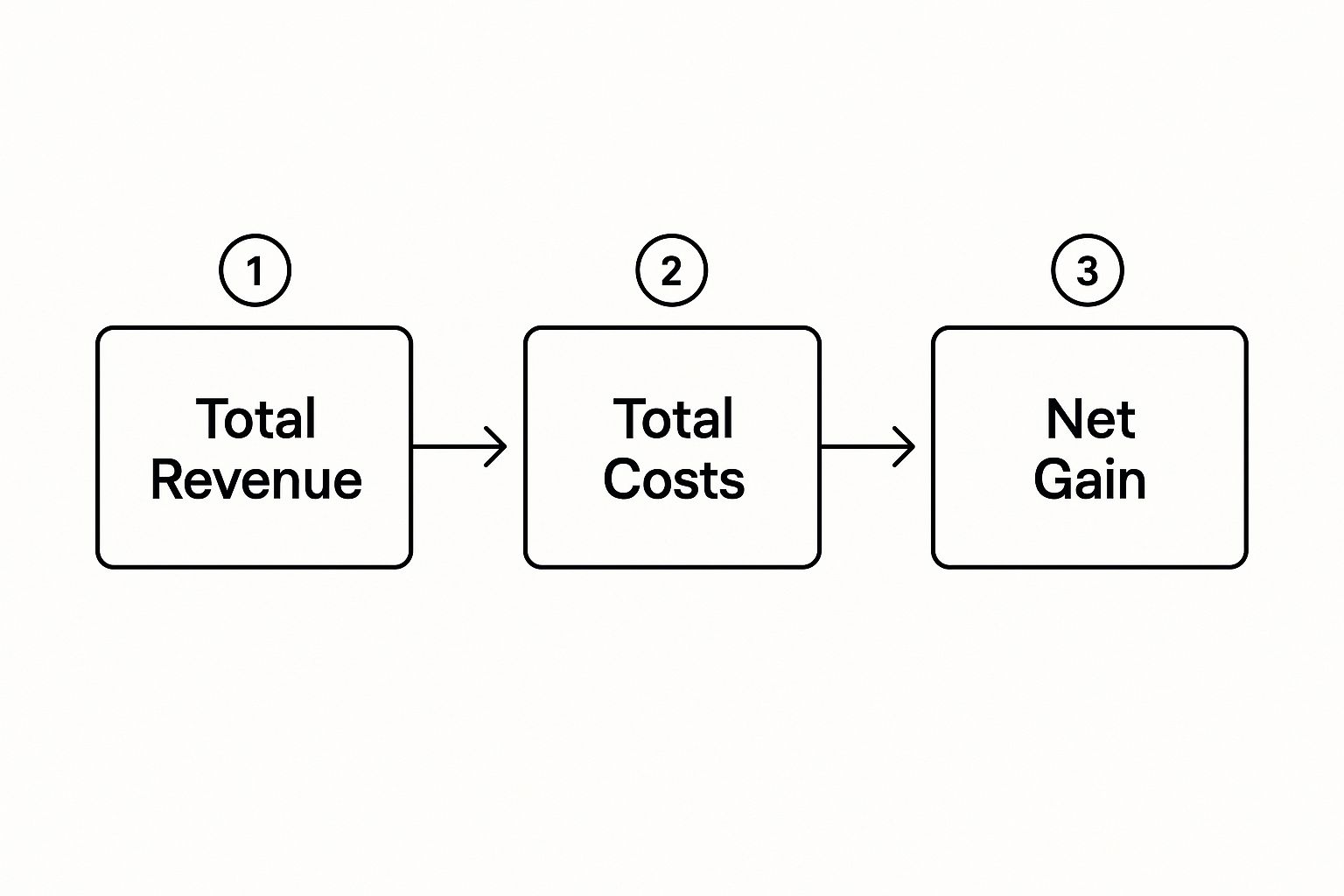
As you can see, after factoring in every single cost, the campaign still delivered a healthy positive result.
To make this even clearer, here’s a simple breakdown of the entire calculation.
PPC Campaign ROI Calculation Breakdown
| Metric | Value (£) | Notes |
|---|---|---|
| Revenue | £9,500 | Total sales generated by the campaign. |
| Cost of Goods Sold (COGS) | £3,800 | 40% of revenue. |
| Gross Profit | £5,700 | Revenue – COGS. |
| Google Ads Spend | £2,000 | Direct media cost. |
| PPC Agency Fee | £750 | Cost for campaign management. |
| Internal Team Time | £300 | Valued at 10 hours @ £30/hour. |
| Total Investment | £3,050 | Sum of all campaign costs. |
| Net Gain | £2,650 | Gross Profit – Total Investment. |
This table neatly lays out all the inputs, showing how we arrived at the final net gain figure before plugging it into the ROI formula.
The Final ROI Calculation (How to Calculate Return on Investment)
Now for the easy part. We just plug our final numbers into the ROI formula we discussed earlier:
(£2,650 / £3,050) x 100 = 86.89%
So, the PPC campaign delivered an 87% ROI. What does that actually mean? For every £1 British Baubles invested, they generated £1.87 in return. That’s a result they can definitely be happy with.
How to Calculate Return on Investment: What Your ROI Figure Is Actually Telling You

So, you’ve crunched the numbers and you have a percentage staring back at you. It’s pretty straightforward: a positive figure means you’re in the black, and a negative one means you’re losing money. But the story doesn’t end there. Honestly, interpreting your ROI is just as crucial as calculating it correctly in the first place.
What counts as a “good” ROI is completely relative. Think about it. A 15% annual return on a safe property investment would be fantastic. But if you only got a 15% ROI on a high-risk, short-term PPC campaign? You’d likely be pretty disappointed. The context – things like risk and timescale – is everything.
Benchmarking Your ROI for Context
To really get a feel for what your number means, you need something to compare it to. I always suggest benchmarking your results against two key areas:
- Your Own Business Goals: Did this investment actually hit the performance targets you set out at the beginning?
- Industry Standards: How does your ROI stack up against what’s considered typical for similar activities in your sector?
This simple step moves you beyond a basic pass-or-fail judgement. Suddenly, ROI becomes a powerful comparative tool, helping you weigh up different investment options and decide where your budget will make the biggest splash. You can use it to see if that Google Ads campaign outperformed your new email marketing platform, for example.
It’s also worth getting your head around what constitutes a good ROAS (Return On Ad Spend), as this can help you set much clearer benchmarks for your paid media efforts.
Your ROI figure isn’t a final grade; it’s a signpost. It tells you whether to continue, adjust, or completely rethink your strategy for a particular investment.
It’s also interesting how the perception of a “good” ROI can shift. Here in the UK, investment habits vary massively between generations. Research shows that about 68% of Gen Z have invested, compared to just 36% of Baby Boomers. Younger investors often chase high-risk, high-growth assets, expecting much faster and higher returns. In contrast, older generations tend to favour steadier, lower-return investments. These different expectations really influence what people consider a successful return. You can find more insights in these UK investment statistics.
Common Mistakes to Avoid When Measuring ROI
The ROI formula looks simple on paper, but a few common traps can easily give you a warped view of your performance. Getting your calculation right means knowing what these pitfalls are and actively sidestepping them.
One of the biggest mistakes we see is ignoring the ‘soft costs’. These are the sneaky, indirect expenses that don’t pop up on an invoice but still represent a real investment of resources. Think about the hours your team spends managing a PPC campaign instead of focusing on other revenue-generating tasks. If you only count your direct ad spend, you’re not getting a true picture of the total cost.
Forgetting About Time and Context (How to Calculate Return on Investment)
Another classic error is forgetting about the bigger picture—specifically, time and context. A profit of £1,000 generated five years from now just isn’t worth the same as £1,000 in your bank today, thanks to things like inflation and opportunity cost. For any long-term project, this can dramatically skew your results.
And on that note, context is king. It’s so easy to misattribute success, especially in marketing. You might be tempted to give a single ad campaign all the credit for a sale, but the reality is usually much more complicated. A customer’s journey often has multiple touchpoints:
- They might have first found you through a blog post.
- A week later, they saw a retargeting ad on social media.
- Finally, they clicked a branded search ad to make their purchase.
Giving 100% of the credit to that final click completely ignores the crucial role the other channels played. This leads to poor budget decisions, as you might slash funding for the very activities that fill the top of your funnel and get people interested in the first place.
Avoiding Common Calculation Traps
To make sure your numbers are both accurate and genuinely useful, make it a habit to double-check these key points:
- Track all costs: Seriously, track everything. This includes software subscriptions, agency fees, and even the calculated cost of your internal team’s time.
- Use net profit, not revenue: Always subtract the cost of goods sold (COGS) and other direct costs from your revenue before you even start thinking about the ROI formula.
- Look at the whole customer journey: Use an attribution model that actually reflects how your customers buy, rather than just giving all the glory to the last click.
By keeping these common slip-ups in mind, you can shift your approach to how to calculate return on investment from a simple maths problem into a proper strategic analysis that drives better decisions.
Your Questions About ROI Answered

Even with a solid formula, a few common questions always seem to surface when people start digging into their return on investment. Let’s get them answered so you can move forward with total confidence.
What Is a Good ROI Percentage?
This is the big one, isn’t it? The honest, no-fluff answer is: it really depends.
What’s considered a “good” ROI is completely relative. It changes based on your industry, the investment’s risk level, and how long you’re measuring it for. For instance, a 500% ROI from a risky, short-term PPC campaign might be seen as perfectly normal. On the other hand, a steady 8% annual return on a commercial property investment would be absolutely fantastic.
As a general rule of thumb in marketing, many businesses shoot for a 5:1 ratio. That’s a 400% ROI, meaning you bring in £5 in revenue for every £1 you spend. Ultimately, though, the best benchmarks are your own historical performance and what you need to achieve your business goals.
How Do I Measure ROI for Non-Revenue Goals? (How to Calculate Return on Investment)
Great question. Not every campaign is about driving immediate sales. What if you’re running a campaign to build brand awareness or improve how people feel about your company?
In these situations, you can’t look at a direct financial return, so you have to track proxy metrics instead.
You can’t put a direct pound-for-pound ROI on brand awareness, but you can absolutely measure its impact. Keep a close eye on metrics like branded search traffic, social media engagement, and direct visits to your website. A steady climb in these areas is a clear sign your efforts are working.
By looking at these softer metrics alongside the hard financial ROI from your sales-focused activities, you get a much fuller, more accurate picture of your overall performance.
How Often Should I Calculate ROI?
The right timing for checking your ROI really comes down to the nature of the investment itself.
Think about it: you wouldn’t measure the return on a new piece of factory equipment every week. By the same token, waiting a full year to check in on a fast-moving digital ad campaign is just asking to waste money.
You need to find a reporting rhythm that makes sense for the investment’s lifecycle:
- Monthly or Quarterly: This is ideal for agile marketing efforts like PPC campaigns, where you need to be nimble and make frequent adjustments based on performance.
- Annually: This is much better suited for long-term capital investments like new software, machinery, or major infrastructure projects.
Struggling to get a clear picture of your PPC campaign’s performance? The experts at PPC Geeks can help you track what matters, cut wasted spend, and deliver measurable growth. Find out how we can improve your ROI by visiting https://ppcgeeks.co.uk/.