
Digital Marketing for Small Businesses: Your First Guide

For any small business, digital marketing isn’t just another option on the list—it’s the most powerful, cost-effective way to find new customers, build a brand people remember, and actually drive sales. Unlike the old-school methods, it gives you laser-focused targeting and results you can measure, turning your marketing spend from a hopeful expense into a direct investment in your growth.
Why Digital Marketing Is Your Greatest Growth Lever
Think of your business as a stall in a local market. With traditional marketing—maybe a sign at the end of the road or a flyer in the local paper—you’re basically waiting for people to stumble upon you. It works, sure, but your growth is capped by who happens to walk past.
Digital marketing smashes those physical walls. It turns your stall into a global storefront that’s open 24/7. Better yet, it doesn’t just sit there waiting. It goes out and finds your customers wherever they are—whether they’re scrolling through Instagram, searching on Google, or checking their emails.
This completely levels the playing field. A small bakery in Bristol can use the same digital tools as a massive supermarket chain to reach thousands of potential customers, all for a fraction of what a single newspaper ad would cost.
Connecting Directly With Your Ideal Customer (Digital Marketing for Small Businesses)
One of the biggest game-changers is precision. Instead of shouting your message into a crowded room hoping someone listens, you can whisper it directly to the people who are already looking for what you offer.
Digital marketing lets you get incredibly specific about who sees your ads. You’re not wasting a penny on people who aren’t interested. You can target based on:
- Demographics: Focus on people by age, location, gender, or even income.
- Interests: Reach those who follow similar brands or have hobbies related to your products.
- Behaviour: Connect with users who’ve recently searched for things you sell or have visited your website.
This focused approach means every pound you spend is working its hardest, delivering a much higher return on your investment. The incredible benefits of digital marketing (https://ppcgeeks.co.uk/marketing/benefits-of-digital-marketing/) are crystal clear, from building real customer loyalty to expanding your reach far beyond your postcode.
Turning Marketing Into a Measurable Investment
Perhaps the most powerful shift is that you can measure everything. Gone are the days of putting an advert in a magazine and just hoping for the best. Digital marketing for small businesses gives you concrete, undeniable data. You can see exactly how many people saw your ad, how many clicked, and how many went on to make a purchase.
This data-driven approach takes the guesswork out of growth. You can see what’s working and what’s not, allowing you to double down on your wins and cut your losses. Marketing stops being an unpredictable expense and becomes a predictable engine for your business.
For UK small businesses, the goals are straightforward. A recent survey found that 54% of businesses use digital marketing primarily to increase sales revenue. Meanwhile, 42% focus on boosting brand awareness and reaching new audiences. This shows that success isn’t just about the next sale; it’s about building a solid, sustainable presence in a very crowded market.
Digital Marketing for Small Businesses: Your Digital Marketing Toolkit Explained
Diving into digital marketing can feel a bit like being handed a toolbox for a job you’ve never done before. You see all these different gadgets, but what do they actually do? The trick is to stop seeing it as one massive, intimidating project and start looking at it as a collection of specialised tools. Each one has a specific purpose, and knowing which one to grab for the right situation is the real secret to building a solid online presence.
Think of your business’s website as the foundation for everything else. It’s your digital shop front, your main office, and your best sales pitch all rolled into one. Before you even think about using the other tools, you have to make sure this foundation is solid, secure, and genuinely welcoming to anyone who stops by.
This image breaks down the three essential pillars of a great website.
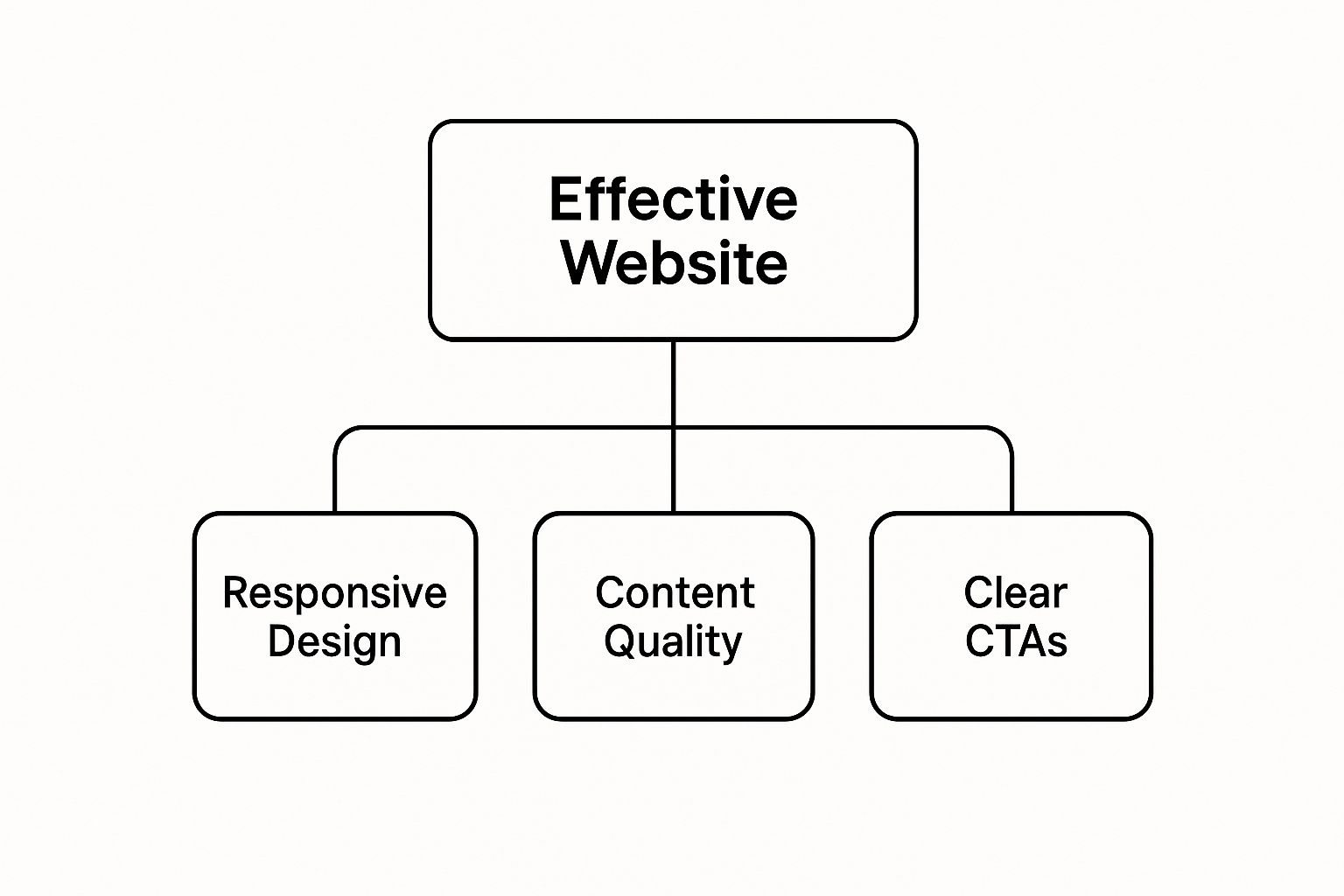
As you can see, a brilliant website is more than just a pretty design. It has to work flawlessly on any device, give people something valuable, and gently nudge them towards taking the next step. Once that foundation is in place, we can start exploring the powerful tools that will bring customers knocking.
Search Engine Optimisation (SEO)
Search Engine Optimisation, or SEO, is all about making your website more visible on search engines like Google. The best way to think about it is this: SEO is like putting up clear, helpful signposts all over the digital world that point directly to your business.
When a potential customer types “artisan coffee in Manchester” into Google, SEO is what helps your coffee shop pop up near the top of the results. It’s a mix of using the right keywords in your website’s content, making sure your site is fast, and building a good reputation online.
Fair warning: it’s a long-term game. You won’t see results overnight, but the effort you put in builds on itself over time. It’s like planting a tree; it takes a while to grow, but eventually, it provides consistent shade and value without you having to water it every single day.
Pay-Per-Click (PPC) Advertising (Digital Marketing for Small Businesses)
If SEO is the slow and steady way to get on the map, Pay-Per-Click (PPC) advertising is like paying for a massive billboard on the busiest digital motorway. With PPC, you place ads on platforms like Google or social media and, just as the name suggests, you only pay a fee when someone actually clicks on your ad.
The biggest plus for PPC is speed. You can get a campaign up and running and start seeing traffic—and potential customers—in a matter of hours. It’s absolutely perfect for promoting a sale, launching a new product, or any time you need to get results, fast.
What’s brilliant about PPC is how specific you can get. You can show your ads to people based on their location, age, interests, and even what they’ve searched for recently. This ensures your budget is spent reaching your ideal customer, not just anyone.
This approach gives you total control over how much you spend and makes it easy to measure what’s working, making it an incredibly powerful tool for driving targeted action.
Social Media Marketing
Think of social media as your digital town square. It’s where your customers and community gather to chat, share ideas, and discover new things. Platforms like Facebook, Instagram, and LinkedIn are your chance to build real relationships, show off your brand’s personality, and connect with your audience in a much more relaxed way.
But good social media marketing isn’t just about shouting about your offers. It’s about being part of the conversation. You can:
- Share things people find useful: Offer tips, behind-the-scenes stories, and helpful info.
- Actually talk to your followers: Reply to comments, ask questions, and run fun polls.
- Build a community: Create a space where customers feel connected to your brand and to each other.
Remember, each platform has its own vibe. Instagram is all about visuals, making it perfect for businesses selling products. LinkedIn, on the other hand, is the go-to network for B2B companies looking to be seen as experts.
Content and Email Marketing (Digital Marketing for Small Businesses)
Content marketing is the fuel that powers almost everything else you do online. It’s the practice of creating and sharing valuable stuff—articles, videos, guides, infographics—that helps your audience solve a problem or learn something new. Great content builds trust and naturally positions you as an expert in your field.
Then there’s email marketing, which is the most direct line you’ll ever have to your audience. Unlike social media, you own your email list. It’s a fantastic tool for guiding potential customers, announcing new products, and bringing people back to buy again. When someone gives you their email address, they’re inviting you to talk to them directly. Don’t waste that opportunity.
These two work best together. You use fantastic content to convince people to sign up for your email list, then use email to share more great content and build a lasting relationship. Many businesses use special software to send these emails automatically; you can learn more about what is marketing automation and see how it can save a huge amount of time.
Digital Marketing for Small Businesses: Building Your First Digital Marketing Plan
Knowing about the different tools in your digital marketing toolkit is one thing. Actually getting them to work together in a coordinated way is something else entirely. Without a clear plan, even the best tools are pretty much useless. It’s a common trap for small businesses to fall into “random acts of marketing”—a Facebook post here, a boosted ad there—with no real strategy tying it all together.
Think of your marketing plan as your roadmap. It doesn’t need to be a hundred-page beast; a simple, clear guide is all you need. What it does is make sure every action you take, and every pound you spend, is a deliberate step towards a specific business goal. It’s your best defence against wasting precious time and money.
Start with SMART Goals
First things first: you need to define what success actually looks like. Vague goals like “get more customers” or “increase sales” aren’t helpful because you can’t measure them. They’re just wishes. To get real results, you need to set SMART goals—goals that are clear, focused, and genuinely actionable.
SMART stands for:
- Specific: Nail down exactly what you want to achieve. Not “more traffic,” but “increase website traffic from organic search.”
- Measurable: How will you track progress? For example, “increase traffic by 20%.”
- Achievable: Be realistic. A 20% increase is a solid starting point; aiming for a 500% increase in a month is setting yourself up for failure.
- Relevant: Make sure the goal actually supports your bigger business objectives, like boosting online orders.
- Time-bound: Give yourself a deadline. “Increase organic traffic by 20% in the next six months.”
Once you have a SMART goal, you have a clear destination. Every marketing decision from that point on can be tested against a simple question: “Does this help us get there?”
Know Your Ideal Customer (Digital Marketing for Small Businesses)
Here’s a hard truth: you can’t sell to everyone. If you try to appeal to the entire market, you’ll end up connecting with no one. The secret to effective marketing is knowing exactly who you’re talking to. This is where creating a simple customer persona comes in.
Think of it like sketching a picture of your perfect customer. Give them a name, a job, and imagine their daily life. Ask yourself a few key questions:
- What are their biggest headaches or problems that my business is perfectly placed to solve?
- Where do they hang out online? (Facebook, Instagram, LinkedIn, specific blogs?)
- What sort of information are they actively looking for?
- What’s the trigger that motivates them to actually make a purchase?
Understanding your customer on this level is a superpower. It allows you to write messages that truly resonate, pick the right channels to find them, and create offers they simply can’t refuse. It’s the difference between shouting into a void and having a meaningful conversation.
Choose Your Battleground Wisely
With your goals set and your customer in sharp focus, the final piece of the puzzle is choosing the right marketing channels. A classic mistake is trying to be everywhere at once. A small business rarely has the resources to master five social media platforms, run PPC ads, and publish a weekly blog.
Instead, start small. Focus your efforts where they’ll have the biggest impact. Go back to your customer persona:
- Selling visual products like handmade jewellery or custom cakes? Instagram and Pinterest are your natural home.
- A B2B consultant offering professional services? LinkedIn and a targeted SEO strategy are probably your best bet.
- Running a local service like plumbing or gardening? Your Google Business Profile and local PPC ads will connect you with people searching for help right now.
Pick one or two channels that feel right, really learn the ropes, and master them before you even think about expanding. Building a solid foundation is everything. For more in-depth guidance on this, our detailed guide on how to create a successful marketing strategy can help you structure your entire approach. This focused method ensures your digital marketing for small businesses is both manageable and effective right from the start.
Digital Marketing for Small Businesses: Keeping Pace with Modern Customer Habits
The digital marketing world doesn’t just change; it sprints. What brought in customers last year might fall flat today, and what works now will almost certainly be old news by tomorrow. This constant motion isn’t just about new tech – it’s driven by the ever-shifting habits of the people you want to reach. Staying relevant means understanding how they find, consume, and interact with brands right now.
Imagine you own a high-street shop, but you’ve decided to lock the doors for anyone arriving by car, forcing them to find another way in. Sounds mad, doesn’t it? Yet, that’s exactly what’s happening when your website isn’t built for mobile phones. A site that’s slow, hard to read, or impossible to navigate on a small screen is effectively closing its doors to a huge chunk of potential customers.
A mobile-first approach is no longer a nice-to-have; it’s the absolute foundation of modern digital marketing for small businesses. People use their phones for everything, from finding local services to making last-minute purchases. If your digital presence isn’t built for their device, you simply don’t exist in those crucial moments.
The Unstoppable Rise of Voice Search
This shift to mobile has sparked another huge change in how people find things. Instead of tapping short, clunky keywords into a search bar, more and more of us are simply asking our devices questions. We’re talking to our phones and smart speakers just like we would talk to a person.
Welcome to the world of voice search, powered by assistants like Siri, Alexa, and Google Assistant. People aren’t typing “coffee Bristol”; they’re asking, “Where’s the best place to get a flat white near me?” This subtle change in language has a massive impact on how your business needs to show up online.
To catch the attention of this growing audience, your website’s content needs to speak their language. Think about the actual questions your ideal customer would ask, and create content that answers them directly and clearly.
- Focus on long-tail keywords: These are longer, more specific phrases that sound like natural speech (e.g., “how to fix a leaky tap under the kitchen sink”).
- Structure content with Q&As: A dedicated FAQ page is a goldmine for voice search because it directly matches the way people ask questions.
- Prioritise local SEO: So many voice searches are about what’s nearby (“find a plumber near me”), so keeping your Google Business Profile perfectly up-to-date is vital.
Capturing Attention with Short-Form Video (Digital Marketing for Small Businesses)
Just as search habits have evolved, so has the way we consume content. Our attention spans are shorter than ever, and the format that has completely captured this fast-paced world is short-form video. Platforms like TikTok, Instagram Reels, and YouTube Shorts are dominating social media, and for good reason.
These quick, snappy video clips are incredibly good at telling a story, showing off a product, or sharing a quick tip in under 60 seconds. For a small business, this format is a gift. You don’t need a Hollywood budget or a professional film crew; all you really need is a smartphone and a bit of creativity.
Short-form video lets you connect with your audience on a much more human level. It’s perfect for showing the personality behind your brand, from behind-the-scenes glimpses to quick “how-to” guides that solve a customer’s problem in seconds.
The numbers prove these shifts aren’t just passing trends. In the UK, mobile traffic has already blown past desktop, and experts predict that by 2025, a staggering 50% of all searches will be done by voice. At the same time, short-form video now accounts for a massive 82% of all internet traffic, making it the main way people consume content online. As you can discover in these key 2025 digital marketing statistics, adapting to these trends isn’t optional for UK small businesses—it’s essential for survival and growth.
Bringing It All Together
Adapting to these modern habits doesn’t mean you have to rip up your old plan and start again. It’s about weaving these new approaches into what you’re already doing. A mobile-friendly website becomes the perfect landing spot for all the traffic you get from a viral TikTok video. Content you’ve optimised for voice search can be easily repurposed into a script for an informative Instagram Reel.
Each element reinforces the others, creating a stronger, more relevant digital presence that meets customers where they are, not where they used to be. By embracing a mobile-first mindset, getting ready for voice search, and tapping into the power of short-form video, your business can stay agile, visible, and connected to today’s customer.
Digital Marketing for Small Businesses: Building Customer Trust in a Data-Driven World
In an age where people are more conscious of their personal data than ever before, trust has become your most valuable currency. It’s a simple transaction, really. Every time a customer hands over their email address or clicks “accept” on a cookie banner, they’re placing a little bit of faith in your business.
How you handle that trust determines everything. Get it right, and you build a loyal advocate. Get it wrong, and you might lose that customer for good.
Think of it like this: intrusive marketing is the pushy salesperson who barges into a private conversation to shout about their latest deals. It’s jarring, unwelcome, and instantly shatters any goodwill. Permission-based marketing, on the other hand, is the helpful shop assistant who waits to be asked before offering advice. It’s a conversation built on consent, not assumption.
This isn’t just about being polite; it’s smart business. Regulations like the General Data Protection Regulation (GDPR) in the UK set firm rules for collecting, storing, and using customer data. Getting to grips with these is non-negotiable if you want to avoid hefty fines and protect your hard-earned reputation.
Turning Transparency Into a Competitive Advantage
Being transparent about data isn’t just about ticking a legal box; it’s a powerful way to stand out from the crowd. When you’re open and honest with your customers about how you use their information, you’re showing them you respect their privacy and value the relationship.
This builds a level of trust that your less-transparent competitors simply can’t replicate. Suddenly, data protection isn’t a boring legal hurdle—it’s a core part of your brand’s promise.
Here are a few practical ways to put this into action:
- Write a clear privacy policy: Ditch the jargon. Use simple, straightforward language to explain what data you collect and why you need it.
- Make opt-outs easy: No one likes a maze. Ensure customers can easily unsubscribe from emails or manage their data preferences at any time.
- Only ask for what you need: Don’t be greedy with data. If it isn’t essential for providing your service, don’t ask for it.
Being upfront about data usage demonstrates integrity and strengthens customer loyalty. People are far more willing to share information with brands they believe are acting in their best interests, creating a positive cycle of trust and engagement.
Respecting Choices to Build Lasting Relationships
When you practise permission-based marketing, every message you send has been invited. This fundamental respect for a customer’s choice is the bedrock of any strong, long-term relationship. It’s what ensures your marketing feels like a welcome service, not an unwanted intrusion.
The world of digital marketing for small businesses in the UK has seen some major shifts, driven by new privacy laws, AI advancements, and changing consumer habits. Privacy rules have pushed businesses to make transparency and data security a priority, which in turn builds greater trust. This evolution is detailed in recent analyses of UK digital marketing trends for 2025, which highlight how customer-first strategies are becoming the new standard.
By adopting a transparent and respectful approach to data, your small business not only complies with regulations but also builds the kind of brand loyalty that drives real, sustainable growth.
Digital Marketing for Small Businesses: How to Budget and Measure What Matters
Throwing money at digital marketing without a solid plan is like trying to fill a bucket with a massive hole in it. You can see the money going in, but you have no real idea what’s leaking out or what, if anything, is actually staying put. For small businesses, smart digital marketing isn’t about having a colossal budget; it’s about making every single pound pull its weight.
Figuring out your budget doesn’t have to be some dark art. A brilliant and simple place to start is the percentage-of-revenue model. You just set aside a specific percentage of your total business revenue for all things marketing. For most small businesses, this usually falls somewhere between 5% and 10%. So, if your annual revenue is £100,000, that gives you a marketing pot of £5,000 to £10,000 for the year.
What’s great about this is that your spending stays in lockstep with the health of your business. As you grow, your marketing firepower scales right alongside you.
Focusing on Key Performance Indicators
Once the money is flowing, you absolutely have to know if it’s actually doing anything. The digital world is awash with data, and it’s incredibly easy to drown in a sea of numbers that don’t mean a thing. Forget about vanity metrics like ‘likes’ or ‘impressions’ for a moment. Instead, zero in on the figures that directly fatten your bottom line.
These are your Key Performance Indicators (KPIs), and they’re the vital signs of your marketing health. You only need to keep an eye on a few to get a crystal-clear picture:
- Conversion Rate: This is simply the percentage of people visiting your website who do what you want them to, whether that’s buying a product or filling out a contact form. It tells you how good your website and ads are at convincing people to act.
- Cost Per Acquisition (CPA): This is the total marketing cost to land one new paying customer. If you spend £100 on ads and get two new customers, your CPA is £50. This is the number that tells you if you’re actually making a profit from your marketing.
- Return on Ad Spend (ROAS): This shows you the revenue you generate for every pound you spend on ads. A ROAS of 4:1 means you’re bringing in £4 for every £1 you put in. It’s the ultimate measure of advertising profitability.
Think of tracking these core metrics as having a compass for your business. It points you towards growth and warns you about dead ends, letting you confidently steer your budget towards what delivers real, tangible results.
Using Free Tools to Track Your Success
You don’t need to shell out for expensive software to get started. Incredibly powerful and completely free tools are out there, ready to give you all the insight you need. The undisputed champion in this arena is Google Analytics. It’s a free service that tracks and reports on your website traffic, showing you exactly where visitors are coming from and what they do once they arrive.
Setting it up is pretty straightforward, and it starts gathering data immediately. You can quickly see which channels—like Google search, social media, or email marketing—are bringing in your most valuable visitors (the ones who actually convert!). This information is pure gold because it tells you exactly where to double down on your efforts.
By pairing a simple budget with a laser focus on a few crucial metrics, you turn marketing from a hopeful expense into a predictable, growth-driving investment. To dig deeper into the specific numbers you should be watching, check out our guide on the most important key performance indicators for digital marketing. This data-first approach empowers you to make smarter decisions, ensuring every pound you spend contributes directly to your business’s success.
Common Digital Marketing Questions Answered
Dipping your toes into the world of digital marketing can feel like opening a Pandora’s box of questions. For most small business owners I’ve worked with, it usually boils down to three big ones: budget, where to even start, and how long it’ll take to see a return.
Getting straight, simple answers to these is the key to moving forward with confidence. The good news? You don’t need a PhD in marketing to figure this out.
How Much Should I Spend on Digital Marketing?
This is always the first question, but there’s no magic number that fits everyone. A really solid, sensible place to start is the percentage-of-revenue model. Most small businesses I see succeeding set aside between 5% and 10% of their annual revenue for all their marketing efforts.
Let’s make that real. If your business turns over £100,000 a year, a marketing budget of £5,000 to £10,000 is a perfectly reasonable starting block. This way, your marketing spend scales up as your business grows, which stops you from getting financially overstretched right at the beginning.
What Is the First Marketing Channel I Should Use? (Digital Marketing for Small Businesses)
The biggest mistake you can make is trying to be everywhere at once. Instead, put your energy where it’s going to make the biggest dent, fast. The right channel for you depends entirely on what you sell and how your customers are likely to look for it.
Here are a few common scenarios I run into all the time:
- For local services (plumbers, cafes, hairdressers): Your absolute first port of call should be your Google Business Profile. It’s free, and it’s what gets you on the map when people frantically search for things “near me.”
- For visual products (fashion, food, crafts): You need to be on Instagram or Pinterest. Simple as that. These platforms are built from the ground up to showcase beautiful things and tempt people into buying with their eyes.
- For B2B services (consultants, agencies): Your strongest opening moves are LinkedIn and SEO. This is where you build credibility and get found by other businesses who are actively searching for the exact expertise you offer.
The secret is to master one or two channels where your ideal customers already hang out. Don’t spread your limited time and money too thin. Go deep, not wide. You’ll see real results much, much faster.
How Long Until I See Results?
This one requires a bit of patience, because the timeline for results can be wildly different depending on your strategy. It’s really important to understand the difference between a quick win and a long-term gain so you don’t get discouraged.
Pay-Per-Click (PPC) ads, for example, can bring in traffic and leads almost instantly—often within days or even hours of going live. It’s like turning on a tap for visibility.
On the other hand, Search Engine Optimisation (SEO) is a marathon, not a sprint. You’re typically looking at 4 to 6 months before you start seeing any meaningful climb in the search rankings. But the payoff is that those results are far more sustainable. Think of it as planting an oak tree; it takes time, but it provides value for years to come.
Ready to get results faster with a strategy that fits your budget? The team at PPC Geeks specialises in creating data-driven campaigns that maximise your return on investment. Find out how we can help.
Author

Search Blog
Free PPC Audit
Subscribe to our Newsletter

The Voices of Our Success: Your Words, Our Pride
Don't just take our word for it. With over 100+ five-star reviews, we let our work-and our satisfied clients-speak for us.

"We have been working with PPC Geeks for around 6 months and have found Mark and the team to be very impressive. Having worked with a few companies in this and similar sectors, I rate PPC Geeks as the strongest I have come across. They have taken time to understand our business, our market and competitors and supported us to devise a strategy to generate business. I value the expertise Mark and his team provide and trust them to make the best recommendations for the long-term."
~ Just Go, Alasdair Anderson