




Choosing a specialist Google Ads agency in the UK is a massive decision. It’s the moment you move from simply running ads to building a strategic, money-making machine. This is about more than just getting clicks; it’s an investment in a system that delivers a measurable return, built by people who know the UK market inside and out.
Why a Specialist Google Ads Agency UK Matters

So many businesses think hiring an agency is just about saving time. And sure, that’s a perk, but it completely misses the point. The real value comes from getting a strategic partner who gets the nuances of the UK market—from the different ways people search in Manchester versus London, to the specific jargon that signals someone is ready to buy.
Let’s take a London-based plumbing company as an example. A generic, one-size-fits-all approach might target broad keywords like “plumber.” The result? Clicks from all over the country and a budget that evaporates with nothing to show for it.
A specialist UK agency knows better. They’ll use tight geotargeting, focusing on specific postcodes, and even weave local phrases into the ad copy. That laser-focused approach instantly boosts lead quality and cuts out the wasted spend.
Navigating the Competitive UK Landscape
The UK’s digital advertising space is crowded and seriously expensive. It’s incredibly easy for a novice to burn through a budget in days and have zero results to show for it. This is where real expertise pays for itself.
An experienced agency doesn’t just blindly set up campaigns. They’re constantly analysing the competitive environment, spotting opportunities that everyone else is missing.
For instance, they might see your competitors are throwing money at expensive, top-level keywords, but are totally ignoring high-intent, long-tail phrases like “emergency boiler repair near Islington.” By smartly targeting these less competitive terms, they can scoop up highly qualified leads for a fraction of the cost per acquisition (CPA).
A top-tier Google Ads agency in the UK doesn’t just manage your account; they become an extension of your marketing team, deeply invested in turning your ad spend into tangible business growth and a higher return on investment.
This kind of insight is make-or-break. The UK advertising industry is booming and projected to hit a market size of £45.4 billion in 2025. That growth is driven by fierce competition, especially when Google dominates 93.24% of the search market. Without an expert in your corner, your ads will just get lost in the noise.
From Clicks to Conversions
Anyone can get you clicks. The real challenge is getting the right clicks—the ones that turn into actual, paying customers. This is where a specialist agency shines, with a relentless focus on conversion rate optimisation (CRO). They know the user’s journey doesn’t stop at the ad; it’s just the beginning.
They’re obsessed with the questions that drive real performance:
- Does the landing page actually match what the ad promised?
- Is the call-to-action (CTA) clear, compelling, and obvious?
- Is the mobile experience smooth for someone browsing on their phone?
- Are we tracking every single valuable action, from phone calls to form fills?
A skilled team will constantly be A/B testing ad copy, landing page designs, and bidding strategies to squeeze more performance out of your budget. This data-led process is what turns your Google Ads account from a cost centre into a reliable, scalable revenue stream.
You can see how this works in the real world by checking out our Google Ads agency success stories. It’s this proactive management that keeps your campaigns ahead of the curve, adapting to market shifts and securing your long-term success.
Google Ads Agency UK: Defining Your Ideal Agency Partner

Choosing the right partner isn’t about finding a ‘good’ agency; it’s about finding the right agency for you. Not every top-rated firm is going to be the perfect match for your business model, your industry, or even your company culture.
The real secret is to stop listening to sales pitches and start defining what a successful partnership actually looks like before you even begin your search.
This means you need to create your own scorecard. Think about your absolute non-negotiables. Is deep, hands-on experience in the UK ecommerce market essential? Do you need an agency that can talk high-level strategy with your board one minute and then dive into the nitty-gritty of technical tracking the next?
By outlining these criteria first, you shift the power dynamic. You’re no longer just being sold to; you’re measuring potential partners against a benchmark of what your business genuinely needs to succeed.
Decoding Google Partner Badges
As soon as you start looking for a Google Ads agency in the UK, you’ll be met with a sea of “Google Partner” and “Google Premier Partner” badges. It’s easy to dismiss these as marketing fluff, but they do tell an important story.
The standard Google Partner badge confirms an agency has met Google’s requirements for certifications, ad spend, and campaign performance. Think of it as a solid baseline—it proves they know their way around the platform.
The Premier Partner badge, however, is a different league entirely. This is awarded to the top 3% of participating companies in the UK each year. These are the agencies managing huge ad spends, consistently delivering rock-solid results for clients, and maintaining a team of highly certified experts.
In the UK’s crowded market, these badges matter. As of May 2025, there are 173 Google Premier Partners and 1,478 Google Partners, making up 1,651 certified agencies. Opting for a Premier Partner often means you’re getting a team that lives and breathes Google Ads strategy at the highest level. Find out more about the UK Google Ads agency ecosystem.
To help you sift through the options, we’ve put together a quick checklist. Use this table to compare agencies and make sure you’re ticking the right boxes from the get-go.
Key Criteria for Vetting a Google Ads Agency UK
| Evaluation Criteria | What to Look For | Red Flags to Watch Out For |
|---|---|---|
| Industry Experience | Demonstrable success stories and case studies in your specific niche or a closely related one. | Vague claims of “experience in all industries” without specific proof. |
| Commercial Focus | They talk about ROAS, CPA, and lead quality. They connect ad performance to your business’s bottom line. | An obsessive focus on vanity metrics like clicks, impressions, or click-through rate (CTR) alone. |
| Team Structure | A clear point of contact who is experienced, backed by a skilled team. You know who is working on your account. | High staff turnover, or being passed off to a junior account manager after the senior team sells you. |
| Communication Style | Proactive, regular updates that provide genuine insight, not just data dumps. They’re honest about challenges. | Radio silence for weeks, or reports that are confusing and filled with jargon. They go quiet when things aren’t working. |
| Strategic Approach | They ask thoughtful, probing questions about your business goals, margins, and customers. | A one-size-fits-all approach. They pitch the same generic strategy without understanding your business. |
| Reporting & Transparency | Customised reports that are easy to understand and clearly show progress against your key performance indicators (KPIs). | Cookie-cutter PDF reports that don’t answer the “so what?” question. Hidden fees or lack of access to your own account. |
Ultimately, this checklist is about finding a true partner, not just a supplier. A great agency will score highly across the board and feel like an extension of your own team.
You might also find our comprehensive guide on how to choose a digital marketing agency useful, as it breaks down this process even further.
Insightful Questions to Ask Potential Agencies
Once you get an agency on a call, your mission is to cut straight through the polished sales talk and see how they actually think. The questions you ask are your best weapon for this.
Don’t just ask, “Have you worked in our industry before?” Go deeper.
Example Questions That Reveal Strategic Thinking:
- “Our business model is lead generation for high-value B2B services. How would you structure the first 90 days to get some quick wins on the board while also building a foundation for long-term growth?”
- “Can you walk me through a case study of a client who had similar challenges to us? I want to understand the core problem you identified and the specific levers you pulled in Google Ads to fix it.”
- “For a company our size, how do you decide on the budget split between brand awareness campaigns and direct-response lead gen? What’s your philosophy on that?”
- “Talk me through your process when a key campaign is underperforming against its targets. Can you give me a real-world example of how you turned one around?”
The answers to these questions will tell you everything you need to know. A top-tier agency will respond with confidence, cite specific examples, and lay out a clear, logical process. Crucially, they’ll ask you sharp questions in return, showing they’re already thinking strategically about your business. That’s the sign of a real partner.
Google Ads Agency UK: Vetting Your Shortlist Like a Pro
Right, you’ve got your list of potential agencies down to a handful of promising contenders. Now the real work starts. This is where you dig deeper than the polished sales pitch and start properly scrutinising their capabilities. A slick website is one thing, but a proven track record of strategic thinking? That’s something else entirely.
The goal here isn’t just to find a competent manager who can click the right buttons. You’re looking for a strategic partner, a true extension of your own team who gets how campaign metrics connect directly to your bottom-line business goals.
Analysing Case Studies with a Critical Eye
Every agency will wave case studies in front of you, but honestly, most of them are designed to showcase vanity metrics like impressions or click-through rates (CTR). Your job is to look past that fluff. A good case study tells a story: here was the problem, here’s our strategy, and here’s the measurable business outcome.
When you’re reviewing their work, ask yourself:
- What was the original problem? Did the client have a sky-high cost per acquisition (CPA), poor quality leads, or were they just struggling to scale? A strong case study will define the challenge from the get-go.
- What was the strategy? Look for actual signs of critical thinking. Did they just throw more money at the problem, or did they pinpoint a specific audience segment, restructure the entire account, or completely overhaul the landing page experience?
- What was the real-world result? Ignore vague claims like “we increased traffic.” You want concrete business metrics like a 35% reduction in CPA, a 50% bump in qualified leads, or a 3x return on ad spend (ROAS).
A top-tier Google Ads agency in the UK won’t just show you impressive final numbers; they’ll be proud to walk you through the strategic journey they took to get there. They should be able to clearly explain why their actions led to those results.
Don’t be fooled by flashy numbers alone. The best agencies showcase their problem-solving skills, not just their ability to generate clicks. A case study should demonstrate a clear line from their strategic insight to the client’s commercial success.
Conducting Reference Checks That Matter (Google Ads Agency UK)
Speaking to an agency’s current or former clients is one of the most powerful vetting tools you have. But just asking generic questions like, “Were you happy with them?” will only get you a polite, surface-level answer. You need to dig into the reality of the day-to-day working relationship.
When you get a reference on the phone, try asking more insightful questions:
- “Could you describe their communication style? Were they proactive with updates and strategic ideas, or did you find yourself chasing them for information?”
- “Tell me about a time a campaign wasn’t performing as you’d hoped. How did the agency handle it? Did they take ownership and present a clear plan to turn things around?”
- “Beyond the scheduled reports, what kind of value did your day-to-day account manager really provide?”
These kinds of questions get to the truth of what it’s really like to work with them. You’re looking for signs of proactivity, accountability, and a genuine sense of partnership.
Dissecting the Agency Proposal
The proposal is the final piece of the puzzle. This is where you can instantly tell the agencies who have genuinely listened apart from those just going through a sales script. A generic, copy-and-paste proposal is a massive red flag.
A winning proposal is a custom strategic document. It should reference specific points from your conversations, acknowledge your unique business challenges, and outline a clear, tailored plan of action. It should also include a preliminary audit of your existing account, highlighting immediate opportunities for improvement. This shows they’ve done their homework and are already thinking like a partner. In fact, running your own checks with a comprehensive PPC audit checklist beforehand can give you a solid baseline to compare their findings against.
Look for a clear breakdown of the first 90 days, totally transparent pricing, and defined key performance indicators (KPIs) that actually align with the goals you discussed. If the proposal feels like it could have been sent to any other company, it’s a pretty good sign that you’ll be treated like just another number on their client list.
Getting Your New Google Ads Agency UK Up to Speed
Once the contracts are signed, the real work begins. Those first 90 days with your new Google Ads agency in the UK are make-or-break; they set the tone for the entire relationship. A messy, disorganised start almost always leads to missed opportunities and frustration down the line. But a smooth, structured onboarding? That builds a powerful foundation for long-term success.
This isn’t just a case of handing over your logins and hoping for the best. It’s about a strategic transfer of knowledge, empowering your new partner to act as a proper extension of your own team from day one. They need to get under the skin of your business—to understand not just what you sell, but why your customers choose you over the competition.
The timeline below maps out the key stages you should have gone through to find your agency, leading right up to this crucial handover.
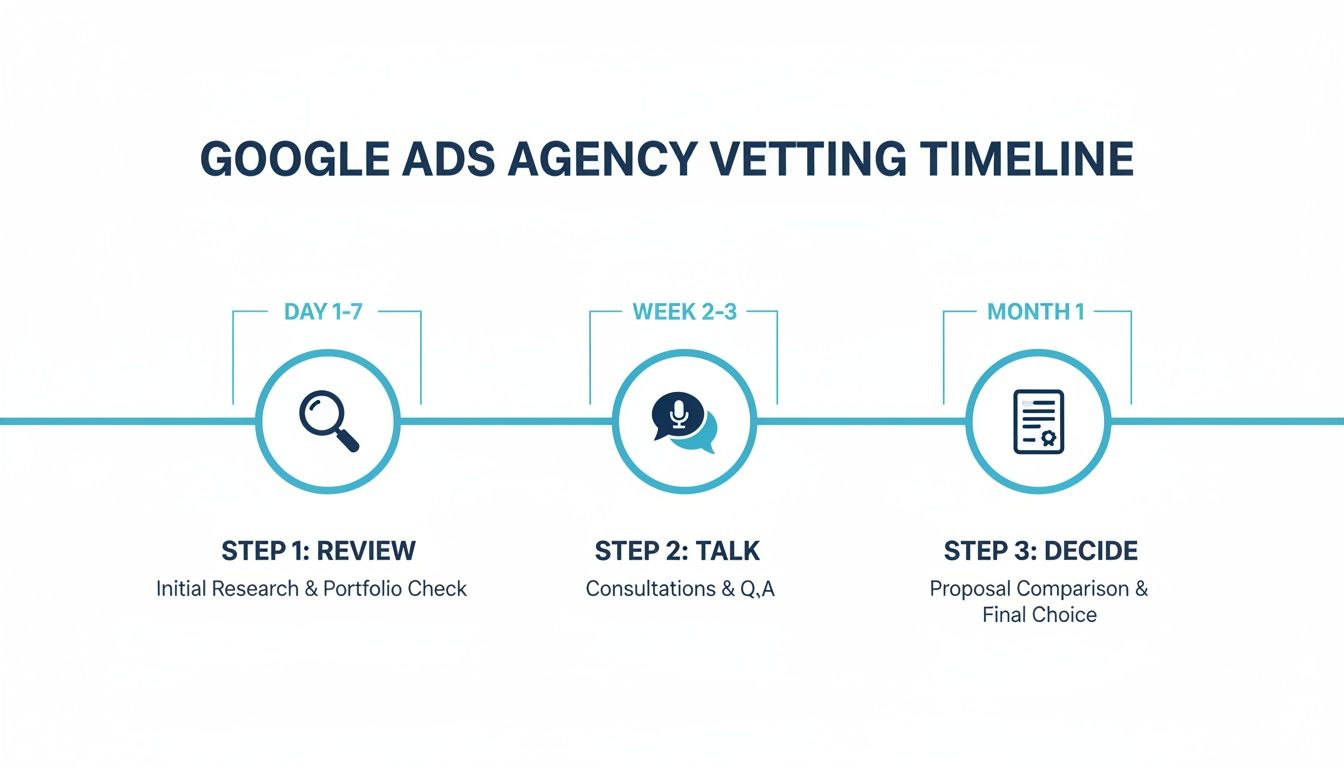
This just simplifies the journey from initial research to making your final decision, showing the logical steps that culminate in this onboarding phase.
Granting Access and Sharing Knowledge
The first practical step is to give them the keys to the kingdom. Your agency needs full, unrestricted access to your digital ecosystem. This isn’t the time for half-measures or limited permissions. They need a complete picture to make smart, informed decisions.
This means providing admin-level access to the essentials:
- Google Ads Account: A no-brainer. They need to see all historical data, campaign structures, and how conversion tracking is set up.
- Google Analytics (GA4): This is vital for understanding user behaviour, where traffic comes from, and how ad clicks translate into actual website engagement.
- Google Merchant Centre: Absolutely non-negotiable for any e-commerce business. This is where they’ll manage product feeds for Shopping campaigns.
- CRM System: Even read-only access here is a game-changer, helping them connect ad performance to genuine lead quality and sales outcomes.
Beyond the technical side, you need to arm them with your business intelligence. Share every scrap of information you have about your ideal customer—their pain points, what motivates them, and the kind of language they use. If you’ve got buyer personas or customer profiles, hand them over.
The more context you provide upfront—from old campaign performance reports to inside knowledge on which products have the best profit margins—the faster your agency can get past the basic setup and start making a real strategic impact.
Setting Realistic Expectations for the First Quarter (Google Ads Agency UK)
It’s easy to get excited and expect explosive results in the first month, but that’s rarely how it works. Any decent agency will be upfront about the initial timeline. The first 30-60 days are really about discovery, cleaning up what’s already there, and establishing a solid data baseline to build on.
Here’s a more realistic look at the first 90 days:
- Month 1 (Foundation & Learning): Expect the agency to be deep in audit mode. They’ll be fixing tracking issues, restructuring campaigns for better control, and launching a few initial tests. Performance might even dip slightly as they pause underperforming ads and start gathering fresh data.
- Month 2 (Optimisation & Iteration): Armed with data from the first month, they’ll start refining bids, testing new ad copy, and looking at landing page performance. You should begin to see positive movement in key metrics like click-through rate (CTR) and cost per conversion.
- Month 3 (Scaling & Growth): By now, the agency should have a clear idea of what’s working. The focus will shift to scaling the winners—intelligently increasing budgets on successful campaigns and exploring new targeting opportunities to drive proper growth.
A smooth start is a shared responsibility. The checklist below outlines the key tasks for both you and your new agency to ensure nothing gets missed in those critical early weeks.
Essential Onboarding Checklist for Your New Agency
| Task Category | Specific Action Items | Who Is Responsible (Client/Agency) |
|---|---|---|
| Account Access | Grant Admin access to Google Ads, Analytics (GA4), and Merchant Centre. | Client |
| Initial Strategy | Hold a kick-off meeting to discuss business goals, target audience, and key products/services. | Both |
| Technical Audit | Agency to perform a full audit of conversion tracking, account structure, and historical data. | Agency |
| Knowledge Transfer | Share all existing customer personas, market research, and competitor analysis. | Client |
| KPI Alignment | Agree on primary KPIs (e.g., ROAS, CPA, Lead Quality) and reporting frequency. | Both |
| Creative Assets | Provide access to brand guidelines, logos, images, and any existing ad copy or video assets. | Client |
| First Campaign Plan | Agency to present a 30-day plan outlining initial changes, tests, and expected focus areas. | Agency |
| Communication | Set up a shared communication channel (e.g., Slack, Teams) and schedule regular check-in calls. | Both |
Following this checklist helps create a transparent and collaborative environment right from the beginning, setting you both up for a successful partnership.
Defining Success with the Right KPIs (Google Ads Agency UK)
Finally, a seamless onboarding solidifies what success actually looks like. It’s time to move beyond vanity metrics like clicks and impressions. Your key performance indicators (KPIs) must be tied directly to your actual business objectives.
For a lead generation business, for instance, your primary KPIs might be:
- Cost Per Acquisition (CPA): How much does it cost, on average, to generate one qualified lead?
- Lead-to-Close Rate: What percentage of those leads turn into paying customers?
- Return on Ad Spend (ROAS): For every pound you put into ads, how much revenue do you get back?
Establishing these benchmarks from day one ensures everyone is pulling in the same direction. It creates a shared language for success and makes performance reviews clear, objective, and focused on what truly matters: your bottom line. This clarity is the bedrock of any great, long-term agency partnership.
Google Ads Agency UK: Managing the Partnership for Long-Term Success
Signing the contract with a Google Ads agency in the UK is just the starting line, not the finish. The real value, the kind that moves the needle for your business, unfolds over months and years of solid collaboration. This isn’t about micromanaging; it’s about building a genuine partnership founded on clear communication, shared goals, and mutual trust.
The initial onboarding gets the technical stuff sorted, but the ongoing work is where the strategic magic happens. It demands a consistent rhythm of communication, a space where both you and the agency can be transparent about what’s working, what isn’t, and where the next big opportunities are hiding. A silent partnership is almost always a failing one.
Establishing an Effective Communication Rhythm
One of the most common pitfalls is treating agency communication as an afterthought. To sidestep this, you need to establish a clear and predictable schedule right from the get-go. This structure ensures those crucial conversations happen regularly, stopping minor issues from snowballing into major headaches.
A solid communication framework usually looks something like this:
- Focused Weekly Check-ins: These aren’t long, drawn-out meetings. Think quick, sharp 15-20 minute calls to skim through the past week’s performance, flag any urgent concerns, and lock in the priorities for the week ahead.
- Strategic Monthly Reviews: Now this is where you go deeper. Here, you should push beyond simple performance stats and get into the bigger picture—market trends, what your competitors are up to, and how the campaigns are actually feeding into your wider business goals.
- An ‘Always-On’ Channel: Using a tool like Slack or a shared Teams channel is brilliant for quick, informal questions and updates. It keeps the conversation flowing without clogging up everyone’s inbox.
This kind of structured approach shifts the dynamic from a simple client-supplier transaction to a truly collaborative team effort. It’s how you stay perfectly aligned on strategy and progress.
Reading Between the Lines of Agency Reports (Google Ads Agency UK)
Agency reports can sometimes feel like a tidal wave of data with very little meaning. Your job is to steer the conversation away from vanity metrics and hone in on the numbers that genuinely impact your bottom line. An agency’s willingness and ability to focus on these crucial metrics is a massive indicator of their real value.
Don’t get distracted by clicks or impressions. Instead, focus your attention on the metrics that truly matter. Getting your head around these numbers is crucial, and you can dive deeper with our detailed guide on the most essential Google Ads reporting metrics for UK marketers.
A great agency partner won’t just fire over a report; they’ll provide context and insight. They should be able to clearly answer the question, “What does this data tell us, and what are we going to do about it next?”
Here are the key business-focused metrics you should be discussing:
- Cost Per Acquisition (CPA): Is the cost to land a new customer heading in the right direction and staying profitable? For a B2B client, a high CPA of £116.13 might be perfectly fine, but for an e-commerce store, the average is much lower at around £45.27.
- Return On Ad Spend (ROAS): Is the campaign actually making you money? How does this figure stack up against your target?
- Customer Lifetime Value (CLV): Are the customers you’re acquiring through Google Ads valuable, repeat buyers? This metric gives you a much longer-term view of your campaign quality.
- Lead Quality: If you’re in the lead generation game, are the leads actually turning into sales? This often means you need to feed back what your sales team is seeing to the agency.
By keeping the focus on these commercial outcomes, you make sure the agency’s efforts are always pointing directly at your business growth.
Collaborating on Strategy and Giving Feedback
Your partnership will only ever be as good as the feedback loop you create. If a campaign is tanking, a good agency will welcome your insights. They’ll see it as a shared challenge to solve, not as a criticism of their work.
When you give feedback, make it specific and back it up with data. For instance, instead of just saying “the leads are bad,” try something like, “the leads from the new search campaign have a 15% lower sales conversion rate than our historical average.” This gives them a concrete problem they can actually investigate.
The UK’s digital agency scene is incredibly dynamic, with industry revenue projected to hit a staggering £20.4 billion by 2025. That growth is fuelled by agencies that deliver real, tangible results. To be one of their success stories, you need to be an active player in the strategic process.
Ultimately, long-term success is a two-way street. It’s your deep industry knowledge combined with their platform expertise that creates the formula for sustained growth. By investing in communication and focusing on shared goals, you build a partnership that delivers results, time and time again.
Your Google Ads Agency Questions Answered
Deciding to bring a Google Ads agency in the UK on board is a big move, and it’s only natural to have a few questions swirling around. Getting straight answers is the only way to feel confident you’re making the right call and to kick off the relationship on the right foot. We’ll tackle some of the most common queries we hear from businesses just like yours.
What’s the Real Cost of a Google Ads Agency in the UK?
This is always the first question, and the honest answer is: it really depends. The price tag is tied to the agency’s size, its reputation, and, frankly, how much heavy lifting your account needs. Most UK agencies use one of three pricing models, so getting your head around them is key.
- Percentage of Ad Spend: A very common approach where agencies charge between 10-20% of your monthly ad budget. It’s straightforward but can get pricey as you start spending more.
- Flat Monthly Retainer: This gives you predictable costs every month. Fees can start from around £500 for simpler accounts and climb past £5,000 for businesses running complex, multi-layered strategies.
- Performance-Based Fee: Some agencies will tie their fee directly to the results they generate, taking a slice of revenue or charging a fixed cost per lead. It’s a great way to align goals, but it’s less common, especially for new clients.
When you’re comparing quotes, don’t just look at the number. A cheaper agency might just be doing the bare minimum, while a pricier one could be offering deep strategic thinking, custom reporting, and access to senior experts. Always ask for a clear breakdown of what’s included in their management fee to understand the true value.
How Long Until I See Proper Results?
You can get traffic flowing almost instantly, but seeing genuine business results takes a bit of time and patience. Any good agency will be very clear about managing expectations for the first 90 days – this is the crucial phase where all the foundations are laid.
Think of it like this: month one is all about setup, research, and getting clean data. In month two, the first wave of optimisations kicks in as the agency refines bids and tests ads, and you should start seeing some positive trends.
By the end of the third month, you’ll have a much clearer picture of what’s possible. Your key metrics, like cost-per-acquisition (CPA), should be heading in the right direction. But sustainable, scalable growth? That often takes three to six months as the agency meticulously fine-tunes every part of the campaign based on hard data.
Will I Actually Own My Google Ads Account?
Yes. One hundred percent. This is a complete non-negotiable. You must always, always have full ownership of your Google Ads account and all the invaluable data inside it.
A professional google ads agency uk will never set up an account in their own name. They’ll simply ask for access to your existing account via their Manager Account (MCC). This gives them the keys to manage and optimise everything without ever taking ownership from you.
Be incredibly cautious if an agency suggests setting up the account under their business. Your account data is a priceless company asset. Owning it means you can easily switch to a new agency or bring management in-house down the line without losing years of performance history.
What Happens if I’m Not Happy with Their Performance?
It’s a perfectly valid worry. Before you sign on the dotted line, scrutinise the termination clause in the contract. A 30-day notice period is standard and fair for most reputable UK agencies, offering a clean and professional exit for both parties if things don’t pan out.
If you start seeing performance dip, the first move should be to have a direct, honest chat with your account manager. Don’t let issues fester. Go into that conversation with specific examples and data points that show what you’re concerned about.
A great agency partner will welcome this feedback. They shouldn’t come back with excuses, but with a clear, written action plan to tackle the problems you’ve highlighted. If things still don’t improve after giving them a fair shot to fix it, you can then move to activate the termination clause with confidence. Open communication is everything.
Ready to stop guessing and start getting real results from your ad spend? At PPC Geeks, we build data-driven Google Ads strategies that are completely aligned with your business goals, making sure every pound you invest works harder for you. Get your free, no-obligation PPC audit today and see what you’re truly capable of.