
Demystifying Google Adwords Costs in the UK

Demystifying Google Adwords Costs in the UK: So, what’s the real cost of getting your business seen on Google? There isn’t a simple price tag. The truth is, it’s a dynamic figure that you have a surprising amount of control over, with the average monthly spend for UK SMBs landing anywhere from £100 to over £10,000.
What you end up paying is really a mix of your industry, how you bid, and how good your ads are.
Decoding Your Potential Google Ads Spend
Think of Google Ads less like buying a product off a shelf and more like stepping into a live auction. You aren’t paying a flat fee. Instead, you’re bidding for the chance to put your ads in front of people who are actively looking for what you offer. What you ultimately pay depends on how much you’re willing to bid and, crucially, how relevant Google thinks your ads are.
This flexibility is a massive plus. Recent surveys show that around 44% of UK businesses spend between £100 and £10,000 a month. That huge range tells you just how scalable the platform is, working just as well for a small startup as it does for a much larger company.
To get a proper handle on these moving parts, it helps to understand a bit more about how much Google Ads cost.
The Two Core Payment Models
At its heart, what you pay comes down to one of two models you’ll choose for your campaigns:
- Cost-Per-Click (CPC): This is the most common setup by a country mile. You only pay when someone actually clicks on your ad. It’s perfect for campaigns where the main goal is to drive traffic to your website and generate leads.
- Cost-Per-Mille (CPM): With this model, you pay for every 1,000 times your ad is shown (an “impression”), whether it gets clicked or not. This is your go-to for brand awareness campaigns where getting eyeballs on your brand is the top priority.
Getting your head around how these models work is the first step. For a deeper dive, it’s worth exploring how different PPC advertising strategies are put together to get the best results.
Key Factors Driving Your Final Bill (Demystifying Google Adwords Costs in the UK)
Your total ad spend isn’t just about the bids you place. Several interconnected elements come together to determine your final bill.
The secret to managing Google Ads costs isn’t about outspending your competitors. It’s about outsmarting them with higher quality ads and smarter targeting.
To help you get a clearer picture, here’s a quick look at the main pillars that decide what you’ll actually pay.
Core Factors Influencing Your Ad Spend
This table breaks down the three main pillars that determine your final Google Ads costs, giving you a quick summary of what really matters.
| Factor | What It Means for You | How It Impacts Your Budget |
|---|---|---|
| Industry Competition | Some sectors, like legal or finance, are packed with businesses bidding on the same keywords. | The more competition, the higher the bids, which pushes up your overall Cost-Per-Click. |
| Ad Quality (Quality Score) | This is Google’s rating of your ads based on their relevance, click-through rate, and landing page experience. | A great Quality Score can actually lower your CPC and boost your ad position, even if you bid less. |
| Bidding Strategy | This is you telling Google how you want to pay—whether that’s for clicks, impressions, or actual conversions. | Your choice of strategy directly controls when and how your budget gets used. |
Mastering how these three factors interact is the key to building a campaign that doesn’t just spend money, but makes it.
Demystifying Google Adwords Costs in the UK: The Three Pillars of Google Ads Pricing
Winning at Google Ads isn’t just about throwing the most money at it. The platform works more like a merit-based auction, where your final cost hinges on a delicate balance of three critical elements. Getting your head around these pillars is the first step to managing your Google Ads costs like a pro.
The main things that influence what you pay are your maximum bid, your ad’s Quality Score, and how competitive your industry is. Together, these factors decide not only if your ad gets shown but where it ranks and exactly how much you’ll fork out for each click. This is great news because it means a smaller business with a super-relevant ad can often outplay a bigger competitor with a massive budget.
The Ad Rank Formula Explained
Google uses a simple but powerful formula to decide your ad’s position on the results page. This is called Ad Rank, and it’s worked out by multiplying your maximum bid by your Quality Score.
Ad Rank = Your Maximum Bid x Quality Score
Think of it this way: your bid is your ticket into the auction, but your Quality Score is how much you impress the auctioneer (Google). A higher Ad Rank means a better ad position, and often, a lower cost per click. Google actively rewards advertisers who give users a great experience.
Unpacking Your Quality Score (Demystifying Google Adwords Costs in the UK)
So, what exactly is this all-important Quality Score? It’s Google’s rating, on a scale of 1 to 10, of the overall quality of your ad and your landing page. It’s not just one thing, but a mix of three main components:
- Expected Click-Through Rate (CTR): This is Google’s prediction of how likely people are to click your ad when it’s shown. It’s based on how your ads have performed in the past.
- Ad Relevance: This measures how well your ad copy matches what a user is actually looking for. Someone searching for “emergency plumber in Leeds” should see an ad that speaks directly to that urgent need.
- Landing Page Experience: After someone clicks your ad, does the landing page deliver on its promise? The page needs to be relevant, easy to get around, and give the user a clear, positive experience.
Improving these three areas sends a strong signal to Google that you’re a top-quality advertiser, which can lead to some serious cost savings. The tricky nature of bidding and ad relevance are big reasons why many wonder about the costs involved. For a deeper dive, you can explore the factors that explain why PPC is so expensive and how to get them under control.
This infographic breaks down the main cost models you’ll come across on your advertising journey.
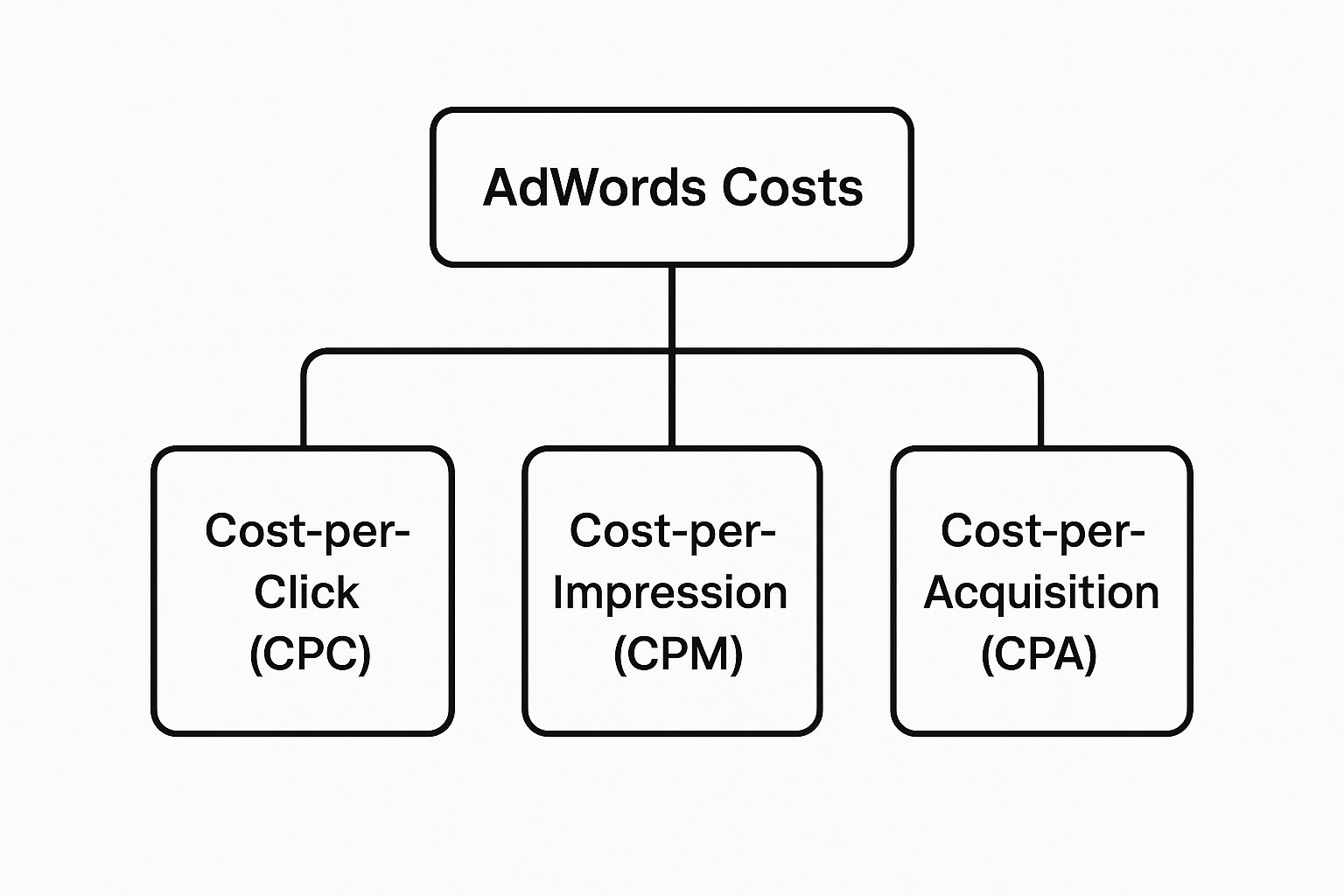
The diagram clearly shows how overall Google Ads costs are managed through different payment structures like CPC, CPM, and CPA, with each one tied to specific campaign goals. By mastering your bid, Quality Score, and overall strategy, you can take back control of your budget and achieve a much stronger return on your investment.
Demystifying Google Adwords Costs in the UK: Setting Realistic Budgets with UK Industry Benchmarks

One of the first, and biggest, questions we always get is: “How much should I actually spend on Google Ads?” Without any context, setting a budget feels like a complete shot in the dark. The real key is to get a handle on what a ‘normal’ cost looks like within your specific industry here in the UK.
Your Google Ads costs are massively influenced by how competitive your sector is. It’s a simple truth: a click for a solicitor’s services will nearly always cost more than a click for a local bakery’s website. But why? It all boils down to the potential value of a single customer.
A law firm might land a client worth thousands from just one click, which justifies a much higher spend. The bakery, on the other hand, depends on getting lots of customers for smaller transactions. For them, a low Cost-Per-Click (CPC) is essential to stay profitable. Understanding this link between what you spend on ads and what a customer is worth over their lifetime is crucial for setting realistic expectations.
Understanding Average Costs Across UK Sectors (Demystifying Google Adwords Costs in the UK)
Getting a feel for the typical CPC in your field is a game-changer. It helps you figure out where you stand against the competition and plan your budget so it actually makes a difference. Across the UK, Google Ads costs can swing wildly from one industry to another, reflecting just how fierce the fight for high-value leads can be.
For example, the legal services sector sees some of the highest CPCs around, averaging about £7.00 per click because of the intense demand. In contrast, industries like travel and tourism often have much lower rates, sometimes closer to £1.50 per click.
Understanding these benchmarks isn’t about matching them penny for penny. It’s about using them as a starting point to inform your bidding strategy and ensure your budget is competitive enough to make an impact.
For businesses that find managing all these moving parts a bit much, it’s often useful to understand how much it costs to hire a PPC agency to handle the nitty-gritty strategy.
Average Cost-Per-Click by UK Industry
To help you see where your business fits into the bigger picture, we’ve put together a table outlining typical CPCs and competition levels for several key UK industries.
| Industry Sector | Average CPC (Search) | Competition Level |
|---|---|---|
| Legal Services | £7.00 – £12.00 | Very High |
| Finance & Insurance | £6.50 – £10.00 | Very High |
| Home Services (Plumbing, etc.) | £4.00 – £8.00 | High |
| Automotive Sales & Repair | £3.00 – £6.00 | High |
| Real Estate | £2.50 – £5.00 | High |
| B2B Services | £2.00 – £4.50 | Medium to High |
| Retail & Ecommerce | £1.50 – £3.50 | Medium |
| Travel & Tourism | £1.00 – £2.50 | Medium |
Use this data to get a sense of what your rivals might be paying and to set a budget that gives you a fighting chance in the ad auction. This kind of information empowers you to make smart, informed decisions rather than just crossing your fingers and hoping for the best.
Demystifying Google Adwords Costs in the UK: How External Events Can Impact Your Ad Spend
Your Google Ads costs don’t exist in a vacuum. Think of the ad auction as a living, breathing marketplace that’s incredibly sensitive to what’s happening in the wider world. Economic shifts, seasonal trends, and major global events can all cause dramatic swings in what you end up paying.
Getting your head around these dynamics is absolutely key to managing your budget properly. When big events unfold, they change two things at once: how your customers search, and how your competitors advertise. This shift in supply and demand has a direct knock-on effect on your cost-per-click (CPC) and your overall ad spend.
For example, a sudden economic downturn might spook many businesses into pulling back their advertising budgets. While that sounds like bad news, it can actually create a golden opportunity. With fewer advertisers bidding, competition drops, which can lead to lower CPCs for those who hold their nerve.
The Pandemic: A Clear Case Study (Demystifying Google Adwords Costs in the UK)
The COVID-19 pandemic gave us a powerful, real-world lesson in how this works. As uncertainty swept the globe, countless UK businesses slashed their marketing spend, causing a huge dip in advertising competition almost overnight.
This had a direct and measurable impact on Google Ads costs. Before the pandemic, Search Network CPCs were holding steady at around £2.00. But as businesses retreated in 2020, that average dropped to just £1.79. This was a direct result of the sudden fall in competition, allowing savvy advertisers to snap up clicks at a much lower price before costs inevitably rebounded. You can dive deeper into how market conditions affect Google Adwords costs over time.
Planning for Seasonal Advertising Spikes
Beyond unpredictable global events, your budget is also hit by much more predictable seasonal trends. For any UK business, certain times of the year bring a guaranteed surge in advertising intensity and, as a result, higher costs.
These seasonal spikes demand a proactive approach to your budget:
- Black Friday & Cyber Monday: Competition goes through the roof in late November as every retailer fights for the attention of holiday shoppers, pushing CPCs way up.
- Christmas Period: The whole of December sees sustained high competition across most consumer-facing industries.
- January Sales: Post-holiday promotions keep the pressure on as businesses try to attract bargain-hunters.
By anticipating these periods, you can be much more strategic with your budget. Plan to increase your daily spend during these peak times to stay in the game, or shift your focus to less competitive keywords to protect your bottom line.
Being aware of these external pressures allows you to adapt your strategy on the fly, turning market volatility into a competitive advantage instead of letting it become an unexpected drain on your budget.
Demystifying Google Adwords Costs in the UK: Practical Strategies to Reduce Your Google Ads Costs
Knowing how Google Ads pricing works is one thing, but actually cutting your costs is where the real magic happens. It’s time to move from theory to action. There are several powerful strategies you can use to get a firm grip on your budget, slash wasted spend, and seriously boost your Return on Ad Spend (ROAS).
These aren’t complicated, out-of-reach ideas. They’re practical steps any UK business can take right now. By focusing on quality, precision, and timing, you can make every pound in your advertising budget work much harder. Let’s break down five key tactics that will get you there.
Boost Your Quality Score
If there’s one lever you can pull to lower your Google Ads costs, it’s your Quality Score. Think of it as your reputation with Google. The platform rewards advertisers who create a great user experience by giving them lower CPCs and better ad positions. A high score is a clear signal that your ads and landing pages are relevant and genuinely helpful.
To get your score up, concentrate on these three core areas:
- Ad Relevance: Your ad copy needs to be a direct match for the keywords you’re targeting. If someone searches for “emergency plumber in Manchester,” your headline should shout that right back at them.
- Expected Click-Through Rate (CTR): Don’t just set and forget your ads. Test different headlines and descriptions to see what actually gets people clicking. A higher CTR tells Google that your ad is a fantastic match for what people are looking for.
- Landing Page Experience: The user’s journey shouldn’t end abruptly after the click. Your landing page has to feel like a natural next step. It needs to load quickly, be easy to use, and have a crystal-clear call-to-action that delivers on the ad’s promise.
Master Your Keyword Targeting (Demystifying Google Adwords Costs in the UK)
Burning cash on irrelevant clicks is the quickest way to empty your budget. Sharpening your keyword strategy is absolutely essential for focusing your spend only on people who are actually interested in what you’re selling. It’s all about getting specific and cutting out the noise.
Start by targeting long-tail keywords. These are the longer, more detailed phrases like “buy vegan leather dog collar UK.” They usually have less competition and much higher conversion rates compared to broad terms like “dog collars.”
Next up, build a rock-solid negative keyword list. This is you telling Google which search terms you never want your ads to show up for. For example, a dealership selling luxury cars should add negative keywords like “cheap,” “free,” and “repair” to fend off the wrong kind of traffic.
Use Smart Ad Scheduling
Let’s be realistic – your customers aren’t searching for you 24/7. Running your ads around the clock is a surefire way to waste money during those quiet hours when conversions just aren’t happening. This is where ad scheduling, also known as dayparting, becomes your best friend.
Dive into your campaign data and pinpoint the days and times when you see the most engagement and conversions. You can then tell Google to show your ads more often—or even exclusively—during these peak periods. A B2B service, for example, will almost certainly find that conversions are at their highest during standard business hours, Monday to Friday.
By focusing your budget on your most profitable hours, you ensure your ads are visible when your customers are most likely to take action, effectively improving your ROAS without increasing your overall spend.
Implement Strategic Location Targeting (Demystifying Google Adwords Costs in the UK)
You wouldn’t advertise in a city where you don’t do business, right? So why waste money showing ads to people outside your most profitable areas? Geotargeting lets you focus your budget on specific countries, regions, cities, or even down to the postcode level.
Dig into your performance reports to see which locations are bringing in the bacon. A local bakery in Bristol might find that 90% of their online orders come from a few surrounding neighbourhoods. They can then pile their budget into these high-performing areas and exclude the rest, making their ad spend instantly more efficient. Understanding this level of detail is a key part of figuring out how much Google PPC costs for your unique business.
Optimise Your Landing Pages
Finally, always remember the user’s journey doesn’t stop at the click. A landing page that converts is absolutely critical for turning that click into a paying customer. To really cut your Google Ads cost per conversion, you have to nail the post-click experience.
Effective Ecommerce Conversion Rate Optimisation ensures your ad spend works harder by turning more visitors into buyers. Your landing page must be fast, mobile-friendly, and perfectly aligned with the promise you made in your ad, guiding the user towards one single, obvious action.
Demystifying Google Adwords Costs in the UK: Taking Control of Your Advertising Spend

The world of Google Ads costs might seem like a bit of a maze, but it’s absolutely not beyond your control. You don’t need the biggest budget to win. Far from it. The real secret is making the smartest decisions with the budget you have. Strategic management is what turns your ad spend from a guessing game into a reliable engine for growth.
By getting hands-on with your Quality Score, laser-focusing your keyword targeting, and constantly testing new ad creative, you take direct control over your return on investment. This proactive approach flips the script, changing advertising from just another expense into a powerful, scalable asset. For anyone in the tech space, weaving in specific digital marketing strategies for tech companies is crucial to unlocking this potential.
Remember, every single pound you invest should be working towards a clear business objective. Consistent optimisation and a relentless focus on quality are what separate a costly campaign from a profitable one.
Ultimately, your goal is to build a sustainable system. To keep your campaigns on track and performing well, a simple checklist is your best friend.
- Weekly Performance Review: A quick check-in on key metrics like CTR and CPC. Are things moving in the right direction?
- Monthly Budget Analysis: Make sure your spending is lining up with your goals. No nasty surprises.
- Ongoing A/B Testing: Always be testing. There’s always a better headline or description out there.
- Negative Keyword Audits: Regularly trim the fat. Cut out those irrelevant search terms that waste your money.
Common Questions Answered
Diving into Google Ads costs can feel like a bit of a minefield at first. Let’s clear up some of the most common questions we hear from UK businesses, giving you some straight-talking, practical answers.
How Much Should a Small Business Spend on Google Ads?
There’s no one-size-fits-all answer here, but a solid starting point for most small businesses in the UK is somewhere between £500 and £1,500 per month.
This kind of budget is the sweet spot. It’s enough to get the wheels turning, gather some meaningful data, test out different keywords, and actually start seeing what works without having to remortgage the office. Once you find your groove, you can scale it up.
Can I Run Google Ads with Just £5 a Day?
Absolutely. Starting with a fiver a day is a smart way to dip your toe in the water, learn how the platform works, and see some initial data without any real risk.
Just be realistic with your expectations. A smaller budget means fewer clicks and conversions, which naturally makes it tougher to optimise and grow quickly. It’s a great approach for super-targeted local campaigns, though.
Think of it this way: a small budget is for learning the ropes and testing the waters. A bigger budget is what you need when you’re ready for aggressive growth and scaling up.
Is Google Ads Cheaper Than Facebook Ads?
This is the classic “it depends” question. The cost really comes down to your industry and what you’re trying to achieve.
As a general rule, Google Ads often has a higher cost-per-click. Why? Because you’re capturing people who are actively looking for what you sell right now. They have high purchase intent. Facebook Ads, on the other hand, usually has a lower CPC but it’s more about building awareness and reaching people based on their interests, not what they’re typing into a search bar.
Ready to stop guessing and start seeing real results from your ad spend? The team at PPC Geeks builds data-driven strategies that boost traffic, leads, and sales while cutting out the wasted budget.
Why not get your free, in-depth audit today and see where you could be saving money and making more?
Author

Search Blog
Free PPC Audit
Subscribe to our Newsletter

The Voices of Our Success: Your Words, Our Pride
Don't just take our word for it. With over 100+ five-star reviews, we let our work-and our satisfied clients-speak for us.

"We have been working with PPC Geeks for around 6 months and have found Mark and the team to be very impressive. Having worked with a few companies in this and similar sectors, I rate PPC Geeks as the strongest I have come across. They have taken time to understand our business, our market and competitors and supported us to devise a strategy to generate business. I value the expertise Mark and his team provide and trust them to make the best recommendations for the long-term."
~ Just Go, Alasdair Anderson