




Figuring out how to increase online sales is all about getting a few key things right: smart website tweaks, razor-sharp digital marketing, and letting the data guide your decisions. It all begins with mapping out a customer journey that’s completely smooth—from the very first ad they see to the moment they hit “buy”—and then branching out to sell wherever your customers hang out.
How to Increase Online Sales: Getting to Grips with the UK E-commerce Scene

Before we jump into the nitty-gritty tactics, it’s vital to get a feel for the current online retail environment here in the UK. The massive shift to e-commerce isn’t just a passing phase; it’s the new standard for retail, which means a solid online presence is no longer a ‘nice-to-have’—it’s essential for growth.
The market trends are crystal clear: convenience, speed, and trust are what shoppers demand. In 2024, UK online sales saw a healthy growth of 3.1%, with another 1.7% increase expected for 2025. This surge is massively influenced by giants like Amazon, which was used by a staggering 91% of online shoppers. This has set the bar incredibly high for delivery speed and customer service, and every business is now expected to keep up.
This guide is your roadmap to navigating this competitive space. We’ll break down the core pillars you need to nail to build a profitable and resilient online business.
Core Strategies for Increasing Online Sales
To really make a dent, you need a strategy that covers all the bases. This guide is built around four key areas that, when you bring them together, create a powerful engine for driving up your revenue.
Here’s a quick look at the key pillars we’ll be diving into. This table gives you a snapshot of what works and what you should be focusing on.
| Strategy Pillar | Primary Goal | Key Actions |
|---|---|---|
| Conversion Rate Optimisation (CRO) | Turn more website visitors into paying customers. | Streamline checkout, improve mobile experience, add social proof. |
| Multichannel Selling | Expand your reach and meet customers everywhere. | Sell on marketplaces, use social commerce, integrate inventory. |
| Data Analytics | Make informed, data-driven business decisions. | Track KPIs, analyse customer behaviour, perform A/B tests. |
| Digital Marketing | Drive targeted, high-quality traffic to your store. | Implement SEO, run PPC campaigns, build an email list. |
Each of these pillars props up the others. Think about it: you can’t optimise conversions if you don’t have any traffic, and driving traffic is a waste of money if your website can’t turn visitors into buyers.
The most successful e-commerce businesses don’t just find customers; they build an ecosystem where every touchpoint—from a social media ad to a follow-up email—is optimised for a seamless buying experience.
Getting your head around how these elements connect is the first step. By focusing on both pulling visitors in and giving them an amazing on-site experience, you’re laying the foundation for sustainable growth. This means you’re not just spending on traffic through channels like those covered in expert PPC services for London-based businesses, but you’re also making sure your site is ready to convert that traffic into actual sales. This complete approach is what separates the online stores that thrive from those that just can’t seem to get going.
How to Increase Online Sales: Turn Your Website Into a Conversion Machine
Getting traffic to your website is only half the job done. If visitors land on your site but don’t buy anything, that marketing budget is essentially going down the drain. This is where Conversion Rate Optimisation (CRO) steps in. It’s the art and science of turning your website from a digital brochure into your hardest-working salesperson.
A lot of businesses think they need a massive, expensive overhaul to get results, but that’s rarely the case. In my experience, it’s the small, strategic tweaks that often deliver the biggest wins. The idea is to remove any friction and build instant trust, guiding a visitor smoothly from their first click right through to the final purchase.
Simplify the Path to Purchase
Think about the last time you abandoned an online shopping cart. Was it because the checkout was a nightmare—too long, asking for your life story, or forcing you to create an account? These are the classic friction points that absolutely kill sales.
It’s a huge problem. Research shows a staggering £4 trillion worth of merchandise was left in abandoned carts last year alone, and a massive chunk of that was completely preventable. Your checkout has to be as quick and painless as humanly possible.
- Offer Guest Checkout: Forcing people to create an account is one of the biggest conversion killers out there. Always, always give new customers a guest checkout option.
- Minimise Form Fields: Only ask for what you absolutely need to process the order. Do you really need their phone number or date of birth right now? Every extra field is another chance for them to walk away.
- Enable Autofill and Multiple Payment Options: Integrate with services like Apple Pay, Google Pay, and Shop Pay. Letting customers pay how they want, often with a single click, slashes checkout time and sends completion rates soaring.
A seamless checkout isn’t just a nice-to-have; it’s a core feature. The less a customer has to think, type, or click, the more likely they are to finish their purchase. I’ve seen clients boost conversions just by removing a single unnecessary step.
By making that final step effortless, you’re not just closing a sale. You’re creating a brilliant experience that brings people back again.
Craft Compelling Product Pages (How to Increase Online Sales)
Your product pages are where the real buying decision is made. They need to do more than just list a few features; they have to answer every possible question and tackle any objection a customer might have before they’ve even thought of it.
Start with your visuals. In e-commerce, your customers can’t touch or feel the product, so your images and videos have to do all the heavy lifting. Don’t skimp here—invest in high-quality, professional photography that shows your product from every conceivable angle.
- Use a mix of images: You need clean studio shots, lifestyle photos showing the product in action, and detailed close-ups of key features or materials.
- Add video content: A short video demo can be incredibly persuasive. It shows scale, function, and benefits in a way that static images just can’t match.
Next, get your copy right. Write product descriptions that speak directly to your ideal customer. Don’t just list what the product is; explain how it will solve their problem or make their life better. Use clear, benefit-focused language that connects with them on an emotional level.
Build Unshakeable Trust with Social Proof
In the anonymous world of online shopping, trust is everything. New visitors are naturally a bit sceptical, and you need to give them solid reasons to feel confident buying from you. This is where social proof becomes your most powerful tool.
Displaying genuine customer reviews and testimonials isn’t optional anymore. Studies consistently show that 93% of customers read online reviews before making a purchase. Integrating a reviews platform so customers can leave feedback right on your product pages is an absolute must.
But it’s not just about reviews. Other trust signals can really reinforce your credibility:
- Security Badges: Pop the logos of well-known payment providers like Visa, Mastercard, and PayPal somewhere visible during checkout.
- Clear Policies: Make sure your returns policy and any money-back guarantees are ridiculously easy to find. A strong, clear guarantee reduces the perceived risk for a new buyer.
- Professional Accreditations: Got any industry certifications or awards? Don’t be shy—show them off.
Optimise for the Mobile Experience (How to Increase Online Sales)
With mobile searches now blowing past desktop, a flawless mobile experience is non-negotiable if you want to increase online sales. It’s not enough for your site to just “work” on a phone; it needs to be designed for it.
Navigation should be simple and intuitive, with big, tappable buttons that are easy to hit with a thumb. Product images have to load in a flash without looking pixelated, and the entire checkout process should be manageable with just a few taps.
Seriously, test your mobile site yourself. Go through the whole process of finding a product and buying it. What seems straightforward on a big screen can be a frustrating mess on a phone. By putting mobile users first, you’re catering to the majority of modern shoppers and capturing sales you would otherwise lose.
How to Increase Online Sales: Expand Your Reach with Multichannel Selling
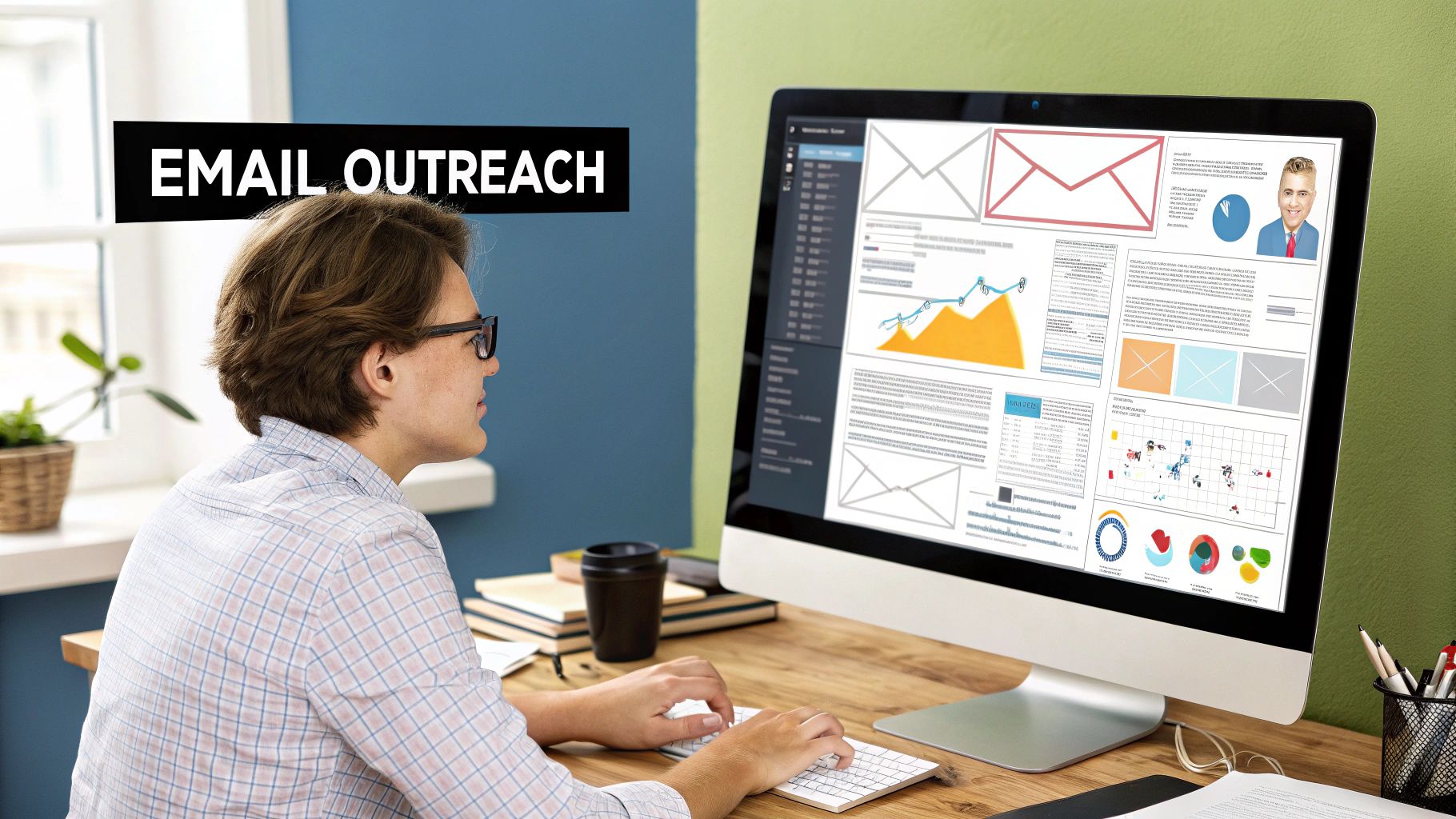
If you’ve poured everything into perfecting your website, that’s a fantastic start. But relying on it as your only sales channel is a bit like setting up a brilliant shop on a single, quiet street. To really scale, you need to be where your customers are already hanging out.
This is the whole idea behind multichannel selling. It’s about building a smart, visible presence on the platforms your ideal buyers use every single day.
Let’s be honest, the modern customer journey is anything but linear. Someone might spot your brand on Instagram, jump over to Amazon to read some reviews, and then finally click ‘buy’ on your website. By showing up at each of these touchpoints, you build a powerful, connected ecosystem that captures sales from every possible angle.
The shift to online is impossible to ignore. Just look at the latest ONS data for May 2025: online spending in Great Britain accounted for 27.2% of all retail sales. That’s a noticeable jump from the previous month, even while overall retail spending took a dip. It’s a clear signal that more and more consumer spending is happening online.
Branching Out to Marketplaces
A great first step into multichannel selling is often with the big players: Amazon and eBay. Think of them as massive search engines for products, packed with a built-in audience actively looking to buy something. Listing your products here gives you instant access to millions of potential customers you simply couldn’t reach on your own.
But don’t just throw your listings up and hope for the best. You need to treat them with the same care as your own product pages.
- Optimise for Search: Amazon and eBay have their own search algorithms. Dig into the right keywords for your product titles and descriptions to make sure you get seen.
- High-Quality Imagery: Just like on your site, crisp, professional photos are non-negotiable. Show your products from every angle, in use, and looking their best.
- Encourage Reviews: Positive reviews are the lifeblood of marketplace success. Make a habit of following up with customers to encourage feedback. It builds trust and gives your rankings a serious boost.
Think of marketplaces as digital high streets. You get massive footfall, but you’re also surrounded by competitors. The key is to stand out with exceptional listings and stellar customer service that reflects your brand’s quality.
Tapping into Social Commerce (How to Increase Online Sales)
Social media isn’t just for building brand awareness anymore; it’s a direct sales channel. Platforms like Instagram, Facebook, and TikTok have evolved to let customers discover and buy products without ever leaving the app. This is social commerce, and it’s an absolute game-changer for visually driven products and impulse buys.
By setting up shops on these platforms, you integrate your product catalogue directly into your social profiles. It creates a completely seamless shopping experience where someone can go from seeing a post to checking out in a few taps. If you’re targeting younger demographics, this is a must. Our guide on PPC for ecommerce dives into how you can use targeted ads to push traffic directly to these social shops.
Maintaining a Cohesive Brand Experience
One of the biggest pitfalls of selling across multiple channels is creating a disjointed experience for the customer. Your brand’s voice, your visuals, and your customer service standards have to be consistent everywhere you sell. A customer who finds you on Amazon should have the exact same positive experience as someone buying directly from your website.
This consistency is what builds trust and reinforces your brand identity. It means that no matter where a customer finds you, they know what to expect—from your product descriptions and return policies to how you handle their questions.
Finally, let’s talk logistics. Managing inventory across different channels is a huge operational challenge. Using an inventory management system that syncs your stock levels in real-time is absolutely vital to avoid overselling and letting customers down. A good centralised system ensures that when an item sells on eBay, the stock count is automatically updated on your website and Amazon, keeping your operations running smoothly.
And as you grow, thinking globally is the next logical step. Developing a solid international market entry strategy is essential for tapping into new customer bases around the world.
How to Increase Online Sales: Use Data Analytics to Make Smarter Decisions
Stop guessing what works and start knowing for sure. Using data to understand your customers is the difference between blindly throwing money at your marketing and investing with real confidence. It allows you to make informed decisions that directly boost online sales by showing you exactly what’s happening on your site.
Many businesses feel a bit overwhelmed by data, but you don’t need to be a statistician to pull out valuable insights. Tools like Google Analytics 4 (GA4) are built to help you track the entire customer journey, from that first ad click right through to the final thank-you page. It’s all about focusing on a few key metrics that tell a clear story.
Pinpointing Your Sales Funnel Leaks
Your sales funnel isn’t a perfect, smooth slide; it’s more like a leaky pipe. Customers will drop off at various stages for countless reasons, and the first step to fixing these leaks is finding out precisely where they are. Think of data analytics as your diagnostic tool.
For instance, you might see a huge volume of traffic hitting your product pages, but only a tiny fraction of those visitors are actually adding items to their cart. That’s a massive red flag. It tells you the problem isn’t your ads—they’re doing their job bringing people in—but something on the product page itself is putting them off.
- High Bounce Rate on Product Pages: This could signal that your product descriptions are vague, your images are low-quality, or maybe your pricing just isn’t competitive.
- High Cart Abandonment Rate: If people are adding items to their cart but not checking out, the culprit might be unexpected shipping costs, a clunky checkout process, or a lack of payment options.
By pinpointing the exact drop-off point, you can focus your optimisation efforts where they’ll have the biggest impact.
I once worked with a client who couldn’t figure out why their sales were flat despite getting great traffic. A quick look at their analytics revealed 70% of users were dropping off at the shipping details page. The problem? They only showed the shipping cost at the very last step. Making this transparent earlier in the process cut their abandonment rate in half, almost overnight.
Identifying Your Most Valuable Channels (How to Increase Online Sales)
Let’s be honest, not all marketing channels are created equal. Are you pouring your budget into Facebook ads when your best, most profitable customers are actually coming from organic search? Without data, you’re just flying blind.
Attribution modelling in GA4 helps you understand which touchpoints contribute most to a sale. You might discover that a customer first found your brand via a blog post (organic search), then saw a retargeting ad on Instagram, and finally made a purchase after getting an email newsletter.
Knowing this lets you allocate your budget far more effectively. If you see that email marketing is driving a significant number of repeat purchases, it just makes sense to invest more in building your email list and crafting compelling campaigns. You can learn more about optimising these different stages in our guide on how to improve conversion rates for your website.
Using A/B Testing to Validate Every Change
Data takes all the guesswork out of website optimisation. Instead of changing your call-to-action button from blue to green because you think it looks better, you can actually test it. This is the real power of A/B testing.
A/B testing, or split testing, simply involves creating two versions of a page (Version A and Version B) and showing each to a different segment of your audience. You then measure which version performs better against a specific goal, like clicks or, more importantly, conversions.
For example, you could test:
- Headline Variations: Does “Shop Our Summer Collection” perform better than “Get Ready for Summer”?
- Button Text: Does “Buy Now” convert better than “Add to Basket”?
- Image Choices: Does a lifestyle image outperform a standard, clean product shot?
By testing just one element at a time, you can scientifically prove which changes actually move the needle. Every winning test becomes a permanent improvement, leading to a continuous cycle of optimisation that steadily pushes your online sales upward. This methodical, data-backed approach is fundamental to any long-term e-commerce growth.
How to Increase Online Sales: Drive High-Quality Traffic with Digital Marketing
So, you’ve built a brilliant website. That’s a huge achievement, but it’s only half the battle. If nobody knows your store exists, it’s not going to make any sales. The next vital step is to get a steady stream of high-quality, targeted traffic flowing to your digital doorstep. This is where a smart digital marketing strategy turns your hidden gem into a bustling marketplace.
The aim isn’t just to rack up clicks; it’s about attracting the right visitors. We’re talking about people who are genuinely interested in what you’re selling and are primed to make a purchase. That means focusing on the channels that connect you with your ideal customers at the exact moment they need what you offer.
Laying the Foundation with Search Engine Optimisation
Think of Search Engine Optimisation (SEO) as your long-term engine for sustainable growth. It’s all about optimising your website to climb the rankings in search engine results for keywords tied to your products. When someone in the UK searches for “eco-friendly dog toys,” you want your store to be right there at the top.
SEO isn’t a quick fix, but the payoff is massive. A solid strategy delivers a consistent flow of organic traffic—visitors you don’t have to pay for on a per-click basis. It’s an investment that keeps on giving.
- Keyword Research: Get inside your customers’ heads. What terms are they actually using? Go beyond the obvious product names and think about the problems they’re trying to solve.
- On-Page SEO: Make sure your product titles, descriptions, and all your page content are clear, compelling, and weave in your target keywords naturally. No keyword stuffing!
- Technical SEO: Your site needs to be fast, mobile-friendly, and easy for search engines to crawl and index. A clunky site is a ranking killer.
The image below breaks down how different traffic sources feed into an online store’s success and how a bit of optimisation can turn that traffic into tangible sales.
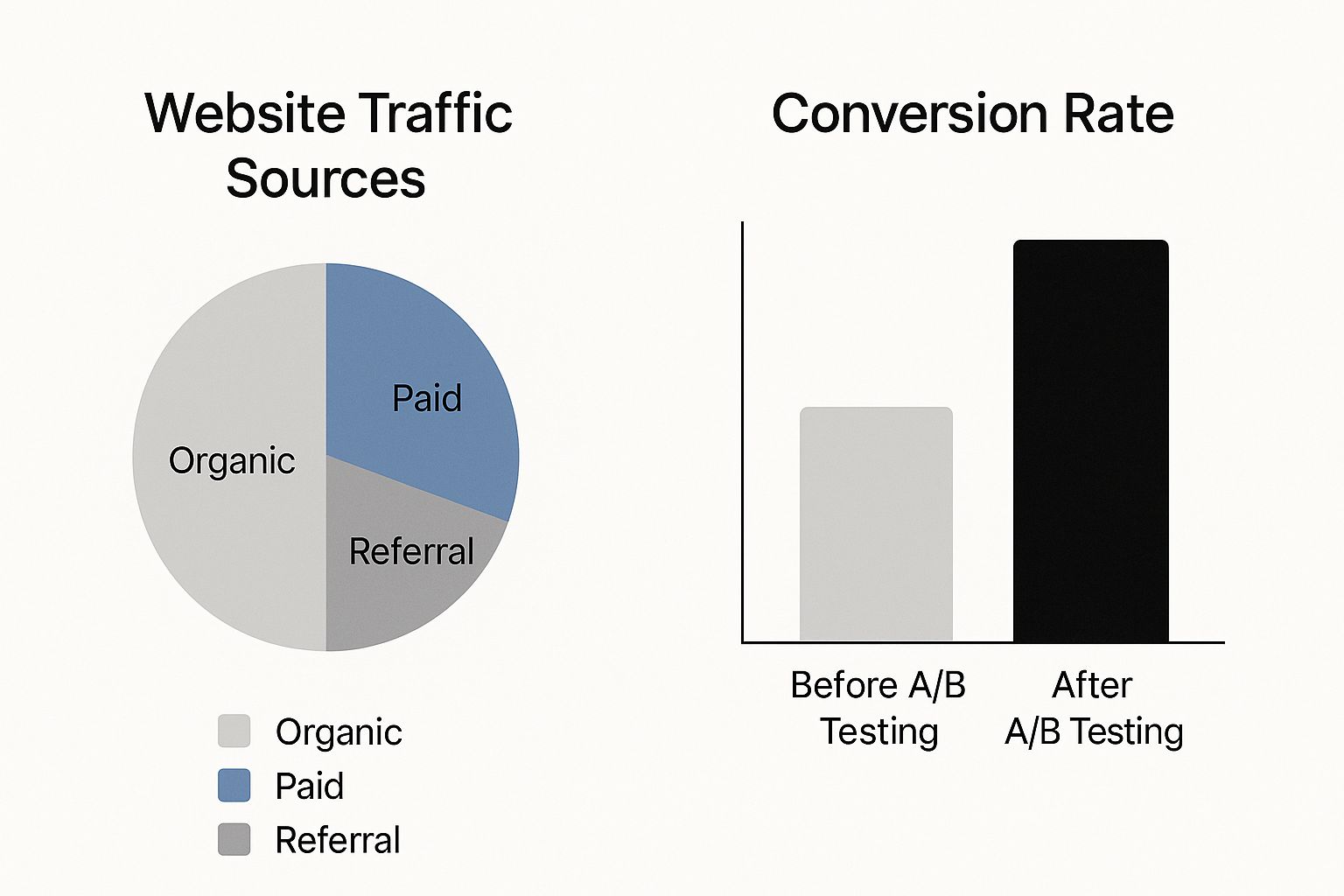
As you can see, a healthy mix of traffic is key. But Conversion Rate Optimisation (CRO) is what really squeezes the value out of every single visitor, no matter how they found you.
To help you get started, we’ve put together this quick comparison of the main digital marketing channels. It should give you a clearer idea of where to focus your efforts first.
Comparing Digital Marketing Channels for E-commerce (How to Increase Online Sales)
| Channel | Best For | Key Metric | Typical Time to Results |
|---|---|---|---|
| SEO | Building long-term, sustainable organic traffic and brand authority. | Organic Rankings, Organic Traffic | 6-12 months |
| PPC (Google Ads) | Driving immediate, high-intent traffic and sales. | Return on Ad Spend (ROAS), Cost Per Acquisition (CPA) | Immediate (within days) |
| Social Media Ads | Building brand awareness and reaching specific demographics with visual ads. | Engagement Rate, Reach, CPA | 1-3 months |
| Email Marketing | Nurturing leads, customer retention, and driving repeat purchases. | Open Rate, Click-Through Rate, Conversion Rate | Immediate to ongoing |
| Content Marketing | Attracting and educating your audience, building trust and authority. | Traffic, Time on Page, Leads Generated | 3-6 months |
Each channel has its strengths, and the best strategies often combine two or three of them to create a powerful, sales-driving machine.
Capturing Immediate Demand with PPC Campaigns
While SEO builds momentum slowly, Pay-Per-Click (PPC) advertising is all about instant impact. Platforms like Google Ads and Microsoft Advertising let you put your products right in front of customers who are actively searching for them. It’s an incredibly effective way to increase online sales, and fast.
The real power of PPC lies in its precision. You can target people based on what they search for, where they live, their age, and even their past browsing behaviour. For instance, a London-based furniture shop could run ads that only appear to people within a 15-mile radius who have just searched for a “handmade oak dining table.”
For a deeper dive, check out our guide on proven strategies to optimise your website for conversions.
A well-run PPC campaign isn’t an expense; it’s a direct investment in sales. By tracking your Return on Ad Spend (ROAS), you can see exactly how much revenue each pound spent on ads is bringing in. This data allows you to scale up your winning campaigns with total confidence.
Nurturing Relationships with Email Marketing (How to Increase Online Sales)
Getting traffic to your site is one thing, but keeping the customers you’ve already won is far more cost-effective. Email marketing is still one of the best tools out there for building customer loyalty and driving repeat business. It’s your direct line to an audience that has already given you a thumbs-up.
But don’t just use it to shout about sales. Your goal should be to provide genuine value.
- Welcome Series: Roll out the red carpet for new subscribers. A series of emails introducing your brand story, showing off best-sellers, and maybe offering a little welcome discount can work wonders.
- Exclusive Content: Give your subscribers the VIP treatment. Share helpful tips, behind-the-scenes content, or early access to new products.
- Personalisation: Segment your email list based on what people have bought before. Sending relevant product recommendations that match their tastes is far more effective than a generic blast.
Ultimately, you need a multi-channel marketing approach. By combining the long-term, organic reach of SEO with the immediate, targeted punch of PPC and the relationship-building power of email, you create a complete system for driving and converting high-quality traffic. For a more comprehensive look at scaling your business, exploring these actionable ecommerce growth strategies will give you even more valuable ideas.
Common Questions About Increasing Online Sales
Diving into the world of e-commerce always brings up a heap of questions. As you start rolling out new strategies to boost your online sales, it’s completely normal to second-guess whether you’re focusing on the right things. This section is all about tackling the most common questions we get from business owners just like you.
We’ll give you clear, straight-to-the-point answers on everything from getting started on a shoestring budget to figuring out which numbers actually matter. The aim here is to arm you with practical advice, clear up any confusion, and help you feel confident in your game plan.
How Much Should I Spend on Marketing to See Results?
Ah, the classic “how long is a piece of string?” question. The honest answer is, it really depends. For most small to medium-sized businesses, allocating 5-10% of your total revenue to marketing is a solid starting point. But this is far from a hard-and-fast rule.
A new business fighting for market share might need to be more aggressive, pushing that figure closer to 15-20% to build that crucial initial buzz and drive traffic. On the flip side, an established brand with a strong organic presence might get away with spending less.
The real key isn’t the amount you spend, but the return you get. Start with a modest, manageable budget and nail one or two channels you know your audience lives on. Then, track your Return on Ad Spend (ROAS) like a hawk.
- PPC Campaigns: You can start seeing data roll in, and even some sales, with as little as £10-£20 a day.
- SEO: This is more of a time investment upfront, but the long-term payoff in “free” traffic is massive.
Treat your marketing budget like a flexible investment, not a fixed cost. When a channel is clearly working, be ready to scale up. If something isn’t delivering after a fair test, don’t be afraid to pull those funds and put them somewhere that will.
Which Sales Channels Are Best for a New Business?
When you’re just starting out, the temptation to be everywhere at once is huge. Resist it. That’s a surefire way to spread yourself too thin and achieve nothing. The smart move is to master one or two channels before you even think about expanding.
For most new e-commerce ventures, this is a winning combination:
- Your Own E-commerce Website: This is your digital storefront, your home base. It gives you complete control over your brand, the customer journey, and most importantly, your profit margins. Platforms like Shopify have made this incredibly easy to set up.
- A Major Marketplace: Getting your products on a platform like Amazon or Etsy gives you instant access to a massive, ready-made audience of buyers. It’s a fantastic way to land your first sales and start building that all-important social proof.
Social commerce is another powerhouse, especially on platforms like Instagram or Facebook where your target audience is already highly engaged. It creates a smooth path from discovery to purchase, all within the app. Just pick the platform where your customers spend most of their time.
How Do I Know If My Strategies Are Actually Working?
Data is your best mate here. Without tracking the right metrics, you’re essentially flying blind. To know for sure if your efforts to increase online sales are hitting the mark, you need to keep a close eye on a few key performance indicators (KPIs).
| Metric | What It Tells You | Why It Matters |
|---|---|---|
| Conversion Rate | The percentage of your website visitors who end up buying. | This is the ultimate health check for your website’s effectiveness. |
| Average Order Value (AOV) | The average amount a customer spends in a single transaction. | Pushing this number up means you’re earning more from every sale. |
| Customer Lifetime Value (CLV) | The total profit you can expect to make from one customer. | This highlights the long-term value of keeping customers happy. |
| Cart Abandonment Rate | The percentage of shoppers who add items to their cart but leave. | A high rate is a massive red flag for friction in your checkout. |
Make sure you have a tool like Google Analytics set up from day one. Check these numbers regularly to understand what’s driving your growth and where you need to make tweaks. A rising conversion rate and AOV are undeniable signs that you’re on the right track.
Ready to stop guessing and start getting real results from your digital marketing? The team at PPC Geeks uses data-driven strategies to build and manage campaigns that deliver measurable growth. Book your free PPC audit today!