




Before you can even think about improving ecommerce conversion rates, you need to get a handle on where you stand right now. It all starts with a simple, yet crucial, first step: understanding your current performance. You need a solid baseline, and that means diving into your data before you change a single thing. This turns vague guesswork into a real, actionable strategy.
Improving Ecommerce Conversion Rates: Establishing Your Current Conversion Baseline
You can’t improve what you don’t measure. It’s a bit of a cliché, but it’s true. Before you start tweaking product pages or overhauling your checkout process, you have to dig into your analytics and establish a clear, accurate baseline. This isn’t about chasing vanity metrics like site traffic; it’s about getting to the real story your numbers are telling.
A thorough self-audit is the only way to kick off a successful conversion rate optimisation project. You’re looking for the weak spots – the points where potential customers are dropping off and, more importantly, why. Is it a confusing product page? High shipping costs that only appear at the last minute? A clunky mobile checkout? Your analytics hold all the answers.
Finding the Truth in Your Data
Start by getting properly acquainted with a tool like Google Analytics. Your goal is to move beyond the high-level dashboard view and start segmenting your data to uncover specific pain points. Looking at the overall conversion rate is fine, but it doesn’t give you the full picture.
Here are the key areas I always investigate first:
- Conversion Rate by Device: Is your mobile conversion rate miles behind your desktop rate? This is a classic sign of a poor mobile user experience that needs immediate attention.
- Conversion Rate by Traffic Source: Are visitors from your PPC campaigns converting better than those from organic search? This helps you understand user intent and tells you where to put your money for the best return.
- New vs. Returning Visitors: If returning visitors convert at a much higher rate (they often do!), your focus should shift to improving that crucial first-time user journey.
This visual breaks down the basic process: start with the data, pinpoint the specific issues, and then set your baseline so you can measure everything you do from here on out.
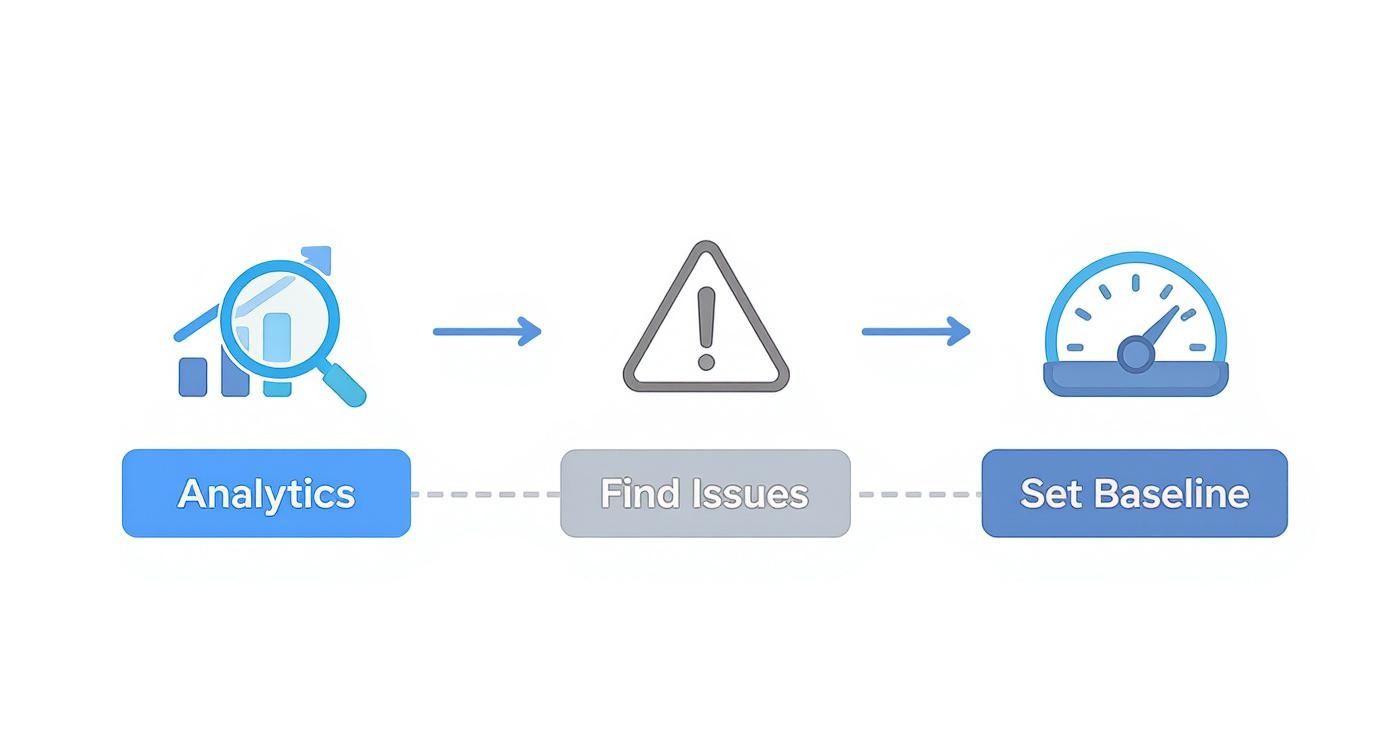
This structured approach makes sure your efforts are focused where they’ll have the biggest impact. No more random changes hoping for the best.
Benchmarking Your Performance (Improving Ecommerce Conversion Rates)
Once you have your numbers, you need to put them in context. What does a “good” conversion rate actually look like? The UK e-commerce scene is fiercely competitive, so it helps to know the lay of the land.
To give you a rough idea, we’ve put together some key benchmarks.
Key UK Ecommerce Conversion Rate Benchmarks
| Metric | Average Rate | Target Rate |
|---|---|---|
| Overall Online Shopping (Late 2023) | 2.18% | 3.0% – 3.5% |
| Overall Online Shopping (Late 2024 est.) | 1.94% | 3.0% – 3.5% |
| Top Performing UK Stores | 3.4%+ | 4.0%+ |
These figures, drawn from wider industry data, show that while the average sits around 2%, many ambitious UK stores are aiming for 3.4% or higher. Understanding these benchmarks helps you set realistic goals. If your rate is 1.5%, aiming for 2% is a solid, tangible first step. If you’re already at 3%, your focus might shift to optimising average order value instead. For a deeper dive, check out our guide on what is a good conversion rate for more detailed industry breakdowns.
Your most important benchmark is your own historical data. The primary goal is consistent, incremental improvement month over month, turning your baseline into a launching pad for growth.
Identifying Funnel Drop-Off Points
Some of the most powerful insights you’ll ever get come from analysing your conversion funnel. Where are you losing people? A typical ecommerce journey moves from viewing a product, to adding it to the cart, starting the checkout, and finally, making the purchase.
By setting up a funnel visualisation in your analytics, you can pinpoint the exact stage where users are giving up. A massive drop-off between “add to cart” and “initiate checkout” is a huge red flag, often pointing to problems like unexpected shipping costs or being forced to create an account. This data transforms a vague problem (“our conversions are low”) into a specific, solvable issue (“we have high cart abandonment, likely due to shipping fees”).
To get a full grasp of the strategies you can use, it’s worth reviewing comprehensive guides on ecommerce conversion rate optimization strategies that really work. Establishing this data-backed starting point is the foundation for everything that comes next.
Improving Ecommerce Conversion Rates: Designing Product Pages That Build Trust
Think of your product page as your digital salesperson, working around the clock. It’s often the last hurdle a customer clears before they decide to buy. Too many businesses treat it like a simple catalogue entry, but it’s actually a powerful tool for building trust and answering questions before they’re even asked. Getting this part right is absolutely fundamental to improving your e-commerce conversion rates.
Put yourself in your customer’s shoes. They can’t touch, feel, or try on your product. Every single element on that page—from the quality of your images to the clarity of your returns policy—either builds their confidence or plants a seed of doubt. Your mission is to get rid of that doubt completely.
The Anatomy of a High-Converting Product Page
A product page that genuinely converts is a masterful blend of compelling visuals, persuasive copy, and undeniable social proof. It has to guide the user seamlessly from their initial interest to a confident decision to buy. Every component has a specific job to do in building that trust and overcoming any hesitation.
A few non-negotiable elements include:
- Exceptional Visuals: You need to go beyond basic studio shots. Use high-resolution images showing the product from multiple angles, in context, and even in a video. For clothing or accessories, showing the item on different body types can be a total game-changer.
- Detailed, Benefit-Driven Descriptions: Don’t just list features; explain how those features actually benefit the customer. Use short, scannable bullet points for the technical specs and a slightly longer paragraph to tell the product’s story.
- Clear and Obvious Calls-to-Action (CTAs): The ‘Add to Cart’ button should be impossible to miss. Use a contrasting colour that draws the eye and punchy, action-oriented text that leaves no room for confusion.
For many online retailers, especially in fashion, bridging that gap between a 2D screen and a 3D product is the biggest challenge. To lower the risk of disappointment and build that all-important customer confidence, you could implement features like virtual clothing try-on apps which let shoppers visualise the fit and style much more accurately.
Harnessing the Power of Social Proof (Improving Ecommerce Conversion Rates)
Nothing builds trust faster than seeing that other people have already bought—and loved—your product. Social proof turns your brand monologue into a community conversation, making the purchase decision feel much safer and more validated.
A huge factor in improving e-commerce conversion rates in the UK is sector-specific performance, particularly in retail segments like fashion and jewellery. On average, UK retail e-commerce conversion rates sit around 1.9%, a pretty modest figure that highlights a massive opportunity for growth, especially when you consider cart abandonment rates are hovering near 70%. That gap between interest and purchase often comes down to a lack of trust at the final hurdle—which is precisely what social proof is designed to fix.
Never, ever underestimate the power of an authentic customer review. Research consistently shows that shoppers trust what their peers say far more than they trust brand messaging. Make your reviews prominent, searchable, and easy to read.
Here’s how you can weave social proof throughout your page:
- Star Ratings Above the Fold: Pop the average star rating right below the product title. It gives an immediate, at-a-glance signal of quality.
- User-Generated Content (UGC): Encourage customers to share photos of themselves using your product. A gallery of real people enjoying your item is infinitely more persuasive than another polished studio shot.
- Detailed Customer Reviews: Don’t just show the star rating; display the full text. It’s even better if you include filters so users can find reviews relevant to them (e.g., filtering clothing reviews by the reviewer’s height and size).
- Expert Endorsements or “As Seen In”: If you’ve been featured in well-known publications or endorsed by an industry expert, showcasing those logos adds a powerful layer of credibility.
Ultimately, a product page is just one type of landing page, and many of the same principles apply. We cover this topic in more detail in our guide to landing page best practices, which offers more tips on design and layout. By combining stellar visuals, clear copy, and authentic social proof, you’ll transform a simple product listing into a powerful conversion engine that builds lasting trust with every visitor.
Improving Ecommerce Conversion Rates: Creating a Frictionless Checkout Experience
So, your customer has browsed your site, fallen in love with a product, and even added it to their basket. They’re right at the finish line, ready to hand over their money… and yet, this is exactly where an incredible number of sales just fall apart. The checkout isn’t just a boring formality; it’s the final, and often most delicate, step in their journey with you.
A clunky, confusing, or surprisingly pricey checkout is the number one reason people abandon their carts. Every single extra field they have to fill in, every unexpected fee, and every forced action creates friction. Your mission is to get rid of that friction completely. You want to make the path to purchase so smooth that clicking ‘buy’ feels like the most natural thing in the world.

This final stage is all about psychology. It’s about reassuring the customer that they’re making a good decision. When you reduce the mental effort required to complete the purchase, you massively increase the chances of closing the sale. This isn’t just a nice-to-have; it’s a critical part of boosting your ecommerce conversion rates.
Ditch Mandatory Account Creation
Honestly, one of the biggest conversion killers I see is forcing users to create an account before they can buy something. Just imagine: a new customer is excited about your product, ready to pay, and suddenly they’re hit with a form demanding they invent a username and password. That excitement immediately turns into hesitation and annoyance.
Forcing registration adds extra steps and makes the customer feel like you’re just trying to grab their data before you’ve even earned their trust. The fix is simple but unbelievably effective: always offer a prominent guest checkout option.
Make guest checkout the default, most obvious choice. It sends a clear message to first-time buyers: we get it, you’re busy, and we want to make this easy for you. You can always ask them to create an account after the sale is complete, framing it as a handy way to track their order.
Be Totally Transparent About All Costs (Improving Ecommerce Conversion Rates)
There’s nothing more infuriating for a shopper than getting to the final payment screen only to see the total price suddenly jump up because of shipping fees or taxes you didn’t mention earlier. This last-minute shock is a massive breach of trust and a guaranteed way to send people running for the hills.
Transparency is non-negotiable. You need to show all costs as early as you possibly can.
- Shipping Calculator: Pop a simple tool on the basket page where people can enter their postcode to see shipping costs straight away.
- Clear Policies: Make sure your shipping and returns policies are linked directly from the basket and checkout pages. Nobody wants to go on a scavenger hunt for basic info.
- No Hidden Fees: The price they see in the basket should be the final price they pay. Full stop. Surprises kill conversions.
This kind of upfront honesty manages expectations and avoids the sticker shock that derails so many sales. It builds confidence right when you need it most.
Streamline the Payment Process
Once a customer decides to buy, your only job is to make it as easy as humanly possible for them to give you their money. This means fewer forms and more modern, trusted payment methods. Every click you can shave off the process is a small win for your conversion rate.
Integrating popular express payment options allows for one-click purchases, which is a game-changer. These methods are built for speed and security, using details the shopper has already saved elsewhere.
| Payment Method | Key Benefit for Shoppers | Impact on Conversions |
|---|---|---|
| Apple Pay / Google Pay | Lets them pay with Face ID or a fingerprint, no card details needed. | Massively reduces friction on mobile, where typing out card numbers is a pain. |
| PayPal | A widely trusted name where users just log in to their account to pay. | Builds huge confidence for shoppers who are hesitant to share card details with a new website. |
| Shop Pay / Amazon Pay | Securely saves shipping and payment info for millions of users across the internet. | Offers a super-fast, one-click checkout for anyone who’s used it before. |
Finally, you need to shout about security. Displaying universally recognised trust seals (like SSL certificates and payment provider logos) visually reassures customers that their sensitive data is safe with you. This powerful trio—speed, choice, and visible security—creates a checkout experience that effortlessly turns browsers into buyers.
Improving Ecommerce Conversion Rates: Mastering the Mobile Shopping Journey
Let’s be honest, most of your customers are scrolling through your shop on their phones. But is your site actually built for them? Having a “mobile-friendly” site isn’t the win it used to be. To really move the needle on your ecommerce conversion rates, you need to craft an experience that feels more natural and intuitive on a small screen than it does on a desktop.
The goal is pretty straightforward: make buying on a phone easier than on a computer. This comes down to the small details that make a massive difference – think thumb-friendly buttons, lightning-fast load times, and simple, tappable forms that don’t make people want to throw their phone across the room.

This screenshot from Apple is the perfect example of what a mobile checkout should feel like. It’s secure, it’s instant, and it asks for almost zero effort from the user. The genius here is the removal of friction. The customer doesn’t have to go digging for their wallet or manually type in card details. What used to be a multi-step chore becomes a single tap.
Closing the Mobile Conversion Gap
There’s a well-known gap between the number of people who browse on their phones versus how many actually follow through with a purchase. For UK businesses, this is both a huge challenge and a massive opportunity.
Industry benchmarks show that mobile conversion rates often hover between 1.5% and 2%. Meanwhile, desktop rates can easily be double that, hitting 3.5% to 4%. Given how glued we are to our smartphones in the UK, optimising your mobile interface is one of the most direct routes to a significant jump in conversions. You can dig into more stats and insights on UK ecommerce benchmarks over at blubolt.com.
The reason for this gap isn’t a lack of buying intent; it’s almost always a clunky user experience. When a potential customer has to pinch, zoom, and struggle to tap tiny buttons, their patience wears thin. Fast.
Designing for Thumbs, Not Cursors (Improving Ecommerce Conversion Rates)
A genuine mobile-first design isn’t about just shrinking your desktop site. It demands a complete rethink of how people interact with your store. A mouse cursor offers pinpoint precision, but a thumb is a much clumsier tool. Every clickable element needs to be designed with this reality in mind.
Here are a few essential tweaks for a proper thumb-friendly experience:
- Large, Tappable Buttons: Make sure your “Add to Basket” and “Checkout” buttons have plenty of space around them. You don’t want someone trying to buy and accidentally hitting the “back” button. A good rule of thumb (pun intended) is a minimum tap target size of 44×44 pixels.
- Simplified Navigation: Forget those complicated dropdown menus that are a nightmare to use on a touchscreen. A clean, simple “hamburger” menu or a streamlined bottom navigation bar is far more effective on mobile.
- Easy-to-Use Forms: Make life easier for your customers by using device features like the numeric keypad for phone number fields and autofill for addresses. The less someone has to manually type, the less likely they are to give up.
The core principle of a great mobile experience is speed and simplicity. If any part of the journey feels slow or complicated, you’re losing sales. Shave seconds off your load time and clicks off your checkout, and you’ll see your conversion rate climb.
Integrating Seamless Mobile Payments
Manually typing in credit card and shipping information on a phone is one of the biggest conversion killers out there. This is where one-click buying and mobile wallets become your secret weapon.
Offering options like Apple Pay and Google Pay isn’t just a nice-to-have anymore; it’s non-negotiable for a modern ecommerce store. These services let shoppers check out using their saved details and biometric authentication, like a fingerprint or Face ID.
This transforms a tedious, multi-step process into a single, secure tap. By removing the biggest pain point in the mobile checkout, you make impulse buys effortless and dramatically slash cart abandonment right at the final hurdle.
Improving Ecommerce Conversion Rates: Using PPC to Recapture Abandoned Carts
Let’s face it, most visitors won’t buy from you on their first visit. It’s just a fact of ecommerce life. They browse, they compare prices, and then life gets in the way. But when someone adds an item to their cart, they’re no longer a casual browser. They’re a red-hot lead who has shown clear intent to buy.
Letting that person just drift away is one of the biggest missed opportunities you can make. This is where a smart Pay-Per-Click (PPC) strategy isn’t just useful; it’s essential.
We’re not talking about those creepy, generic ads that follow you around the internet for weeks. This is about creating thoughtful, timely reminders that give interested shoppers a gentle nudge back towards finishing what they started. When you get it right, it feels less like advertising and more like a genuinely helpful prompt.
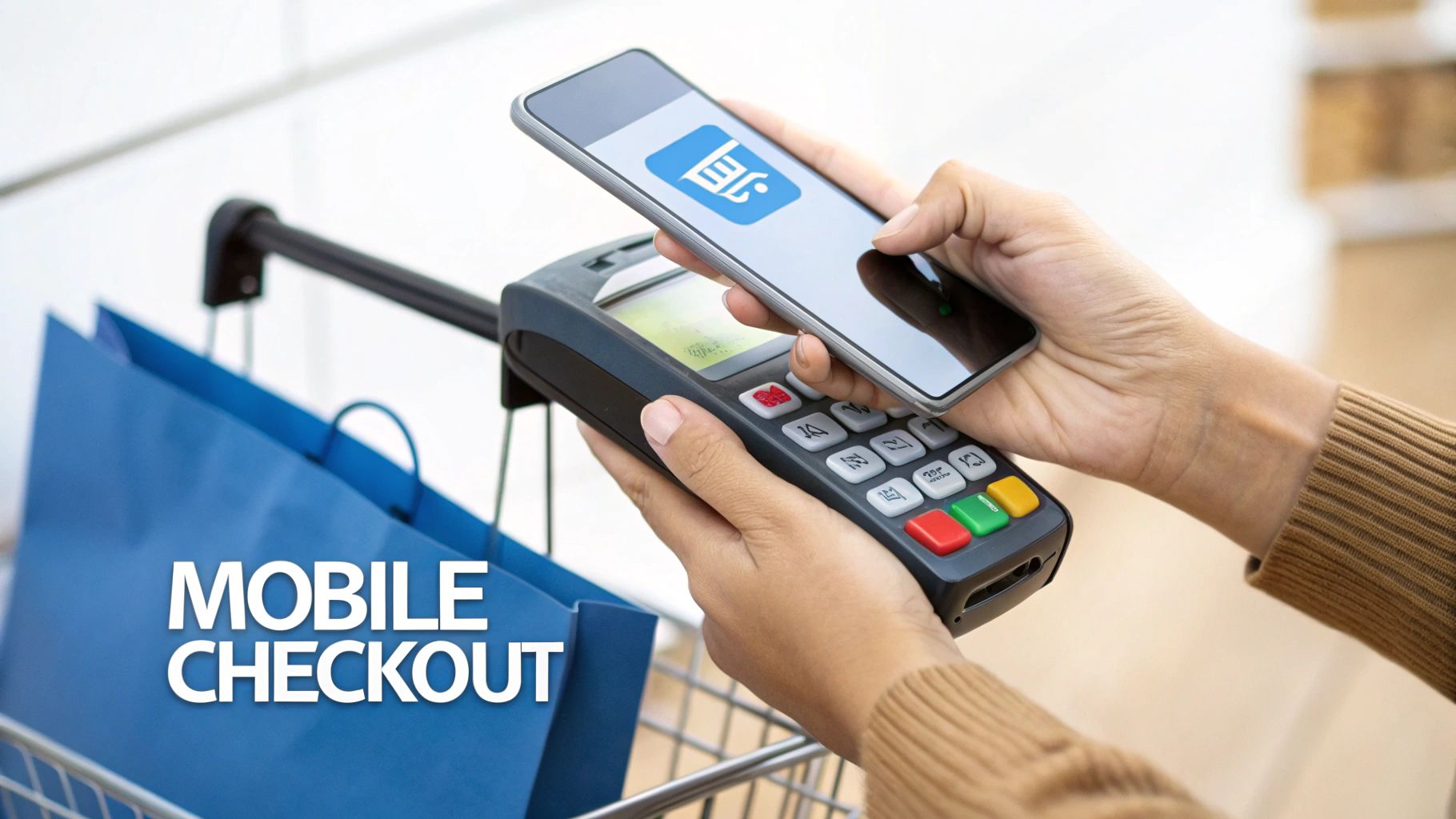
The goal is to re-engage these high-intent users on the platforms they’re already scrolling through, like Google and social media, and turn that moment of hesitation into a sale.
Building Your Retargeting Audiences
First things first: you need to get your audience segmentation sorted. Just lumping every single past visitor into one giant retargeting bucket is a recipe for wasted ad spend. It’s lazy and ineffective.
You have to create specific audiences based on exactly how far they got in their journey. This is what lets you tailor your messaging with pinpoint accuracy.
Here are the essential segments you need to build:
- All Website Visitors: This is your widest net. The goal here is simple brand recall – keeping your store top-of-mind with general ads.
- Product Page Viewers: These folks showed interest in a specific item but didn’t quite commit to adding it to their cart. Your ads can remind them of that product’s benefits or maybe show them some related items they might like.
- Cart Abandoners: This is your golden goose, your highest-value audience. They were one click away from becoming a customer. Ads for this group need to be direct, persuasive, and maybe even sweetened with a small incentive.
By splitting them up, you can be much smarter with your budget. You might go in heavy to recapture those cart abandoners while maintaining a lower, steadier spend on your general visitors.
Crafting Dynamic and Relevant Adverts (Improving Ecommerce Conversion Rates)
Once your audiences are neatly defined, the real magic begins: showing them ads that are hyper-relevant. This is where dynamic product ads become your secret weapon. Instead of a generic brand advert, you can automatically show people the exact products they were looking at or left in their cart.
Think about it. A customer abandons a basket with a specific pair of blue trainers. A few hours later, they’re scrolling through Facebook, and boom – there’s an ad with those very same trainers. That level of personalisation is incredibly powerful because it taps directly into an interest they’ve already shown.
Retargeting isn’t just about showing people what they left behind. It’s about figuring out why they hesitated and addressing that head-on. Was the price a bit high? Was shipping a concern? Your ad can be the solution.
For instance, your ad copy for a cart abandoner could simply say:
“Still thinking about it? Complete your order now and get free shipping.”
Sometimes, that small nudge is all it takes to overcome their final reservation and bring them straight back to your site to seal the deal. This is a classic tactic, and you can see a load of great remarketing ads examples that use similar strategies to brilliant effect.
Optimising for Return on Ad Spend (ROAS)
Bringing back abandoned carts is a numbers game, and the metric that matters most is your Return on Ad Spend (ROAS). Every pound you put into retargeting needs to bring back a whole lot more in revenue. To make that happen, you have to be clinical with your campaign setup.
Here are a few tips I’ve learned to really maximise ROAS:
- Set Frequency Caps: Don’t be that brand. Annoying your audience by hammering them with the same ad dozens of times a day is a quick way to get ignored. Set a sensible cap (say, 3-5 impressions per day) to stay helpful without becoming a pest.
- Use Burn Pixels: This is non-negotiable. As soon as someone buys, you must stop showing them ads for the product they just purchased. Exclude recent converters from your retargeting lists to avoid burning through your budget.
- Test Your Offers: Don’t just guess what will work. Experiment with different incentives for your cart abandoners. Does a 10% discount outperform a free shipping offer? Test them both and let the data tell you which one delivers the better return.
By combining sharp audience segmentation with dynamic, personalised ads, your PPC campaigns can become a highly efficient machine for turning those missed opportunities into loyal, paying customers.
Improving Ecommerce Conversion Rates: Building a Culture of Continuous Testing
Improving ecommerce conversion rates isn’t a one-off project with a neat finish line. The most successful online stores I’ve worked with treat it as a constant process of learning, tweaking, and refining. They’ve moved beyond gut feelings and office debates, building a system where every meaningful change is tested and validated by real customer behaviour. This is where a culture of continuous testing becomes your most powerful asset.
It might sound a bit technical, but the core idea is simple: turn your ideas into data-driven experiments. Instead of just rolling out a change and crossing your fingers, you test it against the current version of your site to see which one actually performs better. This methodical approach takes the mystery out of what your customers truly want and systematically improves your store over time.
From Ideas to Actionable Hypotheses
Every good test begins not with a fancy tool, but with a solid hypothesis. A hypothesis is just a clear, testable statement about a change you believe will produce a specific, measurable result. It’s the framework that turns a vague thought like “our buttons should be brighter” into a proper experiment.
A strong hypothesis always has three parts:
- The Proposed Change: What exactly are you going to alter?
- The Expected Outcome: Which metric do you predict will improve, and by how much?
- The Rationale: Why do you believe this change will cause that outcome?
Let’s make that real. Instead of saying, “Let’s test a new CTA,” you’d frame it like this: “Changing our main CTA button colour from blue to a high-contrast green will increase add-to-cart clicks by 10% because the new colour stands out more against our page background, grabbing more attention.”
See the difference? This structure forces you to think critically about your reasoning and defines what success looks like before you even begin.
Choosing What to Test for Maximum Impact (Improving Ecommerce Conversion Rates)
With endless possibilities, the biggest challenge is often deciding what to test first. The secret is to prioritise changes that have the potential for the biggest impact on your bottom line. Don’t get bogged down testing tiny headline tweaks on a low-traffic page.
Instead, focus your energy on high-traffic, high-impact areas of your site where even small improvements can lead to significant gains in revenue.
- Product Pages: Test things like your CTA button text (“Add to Basket” vs. “Buy Now”), the placement of customer reviews, or whether adding a product video makes a difference.
- Checkout Process: Experiment with a single-page checkout versus a multi-step process. Or, try making your trust seals and payment logos more prominent.
- Homepage: A/B test your main hero image and headline to see which combination grabs the most attention and encourages people to start browsing.
Remember, the goal of testing isn’t just to find a “winner.” It’s to learn something valuable about your audience with every experiment, win or lose. A failed test that proves a new design hurts conversions is just as useful as a winning one—it stops you from making a costly mistake.
Using Tools and Interpreting Results
Once you have a hypothesis, you’ll need a tool to run the experiment. Platforms like Google Optimize (now part of Google Analytics 4), VWO, or Optimizely make setting up A/B tests relatively straightforward. These tools work by showing one version of your page (the control) to a segment of your traffic, and a different version (the variant) to another.
From there, they track user behaviour and tell you, with statistical confidence, which version led to more conversions. The crucial part is letting a test run long enough to gather enough data. Pulling the plug too early can lead to completely wrong conclusions. You need to reach statistical significance, which usually means a 95% confidence level that the results aren’t just down to random chance.
Building this testing muscle transforms your whole approach to ecommerce. Instead of getting stuck in meetings debating opinions, your team can simply say, “Let’s test it.” This data-first mindset ensures your store is constantly evolving based on what customers actually do, not what you think they’ll do. For more inspiration, you can find some fantastic real-world conversion rate optimisation examples that show how other brands have used testing to get brilliant results.
Frequently Asked Questions: Improving Ecommerce Conversion Rates
When you start diving into the world of conversion rate optimisation, a few common questions always pop up. Here are some straight answers to the queries we hear most often from business owners trying to get more customers over the finish line.
What Is a Good Conversion Rate for an Ecommerce Store?
This is the big one, isn’t it? The honest answer is: it depends. While the commonly accepted benchmark for a “good” ecommerce conversion rate in the UK hovers between 2% and 4%, that number doesn’t tell the whole story.
Context is absolutely everything. A small shop selling unique, handmade crafts to a dedicated following might see much higher rates than that. On the other hand, a business selling high-end furniture, where the customer journey is much longer and more considered, could see a lower rate and still be doing brilliantly.
The only benchmark that truly matters isn’t some generic industry average; it’s your own performance over time. Seeing consistent, month-on-month improvement is the real sign that your CRO strategy is working.
How Long Does It Take to See Results from CRO Efforts?
The timeline for seeing a tangible impact really comes down to the scale of the changes you’re making. You’re not going to overhaul your website and see a jump in sales overnight.
Here’s a realistic breakdown:
- Small Tweaks: If you’re A/B testing something simple like a button colour or the wording on a call-to-action, you could see a clear winner in just 2-4 weeks, provided you have enough traffic to get statistically significant data.
- Bigger Changes: For more fundamental shifts—like a complete redesign of your checkout flow or introducing a new payment provider—you’ll need to give it more time. Expect it to take 1-3 months to properly implement, test, and measure the results.
The trick is to think of CRO as a continuous cycle of small, smart improvements rather than waiting for one big, magical fix.
Which Single Change Has the Biggest Impact on Conversion Rates?
If you’re looking for one area that almost always delivers the biggest and fastest wins, focus on simplifying your checkout process. This is the moment your customer’s intent to buy is at its peak, but it’s also where friction and frustration can derail the whole thing.
For most online stores, the single most powerful change you can make is to introduce a guest checkout option. Forcing a new customer to create an account is a notorious conversion killer. Remove that hurdle, make the path to payment as smooth as humanly possible, and you’ll directly tackle one of the main causes of cart abandonment. The lift in sales can be significant and almost immediate.
At PPC Geeks, we live and breathe data-driven strategies that turn ad spend into real, measurable growth. If you’re ready to move beyond guesswork and see tangible results from your ecommerce campaigns, our team of UK-based experts can build a strategy that delivers. Find out how we can help at https://ppcgeeks.co.uk/.