




You’ll often hear that a good conversion rate is somewhere between 2% and 5%. Honestly, that’s a bit like saying “a good temperature is 20 degrees” – it really depends on where you are and what you’re doing. The real answer is that what’s exceptional for one business might be just average for another. It all comes down to your industry, your goals, and who you’re trying to reach.
Understanding Your Conversion Rate
Before we get bogged down in benchmarks, let’s get back to basics. What exactly is a conversion rate?
Think of it like owning a high-street shop. Loads of people might wander in, browse the shelves, and then walk out. Only a handful will actually go to the till and buy something. Your conversion rate is simply the digital version of that scenario.
It’s the percentage of people visiting your website who take a specific, desired action. This single number is one of the most powerful ways to gauge how well your marketing and website are actually working.
A Conversion Is More Than Just a Sale
It’s a common trap to think “conversion” is just another word for “sale.” While making a sale is obviously a massive win for any e-commerce site, the term itself is much broader. A conversion is any meaningful goal you want a user to hit.
For your business, that valuable action might be:
- Signing up for a newsletter: Perfect for building your email list for future campaigns.
- Requesting a free demo: A massive step for B2B software companies.
- Downloading a whitepaper or guide: This flags someone as a warm lead who’s interested in what you have to say.
- Filling out a contact form: This generates a direct, hot-off-the-press enquiry for your team.
In essence, your conversion rate is a measure of how good your website is at convincing visitors to take that next step, whatever that step might be.
Why This Metric Is So Important
Keeping a close eye on your conversion rate gives you a direct line of sight into what’s working—and, more importantly, what isn’t.
A low rate could be a red flag for a confusing website layout, a weak offer, or maybe you’re just pulling in the wrong crowd. On the flip side, a high rate is a clear signal that your message and design are hitting the mark with visitors.
Once you get your head around this fundamental idea, you can start making smart, targeted improvements. To take things to the next level, our detailed guide explains what conversion rate optimisation is and how it can directly pump up your sales figures.
How to Calculate Your Conversion Rate Accurately
Before you can even think about improving things, you need to know exactly where you stand. Calculating your conversion rate is that crucial first step. Without a solid number, you’re just flying blind.
Luckily, the calculation itself is beautifully simple. It’s the one formula every single marketer should have memorised.
(Total Number of Conversions / Total Number of Visitors) x 100 = Conversion Rate (%)
This little equation cuts through all the noise, turning raw data into a clear percentage that tells you how well your website or landing page is actually doing its job. Let’s run through a few real-world examples to see it in action.
Applying the Formula to Your Business
The great thing about this formula is that it works for pretty much any business or goal you can think of. The logic stays the same.
- E-commerce Example: An online fashion boutique gets 10,000 visitors in a month. Out of those, they make 200 sales. Their conversion rate is (200 / 10,000) x 100 = 2%. Simple.
- B2B Lead Generation Example: A software company’s shiny new landing page attracts 5,000 visitors. From that traffic, 150 people fill out the demo request form. Their conversion rate is (150 / 5,000) x 100 = 3%.
- Publisher Example: A personal finance blog pulls in 25,000 visitors to a popular article. Of those readers, 1,250 sign up for the weekly newsletter. The conversion rate for that specific goal is (1,250 / 25,000) x 100 = 5%.
As you can see, what counts as a “conversion” can be completely different depending on the business model.
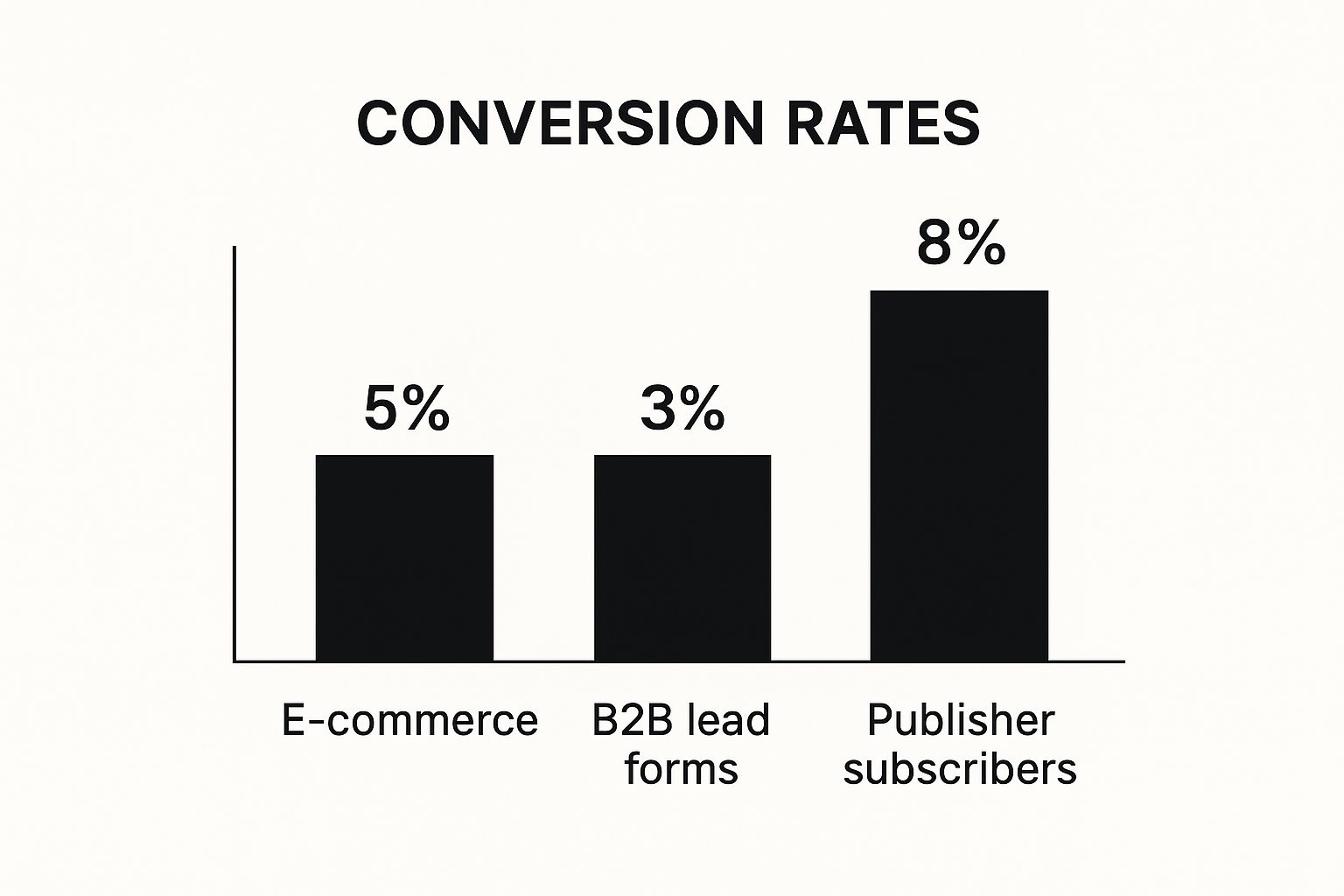
This just goes to show that a “good” conversion rate is all about context. What’s a brilliant result for a B2B firm is completely different from what a publisher is aiming for. Understanding these different key performance indicators for digital marketing is absolutely essential if you want to set targets that actually make sense for your business.
Finding Your Industry Conversion Rate Benchmark
So, you’ve nailed down how to calculate your conversion rate. The next logical question is a big one: “Is my number any good?” This is where industry benchmarks come into play, giving you some much-needed context for your data.
Comparing your performance is how you find out if that 2% conversion rate is perfectly average, something to celebrate, or a red flag that something needs fixing—fast. Think of benchmarks as a starting point, not a strict report card. They’re there to help you set realistic goals.
Why Do Conversion Rates Vary So Much?
You can’t compare apples and oranges, and the same goes for conversion rates. An e-commerce brand selling £20 t-shirts will almost always have a higher conversion rate than a B2B software company trying to close a £5,000 annual subscription. The customer’s commitment, the cost, and the sheer amount of thought required are worlds apart.
Several key factors are behind these massive differences between industries:
- Purchase Complexity: A simple, low-cost item doesn’t require much thought. That leads to quick decisions and higher conversion rates. A complex, high-ticket service? That involves a much longer sales cycle and, you guessed it, a lower rate.
- Sales Cycle Length: B2B purchases are notorious for needing multiple touchpoints, demos, and sign-offs from different stakeholders. This stretches out the time to conversion and naturally lowers the immediate rate compared to a spontaneous B2C buy.
- Lead Quality: Where your traffic comes from matters. A lot. A visitor who clicked on a highly targeted ad is far more likely to convert than someone who just stumbled onto your site from a random social media post.
- Brand Trust and Authority: Big, established brands often enjoy higher conversion rates simply because people already trust them. If you’re a newer business, you have to work that much harder to build the same level of confidence.
This is exactly why figuring out what a good conversion rate is for your specific industry is so crucial for measuring performance accurately.
Average Conversion Rates by Industry
To give you a clearer picture, let’s look at some real-world figures. While these numbers can and do change, they offer a solid baseline for what different sectors can realistically expect from their marketing.
Here’s a look at some industry benchmarks. Use them to get a feel for how you stack up and to set some achievable goals for your own business.
| Industry | Average Conversion Rate (%) |
|---|---|
| Arts & Entertainment | 7.92 |
| Automotive | 5.10 |
| B2B Services | 4.88 |
| Education | 6.78 |
| Finance & Insurance | 8.19 |
| Health & Medical | 5.31 |
| Home Goods | 3.32 |
| Legal Services | 9.87 |
| Real Estate | 3.51 |
| Restaurants | 9.07 |
| Shopping & Retail | 3.26 |
| Sports & Fitness | 4.67 |
| Technology | 2.92 |
| Travel & Hospitality | 4.31 |
Data sourced from WordStream’s 2023 performance benchmarks.
As you can see, the numbers are all over the place. This data helps paint a picture of why context is so important when evaluating your own conversion rates.
The data clearly shows that industries like legal services and finance often see higher search conversion rates. This makes sense—users in these spaces usually have a specific, urgent need. On the flip side, sectors with broader audiences or less immediate purchase drivers, like arts and entertainment, tend to have lower rates.
A “good” conversion rate isn’t a single number—it’s a moving target influenced by your industry, business model, and the type of action you are measuring. Use benchmarks as a guide, not a final grade.
The most important thing to remember is to focus on your own continuous improvement. Start by measuring where you are now, then see how that compares to your industry’s average. From that point on, your main goal should be to consistently beat your own last record, turning average results into exceptional ones over time.
Key Factors That Influence Your Conversion Rate
A low conversion rate is rarely down to bad luck. Think of it as a symptom, not the disease. Just like a mechanic trying to figure out a funny noise in an engine, you need to get under the bonnet of your website and marketing to see what’s really going on.
Getting a handle on these core elements is the first step. It’s how you’ll pinpoint the weak spots and start making improvements that actually move the needle. Several critical factors work together to either help or hinder your results, and understanding them is what separates the pros from the amateurs.
The Quality of Your Traffic
Let’s be clear: not all website visitors are created equal.
Imagine you own a high-end steak restaurant. If your advertising somehow brings in a busload of dedicated vegans, your conversion rate (people ordering a steak) is going to be precisely zero. It doesn’t matter how incredible your food is. The same principle applies online.
High-quality traffic comes from people whose problems you can genuinely solve. If your paid ads are poorly targeted, or your SEO efforts rank you for irrelevant keywords, you’re just attracting window shoppers who were never going to buy in the first place.
This is why focusing on search intent is so vital. A visitor typing “best accounting software for small businesses” is a world away from someone searching “what is accounting?”. One is ready to buy; the other is just curious.
Your Value Proposition and Offer Clarity
Once the right people land on your page, do they instantly get it? A muddled or confusing value proposition is an absolute conversion killer.
Within seconds of arriving, a visitor should be able to mentally tick off three questions:
- What is this? (Product or service)
- Who is it for? (Me?)
- Why should I choose it over the others? (What’s the hook?)
If your headline is vague, or your main offer is buried under a mountain of jargon, people will just click the back button. Clarity builds confidence, and confidence is what gets people to convert.
Your value proposition must be a clear, compelling promise of the value a customer will receive. It’s the primary reason a prospect should buy from you and not your competitor.
The User Experience and Page Design
A confusing, slow, or untrustworthy-looking website actively works against you. The user experience (UX) is like an invisible force that guides a visitor from curiosity to action. A clunky design creates friction, making it harder for people to do what you want them to.
For example, a slow-loading page is a huge turn-off; 47% of consumers expect a website to load in two seconds or less. That’s a brutal standard. Other common UX roadblocks include:
- Confusing Navigation: If users can’t find what they’re looking for, they’re gone.
- Poor Mobile Optimisation: With most traffic now coming from mobiles, a site that isn’t responsive is throwing money away.
- A Complicated Checkout Process: Too many steps or required fields is the fastest way to get an abandoned cart.
This is why landing page optimisation is essential to boost your conversions. It’s all about smoothing out these friction points.
The Strength of Your Call-to-Action
Your Call-to-Action (CTA) is the final, crucial instruction. It’s the “Buy Now,” “Sign Up,” or “Request a Demo” button that needs to seal the deal. A weak, hidden, or uninspiring CTA leaves potential customers hanging, unsure what to do next.
A really effective CTA is:
- Visible: It uses a contrasting colour that makes it pop off the page. You can’t miss it.
- Clear: The text is direct and tells people exactly what will happen. Think “Get Your Free Quote” instead of just “Submit.”
- Compelling: It subtly reinforces the value of taking action.
It’s important to remember that all these elements are connected. A weakness in one area can easily undermine the strengths of all the others.
Proven Strategies to Improve Your Conversion Rate

Alright, so you know what a good conversion rate looks like for your industry. That’s the first step. Now for the fun part: turning that knowledge into action and actually boosting your own numbers.
This whole process is what we call Conversion Rate Optimisation (CRO). It’s not about tearing everything down and starting again. Instead, it’s about making smart, data-backed tweaks that can lead to some seriously big wins. Think of it as systematically removing all the little bumps and obstacles on your customer’s path to purchase.
Test Your Way to Success
One of the most powerful tools in your CRO arsenal is A/B testing, sometimes called split testing. It’s simple, really. You create two versions of a single element on your webpage—say, a headline or a button—and show them to different groups of visitors to see which one gets better results.
It’s a bit like a science experiment. By changing just one thing at a time, you get clear, undeniable proof of what your audience responds to. Some of the best things to test for a quick impact are:
- Headlines: Does asking a question pull people in more than stating a benefit? Let’s find out.
- Call-to-Action (CTA) Buttons: Test the wording (“Get Started Free” vs. “Sign Up Now”), the colour, even its position on the page.
- Images: Does a clean product shot work better, or a photo of someone happily using it?
Speed Up and Simplify Everything
We live in an age of instant gratification. Nobody has time for a slow website. A sluggish site is one of the quickest ways to kill your conversions. In fact, even a one-second delay in page load time can lead to a 7% drop in conversions. You don’t need a big budget to fix this; there are plenty of free tools out there to analyse your site speed and show you what’s causing the hold-up.
Just as important is keeping things simple. If your checkout process or sign-up form is a multi-page epic, you’re just asking for people to give up. Every single field you force someone to fill in is another reason for them to leave. Take a hard look at your forms and be ruthless—if it’s not essential, get rid of it. The easier you make it, the more people will follow through.
The core principle of optimisation is simple: make the desired action as easy and obvious as possible for the user. Every click you save them is a potential conversion you gain.
Build Trust with Social Proof
It’s human nature: we’re more likely to do something if we see others have done it first and had a good experience. This is the power of social proof. By showing off positive feedback from your existing customers, you build instant credibility and lower the perceived risk for anyone new to your brand.
Here are a few easy ways to use social proof:
- Testimonials and Reviews: Place glowing reviews from happy customers right next to your “buy now” buttons.
- Case Studies: Tell detailed stories of how your product or service solved a real problem for a client.
- Trust Badges: Show off logos of well-known clients, industry awards you’ve won, or secure payment symbols.
By putting these strategies into play, you stop being a passive observer of your metrics and start actively shaping your success. For an even deeper dive, our comprehensive guide offers more expert advice on how to improve your conversion rate with techniques you can use today.
Common Questions About Conversion Rates
Once you start digging into your conversion rate, you’ll find that one question often leads to another. It’s a metric with a lot of layers, and getting to grips with the details is what separates tracking a number from actually improving it.
Let’s tackle some of the most common questions that come up. We’ll clear up the difference between the small wins and the big ones, figure out how long you really need to run that test for, and even explore why a sky-high conversion rate isn’t always the good news you think it is.
What’s the Difference Between Micro and Macro Conversions?
Not all conversions are created equal. To make sense of it all, it helps to split them into two camps: macro and micro conversions.
A macro conversion is your primary goal. It’s the main event, the reason you’re in business. For an e-commerce shop, that’s a sale. For a B2B company, it might be a request for a demo. These are the actions that hit your bottom line and are the ultimate measure of success.
Then you have micro conversions. Think of these as the smaller, promising steps a user takes on their journey toward the main goal. They aren’t the final destination, but they show someone is engaged and heading in the right direction.
A few examples of micro conversions include:
- Watching a product video
- Adding an item to their basket
- Downloading a white paper or guide
- Signing up for your newsletter
You absolutely need to track both. Macro conversions tell you if you’re making money. But micro conversions? They give you the story behind the numbers, helping you understand the customer journey and pinpoint exactly where your funnel might be leaking.
How Long Should I Run an A/B Test?
A/B testing is a fantastic tool for boosting your conversion rate, but cutting a test short is a classic mistake that can lead you completely astray. It’s tempting to call it a day as soon as one version inches ahead, but that’s a recipe for dodgy data.
As a rule of thumb, you should aim to run an A/B test for at least one full business cycle—usually one to two weeks. This helps iron out the quirks in user behaviour, like the difference between your weekend window shoppers and your weekday power users.
Even more crucial is reaching statistical significance. This is the point where you have enough data to be confident your results aren’t just a fluke. Most testing tools will tell you when you’ve hit this, which is typically a 95% confidence level. Don’t even think about stopping the test until your tool gives you that green light.
Can a High Conversion Rate Ever Be a Bad Thing?
It sounds bonkers, but yes, a ridiculously high conversion rate can sometimes be a red flag. While it’s usually time to pop the champagne, an unusually high rate might be screaming that something is wrong under the bonnet.
For example, if your lead generation form is suddenly converting at 50%, you might just be attracting a flood of low-quality leads or spam bots. This can happen if your offer is too broad or your form has zero friction to weed out the tyre-kickers. You’re left with amazing-looking stats but a sales team pulling their hair out chasing dead ends.
Likewise, a product with an off-the-charts conversion rate might simply be priced too low. You could be leaving a serious amount of cash on the table. A high rate is great, but it’s only valuable when it’s driving profitable growth. Always take a step back and look at the bigger picture.
At PPC Geeks, we help businesses turn clicks into customers. If you’re ready to improve your conversion rates and get more from your marketing budget, explore our expert PPC management services at https://ppcgeeks.co.uk/.