




A successful D2C growth playbook isn’t just a shopping list of marketing tactics; it’s your strategic blueprint for scaling up without falling apart. It all starts with a rock-solid foundation built on profitable unit economics, a crystal-clear brand position, and a realistic financial model. Nail this before you spend a single pound on ads, and you’re setting every subsequent move up for long-term success.
Building Your Foundation for Sustainable D2C Growth
Before you even think about channels and campaigns, the first job is to get intimately familiar with the numbers that define your business’s health. Too many brands chase revenue at all costs, only to discover they’re actually losing money on every single sale. Don’t be one of them.
The heart of your foundation is mastering your unit economics. This means getting forensic with two key metrics: Lifetime Value (LTV) and Customer Acquisition Cost (CAC). LTV is the total revenue you can realistically expect from one customer over their entire relationship with your brand. CAC is simply what it costs, in sales and marketing, to get that new customer through the door.
The golden rule for a healthy D2C brand is an LTV to CAC ratio of at least 3:1. For every £1 you spend to bring in a customer, you need to be making at least £3 back from them over time. Anything less is a red flag that your growth is probably unprofitable and unsustainable.
Defining Your Brand Position in the UK Market
With your financial guardrails in place, the next pillar is figuring out exactly who you are and who you’re for. The UK market is seriously crowded—a generic brand with a bland message is going to get completely ignored. Your brand positioning is about carving out a unique space in your customer’s mind.
To do that, you need to answer some tough questions:
- Who is your ideal customer? And I mean really ideal. Forget basic demographics. What do they care about? What keeps them up at night?
- What specific problem do you solve for them? How does your product make their life genuinely better?
- What makes you different? Is it your obsessive focus on quality, a unique ingredient, game-changing customer service, or a powerful brand story that no one else can tell?
Take a D2C coffee brand in the UK, for example. They could differentiate not just on flavour, but on their unwavering commitment to ethically sourced beans and 100% compostable packaging. This immediately grabs the attention of environmentally-conscious millennials. It’s not just a feature; it’s who they are. This deep understanding is absolutely essential when you start mapping the D2C buyer journey through your PPC campaigns, as it shapes every ad, keyword, and landing page.
Setting Realistic Growth Targets and Financial Models (The D2C Growth Playbook)
The final piece of your foundation is a no-nonsense financial model. This isn’t some ridiculously complex spreadsheet for investors; it’s a practical tool to guide your day-to-day decisions. It should map out your expected revenue, costs, and profitability over the next 12-18 months.
Your initial model needs to cover the basics:
- Cost of Goods Sold (COGS): The raw cost to produce each item you sell.
- Operational Costs: Things like website hosting, software subscriptions, and salaries.
- Marketing Spend: A realistic budget for your first ad campaigns.
- Profit Margin: The percentage of revenue left after you’ve paid for everything else.
This simple framework lets you set growth targets that are ambitious but actually achievable. And the opportunity is massive. The UK direct selling market hit USD 3,078.1 million in 2022 and is on track to reach USD 4,580.3 million by 2030, which shows a huge appetite for brands that build direct relationships with their customers. By putting in the work to build this solid financial and strategic foundation now, you’re preparing your brand not just to launch, but to scale profitably for years to come.
The D2C Growth Playbook: Mastering Your Paid Media and Channel Mix
With your financial foundations sorted, it’s time to actually go out and find some customers. A killer paid media strategy isn’t about spraying your budget everywhere and hoping something sticks. It’s about being in the right places, at the right time, with a message that genuinely connects. For most D2C brands, this means looking beyond the default Google and Meta duopoly.
The goal is to build a resilient, diversified channel mix that catches customers at every stage of their journey. While Google Ads is brilliant for capturing people already looking for you, platforms like Microsoft Ads (formerly Bing) can offer a real competitive edge. You’ll often find an older, more affluent demographic there, and crucially, less competition means your ad spend stretches further.
Diversifying isn’t just a box-ticking exercise. It’s about strategically layering platforms so that each channel makes the others stronger. That’s a cornerstone of any effective D2C growth playbook.
Building Your High-Intent Google Ads Engine
For pretty much any UK D2C brand selling physical products, Google Ads is the non-negotiable starting point. This is where you find people who are literally typing “I want to buy X” into a search bar. Your focus should be on campaigns that scream product visibility and purchase intent.
Your core Google Ads setup should revolve around these three pillars:
- Google Shopping Campaigns: These are your workhorses. Get your product feed optimised (we’ll cover that later), and you can put your products right in front of buyers the second they’re ready to pull out their wallets.
- Performance Max (PMax): PMax uses machine learning to push your ads across all of Google’s channels—YouTube, Display, Search, Gmail, you name it. Feed it strong creative and clear conversion goals, and it can become a seriously powerful, automated growth engine.
- Brand Search Campaigns: You absolutely have to protect your own turf. Bidding on your brand name ensures that when someone searches for you, they find you at the top, not a competitor trying to siphon off your hard-earned traffic.
The opportunity in the UK is just too big to ignore. UK eCommerce is the third-largest market on the planet, with online sales accounting for a massive 36.3% of total retail in early 2021. Forecasts predict revenues will hit £212.21 billion by 2025, which is a huge runway for brands that can master platforms like Google Ads.
A classic mistake I see is teams getting bogged down trying to figure out why a specific ad creative won. A better approach is to focus on improving the process that creates winning ads in the first place. Think of it like a machine: constantly refine your inputs—audiences, concepts, hooks—to increase your overall win rate, rather than getting lost in the randomness of a single result.
Conquering Social with Creative That Converts (The D2C Growth Playbook)
While Google captures intent, social media advertising on platforms like Meta (Facebook and Instagram) and TikTok create s it. This is where you build your brand story, cultivate a community, and reach people who don’t even know they need your product yet. Success here isn’t about technical wizardry; it’s all about thumb-stopping creative and nailing your audience targeting.
To avoid burning cash, get laser-focused with your social strategy:
- Start with Retargeting: Your first port of call should be showing ads to people who have already visited your website but didn’t buy. This is the lowest-hanging fruit and will almost always deliver your highest Return on Ad Spend (ROAS).
- Build Lookalike Audiences: Once you have a decent list of past customers, create lookalike audiences. The platform’s algorithm will go out and find new users who share traits with your best customers, making your prospecting efforts dramatically more efficient.
- Test Creative Relentlessly: On social, creative is king. Constantly test different formats (video, static images, carousels), hooks, and messages to see what hits home. Ditch the losers fast and scale up the winners.
For a deeper dive into platform-specific tactics, our complete guide on D2C PPC advertising has frameworks busy marketing managers can use to structure campaigns for maximum impact: https://ppcgeeks.co.uk/ppc/d-2-c-ppc-advertising/
Allocating Your Budget Across Channels
So, where should the money actually go? A common trap is spreading your budget too thinly across a dozen channels just to feel “diversified.” This usually just leads to inconclusive data and wasted spend.
Instead, I recommend a waterfall approach.
- Phase 1: Go all-in on your primary high-intent channel first—for most, that’s Google Ads. Fund it until you hit the point of diminishing returns, where adding more budget doesn’t generate a proportional increase in profitable sales.
- Phase 2: Once Google is maxed out, start funnelling the overflow budget into your next most promising channel. This is often Meta, starting with retargeting and then expanding to lookalike prospecting.
- Phase 3: As your Meta campaigns mature and prove their worth, you can then start exploring a third channel. Maybe that’s TikTok for top-of-funnel brand building or Microsoft Ads to tap into a different audience segment.
This methodical approach ensures you’re always pouring fuel on a proven fire, letting you scale your paid media efforts confidently and profitably. It turns your ad spend from a cost centre into a predictable, self-funding engine for growth.
The D2C Growth Playbook: Optimising the Path From Click to Conversion
Pouring cash into driving clicks without a solid plan to turn them into customers is just burning money. Simple as that. The real magic—and profit—happens in that crucial journey a user takes from their first flicker of interest to hitting ‘confirm purchase’. Getting this right isn’t a one-off job; it’s about constantly smoothing out the bumps and building trust along the way.
This is the absolute engine room of The D2C Growth Playbook. It’s all about fine-tuning every single touchpoint, and that starts with the very first thing a potential buyer sees: your product listing.
Dominating with a Flawless Product Feed
For any D2C brand that’s serious about winning on Google Shopping, your product feed is your single most valuable asset. It’s not just some spreadsheet you upload and forget about. It’s the lifeblood of your campaigns, feeding Google’s algorithms all the raw data they need to decide when and where to show your products.
A messy or incomplete feed leads to missed opportunities and wasted ad spend. Think of it as the foundation of your entire Shopping strategy—if that’s shaky, everything you build on top will eventually crumble.
So, what does a high-performing feed actually look like?
- Keyword-Rich Titles: Don’t just put “Men’s Jumper.” Get specific. Think like a customer. “Brand X Men’s Merino Wool Jumper in Navy Blue – Size Large” is infinitely better. Include the brand, colour, material, size—anything that helps Google match you to a ready-to-buy shopper.
- High-Quality Images: This is your digital shop window, so make it count. Use multiple, high-res images. Show the product from every angle, show it in use, and always include a clean shot on a pure white background.
- Comprehensive Attributes: The more you tell Google, the better it can help you. Fill out every relevant field you can:
gtin,mpn,colour,size,material,product_type. This data is gold.
A classic rookie mistake is treating the feed as a set-and-forget task. It needs to be a living document. You should be constantly tweaking it—updating stock levels, ensuring pricing is bang-on, and even testing different title variations to see what boosts your click-through rates.
Engineering High-Converting Landing Pages (The D2C Growth Playbook)
Right, so someone has clicked your ad. What now? The landing page has one job and one job only: get the conversion. Every single element, from the headline to the button colour, needs to be pushing towards that one goal. This is where you deliver on the promise your ad made.
A killer landing page isn’t about flashy design; it’s about clarity, persuasion, and making the user feel confident in their decision. You have to answer their questions before they even have a chance to ask them. For a much deeper dive into the specific elements that make all the difference, check out our guide on landing page best practices.
The numbers back this up. Online sales accounted for 26.7% of all UK retail in late 2022. After a small dip, they’re set to bounce back to 27.6% by August 2025. That sustained growth shows just how massive the opportunity is for brands that can master the digital shelf.
To help you get there, we’ve put together a checklist of the most important things to review on your product and landing pages. Run through these regularly to find quick wins and plug any leaky holes in your conversion funnel.
High-Impact Conversion Optimisation Checklist
| Optimisation Area | Key Action Items | Expected Impact |
|---|---|---|
| Above the Fold | Clear value proposition, high-quality product images, prominent call-to-action (CTA), social proof (reviews). | Reduced bounce rate, immediate user engagement. |
| Product Information | Detailed, benefit-led descriptions, clear pricing (including shipping), size/variant selectors, stock status. | Increased user confidence, fewer abandoned carts. |
| Trust & Credibility | Customer reviews/testimonials, trust badges (secure payment, etc.), clear returns policy, ‘About Us’ link. | Higher conversion rates, reduced purchase anxiety. |
| User Experience (UX) | Fast page load speed, mobile-first design, simple navigation, easy-to-use checkout process. | Lower friction, improved overall user satisfaction. |
| Call-to-Action | Contrasting button colour, compelling and action-oriented text (e.g., “Get Yours Now” vs. “Submit”). | Improved click-through rate on the primary conversion goal. |
Ticking these boxes isn’t just about best practice; it’s about systematically removing every ounce of friction between a potential customer and a completed sale.
Ensuring Accurate Conversion Tracking
Here’s the hard truth: you can’t improve what you can’t measure. And in a world of tightening privacy rules and the slow death of third-party cookies, rock-solid conversion tracking is non-negotiable. The basic, out-of-the-box setup just doesn’t cut it anymore.
This is where a modern tracking stack becomes absolutely essential for any ambitious D2C brand.
- Google Analytics 4 (GA4): This is the new standard, and you need to be on it. GA4’s event-based model is designed for today’s cross-device customer journey, giving you a much clearer picture of how users interact with your brand from first click to final purchase.
- Server-Side Tagging: Browser-based tracking is becoming less and less reliable thanks to ad blockers and privacy updates like iOS 14. Server-side tagging is the answer. It sends conversion data directly from your server to platforms like Google and Meta, bypassing the browser issues and giving you cleaner, more accurate data.
Getting this technical foundation right is critical. It ensures your ad platforms receive the high-quality signals they need to learn, adapt, and find more of your ideal customers. It’s the feedback loop that makes your entire paid media operation smarter and more profitable with every single sale.
The D2C Growth Playbook: Getting Serious with Testing and Attribution
Sustainable growth isn’t about guesswork; it’s built on a foundation of continuous improvement. Once you’ve got traffic coming in and a funnel that’s working reasonably well, it’s time to build a data-driven culture of testing and proper measurement. This is where we move beyond random tweaks and create a systematic process for learning what actually moves the needle for your brand.
Without a solid framework for testing and measurement, different teams can end up pulling in opposite directions, and growth grinds to a halt. A proper system turns that uncertainty into a reliable process for scaling your D2C business profitably. It ensures every pound you spend is an investment in learning.
Building Your Testing Roadmap
One of the biggest mistakes I see is brands trying to test everything at once, or getting bogged down in tiny changes like button colours. Real impact comes from prioritising high-leverage experiments that can deliver significant wins. Your testing roadmap should be a living, breathing document that focuses on the big questions.
Instead of getting lost in the weeds asking “Which button colour works best?”, start asking bigger, more strategic questions:
- Offer Testing: Does a “15% Off” discount outperform “Free Shipping”? We need to look at both the conversion rate and the impact on our Average Order Value (AOV).
- Creative Concept Testing: Is user-generated content (UGC) in our social ads driving a lower Cost Per Acquisition (CPA) than our polished studio shots?
- Landing Page Headline Testing: Does a benefit-led headline like “Get a Perfect Night’s Sleep” convert better than a feature-led one like “Shop Our Memory Foam Mattresses”?
The goal of testing isn’t just to find a single winner. It’s about building a better machine for generating winners. Your real aim should be to identify the losing ideas as quickly and cheaply as possible, kill them off, and double down on the concepts that show early promise. Treat it as a system for increasing your overall win rate over time.
Moving Beyond Last-Click Attribution (The D2C Growth Playbook)
If you’re still relying solely on last-click attribution, you’re looking at your marketing performance with one eye closed. It’s a dangerously incomplete picture. This model gives 100% of the credit to the final touchpoint before a sale, completely ignoring the social media ad that first introduced the customer to your brand or the email that nurtured their interest along the way.
To get a more accurate view, D2C brands need to dig into the more sophisticated models available right inside platforms like Google Analytics 4 (GA4).
- Data-Driven Attribution (DDA): This is the default model in GA4 for a good reason. It uses your account’s specific data and a bit of machine learning magic to assign fractional credit to each touchpoint along the customer journey. This gives you a much clearer sense of which channels are introducing, assisting, and ultimately closing your sales.
- Linear or Time-Decay Models: While simpler than DDA, these models still give you a more balanced view than last-click. A linear model gives equal credit to every single touchpoint, while a time-decay model gives more credit to the touchpoints that happened closer to the conversion.
Choosing the right model helps you finally understand the synergy between your channels. You might discover that your TikTok campaigns aren’t driving many direct sales (on a last-click basis), but they’re a critical first touchpoint for your highest-value customers. That insight alone stops you from mistakenly cutting a channel that’s actually fuelling the top of your funnel and building your brand. It’s all about seeing the complete story of how customers find you, get to know you, and decide to buy.
The D2C Growth Playbook: Driving Lifetime Value Through Customer Retention
It can cost up to five times more to win a new customer than to keep an existing one. It’s a classic marketing stat, but you’d be surprised how many D2C brands pour their entire budget into the top of the funnel, completely ignoring the goldmine they’re already sitting on.
The real secret to sustainable, profitable scaling isn’t just about landing that first sale; it’s about earning the second, third, and fourth. Focusing on your existing customers transforms your business from a leaky bucket into a compounding growth engine. Every pound you invest in keeping them happy pays dividends, turning one-time buyers into loyal advocates for your brand.
Building Your Automated Communication Engine
Your most powerful retention tools are the direct lines you own to your customers: email and SMS. Forget just blasting out discount codes. Used smartly, these channels become an automated system for building relationships and driving repeat purchases at scale.
This all kicks off the moment someone makes their first purchase.
- The Welcome Series: Don’t just fire off a generic order confirmation. This is your moment to make a killer first impression. A 3-5 part email flow can onboard them properly, share your brand story, offer genuine value (like tips on using their new product), and set the stage for what’s next.
- Win-Back Flows: What about customers who’ve gone quiet for 60, 90, or 120 days? An automated win-back series can re-engage them with a tailored offer, a reminder of why they bought from you in the first place, or a simple “we miss you” message. It’s a hell of a lot cheaper than finding a brand-new customer.
Think of your post-purchase experience as the start of your next marketing campaign. The goal is to make the customer feel so good about their decision that they’re already excited to buy from you again. This simple mindset shift is transformative.
Fostering Loyalty and Personalisation (The D2C Growth Playbook)
Once your automated flows are humming along, the next layer is creating genuine loyalty. This is about more than a flimsy “buy ten, get one free” punch card. A modern loyalty program should make your customers feel like valued insiders—part of an exclusive club.
Consider offering points-based rewards not just for purchases, but for engagement. Actions like leaving a review, following you on social media, or referring a friend can all earn points. This builds a community around your brand and deepens the customer relationship. It’s a critical piece of the puzzle when it comes to maximising what is customer lifetime value, as it encourages the exact behaviours that lead to long-term profit. You can learn more about calculating and improving what is customer lifetime value in our detailed guide.
Personalisation is the fuel that makes all of this work. You need to use the data you have to create experiences that feel one-to-one.
- Segmented Offers: Stop sending the same email to everyone. A customer who has only ever bought skincare products shouldn’t be getting promos for your new haircare line. Segment your audience based on past purchases to send hyper-relevant offers that are far more likely to convert.
- Post-Purchase Follow-ups: Imagine you sell coffee pods. Sending a perfectly timed email reminder a month after purchase, just as your customer is likely running low, isn’t just a sales tactic. It’s a genuinely helpful service that builds trust and drives effortless repeat sales.
By mastering retention, UK SMEs can build a resilient brand that not only survives market shifts but thrives on the loyalty of a dedicated customer base. It’s the most profitable, sustainable path to long-term growth.
Your 365-Day D2C Growth Action Plan
Turning strategy into action is where most plans fall apart. Let’s translate everything we’ve talked about into a real, time-bound roadmap. The whole point of this playbook isn’t to give you more work; it’s about bringing sharp focus to what actually matters at each stage of your growth.
I’ve broken this action plan into three clear phases, with each one building on the last. It’s designed to stop you from feeling overwhelmed by getting the foundational stuff right first, then layering on scale and sophistication as you go. Think of it as your clear path to measurable, sustainable growth.
The First 90 Days: Foundations and First Wins
The first three months are all about nailing the fundamentals. Before you can even think about scaling, you need a solid base to build on. This period is less about explosive, vanity-metric growth and more about setting up the systems that make future growth possible – and profitable.
Your absolute priorities for this quarter are:
- Nail Your Tracking: Get Google Analytics 4 implemented correctly from day one. Set up server-side tagging to get the most accurate conversion data you can in a world that’s rightly focused on privacy. You simply can’t improve what you can’t measure.
- Master Your Numbers: Calculate your current Lifetime Value (LTV) and Customer Acquisition Cost (CAC). This isn’t just a box-ticking exercise; your LTV:CAC ratio is the north star for every single marketing decision you’ll make from here on out.
- Launch Initial Test Campaigns: Pick one or two high-intent channels – that’s likely going to be Google Shopping and Brand Search – and get your first campaigns live. The goal right now isn’t immediate profit. It’s about gathering data, learning what messages click with your audience, and establishing a performance baseline.
The Next 180 Days: Scale and Optimise (The D2C Growth Playbook)
With a solid foundation in place, the next six months are all about scaling what’s working and relentlessly optimising the entire customer journey. You’ve got data. You have baseline metrics. Now it’s time to pour some fuel on the fire.
During this phase, your focus shifts to expansion and efficiency:
- Scale Proven Channels: Take the winning campaigns from your first 90 days and start methodically increasing the budget. As long as your LTV:CAC ratio stays healthy, keep pushing.
- Optimise the Funnel: This is where you get granular. Dive deep into your landing pages and product feed. Start A/B testing key elements like headlines, product descriptions, and calls-to-action. Small tweaks here can have a massive impact on your conversion rates down the line.
- Introduce a Second Channel: If Google Ads is your workhorse, now is the time to layer in a prospecting channel like Meta (Facebook/Instagram). I’d always recommend starting with retargeting audiences before you even think about expanding to lookalikes.
The Full Year Horizon: Expansion and Retention (The D2C Growth Playbook)
As you head towards the 365-day mark, your business should have a predictable engine for bringing in new customers. The focus now broadens to long-term defensibility. That means expanding your reach and, crucially, doubling down on keeping the customers you’ve already worked so hard to win.
Your annual goals should include:
- Deepen Retention Efforts: It’s time to properly build out your email and SMS marketing. Implement automated flows for welcome series, abandoned carts, and win-back campaigns to drive those all-important repeat purchases.
- Build a Testing Culture: Formalise your testing roadmap. Move away from random, ad-hoc tests to a structured programme of experimentation across your entire marketing funnel.
- Explore New Growth Levers: With your core channels humming along, you can begin experimenting with a third or fourth channel. This could be something like TikTok for brand awareness or even Microsoft Ads to capture a different audience segment that your competitors are ignoring.
This timeline gives you a visual on the key stages for turning a first-time buyer into a loyal advocate for your brand.
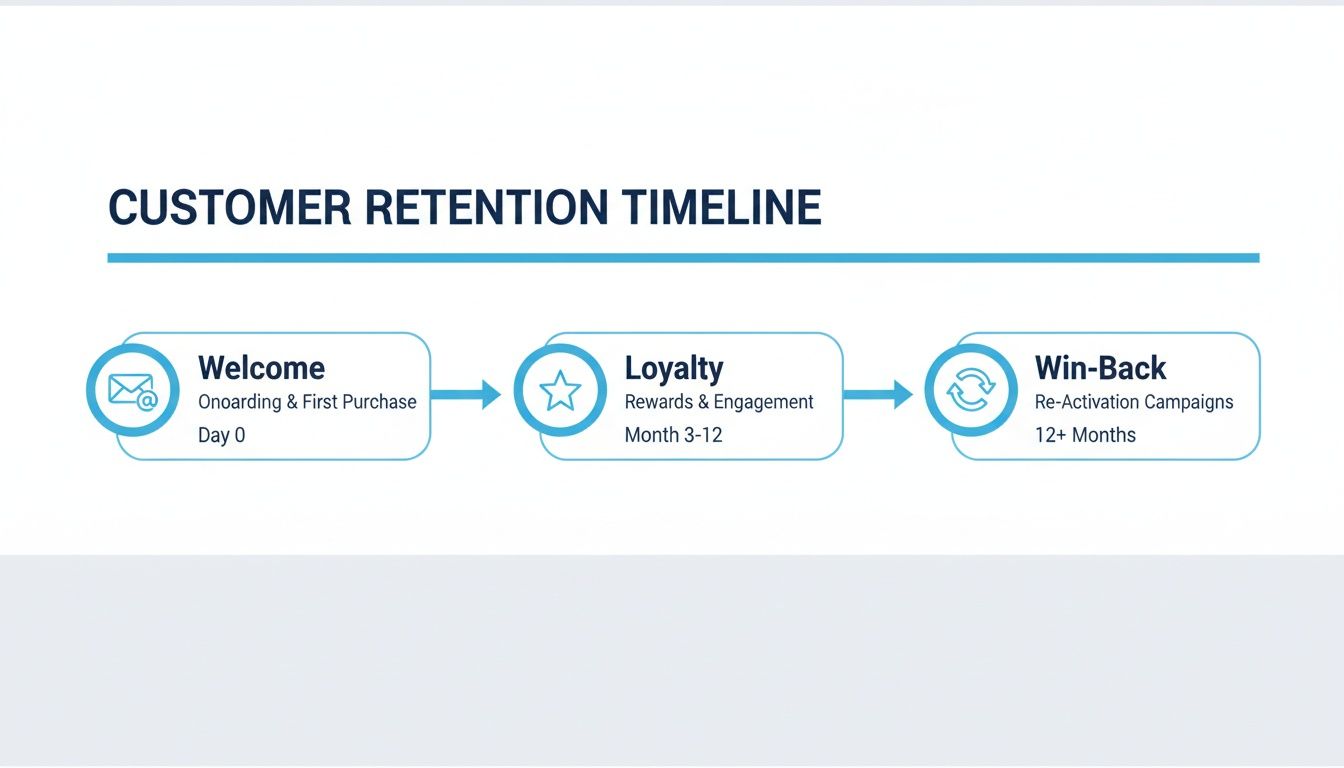
It’s a great reminder that effective retention isn’t a one-off event. It’s a continuous process of welcoming, rewarding, and re-engaging the people who matter most to your business.
The D2C Growth Playbook: Got Questions? We’ve Got Answers
Scaling a D2C brand can feel like you’re trying to solve a puzzle with a million moving pieces. It’s only natural to have questions. Here are some of the most common ones we hear from brand owners and marketing managers across the UK.
What’s the One Metric That Truly Matters for a New D2C Brand?
It’s easy to get fixated on daily ROAS (Return on Ad Spend), but for a new brand, that’s a red herring. The single most important number you should be obsessed with is your LTV:CAC ratio – that’s your customer Lifetime Value to Customer Acquisition Cost.
Why? Because a healthy ratio, ideally 3:1 or higher, is the ultimate proof that your business model is actually working. It confirms you’re not just buying one-off sales but acquiring customers who will stick around and spend more over time. Chasing short-term ROAS can lead you down a rabbit hole of acquiring low-value, one-and-done customers. Nail your LTV:CAC, and you’ve built the foundation for sustainable growth.
How Much Should I Actually Spend on Paid Ads When I’m Just Starting? (The D2C Growth Playbook)
Forget about finding a “magic number” – it doesn’t exist. The smartest way to begin is by setting aside a dedicated ‘learning budget’ for the first one to three months. This should be an amount you’re mentally prepared to write off entirely for the sake of gathering data.
This budget needs to be chunky enough to get statistically significant results from one or two core channels, like Google Shopping and Meta Ads.
Think of it this way: you’re not paying for profit just yet; you’re paying for validated learnings. This initial spend is an investment in discovering which audiences, creatives, and offers actually move the needle. Once you find that profitable combination and can see a positive LTV:CAC, you can pour fuel on the fire with confidence.
Which Ad Channel Should a UK D2C Brand Tackle First?
For most UK brands selling physical products, the answer is almost always Google Shopping. It’s simply the best place to capture high-intent customers who are literally typing in what they want to buy. You meet them at the exact moment of need. It’s hands down the most efficient channel for getting those crucial first sales in the door and proving your offer resonates.
Once you’ve got Google Shopping ticking over nicely and bringing in consistent revenue, that’s your cue to layer in social platforms like Meta or TikTok. Use these channels for top-of-funnel brand building, reaching new audiences, and running powerful remarketing campaigns to nudge those “I’ll think about it” visitors back to your site. This creates a powerful, full-funnel machine that drives growth from all angles.
Ready to stop guessing and start growing? The team at PPC Geeks builds data-driven strategies to increase traffic, leads, and sales while maximising your budget. Get your free, in-depth PPC audit today.