




What Is the Amazon Buy Box and Why Does It Matter?

Think of the Amazon UK marketplace like a massive, bustling high street. Every product page is a shop, but the Amazon Buy Box is the prime, front-and-centre display window everyone sees first. It’s that all-important section with the ‘Add to Basket’ and ‘Buy Now’ buttons.
When several sellers are listing the same item, they’re all fighting for that coveted spot. But here’s the catch: only one seller can “win” the Buy Box at any given time. Amazon’s algorithm picks the seller it thinks offers the best all-around value and customer experience, making their offer the default choice.
The True Value of This Digital Real Estate
Winning this spot isn’t a game of chance. It’s the direct result of a smart, data-driven strategy. For any UK ecommerce brand, holding the Buy Box isn’t just a nice bonus; it’s a make-or-break factor for your sales.
Picture it: you’re scrolling through Amazon for a new gadget, and right there at the top is the inviting Buy Box. It’s the golden ticket that snares an incredible 85% of all purchases on the platform. This single feature makes shopping ridiculously easy, removing the need to sift through different offers. Most shoppers just click ‘Add to Basket’ without a second thought.
If you lose the Buy Box, your offer gets tucked away under a small “Other Sellers on Amazon” link. Let’s be honest, very few customers ever bother to click that.
In short, if you aren’t winning the Buy Box, you are practically invisible to the vast majority of your potential customers, even if you have the lowest price.
Why Every UK Seller Should Care
Getting to grips with what the Buy Box is and how to win it is absolutely fundamental to your success on Amazon. It goes way beyond direct sales, too—it massively impacts your advertising. To run Sponsored Products campaigns, your offer must be in the Buy Box. This directly links your marketing spend to your ability to secure this prime spot.
Take a look at our guide on Amazon search optimisation to see how all these pieces fit together.
Dominating the Buy Box means you get:
- Massively Increased Sales: You grab the lion’s share of sales for that product.
- Enhanced Visibility: Your brand becomes the default choice, building trust and recognition.
- PPC Campaign Eligibility: It’s a non-negotiable for running most types of Amazon ads.
This guide will demystify the entire process, showing you exactly how to turn Buy Box ownership into a reliable engine for growth.
Buy Box at a Glance: Key Factors and Their Impact
Before we dive into the nitty-gritty, here’s a quick overview of the main ingredients Amazon’s algorithm looks at. Think of this as your cheat sheet for what matters most.
| Key Factor | Why It Matters for UK Sellers | Typical Algorithm Weight |
|---|---|---|
| Fulfilment Method | Using FBA gives you a huge advantage due to Amazon’s trust in its own logistics. | Very High |
| Landed Price | This is your total price (including delivery). It needs to be competitive, but not always the lowest. | High |
| Seller Performance | Metrics like Order Defect Rate, feedback score, and shipping times are crucial for building trust. | Medium |
| Inventory Health | Consistent stock levels are key. Running out of stock will instantly lose you the Buy Box. | Medium |
These four pillars are the foundation of winning the Buy Box. Getting them right puts you in a powerful position, but as we’ll see, the devil is in the detail.
Getting Your Foot in the Door: Buy Box Eligibility Essentials
Before you can even think about winning the Amazon Buy Box, you have to qualify. It’s a bit like trying to win a race – you can’t take home the trophy if you’re not even allowed on the starting line. Amazon has a set of non-negotiable standards designed to keep the customer experience top-notch. If you don’t tick these boxes, even the sharpest pricing or quickest delivery won’t matter one bit.
So, let’s break down what you need to do to get your business Buy Box ready.
Have a Professional Seller Account
First things first, you need a Professional Seller account. The Individual Seller plan, which is fine for someone selling a few bits and bobs from their garage, simply won’t cut it. Upgrading to a Professional account tells Amazon you’re serious about selling and unlocks the essential tools and reports you’ll need to compete properly.
Think of it as the price of admission. Without this account, your products will never even be considered for that coveted ‘Add to Basket’ button, no matter how great they are. It’s the foundational step to playing in the big leagues.
Stick to Selling New Products
Amazon is obsessed with its customer experience, and a huge part of that is the quality of the products sold. To be eligible for the main Buy Box, you absolutely must be selling items in new condition.
You can still sell used or refurbished goods on the platform, but they have their own, separate “Buy Used Box.” This gets a tiny fraction of the traffic and sales. If your business is built around selling brand-new items, this is an easy requirement to meet.
The Buy Box algorithm is all about building trust and delivering a predictable experience. By keeping the main Buy Box exclusively for new items, Amazon promises customers a factory-fresh product every time, which is a cornerstone of its brand.
Keep Your Stock Levels Healthy
The final piece of the eligibility puzzle is maintaining a healthy level of inventory. It sounds obvious, but you can’t win the Buy Box if you have nothing to sell. Running out of stock is one of the fastest ways to get kicked out of the running, as Amazon’s algorithm will immediately favour another seller who can actually fulfil the order.
Having consistently low stock or, even worse, frequent stockouts, screams unreliability to the algorithm, and Amazon hates that. Here’s what to focus on:
- Avoid Stockouts At All Costs: Running out of a popular product is a cardinal sin. You don’t just lose the Buy Box; you lose sales momentum that’s a real pain to build back up.
- Keep Your Data Accurate: The stock levels you show in Seller Central must be bang on. Overselling and having to cancel orders is a massive red flag.
- Forecast Like a Pro: Use your sales data to get a handle on future demand. This is especially critical around massive shopping events like Black Friday and Christmas.
Nailing these three things—a Professional account, selling new items, and keeping products in stock—doesn’t guarantee you’ll win the Buy Box. What it does do is get you in the game. Once you’ve got these fundamentals locked down, you can start focusing on the other factors that’ll help you climb to the top.
The Four Pillars of Winning the Amazon Buy Box
So, you’ve ticked the basic eligibility boxes. Now the real game begins. Winning the Amazon Buy Box isn’t about finding a single magic trick; it’s about proving to Amazon’s algorithm that you’re a reliable, top-tier seller.
Think of your strategy like a four-legged stool. If one leg is wobbly, the whole thing is unstable. To consistently own that prime digital real estate, you need to nail four critical areas. These are the pillars holding up your entire Buy Box strategy, and understanding how they work together is the secret to getting ahead of your competitors.
Pillar 1: Strategic Pricing
Price is obviously a huge factor, but let’s be clear: this isn’t a race to the bottom. Amazon’s algorithm is smarter than that. It looks at your landed price—the total amount the customer pays, including delivery. While you need to be competitive, slashing your prices is a short-term move that kills your profit margins.
Think of it this way: the algorithm prioritises the best overall deal for the customer, not just the lowest number. If your seller feedback is stellar and you offer next-day delivery, you can often win the Buy Box even if you’re slightly more expensive. A trusted seller delivering tomorrow is a much better customer experience than a slightly cheaper item arriving next week from a seller with dodgy reviews.
This flowchart gives you a quick visual reminder of the absolute basics you need in place before you can even think about competing on these four pillars.
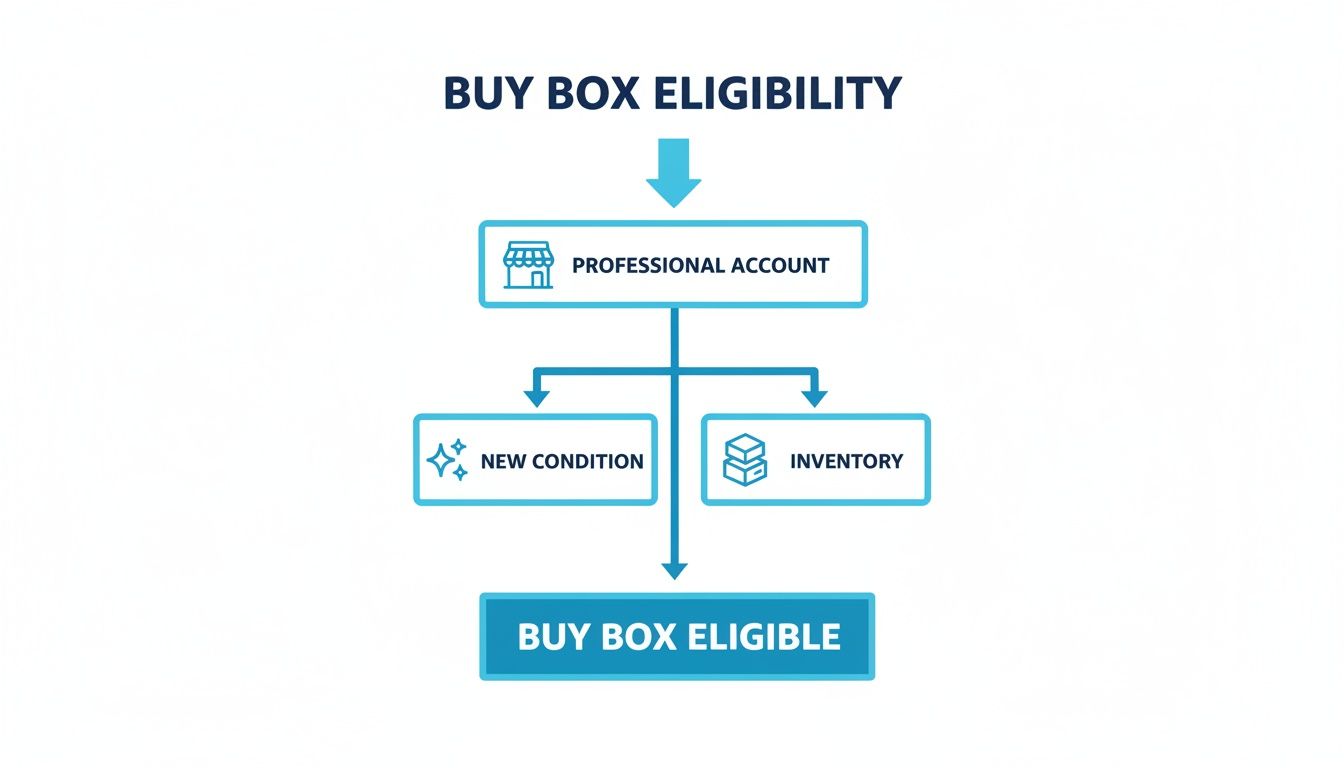
Without these fundamentals, optimising the other pillars is a waste of time.
Pillar 2: Fulfilment Method
How you get your products into customers’ hands might just be the most important piece of the puzzle. Amazon has immense confidence in its own logistics network, which gives sellers using Fulfilment by Amazon (FBA) a massive head start.
When you’re on FBA, Amazon takes care of storage, packing, shipping, and even customer service. Your products instantly become Prime-eligible, which is a powerful signal of trust to both shoppers and the Buy Box algorithm. For Amazon, an FBA seller is a safe bet—it can guarantee delivery speed and service quality because it’s running the show.
Can you still win the Buy Box using Fulfilment by Merchant (FBM)? Absolutely, but the bar is set much higher. You need to be just as fast and reliable as FBA, with perfect performance metrics to back it up. A strong alternative is Seller Fulfilled Prime (SFP), a programme where top-performing FBM sellers can earn the Prime badge, but the performance standards are incredibly strict.
To see how these two methods stack up, let’s break it down.
FBA vs FBM: How Fulfilment Impacts Your Buy Box Chances
| Fulfilment Aspect | Fulfilment by Amazon (FBA) | Fulfilment by Merchant (FBM) |
|---|---|---|
| Prime Eligibility | Automatic. This is a huge Buy Box advantage. | Requires meeting the very tough Seller Fulfilled Prime (SFP) criteria. |
| Delivery Speed | Guaranteed fast shipping, managed entirely by Amazon. | Completely on you. Depends on your own logistics and courier choice. |
| Customer Service | Handled 24/7 by Amazon’s own team. | Your responsibility. Directly impacts your feedback and response time metrics. |
| Buy Box Weight | Extremely high. FBA offers are heavily favoured by the algorithm. | Lower. You need flawless metrics across the board to compete with FBA. |
While FBA isn’t technically mandatory, it’s the most direct route to earning the algorithm’s trust and giving your Buy Box win rate a serious boost. You’re essentially letting Amazon handle several of the most important performance metrics for you.
Pillar 3: Seller Performance
Your reputation on Amazon is always being watched. The platform tracks a whole host of metrics that create a detailed picture of the customer experience you provide. Keeping these numbers in excellent shape is non-negotiable.
Here are the big ones you need to live and breathe:
- Order Defect Rate (ODR): This is a blend of negative feedback, A-to-z claims, and chargebacks. You absolutely must keep this below 1%. A high ODR is a massive red flag.
- Cancellation Rate: How often you cancel an order before it’s shipped (usually due to stock issues). Keep this below 2.5%.
- Late Shipment Rate: This tracks orders sent out after the expected dispatch date. It needs to stay below 4%.
- Valid Tracking Rate: Customers want to know where their parcel is. You must provide valid tracking numbers for at least 95% of your shipments.
- Customer Feedback Score: Your overall seller rating over the last year is a powerful sign of trustworthiness. The higher, the better.
Hitting these targets consistently shows Amazon you’re a reliable seller who delivers a great experience. This performance history is a core part of the Buy Box calculation.
Pillar 4: Inventory Health
It’s simple: you can’t sell what you don’t have. Running out of stock is one of the fastest ways to lose the Buy Box. The moment you go out of stock, the algorithm will instantly hand that prime spot over to a competitor who can fulfil the order.
Amazon’s algorithm loves sellers who manage their inventory well. Frequent stockouts tell Amazon that you can’t handle the demand, which leads to a bad experience for shoppers. It’s not just about avoiding hitting zero; it’s about maintaining enough stock to meet your expected sales, day in and day out.
Managing these four pillars is a constant balancing act. You have to monitor your performance, adapt your pricing, and keep your logistics running like clockwork. Getting this right is the key to winning—and keeping—the Amazon Buy Box. Nailing these elements also builds a solid foundation for your other marketing efforts. If you want to dive deeper, you can learn more about how PPC works on Amazon in our detailed guide.
Practical Strategies to Win and Keep the Buy Box

Knowing the theory behind the Amazon Buy Box is one thing, but actually winning it day in, day out? That’s where the real work begins. For UK brands, this means getting your hands dirty and turning that knowledge into tangible tactics that put you ahead of the competition.
It’s not enough to just be eligible and understand the four pillars, especially when you’re up against a dozen other sellers eyeing the same prize. You need to be proactive. That means combining smart pricing, perfect listings, and a savvy advertising strategy to make your offer irresistible to Amazon’s algorithm.
Master Your Pricing with Automation
Trying to manually keep up with price changes is a recipe for disaster, particularly as your product catalogue grows. This is exactly why automated repricing tools are no longer a ‘nice-to-have’—they’re essential. This software keeps an eye on your competitors 24/7, adjusting your prices on the fly based on rules you’ve set.
But this isn’t about a race to the bottom. A good repricer is smarter than that. It’s about winning the Buy Box at the highest possible price.
Think of it this way: if the current Buy Box winner is priced at £20 and you have better seller metrics, your repricer might snag the spot for you at £20.25. It can then test the waters, slowly nudging the price up to see how high you can go while still holding the Buy Box, protecting your precious profit margins.
These tools are incredibly flexible. You can set up specific rules like:
- Compete by Fulfilment: Create different rules for when you’re up against an FBA seller versus an FBM seller.
- Target the Buy Box: Tell the software to price just under the current Buy Box owner to wrestle control.
- Set Price Floors and Ceilings: Define your absolute minimum and maximum prices to make sure you never sell at a loss or price yourself out of the market.
Optimise Your Product Listings
While not a direct ranking factor like price or fulfillment, a beautifully optimised product listing is your secret weapon. A clear, accurate, and persuasive listing boosts your conversion rate, and that sends all the right signals to Amazon’s algorithm. More sales means your offer is popular, which indirectly gives your Buy Box chances a healthy nudge.
Get your listings into top-tier shape:
- Accurate Data: Double-check every single detail, from dimensions to colour. Any mistake can lead to returns and bad feedback, which is poison for your seller metrics.
- High-Quality Images: Use professional, high-resolution images and videos that showcase your product from every conceivable angle. Let shoppers see exactly what they’re getting.
- Compelling Copy: Write sharp, benefit-focused titles, bullet points, and descriptions. Your goal is to answer a customer’s questions before they even think to ask them.
Amplify Your Efforts with Amazon PPC
A well-oiled Amazon Pay-Per-Click (PPC) machine works in perfect harmony with your Buy Box strategy. No, running ads doesn’t directly tell the algorithm to hand you the Buy Box, but its indirect impact is massive. Ads drive a steady stream of highly motivated buyers straight to your product page.
All this extra traffic and the sales that follow give your sales velocity a serious boost. And as we know, a high sales volume tells Amazon your offer is hot property and trustworthy. This improves your ranking and, over time, your Buy Box win rate. Think of PPC as pouring petrol on a fire; it speeds up the positive feedback loop that helps you win—and keep—the Buy Box. To really get the most from your campaigns, you should also look into optimising your Amazon Sponsored Display ads, as a well-rounded strategy always delivers the best results.
How to Monitor Performance and Troubleshoot Common Issues
Winning the Amazon Buy Box isn’t a one-and-done deal; it’s an ongoing battle. Your competitors are constantly tweaking prices, new customer feedback is always rolling in, and your stock levels can change in an instant. To protect your sales, you’ve got to stay vigilant and know how to spot trouble the second it appears.
For any serious UK seller, this means keeping a close watch on your performance and being ready to pounce the moment something looks off. The most critical weapon in your arsenal is the Buy Box Percentage metric.
You might also see it called the “Featured Offer Percentage,” but it tells you the same thing: how often your offer is the default choice when a customer lands on a product page. Think of it as your Buy Box scorecard.
Finding Your Buy Box Percentage
Getting your hands on this vital statistic inside Seller Central is simple. Just head to the ‘Business Reports’ section from your main dashboard. In there, you’ll find a goldmine of data on your sales and traffic, including the all-important “Featured Offer %” metric. This figure gives you a crystal-clear picture of where you stand, showing you which products are winning and, more importantly, which are losing out.
Making a daily habit of checking this percentage is non-negotiable. A sudden drop is your first and clearest warning sign that something has gone wrong and needs your immediate attention.
Diagnosing Why You Lost the Buy Box
When your Buy Box percentage takes a nosedive, it’s time to play detective. The culprit usually falls into one of three common categories. By running through a quick checklist, you can pinpoint the problem and take action before it seriously dents your revenue.
Here’s a straightforward diagnostic process to follow:
-
Check Your Competitors’ Pricing: Nine times out of ten, the issue is a competitor undercutting you. Even a tiny price drop can be enough for Amazon’s algorithm to switch its allegiance. Head to your “Manage Inventory” page to see the current Buy Box price and see how yours stacks up.
-
Review Your Seller Metrics: Has your account health taken a hit recently? A string of negative feedback, a late shipment, or an A-to-z claim can push up your Order Defect Rate (ODR). Amazon craves reliability, so if your performance score dips, you can lose the Buy Box even if your price is the lowest.
-
Confirm Your Inventory Levels: You can’t win the sale if you have nothing to sell. Have you run out of stock on a popular item? The second your inventory hits zero, Amazon hands the Buy Box to the next eligible seller. Double-check that your stock levels in Seller Central are accurate and that you have enough units to meet demand.
Key Takeaway: Losing the Buy Box is rarely a random event. It’s a direct message from Amazon’s algorithm telling you that another seller is currently offering a better overall package to the customer – whether that’s through price, delivery speed, or their reputation as a seller.
By regularly keeping an eye on your key metrics and using this troubleshooting checklist, you can react to threats almost as soon as they appear. This proactive approach turns what could be a sales disaster into a manageable blip on the radar.
For an even deeper dive into making all parts of your Amazon machine work together, check out our ultimate guide to Amazon PPC audits. This kind of agility is what separates the top sellers from everyone else.
Your Buy Box Success Checklist and Next Steps
Alright, let’s pull it all together. Getting a handle on the Amazon Buy Box isn’t a one-and-done job; it’s the start of a smarter, more proactive way of selling. To consistently own that prime piece of digital real estate, you need to stay on your toes. This final checklist is designed to cut through the noise and give you a clear, actionable roadmap.
Think of this as your pre-flight check. It’s a series of steps to run through regularly to make sure you’re always in the best possible position to win that all-important ‘Add to Basket’ button and really start scaling your business. It’s not about ticking boxes once; it’s about building a rhythm for peak performance.
Your Essential Buy Box Checklist
Here’s a practical, step-by-step checklist to weave into your weekly or monthly Amazon routine. Every single point here directly feeds into your ability to win and keep the Buy Box.
-
1. Confirm Your Eligibility: First things first, is your Professional Seller account in good standing? No issues? Good. Now, double-check that your listings are for new-condition items only and that your stock levels in Seller Central are spot on.
-
2. Review Your Pricing Strategy: Are you still manually changing prices? If so, it’s time to look at an automated repricer to stay competitive without torching your profits. Set firm minimum and maximum price points to defend your margins while you chase the Buy Box.
-
3. Analyse Fulfilment Performance: If you’re fulfilling orders yourself (FBM), be honest: are your shipping times and reliability truly as good as FBA? It might be worth re-evaluating whether shifting your bestsellers to FBA could give your win rate a massive, instant lift.
-
4. Scrutinise Your Account Health: Get into your Seller Central dashboard and have a proper look at your performance metrics. Is your Order Defect Rate (ODR) comfortably below 1%? How are your Late Shipment and Cancellation Rates looking? Amazon is notoriously strict here.
-
5. Forecast Inventory Needs: Check your sales data from the last 30-90 days. Can you see any seasonal bumps or promotional lifts on the horizon? Getting ahead of your inventory is the only way to avoid the stockouts that will lose you the Buy Box in a heartbeat.
Turning Insights into Action
This checklist tells you what to do, but your success really hinges on how you do it. The aim is to shift from just putting out fires – like a sudden drop in your Buy Box share – to fine-tuning your entire operation before problems even start.
Treat every single metric as a lever you can pull. A small improvement in your seller feedback score or just shaving a day off your handling time can be the tiny edge that makes the Buy Box algorithm swing your way.
So, what’s next? Build a routine around these checks. Stick a recurring reminder in your calendar to audit your account health and pricing rules. When you make Buy Box optimisation a core part of your business rhythm, it stops being a complicated headache and becomes a powerful, predictable engine for growth.
Got Questions About the Amazon Buy Box? We’ve Got Answers
Even when you think you’ve got your strategy nailed down, the daily grind of competing for the Amazon Buy Box can throw up some curveballs. Let’s tackle some of the most common questions we hear from UK brands to clear up any confusion and get you back on track.
Do I Have to Be the Cheapest Seller to Win the Buy Box?
Not at all. While a competitive price is a massive piece of the puzzle, Amazon’s algorithm is smart. It’s built to reward the best overall customer experience, not just the rock-bottom price.
Think of it like this: a seller using Fulfilment by Amazon (FBA) with a flawless track record and plenty of stock can easily snag the Buy Box, even if they’re a few quid more expensive. Amazon is playing the long game. It knows a happy customer who gets their order quickly from a reliable seller is more valuable than one who saves a couple of pounds but has a poor experience. Strong fulfilment and great service often trump a slightly lower price.
How Long Does It Take to Become Buy Box Eligible?
There’s no magic number here. Eligibility isn’t about how long you’ve been selling; it’s all about your performance from day one. If you’re a new seller with a Professional account, your mission is to start generating sales while keeping your metrics absolutely pristine. That means shipping on time, every time, avoiding cancellations, and being lightning-fast with customer queries.
For a new seller who gets everything right, eligibility can come within a few weeks, maybe a couple of months. The goal is to build a solid, positive history that proves to Amazon you’re a safe pair of hands.
What on Earth Is a Suppressed Buy Box?
Losing the Buy Box to a competitor is one thing. A suppressed Buy Box is a whole different level of bad news. It’s when Amazon completely removes the ‘Add to Basket’ button from the product page because it believes no one on the listing is offering a fair deal to the customer.
This usually happens for two reasons: either all the sellers have priced the item way above what Amazon thinks it’s worth, or every single seller has terrible performance metrics. When this happens, a customer has to click ‘See All Buying Options’ to even think about buying. That extra step is a sales killer.
Does Running Ads Help Me Win the Buy Box?
Indirectly, yes. You can’t pay your way to the top of the Buy Box algorithm, but running smart Amazon PPC campaigns creates a powerful ripple effect. Successful ads funnel more high-intent shoppers to your listing. When they buy, your sales velocity shoots up.
That spike in sales is a huge green flag for Amazon. It shows your offer is in demand and your stock is flying off the shelves. This boosts your sales history and, in turn, strengthens your seller metrics over time. It’s a classic feedback loop: ad success helps fuel Buy Box success, which then makes your ads even more effective.
Trying to master the Amazon Buy Box while juggling a PPC strategy can feel like spinning plates. But you don’t have to go it alone. The expert team at PPC Geeks builds data-led strategies to get you seen, win the Buy Box more often, and send your sales soaring—all while improving your ROI. Get in touch today for a free, in-depth audit of your Amazon account and see what’s possible.