




What Is Performance Marketing? Imagine only paying for your advertising when it actually works.
No, really.
That’s the core promise of performance marketing.
It’s a completely results-driven approach where you only open your wallet for specific, measurable actions—like a click, a lead, or even a completed sale.
This model flips the traditional risk of advertising on its head.
Instead of you, the business owner, shouldering the cost, the risk shifts to the publisher.
Your budget is spent on tangible outcomes, not just crossing your fingers for visibility.
What Is Performance Marketing? The Pay-for-Results Model Explained
Think of it like hiring a salesperson who works purely on commission. You wouldn’t pay them a hefty salary just to show up and make calls; you reward them when they actually close a deal and bring in revenue. Performance marketing applies that exact same, no-nonsense logic to the digital world.
It’s a world away from traditional advertising, where you pay a flat fee upfront for ad space—be it a billboard, a TV spot, or a magazine spread—with absolutely no guarantee of a return. You’re paying for the potential to be seen, whether anyone actually acts on your ad or not.
Performance marketing isn’t about paying for potential eyeballs. It’s about investing directly in the actions that fuel your business growth. It’s a system built from the ground up on accountability and a crystal-clear return on investment (ROI).
To get a better sense of how these two worlds differ, here’s a quick side-by-side look.
Performance Marketing vs Traditional Marketing At a Glance
| Attribute | Performance Marketing | Traditional Marketing |
|---|---|---|
| Payment Model | Pay-per-action (click, lead, sale) | Pay upfront for ad space or airtime |
| Risk | Primarily on the publisher/partner | Primarily on the advertiser (your business) |
| Measurement | Highly measurable with clear ROI | Difficult to track direct ROI |
| Targeting | Precise, data-driven audience targeting | Broad, demographic-based targeting |
| Optimisation | Real-time, based on performance data | Limited; changes require new campaigns |
| Focus | Generating specific, tangible actions | Building broad brand awareness |
As you can see, the focus is worlds apart. One is about guaranteed action, the other is about casting a wide net and hoping for the best.
Who Are the Key Players?
What Is Performance Marketing? So, how does this all come together? The ecosystem is surprisingly straightforward, usually involving three main groups working in partnership:
- Advertisers (or Merchants): That’s you! You have a product or service you need to promote and want to see measurable results from every pound you spend.
- Publishers (or Affiliates): These are your marketing partners. They could be anyone from influential bloggers and social media personalities to coupon sites or even other businesses with an audience that aligns with yours.
- Platforms and Networks: Think of these as the matchmakers. They provide the technology that connects advertisers with publishers, tracking all the actions, handling payments, and generally keeping the campaigns running smoothly.
Why This Matters for UK Businesses
This transparent, results-first approach is no longer just a “nice-to-have”—it’s become an essential strategy for UK businesses that need to make their marketing budgets work harder. The UK’s digital ad market is on track to blow past £40 billion this year, and that explosive growth is being fuelled by ROI-focused strategies like performance marketing.
A huge part of this is paid search, which is already used by 65% of UK businesses. By paying only for what works, even small and medium-sized enterprises (SMEs) can get in the ring and compete effectively, ensuring every pound is pulling its weight towards real, quantifiable growth.
If you’re just dipping your toes in the water, our comprehensive guide to PPC marketing for 2025 is a brilliant place to build your foundation.
Exploring the Core Channels
What Is Performance Marketing? Performance marketing isn’t a single, rigid strategy. Think of it more like a dynamic ecosystem, powered by several distinct channels. While they all operate on the same core principle—paying for results—each one has its own unique way of getting the job done, catering to different business goals and audiences.
Understanding these channels is a bit like learning the different tools in a toolkit. Each is designed for a specific job, but when you know how to use them together, you can build something remarkable.
Let’s break down the primary engines that drive modern performance marketing campaigns.
What Is Performance Marketing? Paid Search or Pay Per Click (PPC)
Paid search, more commonly known as Pay-Per-Click (PPC), is probably the most direct form of performance marketing you’ll encounter. It’s the art and science of placing ads on search engines like Google and Bing. The “performance” part is crystal clear: you bid on keywords relevant to your business, and you only pay when a genuinely interested person actually clicks on your ad.
You aren’t just paying for your ad to exist on the page; you’re paying for the tangible action of a click. This makes PPC an incredibly powerful way to capture high-intent customers at the very moment they’re searching for a solution you offer.
- Example for a UK Business: A plumbing company in Manchester bids on “emergency plumber Manchester.” Their ad pops up at the top of Google. They only pay when a homeowner with a burst pipe clicks that ad to visit their website or call them, ensuring every penny of their budget goes towards a high-quality, urgent lead.
What Is Performance Marketing? Affiliate Marketing
Affiliate marketing is all about partnerships. You team up with third parties—known as affiliates or publishers—to promote your products or services. These partners could be anyone from bloggers and influencers to review sites or even other businesses that complement your own.
They promote your brand to their audience using a unique, trackable link. Here’s the key: you only pay them a commission when their efforts lead to a specific, agreed-upon action, like a completed sale. This approach essentially turns brand advocates into a powerful, performance-based sales force. It’s a low-risk way to expand your reach because you’re only paying for successful conversions.
In essence, affiliate marketing allows you to tap into established, trusted communities. You’re leveraging the credibility an affiliate has already built with their audience to drive sales, and you only pay them when that trust translates into real revenue for your business.
Paid Social Media Advertising (What Is Performance Marketing?)
While we often think of social media for building brand awareness, it’s become an absolute powerhouse for performance marketing. Platforms like Meta (Facebook and Instagram), LinkedIn, and TikTok offer incredibly sophisticated advertising tools that let you run campaigns focused on measurable actions.
This screenshot from Wikipedia’s page on performance-based advertising shows the different models used, many of which are central to paid social campaigns.
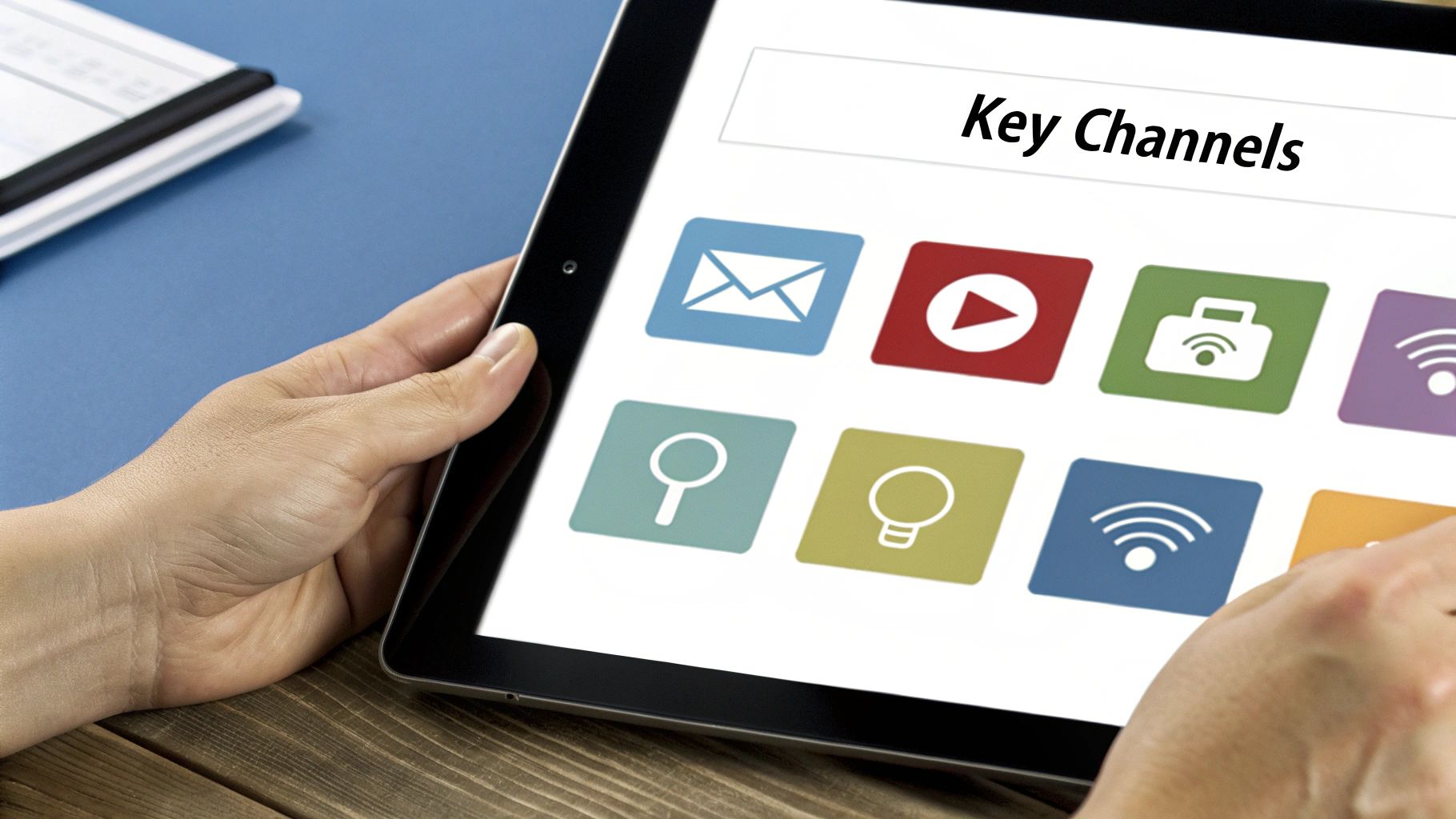
The models shown, such as Cost Per Lead (CPL) and Cost Per Acquisition (CPA), are the lifeblood of performance-focused social media advertising. They allow you to pay for direct results, not just visibility.
Instead of just paying for impressions or reach, you can design campaigns to optimise for—and pay based on—specific outcomes like:
- Lead Generation: A user fills out a contact form right there in the social media app.
- Conversions: A user clicks your ad and makes a purchase on your website.
- App Installs: A user downloads your mobile app.
The deep user data available on these platforms allows for laser-focused targeting, making sure your performance-based ads are shown to the people most likely to take the action you want.
- Example for a UK Business: A London-based fintech startup wants sign-ups for its new budgeting app. They run a LinkedIn campaign targeting professionals in financial services, optimising for “Lead Generation.” They only pay when someone submits their email through the instant form, giving them a predictable Cost Per Lead (CPL).
Native Advertising
What Is Performance Marketing? Native advertising is a much more subtle form of performance marketing. The idea is to create paid content that blends in seamlessly with the user’s experience on a given platform. These ads don’t scream for attention like traditional, disruptive banner ads. Instead, they match the look, feel, and function of the editorial content around them.
Think of those “sponsored content” articles you see on news websites or the “promoted listings” on e-commerce sites. The goal is to provide value and engage the user in a less intrusive way, driving actions like clicks or content downloads. Performance is measured by the engagement these ads generate, connecting your spend directly to user interest.
How to Measure Real Performance
In performance marketing, success isn’t a vague feeling or a hopeful guess—it’s a number. This whole approach is built on crystal-clear accountability, where every pound you spend can be tracked and measured against a specific outcome. But to really get a grip on what’s working, you need to speak the language of its key metrics.
Getting past the jargon is crucial. These metrics, or Key Performance Indicators (KPIs), are the vital signs of your campaigns. They don’t just tell you what’s happening; they tell you why it’s happening and how profitable your efforts truly are.
Decoding the Core Metrics
Let’s break down the essential KPIs that form the bedrock of any performance marketing strategy. Each one tells a different part of the story, from someone showing initial interest all the way through to the final sale. Once you understand them, you can diagnose problems and double down on what’s working with real confidence.
These are the big three you’ll encounter everywhere:
- Cost Per Click (CPC): This is simply the price you pay each time someone clicks on your ad. It’s a direct measure of how much it costs to get a single visitor over to your website or landing page.
- Cost Per Lead (CPL): This metric works out the cost of acquiring a single potential customer—think of someone filling out a contact form or subscribing to your newsletter. It’s absolutely critical for service-based businesses.
- Cost Per Acquisition (CPA): Often called Cost Per Sale (CPS), this is the total cost to land one paying customer. It directly connects your marketing spend to actions that actually generate revenue.
The image below gives you a feel for how these initial metrics play out in a typical campaign, showing the relationship between clicks, conversions, and cost.
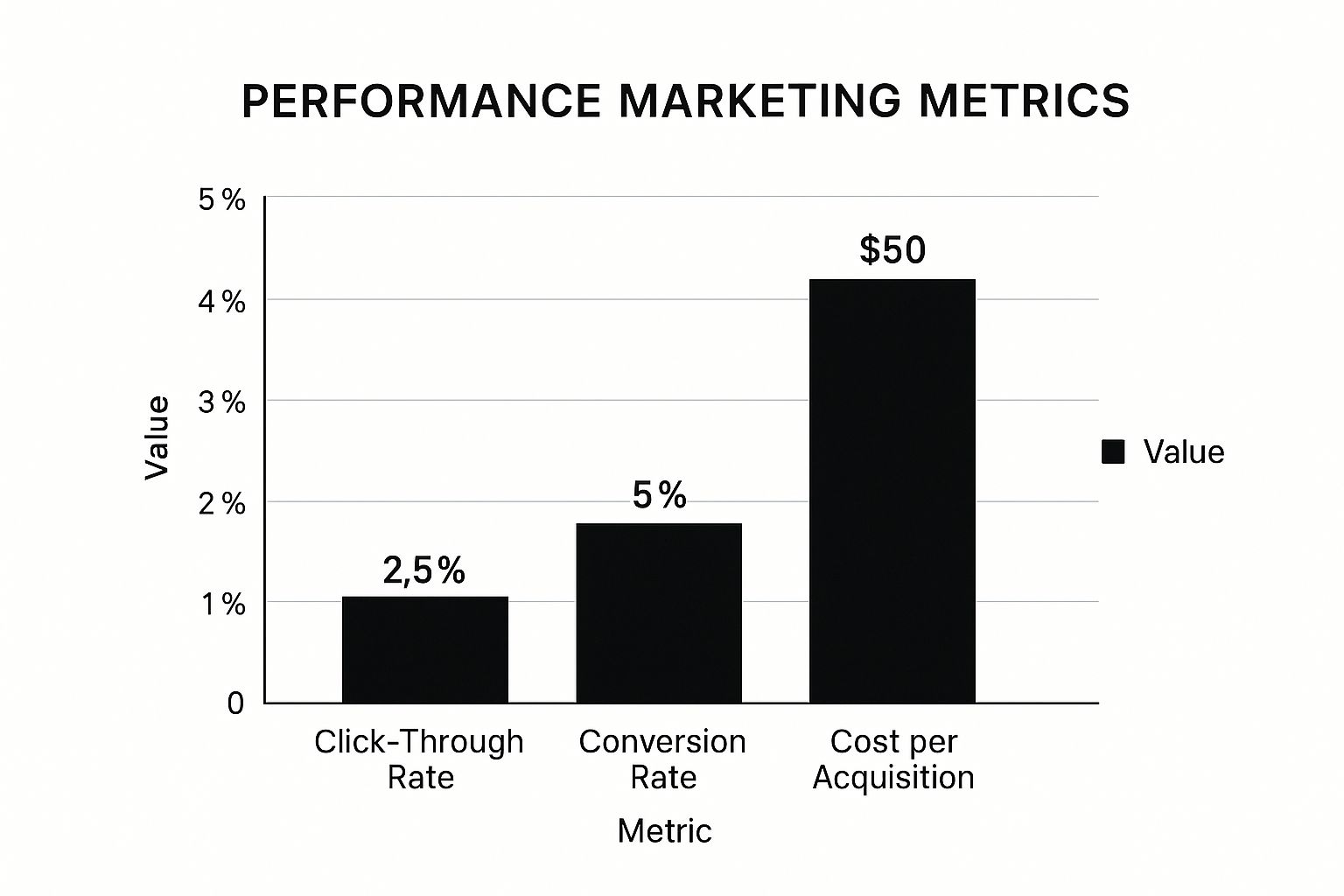
As you can see, a 2.5% click-through rate can lead to a 5% conversion rate, which in this example, results in a £50 cost for each new customer you bring in.
Understanding Key Performance Marketing Metrics
To make these concepts even clearer, the table below breaks down the most common metrics. It explains what each KPI measures and where you’re most likely to use it, giving you a practical cheat sheet for your campaigns.
| Metric (KPI) | What It Measures | Common Use Case |
|---|---|---|
| Cost Per Click (CPC) | The price paid for a single click on an ad. | Driving traffic to a website or landing page for brand awareness or top-of-funnel engagement. |
| Cost Per Lead (CPL) | The total cost to generate one lead (e.g., a form submission or sign-up). | B2B marketing or service industries where the goal is to fill the sales pipeline. |
| Cost Per Acquisition (CPA) | The cost to acquire one paying customer. | E-commerce or any business model where the primary goal is a direct sale. |
| Return On Ad Spend (ROAS) | The total revenue generated for every pound spent on advertising. | Measuring the direct profitability and financial return of ad campaigns. |
| Click-Through Rate (CTR) | The percentage of people who see your ad and then click on it. | Assessing the creative and messaging effectiveness of an ad. |
| Conversion Rate (CVR) | The percentage of visitors who complete a desired action (e.g., purchase, sign-up). | Evaluating how well a landing page or offer converts traffic into leads or sales. |
These metrics aren’t just abstract numbers; they are the tools you use to fine-tune your strategy, cut waste, and pour fuel on the fire of what’s already working.
Choosing the Right Metric for Your Goal
Not all metrics are created equal, and the “most important” one depends entirely on your business model and what you’re trying to achieve. A B2B consultancy, for instance, might be obsessed with its Cost Per Lead (CPL), as each lead could be worth thousands in potential business. Their main goal is to fill the sales pipeline with qualified prospects as efficiently as possible.
On the other hand, an e-commerce store selling fashion accessories will live and die by a completely different number. For them, it’s all about immediate profitability.
The ultimate measure of profitability in performance marketing is Return On Ad Spend (ROAS). It answers the most important question of all: “For every pound I spend on ads, how many pounds am I getting back?”
ROAS is calculated with a beautifully simple formula: Total Revenue / Total Ad Spend. So, if you spend £1,000 on ads and generate £5,000 in sales, your ROAS is 5x, or 500%. This single figure tells you whether your campaigns are a profitable engine for growth or just a drain on your resources. Mastering this is key to scaling, and you can get some expert advice on how to improve your Google Ads performance to send your ROAS soaring.
What UK Businesses Prioritise
While ROAS is a powerful measure of profitability, it’s interesting to see what metrics UK businesses actually focus on day-to-day. A recent survey of over 500 UK businesses found that direct Sales is considered the most valuable metric by 22% of companies. This is followed closely by social media engagement (20%) and website traffic (18%), which shows a strong preference for immediate results and audience interaction.
This data highlights that while complex metrics are vital for optimisation, the fundamental goals of driving sales and engaging customers are still top of the list for most businesses. By understanding and tracking the right set of KPIs for your specific goals, you can turn your marketing from a cost centre into a predictable and profitable system.
Why Performance Marketing Is a Game-Changer for SMEs
For a lot of small and medium-sized businesses, traditional advertising feels like putting all your chips on red and hoping for the best. You pour a huge chunk of your budget in upfront, send a campaign out into the world, and cross your fingers. Performance marketing completely flips that script. It turns marketing from a risky punt into a predictable, results-focused investment.
This model is a massive deal for SMEs because it zeroes in on their biggest worries: tight budgets and the need for real, measurable growth. Instead of paying for potential views or vague “brand awareness,” you only pay when someone takes a specific, valuable action. It’s a pay-for-results approach that really levels the playing field, letting smaller businesses go toe-to-toe with the big corporations and their bottomless pockets.
What Is Performance Marketing? Minimising Financial Risk
The single biggest win for any SME is how much it slashes financial risk. With performance marketing, your budget is welded directly to actual outcomes. If a campaign isn’t getting clicks, leads, or sales, your costs stay low. Simple as that. This makes your marketing spend predictable and, most importantly, controllable.
Think about a local bakery in Bristol trying to get the word out about its new online delivery service. With the old-school model, they might drop a few thousand on a local radio ad and have no real clue if it led to a single order. Using performance marketing, they could run a pay-per-click (PPC) campaign and only pay when a hungry Bristolian actually clicks their ad. Every single pound is spent on someone genuinely interested.
Performance marketing gives SMEs a financial safety net. It removes the guesswork and ensures that your hard-earned budget is only spent on the actions that directly contribute to your bottom line, making every marketing pound accountable.
This approach also gives you the confidence to test new ideas and channels. You can play around with different ad designs or target new audiences without betting the farm on something that hasn’t been proven yet.
The Power of Precise Tracking and Targeting
What Is Performance Marketing? Beyond just being cost-effective, performance marketing offers a level of transparency that’s unheard of in traditional advertising. Every click, every lead, and every sale can be traced right back to the specific ad and channel that brought it in. For an SME, this granular data is like striking gold, offering crystal-clear insights into what’s actually making the till ring.
This trackability means you can make decisions based on cold, hard data instead of just gut feelings. You can see which keywords are hitting the jackpot, which social media ads are getting all the love, and which affiliate partners are sending you the best customers. It’s a constant feedback loop that lets you optimise in real-time, making your campaigns smarter and more efficient as you go.
And the targeting? It’s incredibly precise, which is a lifesaver when you can’t afford to waste a penny on people who aren’t interested. You can target potential customers based on:
- Demographics: Focusing on specific age groups, genders, or locations.
- Interests: Reaching people who have shown interest in products or services like yours.
- Behaviours: Targeting users based on what they do online and what they’ve bought before.
This means a bespoke furniture maker in Sheffield can run ads that are only shown to people in the Yorkshire area who’ve recently searched for “handmade oak tables.” This laser focus ensures you get the maximum bang for your buck—a luxury that used to be completely out of reach for smaller businesses. For many, figuring out why your business needs professional PPC management is the first step to unlocking this kind of power.
Navigating Common Challenges and Pitfalls
While the pay-for-results model sounds like a dream, it’s not a magic wand. To really succeed with performance marketing, you need to go in with your eyes wide open, ready to tackle the hurdles that can trip up even the most enthusiastic marketers.
Being prepared for these common pitfalls is what separates a frustrating, budget-draining campaign from a resilient, profitable one. Knowing what to avoid is just as important as knowing what to do.
The Reality of Ad Fraud
Let’s start with the big one: ad fraud. This is basically any shady attempt to illegitimately collect money from your advertising campaigns. It comes in all shapes and sizes, from bots generating thousands of fake clicks on your PPC ads to dodgy publishers sending you fraudulent leads.
If you don’t keep it in check, ad fraud can completely drain your budget and make your performance data utterly useless.
Thankfully, you’re not defenceless. Here’s how to fight back:
- Keep a close eye on your metrics. Look for strange spikes in clicks that don’t lead to more conversions, or a sudden flood of traffic from a country you’re not even targeting.
- Use fraud detection tools. Most big platforms have some built-in protection, but third-party tools can add a much-needed extra layer of security.
- Work with reputable partners. Established affiliate networks and ad platforms have much stricter vetting processes for who they let in. Stick with the names you trust.
The Attribution Headache
What Is Performance Marketing? Another common headache is attribution—the art and science of figuring out which marketing touchpoint gets the credit for a sale. A customer’s journey is almost never a straight line.
They might see your ad on social media, click a Google search ad a week later, and finally buy after clicking a link in your newsletter. So, who gets the credit? The first click? The last click? All of them?
Attribution isn’t just about giving credit where it’s due; it’s about truly understanding the entire customer journey. Get it right, and you can pour your budget into the channels that actually influence people, not just the ones that happen to get the final click.
Choosing the wrong attribution model can lead you to undervalue crucial channels that are doing the heavy lifting of building awareness and trust early on.
Rising Costs and Fierce Competition
It’s no secret that performance marketing works. And because it works, everyone’s doing it. This means competition is getting fiercer by the day.
On popular platforms like Google Ads and Meta, the cost of reaching your ideal customer is climbing. A keyword that was a bargain last year might now have a much higher Cost Per Click (CPC), putting a real squeeze on your profit margins.
To stay ahead of the game, you’ve got to be strategic:
- Go for long-tail keywords. Instead of battling it out for broad, expensive terms like “running shoes,” target more specific phrases like “best trail running shoes for wide feet UK.” They’re less competitive and often convert better.
- Don’t put all your eggs in one basket. Diversify! Explore less saturated platforms or jump on emerging channels where your audience is hanging out.
- Focus on Customer Lifetime Value (LTV). A high cost to get a new customer might seem scary at first, but it could be a brilliant investment if that customer sticks around and buys from you again and again. Understanding how to calculate customer lifetime value lets you make much smarter bidding decisions and justify spending more to acquire the right kind of customer.
Your First Performance Marketing Campaign Checklist
Right, ready to stop talking theory and start making things happen? Kicking off your first performance marketing campaign can feel like a massive task, but I promise it’s manageable when you break it down. This checklist is your roadmap, designed to walk you from a rough idea to a confident launch, step by step.
Think of it as your pre-flight check. Each point ensures you know your destination, have the right gear on board, and can actually read the instruments to track your progress. Let’s get into it.
Define Crystal-Clear Objectives
Before you dream of spending a single penny, you absolutely must define what a win looks like. Forget vague goals like “increase brand awareness” – that sort of thinking has no place here. Your objectives need to be sharp, measurable, and tied directly to a real business outcome.
So, what’s the one action you want someone to take?
- Selling products online? You’re likely chasing a specific Return On Ad Spend (ROAS).
- A B2B or service business? You’ll be gunning for a qualified lead from a form fill, which means a target Cost Per Lead (CPL) is your goal.
- Got an app? It’s all about getting new installs, so your focus will be on Cost Per Install (CPI).
Your objective is your campaign’s North Star. Every single decision—from the channels you pick to the ad copy you write—must point back to this one measurable goal. Without it, you’re just throwing money into the wind and hoping for the best.
What Is Performance Marketing? Pinpoint Your Ideal Audience and Channels
Once you know what you want to achieve, the next question is who you need to reach. The biggest mistake you can make is trying to appeal to everyone. You need to get specific and build a detailed picture of your ideal customer. Think about their demographics, what they’re interested in, and how they behave online.
With that profile in your back pocket, you can figure out where they hang out.
- Identify Your Customer: Who are they, really? What problem are you solving for them?
- Research Their Hangouts: Are they typing questions into Google? That’s a strong signal for PPC. Are they scrolling through products on Instagram? Paid social is your best bet. Do they trust bloggers and influencers? Affiliate marketing could be perfect.
- Choose Your Battlefield: Don’t spread yourself too thin. Start with one or two channels where you feel most confident you’ll find your audience. You can always expand later.
Set a Realistic Budget and Create Compelling Assets
Your budget shouldn’t be a random number plucked from thin air; it should flow directly from your objectives. For example, if your target CPA is £50 and your goal is to land 20 new customers, you need a starting budget of at least £1,000. See? This data-driven approach takes all the guesswork out of it.
Next up, you need the actual stuff that people will see and click on – your creative assets. This covers both the ad itself and the page it sends people to.
- The Ad: Your ad copy and visuals have to grab attention. They need to clearly spell out your value and have a strong call-to-action (CTA) that tells people exactly what to do next.
- The Landing Page: A click is only the beginning. The landing page must feel like a natural next step from the ad. It should be laser-focused on that one conversion goal and designed to be as smooth and easy to use as possible.
Implement Tracking and Analytics
What Is Performance Marketing? This last step is the absolute heart of performance marketing. It’s completely non-negotiable. If you can’t measure it, you can’t improve it. Before a single ad goes live, you must have your tracking set up perfectly.
This means getting your tracking pixels installed (like the Meta Pixel or the Google Ads tag) and defining your conversion events in your analytics platform. This is the plumbing that allows you to see which ads are actually working, measure your KPIs in real-time, and make smart, data-backed decisions to make your campaign more and more profitable.
Your Questions, Answered on What Is Performance Marketing?
Even when you’ve got your head around the basics, a few practical questions always pop up. Let’s tackle the most common ones head-on, so you can move forward with a bit more clarity.
How Much Does Performance Marketing Cost?
Ah, the classic “how long is a piece of string?” question. The truth is, there’s no single price tag. The cost is entirely down to your goals and just how competitive your industry is. Instead of a fixed fee, you decide what you’re willing to pay for a specific result.
For example, you might decide a new customer is worth £40 to your business. That becomes your target Cost Per Acquisition (CPA). The total cost is then simply your target CPA multiplied by how many new customers you want to bring in. The main thing to remember is that you are in control of the budget because you define what a result is worth.
What Is the Difference Between Performance Marketing and Brand Marketing?
Think of it like this: one is a direct sales pitch, and the other is a compelling story that builds a relationship over time.
- Performance Marketing is all about the here and now. It’s transactional, action-focused, and its success is measured by cold, hard numbers like clicks, leads, and sales. The goal is simple: generate a direct, measurable return on your investment.
- Brand Marketing is playing the long game. It’s about building recognition, loyalty, and trust. Success here is measured more broadly through things like brand sentiment and how much of the conversation you own in your market.
A truly healthy marketing strategy needs both. Good brand marketing builds the trust that makes your performance campaigns hit harder and feel less like a cold pitch.
Performance marketing asks your audience to do something now, while brand marketing shapes how they feel about you later. Both are absolutely essential for long-term growth.
How Long Does It Take to See Results?
What Is Performance Marketing? One of the best things about performance marketing is how quickly you get feedback. With channels like Pay-Per-Click (PPC), you can start seeing traffic and clicks literally within hours of hitting ‘launch’. This instant data is brilliant for early testing and learning what resonates.
But seeing profitable and consistent results? That takes a bit more patience. You should expect an optimisation phase lasting anywhere from a few weeks to a couple of months. During this time, you’ll be digging into the data, tweaking your targeting, and testing different ads to find that winning formula that delivers a strong, scalable return.
Can I Do Performance Marketing with a Small Budget?
Absolutely. In fact, it’s one of the best ways for businesses with tighter purse strings to get into advertising. Because you only pay when something happens, you aren’t just throwing money at campaigns that aren’t delivering.
You can start small with a modest daily budget on platforms like Google Ads or Meta, focusing on a very specific niche audience or a handful of high-intent keywords. As you start to see results and prove the model works, you can confidently reinvest your profits to scale things up.
Ready to stop guessing and start getting measurable results from your advertising? The team at PPC Geeks builds data-driven performance marketing campaigns that minimise wasted spend and maximise your ROI. Get your free, no-obligation PPC audit today and discover how much more you could be achieving.