




An ad impression is one of the most fundamental metrics you’ll come across in digital advertising. In simple terms, it represents a single instance where your ad is successfully loaded and displayed on a user’s screen. Think of it as a digital “sighting” of your advertisement – the absolute starting point for measuring your campaign’s visibility.
Understanding Ad Impressions: Your First Key Metric
Imagine your ad is a digital billboard on the side of a busy motorway. Every time a car passes and has the opportunity to see your ad, that counts as one impression. It doesn’t matter if the driver was looking at their phone, chatting with a passenger, or focused on the road – the ad was displayed, and the opportunity was there.
In the online world, it’s the same principle. An impression is simply a count of how many times your ad is fetched from its server and loaded onto a webpage or app. It’s the very first step in a potential customer’s journey.
Crucially, this metric doesn’t confirm that a person actually saw or engaged with your ad, only that it was delivered. For example, if your ad loads at the bottom of a webpage but the user never scrolls down that far, an impression is still counted.
To help clear things up, here’s a quick summary of what an ad impression really means.
Ad Impression At a Glance
| Characteristic | Description |
|---|---|
| What it is | A single instance of an ad being displayed on a screen. |
| What it measures | The opportunity for an ad to be seen; its potential exposure. |
| What it is NOT | A measure of engagement, clicks, or actual viewership. |
| Why it matters | It’s the base metric for calculating CTR, CPM, and brand awareness. |
Ultimately, impressions are the foundation upon which almost every other PPC metric is built.
Why Impressions Form the Foundation of PPC
Despite their simplicity, impressions are absolutely vital. They form the base layer for other critical calculations like click-through rate (CTR) and provide the first real glimpse into how your campaign is performing. Getting your head around impressions is the first step to mastering more advanced topics, which you can dive into by exploring our guide on PPC advertising basics.
Impressions help you understand:
- Brand Awareness: A high number of impressions suggests your brand is getting significant exposure to your target audience. Lots of sightings means you’re getting your name out there.
- Ad Reach: This metric indicates how widely your message is being distributed across different platforms and websites.
- Campaign Pacing: By monitoring impressions, you can quickly see if your budget is being spent as planned and your ads are actually being served.
An impression is the raw material of digital advertising. It’s the opportunity for your message to be seen, and without it, no clicks, conversions, or sales can ever happen.
At the end of the day, this simple count is the bedrock upon which all your more complex performance analysis is built.
How Different Ad Platforms Count Impressions
So, you’ve got the basics of what an ad impression is. Great. But here’s where it gets a bit tricky: not every platform plays by the same rules. If you’re running campaigns across multiple channels (and most businesses in the UK are), these small differences can throw your data into a real spin. Getting your head around each platform’s specific method is the first step to accurately reading your reports.
The main point of confusion usually comes down to when an impression is actually counted. Is it the moment the ad is called from the server? Or does it only count when it physically pops up on someone’s screen? This single distinction is why you’ll often see wildly different impression numbers for the exact same campaign on Google versus, say, Facebook.
Google Ads Impression Counting
For its bread-and-butter Search and Shopping campaigns, Google Ads keeps things pretty simple. An impression is logged as soon as your ad appears on a search engine results page (SERP). It doesn’t matter if the user has to scroll down to see it. If your ad is served on page one, even at the very bottom, that’s one impression in the bag.
But when you step into the world of display campaigns, the game changes. To keep up with industry standards around viewability, an impression is often only counted when at least 50% of the ad is visible on-screen for one second or longer. This is a much stricter approach, and you can learn more about how it impacts your campaigns in our guide to what is display advertising.
Meta and Microsoft Ads Nuances
Over on platforms like Facebook and Instagram, the methodology is different yet again.
On Meta (that’s Facebook and Instagram), an impression is counted the instant an ad is rendered and enters a user’s feed. It doesn’t need to be scrolled into view to be counted.
This means your ad could be lurking several thumb-flicks down the feed, but if it has loaded, it’s already been counted as an impression. As you can imagine, this often leads to much higher impression volumes compared to platforms with tougher viewability rules.
Similarly, Microsoft Advertising (what we used to call Bing Ads) counts a search ad impression when the ad is served on the search results page. Just like Google, they also have more advanced uses for this data, like impression-based remarketing. This feature lets you build audience lists from people who were simply shown an ad, even if they never clicked. It’s a perfect example of how each platform uses impression data for its own strategic ends.
Getting to Grips with Impressions, Clicks and Reach
Seeing a high impression count can give you a nice confidence boost, but it’s only one piece of the PPC puzzle. To really understand what ad impressions are, you need to see how they stack up against other vital metrics. If you don’t, you’re flying blind, risking misinterpreting your campaign data and making some dodgy strategic calls.
Think of it this way: impressions tell you how many times your shop window was seen, but they don’t tell you who saw it or if they even bothered to step inside. This is where other metrics come in to paint the full picture of how your ads are actually performing.
Impressions vs Reach
The most common mix-up is between impressions and reach. They sound similar, but they measure two completely different things, and getting them confused is a classic rookie error.
- Impressions: This is the grand total of every single time your ad was displayed. If one person sees your ad five times, that’s logged as five impressions.
- Reach: This counts the number of unique individuals who saw your ad at least once. If that same person sees your ad five times, your reach is just one.
A high number of impressions paired with a low reach is a dead giveaway that the same small group of people are seeing your ad over and over again. This might be your goal for a remarketing campaign, but if you’re trying to attract new customers, it’s a red flag.
Key PPC Metrics Compared
To make this crystal clear, let’s break down the key differences between impressions and some of the other common metrics you’ll see in your advertising dashboard.
| Metric | What It Measures | Key Difference from Impressions |
|---|---|---|
| Reach | The number of unique people who see your ad. | One person seeing an ad 10 times is 10 impressions, but only 1 reach. |
| Clicks | The number of times a user clicks on your ad. | Clicks measure active engagement; impressions measure passive visibility. |
| Views | For video, it’s a user watching a set amount of your ad (e.g., 30 seconds). | Views confirm a higher level of attention than a fleeting impression. |
| Viewable Impressions | Impressions where at least 50% of the ad was on-screen for at least one second. | This filters out impressions that were never actually seen by a human. |
Each metric tells a different part of the story. Impressions give you a sense of your ad’s overall exposure, but you need the others to understand if that exposure is actually leading to meaningful engagement.
Impressions vs Clicks and Views
While impressions measure visibility, clicks and views are all about interaction. A click is beautifully straightforward: it’s recorded when someone actively clicks on your ad to check out your website or landing page. It’s a clear signal that you’ve sparked their interest and it’s the first step towards a potential conversion.
For video content, we talk about views. A “view” on a platform like YouTube is usually only counted after someone has watched a specific amount of your ad—say, 30 seconds. This is far more valuable than a simple impression, which is counted the moment the video ad loads, whether it was watched or not.
The diagram below shows how different platforms count that very first step—the impression—which has to happen before any click or view can.
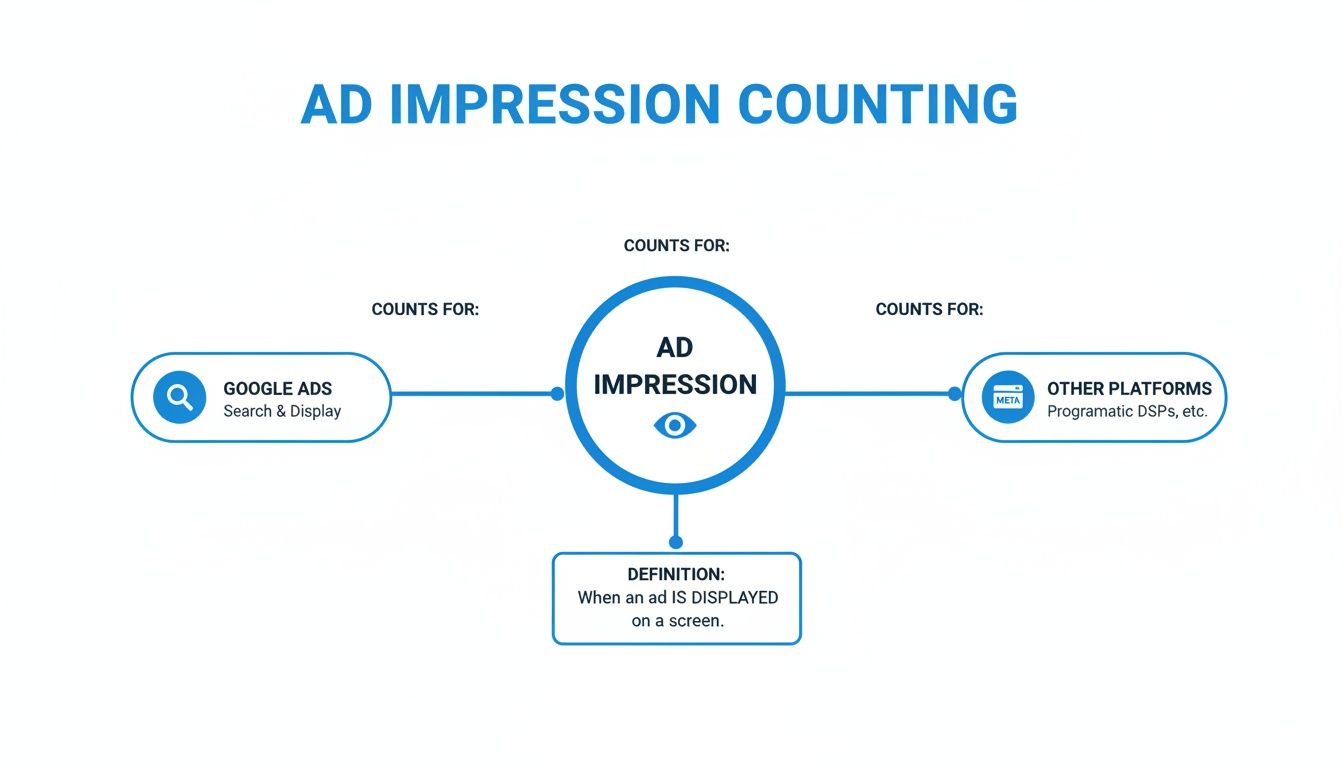
As the map shows, the exact definition of an impression can change from one platform to another. That’s a massive reason why you should always analyse your data on a per-platform basis. To dig a bit deeper, you might want to check out this practical cost per impression example to see exactly how this metric hits your budget.
So, Why Do Impressions Actually Matter for Your UK Business?
It’s one thing to know what an ad impression is, but understanding why it’s so vital to your strategy is how you turn raw data into actual profit. Impressions are the foundation that all other critical performance metrics are built on. Without them, you have no real way of knowing if your creative is hitting the mark, if your bids are competitive, or what your overall brand visibility even looks like.
Think of it this way: impressions are the starting point of a crucial equation. Your Click-Through Rate (CTR), which is the best measure of how compelling your ad is, is calculated by dividing your total clicks by your total impressions. A mountain of impressions but a tiny CTR is a massive red flag that your messaging just isn’t connecting with the audience you’re paying to reach.
From Simple Visibility to a Genuine Competitive Edge
Impressions are also the basis for common pricing models and let you see how you stack up against the competition. For example, the Cost Per Mille (CPM) model bills you for every thousand impressions your ad gets. It’s a go-to method for campaigns where the main goal is simply getting your brand name out there and raising awareness.
On top of that, a key metric called Impression Share reveals the percentage of all possible impressions you managed to capture. If your Impression Share is low, it’s a clear signal that competitors are outbidding you or have a higher Quality Score, effectively elbowing your ads out of the picture.
Impressions are far more than just a vanity metric. They are the foundational layer of your entire advertising feedback loop, directly influencing how you measure engagement, gauge market visibility, and manage your budget.
Here in the UK, the scale of this opportunity is immense. To give you an idea, YouTube’s ad reach in early 2025 was equivalent to 79.0% of the UK’s total population – a staggering volume of potential impressions. For a PPC Geeks client, a well-managed Google Ads campaign on YouTube could put their brand in front of nearly 53 million people. You can dive deeper into UK digital trends in DataReportal’s 2025 analysis.
Avoiding Common Mistakes That Waste Ad Spend
Not all impressions are created equal. Far from it, in fact. Some can actively burn through your budget without delivering a single ounce of value, and knowing what an ad impression is means also knowing the traps that lead to dodgy metrics and wasted cash.
By getting a handle on these common slip-ups, you can make sure your budget is spent on getting your ads in front of real people who might actually care.
One of the biggest money-pits is fraudulent bot traffic. These automated scripts can rack up thousands of fake impressions, making your campaigns look way more successful than they actually are. This non-human activity eats up your budget and gives you zero chance of a sale, completely skewing your performance data.
Another huge problem is poor viewability. A standard impression often gets counted the moment an ad is served, but what if it loads at the bottom of the page and the user never scrolls that far down? You’ve just paid for an impression that was never even seen by a human.
Key Threats to Your Impression Quality
To protect your ad spend, you’ve got to be on the lookout for the most common threats that make your impressions worthless. Staying vigilant is the only way to maintain a healthy return on your investment.
- Fraudulent Bot Traffic: Automated programmes built to generate fake ad impressions. They inflate your numbers and swallow your budget whole.
- Poor Viewability: Your ad is served, but it’s tucked away “below the fold” or hidden from view, meaning it never actually makes it onto the user’s screen.
- Ad Fatigue: Hammering the same audience with the same ad too many times causes them to switch off, leading to rubbish returns and a low click-through rate.
An impression that isn’t seen by a relevant human is worse than useless—it’s a direct cost to your business with absolutely no potential upside. Prioritising viewable, high-quality impressions is everything in effective campaign management.
By actively watching out for these issues, you can stop your ad spend from being frittered away on meaningless numbers and focus on what really matters: getting your brand in front of real, potential customers.
Turning Raw Impression Data Into Real Results
Getting your head around what ad impressions are is just the first step. The real prize is turning them into profit. This is where expert analysis comes in, transforming that raw data into a genuine growth strategy for your business.
It’s about moving beyond just being seen and starting to drive real, measurable outcomes. This is the moment an impression stops being a simple metric and becomes a powerful tool for boosting your return on investment.
A deep dive into something like Impression Share, for instance, can uncover all sorts of hidden market opportunities, showing you exactly where you’re losing ground to your competitors. Meticulous tracking, in turn, makes sure your budget is only ever spent on your most effective campaigns, cutting out the waste.
Proactive campaign management, combined with precise conversion tracking, turns simple visibility into tangible results like leads and sales. Every single impression has to be made to count towards your bottom line.
With UK digital ad spend forecast to hit a massive £45 billion by 2026, the sheer volume of impressions is set to explode. And with 33% of UK businesses already seeing their Google Ads costs creep up, you can’t afford to be passive. Proactive management is the only way to avoid wasted spend and turn those raw impressions into growth. You can see more on these trends over on Statista.com.
By focusing on quality impressions and strategic analysis, you can make sure your ad spend feels like an investment, not just another business expense. For more practical tips on this, check out our guide on how to measure advertising effectiveness.
Got Questions About Ad Impressions? We’ve Got Answers.
Even once you get your head around the basics, a few practical questions always seem to pop up. Let’s tackle them head-on. Getting these sorted is key to bridging the gap between theory and actually running a successful campaign.
Are More Ad Impressions Always a Good Thing?
Not really, no. It’s easy to get fixated on big numbers, but quality will always trump quantity. Think about it – a million impressions hitting an audience that has zero interest in your product is pretty useless. You’d get much better results from just a thousand impressions served to people who are actually looking for what you sell. The real goal is to get impressions that turn into clicks and, ultimately, conversions.
Why Is My Impression Count Huge but My Clicks Are Tiny?
Ah, the classic dilemma. This almost always points to a mismatch between your ad and your audience. Either your targeting is off and you’re showing up for irrelevant searches, or your ad itself just isn’t grabbing anyone’s attention. A low click-through rate is a massive red flag telling you to either sharpen up your targeting or get back to the drawing board with your ad copy and creative.
Can I Be Charged for Impressions Nobody Even Saw?
Unfortunately, yes. A standard impression gets counted the moment the ad server sends it to a webpage, not when a person’s eyes have actually landed on it. This is precisely why the metric of ‘viewable impressions’ was created. It’s a much more honest way of measuring performance, making sure you’re only paying for ads that genuinely had a chance to be seen by a potential customer.