




Amazon SEO Optimisation: Boost Rankings and Sales — At its core, Amazon SEO is simply the art of optimising your product listings to climb higher in Amazon’s search results. It’s a mix of strategic keyword use, tweaking everything from your titles to your images, and keeping a close eye on performance metrics. Get it right, and you’ll see a boost in visibility, traffic, and—most importantly—sales.
Think of it as making your products impossible for ready-to-buy shoppers to miss.
Amazon SEO Optimisation: Getting Inside the Head of the Amazon A10 Algorithm
To really win at Amazon SEO optimisation, you first have to understand the system deciding who sees your product. Amazon isn’t just a marketplace; it’s a search engine, and the A10 algorithm is the brain behind it all. Too many sellers are still playing by the old rules of its predecessor, A9, but the game has completely changed. If you want a ranking strategy that actually lasts, you need to start thinking like A10.
Unlike the old days of rewarding flash-in-the-pan sales spikes, A10 is all about long-term, sustainable performance. It’s built to find products that not only sell but also deliver a consistently positive and trustworthy experience for the customer.
Here’s a look at what A10 really cares about:
- Consistent Sales Velocity: A steady flow of sales is gold. A10 values this far more than a sudden, short-lived surge, seeing it as proof of genuine, ongoing demand.
- Customer Engagement: The algorithm is watching. It tracks how shoppers interact with your listing—how long they stay on the page, whether they click through your images, and if they engage with the Q&A section. These are all signals of a compelling product.
- Seller Authority and Trust: Your overall seller health is a massive factor. Things like your shipping performance, customer feedback score, and even your inventory levels directly affect how much A10 trusts you enough to show your listings.
- Organic Performance: Ads have their place, but A10 puts a lot more weight on organic sales. When a product converts well without a paid push, Amazon sees it as highly relevant and valuable to its customers.
The A10 Algorithm’s Key Ranking Signals
The shift to the A10 algorithm has made Amazon SEO optimisation a bit more complex, but it’s also pushed sellers to be more customer-focused, which is a good thing. The focus is no longer just on matching keywords but on a much deeper analysis of how a listing performs over time.
This means sellers have to obsess over long-term customer engagement and building brand trust. Key ranking factors now include sales velocity, click-through rate (CTR), conversion rate (CR), and a whole host of customer behaviour metrics. If you want to dive deeper, you can find more insights into these Amazon product SEO strategies and how they influence rankings.
Knowing these signals is everything, because every single tweak you make should be aimed at improving one of these core areas. It’s not enough to just cram keywords into your title anymore. You need to build a listing that genuinely persuades customers to click “Add to Basket.”
The single biggest mistake I see sellers make is treating Amazon like Google. Amazon’s search engine has one simple goal: sell products. The A10 algorithm is fine-tuned to pinpoint listings that are most likely to end in a sale, not just provide an answer to a query.
How A10 Judges Performance and Relevance (Amazon SEO Optimisation)
Imagine A10 looking at your product through two main lenses: performance and relevance. You need to nail both to get to the top.
Here’s a quick look at the core factors the A10 algorithm uses to rank products. It’s a blend of signals that prove your product is a great seller and signals that confirm it’s the right fit for a customer’s search.
Core Ranking Factors for the Amazon A10 Algorithm
| Factor Category | Specific Metric | Why It Matters for SEO |
|---|---|---|
| Performance | Conversion Rate (CR) | The ultimate signal. A high CR tells Amazon your product turns browsers into buyers, making it a top choice for rankings. |
| Performance | Sales Velocity | Consistent sales over time prove ongoing demand, which A10 values more than short-term spikes. |
| Performance | Seller Feedback & Reviews | Positive reviews and a strong seller rating build trust with both customers and the algorithm. |
| Performance | Fulfilment Method (FBA) | Using FBA signals reliability and fast shipping, which Amazon heavily favours for a better customer experience. |
| Relevance | Title Keywords | The most heavily weighted field for keywords. Placing your most important terms here is non-negotiable. |
| Relevance | Bullet Point & Description Keywords | These sections provide crucial context, helping A10 understand your product’s features and benefits. |
| Relevance | Backend Search Terms | A hidden opportunity to add extra keywords and synonyms without cluttering your public listing. |
| Relevance | Product Category & Sub-category | Placing your product in the most specific, accurate category is vital for indexing and showing up in relevant searches. |
Getting these factors right is the bedrock of a solid Amazon SEO strategy. Each element sends a powerful message to the algorithm, helping it understand that your product is not only relevant but also a proven seller.
Performance Factors are all about sales metrics and happy customers. These are the hard numbers that tell Amazon your product is a winner.
- Conversion Rate (CR): The percentage of visitors who end up buying. A high CR is arguably the most powerful ranking signal you have.
- Sales History: A long track record of consistent sales proves your product has staying power.
- Fulfilment Method: Using Fulfilment by Amazon (FBA) is a huge advantage. Amazon trusts its own logistics network to deliver a fast, reliable experience, and it rewards sellers who use it.
Relevance Factors are what make sure your product appears for the right search queries. This is where your classic keyword optimisation comes into play.
- Keyword Placement: Getting keywords into your title, bullet points, and description is how you tell A10 what your product is. Simple as that.
- Backend Search Terms: These are your hidden keywords. They give A10 extra context without making your customer-facing copy look spammy.
- Product Category: Don’t just pick a general category. Placing your product in the most specific and accurate one available is crucial for proper indexing.
Mastering these elements is how you build a powerful flywheel effect. Better visibility leads to more sales, and more sales lead to even better visibility. By lining up your strategy with what the A10 algorithm wants to see, you’re setting yourself up for long-term success.
Amazon SEO Optimisation: Mastering Keyword Research for Amazon
If you get one thing right in your Amazon strategy, make it keyword research. This is the absolute foundation of your entire Amazon SEO optimisation plan. It’s not about guessing what your customers might be looking for; it’s about knowing for sure.
This is where you dig in and find the exact words and phrases that connect a shopper’s problem with your product. Nail this, and you land on page one. Get it wrong, and you’re just another product lost in the digital wilderness.
Think of it as learning to speak your customer’s language. Are they searching for a “water-resistant hiking rucksack” or a “waterproof travel backpack”? The tiny differences in how people search can have a huge impact on your visibility. A solid keyword strategy makes sure your listing speaks directly to the people ready to buy, making your product the obvious choice.
Building Your Initial Keyword List
Honestly, the best place to start is right on Amazon itself. The search bar is your first, and best, free tool. It gives you real-time suggestions based on what thousands of shoppers are searching for right now.
Start typing a broad term for your product, like “yoga mat,” and just watch what the autocomplete suggests.
These suggestions are pure gold. They show you longer, more specific phrases—what we call long-tail keywords—which usually have less competition and much higher conversion rates. For example, a search for “yoga mat” might bring up:
- “yoga mat for hot yoga non slip”
- “yoga mat thick for pilates”
- “eco friendly yoga mat cork”
Each one of these isn’t just a keyword; it’s a specific customer with a specific need. Grab all of these and pop them into a master list. This is your starting point.
This infographic really shows the connection between what a customer does, how they convert, and how that builds the brand trust Amazon’s A10 algorithm loves.
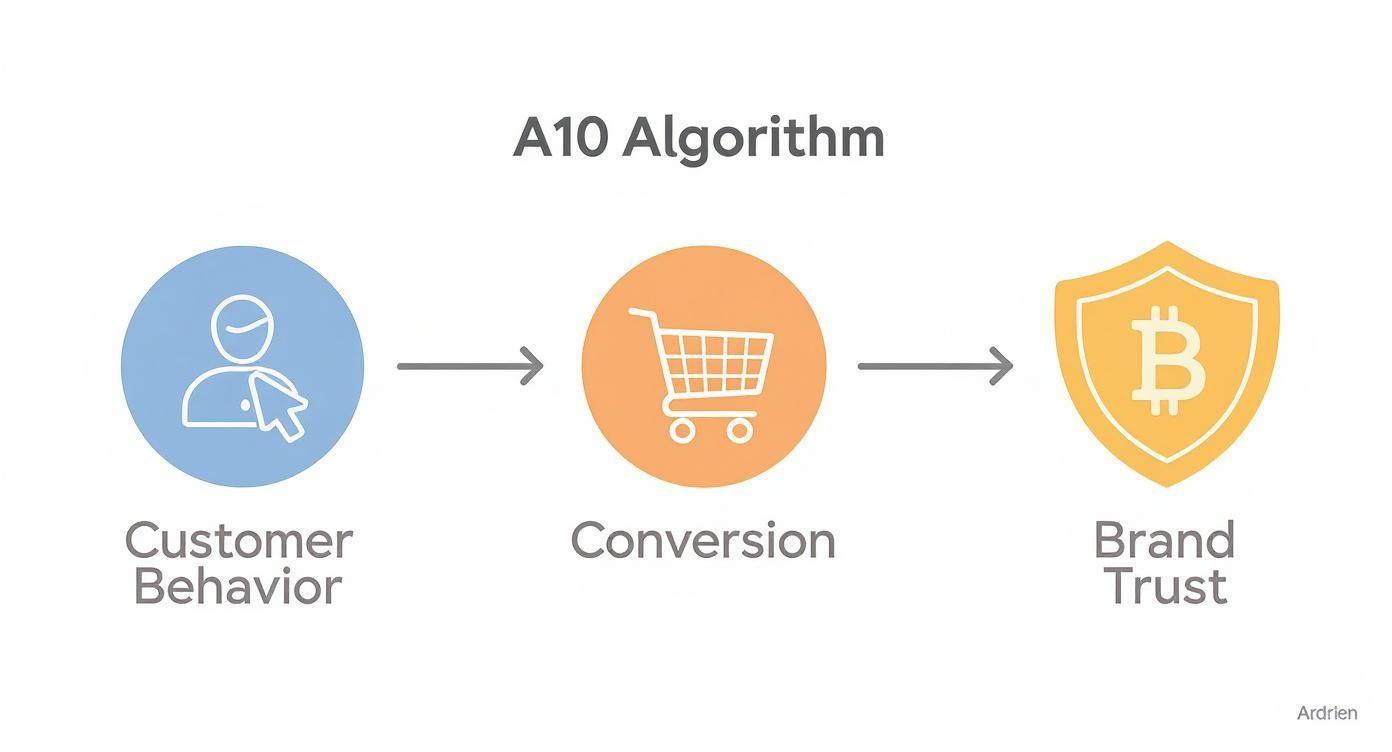
Ultimately, great keyword research isn’t just some SEO task you tick off a list. It’s a core business activity that directly fuels your sales and builds your brand’s authority on the platform.
Expanding Your Research with Competitor Analysis (Amazon SEO Optimisation)
Got your starter list? Good. Now it’s time to see what’s working for the competition. This is often called a reverse-ASIN lookup, and it’s basically a sneaky way of analysing the keywords your top competitors are ranking for. You’ll need a specialised SEO tool for this, but the insights are invaluable.
Just find the ASINs (Amazon Standard Identification Number) for the top three to five products in your niche. Plug these into your keyword tool and see what terms are driving their organic traffic. You’re looking for two things here:
- Keyword Overlaps: These are the big, high-volume terms that are essential for your category. You have to be targeting these.
- Keyword Gaps: These are profitable keywords your competitors are ranking for that you’ve completely missed. These are your golden opportunities.
By reverse-engineering what already works, you’re not just building a bigger keyword list. You’re gaining intel into what the market actually wants. You might even uncover a feature or benefit that customers are desperate for, which you can then shout about in your own listing.
It’s worth remembering that Amazon SEO and PPC advertising are two sides of the same coin. For anyone juggling budgets across different platforms, understanding how they differ is crucial. You can dive deeper into the strategic differences in our guide on the PPC Geeks blog. It’ll help you build a much more balanced and effective marketing plan.
Categorising and Prioritising Your Keywords
By now, your master list is probably looking a bit wild. To make it usable, you need to get organised. Start grouping your keywords into logical categories so you can map them strategically across your product listing.
| Keyword Type | Description | Where to Use It |
|---|---|---|
| Primary Keywords | The most crucial, high-volume terms that perfectly describe your product. | Product Title, first Bullet Point |
| Secondary Keywords | Important variations and related terms that still get good search volume. | Bullet Points, Product Description, A+ Content |
| Long-Tail Keywords | Super specific, multi-word phrases that target niche customer needs. | Backend Search Terms, Product Description |
| Competitor Keywords | Brand names of your direct competitors (handle with care!). | Backend Search Terms (never in the main listing) |
You’ll want to prioritise keywords based on a mix of relevance, search volume, and competition. Your primary keywords are non-negotiable—they have to go in the most important places, especially your title. The secondary and long-tail keywords give the algorithm the context it needs to understand your product fully, helping you show up for a much wider range of searches. This structured approach is fundamental to any successful Amazon SEO optimisation strategy.
Amazon SEO Optimisation: Optimising Your Product Listing for Clicks and Sales
Okay, you’ve done the keyword research. Now you have the raw materials to build a product listing that actually performs. Proper Amazon SEO optimisation isn’t just about stuffing keywords into a page to please the A10 algorithm; it’s about crafting a persuasive sales pitch that turns casual browsers into buyers. Every single part of your listing—from the title right down to the last bullet point—has to work in harmony to improve your visibility and, crucially, your conversion rate.
This is where the art and science of selling on Amazon really come together. You need to skilfully weave your most important keywords into copy that genuinely solves a customer’s problem and builds their trust. A well-optimised listing doesn’t just rank; it sells.

Crafting a High-Performance Product Title
Your product title is the single most valuable piece of real estate you have for on-page SEO. It’s the very first thing shoppers see in the search results, and it carries the most weight with Amazon’s ranking algorithm. The mission here is to create a title that’s both packed with relevant keywords and irresistible to click.
I see sellers make two common mistakes all the time. They either cram the title with a nonsensical jumble of keywords, making it unreadable, or they write a short, vague title that misses out on mountains of potential search traffic. The sweet spot is right in the middle.
A solid title formula usually looks something like this:
- Brand Name: Always lead with your brand to build recognition.
- Main Product Type: Tell them exactly what it is.
- Top 1-2 Keywords: Weave in your most critical search terms.
- Key Feature/Benefit: Shout about a major selling point (e.g., “Waterproof,” “Eco-Friendly”).
- Defining Detail: Add specifics like size, colour, or quantity.
For example, a weak title like “Yoga Mat” is easily forgotten. But an optimised version is far more powerful: “ZenFlow Pro Eco-Friendly Cork Yoga Mat – Non-Slip, Extra Thick for Pilates and Hot Yoga (180cm, Natural)”. This version hits multiple keywords while giving the shopper all the essential info they need to click with confidence.
Writing Bullet Points That Convert (Amazon SEO Optimisation)
Think of your bullet points as your elevator pitch. Shoppers are often just skimming, looking for a quick thumbs-up that your product is what they need. This is your prime opportunity to expand on the features from your title and translate them into real-world benefits.
Each bullet point should kick off by highlighting a key feature and then immediately explain why that matters to the customer. This benefit-first approach speaks directly to their pain points and helps them picture themselves using your product.
Let’s take a generic bullet point for a travel backpack and give it some life:
- Weak: “Made from durable polyester.”
- Strong: “Tear-Resistant Ballistic Polyester: Built to withstand rough handling by airport staff and rugged trails, ensuring your gear stays protected on any adventure.”
See the difference? The second version connects the feature (tough material) to a clear benefit (protection and peace of mind), which is way more persuasive. Use this space to naturally work in your secondary and long-tail keywords.
The most effective product listings anticipate and answer customer questions before they’re even asked. When you address potential worries in your bullet points—like durability, ease of use, or materials— you build the trust needed to close the sale.
Developing a Story with Your Product Description
If a shopper has scrolled all the way down to your product description, they’re seriously interested. This is where you can go beyond just listing features and start telling a story about your brand and product. While the bullet points are for the skimmers, the description is for the considered buyer who wants more detail.
Use this space to:
- Elaborate on the product’s main uses.
- Share your brand’s mission or a unique origin story.
- Cover more detailed technical specs.
- Reinforce the key benefits you mentioned in the bullet points.
For sellers enrolled in Amazon’s Brand Registry, A+ Content is an absolute game-changer. It lets you swap out the plain text description for a visually rich layout with high-quality images, comparison charts, and branded modules. It’s been shown that A+ Content can bump up conversion rates by as much as 10% simply by making your page look more professional and engaging.
The Power of Visuals and Mobile Friendliness (Amazon SEO Optimisation)
Your product images do so much more than just show what the product looks like; they are one of your most critical conversion tools. High-quality, professional images are non-negotiable. Your image gallery should include:
- Primary Image: A crystal-clear shot of the product on a pure white background.
- Lifestyle Images: Photos showing the product in use, helping customers imagine it in their own lives.
- Infographics: Images that use text and graphics to highlight key features, dimensions, or benefits.
- Instructional Shots: Photos demonstrating how to use or assemble the product.
This visual strategy also has to be built with mobile shoppers in mind. Mobile optimisation is now a massive factor in Amazon SEO success. With over 85% of Amazon purchases now made on mobile devices, you simply can’t afford to have a listing that looks terrible on a phone.
Putting all these pieces together is just one part of the puzzle. A powerful listing needs traffic and a strong brand behind it. For more on how to build a complete strategy, have a look at our guide on digital marketing for ecommerce, which explores how to make all your marketing channels work together.
Amazon SEO Optimisation: Leveraging Backend Keywords for Hidden Visibility
While your title and bullet points are the public-facing heroes of your listing, a huge part of your Amazon SEO optimisation happens behind the scenes. What customers don’t see can have a massive impact on your search rankings. This is where backend keywords and other hidden data fields in Seller Central come in, acting as your secret weapon for discoverability.
Think of the backend as a direct line to Amazon’s A10 algorithm. It’s your chance to feed it all the relevant search terms, synonyms, and contextual data that wouldn’t fit naturally—or would just look clunky—on your main product page. Get this right, and you help Amazon understand your product on a much deeper level, indexing it for a far wider net of relevant searches.

Maximising the Generic Keywords Field
The most important backend field goes by a couple of names, usually ‘Search Terms’ or ‘Generic Keywords’. This single field gives you a generous character limit (currently just under 250 bytes) to stuff with keywords that are invisible to shoppers but fully indexed by Amazon. It’s the perfect home for all those terms you couldn’t squeeze in elsewhere.
Let’s say you’re selling a “waterproof hiking rucksack”. Your backend is the ideal place for:
- Synonyms: backpack, daypack, knapsack, pack
- Common Misspellings: ruck sack, hking, water proof
- Use-Cases: trekking, camping, travel, outdoor gear
- Related Terms: durable, lightweight, tear-resistant
The golden rule here is to avoid repetition. If a keyword is already in your title or bullet points, adding it again in the backend is a waste of space. Amazon’s guidelines are crystal clear on this. Also, skip the punctuation. A simple space between each word is all you need.
Rules of the Road for Backend Search Terms (Amazon SEO Optimisation)
To get the most out of this field without running into trouble, you need to stick to the best practices. Following them ensures your terms get indexed properly and you don’t get penalised for breaking the rules.
- Stay Under the Limit: Always stick to the character/byte limit. If you go over, Amazon might just ignore the entire field.
- No Repeats: Don’t repeat keywords already present in your title, bullets, or description. It’s a waste of precious real estate.
- No Competitor Brands: Never, ever use competitor brand names or ASINs. This is a fast track to getting your listing suppressed.
- Use Spaces, Not Commas: Separate keywords with a single space. Punctuation is just wasted characters.
- Logic Isn’t Required: The algorithm doesn’t care about sentence structure. Just list the words.
- Include Variations: Add singular and plural versions if they’re common search patterns, along with any common misspellings you’ve found.
Think of your backend search terms as a keyword “spillover” bucket. It’s the place for all the slightly less critical but still highly relevant terms that help the algorithm build a complete picture of your product.
Filling Out Other Vital Backend Attributes
Beyond the main search terms field, Seller Central has several other tabs with attributes that quietly contribute to your SEO. Fields like ‘Subject Matter,’ ‘Intended Use,’ and ‘Target Audience’ might seem minor, but they provide crucial categorisation data for the A10 algorithm.
For instance, a seller of a premium kitchen knife could fill these out like this:
- Intended Use: Slicing, dicing, chopping, mincing
- Subject Matter: Culinary arts, gourmet cooking, food preparation
- Target Audience: Professional chefs, home cooks, culinary students
Filling these out properly helps Amazon place your product in more specific filtered searches—those handy options shoppers see on the left-hand sidebar. A customer filtering for “gifts for home cooks” is way more likely to see your product if you’ve told Amazon that’s exactly who you’re targeting. This level of detail in your Amazon SEO optimisation strategy is what separates good listings from great ones, helping you capture highly qualified traffic you would otherwise miss entirely.
Amazon SEO Optimisation: Driving Rankings with Reviews and External Traffic
Getting your listing perfectly optimised is a brilliant first step, but modern Amazon SEO optimisation is about more than just what happens on your product page. If you really want to get ahead of the competition, you need to pull two powerful levers that many sellers either forget about or get wrong: customer reviews and external traffic. These elements act as powerful social proof, sending strong signals to the A10 algorithm that your product is a hit with the wider market.
Amazon’s algorithm doesn’t just look for products that convert well; it actively rewards those that build trust and authority. This is exactly where a consistent flow of genuine reviews and a stream of high-intent shoppers from outside of Amazon become your secret weapons.
Building Social Proof with Authentic Customer Reviews
On Amazon, customer reviews are the currency of trust. They are one of the single biggest factors that influence a shopper’s decision to click “Add to Basket.” A healthy number of positive reviews tells both potential buyers and the A10 algorithm that your product is the real deal and lives up to its promises.
But, and this is a big but, you have to generate these reviews carefully and stick to Amazon’s very strict rules. The old days of offering incentives for reviews are long gone, and breaking the rules can get you into serious trouble. The trick is to encourage authentic feedback without ever crossing the line and asking for a positive review.
Here are a few policy-friendly ways to encourage reviews:
- Amazon’s “Request a Review” Button: This is your safest bet. Inside your Seller Central order details, you’ll find a feature that lets you send a standardised, pre-approved email to customers asking for a product review and seller feedback. It’s simple, effective, and 100% compliant.
- Third-Party Automation Tools: To save yourself some time, several reputable services can automate the “Request a Review” process for you. They handle the sending, ensuring every message is fully compliant with Amazon’s terms.
- Product Inserts: A professionally designed card inside your packaging can work wonders. You can use it to thank the customer and gently guide them on how to leave a review if they’d like. Just remember, it can’t offer any kind of compensation or discount in exchange for a review.
A classic mistake is getting obsessed with the number of reviews. What really matters to the algorithm is the quality and recency. A steady trickle of new, detailed reviews is far more valuable than a sudden dump of old, one-line ratings.
The Untapped Power of External Traffic (Amazon SEO Optimisation)
While optimising for searches within Amazon is essential, the A10 algorithm loves it when sellers bring new customers to the party. Driving traffic from external sources like your blog, social media channels, or an email list is a massive signal to Amazon that your product has demand that extends beyond its own marketplace.
When a shopper clicks a link from outside Amazon and completes a purchase, Amazon views this as a top-tier conversion. You haven’t just made a sale; you’ve brought a fresh shopping session into their ecosystem. The algorithm will often reward you for this with a nice bump in your organic rankings.
This strategy proves your product isn’t just relying on paid ads to be seen. In fact, organic Amazon SEO efforts consistently deliver a much better ROI than paid advertising. Research shows that SEO converts 84.62% more users than pay-per-click (PPC) advertising because it taps into higher purchase intent. You can read more about the impressive ROI of organic traffic at searchatlas.com.
Practical Strategies for Driving High-Intent Traffic
Driving external traffic isn’t about just plastering your links everywhere online. It’s about strategically promoting your product to audiences who are already interested in what you sell. This is where having a solid content strategy really pays off.
Here are a few effective channels to focus your Amazon SEO optimisation efforts on:
- Influencer Collaborations: Find and partner with influencers in your niche who have a genuinely engaged following. An authentic product demo or a heartfelt recommendation can send a wave of motivated buyers straight to your listing.
- Social Media Marketing: Use platforms like Instagram, TikTok, or Facebook to show your product in its element. Think lifestyle shots, how-to videos, and sharing content from your customers. This helps build a community and drives targeted traffic directly to your Amazon page.
- Content Marketing and Blogs: Writing blog posts that solve a problem for your target customer is a fantastic way to introduce your product. For instance, if you sell kitchen gadgets, a post on “Top 5 Tools for Faster Meal Prep” can naturally feature your product with a direct link to buy it on Amazon. For a much deeper look at this strategy, check out our guide on content marketing for ecommerce.
When you combine a rock-solid on-page strategy with a proactive plan for getting reviews and driving external traffic, you create a powerful flywheel effect. More reviews boost your conversion rate, and more external traffic signals greater authority to Amazon—both of which tell the algorithm that your product deserves to be at the top of the search results.
Frequently Asked Questions About Amazon SEO
Even when you feel you’ve got a solid strategy dialled in, there are always a few lingering questions about the finer points of Amazon SEO. Let’s tackle some of the most common queries we hear from sellers to clear up any confusion and help you sharpen your approach.
How Long Does It Take to See Results?
This is the big one, isn’t it? The honest answer is: you need to be patient. You won’t see your rankings jump to page one overnight. Typically, you can expect to see noticeable movement in your search position and organic sales within several weeks to a few months.
Of course, this timeline depends on a few things. The competitiveness of your product category plays a huge role, as does how well-optimised your listing was to begin with. Amazon’s indexing speed varies too, so the key is consistent monitoring and making small, data-driven tweaks for long-term growth.
Should I Use the Same Keywords Everywhere?
Absolutely not. Resist the urge to just copy and paste your main keywords into every single field. Amazon’s A10 algorithm is smart enough to understand synonyms, context, and related terms. “Keyword stuffing” just makes your listing a nightmare for customers to read and offers zero real SEO benefit.
A much better strategy is to map your keywords logically across your listing:
- Title: This is prime real estate. Put your most important, high-volume keywords right here for maximum impact.
- Bullet Points: Weave in your secondary keywords and long-tail variations that naturally explain your product’s features and benefits.
- Description & A+ Content: This is your space to tell a story. Use more descriptive, long-tail phrases that answer customer questions.
- Backend Search Terms: This is the perfect spot for all the extras – synonyms, common misspellings, and related terms you couldn’t fit anywhere else.
Using this method casts a much wider net, helping you show up for a broader range of customer searches without sacrificing readability.
Is It Better to Focus on SEO or PPC?
We get this question all the time, but it’s the wrong way to think about it. It’s not an “either/or” choice. A truly powerful Amazon strategy integrates both SEO and PPC to create a growth flywheel that builds on itself.
SEO is all about building your organic foundation. A well-optimised listing naturally converts better, which means every ad click you pay for is more likely to turn into a sale. This improves your listing’s quality score and, over time, reduces how much you need to rely on paid ads.
PPC, on the other hand, gives you immediate visibility and incredibly valuable data. It’s the fastest way to get those crucial initial sales for a new product, test which keywords actually convert, and quickly discover which search terms are the most profitable for your business.
The sales you generate from PPC campaigns directly boost your organic rankings. In turn, your strong SEO foundation makes every pound you spend on advertising more efficient. For a deeper dive into building a winning paid strategy, check out our approach to Amazon Pay Per Click advertising. Combining these two is the real secret to sustainable, scalable success on Amazon.
Ready to stop guessing and start growing? PPC Geeks offers a free, in-depth audit to uncover the hidden potential in your Amazon account. Let our award-winning team build a data-driven strategy to boost your rankings and maximise your ROI. Get your free Amazon Ads audit today