




Think of digital marketing as your business’s front door in today’s world. It’s what keeps you open and visible to customers 24/7, making sure you’re not just surviving but thriving. For a small business, it’s the single most effective way to go toe-to-toe with the big players, connect with the people who actually want your services, and see real, measurable growth.
It’s the difference between setting up your shop on the UK’s busiest high street or being tucked away down a forgotten alley. One gets footfall; the other gets ignored.
Why Your Small Business Needs Digital Marketing Now
Let’s be honest, having a fantastic product or service just isn’t enough anymore. The market is crowded, and your biggest battle is simply getting noticed by the right people. This is where digital marketing steps in. It’s not some overly complex, techy chore only for massive corporations; it’s a practical toolkit for businesses of every size.
The whole point is to level the playing field. Digital marketing gives your small business the power to reach potential customers all across the UK with pinpoint accuracy—something that used to require a colossal advertising budget. You can stop shouting into the void with old-school methods and start having actual conversations with people already looking for what you offer.
This infographic neatly sums up the main benefits.
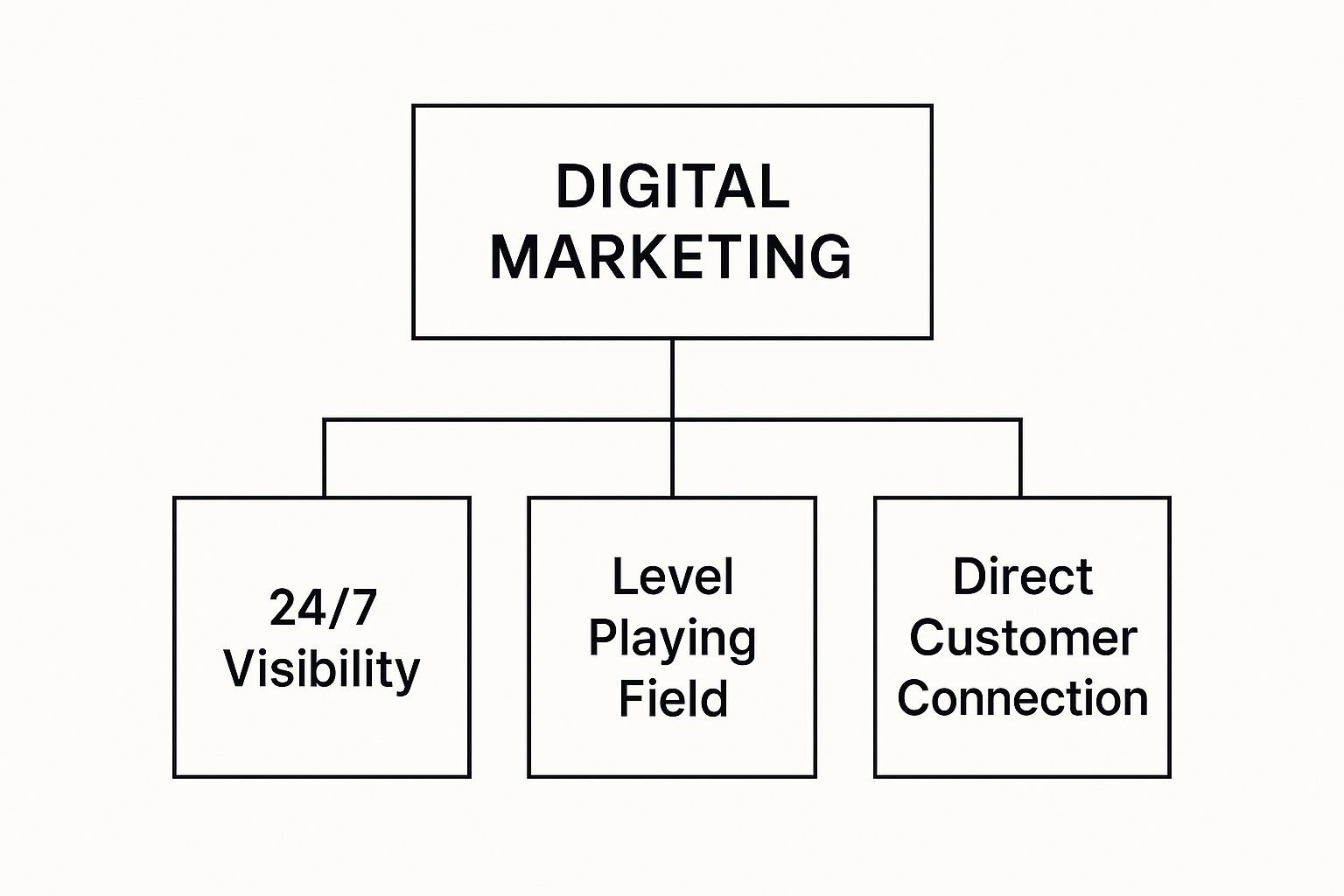
As you can see, it all boils down to being constantly visible, competing fairly, and engaging directly with your audience. Get these right, and you’ve built a solid foundation online.
Connecting with Today’s Customers (Digital Marketing for Small Business Success)
The way people shop has completely changed. Their journey now starts online, with customers doing their homework long before they decide to buy. It’s no surprise that 74% of small businesses in the UK now have a website—they’re adapting to this shift.
And it’s a crucial move, especially when you learn that over 81% of customers research a business online before they even think about making a purchase. If you don’t have a digital presence, you’re invisible to a massive chunk of your potential market. You can dig into more data on UK small business trends to see just how significant this is.
Throughout this guide, we’ll break down the core pillars of a strong digital strategy:
- Search Engine Optimisation (SEO): Making sure you show up on Google when people search for what you do.
- Paid Advertising (PPC): Getting in front of new audiences fast with targeted ads.
- Social Media Marketing: Building a community and chatting with customers where they hang out online.
- Email Marketing: Keeping relationships warm and bringing customers back for more.
Understanding how these channels slot together is the key to building a powerful, profitable online presence. The goal isn’t to get bogged down in technical details but to make digital marketing feel essential and, more importantly, achievable. Start small, stay consistent, and you’ll build success that lasts.
Digital Marketing for Small Business Success: Building Your Foundation with a Strong Website and SEO
Think of your website as your digital headquarters. It’s your shopfront, your sales brochure, and your customer service desk, all rolled into one tidy package. This is where potential customers come to size you up, decide if they can trust you, and ultimately, choose to buy from you. But having a brilliant website isn’t enough; people actually have to find it first.
That’s where Search Engine Optimisation (SEO) comes into play. SEO is the map that leads customers straight from a Google search to your digital front door. Without it, your perfectly designed online shop is tucked away on a quiet side street where nobody ever walks past. For any small business, a strong website backed by smart SEO is the most powerful combination for attracting local customers.
What Makes a Great Small Business Website
Your website doesn’t need to be overly complicated or win any design awards, but it absolutely must be effective. Its main job? To turn curious visitors into paying customers. To do that, every small business website has to get a few core elements right.
These are the non-negotiables:
- Crystal-Clear Contact Information: Make it painfully easy for people to find your phone number, email, and physical address. Ideally, this info should be visible on every single page of your site.
- Simple Navigation: Visitors should be able to find what they’re looking for within a couple of clicks. A confusing menu is a one-way ticket to losing a potential customer for good.
- Mobile-Friendly Design: A huge slice of UK customers search on their phones, so your site must look and work flawlessly on a small screen. This isn’t just a ‘nice-to-have’ anymore; Google actively prioritises mobile-friendly sites in its search results.
- Fast Loading Speed: If your site takes more than a few seconds to load, people will simply leave. Page speed is a massive factor for both user experience and your SEO rankings.
Treat your website like your best salesperson, one who works tirelessly around the clock. It needs to be professional, helpful, and incredibly easy to deal with.
Mastering Local SEO for Immediate Impact (Digital Marketing for Small Business Success)
For most small businesses, bringing in customers from the local area is the number one priority. Local SEO is all about optimising your online presence to pop up in searches made by people in your specific geographical area. This is your secret weapon for dominating the local market.
When someone in your town searches for “best coffee near me” or “emergency plumber in Manchester,” you want your business to be the very first thing they see.
The absolute centrepiece of any local SEO strategy is your Google Business Profile (formerly known as Google My Business). This free listing is what shows up in Google Maps and the “local pack” in search results. Claiming and fully optimising it is arguably the single most important digital marketing action you can take for your small business.
Actionable Steps for Local SEO Success
Getting started with local SEO is a lot more straightforward than you might think. Just focus on these high-impact tasks to start seeing real results.
- Claim and Complete Your Google Business Profile: Don’t skip a single section. Fill out your services, opening hours, add plenty of photos, and write a detailed business description. Consistency is king—make sure your business name, address, and phone number are identical here and on your website.
- Encourage Customer Reviews: Positive reviews are a huge signal to Google that your business is trustworthy and popular. Don’t be shy about asking happy customers to leave you a review; it makes a massive difference to your local ranking.
- Find Your Local Keywords: Get inside your customers’ heads. Instead of just “hairdresser,” they might search for “curly hair specialist Leeds” or “balayage salon near Bristol.” Sprinkle these specific, location-based phrases throughout your website’s main pages.
- Monitor Your Performance: You need to know what’s working and what isn’t. Setting up free tools to track your website’s performance is essential. In fact, you can explore the benefits of using Google Search Console essential tools for SEO success in our detailed guide. It gives you crucial insights into how people are actually finding you online.
By focusing on these foundational elements, you create a powerful one-two punch: a website that turns visitors into customers, and an SEO strategy that brings a steady stream of local people right to you.
Digital Marketing for Small Business Success: Finding New Customers Faster with Paid Advertising
While SEO is your long game for building a rock-solid reputation, sometimes you just need to get in front of customers right now. This is where paid advertising truly shines. It’s the digital equivalent of placing a perfectly targeted advert in a magazine you know your ideal customers read religiously.
Paid advertising, often called Pay-Per-Click (PPC), is all about buying visibility on search engines and social media platforms. Instead of waiting months to climb the organic rankings, you can appear at the top of the search results almost instantly. It’s an incredibly powerful tool for driving rapid growth, launching a new product, or shouting about a seasonal offer.
The key thing to realise is that paid ads aren’t a money pit when they’re used correctly. They are a controllable, scalable, and highly measurable way to drive targeted traffic and generate leads from day one.
Understanding Google Ads vs Social Media Ads
The world of paid advertising for a small business really boils down to two major players, and they each serve a very distinct purpose. Getting your head around the difference is crucial for spending your budget wisely.
Think of it like fishing versus prospecting.
With Google Ads, you’re “fishing” for customers who are actively looking for a solution. They’re typing things like “emergency roof repair Sheffield” or “best vegan cakes in Brighton” into the search bar. They have a problem, and they’re ready to buy.
On the other hand, social media ads (on platforms like Facebook and Instagram) are much more like “prospecting.” You’re putting your business in front of people based on who they are—their interests, their demographics, their online habits. They might not be searching for your product at that very moment, but your advert pops up in their feed because they fit the profile of your perfect customer.
The core difference is all about user intent. Google Ads captures existing demand, while social media ads generate new demand. A smart digital marketing strategy often uses both to great effect.
Setting Up a Simple Local Campaign (Digital Marketing for Small Business Success)
Getting started with paid ads doesn’t require a massive budget or a degree in computer science. Let’s walk through a simple, real-world example of setting up a small-budget local campaign on Google Ads for a fictional Bristol-based gardening service.
- Define Your Goal: The goal is crystal clear—get phone calls from homeowners in Bristol who need their gardens tidied up.
- Choose Your Keywords: Focus on what people would actually type into Google. Good examples would be “gardener in Bristol,” “lawn mowing service Bristol,” and “hedge trimming Bristol.” Steer clear of broad terms like “gardening.”
- Set Your Geographic Target: You can tell Google to only show your ads to people physically located within a specific area, like a 15-mile radius of your business address. This is brilliant because it stops you from wasting money on clicks from people who are too far away to become customers.
- Create a Compelling Ad: Your ad copy needs to be simple and direct. Something like: “Reliable Bristol Gardener. Lawn Mowing & Hedge Trimming. Get a Free Quote Today!”
- Set Your Budget: This is where small businesses have complete control. You can set a maximum daily budget—even just £10 or £20 a day—to make sure you never overspend. You only pay when someone actually clicks on your ad.
For a deeper dive into the specific options available, our guide on different Google Ads campaign types can help you choose the best fit for your goals.
Measuring Your Success Simply
You don’t need complicated spreadsheets to know if your ads are working. To start with, just focus on a few simple metrics:
- Clicks: How many people clicked on your ad and landed on your website.
- Cost Per Click (CPC): How much you paid, on average, for each of those clicks.
- Conversions: This is the most important one. A conversion is a desired action, like a phone call, a contact form submission, or a sale. Tracking this tells you if your investment is actually turning into business.
By starting small with a focused local campaign, you can quickly see the power of paid advertising. It’s an accessible and hugely effective part of digital marketing for any small business aiming for immediate results.
Digital Marketing for Small Business Success: Engaging Your Community on Social Media
Forget thinking of social media as just another digital billboard for your business. It’s more like your local town square—a place where you can build real relationships, listen in on conversations, and become a trusted voice in the community. The secret is to stop posting adverts and start turning followers into loyal customers who genuinely feel connected to your brand.
The goal is to stop broadcasting at people and start connecting with them. This means creating stuff that your audience actually wants to see, share, and chat about. When you nail this, social media becomes a powerful engine for digital word-of-mouth.
Choosing the Right Platforms for Your Audience
One of the biggest blunders small businesses make is trying to be everywhere at once. Don’t spread yourself thin. The smart move is to pick one or two platforms where your ideal customers already hang out and absolutely master those first. For most UK businesses, the choice usually boils down to a few key players.
Research shows UK small businesses are all-in on content, with Facebook used by a massive 76% and Instagram close behind at 63%. These platforms are the bedrock of many winning strategies. For example, the average engagement rate for Instagram content among UK small businesses is 0.43%—a figure that blows other platforms out of the water and makes it a powerhouse for connecting with local audiences.
Here’s a quick rundown to help you decide where to plant your flag:
- Facebook: Perfect for building a community. If you’re a cafe, a local tradesperson, or a community event organiser, this is your turf. Facebook Groups are especially potent for creating a dedicated space for your biggest fans.
- Instagram: The undisputed king for anything visual. If you’re a boutique, a restaurant, a designer, or a tradesperson with a portfolio of cracking work, Instagram’s visual-first format is the best way to show it off.
- LinkedIn: Absolutely essential for B2B (business-to-business) companies. If your customers are other businesses, this is where you build professional credibility, share industry insights, and network with decision-makers.
- TikTok: Brilliant for reaching a younger audience with creative, short-form video. It’s a goldmine for brands with a bit of personality that can jump on trends quickly.
Your time is precious. Focus your energy where you can make the biggest splash. It’s far better to be consistently brilliant on one channel than mediocre and sporadic on five.
Creating Content That Genuinely Connects (Digital Marketing for Small Business Success)
Once you’ve picked your platform, it’s time to create content people actually care about. Ditch the hard sell in every post. A good rule of thumb is to make your social media feed 80% value and 20% promotion.
Value comes in all sorts of flavours. It could be entertaining, educational, or inspiring. The aim is to make your followers feel like they get something from following you, turning your profile into a go-to spot rather than just another advert cluttering their feed.
Here are a few content ideas that work wonders for small businesses:
- Behind-the-Scenes Stories: Show the people behind the business. Introduce your team, give a sneak peek of how your products are made, or share a funny moment from the workday. People connect with people, not faceless logos.
- User-Generated Content (UGC): Let your customers be the stars! Share photos, videos, or reviews from happy clients. This is brilliant social proof and makes your customers feel seen and appreciated.
- Genuinely Helpful Tips: A local accountant could share quick tips for tax season. A bakery could post a simple recipe. This shows you know your stuff and builds trust.
The Power of Consistency and Engagement
The final pieces of the puzzle are consistency and real, human engagement. Posting regularly—whether that’s three times a week or once a day—keeps your brand front and centre in people’s minds. But what’s even more important is engaging with the people who interact with you.
That means replying to every single comment and direct message. Thank people for their kind words and properly answer their questions. This two-way conversation is what turns a passive follower into a true advocate for your business.
While organic engagement is the foundation, you can also give your reach a boost. To learn more about getting your content in front of a bigger, more targeted audience, check out the key advantages of social media advertising in our guide. It breaks down how even a small, targeted ad budget can massively accelerate your community-building efforts.
Digital Marketing for Small Business Success: Driving Repeat Business with Email Marketing
Think of your social media as a bustling town square where you shout your message to the crowd. Email marketing, on the other hand, is the quiet, private chat you have with a customer over a coffee. It’s your chance to send a personal note, build real loyalty, and create a connection that public channels just can’t replicate.
Unlike a social media feed, where your post is just one of many distractions, an email lands directly in your customer’s inbox. This direct line is your secret weapon for turning one-time buyers into loyal fans who feel genuinely valued. For any small business serious about long-term growth, this isn’t just a ‘nice to have’—it’s essential.
Building Your Email List the Right Way
Before you can start those conversations, you need people to talk to. Building an email list is all about giving people a compelling reason to invite you into their personal space. The trick is to be helpful and inviting, not pushy, and make the whole sign-up process a piece of cake.
You don’t need any complicated tricks to get going. Here are a few dead-simple ways to encourage sign-ups:
- Simple Website Forms: Pop a clear sign-up form on your homepage and at the end of your blog posts. Offer a little something in return, like a 10% discount on their first order or a free downloadable guide.
- In-Store Sign-ups: Got a physical shop? A simple clipboard by the till or a QR code customers can scan while they wait is incredibly effective. Just give them a quick line about what they’ll get, like exclusive deals or a heads-up on new stock.
- Social Media Links: Use that prime real estate in your social media bio to link straight to a sign-up page. Every now and then, post a reminder about the perks of being on the list.
Your email list is one of the most valuable assets your business has because you own it outright. Unlike your social media followers, which can disappear overnight with an algorithm change, your email list is a direct, reliable line to your customers.
Simple Campaigns for Maximum Impact
You don’t need to be a marketing genius to send emails that work. The goal is to provide real value and make your subscribers feel like they’re part of an exclusive club. By focusing on a few core campaign types, you can get fantastic results without feeling overwhelmed.
Here are three campaign ideas that are perfect for any small business:
- The Welcome Series: Set up an automated sequence of 2-3 emails for new subscribers. The first email should deliver their promised discount and a warm thank you. The second can share a bit about your brand’s story, and the third can show off your best-selling products or services.
- Exclusive Offers: Treat your subscribers like VIPs. Send them special discounts or early access to sales that the general public can’t get. This makes being on your list feel genuinely worthwhile and strengthens their loyalty.
- Valuable Newsletters: Put together a simple weekly or monthly newsletter that’s more than just a sales pitch. Share useful tips, behind-the-scenes glimpses, or interesting industry news. This builds your reputation as an expert and keeps your brand front and centre in their minds.
Even the smallest personal touches can make a huge difference. Just using a subscriber’s first name in the subject line can give your open rates a serious boost, making your email feel less like a mass mailing and more like a personal message. It’s these little things that forge strong, lasting customer relationships.
Digital Marketing for Small Business Success: Creating Your First Digital Marketing Plan
Trying to bring all these channels together can feel like the hardest part of the puzzle. But a solid plan is what separates good ideas from genuine results. The secret to digital marketing for a small business isn’t about doing everything at once. Far from it. It’s about starting small, being consistent, and putting your energy where it will make the biggest difference.
Think of this as your one-page roadmap. A simple, actionable plan stops you from getting overwhelmed and makes sure every pound you spend is pushing you towards a clear goal. It’s the difference between chucking darts at a board randomly and actually aiming for the bullseye.
Define Your Single Most Important Goal
Before you even think about which channels to use, you need to nail down what you actually want to achieve. Be specific. Be realistic. A great place to start is setting a tangible goal that has a direct impact on your bottom line.
Instead of a woolly aim like “get more customers,” try something concrete:
- Generate 10 new quote requests through the website each month.
- Increase footfall to our shop by 15% in the next quarter.
- Get 50 new subscribers for our email newsletter this month.
A clear, measurable goal gives your marketing a purpose. It’s the destination you’re plugging into your satnav before you even start the engine.
Identify Your Ideal Customer (Digital Marketing for Small Business Success)
You can’t talk to everyone, so stop trying. Focus on talking to the right person. Who is the one person most likely to buy from you? Get a really clear picture of them in your head. Where do they live? What’s their job? What headaches do they have that you can solve?
Knowing this helps you choose your channels wisely. If your ideal customer is a homeowner in their 50s, you’re going to find them in very different online spaces than a university student. This focus makes your marketing more efficient and a whole lot more effective.
Choose One or Two Channels to Master
Right, this is the most important step: do not try to be everywhere. Pick just one or two channels to start with, based on your goal and your ideal customer. If you’re a local plumber, pouring your effort into Local SEO and Google Ads makes perfect sense. If you run a boutique selling handmade jewellery, Instagram and email marketing are probably your best bets.
The goal is to master one channel before you even think about adding another. It’s far better to be brilliant on Facebook than to be distinctly average on Facebook, Instagram, TikTok, and LinkedIn combined. Consistency on one platform will always beat sporadic efforts on five.
This focused approach is absolutely crucial, especially as investment in digital keeps climbing. Digital marketing spending among UK companies was projected to surge by 28.29% in 2022, a clear sign that businesses are putting their money where the results are. You can explore more data about UK digital marketing investments on limeup.io to see just how serious this trend is. By choosing your channels carefully, you ensure your budget is used effectively. To help you structure all this, our detailed guide explains how to create a successful marketing strategy from start to finish.
Got Questions About Digital Marketing? We’ve Got Answers
Stepping into the world of digital marketing always brings up a few practical questions. It’s completely normal. Getting clear, straightforward answers is the key to moving forward with a bit of confidence. We’ve pulled together some of the most common queries we hear from business owners just like you.
This isn’t about dry, complicated theory; it’s about giving you the practical insights you need to get off to a flying start.
How Much Should a Small Business Spend on Digital Marketing?
There’s no single magic number, but a good rule of thumb is to set aside 5-10% of your revenue for marketing. If you’re a brand new business and growth is your main goal, you might need to push that a little higher to get some initial momentum.
The best way forward? Start with a modest, manageable budget on just one or two channels. This could be a few hundred pounds a month for some highly targeted local Google Ads or a small, focused Facebook ad campaign.
The most important principle is to track your return on investment. Once you see a channel is actually delivering results—like genuine customer enquiries—you can confidently put more money into what’s working. The trick is to start small, measure everything, and scale up based on real performance.
Which Digital Marketing Channel Is Best to Start With?
Honestly, this depends entirely on your specific business and, most importantly, where your customers hang out online. Please don’t fall into the trap of trying to be everywhere at once. It’s a recipe for burnout.
If you offer a service that people actively search for when they have a problem (think emergency plumber or local locksmith), then starting with Local SEO and Google Ads is a brilliant choice. You’re catching people at the exact moment they need what you’ve got.
On the other hand, if you sell a visual product or run a business with a strong community feel, like a boutique clothing shop or a local café, putting your energy into Instagram and Facebook will probably get you much further. The key is to pick one or two channels where your audience is most active and really master them before you even think about expanding.
How Long Does It Take to See Results?
This is a big one, and the results vary massively depending on the channel. It’s helpful to think in terms of short-term wins versus long-term, sustainable growth.
- Paid Advertising (PPC): With channels like Google Ads or social media ads, you can start seeing traffic and leads almost immediately. We’re talking within days or even hours of launching a campaign. The only catch is that the results stop the second you stop paying.
- Search Engine Optimisation (SEO): This is the long game. It can easily take 3-6 months of consistent work to see a real shift in your search rankings and organic traffic. The massive payoff, though, is that these results are far more sustainable, building a valuable, long-term asset for your business.
A smart, balanced strategy often uses paid ads to get some quick wins and build momentum while you quietly build your powerful SEO foundation in the background.
Ready to get expert help with your paid advertising and see results faster? The team at PPC Geeks creates data-driven campaigns that increase traffic, generate leads, and maximise your return on investment. Reclaim your time and get a free, in-depth audit of your account at https://ppcgeeks.co.uk/.