




A Guide to B2B PPC Advertising Strategy: B2B PPC advertising is all about using platforms like Google and LinkedIn to get your ads in front of the right business decision-makers. It’s a world away from advertising to the general public. Instead of chasing quick consumer sales, the entire game is about generating highly qualified leads within specific professional industries.
A Guide to B2B PPC Advertising Strategy: What B2B PPC Advertising Really Means
Picture this: you’re trying to sell sophisticated manufacturing software. You wouldn’t stand in a busy shopping centre shouting about it, would you? That would be a massive waste of time and money. B2B PPC works more like a specialist headhunter, pinpointing the exact procurement managers or CTOs who are actively looking for the solution you provide.
This level of precision is non-negotiable because the B2B buying journey is a completely different beast to a consumer purchase. A B2C campaign might target someone looking for a new pair of trainers – a decision made quickly, often driven by emotion. B2B decisions, on the other hand, are complex, logical, and almost always involve multiple people signing off.
B2B PPC vs B2C PPC Key Differences
To really grasp the shift in mindset, it helps to see the two approaches side-by-side. The strategy, goals, and even the language used are fundamentally different when you’re talking to a business professional versus a casual shopper.
| Factor | B2B PPC (Business-to-Business) | B2C PPC (Business-to-Consumer) |
|---|---|---|
| Primary Goal | Lead Generation, Nurturing | Direct Sales, Brand Awareness |
| Audience | Niche, job titles, industries, company size | Broad, demographics, interests, behaviours |
| Sales Cycle | Long (months, even years) | Short (minutes, hours, days) |
| Decision-Making | Logical, data-driven, committee-based | Emotional, impulsive, individual |
| Offer/CTA | Demos, whitepapers, case studies, webinars | “Buy Now”, discounts, limited-time offers |
| Keywords | Technical, “solution-aware”, long-tail | Broad, generic, brand-focused |
| Ad Copy Tone | Professional, value-driven, credible | Emotional, persuasive, urgent |
| Deal Value | High (thousands to millions) | Low (tens to hundreds) |
As you can see, B2B PPC is less about the instant gratification of a sale and more about initiating a valuable, long-term business relationship.
The Core Strategic Shift (A Guide to B2B PPC Advertising Strategy)
Everything has to be recalibrated for a professional audience. B2B sales cycles can stretch for months, and the deal values can easily run into the thousands or even millions of pounds. This changes the entire playbook, from the words in your ads to the experience on your landing page.
Instead of pushing for flash sales or impulsive clicks, B2B PPC has to focus on:
- Building Trust and Credibility: Your ads and content must ooze expertise. Think valuable offers like whitepapers, detailed case studies, or sign-ups for an industry webinar.
- Targeting by Profession, Not Personality: Success hinges on reaching specific job titles, industries, and company sizes, not broad demographic interests.
- Nurturing Leads Over Time: The aim isn’t an instant sale. It’s to capture a qualified lead and then carefully guide them through a lengthy consideration phase.
B2B PPC is less about making a quick sale and more about starting a valuable, long-term business conversation. The focus shifts from transactional wins to strategic relationship-building, using data to find the right companies and decision-makers.
Here in the UK, B2B PPC has become an absolutely vital part of any serious digital marketing strategy. Analysis from thousands of campaigns shows the average cost-per-click (CPC) for UK B2B sectors was £1.87, with a pretty standard conversion rate of 3.2%. This just goes to show how crucial an efficient, well-managed strategy is to get the most out of every pound spent. It’s why the role of B2B PPC advertising experts has become so critical for businesses wanting to navigate this complex field and really drive growth.
A Guide to B2B PPC Advertising Strategy: Choosing Your B2B Advertising Platforms
Picking the right platform for your B2B PPC ads is a bit like choosing the right tool for a delicate job. You wouldn’t use a sledgehammer to fix a watch, and you definitely shouldn’t be using a purely B2C-focused platform to try and catch the eye of a senior IT director. The game is all about putting your budget where your ideal decision-makers are actually spending their time and are open to what you’ve got to say.
This isn’t just about ticking off features on a list; it’s about making sure the platform’s vibe and strengths match your business goals. Each channel is its own little world with a unique audience mindset. Getting your head around these differences is the first real step to building a B2B ad strategy that’s both powerful and doesn’t burn through your cash.
Google Ads: The High-Intent Search Giant
Think of Google Ads as the digital equivalent of a massive, bustling high street for problem-solvers. When a business professional has an urgent problem they need to fix—whether it’s finding “enterprise CRM software” or “cybersecurity compliance services”—their first port of call is almost always Google. This makes it a beast of a platform for grabbing high-intent leads who are actively looking for a solution right now.
On average, the click-through rate for B2B search ads on Google hovers around 2.41%, with the cost per click averaging £3.33. Yes, the cost can feel a bit steep, but you’re paying a premium to get in front of an audience that has already raised its hand and said, “I have this problem.” Your ad becomes the immediate answer they’re hunting for.
This platform really shines when your product or service solves a clear, searchable pain point. If you know the exact phrases your prospects are typing into that search bar when they’re in a bind, Google Ads gives you a direct line to them at that crucial moment of need.
LinkedIn Ads: The Professional Targeting Powerhouse (A Guide to B2B PPC Advertising Strategy)
If Google Ads is all about capturing existing demand, LinkedIn Ads is about creating it with pinpoint accuracy. Honestly, no other platform even comes close to its professional targeting capabilities. Imagine being able to show your ads only to Chief Financial Officers at fintech companies with over 500 employees, all based in London. That’s the kind of surgical precision LinkedIn puts at your fingertips.
LinkedIn is the natural home for account-based marketing (ABM), letting you target specific companies and job titles with messages crafted just for them. It’s perfect for the long game—nurturing leads through a lengthy sales cycle, building your brand up as a thought leader, and starting relationships before a prospect even knows they need you.
LinkedIn is less about the quick win and more about strategic positioning. It’s where you build credibility and make damn sure that when your target accounts are finally ready to buy, your brand is the first one that pops into their heads.
This platform is tailor-made for high-value services or complex products with a drawn-out buying process. While the cost per lead can be higher, the quality you get is often in a different league. For those wanting to really get stuck in, our guide on LinkedIn Ads for brand awareness and lead generation is a fantastic roadmap to success.
Microsoft Ads: The Overlooked Opportunity
Often stuck in Google’s shadow, Microsoft Ads (what we used to call Bing Ads) is a massively overlooked but incredibly valuable channel for B2B PPC. Its audience tends to be a bit older, more affluent, and often more business-focused, simply because it’s the default search engine on countless work PCs. For many B2B advertisers, this demographic is a genuine goldmine.
One of the biggest perks of Microsoft Ads is the lack of competition. Fewer advertisers means lower costs per click and a potentially higher return on your ad spend, especially for well-run campaigns. If you’re in sectors like finance, legal, or industrial services, this platform can deliver surprisingly strong results without the frantic bidding wars you’ll find on Google.
Here’s a quick way to think about it:
| Platform | Primary Strength | Best For | Audience Mindset |
|---|---|---|---|
| Google Ads | Capturing search intent | Immediate lead generation | “I need a solution now.” |
| LinkedIn Ads | Precise professional targeting | Account-based marketing | “I’m here for professional insights.” |
| Microsoft Ads | Reaching a mature audience | Niche B2B sectors, lower CPCs | “I’m researching for work.” |
At the end of the day, the best results often come from a diversified approach. Starting with Google to catch that high-intent traffic, layering in LinkedIn for hyper-targeted ABM, and then testing the waters with Microsoft for some cost-effective reach can create a B2B PPC strategy that’s both balanced and resilient.
A Guide to B2B PPC Advertising Strategy: Building Your B2B Keyword and Audience Strategy
Getting B2B PPC right boils down to two things: reaching the right companies and then connecting with the right people inside those companies. This isn’t about casting a wide net and hoping for the best; it’s precision work. Nail this foundation, and every pound you spend will work harder, pulling in prospects who are actually in the market for what you sell.
Let’s build this strategy from the ground up. We’ll start with the language your ideal customers use to find solutions, then move on to the professional DNA that defines them. This dual approach ensures your message doesn’t just get seen—it hits home with key decision-makers.
Mastering B2B Keyword Research
A solid B2B PPC strategy is built on meticulous keyword research. While there are some great guides on how to conduct keyword research for SEO that are useful here, B2B requires a different mindset. We need to sidestep broad, generic terms and zero in on the specific, high-intent phrases that scream “I have a business problem that needs solving.”
You have to think like your customer. A marketing manager isn’t just typing “software” into Google. They’re searching for “SaaS project management tool for remote teams” or “enterprise lead attribution platform.” These are long-tail keywords, and they are the absolute lifeblood of efficient B2B PPC. The traffic is lower, sure, but it’s vastly more qualified.
To put together a powerful keyword list, concentrate on terms that show:
- Problem Awareness: Phrases that spell out the pain point, like “how to reduce supply chain costs.”
- Solution Searching: Terms looking for a category of solution, such as “inventory management systems.”
- Brand/Product Comparison: Keywords like “[Competitor A] vs [Competitor B]” or “reviews for [Your Product].”
Defining Your Audience with Precision (A Guide to B2B PPC Advertising Strategy)
Once you know what your audience is searching for, you need to pin down exactly who they are. This is where audience targeting becomes your secret weapon, letting you layer on demographic and firmographic data to build a laser-focused profile of your ideal customer.
This goes way beyond basic demographics. In the B2B world, you have to get granular with professional attributes.
The real magic in B2B PPC happens when you stop targeting individuals and start targeting professional roles within specific business contexts. It’s the difference between advertising to ‘John Smith’ and advertising to ‘John Smith, Head of Procurement at a UK-based logistics firm with 500+ employees’.
This infographic perfectly illustrates how different ad platforms serve distinct strategic needs—from catching broad search intent on Google to executing precise professional targeting on LinkedIn.
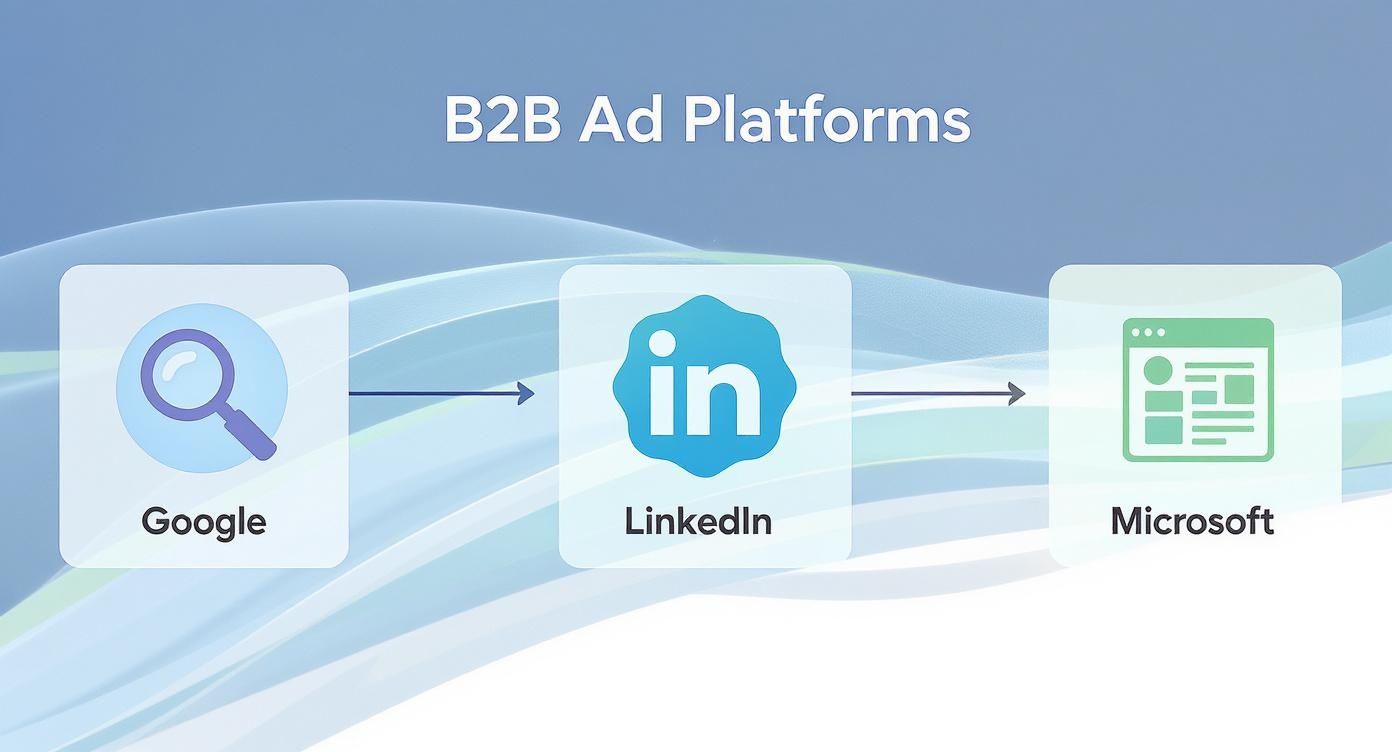
As the visual shows, your choice of platform is fundamental to your audience strategy, because each one gives you a unique toolkit for reaching your defined targets.
To really get to grips with this, it’s worth learning more about what is audience targeting and how to apply its principles. The aim is to construct audiences using layers of data, making sure your ads are only ever shown to the most relevant professionals.
Key targeting layers for B2B PPC advertising include:
- Firmographics: Company size, industry (e.g., manufacturing, legal services), and annual revenue.
- Demographics: Job title, seniority level (e.g., C-Suite, Manager, Intern), and specific job function (e.g., IT, Marketing).
Activating Account-Based Marketing in PPC
Account-Based Marketing (ABM) pushes this precision to its logical conclusion. Instead of targeting broad audience segments, ABM concentrates all your advertising firepower on a handpicked list of high-value target companies. Think of it as the PPC equivalent of sending a bespoke proposal directly to your dream client’s desk.
For businesses dealing with high-value contracts and long sales cycles, this approach is a game-changer.
Let’s say you sell specialised cybersecurity software for the financial sector. With an ABM strategy, you could upload a list of the top 50 UK investment banks you want as clients. From there, you can launch hyper-personalised campaigns on platforms like LinkedIn, serving ads only to the CTOs and IT Security Managers within those specific firms.
You can even tweak the ad copy to mention challenges unique to their industry, making the message impossible to ignore. This method slashes wasted ad spend and aligns your marketing directly with your sales team’s priority list, creating a powerful, unified push to win those key accounts.
A Guide to B2B PPC Advertising Strategy: Creating Ads and Landing Pages That Convert
Getting a decision-maker to click your ad is just the first move. The real game in B2B PPC is turning that initial click into a qualified lead, and that’s where the magic really happens. This is only possible when your ad and landing page work in perfect harmony, creating a seamless journey from curiosity to conversion.
Unlike B2C ads that often pull on heartstrings or create a sense of urgency, B2B ad copy needs to be built on a rock-solid foundation of value and credibility. Your audience isn’t looking for a quick purchase; they’re searching for a trusted partner to solve a complex, expensive business problem. The goal is simple: make them think, “Finally, someone who gets it.”
Writing Ad Copy That Speaks to Professionals
Your ad copy is your first impression. It’s got to be sharp, solution-focused, and communicate value in a split second. Forget fluffy language and vague promises—they’re a one-way ticket to getting ignored. Specificity and ROI-driven messaging are what earn you the click.
Put yourself in their shoes. A CFO isn’t moved by a flashy discount; they want to hear about “reducing operational overheads by 20%.” A marketing director doesn’t care about “better campaigns”; they need a “platform that integrates with their existing martech stack.”
Here are the core principles for writing B2B ad copy that hits the mark:
- Focus on Problems and Solutions: Lead with the pain point. Your headline should instantly connect with a challenge they’re facing (e.g., “Inefficient Supply Chain?”).
- Use Their Language: Sprinkle in industry-specific terms. This isn’t about showing off; it’s about showing you’re an insider who understands their world.
- Highlight Tangible Outcomes: Quantify everything. Use numbers, percentages, and hard results (e.g., “Trusted by 500+ UK Firms,” “Cut Reporting Time in Half”).
- Offer Value, Not Just a Product: Your call-to-action should promise valuable insight, not a pushy sales pitch. Think “Download the Free Report,” “Request a Demo,” or “Get a Custom Quote.”
In B2B PPC, your ad isn’t just an advertisement; it’s the start of a consultation. It must promise a solution and a clear path to understanding how that solution delivers a return on investment.
This approach acts as a filter, attracting prospects who are genuinely in the market for a solution while weeding out the tyre-kickers. It aligns perfectly with the logical, data-driven mindset of a B2B buyer, making sure your ad spend goes towards generating high-quality leads.
Designing High-Performance B2B Landing Pages (A Guide to B2B PPC Advertising Strategy)
Once you’ve earned that click, the landing page has to deliver on the ad’s promise. Immediately. Any disconnect between your ad and your landing page is the fastest way to lose a potential lead. The page must feel like a natural next step, designed to build trust and guide them towards one single, specific action.
A great B2B landing page is a conversion machine. Every single element, from the headline to the button colour, works towards one goal: convincing the visitor to fill out that form. This demands a laser focus on clarity, proof, and simplicity. If you want to go deeper, our guide on landing page best practices is packed with actionable tips.
Key elements for a landing page that converts include:
- A Clear Value Proposition: The headline must echo the ad’s message and state the main benefit in one powerful, unmistakable sentence.
- Compelling Social Proof: This is non-negotiable. Display logos of well-known clients, customer testimonials, industry awards, and snippets from case studies to build trust with a naturally sceptical business audience.
- Streamlined Lead Capture Forms: Only ask for what you absolutely need. Every extra field you add is another reason for them to leave.
- Benefit-Oriented Content: Use bullet points and concise copy to explain how your solution solves their problem. Focus on outcomes, not just a list of features.
By ensuring your ads and landing pages are perfectly aligned, you create a cohesive and trustworthy experience that effectively transforms clicks into valuable business opportunities.
A Guide to B2B PPC Advertising Strategy: Measuring Success and Proving ROI
In B2B advertising, the finish line is rarely a quick, clean sale. With sales cycles that can stretch for months and involve a whole committee of decision-makers, proving your ad spend is actually working can feel like pulling teeth. You have to look past the obvious numbers and zero in on the metrics that genuinely signal business impact.
Clicks and impressions are just the start of the story, not the end. While they show your campaigns are active, they don’t tell you a thing about lead quality or, more importantly, revenue. To get a real grip on ROI, you need to go deeper. Getting your head around understanding key metrics like reach and impressions is a great first step before you tackle the more complex B2B KPIs.
It’s all about shifting your focus from vanity metrics to the performance indicators that connect directly to your bottom line.
Essential B2B PPC Metrics and KPIs
Here’s a breakdown of the most important metrics for measuring the success and ROI of B2B advertising campaigns. These go way beyond surface-level clicks and impressions to give you a true picture of what’s working.
| Metric | What It Measures | Why It’s Important for B2B |
|---|---|---|
| Cost per Lead (CPL) | The total cost to generate a single lead (e.g., a form submission or content download). | This is your fundamental efficiency metric. It tells you exactly how much it costs to get a potential customer to raise their hand. |
| Cost per Qualified Lead (CPQL) | The cost to acquire a lead that sales has vetted and confirmed meets your ideal customer profile. | A far more valuable metric than CPL, CPQL shows you the cost of generating a real opportunity, not just a name in a database. |
| Customer Lifetime Value (CLV) | The total estimated revenue a single customer will generate over the course of your entire business relationship. | CLV gives you the long-term perspective needed to justify your initial ad spend. A high CLV can make a seemingly high CPL look very reasonable. |
| Return on Ad Spend (ROAS) | The gross revenue generated for every pound spent on advertising. (Revenue / Ad Spend). | This is the ultimate proof of profitability. ROAS gives you a clear financial snapshot of your campaign’s direct contribution to the business. |
Tracking these KPIs is non-negotiable. They provide the hard data you need to prove the value of your campaigns to stakeholders and make smarter decisions about where to put your budget next.
A high click-through rate means nothing if none of those clicks turn into qualified leads. In B2B, the goal isn’t just to generate leads; it’s to generate leads that have a genuine chance of becoming high-value, long-term customers.
The Challenge of B2B Attribution (A Guide to B2B PPC Advertising Strategy)
Attribution is one of the trickiest parts of the B2B PPC puzzle. A typical customer journey is rarely a straight line. It might involve a Google search, seeing a LinkedIn ad a week later, clicking a retargeting banner, and finally converting through an email campaign.
If you only give credit to that final email click, you’re missing the massive role your PPC ads played in getting them there. You’re blind to what actually started the conversation.
This is where multi-touch attribution models come in. Instead of giving 100% of the credit to the last interaction, these models share the credit across the various touchpoints that influenced the journey.
Here are a few common models:
- Linear Model: Spreads the credit out evenly across every single touchpoint. Simple, but fair.
- Time-Decay Model: Gives more credit to the touchpoints that happened closer to the final conversion.
- Position-Based Model: Gives the most credit to the very first and very last interactions, with the rest shared among the touchpoints in the middle.
Picking the right attribution model helps you see the bigger picture. You can finally understand which campaigns are brilliant at creating initial awareness versus those that are killer at closing deals. This holistic view lets you make much smarter budget decisions and prove the full financial value of your B2B PPC advertising efforts.
A Guide to B2B PPC Advertising Strategy: Common B2B PPC Mistakes to Avoid
Running B2B PPC campaigns can feel like navigating a minefield. Even seasoned marketers slip up, and these common mistakes can quietly drain your budget, chipping away at your ROI until there’s nothing left. Getting a handle on these pitfalls is the first step to building a PPC strategy that actually delivers.
One of the biggest blunders is talking to businesses like they’re consumers. You can’t advertise a complex SaaS platform the same way you’d sell a pair of trainers. The snappy, emotional language that works in B2C just doesn’t land with a professional audience that needs logical, data-driven solutions to solve real business pains.
Neglecting Negative Keywords
Another massive hole in many B2B campaigns is a weak negative keyword list. Think of negative keywords as the bouncer for your ads—they’re there to turn away all the irrelevant traffic you don’t want.
Without a solid list, your ads for “business accounting software” could easily show up for searches like “free accounting courses” or “accountant job vacancies”. You’ll get plenty of clicks, but they’ll be from people who have zero intention of ever buying from you. This is one of the quickest ways to burn through your ad spend with nothing to show for it.
In B2B PPC, precision is everything. Every irrelevant click is more than just wasted money; it’s a missed opportunity to reach a genuine decision-maker. Building a strong negative keyword list is one of the most powerful actions you can take to protect your budget.
Misaligning Marketing and Sales (A Guide to B2B PPC Advertising Strategy)
Finally, a classic mistake that happens far too often is the disconnect between marketing and sales. Marketing might be high-fiving over a record number of new leads, but if the sales team is complaining that they’re all useless, the whole effort has been a waste of time. It’s a recipe for friction and total inefficiency.
The fix? Get both teams in a room and hammer out a crystal-clear definition of a Marketing Qualified Lead (MQL) and a Sales Qualified Lead (SQL). When everyone is on the same page, marketing can focus on bringing in the right people, and sales can spend their time nurturing prospects who are actually likely to become customers.
Here are a few other common tripwires to look out for in B2B PPC:
- Ignoring Long Sales Cycles: B2B decisions aren’t made overnight. If you’re not running retargeting campaigns and nurturing leads over time, you’re losing touch with prospects right when they’re deep in the consideration phase.
- Focusing on Vanity Metrics: A sky-high click-through rate means nothing if those clicks don’t convert. Ditch the ego-boosting numbers and focus on metrics that actually matter, like Cost per Qualified Lead (CPQL) and Return on Ad Spend (ROAS).
- Using Generic Landing Pages: You wouldn’t send a VIP to the general reception desk, so why send highly targeted ad traffic to your generic homepage? Every ad group needs its own dedicated landing page that directly reflects the ad’s promise.
B2B PPC: Your Questions Answered
When you’re diving into B2B PPC, a few questions always pop up. It’s a different beast to consumer advertising, with its own set of rules and challenges. Let’s clear up some of the most common ones.
Is B2B PPC Actually Any Good for Lead Generation?
Absolutely. When it’s done right, it’s one of the most powerful tools for generating high-quality leads. While SEO and content marketing build momentum over time, B2B PPC puts you in front of professionals who are actively looking for a solution right now.
The magic is in the targeting. You can zero in on specific job titles, industries, and even company sizes. This means your ads aren’t just shouting into the void; they’re reaching the decision-makers at the very moment they need you. That precision is what fills your sales pipeline with relevant, qualified leads.
What’s the Real Difference Between B2B and B2C PPC?
It all comes down to the audience and the sales process. B2B PPC is a long game. You’re targeting professionals in niche markets who make decisions based on logic, ROI, and how you can solve a complex business problem. The sales cycle can take months, and it’s all about nurturing that initial lead.
B2C PPC is the opposite. It’s about grabbing a broad consumer audience with emotional, urgent messaging. The goal is a quick transaction and a short sales cycle. B2B is about starting a long-term business relationship, not just making a quick sale.
This core difference shapes everything you do—from the keywords you choose and the copy you write to the platforms you advertise on and what you count as a “conversion.”
How Much Should I Actually Budget for B2B PPC?
There’s no magic number here; it really depends on your industry, your goals, and how competitive your keywords are. The best way to get a realistic figure is to work backwards from your revenue targets.
- Set Your Goal: First, figure out how many qualified leads you need to hit your monthly sales target.
- Estimate the Cost: Do some research on the average Cost per Qualified Lead (CPQL) in your sector. Industry data shows that the average B2B Cost Per Acquisition (CPA) can easily top £115.
- Do the Maths: Multiply your required leads by your estimated CPQL. That gives you a solid baseline for your monthly budget.
A smart approach is to start with a modest test budget. Prove the model, see what works, and then scale up your investment. It’s much safer to prove the ROI on a smaller spend before you go all in.
Ready to stop wasting money and unlock the true potential of your advertising? The experts at PPC Geeks offer a free, in-depth audit to identify exactly where your campaigns can be improved. Get your free analysis and start driving measurable growth today at https://ppcgeeks.co.uk/.


