




When you hear “OpenAI ad solutions,” don’t picture a single, shiny new platform you have to learn from scratch. It’s not a product you buy off the shelf. Instead, think of it as a powerful set of AI capabilities, built on groundbreaking models like GPT-4 and DALL-E, designed to supercharge your existing advertising efforts.
It’s like having a tireless, data-obsessed marketing assistant who can brainstorm ad copy, design visuals, and analyse performance 24/7.
OpenAI Ad Solutions: So, What Exactly Are We Talking About?
Trying to run a PPC campaign without solid data and insights is like trying to navigate London during rush hour blindfolded. You might get somewhere eventually, but you’ll burn through a lot of time, energy, and cash making wrong turns. Traditional advertising often feels just like that—a series of educated guesses on which creative, copy, and audience will finally click.
OpenAI ad solutions are the intelligent satnav for that journey.
Rather than being one specific tool, these solutions represent a fundamental shift in how we build, run, and measure campaigns. They’re the underlying technologies that can be plugged into the tools you already use, or used to create entirely new ones. This lets marketers like us move from making reactive, manual tweaks to running automated, predictive strategies that are always learning.
For a deeper dive into this emerging ecosystem, check out our complete guide to the OpenAI Ads platform.
Crucially, this technology is here to augment your expertise, not replace it. It does the heavy lifting—sifting through mountains of data and generating endless content variations—so your team can focus on big-picture strategy and creative direction.
To give you a clearer picture, let’s look at the key functions AI brings to the table and the problems they solve.
Key Capabilities of OpenAI Ad Solutions at a Glance
This table breaks down the core areas where AI makes a real difference in day-to-day campaign management.
| Capability Area | Core Function | Business Impact |
|---|---|---|
| Creative Generation | Uses AI to produce ad copy, headlines, images, and video concepts at scale. | Overcomes creative block, enables rapid A/B testing, and provides endless ad variations to keep campaigns fresh. |
| Audience Intelligence | Analyses vast datasets to uncover hidden patterns and create hyper-targeted audience segments. | Improves ad relevance, finds new high-intent customers, and boosts ROI by reaching the right people. |
| Performance Optimisation | Automates bidding, reallocates budgets in real-time, and predicts campaign outcomes. | Maximises ad spend efficiency, improves conversion rates, and adapts instantly to market changes. |
Each of these capabilities tackles a fundamental challenge in advertising, making campaigns smarter, faster, and more effective.
The Three Pillars of AI-Powered Advertising
To really get a handle on the value OpenAI brings to your campaigns, it helps to think of its capabilities in three main areas. Each one supports a critical stage of the campaign lifecycle:
- Creative Generation: This is all about using AI to churn out ad copy, headlines, and visuals on a massive scale. Imagine an infinite brainstorming session that never gets tired or runs out of ideas. It’s the perfect way to fight creative fatigue and test far more ad variations than a human team ever could.
- Audience Intelligence: Here, AI dives deep into colossal datasets to spot patterns in consumer behaviour that would be invisible to us. This allows you to build incredibly specific audience segments and powerful lookalike audiences, making sure your ads land in front of people who are genuinely interested in what you’re selling.
- Performance Optimisation: This is where AI puts on its campaign manager hat. It can automate bidding strategies, shift budget to your best-performing ads in real-time, and even offer predictive insights to help you get the absolute most out of every pound you spend.
This move toward AI-driven marketing is picking up serious steam. The UK, in particular, is a hotbed for this stuff. OpenAI has even called it a ‘centre of excellence’ thanks to high AI adoption rates and a creative industry valued at a whopping £21 billion. This makes it the perfect place for businesses of all sizes to start testing these powerful new ad solutions.
OpenAI Ad Solutions: Reimagining Ad Creative and Copywriting
This is where OpenAI solutions stop being a buzzword and start acting as your team’s creative co-pilot. For years, the creative process has been a real bottleneck, held back by human hours, tight budgets, and the dreaded blinking cursor on a blank page. Now, AI gives us a seriously powerful way to smash through those barriers.
Think about needing a fresh batch of visuals for a new product launch. Traditionally, that meant pricey photoshoots or endless back-and-forth with a design team. With tools like DALL-E, you can generate stunning, high-quality ad visuals and product mockups from a few simple lines of text.
This completely changes the speed of your creative workflow. Instead of waiting days for a single concept, you can knock out a dozen variations in minutes. This opens the door to far more A/B testing and gets your campaigns live much faster. It’s not about replacing human creativity; it’s about giving it a massive boost with an endless supply of inspiration.
From Blank Page to Brand-Aligned Copy
The exact same principle applies to writing ad copy. Nailing persuasive headlines and calls-to-action that truly connect with different audience segments is a huge challenge. Generative AI models are brilliant at this, churning out tailored content at a scale that was just impossible before.
You can feed the AI your brand guidelines, target audience personas, and key product features. In return, it serves up copy variants for every platform you need—punchy headlines for Google Ads, engaging stories for Facebook, and benefit-led descriptions for your e-commerce site.
This lets your marketing team shift their focus from writing every single word from scratch to editing and polishing the best AI-generated options. The result? A much smarter use of their time, concentrating on perfecting the message rather than just getting it on the page. To see how this plays out across different formats, our guide on using ChatGPT for different ad formats dives into more detailed examples.
The True Advantage of AI in Creative Work: The goal isn’t to find one perfect ad. It’s to rapidly generate hundreds of good variations, allowing data—not just intuition—to determine which creative elements drive the highest performance and deliver the best return on investment.
A Practical Example In Action (OpenAI Ad Solutions)
Let’s say you’re a UK-based e-commerce brand selling sustainable coffee beans. You want to launch a new ad campaign targeting eco-conscious millennials in cities like London and Manchester.
Here’s how OpenAI ad solutions can streamline the whole thing:
- Visual Generation (DALL-E): You start with a simple prompt: “A photorealistic image of a minimalist kitchen counter in London, morning light, with a sleek, unbranded bag of coffee beans next to a reusable cup. Modern and aspirational.” The AI produces several high-res images that absolutely nail the brief.
- Copywriting (GPT-4): Next, you give the AI your product details and target audience profile. Your prompt might be: “Write three short, punchy Google Ads headlines and two descriptions for our ethically sourced coffee. Target audience is 25-35, values sustainability. Mention free UK delivery.”
- Variation and Iteration: The AI delivers multiple options. You can then ask for quick tweaks like, “Make the tone more casual,” or “Add a sense of urgency.” This back-and-forth process quickly builds a complete set of brand-aligned creative assets, all ready for testing.
This entire workflow turns a task that could easily take a week into a single afternoon’s work.
Amplifying Your Creative Team
Ultimately, bringing OpenAI into your creative process is all about empowerment. It demolishes creative roadblocks by providing instant inspiration and allows for lightning-fast iteration based on real-world performance data.
By automating the grunt work of initial content creation, these tools free up your team to focus on high-value, strategic tasks. They can spend more of their time analysing results, digging into customer psychology, and crafting the big-picture campaign narrative.
This shift means your team can test more ideas, learn from them faster, and consistently produce higher-performing ads. It’s a fundamental change that turns the creative function from a resource-heavy department into a scalable engine for growth.
OpenAI Ad Solutions: Sharpening Your Audience Targeting
While AI-powered creative is a brilliant way to freshen up your ads, the real magic of OpenAI ad solutions happens when you point that intelligence at your strategy. For years, audience targeting has been a bit of a guessing game—a mix of demographic data, gut feelings, and fingers crossed. AI flips that script, making it a data-driven science.
Think of an AI model as a master detective, combing through mountains of data for clues a human analyst might easily miss. It can process thousands of data points on user behaviour, purchase history, and engagement, spotting subtle patterns that scream “ready to buy.”
This means you can finally move beyond basic targeting like age and location. Instead, you can build campaigns around complex behavioural segments, finding groups of users who share niche interests or are just starting to show they’re in the market for what you sell.
Discovering Hidden Customer Segments
One of the most valuable things AI can do for your targeting is uncover high-value customer segments you never even knew you had. By digging into your first-party data, like CRM entries and website analytics, the AI can connect the dots between seemingly random attributes.
For example, an e-commerce brand selling outdoor gear might find out that a big chunk of their highest-spending customers also follow sustainable living blogs and specific travel influencers. That insight is pure gold. Suddenly, the brand can expand its reach with messaging that speaks directly to these newly discovered values.
This approach turns your ad spend from a wide, hopeful net into a precision tool. You end up focusing your budget only on the people who have a proven likelihood of converting.
AI doesn’t just find the audience you think you have; it reveals the audience you actually have. This fundamental shift allows you to build campaigns based on real-world behaviour, not just demographic assumptions, dramatically improving ad relevance and ROI.
The massive growth in AI adoption shows just how ready people are for this level of personalisation. Just look at the UK, where 21.1 million people used AI tools in September 2024. That’s an incredible 78% monthly audience growth from the year before. You can get more details on this trend in this report on OpenAI’s UK expansion from The Media Leader. This huge user base creates a rich data pool for AI to learn from.
Building Superior Lookalike Audiences
Lookalike audiences are a staple in digital advertising, but they’re only as good as the source data you feed them. This is where AI really takes things up a notch. By plugging an OpenAI model into your customer data platform (CDP), you can create seed audiences that are incredibly detailed and accurate.
Instead of just uploading a list of past buyers, you can ask the AI to build a profile based on much sharper criteria:
- Lifetime Value: Pinpoint the shared characteristics of customers with the highest lifetime spend.
- Product Affinity: Find users who frequently buy products from a specific category.
- Engagement Signals: Identify customers who often interact with your content but haven’t made a purchase yet.
The AI then builds a highly detailed profile from these inputs, which can be used to generate a lookalike audience of exceptional quality. This ensures your prospecting campaigns are reaching new people who behave just like your most valuable existing customers.
Ultimately, having these advanced targeting capabilities means less wasted ad spend and a much higher chance of connecting with people who are genuinely interested in your offer. It’s all about making every single impression count by getting the right message to the right person, at exactly the right time.
OpenAI Ad Solutions: Optimising Campaign Performance and Budgets
Once you’ve sharpened your targeting, the next step is to take the manual guesswork out of managing your campaigns. This is where OpenAI ad solutions truly shine, shifting from a strategic tool to an operational powerhouse that automates the complex, time-sapping tasks we all know too well.
For years, optimising a campaign meant living inside spreadsheets. We’d manually tweak bids and shift budgets based on data that was already a day old. AI flips this reactive process on its head, using live information to make predictive adjustments that get the most out of every pound spent.
Instead of you needing to spot which channels or ads are flying, the AI identifies top performers in real time. It then automatically funnels your budget towards what’s working right now, making sure not a single penny of your ad spend is wasted on underperforming assets.
Automated Bidding and Budget Allocation
At the very heart of performance optimisation is the automation of bidding strategies. AI models can process thousands of signals in the blink of an eye—far beyond what any human could manage—to figure out the perfect bid for each ad auction.
This isn’t just about setting a maximum cost-per-click. The AI looks at everything from device type and time of day to user location and browsing history, all to predict the likelihood of a conversion. It then bids more aggressively for high-value impressions and pulls back on the long shots, squeezing maximum value from your budget.
This dynamic approach is a massive leap forward from traditional, rule-based bidding. If you’re familiar with platforms like Google, you can get a good feel for the principles behind these systems in our guide to Google Ads Smart Bidding strategies. OpenAI simply takes these concepts and dials them up, unlocking even more sophisticated predictive power.
The Strategic Shift: By handing over budget and bid management to AI, your role changes for the better. You go from being a hands-on operator, constantly pulling levers, to a high-level strategist who sets the goals and lets the technology execute the tactics with flawless precision.
This frees you up to focus on what really moves the needle: understanding your customers, refining your offer, and planning your next big campaign.
Clearer Measurement in a Privacy-First World (OpenAI Ad Solutions)
With privacy regulations getting tighter and third-party cookies disappearing, accurately measuring campaign performance has become a real headache for marketers. AI offers a powerful solution through advanced attribution and measurement modelling.
By analysing anonymised and aggregated data, OpenAI ad solutions can fill in the gaps left by lost tracking signals. The AI can spot correlations between ad exposure and conversion events, giving you a much clearer picture of your customer’s journey.
- Attribution Modelling: It can build models that show how different touchpoints—from a social media ad to a search click—contributed to a final sale, even without direct, one-to-one tracking.
- Predictive Analytics: AI can forecast future campaign performance based on early data, helping you make smarter decisions about where to invest your budget for long-term growth.
This gives you actionable insights that are both powerful and fully compliant with regulations like GDPR.
Traditional vs AI-Powered Ad Campaign Management
The difference between the old way of doing things and the new, AI-augmented approach is stark. To put it into perspective, here’s a look at how integrating OpenAI ad solutions can transform your day-to-day workflows.
| Task | Traditional Approach | OpenAI-Augmented Approach |
|---|---|---|
| Budget Allocation | Manual shifts based on weekly or monthly reports, often lagging behind real performance. | Automated, real-time adjustments based on live conversion data, maximising spend efficiency. |
| Bidding Strategy | Static, rule-based bidding (e.g., max CPC) that treats most impressions similarly. | Dynamic, predictive bidding that evaluates thousands of signals for each auction to optimise for ROI. |
| Performance Analysis | Time-consuming data analysis in spreadsheets to identify trends and insights. | Instant, actionable insights delivered via dashboards, highlighting opportunities and flagging issues. |
| Measurement | Heavily reliant on third-party cookies, with accuracy declining due to privacy changes. | Advanced attribution models that provide a clear view of performance while respecting user privacy. |
Ultimately, bringing AI into your performance management isn’t just about being more efficient; it’s about being more effective. It ensures your campaigns are always learning, adapting, and optimising towards your business goals, giving you a serious competitive advantage.
OpenAI Ad Solutions: Using AI in Your Ad Strategy Responsibly
Bringing powerful tech like OpenAI ad solutions into your marketing mix is exciting, but it comes with serious responsibilities. It’s not just about cranking up performance; it’s about doing it ethically, transparently, and in a way that keeps your customers’ trust. For any business in the UK, that means playing strictly by the rules of regulations like GDPR.
Getting this right means striking a careful balance between innovation and compliance. You need a rock-solid focus on data privacy, a real commitment to fairness in your targeting, and clear communication with your customers about how their information is being used. This isn’t just a nice-to-have – it’s the foundation for any long-term success with AI.
Navigating Data Privacy and Compliance
Data is what makes any AI system tick, but how you use it is, quite rightly, governed by strict laws. When you start using OpenAI ad solutions, especially for things like analysing customer data to build audiences, you have to put privacy first, every single time. This is more than a legal tick-box exercise; it’s fundamental to your brand’s reputation.
For businesses in the UK, sticking to GDPR is the law of the land. This means you must have a lawful reason for processing personal data and be totally upfront with people about it. OpenAI’s own approach is to train its models on publicly available information while actively working to minimise how much personal data it processes, a practice that’s designed to align with privacy laws.
The growing importance of data sovereignty – where data is stored and processed – is another key factor. For example, OpenAI is expanding its UK presence with partnerships that allow businesses to store data locally. This boosts security and helps ensure you’re compliant with UK data protection rules. You can read more about how OpenAI is adapting its infrastructure for the UK market on Tech.EU.
The Golden Rule of AI and Data: Only use data in ways you’d be comfortable explaining directly to your customers. If it feels a bit shady or invasive, that’s your cue to rethink your strategy and put transparency first.
Avoiding Algorithmic Bias (OpenAI Ad Solutions)
One of the biggest ethical headaches with AI in advertising is the risk of algorithmic bias. If an AI model is trained on historical data that reflects existing human biases, it can easily learn and even amplify them. This could mean you accidentally exclude entire demographics from your campaigns or, worse, target vulnerable groups with ads that are completely inappropriate.
Getting ahead of this risk takes proactive effort. You have to regularly check your AI-generated audiences and campaign results to make sure they’re fair and inclusive.
- Review Your Data: Make sure the data you’re feeding the AI is diverse and represents your entire potential market, not just the people who’ve converted in the past.
- Monitor Outcomes: Keep a close eye on performance across different demographic groups. If you see skewed results, investigate.
- Maintain Human Oversight: Never let AI targeting run completely on autopilot. Your team’s judgement is crucial for catching and fixing biases before they become a real problem.
A Practical Implementation Roadmap
You don’t have to dive headfirst into AI and change everything overnight. A phased approach is much smarter. It lets you build confidence, show the value, and get your team up to speed without causing chaos. Start small, get a win, and build from there.
- Launch a Pilot Project: Pick one specific, low-risk area where AI could make a big impact. A great starting point is using it to generate new ad copy variations for a campaign that’s been underperforming.
- Measure and Learn: Set clear goals for your pilot. Did the AI-generated copy lift your click-through rates? Did it slash the time your team spent writing ads?
- Scale Success: Use the positive results from your pilot to make the case for expanding AI into other areas, like building new audience segments or optimising your budget allocation.
OpenAI Ad Solutions: Your First Steps with AI-Powered Advertising
Turning all this theory into real-world action is where the magic happens. The good news is that embracing OpenAI ad solutions doesn’t mean you have to rip up your entire marketing playbook and start from scratch. Far from it. A smarter, step-by-step approach is the way to go, letting you build confidence and prove the value of AI without taking big risks.
Think of it as a ‘crawl, walk, run’ strategy. You don’t jump straight into a marathon. You start by identifying a single, nagging problem that’s been a real headache. Is it creative burnout in a campaign that’s been running for months? Or maybe you’re burning cash on inefficient audience segments? Nailing down a specific challenge gives your first experiment a clear sense of purpose.
Starting with Small, Focused Experiments
The biggest mistake you can make is trying to automate everything at once. Your first move should be to simply play around with free or low-cost tools to get a feel for what’s possible. This is all about getting your team comfortable with the tech and seeing its potential with your own eyes.
A great, low-stakes place to start is using generative AI just for brainstorming ad ideas. For a proper walkthrough, check out our guide on how to start using ChatGPT for your ads. This early stage isn’t about transforming your business overnight; it’s about learning the ropes.
The Power of the Pilot Project: Your first AI project isn’t about smashing your ROI targets. It’s about getting a small, measurable win. Something like generating 20% more ad variations in half the time. That’s a clear victory that builds a solid case for doing more.
Once you’ve got a successful pilot in the bag, you can move from crawling to walking. This might mean carving out a small slice of your budget for a dedicated AI-powered platform on one specific campaign. This way, you can run it head-to-head with your usual methods and see exactly how it stacks up.
Evaluating and Choosing the Right Partner
As you get ready to scale up your use of OpenAI ad solutions, you’ll probably start looking at specialised platforms that have this tech baked in. Picking the right partner is absolutely critical, so you need a checklist to make sure they’re the right fit for your business.
Here are a few things to keep in mind:
- Business Alignment: Does the platform actually solve your problems? A tool that’s brilliant for creating visuals is no good if your main issue is audience analytics.
- Budgetary Fit: Make sure the pricing is straightforward and can grow with you. Steer clear of any solution that tries to lock you into a long, pricey contract before you’ve even proven it works.
- Technical Capability: How smoothly will it slot into your current marketing setup? A platform that needs a team of developers to manage it probably isn’t right for a small marketing department.
This process helps you picture how to test the waters with AI, put some rules in place, and then build trust in the results over time.
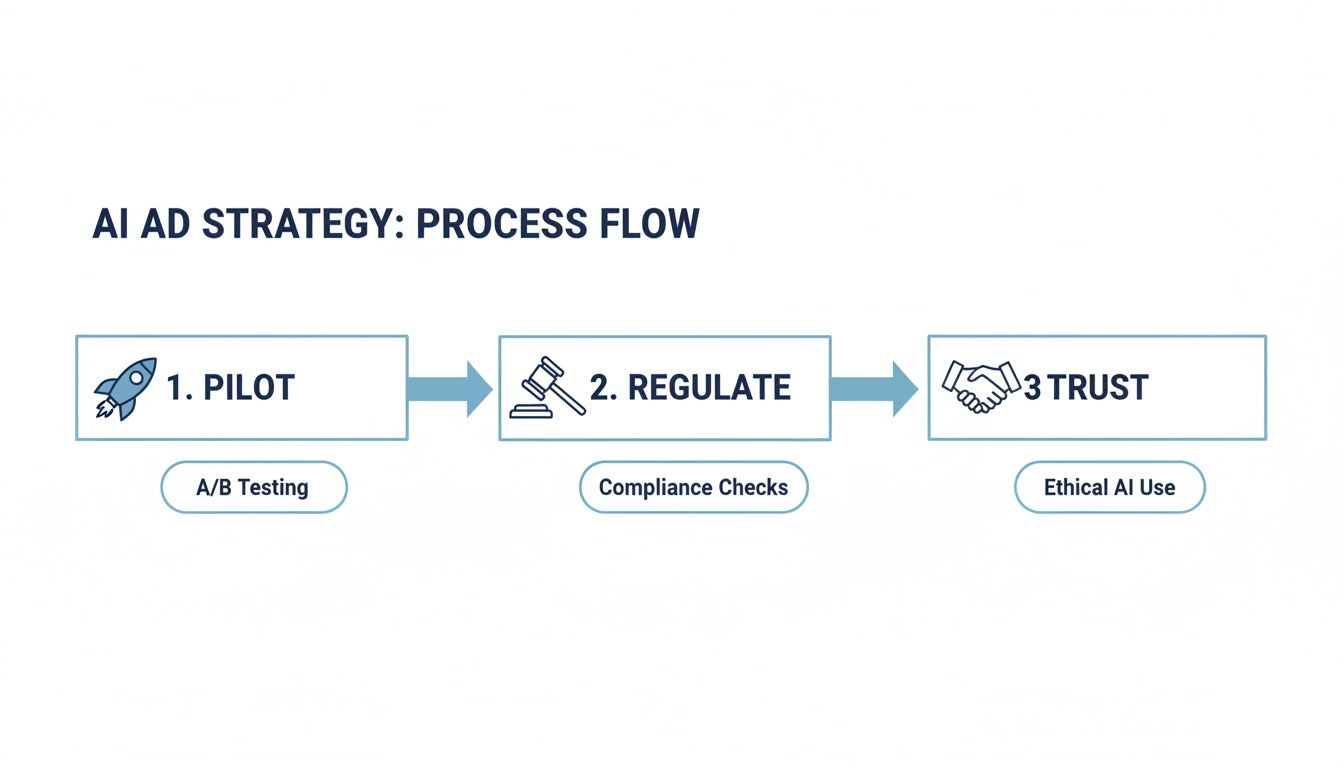
This workflow shows why it’s so important to start small with a controlled test, establish clear oversight, and only scale up when you have proven performance and confidence. By taking this methodical approach, you set your business up to embrace AI not as a gimmick, but as a genuine driver of marketing success.
Frequently Asked Questions About OpenAI Ad Solutions
Jumping into AI-powered advertising can feel a bit daunting, and it’s natural to have questions. We’ve rounded up some of the most common queries we hear from marketers who are thinking about using OpenAI ad solutions. Here are some straight-talking answers to help you get started with confidence.
Can OpenAI Completely Replace My Marketing Team?
No, and honestly, that’s not what it’s for. Think of AI as a hugely powerful assistant or a “co-pilot” for your marketing experts, not a replacement. Its real strength lies in automating the repetitive, data-heavy tasks that eat up so much time – things like churning out hundreds of ad copy variations, analysing performance data, or flagging potential new audience segments.
This frees up your team to do what they do best: focus on high-level strategy. They can pour their energy into creative direction, understanding the psychology behind customer decisions, and making the final strategic calls based on the insights AI provides. The aim is to supercharge your team’s skills, making them quicker, smarter, and more effective.
Is It Expensive to Get Started with AI Ads?
The cost can vary quite a bit, but you absolutely don’t need a massive budget to start experimenting. Many of the tools that use OpenAI’s technology have tiered pricing plans, and you’ll often find free trials or affordable entry-level options that are perfect for smaller businesses.
A really smart way to begin is with a small, focused pilot project. For instance, you could use an AI tool just to generate ad copy for one specific campaign. This lets you measure the direct impact and prove the return on your investment before you even think about committing to a bigger spend.
How Does OpenAI Handle My Customer Data and Privacy?
This is a massive concern, and rightly so, especially for any business operating under UK regulations like GDPR. Reputable OpenAI ad solutions are built with privacy as a fundamental principle. OpenAI trains its big, core models on a huge dataset of public internet information, not your private customer lists.
When you use platforms that integrate OpenAI, your own first-party data is typically used to fine-tune a model for your specific campaigns, but that data always remains yours. It’s crucial to partner with providers who are completely transparent about their data policies and can confirm they are fully GDPR-compliant. This ensures your customer’s data is handled legally, ethically, and securely.
The core idea is that the AI learns from the patterns in your data to get better at its job; it doesn’t store or “remember” personal information from your datasets for any other reason.
What Kind of Results Can I Realistically Expect?
In the beginning, the most noticeable results are usually efficiency gains. Your team might find they’re spending 50% less time writing ad copy, or you could uncover new, high-performing audience segments in a matter of days instead of weeks.
Before long, these efficiencies start showing up in your core performance metrics. You should expect to see improvements in areas like:
- Click-Through Rates (CTR): More relevant, AI-generated creative just connects better with audiences.
- Cost Per Acquisition (CPA): Smarter targeting and better budget optimisation mean you waste less money.
- Return on Ad Spend (ROAS): When you combine better creative, sharper targeting, and slicker management, your overall return naturally gets stronger.
The trick is to set clear, measurable goals for your first few tests. That way, you can track your progress properly and see the value for yourself.
Ready to see how a data-driven, expert approach can transform your PPC results? The team at PPC Geeks creates bespoke ad strategies that deliver measurable growth. Book your free, in-depth PPC audit today and discover your campaign’s true potential.