




So, you’re hearing a lot about “ChatGPT advertising services,” but what does that actually mean? In simple terms, it’s about blending the raw power of artificial intelligence with the strategic oversight of seasoned human experts to build, run, and fine-tune paid ad campaigns.
We use AI for the heavy lifting—things like churning out ad copy variations, digging into audience research, and making sense of performance data. This frees up marketing pros to focus on the bigger picture, nail down the strategy, and ultimately, get better results, faster.
ChatGPT Advertising Services: The New Era of PPC Advertising

The chatter around AI in marketing has well and truly moved on from “what if?” to “what now?”. For those of us in the trenches—both at digital ad agencies and in-house teams—ChatGPT has become a genuine workhorse. It’s moved far beyond the initial hype to deliver real, measurable improvements to campaign performance and day-to-day efficiency. This isn’t just another shiny new tool; it’s a fundamental shift in how we approach paid advertising.
Agencies that are smart about integrating ChatGPT advertising services are pulling way ahead of the pack. They’re able to produce huge volumes of creative variations, uncover audience insights that were previously hidden, and automate the tedious, routine tasks that used to eat up so many hours. This guide is designed to take you past the basics and give you a proper playbook for using AI effectively and responsibly in your campaigns.
What This Guide Covers
We’re going to break down the core pillars of using ChatGPT for paid ads, with actionable steps and examples pulled from the real world. Forget the theory; this is all about practical application. You’ll learn how to master:
- High-Impact Ad Copy Creation: We’ll show you how to generate compelling headlines and descriptions that actually connect with specific audience segments.
- Detailed Audience Persona Development: Learn to build rich, detailed customer profiles to sharpen your targeting on platforms like Google and Meta.
- Landing Page and Content Optimisation: We’ll cover how to draft high-converting copy for landing pages that feels like a natural extension of your ad campaigns.
The speed at which AI has been adopted is staggering. In the UK, ChatGPT shot up to become the second most downloaded app between September and November 2024. Now, a massive 1 in 5 people active on the internet say they use it. The uptake is even stronger in business hubs like London, where 30% of all Londoners were using the tool as of February 2025. This isn’t just a tech trend; it shows AI is already deeply embedded in how decision-makers and creatives work.
The key takeaway is simple: your job won’t be replaced by AI, but it might be by someone who knows how to use AI effectively. Mastering these tools is about augmenting your skills, not replacing them.
To really succeed in this new landscape, brands must get their heads around how large language models are shaping customer perceptions and product recommendations. For a deeper dive into making your brand more visible in an AI-driven world, check out this excellent piece on how to be the brand that ChatGPT recommends.
This is a critical piece of the puzzle, especially as the very nature of search is changing. It’s vital to understand how to navigate these shifts, which we cover in our guide on ads in AI Overviews and the new era of search advertising.
Core Applications of ChatGPT for Paid Ads
Right, let’s get down to brass tacks. Theory is one thing, but where does a tool like ChatGPT actually make a difference in your day-to-day advertising grind? It’s not a magic button that runs campaigns for you; think of it more like a seriously powerful co-pilot that can accelerate and elevate the critical, often time-consuming, tasks.
The real win when you bring ChatGPT advertising services into your workflow is its knack for boosting creativity, slashing research time, and giving you solid first drafts for all the core bits of a campaign. This is how your team gets back the hours they used to lose on repetitive work, freeing them up to focus on the big-picture strategy and analysis that actually moves the needle.
Let’s break down the most impactful, day-to-day applications.
Generating High-Converting Ad Copy (ChatGPT Advertising Services)
We’ve all been there. The relentless demand for fresh, engaging ad copy is a constant battle. Ad fatigue creeps in, and trying to brainstorm yet another variation for a different audience or platform can drain your creative energy fast. This is, without a doubt, the most immediate and powerful way to use ChatGPT.
Instead of staring at a blank page, you can feed the AI the key details: your product, your target audience, and your unique selling points (USPs). Within seconds, you’ll have a whole arsenal of headlines, descriptions, and calls-to-action ready to test.
Take a typical, uninspired Google Ad, for instance. It might look something like this:
Before ChatGPT:
- Headline 1: Quality Leather Sofas
- Headline 2: Shop Our Sofa Collection
- Headline 3: Free UK Delivery
- Description: Find your perfect leather sofa today. Wide range of styles and colours. Shop now for fast, free delivery across the UK.
It’s functional, sure, but it’s completely forgettable. By giving ChatGPT some specific details, you can get much richer, more targeted copy.
Expert Tip: The quality of the copy you get out is directly tied to the quality of the prompt you put in. Be specific. Tell it about your customer’s pain points, your brand’s tone of voice, and any offers you’re running.
A well-thought-out prompt can transform that bland ad into something far more compelling:
After ChatGPT:
- Headline 1: Handcrafted Leather Sofas
- Headline 2: Built to Last a Lifetime
- Headline 3: 10-Year Guarantee Included
- Description: Discover timeless style with our artisan-made leather sofas. Spills? Kids? No problem. Our durable finishes stand up to real life.
See the difference? This version hits on quality, durability, and peace of mind, tapping into deeper customer concerns. If you want to see just how far you can push this, check out our collection of ChatGPT ad examples for more practical ideas and inspiration.
Building Detailed Audience Personas
Great targeting is the bedrock of any paid ad campaign that actually works. If you’re trying to talk to everyone, you’ll end up connecting with no one. ChatGPT is a brilliant research assistant for fleshing out rich, detailed audience personas that go way beyond basic demographics.
You can ask it to build a complete profile of your ideal customer, digging into their daily challenges, what motivates them, where they hang out online, and even the kind of language they use. This level of insight is absolute gold for crafting messages that truly resonate and for picking the right platforms to run your ads on.
To get the most out of ChatGPT for advertising tasks like persona building, it helps to use structured prompts. Clear, detailed instructions will always yield better, more actionable results.
Here’s a look at some ready-to-use prompt templates for a few of the most common jobs we’ve discussed.
ChatGPT Prompt Templates for Core Advertising Tasks (ChatGPT Advertising Services)
| Advertising Task | Example ChatGPT Prompt |
|---|---|
| Audience Persona Development | “Act as a market research analyst. Create a detailed customer persona for a new brand of sustainable, subscription-based coffee beans in the UK. The target customer is environmentally conscious, works from home, values convenience, and has a household income of £50,000+. Include these sections: Demographics (Name, Age, Location, Job Title), Goals & Motivations, Pain Points & Challenges (especially regarding their current coffee habits), and Watering Holes (social media, blogs, newsletters).” |
| High-Intent Ad Copy | “Write 5 Google Ads Responsive Search Ad variations for a company that sells premium, handcrafted leather sofas in the UK. The target audience is homeowners aged 35-55 who value quality and durability. USPs: 10-year guarantee, handmade in the UK, stain-resistant finishes. The tone of voice should be sophisticated but approachable. Include strong calls-to-action focused on browsing the collection and the peace of mind our guarantee offers.” |
| Landing Page Headline & Intro | “Generate 3 compelling landing page headline options and a short introductory paragraph for our new ‘Artisan Leather Sofa’ collection. The user has just clicked an ad with the headline ‘Handcrafted Leather Sofas Built to Last a Lifetime’. The goal is to build trust and encourage them to explore the products. Emphasise the craftsmanship, premium materials, and the 10-year guarantee.” |
| Product Feed Optimisation | “Optimise the following product title and description for Google Shopping. The current title is ‘Nike Trainers’ and the description is ‘Black and white Nike shoes’. Product details: Brand: Nike, Model: Air Max 270, Gender: Men’s, Colour: Black & White, Size: 9 UK. Create a new title and a 150-word description that are SEO-friendly, descriptive, and include key attributes.” |
Using prompts like these gives your team a clear, relatable picture of who they’re targeting, ensuring every piece of copy and creative is perfectly aligned from the get-go.
Drafting Compelling Landing Page Content
A killer ad can be completely torpedoed by a weak or confusing landing page. The journey from ad to page needs to feel seamless, and the page itself has to do the heavy lifting of convincing the visitor to act. ChatGPT is fantastic for knocking out excellent first drafts of landing page copy.
By giving it the context—what ad the user clicked, the product’s key benefits, and what you want them to do next—you can generate:
- Benefit-Driven Headlines: Go beyond just naming the product and start promising a solution to your customer’s problem.
- Persuasive Body Copy: Quickly create paragraphs that handle common objections, highlight standout features, and build that all-important trust.
- Clear Calls-to-Action: Brainstorm a bunch of different CTAs to figure out which language is the most motivating for your audience.
This approach massively shortens the time it takes to get from an idea to a live page that’s ready for A/B testing, which means you can start optimising that much faster.
Optimising E-commerce Product Feeds (ChatGPT Advertising Services)
For any e-commerce brand, the product feed is the engine that powers Google Shopping and dynamic ads on social media. A badly optimised feed stuffed with generic titles and descriptions is a one-way ticket to poor visibility and wasted ad spend.
ChatGPT can turn this tedious but crucial task into a streamlined process. Just feed it a basic product title and its attributes (like brand, colour, size, and material), and ask it to write optimised titles and descriptions that follow industry best practices.
Take a bog-standard product title: “Nike Trainers“.
An AI-optimised version would be miles better and far more search-friendly: “Nike Air Max 270 Men’s Trainers – Black & White – Size 9 UK“.
This level of detail is exactly what you need to show up for those super-specific, high-intent searches. Better yet, you can apply this logic at scale, using spreadsheets and API integrations to update thousands of products in a fraction of the time it would take manually. It’s a genuine competitive advantage.
ChatGPT Advertising Services: Building a Scalable Agency Workflow
Moving from playing around with ChatGPT to building a structured, scalable system is the single biggest leap an agency can make. A few ad-hoc prompts are great for a quick win, but a repeatable workflow is what turns ChatGPT advertising services from a neat party trick into a real operational advantage. This is all about baking consistency, quality, and efficiency directly into how you run campaigns.
The aim isn’t just to work faster; it’s to create a solid framework that lets your team pump out high-quality work, even when AI is doing the heavy lifting. This means creating shared resources, having crystal-clear review processes, and making sure everyone on the team knows the score when it comes to using AI responsibly.
This chart shows exactly how AI slots into the core advertising tasks we handle every day, from knocking out initial ad copy to building personas and drafting landing pages.
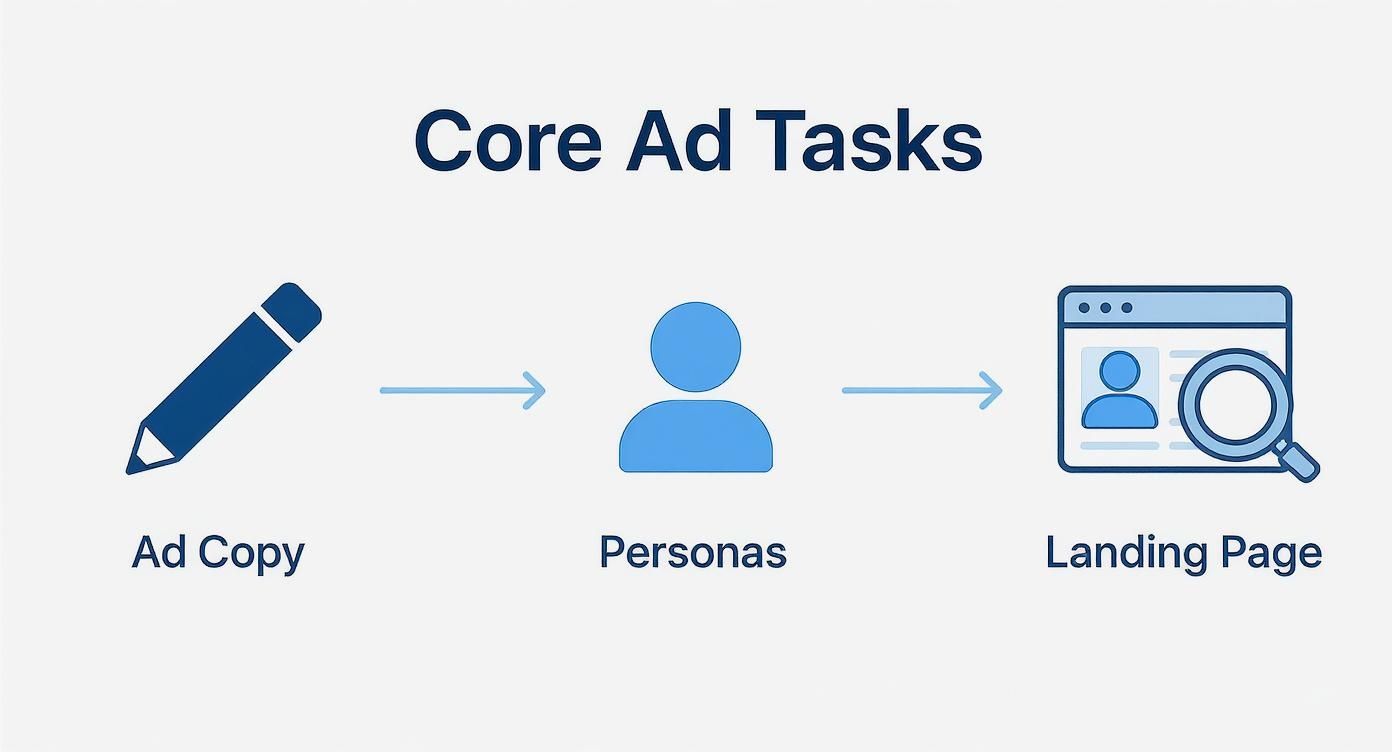
As you can see, AI acts as a massive accelerator at multiple stages, giving us the raw materials that our human strategists then shape and refine.
Creating a Centralised Prompt Library
The first step to scaling anything is consistency. A centralised prompt library becomes your agency’s single source of truth for getting the best out of ChatGPT. Instead of every team member reinventing the wheel, you build a shared bank of proven, high-performing templates for all the usual jobs.
Think of this library as a living document, something you’re constantly tweaking and adding to. It’s best to keep it organised:
- By Task: Separate folders for ad copy, audience personas, keyword research, and landing page content.
- By Platform: Have specific prompt flavours for Google Ads (like RSA headlines), Meta (primary text, for example), and LinkedIn.
- By Tone of Voice: Store templates that tell ChatGPT exactly how to talk, whether it’s for a corporate client or a quirky startup.
This simple step doesn’t just save a ridiculous amount of time; it massively cuts down on the variation in output. A new starter can jump in and start producing work that’s instantly up to your agency’s standard.
Establishing Quality Assurance and Human Review (ChatGPT Advertising Services)
Let’s be clear: AI is a co-pilot, not the pilot. Every single bit of AI-generated content must go through a proper human review before it ever sees the light of day. This quality assurance (QA) step is completely non-negotiable if you care about brand safety and campaign performance.
Your QA checklist should cover a few key things:
- Factual Accuracy: Has it made any claims that could be false or misleading?
- Brand Voice Alignment: Does the copy actually sound like the client, or is it just generic mush?
- Platform Compliance: Does it follow the rules for Google, Meta, or wherever it’s going?
- Strategic Fit: Does this message actually match the campaign goals and speak to the right audience?
Remember, AI models don’t get context or nuance like a seasoned marketer does. The human layer is where you apply strategy, brand knowledge, and critical thinking to polish the raw AI output into something brilliant.
Figuring out how to structure these processes is key. For agencies wanting to get serious about this, our overview of a ChatGPT campaign agency structure provides a solid, practical roadmap.
Packaging Services for UK SMEs
For small and medium-sized businesses (SMEs), the perks of AI-powered advertising are huge, but getting started can feel like a massive headache. As an agency, you can package your ChatGPT advertising services in a way that makes the value proposition crystal clear.
Focus on the results they’ll actually see:
- Faster Campaign Launches: Emphasise how quickly you can get from a brief to live ads.
- Deeper Audience Insights: Explain how AI research uncovers new targeting angles they’d never have found otherwise.
- More Creative Testing: Show them the power of testing dozens of ad variations to find the winner, fast.
Knowing who uses these tools in the UK helps you target your services. The UK user base for ChatGPT is quite specific, with 61% of sessions happening on mobile and desktop use peaking during working hours. This dual-platform pattern is vital for shaping campaigns. Adoption is highest among mid-to-high earners in management roles, especially in cities like London, Manchester, and Newcastle, making them a perfect audience for premium, AI-driven ad services.
By building a robust internal workflow, you create a powerful engine for growth. It lets you deliver the kind of sophisticated, data-backed advertising solutions that were once reserved for the big players, bringing incredible value to the SMEs you work with.
ChatGPT Advertising Services: Advanced Strategies for Performance Measurement
So, you’ve got a solid workflow for churning out ad copy and building personas. Great. But if you stop there, you’re only scratching the surface of what’s possible with ChatGPT in your advertising. The real magic happens when you move beyond simple generation and start creating a powerful feedback loop, where real-world performance data continuously sharpens your AI-assisted strategy.
This is where you start treating ChatGPT less like a content-writing intern and more like a strategic partner. We’re talking about feeding it performance data to spot trends, scripting more complex assets like video ads, and even getting it to draft your initial performance reports.
The ultimate goal is to build a cycle: AI helps create the ads, you measure how they do, and then you feed that data back in to make the next batch even smarter.
Creating a Data Feedback Loop
This is easily the most powerful advanced strategy you can implement. Stop thinking of prompts as one-and-done commands. Instead, start a continuous conversation with the AI, fuelled by hard data from your campaigns.
Once a set of AI-generated ads has been live for a week or two, take the results and feed them straight back into ChatGPT.
For instance, your follow-up prompt could look something like this:
“I ran a Google Ads campaign for a client selling handcrafted leather sofas. Here are the performance metrics for five different ad headlines you helped me write:
- Headline A (‘Built to Last a Lifetime’): CTR 4.2%, CVR 1.8%
- Headline B (‘Discover Timeless Style’): CTR 2.9%, CVR 1.1%
- Headline C (‘Artisan-Made in the UK’): CTR 3.8%, CVR 2.5%
- Headline D (‘Free Delivery & 10-Year Guarantee’): CTR 5.1%, CVR 3.2%
- Headline E (‘The Centrepiece of Your Living Room’): CTR 2.1%, CVR 0.8%
Analyse these results. What themes, keywords, and emotional triggers seem to be resonating most with the audience? Based on this analysis, generate 10 new headline variations that lean into the successful elements of Headline D and C.”
This simple act transforms ChatGPT from a generator into an analytical tool. It starts to learn what actually works for your audience, helping you systematically double down on winning creative angles and improve performance over time.
A/B Testing AI vs Human Copy (ChatGPT Advertising Services)
Look, don’t just take it on faith that the AI copy is better. You need to prove it. Running structured A/B tests against your team’s best efforts is the only way to validate this new workflow and show tangible ROI to clients or your boss.
Here’s a straightforward way to set this up:
- Establish a Baseline: First, get a control ad group running with copy written entirely by your human team. Let it run long enough to gather solid baseline data on metrics like click-through rate (CTR) and conversion rate (CVR).
- Create the AI Variant: Next, use your sharpest prompts to generate a set of challenger ads. Make sure the AI gets all the same context, USPs, and audience info your human copywriter had.
- Run a Clean Experiment: Launch the AI-generated ads in a separate ad group or as a formal experiment, targeting the exact same audience. It’s crucial that budgets and settings are identical to keep the playing field level.
- Analyse the Results: After you have a statistically significant amount of data, compare the key performance indicators (KPIs). Don’t just glance at the CTR. Is the AI copy driving more qualified traffic? Are the conversion rates higher?
Sometimes, you’ll find the AI-generated copy wins on direct response metrics because it’s brilliant at weaving in keywords and clear calls-to-action. Other times, the human touch will win out on brand tone or emotional connection. The key is to learn from both. Often, the absolute best results come from a hybrid approach, where a human expert refines the AI’s strongest ideas.
Deepening Your Measurement Approach
To really prove the value of your campaigns, you have to look beyond simple last-click results. This is where more sophisticated measurement becomes essential. You need to understand how all the different touchpoints—both AI-assisted and not—contribute to that final sale or lead.
To get a clearer picture of the entire customer journey, it’s vital to understand the principles behind different measurement frameworks. For a detailed breakdown, our guide on what is attribution modelling provides an excellent foundation for assessing campaign contribution more accurately.
This knowledge helps you assign proper credit to the AI-generated content that might be influencing customers much earlier in their buying process. By implementing a more nuanced measurement strategy, you can prove the full value of your ChatGPT advertising services.
ChatGPT Advertising Services: Navigating Compliance and Brand Safety with AI

The speed and scale of ChatGPT advertising services are a massive advantage, but they don’t come without serious responsibilities. Just letting the AI generate content and pushing it live without a second thought is a recipe for disaster. If you’re going to use these tools, you need a rock-solid framework for managing compliance and protecting the brand you’ve worked so hard to build.
The fundamental issue is that AI models don’t understand things like context, ethics, or the subtle policies of ad platforms like Google and Meta. They’re trained on a universe of data that can be biased, out-of-date, or just plain wrong. This is why a human-led quality check isn’t just a good idea—it’s absolutely essential.
Think of ChatGPT as an incredibly gifted but very green junior team member. It’s brilliant and fast, but it lacks the seasoned judgement of a senior strategist. Your job is to be that final, critical layer of review.
Your Brand Safety and Compliance Checklist
To use AI safely, you have to set up clear guardrails. This isn’t about slowing yourself down; it’s about creating a sustainable workflow that keeps risk to a minimum. Before any AI-generated ad copy, landing page, or report gets the green light, it needs to pass a rigorous human review.
Here’s a practical checklist you can put into action right away:
- Factual Accuracy Check: Does the copy make specific claims or mention stats? Every single fact must be checked against a reliable source. AI models are notorious for “hallucinating” or confidently inventing information out of thin air.
- Ad Platform Policy Compliance: Does the ad copy stick to the strict rules of Google, Meta, and any other platform you’re on? Be extra vigilant about sensitive topics, misleading claims, and forbidden content. An accidental violation can get your account suspended.
- Brand Voice Alignment: Does it actually sound like you? The output needs to be tweaked to match your brand’s unique tone, language, and messaging. Generic AI-speak is a surefire way to disconnect from your audience.
- Scrutinise for Unintentional Bias: Carefully review the copy and any associated imagery for hidden biases related to gender, race, age, or anything else. AI can accidentally parrot stereotypes it learned from its training data.
The golden rule here is simple: never trust, always verify. AI is a co-pilot, not the pilot. The final responsibility for every word, claim, and image lands squarely on the advertiser, not the algorithm.
The Human Review Is Non-Negotiable
Relying entirely on automated output is a massive gamble. A single misleading claim can get your ad account shut down, while off-brand messaging can destroy years of customer trust in an instant. That human review is your most important line of defence.
To really get this right, it’s worth digging into a practical guide to ethical AI for business to build a solid foundation.
This oversight makes sure your advertising stays effective, compliant, and true to who you are. By marrying AI’s creative firepower with human strategic oversight, you can harness its power responsibly. This turns a potential risk into a serious competitive advantage, and it’s the hallmark of professional ChatGPT advertising services.
Got Questions About Using ChatGPT in Your Ads? We Have Answers.
Let’s be honest, even with the best strategy in the world, bringing a tool like ChatGPT into your advertising workflow is going to raise a few eyebrows and a lot of practical questions. We see the same concerns pop up time and again with agencies and in-house teams dipping their toes into ChatGPT advertising services. Tackling these head-on is the best way to build confidence and make sure you’re using this tech smartly and safely.
Here are the most common queries we get from advertisers, with some straight-talking answers to help you navigate the initial hurdles, from data privacy nightmares to keeping clients in the loop.
Is My Campaign Data Safe with ChatGPT?
This is the big one, and usually the first question out of anyone’s mouth. If you’re just dropping client campaign details, keywords, or performance data into the standard public version of ChatGPT, you’re right to be worried. That information could easily be used to train the model, which is a massive data privacy red flag for any agency worth its salt.
But that doesn’t mean you have to avoid it entirely. You just need to be smart about it. The solution is to use a business-grade version like ChatGPT Team or Enterprise, or to work directly through the API. These paid versions come with much stricter data privacy policies, specifically stating that your inputs won’t be used for training.
The Golden Rule: Never, ever paste sensitive client info—customer lists, confidential performance data, or details about an unannounced product—into the free, public version of ChatGPT. Stick to a secure, enterprise-level AI tool that guarantees your data stays yours.
What if the AI-Generated Content is Generic or Off-Brand?
We’ve all seen it. You ask for ad copy and get something so bland and generic it could be for literally any brand. It’s a common frustration, but it’s not the AI’s fault. It happens when your prompts are too vague or lack the necessary context. The AI doesn’t know your brand’s unique personality until you teach it.
The trick is to move beyond simple commands and start writing highly detailed prompts that act as a mini-brand-guide. Think of it as briefing a new junior copywriter. You’d give them:
- Tone of Voice: Don’t just say “friendly.” Be specific. Is it “witty and informal,” “authoritative but approachable,” or “luxurious and aspirational”?
- Target Audience: Paint a picture of the customer you’re talking to. Who are they? What do they care about?
- Brand Lexicon: Give it a list of words the brand loves to use, and just as crucial, a list of words it would never use.
- Good Examples: Feed the AI some of your best-performing, human-written ad copy and ask it to capture that style.
When you provide this level of detail, you’re not just asking a question; you’re giving a proper creative brief. That’s how you guide the AI from producing generic fluff to content that feels genuinely on-brand.
How Should I Talk About AI’s Role with My Clients?
Being upfront is always the best policy. Clients are naturally curious about AI, and some might be a bit nervous. Trying to hide the fact that you’re using it is a recipe for disaster and can break trust. Being open, on the other hand, can position you as a modern, efficient partner.
Frame it as a tool that supercharges your human experts, not a replacement for them. Explain that using ChatGPT advertising services lets your team:
- Ramp up creative testing by generating heaps of ad variations in a fraction of the time.
- Dig up deeper audience insights through rapid-fire data analysis.
- Spend more time on high-level strategy instead of getting bogged down in repetitive tasks.
The key is to reassure them that every single piece of AI-generated content is put through a rigorous review by a real person. This ensures quality, accuracy, and brand alignment. It shows you’re using tech to get better results while keeping human strategic oversight right where it belongs.
At PPC Geeks, we blend the efficiency of AI with over a century of combined human expertise to build campaigns that deliver real, measurable growth. To see how our data-driven approach can transform your advertising, book your free PPC audit today at https://ppcgeeks.co.uk/.