




The Complete Ecommerce PPC Guide: A UK Retention Playbook — You’re probably in one of two positions right now. Your Google Ads account is bringing in orders, but too many customers buy once and vanish. Or you’re still judging every campaign on first-order ROAS, even though you know that approach can make a healthy-looking account subtly unprofitable.
That’s the gap most complete ecommerce PPC guide articles miss. They teach you how to win the click, maybe even the first sale, but they stop before the harder part. Keeping customers active, profitable, and easier to sell to the second time. For UK ecommerce brands, that’s where PPC becomes more than an acquisition channel. It becomes a retention system.
The strongest accounts don’t separate acquisition and retention as if they belong to different teams. They use Shopping, Search, Display, YouTube, first-party audiences, feed labels, geo controls, and clean measurement to move customers from first purchase into repeat purchase. That shift matters most when margins are tight, delivery costs vary by region, and broad prospecting keeps getting less forgiving.
Complete Ecommerce PPC Guide: Laying the Groundwork Beyond First-Click ROAS
Acquisition-only PPC thinking creates a false sense of progress. You can hit your front-end target, celebrate a clean dashboard, and still lose money because the business keeps refilling the same bucket. New customers arrive. Existing customers drift away. Paid media keeps working harder just to stand still.
That’s why any serious complete ecommerce PPC guide has to start with retention economics, not campaign types.

Stop judging paid traffic like a one-order business
If you only optimise to first-order ROAS, you’ll tend to overvalue cheap new-customer sales and undervalue the campaigns that make a second or third order more likely. That distorts bidding, creative, and budget allocation.
A better starting point is simple:
- Check repeat behaviour: Pull order history from Shopify, Magento, WooCommerce, or your CRM and separate first-time buyers from repeat buyers.
- Review time to second purchase: Don’t overcomplicate it. Look at how long customers usually take to buy again by product type.
- Map drop-off points: Some brands lose people after delivery. Others lose them after product usage confusion, weak replenishment timing, or poor post-purchase communication.
Practical rule: If your paid media report ends at the first conversion, you’re optimising ads for the platform, not for the business.
Attribution also matters here. If branded search keeps getting the credit for returning customers, your account can look healthier than it really is. A more informed view of attribution modelling in PPC helps you see whether retention campaigns are assisting profitable repeat orders or merely mopping up demand you created elsewhere.
Track the metrics that reflect customer quality (Complete Ecommerce PPC Guide)
You don’t need a complicated data warehouse to start. Most ecommerce brands already have enough information to make better decisions if they look in the right place.
Focus on:
| Metric | What it tells you | Why PPC teams should care |
|---|---|---|
| Repeat purchase rate | How many customers come back | Shows whether first-order traffic has downstream value |
| Purchase frequency | How often customers buy | Helps set audience windows and reactivation timing |
| Customer lifetime value | Revenue value over time | Changes what you can afford to pay for a first sale |
| Churn or lapse behaviour | When buyers stop returning | Reveals when remarketing should shift from nurture to win-back |
You don’t need to publish these figures in a board deck to use them well. You need them to answer practical questions. Which products create repeat buyers? Which traffic sources create one-and-done customers? Which segments deserve more aggressive bidding because they tend to buy again?
Define success before you touch the campaigns
A retention-led PPC account behaves differently. It protects high-intent audiences. It values post-purchase messaging. It accepts that some campaigns won’t look spectacular on a first-click basis, but still support stronger account economics over time.
Three warning signs usually show up in leaky accounts:
- The welcome journey is weak. New customers buy, then hear almost nothing useful afterwards.
- Search is left unguarded. Brand queries like delivery help, setup support, or refill intent get handled poorly.
- Remarketing is too broad. Existing customers, cart abandoners, and one-time buyers all get thrown into the same pool.
That’s when PPC turns into a treadmill. Spend rises, but customer value doesn’t keep up.
Complete Ecommerce PPC Guide: Building Your High-Value Retention Audiences
Most audience setups in Google Ads are built for prospecting. Broad site visitors, all converters, all users, maybe cart abandoners if someone remembered to create the list. That isn’t enough if you want PPC to help retention.
Retention audiences need to reflect customer state. Someone who bought once last week needs a different message from someone who hasn’t purchased in months. Someone with high order value needs different treatment from someone who only bought your entry product.
Start with segments that change what ads you run
Four audience groups do most of the heavy lifting.
One-time buyers
This is the first audience I’d build in almost every ecommerce account. Exclude anyone with multiple purchases and keep the window tied to your buying cycle. If you sell skincare, coffee, supplements, pet consumables, accessories, or replacement parts, this group is often your easiest path to improved account efficiency.
Use it for:
- Second-order campaigns: Show accessories, refills, or bestsellers that logically follow the first product.
- Search observation: Bid differently when past buyers search category or brand terms again.
- Message control: Swap first-purchase copy for “complete your routine”, “top up before you run out”, or “made to work with your last order”.
High-value customers (Complete Ecommerce PPC Guide)
Build this from CRM exports or platform data, then upload hashed lists into Google Ads through Customer Match. Don’t define “high value” by instinct. Use your own order history, margin data, and repeat behaviour.
This group is useful for:
- protecting branded search from generic promos
- testing premium creative
- feeding stronger signals into automated campaigns
For brands trying to future-proof audience quality, first-party data in PPC becomes central, not optional.
Use lapsed customers and abandoners differently
A lot of accounts treat these groups the same because both are “people who didn’t buy recently enough”. That’s a mistake.
Lapsed customers (Complete Ecommerce PPC Guide)
These are previous buyers who’ve gone quiet beyond the normal reorder window. Don’t throw discounts at them by default. Start by matching message to likely reason for lapse. If the product is seasonal, your ads should reflect seasonality. If the item is replenishable, push convenience. If usage may have tailed off, remind them why they bought in the first place.
Recent cart abandoners
This is a short-window audience. The ads should be specific and immediate. Generic brand banners waste intent here. Use product-led creative, delivery reassurance, return policy support, or stock urgency only if it’s genuine and already part of your offer.
Cart abandoners aren’t a retention audience because they’re warm. They’re a retention audience because they’ve already shown the exact friction your ads need to solve.
Build the audiences inside your data flow, not as one-off lists (Complete Ecommerce PPC Guide)
The mechanics matter less than the discipline behind them. A clean setup usually combines three sources:
- GA4 audiences based on ecommerce events and purchase behaviour
- Google Ads tags for faster audience population where needed
- CRM uploads for value-based segmentation and customer-state matching
Keep naming conventions blunt and operational. “OTB 30d no second purchase” is better than something clever no one can interpret in three months.
A practical audience set might look like this:
| Audience | Built from | Main use |
|---|---|---|
| One-time buyers | Purchase data excluding repeat buyers | Drive second purchase |
| High-value customers | CRM or backend export | Reward, protect, upsell |
| Lapsed customers | Past buyers outside expected reorder window | Reactivation |
| Cart abandoners | Add-to-cart without purchase | Recovery |
Gain comes when these lists shape exclusions as well as targeting. Existing customers shouldn’t keep seeing first-order offers. High-value buyers shouldn’t be pooled with bargain-driven shoppers. Retention starts getting cheaper once the account stops speaking to everyone the same way.
Complete Ecommerce PPC Guide: PPC Tactics for Flawless Onboarding and Activation
The first week after purchase decides more than most brands realise. Customers are excited, slightly uncertain, and still forming their opinion of whether they made the right call. If your ads vanish the moment payment clears, you leave that whole period unmanaged.
A better approach is to treat the first few days after purchase as an activation window.
What the first week should look like
Take a common ecommerce example. A customer buys a specialist hair tool, a coffee machine, a supplement bundle, or a premium skincare set. The transaction is complete, but the experience isn’t.
Day one, they search your brand name again. Not to buy. To check delivery, find instructions, or confirm they ordered the right variant. If your search coverage is weak, a marketplace listing, reseller, or random review site can intercept that query. That’s avoidable.
By day three, they may want setup help, usage advice, or reassurance they’re using the product correctly. If your onboarding content lives on YouTube, your help centre, or a product guide page, paid support can keep that path visible.
By day six, one of two things happens. They’ve started using the product and are on course for loyalty, or they haven’t engaged properly and are drifting towards buyer’s remorse.
Control the searches that happen after the sale (Complete Ecommerce PPC Guide)
Brand search campaigns aren’t only for acquisition defence. They’re useful after purchase when searching for terms like:
- Brand + delivery
- Brand + returns
- Brand + login
- Brand + how to use
- Brand + setup
- Product name + instructions
Those searches often get ignored because they don’t look revenue-focused enough. In reality, they protect confidence at the exact moment confidence matters.
Use ads and assets that point to:
- help centre pages
- setup videos
- account login areas
- product registration or warranty pages
- “getting started” collections for complementary products
The easiest repeat customer to win is the one who had a smooth first experience.
Use low-friction remarketing for activation, not just sales
Display and YouTube can support the journey without becoming intrusive. New-customer audiences in the first post-purchase window often respond better to useful creative than to another hard sell.
A clean activation sequence usually includes:
- Welcome creative with simple brand reassurance
- Usage or setup content matched to the purchased product category
- Benefit-led reminders that reinforce why the product was worth buying
- Soft cross-sell exposure only after the product has likely been used
If the brand sells something technical, the first ads should reduce confusion. If the product has a ritual or routine, the ads should make that routine easier to adopt. If replenishment is likely, the ads should educate first and sell later.
What doesn’t work in post-purchase PPC (Complete Ecommerce PPC Guide)
The common failures are predictable.
| Weak approach | Why it underperforms |
|---|---|
| Showing the same generic banners to every buyer | No relevance to what they actually bought |
| Pushing another sale immediately | Feels tone-deaf before product adoption happens |
| Ignoring help intent in search | Lets third parties control a fragile moment |
| Running no exclusions for recent purchasers | Wastes budget and creates poor user experience |
This part of the account rarely gets credit in standard reports. Still, it often improves the quality of the next conversion. Customers who understand the product, trust the brand, and know where to go for support are easier to retain and cheaper to re-market to later.
Complete Ecommerce PPC Guide: Driving Engagement and Loyalty with Remarketing
A customer buys once, likes the product, then disappears for six months. In a lot of accounts, PPC still treats that person the same way it treats a cart abandoner from yesterday. That is where retention value gets lost.
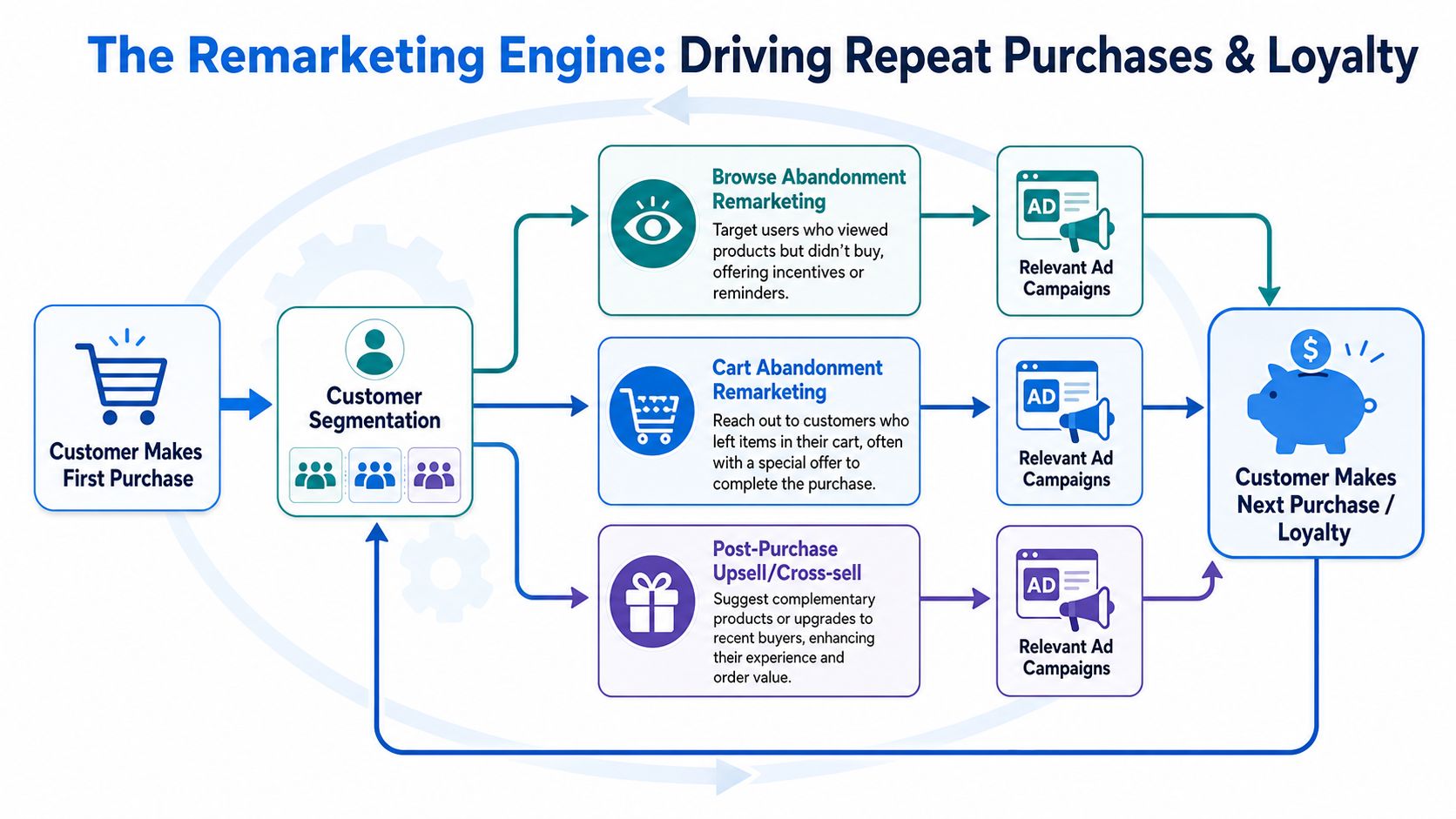
Good remarketing fixes that by matching the ad to the customer’s stage after purchase. The goal is not just to squeeze out one more conversion. It is to increase second-order rate, shorten time to repeat purchase, and keep the brand visible without becoming irritating. For UK ecommerce brands, that often means different treatment for a first-time beauty buyer, a seasonal fashion shopper, and a repeat supplement customer, even if all three sit inside the same ad platform.
Use dynamic remarketing for the next logical order
Dynamic remarketing works best when product sequencing reflects buying behaviour. If the feed and audience rules are left too broad, platforms tend to spend on whatever gets the cheapest click or easiest view-through conversion. That usually pushes budget toward low-value products or people who were already likely to come back.
Three uses tend to produce the clearest retention gains:
- Cross-sell after first purchase: Show add-ons or companion products that fit what the customer already bought.
- Upsell existing customers: Push larger sizes, premium versions, or bundles once the first product has had time to land.
- Split browse and cart intent: A product viewer often needs reassurance. A basket abandoner usually needs a reason to finish the order.
The message needs to reflect that difference.
| Audience | Better message | Weak message |
|---|---|---|
| Recent buyer of espresso machine | “Complete your setup with the accessories customers buy next” | “Shop our full range” |
| Customer who bought entry skincare set | “Ready for the full routine” | “Buy now and save” |
| Cart abandoner on trainers | “Still deciding? See fit, delivery and returns before you order” | “Don’t miss out” |
For many UK retailers, returns policy, delivery cut-off times, and stock confidence matter as much as the discount. If those are common objections in the category, put them in the creative.
Change search messaging with RLSA (Complete Ecommerce PPC Guide)
Returning customers search in a different way. They often use shorter queries, include the brand name, or look for a specific refill, flavour, size, or compatible item. Search campaigns should reflect that instead of forcing repeat buyers back through generic category journeys.
Use RLSA to:
- bid more aggressively on category and brand terms for existing customers
- show repeat-purchase copy to previous buyers instead of prospecting copy
- send lapsed customers to refill, reorder, or “new in” pages based on their past order type
Copy should assume familiarity without sounding invasive. Good examples include:
- “Back for your next order? Shop refills and favourites”
- “New arrivals that work with your last purchase”
- “Reorder your usuals with quick UK delivery”
This video gives a useful visual walkthrough of remarketing mechanics before you start adapting them for retention:
You can also review practical remarketing ad examples for PPC to compare your own messaging against actual audience intent.
Bid by customer value, not just recency
A buyer who purchased once during Black Friday is not the same as a customer who reorders every 45 days at full price. Treating them as one audience usually inflates remarketing spend and hides the true retention picture.
A better setup separates customers by likely future value, not just by how recently they visited. In practice, that usually means building different audience groups for:
- one-time buyers versus repeat buyers
- replenishment customers versus occasional gift buyers
- high-margin customers versus customers with heavy delivery or discount costs
- recent purchasers versus lapsed customers who need a stronger reason to return
Retention PPC transcends its role as a recovery channel. It starts acting like account management at scale. The account recognises who should see a refill ad, who should see a bundle, and who should be suppressed entirely because another impression is unlikely to pay back.
That is the difference between remarketing that fills attribution reports and remarketing that helps turn first orders into customer relationships.
Complete Ecommerce PPC Guide: Advanced Retention Plays for UK Ecommerce
A retention account usually breaks in places the ad platform never reports clearly. The first order looked profitable. The second order never came, or it arrived with poor margin because the wrong products, regions, and customer groups were pushed too hard.

Keep the account in the right order
Retention campaigns depend heavily on product data, conversion quality, and clean campaign structure. Get the order wrong and the account spends money before it has the inputs needed to make sensible decisions.
The sequence I use is feed first, tracking second, architecture third.
Start with the feed because retention ads often rely on dynamic product selection. If availability is wrong, prices lag behind the site, or titles fail to distinguish refill products from one-off purchases, Performance Max and Shopping will both drift toward weak outputs. After that, confirm tracking quality, especially repeat purchase events, new versus returning customer flags, and margin-aware conversion values where possible. Only then is it worth restructuring campaigns and asset groups.
PPC Geeks has written about this feed-first approach elsewhere. The point is simple. Better bidding cannot rescue poor product data.
Make Performance Max useful for retention (Complete Ecommerce PPC Guide)
Performance Max can help retention, but only if you constrain it with better business inputs. Left to optimise for raw conversion volume, it often spends too much on easy repeat purchases that would have happened anyway, or on low-margin products that look good in-platform and poor in the finance sheet.
A stronger setup usually includes:
- audience signals based on previous buyers, subscribers, or high-value customer uploads
- asset groups split by customer need, such as refill cycles, add-ons, seasonal reorders, or upgrade paths
- separate product sets for retention-led SKUs instead of letting the full catalogue compete for budget
- conversion values adjusted to reflect expected customer value, not just basket size
If your team has not already modelled customer value properly, fix that before scaling these campaigns. A practical starting point is this guide on how to calculate customer lifetime value for ecommerce PPC.
For UK brands with repeat purchase patterns, I usually keep acquisition and retention product groupings separate. It gives cleaner search term control, clearer reporting, and fewer cases where hero products absorb spend that should have gone to refills or accessories.
Use feed labels that reflect how customers buy again
Custom labels are one of the simplest retention controls in the account, and one of the most underused. They help decide which products deserve repeat exposure and which ones should stay out of retention campaigns altogether.
Useful labels include:
- Refills
- Accessories
- Complementary products
- Subscription alternatives
- High-margin repeat products
- Low-margin bulky products
That structure matters in practice. A refill SKU with healthy margin and predictable reorder behaviour should not be treated the same way as a large discounted item with expensive delivery and low repeat intent. Feed labels give you a cleaner way to set campaign priority, shape asset groups, and protect budget.
Build around profit per postcode (Complete Ecommerce PPC Guide)
Retention strategy in the UK needs a postcode view. Delivery costs, return rates, and service reliability vary too much to treat the country as one uniform market.
The practical fix is to join PPC decisions to operational data. Look at where repeat customers are profitable after shipping, returns, and discounting. Then change bids, product coverage, and messaging to match that reality.
| Operational input | PPC action |
|---|---|
| Remote delivery zones hurt margin | Reduce bids, exclude selected areas, or suppress low-margin products there |
| Strong repeat customers cluster in certain regions | Prioritise retention spend where delivery economics and repeat behaviour align |
| Accessories are profitable nationwide, bulky goods are not | Split product groups by fulfilment suitability |
| Certain postcode areas return items more often | Change message, product focus, or coverage |
I would also split reporting by customer state where possible. A repeat buyer in the Highlands may still justify aggressive remarketing if their reorder pattern is strong and returns are low. A first-time discount-led customer buying a bulky item into a costly delivery zone often does not.
That is the broader retention point. PPC should not only chase the next sale. It should protect profitable customer relationships, suppress waste, and steer budget toward the buyers and products that strengthen long-term ecommerce growth.
Complete Ecommerce PPC Guide: Measuring Retention Success in Your PPC Campaigns
Retention PPC gets judged badly when teams rely on the wrong reports. Last-click revenue tells you who closed the sale. It doesn’t tell you whether newer customer cohorts are sticking around longer, buying again faster, or becoming more valuable over time.
That’s why measurement has to move beyond the ad platform dashboard.

Use cohort analysis to see whether customers are actually returning
In GA4, cohort reporting helps you compare groups of customers by when they were first acquired, then track whether later behaviour improves. That matters because retention campaigns usually don’t change performance overnight. They improve the quality of what happens after acquisition.
A useful process looks like this:
- Create acquisition cohorts by first purchase month.
- Review return behaviour over the following periods.
- Compare newer cohorts with older ones after retention campaigns go live.
- Check whether second purchases happen more consistently, not just whether one campaign delivered a short-term spike.
You’re looking for directional improvement. Are customers acquired after you introduced onboarding support and smarter remarketing behaving better than those acquired before? If yes, retention PPC is doing its job.
For brands trying to tie paid media to long-term customer value, a clear method for calculating customer lifetime value gives those cohort patterns commercial context.
Treat GA4 ecommerce tracking as the source of truth (Complete Ecommerce PPC Guide)
A common technical failure in UK ecommerce is relying too heavily on Google Ads’ standard conversion tracking. According to Oxedent’s retail PPC guide, it frequently overcounts sales compared to GA4 with enhanced ecommerce events, and correcting that matters because automated bidding performs badly when the signal is noisy.
That has direct consequences for retention work.
If Google Ads overstates conversions:
- repeat-purchase campaigns can look healthier than they are
- Target ROAS bidding can chase the wrong users
- product-level optimisation becomes less trustworthy
- cohort analysis and PPC reporting stop lining up
Read the data like an operator, not a platform user
The best retention reporting combines ad data, ecommerce data, and business judgement. Not every good retention campaign will dominate a standard campaign table. Some will shorten the path to second purchase. Some will improve customer quality. Some will reduce wasted spend by excluding people who don’t need a first-order message anymore.
Use a short review framework:
- Audience quality: Which segments are producing repeat buyers, not just orders?
- Product influence: Which products trigger better downstream behaviour?
- Timing: Are customers returning when expected, earlier, or not at all?
- Tracking integrity: Do Google Ads and GA4 tell the same story directionally?
Good retention measurement asks whether paid media is creating better customers, not just more transactions.
Once you start reading the account that way, you stop rewarding campaigns for looking busy and start rewarding them for improving customer economics.
Complete Ecommerce PPC Guide: Creating Your Continuous Optimisation Loop
Retention PPC isn’t a project you complete. It’s a loop you run. Analyse what customers do after the first order, segment them by value and behaviour, engage them with ads that match their stage, measure whether those cohorts improve, then feed the findings back into the next round of targeting, feed structure, and budget decisions.
That loop is what turns a decent account into a durable one.
Use a simple operating rhythm
Teams often don’t need more complexity. They need more consistency.
A practical cycle looks like this:
- Analyse: Review GA4, product-level performance, customer-state audiences, and backend order behaviour.
- Segment: Refresh one-time buyer, lapsed, repeat, and value-based lists.
- Engage: Adjust remarketing, onboarding support, Search messaging, feed labels, and exclusions.
- Measure: Check cohort behaviour and conversion quality, not just campaign totals.
- Repeat: Keep what improves customer quality. Cut what only creates noise.
This approach also keeps automated campaigns in check. Without that discipline, platforms drift towards whatever converts most easily, not what retains customers most profitably.
Start lean and scale from evidence
For SMEs, that’s good news. You don’t need a huge budget to begin testing retention properly. In the UK ecommerce sector, the average Google Ads CPC is projected at approximately £0.89 in 2026, and starting with daily budgets of £20 to £50 allows businesses to gather performance data before scaling campaigns that show positive ROI, according to this UK ecommerce PPC cost breakdown.
That kind of benchmark makes retention testing far more accessible than many brands assume. The key is not spreading that budget thinly across every campaign type at once. Protect the account structure. Pick the audiences that matter most. Build from customer behaviour, not platform suggestions.
A well-run retention programme usually feels calmer than a purely acquisition-led one. Fewer wasted impressions. Cleaner audience logic. Better use of first-party data. More confidence in what to scale.
If you want a second pair of eyes on how your ecommerce account handles retention, PPC Geeks offers a free audit that reviews campaign structure, feed setup, tracking quality, and wasted spend. For UK brands trying to turn one-time buyers into repeat customers without rebuilding everything from scratch, that’s a practical place to start.