




A cost per click calculator is a deceptively simple tool for a vital metric. In essence, it tells you exactly how much you’re paying, on average, every single time someone clicks on one of your ads. All you need to do is plug in your total ad spend and the total number of clicks you received to get your Cost Per Click (CPC). This figure is the bedrock of your entire PPC performance analysis.
Your Interactive Cost Per Click Calculator
Want an instant answer? Go ahead and use our interactive tool below to find your exact Cost Per Click. Just pop in your total ad spend and the number of clicks your campaign brought in, and you’ll get the precise figure in seconds.
[INTERACTIVE CALCULATOR EMBED]
Understanding the Formula (Your Cost Per Click Calculator)
Behind every cost per click calculator is a straightforward formula that every advertiser should have burned into their memory. It’s the absolute baseline for understanding where your budget is going.
The calculation is simple: Total Ad Spend / Total Clicks = Cost Per Click (CPC)
Let’s say you spent £500 on a Google Ads campaign last month and it generated 250 clicks. Your CPC would be £2.00 (£500 / 250 clicks). While the maths is easy, this number is your starting line. It’s a key performance indicator (KPI) that unlocks much deeper insights into your campaign’s health and, ultimately, its profitability.
A low CPC isn’t always a win, and a high CPC isn’t automatically a loss. The real value is all about the quality of that traffic and what those clicks actually lead to—whether that’s a sale, a qualified lead, or another action that matters to your business.
Why This Number Is Just the Beginning
Getting your baseline CPC is the first step on the ladder. The real work, and where the magic happens, is when you start to analyse what that number actually means for your business.
It has a direct impact on your budget pacing, profitability, and overall campaign efficiency. A seemingly tiny change in your CPC can have a massive knock-on effect on your return on investment.
Think of it this way: your CPC is one important piece of a much larger puzzle. To get the full picture, you also need to look at your Customer Acquisition Cost (CAC). To see how these crucial metrics work together, you might want to check out our guide on calculating customer acquisition costs.
Once you have your number, the next sections of this guide will walk you through whether it’s competitive, how to lower it strategically, and how to look beyond CPC to the metrics that truly drive business growth.
Your Cost Per Click Calculator: Why Your CPC Matters More Than You Think
Your Cost Per Click isn’t just another number tucked away in your Google Ads dashboard; it’s the financial pulse of your entire campaign. Think of it as the cover charge for every potential customer who steps through your digital front door. A sky-high CPC can burn through your budget with just a handful of visitors, while one that’s suspiciously low might mean you’re attracting the wrong kind of crowd.
This single metric has a direct say in how fast you spend your money and, crucially, what your final return on investment (ROI) looks like. It’s right at the top of your funnel, and its cost sends ripples down through every other metric you track.
The True Cost of a Click
It’s tempting to chase the lowest possible CPC, but honestly, that’s a rookie mistake. A cheap click isn’t always a good click. The real gold is in the intent behind the search that triggered your ad in the first place.
Let’s say you run a high-end furniture shop. You could bid on two very different keywords:
- “free interior design ideas” – this will probably have a low CPC.
- “buy handmade oak dining table” – this is going to cost you a lot more per click.
That second keyword, despite being pricier, brings in someone who is miles further down the buying journey. They know what they want and they’re ready to spend. Paying more for that single, high-intent click is almost always going to be more profitable than scooping up dozens of cheap clicks from people who are just window shopping.
Navigating Market Volatility (Your Cost Per Click Calculator)
Your CPC isn’t a set-it-and-forget-it number. It’s constantly shifting, swayed by everything from seasonal rushes and competitor bidding wars to wider economic wobbles. This means you can’t just launch your campaigns and hope for the best. You need to be actively managing them to protect your ad spend and stay ahead of the curve.
Just look at the UK market for a prime example. Recent data from Facebook Ads showed some wild swings, with the average UK CPC starting at a modest £0.79 in January and soaring to £1.85 by December. That’s a massive 73% increase year-on-year, with costs in Q4 really ramping up due to seasonal demand. For any business trying to manage this alone, that kind of turbulence can drain a budget in no time, all spent on clicks that go nowhere. You can dig into more of this data on UK social media advertising costs to see these trends.
At the end of the day, understanding your CPC is all about managing risk and spotting opportunities. It’s finding that sweet spot between what you pay for a visitor and the value they could bring to your business.
Ignoring CPC is like driving without a fuel gauge. You might get away with it for a while, but eventually, you’re heading for a very expensive breakdown on the side of the road. By using a cost per click calculator and keeping a close eye on this figure, you’re the one in the driver’s seat of your campaign’s financial future.
Your Cost Per Click Calculator: How Does Your CPC Stack Up Against UK Benchmarks?
So, you’ve run the numbers through a cost per click calculator. The first question that always pops into my head, and probably yours too, is: “Is this CPC any good?” Knowing the figure is just step one; understanding what it means in the real world is where the strategy really begins.
What might seem like a high CPC could actually be incredibly profitable in a cut-throat industry. On the flip side, a rock-bottom CPC could just mean you’re attracting window shoppers with no intention of buying.
Comparing your costs against UK industry benchmarks is the essential reality check you need. For example, recent analysis of Google Ads in the UK shows the average CPC has climbed to £3.94 across all industries—a 10% jump year-on-year. If you’re in B2B, you’ll have felt an even bigger pinch, with costs soaring 29% to an average of £4.27 per click. These pressures are real, with 43.4% of UK businesses reporting that their CPCs are on the rise.
These numbers aren’t just stats; they paint a picture of an increasingly competitive market, making it crucial to know where you stand.
Average Cost Per Click (CPC) in the UK by Industry
To give you a clearer picture, here’s a snapshot of average CPCs across different UK industries on Google Ads. Use this to get a feel for how your own campaign performance compares.
| Industry | Average CPC (Search) | Notes on Competitiveness |
|---|---|---|
| Legal | £6.50+ | Extremely competitive. High cost is justified by the massive lifetime value of a single client. |
| Finance & Insurance | £5.00 – £6.00 | Highly competitive keywords, especially for terms like “car insurance” or “mortgage.” |
| B2B Services | £4.00 – £5.00 | High intent keywords often lead to valuable long-term contracts, justifying the cost. |
| Real Estate | £2.50 – £3.50 | Competitive, but costs can vary hugely between commercial and residential property keywords. |
| Ecommerce | £1.00 – £2.00 | Lower CPCs are essential here, as profit margins on individual products are much smaller. |
| Travel & Tourism | £0.80 – £1.50 | Generally lower CPCs, but can spike dramatically during peak booking seasons. |
It’s clear that not all clicks are created equal. The costs can vary wildly from one sector to the next, which is why a one-size-fits-all approach just doesn’t work.
So, What’s a “Good” CPC Then? (Your Cost Per Click Calculator)
Honestly, a “good” CPC is any CPC that allows your business to stay profitable. It’s not about chasing some arbitrary industry average you found online. It’s all about making sure your Cost Per Acquisition (CPA) is sustainable for your business model. A high CPC is perfectly fine if your conversion rate and average order value can support it.
Let’s break it down with a few real-world scenarios:
- The High-Stakes Legal Sector: This is one of the priciest battlegrounds in PPC, with average CPCs often topping £6.00. A single click is expensive, no doubt. But if that click turns into a client for a high-value service like corporate law, the return on investment can be enormous.
- The Volume Game of Ecommerce: An online fashion retailer might be aiming for a CPC well under £1.00. Their entire model is built on volume. Paying too much per click would instantly wipe out the profit margin on their sales.
- The Long-Term Play in B2B: For a software-as-a-service (SaaS) company, a £4.00 CPC might be a bargain if the lifetime value of that customer runs into the thousands. The initial click cost is just a small piece of a much larger profitability puzzle.
And it’s not just Google. Costs fluctuate everywhere. This chart shows just how volatile UK CPCs on Facebook were throughout last year.
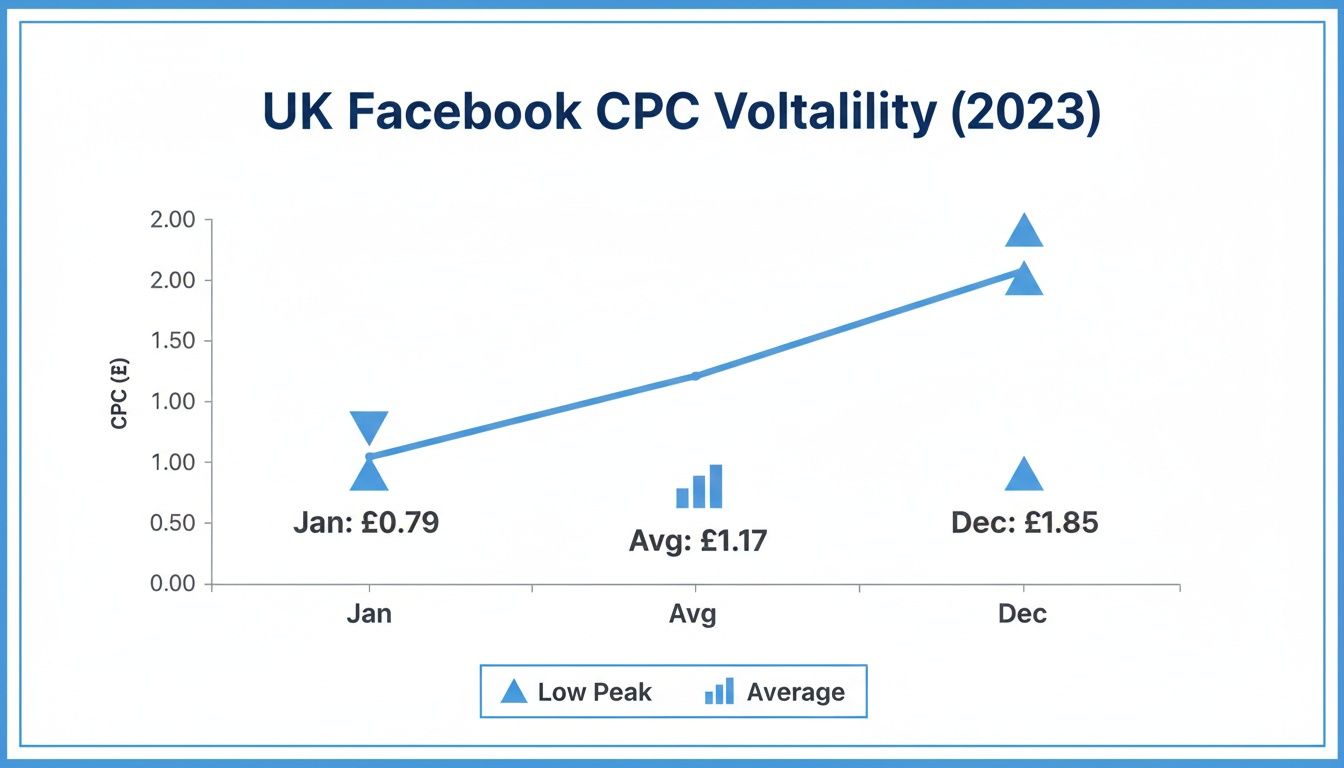
That huge jump in Q4 is classic seasonal demand—Black Friday, Christmas, you name it. It hammers home how critical sharp budget management is when competition heats up.
The goal isn’t to find the cheapest clicks. The goal is to find the most profitable clicks. This shift in mindset is absolutely fundamental to scaling your campaigns and seeing real growth.
Knowing where you stand is the first step. If your costs feel way out of line for your industry, it could be a warning sign. Maybe there are issues with your Quality Score, your ad relevance is off, or you’re targeting the wrong crowd.
For a deeper dive into what you should be paying, check out our guide on how much Google PPC should cost to benchmark your spending even further. With this context, you can go from just calculating your CPC to actively taking control of it.
Your Cost Per Click Calculator: Actionable Strategies to Lower Your Cost Per Click
Knowing your Cost Per Click is a great starting point, but the real magic happens when you actively start pushing that number down without sacrificing lead quality. A lower CPC means your budget stretches further, letting you capture more potential customers for the exact same spend. It’s all about working smarter, not just throwing more money at the problem.
The secret? It all boils down to relevance. Google and other platforms absolutely love advertisers who provide a fantastic user experience. By tightening up the alignment between your keywords, ads, and landing pages, you can systematically chip away at your CPC and seriously boost your campaign’s profitability.
Boost Your Quality Score
Think of your Quality Score as your reputation with Google. It’s their rating of the quality and relevance of your keywords and PPC ads. This metric is a massive deal because a higher Quality Score directly leads to lower ad costs and better ad positions. The better your reputation, the more Google helps you out.
To give it a lift, you need to nail three core components:
- Expected Click-Through Rate (CTR): Is your ad genuinely compelling? You need to write ad copy that speaks directly to the searcher’s problem and packs a punch with a strong call to action.
- Ad Relevance: Does your ad actually make sense for the keywords you’re bidding on? We always build tightly themed ad groups where keywords and ads are practically soulmates.
- Landing Page Experience: When someone clicks your ad, does the landing page deliver on its promise? Your page needs to be fast, mobile-friendly, and a perfect match for the ad they just clicked.
Nailing these elements sends a clear signal to Google that you’re providing value, and they’ll reward you with a lower CPC. For a really deep dive, our guide on Quality Score optimisation has everything you need to know.
Master Your Keyword Strategy (Your Cost Per Click Calculator)
The keywords you choose are the very foundation of your entire campaign. Targeting broad, hyper-competitive terms is a surefire way to burn through your budget with expensive, low-quality clicks. The trick is to get much more specific and strategic.
Uncover Long-Tail Keywords
Instead of throwing money at a generic term like “solicitors”, zero in on a long-tail keyword like “family law solicitor in Manchester”. Sure, these longer phrases have lower search volume, but they’re significantly less competitive and signal a much higher intent from the user. The clicks are cheaper, and the traffic you get is far more qualified.
Build a Robust Negative Keyword List
Negative keywords are every bit as important as the ones you actively target. They act as a filter, preventing your ads from showing up for irrelevant searches and stopping wasted spend dead in its tracks. For example, if you sell premium leather shoes, you’d want to add terms like “cheap”, “repair”, and “second-hand” to your negative list. This one simple action ensures your budget is only spent on clicks that actually matter.
Pro Tip: Don’t just set your negative keywords and forget about them. Make it a habit to regularly review your Search Query Report to sniff out new irrelevant terms triggering your ads. We often find that a diligent monthly clean-up can slash wasted spend by 10-15% almost overnight.
By constantly refining your keyword targeting and improving your Quality Score, you can take direct control of your ad spend. These aren’t just one-time fixes; they’re the ongoing optimisation tasks that separate the struggling campaigns from the wildly profitable ones. They make sure every single pound you invest is working as hard as possible to bring you valuable new customers.
Your Cost Per Click Calculator: Looking Beyond CPC to Metrics That Drive Real Growth
Getting a low CPC is a fantastic starting point, but let’s be honest, it’s only one chapter of a much bigger story.
If those affordable clicks aren’t turning into actual sales or qualified leads, then you’re essentially paying for digital window shoppers. You might feel like you’re winning the battle for cheap traffic, but you’re quietly losing the war for profitability.
To build a truly successful campaign, you have to connect the dots between what you pay for a click and the real-world value it generates. This is where you shift from simply managing ad spend to making strategic investments that directly fuel your bottom line. It’s time to look beyond that initial click and get obsessed with the numbers that actually drive business growth.
The Profitability Trio: CPA, ROAS, and Conversion Rate
While CPC tells you the cost of entry, these next few metrics reveal the true health and performance of your campaigns. Think of them as the vital signs that show whether your ad budget is working as hard as it should be.
-
Conversion Rate: This is the percentage of clicks that result in a desired action, like a purchase or a form submission. A high conversion rate is a great sign that your ads and landing pages are perfectly aligned with what your audience wants.
-
Cost Per Acquisition (CPA): This one is crucial. It tells you exactly how much you’re spending to get one new customer or lead. It gives you a crystal-clear view of your marketing efficiency and is a vital number for sustainable growth.
-
Return On Ad Spend (ROAS): This is the ultimate measure of profitability. It calculates how much revenue you earn for every pound you spend on advertising, directly tying your campaign efforts to your financial results.
These metrics work together to paint the full picture. You might have a high CPC, but if your conversion rate is strong and your ROAS is through the roof, that expensive click was actually a brilliant investment. Understanding your CPA is especially important, and you can learn more about what Cost Per Acquisition is in our detailed guide.
PPC Metric Relationships At a Glance (Your Cost Per Click Calculator)
Understanding how these key performance indicators connect is what separates good campaigns from great ones. This table breaks down how they relate to each other and contribute to the bigger picture of your campaign’s profitability.
| Metric | What It Measures | How It Relates to CPC | Business Goal |
|---|---|---|---|
| CPC | The cost of a single click on your ad. | The foundational cost metric. | Acquire traffic efficiently. |
| Conversion Rate | The percentage of clicks that become conversions. | High conversion rates can justify a higher CPC. | Maximise the value of incoming traffic. |
| CPA | The total cost to acquire one new customer or lead. | Directly influenced by CPC and Conversion Rate. | Acquire customers at a sustainable cost. |
| ROAS | The revenue generated for every pound spent on ads. | A high ROAS can make a high CPC profitable. | Ensure advertising spend is generating profit. |
Each metric tells part of the story, but seeing them together is how you get the full narrative and make truly smart decisions about your budget and strategy.
Real-World Scenarios: Putting It All Together
Let’s see how this all works in practice for two very different business models. The numbers will show just how misleading a narrow focus on CPC alone can be.
Scenario 1: The B2B Service Provider
A marketing agency is running a campaign to generate leads for their PPC management services.
- Total Ad Spend: £1,000
- Total Clicks: 200
- CPC: £5.00
- Leads (Conversions): 10
- New Clients from Leads: 2
- Lifetime Value of a Client: £5,000
At first glance, a £5.00 CPC might seem a bit steep. But with 10 leads, their CPA is a very reasonable £100 per lead (£1,000 / 10). Since they converted two of those leads into clients, their true acquisition cost is £500 per client (£1,000 / 2). With each client being worth £5,000, their ROAS is an incredible 10:1 (£10,000 revenue / £1,000 spend). Suddenly, that £5 click looks like an absolute bargain.
Scenario 2: The Ecommerce Store
An online retailer is selling handmade leather wallets.
- Total Ad Spend: £1,000
- Total Clicks: 1,000
- CPC: £1.00
- Sales (Conversions): 20
- Average Order Value: £50
Here, the £1.00 CPC looks fantastic on paper. Who wouldn’t want £1 clicks? However, with only 20 sales, their CPA is £50 per sale (£1,000 / 20). Since each sale is also worth £50, their ROAS is just 1:1 (£1,000 revenue / £1,000 spend). They’re simply breaking even. The low CPC was masking a serious profitability problem.
Your cost per click calculator gives you the starting number, but your ROAS and CPA tell you if you’re actually making money. This is the crucial shift from managing clicks to managing profits.
At PPC Geeks, our entire approach is built around this very principle. We implement precise conversion tracking and build our strategies around the metrics that matter most to your business goals, ensuring every pound spent is an investment in tangible, measurable growth.
Got Questions About Your CPC? We’ve Got Answers.
Once you start digging into your campaign data and playing with a cost per click calculator, the real-world questions quickly bubble up. Getting to grips with CPC isn’t just about the maths; it’s about understanding the natural rhythm of your campaigns and knowing when to make a move—and, just as importantly, when to hold steady.
Here are a few of the most common queries we hear from businesses trying to make sense of their ad spend.
How Often Should I Check My CPC?
It’s so tempting to hit refresh on your ads dashboard every few hours, but honestly, it’s one of the worst things you can do. Daily fluctuations are completely normal and are often just background noise. If you react to every little dip or spike, you’ll end up making frantic, short-sighted changes that can derail your campaign’s long-term performance.
My advice? Zoom out a bit. Look at your CPC on a weekly basis. A full week’s worth of data smooths out those daily jitters and starts to reveal genuine trends. This is where you can make informed, strategic tweaks instead of knee-jerk reactions.
We always advise our clients to review CPC trends weekly, but we only make major strategic changes based on bi-weekly or even monthly performance data. This stops you from over-managing the account and gives your campaigns the breathing room they need to gather meaningful results.
What Is a Good Quality Score?
Ah, the million-dollar question. Google scores from 1 to 10, but what’s actually “good” is all relative to your industry and keywords.
As a general rule, a Quality Score of 7/10 is a solid baseline to aim for. If you’re hitting an 8, 9, or 10, you’re in fantastic shape and will be rewarded with a serious cost advantage.
But if you see a score below 7, don’t panic. Think of it as an opportunity. It’s a clear signal from Google that there’s a mismatch between your keywords, your ad copy, and what users find on your landing page. The first things to look at are improving your ad relevance and making sure your landing page gives the searcher exactly what they were looking for.
Can a High CPC Ever Be a Good Thing?
Yes, absolutely! While everyone’s goal seems to be lowering their CPC, a high cost per click isn’t automatically a bad sign. In fact, in some situations, it can be a very, very good thing for your business.
- High-Intent Keywords: Think about terms that scream “I’m ready to buy now!” like “emergency plumber near me.” Clicks for these keywords will always be more expensive, simply because they are far more likely to turn into immediate business.
- High-Value Customers: In super-competitive sectors like finance or law, the lifetime value of a single new client can be enormous. Paying a high CPC is easily justified when the potential return on that click is so significant.
- Outbidding Competitors: Sometimes you just have to pay a premium. Strategically paying more to secure those top ad positions can be a smart move to capture valuable market share from your rivals.
The trick is to stop looking at CPC in a vacuum. A high CPC that delivers a brilliant Return On Ad Spend (ROAS) is a winning formula every single time. If you’re struggling to tell which signals are good and which are bad, it might be time for a professional to take a look and make sure you’re not leaving money on the table.
Tired of the guessing games? If you want a clear, data-driven strategy to get more from your PPC budget, PPC Geeks can help. Our free, in-depth audits show you exactly where your money is going and how to optimise it for maximum return.
Get your free PPC audit today at https://ppcgeeks.co.uk/.