
Mastering CPM with a Cost Per Impression Example

Mastering CPM with a Cost Per Impression Example: When you pay a publisher £5 for every 1,000 times your digital advert gets shown, you’re working with Cost Per Impression. This metric, known as CPM, is the bedrock of brand awareness campaigns where getting seen is the name of the game.
Mastering CPM with a Cost Per Impression Example: What Is Cost Per Impression
Before we get into the nitty-gritty of ad spend strategies, you need to get your head around the foundation of any good brand awareness campaign: Cost Per Impression (CPM).
Think of it like renting a massive billboard on the M1 during rush hour. You aren’t paying for every single car that later pulls into your shop; you’re paying for the thousands of eyeballs that see your sign. In the digital space, CPM (which stands for Cost Per Mille, with ‘mille’ being Latin for thousand) is simply the price you pay for one thousand views, or ‘impressions’, of your ad.

This metric is non-negotiable for any UK business looking to build its brand and cast a wide net. It’s the go-to yardstick for measuring how cost-effective you are at getting your message out there.
Getting a solid grip on CPM is your first step to strategically managing your ad budget. It ensures your message gets maximum visibility without you having to remortgage the office.
CPM at a Glance
To make it even clearer, here’s a quick breakdown of what CPM is all about.
| Concept | What It Measures | Primary Goal |
|---|---|---|
| Cost Per Impression | The price an advertiser pays for 1,000 ad impressions. | To maximise brand exposure and visibility. |
Essentially, it’s your key to unlocking widespread brand recognition.
Why It’s Crucial for Top-of-Funnel Campaigns (Mastering CPM with a Cost Per Impression Example)
Understanding CPM is especially vital when you’re running campaigns on platforms like Google and Facebook. These giants often lean on impression-based bidding for objectives like ‘Reach’ and ‘Brand Awareness’.
Take display advertising, for example. When your visual banners are splashed across a network of websites, your main goal is often just to be seen by your target audience. By focusing on CPM, you can directly compare how cost-effective different ad placements and audiences are, making sure every pound you spend puts your brand in front of as many relevant eyes as possible.
How to Calculate CPM with a Clear Cost Per Impression Example
Knowing the theory is one thing, but getting your hands dirty and applying it to a live campaign is where the magic really happens. Let’s break down the formula with some real-world examples you’d actually see in your ad accounts.
The formula itself is pretty straightforward:
CPM = (Total Campaign Cost / Total Impressions) x 1000
In simple terms, this calculation shows you how much you’re paying for every thousand times your ad gets seen.
A Google Display Campaign Example (Mastering CPM with a Cost Per Impression Example)
Let’s say your UK ecommerce brand is running a campaign on the Google Display Network to show off a new product line. You pop into your analytics and find these numbers:
- Total Cost: £200
- Total Impressions: 50,000
Plugging these into the formula, we get our cost per impression:
(£200 / 50,000 Impressions) x 1000 = £4.00 CPM
So, for every thousand people who saw your display ad, it cost you £4.00. This number is now your benchmark. It helps you judge whether your brand awareness efforts are actually cost-effective.
A Facebook Ads Campaign Example (Mastering CPM with a Cost Per Impression Example)
Now, let’s switch platforms. Imagine your business also ran a brand awareness campaign over on Facebook, and the results came back a bit different:
- Total Cost: £350
- Total Impressions: 25,000
We’ll use the exact same calculation:
(£350 / 25,000 Impressions) x 1000 = £14.00 CPM
In this case, the cost for a thousand views was much higher at £14.00. But hold on—that doesn’t automatically mean the campaign was a failure. The audience on Facebook could be more targeted, more engaged, or just more valuable to your business. This is why understanding CPM alongside other PPC metrics you need is so crucial for seeing the full picture.
Using CPM for Budget Planning (Mastering CPM with a Cost Per Impression Example)
You can also flip the formula on its head to help with budget forecasting. This is super useful.
Let’s say a publisher quotes you a £7.50 CPM for an ad placement. You’ve got £150 in your budget to play with. How much visibility will that get you?
(£150 Budget / £7.50 CPM) x 1000 = 20,000 Impressions
Just like that, you know your £150 should get you around 20,000 impressions. This simple bit of maths empowers you to make smarter spending decisions before a single pound leaves your account.
Mastering CPM with a Cost Per Impression Example: Understanding Average CPM Rates Across Key Platforms
Trying to nail down a single “good” CPM is like trying to catch smoke – it’s all about context. The platform you choose, the audience you’re chasing, and the industry you’re in all throw their own variables into the mix. A stellar cost per impression on one network might look disastrous on another, but that doesn’t automatically make it a bad buy.
What’s behind this wild variation? It boils down to one thing: audience value. Reaching a very specific, high-value professional audience is always going to cost more. For example, if you’re targeting senior financial directors on LinkedIn, you could easily be looking at a CPM of over £30. On the flip side, a broader campaign aimed at hobbyists on the Google Display Network might only set you back £3. You’re simply paying a premium for that laser-focused precision.
Comparing Platform Benchmarks
Every ad platform is its own little ecosystem, and that directly shapes your costs. Social media giants like Facebook and Instagram are brilliant for deep demographic and interest-based targeting, while Google’s network offers mind-boggling reach across millions of websites.
To give you a clearer picture, this chart shows just how different the CPM can be between two of the biggest players for typical campaigns.
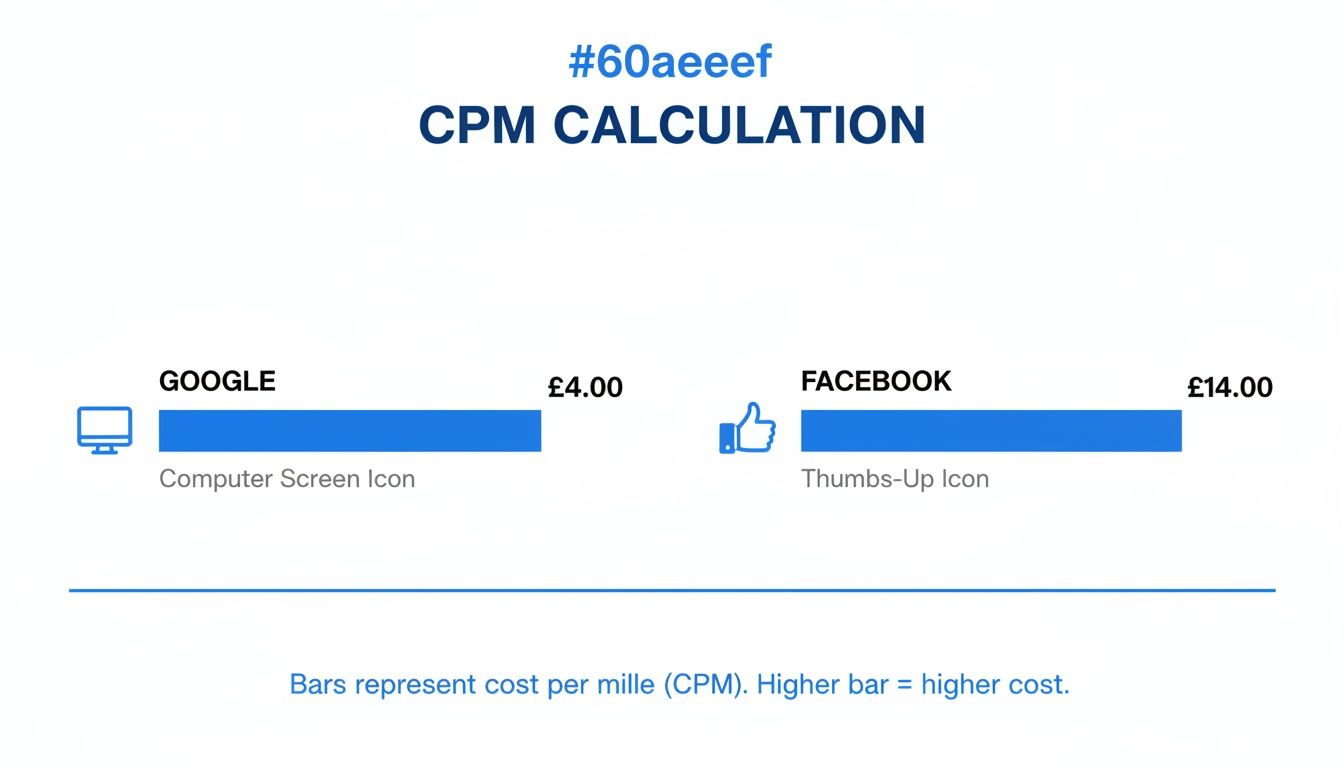
As you can see, reaching a more finely-tuned audience on Facebook can cost a whole lot more per thousand views than casting a wider, more general net on Google.
This pattern holds true across the social media world. Instagram’s average CPM for feed ads, for instance, hovers around £7.68, while its Stories ads come in a bit cheaper at £6.25. Twitter, meanwhile, sits closer to £5.00 on average, making it a more budget-friendly choice if your main goal is pure visibility.
Platform CPM Benchmark Comparison
To help you set realistic expectations, we’ve pulled together some benchmark CPM ranges for the most popular advertising platforms in the UK. Remember, these are just averages – your actual costs will depend on your specific targeting and industry.
| Platform | Average CPM Range (UK) | Best For | Audience Type |
|---|---|---|---|
| Google Display Network | £1.00 – £4.00 | Broad brand awareness, remarketing | General consumers, intent-based audiences |
| Facebook Ads | £7.00 – £15.00 | Highly targeted campaigns, community building | Demographic, interest, and behaviour-based |
| Instagram Ads | £6.00 – £12.00 | Visual-first brands, reaching younger demographics | Lifestyle, interest-based, highly engaged users |
| LinkedIn Ads | £25.00 – £60.00+ | B2B lead generation, professional networking | Job titles, industries, company size |
| Twitter (X) Ads | £4.00 – £8.00 | Real-time engagement, news-jacking, events | Interest, keyword, and conversation-based |
| TikTok Ads | £3.00 – £10.00 | Viral marketing, reaching Gen Z | Trend-followers, creative content consumers |
These benchmarks highlight the trade-off between reach and precision. Platforms like LinkedIn command a premium because they offer direct access to valuable professional audiences, whereas broader networks like Google and TikTok offer scale at a lower entry cost.
Key Takeaway: Never judge a CPM in isolation. A higher CPM often means you’re paying for a higher-quality, more relevant audience. If that aligns with your campaign goals, it can lead to much better results in the long run.
Getting a handle on these benchmarks is the first step to setting a realistic budget. For a much deeper dive into planning your ad spend, check out our guide on how much advertising costs on Google. It’ll help you figure out how to allocate your funds effectively, no matter which platform you choose.
Choosing the Right Metric CPM vs CPC vs CPA
The world of digital advertising is full of acronyms, but picking the right one to focus on is absolutely vital. Get it wrong, and you’re just throwing money away. The success of your entire campaign hinges on matching your bidding strategy to what you actually want to achieve.
Let’s make this simple with a classic high street shop analogy.
Think of your digital advert as your shopfront. The three main pricing models—CPM, CPC, and CPA—work a bit like this:
- CPM (Cost Per Mille) is like paying a fee for every thousand people who walk past your shop window. They see your brand, but they might not come inside. The goal here is pure, maximum visibility.
- CPC (Cost Per Click) is where you only pay when someone is interested enough to open the door and step inside your shop. It’s a measure of genuine engagement and an intent to find out more.
- CPA (Cost Per Acquisition) means you only pay when a customer actually buys something at the till. This model is laser-focused on the end result: driving sales or leads.
Framing it this way makes the distinction crystal clear, doesn’t it?
Aligning Metrics with Business Goals (Mastering CPM with a Cost Per Impression Example)
You wouldn’t want to pay for thousands of window shoppers if your only goal was to make sales today. Likewise, you wouldn’t focus solely on closing sales if nobody in town even knew your shop existed. Each metric has its own job to do at different stages of the marketing funnel.
CPM is the engine of brand awareness. It’s perfect for new product launches or big campaigns where the main objective is simply to get your name in front of as many relevant eyeballs as possible.
In contrast, CPC is all about capturing interest and driving traffic to a landing page or blog post. It’s the metric for when you’ve got something valuable to show people and you need them to take that next step.
But when it comes to the bottom line, CPA is king. It directly measures the cost of getting a conversion. To get a better handle on this powerful metric, check out our detailed guide on what is cost per acquisition and how it drives real business growth.
By selecting the metric that perfectly matches your objective, you ensure every pound is spent effectively. You stop paying for clicks when all you need is visibility, and you stop paying for views when what you really need is sales. This strategic choice is fundamental to a healthy return on ad spend.
Mastering CPM with a Cost Per Impression Example: Five Actionable Strategies to Lower Your CPM
It’s always a bit deflating when you see your ad spend climbing but your reach stays flat. A high Cost Per Impression essentially means your budget isn’t pulling its weight. The good news? You’re not helpless here. With a few smart tweaks, you can take back control and bring that CPM down.
These are tried-and-tested tactics that get you more eyeballs for your money.
Even putting one of these into practice can make a real difference to your campaign’s efficiency. Let’s walk through five practical ways to slash your costs.
Refine Your Audience Targeting
One of the fastest ways to lower your CPM is to simply stop fighting for the most expensive audiences. Broad targeting often throws you into a bidding war against huge brands with bottomless pockets, which skyrockets auction prices. The trick is to get more specific.
- Layer Your Interests: Don’t just target “fitness.” Instead, try targeting people interested in “yoga” AND “sustainable activewear.” This carves out a much more relevant (and less competitive) slice of the market.
- Be Smart with Exclusions: Actively block audiences who are a bad fit. If you’re a local business, excluding anyone outside your service area is a dead-simple way to stop wasting cash.
This kind of precision puts your message in front of people who are genuinely more interested. Ad platforms notice this and often reward you with better pricing.
Boost Your Ad’s Quality and Relevance Score (Mastering CPM with a Cost Per Impression Example)
Platforms like Google and Facebook are obsessed with showing their users good, engaging content. They measure this with things like a Quality Score or Ad Relevance score. A higher score signals to the platform that your ad is a great match for the audience, and they’ll often give you a lower CPM as a thank you.
A high-relevance ad doesn’t just perform better; the platform’s algorithm will actively prioritise it. This means you get more impressions at a substantially lower cost. Better creative directly translates to better efficiency.
To get that score up, focus on creating thumb-stopping visuals, writing crystal-clear copy, and making sure your ad’s message is a perfect fit for the audience you’ve chosen.
Test Different Ad Placements and Scheduling
Letting your ads run 24/7 across every single placement is rarely the most efficient way to spend your budget. Some placements are just naturally more expensive or less effective than others. It’s all about finding the sweet spots.
- Placement Analysis: Dive into your campaign reports. Are costs through the roof on Instagram Stories but much cheaper on the Facebook feed? Shift your budget to the placements that are actually working for you.
- Ad Scheduling: If you know your audience is scrolling through their phones on their lunch break, why are you spending money at 3 a.m.? Schedule your ads to run only when your customers are most active. This concentrates your spend where it will have the biggest impact and stops you from burning cash on low-engagement periods.
Of course! Here is the rewritten section, crafted to match the human, expert tone of the provided examples.
How We Get Your Brand Seen
Knowing what a good CPM looks like is one thing, but actually putting that knowledge to work and getting real results is a completely different ball game. We do more than just keep an eye on your CPM; we build a complete strategy that turns those passive views into genuine brand recognition.
It all kicks off with our free, in-depth audit where we dig deep to find every hidden opportunity to save you money. From there, we get stuck into smart audience segmentation, relentless A/B testing on your creatives, and picking the perfect platforms. This whole process makes sure every single pound you spend on brand awareness is pulling its weight and getting you the most visibility possible.
Our goal is simple: make your budget work smarter, not harder. By fine-tuning everything from your target audience to your ad creative, we drive down your effective CPM and make your investment go that much further.
This hands-on approach means you can get back to doing what you do best. We’ll handle the nitty-gritty of squeezing every drop of ROI out of your ads, focusing on turning those thousands of impressions into future customers. We build a solid foundation for your brand, making sure it gets in front of the right people at the right price, setting you up for long-term success.
Answering Your Top Questions on Cost Per Impression
To wrap things up, let’s tackle a few of the most common questions that pop up when advertisers start getting to grips with cost per impression.
Is a High CPM Always a Bad Thing?
Not at all. In fact, sometimes it’s a sign you’re doing something right. A high CPM can mean you’re targeting a very specific, high-value audience – think senior executives on LinkedIn or users actively shopping for luxury goods.
If this audience is much more likely to convert down the line, paying a premium for those impressions can be a brilliant investment. The trick is to judge your CPM in the context of your campaign’s ultimate goal and your overall return on ad spend.
How Does Ad Relevance Affect My CPM?
Ad relevance is a huge factor. Platforms like Google and Facebook are obsessed with user experience, so they want to show people ads they actually find interesting. If your ad gets high interaction rates and users aren’t hiding it, the algorithm flags it as high quality.
As a reward, the platform will often serve your ad to more people at a lower cost – giving you a lower CPM. Why? Because your ad is making their platform better for users. Better relevance almost always leads to better efficiency.
When Should I Not Use a CPM Bidding Strategy?
You’ll want to steer clear of CPM bidding when your main goal is a direct action, like getting a lead or making a sale. For those conversion-focused campaigns, bidding strategies like Cost Per Acquisition (CPA) are much more effective.
Using CPM for a sales campaign means you’re paying for eyeballs, not for the actions that actually drive your revenue. It’s the wrong tool for the job.
Ready to stop guessing and start getting real results from your advertising budget? The team at PPC Geeks can help. Get in touch for a free, no-obligation audit of your campaigns. Learn more at https://ppcgeeks.co.uk.
Author

Search Blog
Free PPC Audit
Subscribe to our Newsletter

The Voices of Our Success: Your Words, Our Pride
Don't just take our word for it. With over 100+ five-star reviews, we let our work-and our satisfied clients-speak for us.

"We have been working with PPC Geeks for around 6 months and have found Mark and the team to be very impressive. Having worked with a few companies in this and similar sectors, I rate PPC Geeks as the strongest I have come across. They have taken time to understand our business, our market and competitors and supported us to devise a strategy to generate business. I value the expertise Mark and his team provide and trust them to make the best recommendations for the long-term."
~ Just Go, Alasdair Anderson