




10 Effective Marketing Methods for Small Business in 2025: Navigating the world of marketing can feel overwhelming for a small business. With limited budgets and even more limited time, choosing the right approach is critical. Traditional advice often misses the mark, offering generic tips that don’t translate into real, scalable growth. This guide cuts through the noise. We’ve compiled 10 powerful and practical marketing methods for small business owners in the UK, designed to deliver measurable results without needing a colossal budget.
This article moves beyond theory to provide actionable strategies you can implement immediately. You will discover how to harness the power of content to attract your ideal customer, optimise your online presence to dominate local search, and build a loyal community that champions your brand. We will cover a comprehensive mix of digital and offline channels, including everything from sophisticated pay-per-click advertising campaigns to the simple, yet potent, impact of referral programmes.
Each method is broken down into clear, manageable steps, complete with practical examples relevant to UK-based SMEs, startups, and ambitious entrepreneurs. Let’s explore the strategies that will not just help your business survive, but thrive in today’s competitive marketplace, providing a clear roadmap to unlocking sustainable growth.
1. Effective Marketing Methods for Small Business: Content Marketing
Content marketing is a powerful, strategic approach focused on creating and distributing valuable, relevant, and consistent content to attract and retain a specific audience. Unlike traditional advertising that interrupts, this marketing method for small business provides useful information, builds trust, and establishes you as an authority in your field. The goal is to educate or entertain potential customers, positioning your brand as the go-to resource when they are ready to buy.

This method shines when your customers have questions or complex problems to solve before making a purchase. For example, River Pools & Spas became an industry leader simply by writing blog posts that answered every conceivable customer question about fibreglass pools. This educational content generated millions in revenue and transformed their business.
How to Get Started
To implement content marketing effectively, start by understanding your audience’s pain points.
- Answer Customer Questions: Use tools like AnswerThePublic or simply listen to your sales team to identify the most common queries your customers have.
- Create a Content Calendar: Plan your content in advance to ensure you publish consistently. This helps build an engaged audience that looks forward to your insights.
- Repurpose Your Content: Maximise your effort by turning a single blog post into a series of social media updates, an infographic, or even a short video.
- Optimise for Search: Use basic keyword research to find the topics your target audience is searching for online, increasing your chances of being discovered.
By consistently delivering value, you build a loyal following and drive profitable customer action. For businesses aiming to scale, understanding the nuances of content marketing for ecommerce can provide a significant competitive advantage.
2. Social Media Marketing
Social media marketing is the use of platforms like Facebook, Instagram, and LinkedIn to connect with your audience, build brand awareness, and drive sales. This marketing method for small business allows you to engage directly with customers where they spend their time online, fostering a community around your brand through both organic content and paid advertising.

This method excels at building brand personality and loyalty. For instance, the beauty brand Glossier grew into a billion-dollar company primarily through authentic Instagram engagement, turning customers into advocates. Similarly, Duolingo captured a massive audience on TikTok with its quirky, personality-driven videos, proving that even educational brands can go viral and build a powerful connection with users.
How to Get Started
To leverage social media effectively, focus on building genuine connections rather than just broadcasting promotions.
- Choose Platforms Wisely: Don’t spread yourself thin. Start with one or two platforms where your target audience is most active.
- Post Consistently: Aim to post at least 3-5 times per week to stay top-of-mind and maintain engagement with the platform’s algorithm.
- Embrace the 80/20 Rule: Dedicate 80% of your content to educating or entertaining your audience and only 20% to direct promotion.
- Invest in Visuals: Use high-quality images and native video content, as they consistently receive higher engagement rates across all major platforms.
By creating a strong social presence, you can build a loyal community that supports your business long-term. For those looking to accelerate growth, mastering paid channels is crucial, and you can learn more about how to run effective Instagram ads to reach a highly targeted audience.
3. Effective Marketing Methods for Small Business in 2025: Email Marketing
Email marketing is a direct communication channel that involves building a list of subscribers and sending them targeted messages to nurture relationships, provide value, and drive sales. For small businesses, it remains one of the highest-ROI marketing methods, with a reported average return of £36 for every £1 spent. Unlike social media, you own your email list, giving you a direct and reliable way to reach your audience.
This method excels at moving potential customers through the sales funnel by delivering personalised content directly to their inbox. Media company Morning Brew, for example, grew to over four million subscribers and sold for a reported £56 million, all built on the back of a compelling daily email newsletter. This demonstrates the immense power of building an engaged and loyal email audience.
How to Get Started
To launch a successful email marketing strategy, focus on list growth and delivering genuine value.
- Offer a Compelling Lead Magnet: Encourage sign-ups by offering something valuable in exchange for an email address, such as a discount code, a free ebook, or an exclusive toolkit.
- Segment Your Audience: Group subscribers based on their interests, purchase history, or behaviour. This allows you to send more relevant and effective campaigns that resonate with specific segments.
- Write Compelling Subject Lines: Create curiosity and be specific about the value inside your email. A great subject line is often the deciding factor in whether your email gets opened.
- Automate Key Communications: Use automation for welcome series, abandoned cart reminders, and re-engagement campaigns. This saves time and ensures timely communication.
By nurturing your list with consistent, valuable content, you build a powerful asset for your business. For those looking to scale their efforts, exploring what marketing automation is can unlock even greater efficiency and personalisation.
4. Search Engine Optimisation (SEO)
Search Engine Optimisation (SEO) is the practice of improving your website to increase its visibility when people search for products or services related to your business in Google and other search engines. Unlike paid ads, this marketing method for small business focuses on attracting organic (unpaid) traffic. By optimising your site’s content and technical structure, you earn a higher ranking in search results, making it easier for potential customers to find you.
This method is ideal for businesses whose customers actively search for solutions online. For instance, Brian Dean of Backlinko built a multi-million visitor audience almost entirely through SEO, pioneering techniques like the ‘Skyscraper Technique’ to create content that outranked competitors. Similarly, Canva dominates design-related search terms, driving massive, sustainable traffic and user acquisition by being the top answer for countless queries.
How to Get Started
To implement SEO effectively, you need a systematic approach to both on-page and off-page factors.
- Target Long-Tail Keywords: Start by focusing on specific, longer search phrases (e.g., “emergency plumber in south London”) which have lower competition and higher conversion intent.
- Optimise for Local Search: Claim and fully optimise your Google Business Profile. This is crucial for attracting nearby customers searching for local services.
- Create Authoritative Content: Develop comprehensive content that thoroughly answers user questions, establishing your Experience, Expertise, Authoritativeness, and Trust (E-E-A-T).
- Focus on Technical Health: Ensure your website is fast, mobile-friendly, and secure. Use tools like Google Search Console to monitor performance and fix errors.
By investing in SEO, you build a valuable long-term asset that generates consistent, high-quality leads. For a deeper dive, exploring resources on advanced SEO strategies can help you gain a competitive edge.
5. Effective Marketing Methods for Small Business: Local Marketing & Google Business Profile
Local marketing is a vital strategy focused on promoting your business to customers within your immediate geographic area. The cornerstone of this approach is your Google Business Profile (GBP), which allows your business to appear in local search results and on Google Maps. This is one of the most effective marketing methods for small business, particularly those with a physical location or defined service area, as nearly half of all Google searches have local intent.
This method is crucial when customers are looking for products or services “near me.” For example, a local restaurant can drive foot traffic by appearing at the top of Google Maps with glowing reviews, while a plumbing company can dominate local search results for emergency call-outs. By optimising for local search, you connect with customers at the exact moment they need what you offer, turning online searches into real-world business.
How to Get Started
To leverage local marketing, focus on making your business as visible as possible to nearby customers.
- Claim and Complete Your GBP: Ensure every section of your Google Business Profile is filled out, including services, opening hours, and photos. This is your digital shopfront.
- Generate Consistent Reviews: Actively encourage satisfied customers to leave reviews. Positive feedback significantly boosts your local ranking and builds trust with potential clients.
- Publish GBP Posts: Use the “Posts” feature on your profile to share weekly updates, offers, and news. This signals to Google that your business is active and relevant.
- Ensure NAP Consistency: Your Name, Address, and Phone number (NAP) must be identical across all online directories (like Yell and Thomson Local) to avoid confusing search engines.
6. Referral & Word-of-Mouth Marketing (Effective Marketing Methods for Small Business)
Referral marketing systematises the process of getting existing customers to recommend your business to others. While word-of-mouth happens naturally, a structured referral programme incentivises customers to actively promote your business through rewards or discounts. It stands out as one of the most trusted marketing methods for small business, leveraging the power of authentic social proof.
The infographic below highlights just how impactful referred customers can be.
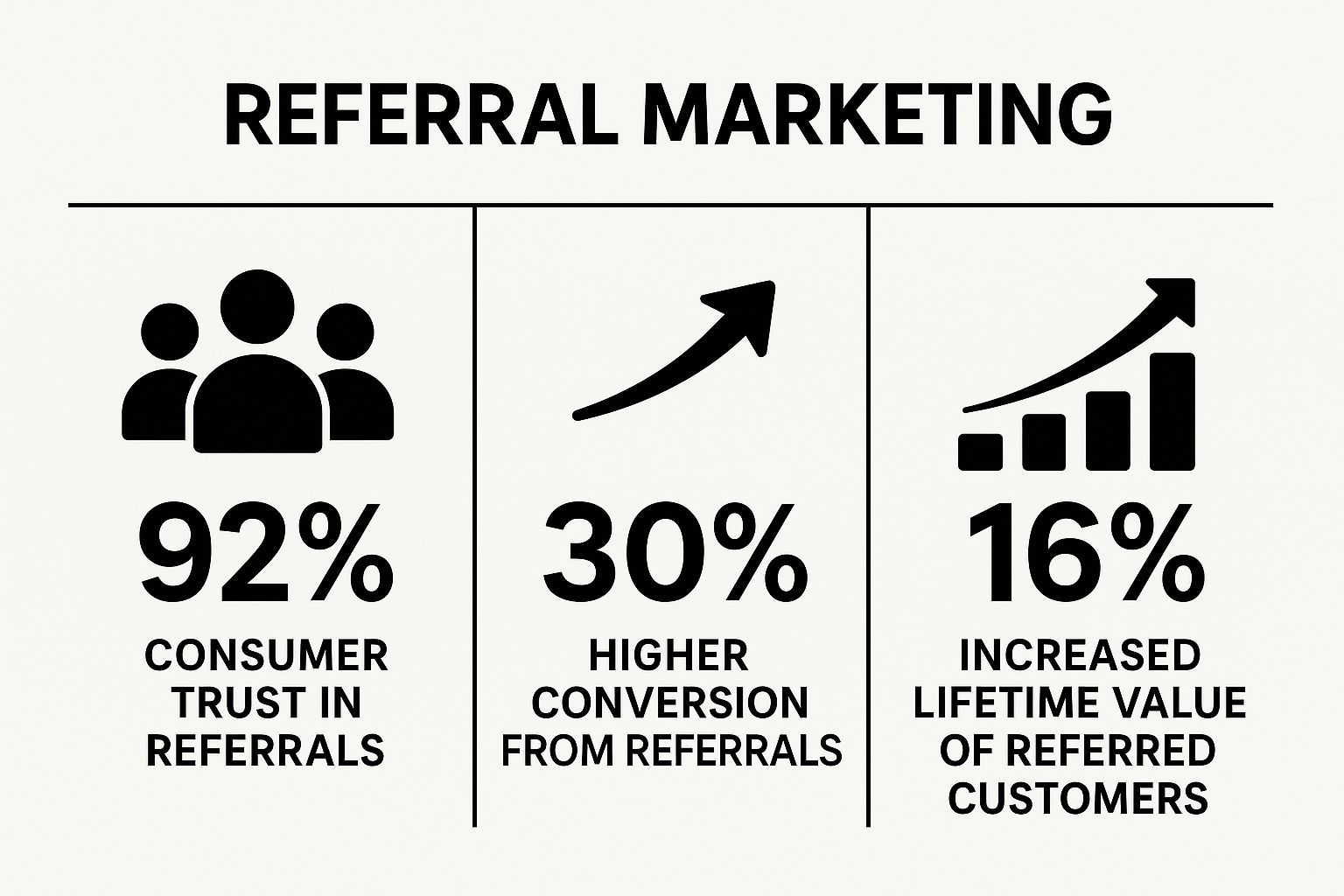
These statistics demonstrate that referred customers not only convert at a higher rate but are also more valuable over time. This approach works best when you have a loyal customer base and a product or service that generates positive experiences. For instance, Dropbox famously achieved 3900% growth in 15 months by offering free storage space to both the referrer and the new user, a strategy that turned happy customers into powerful advocates.
How to Get Started
To launch a successful referral programme, focus on making participation easy and rewarding.
- Make Referring Easy: Implement one-click sharing options via email, social media, or a unique referral link that customers can easily copy and paste.
- Offer Dual Incentives: Provide a reward to both the person referring and the new customer they bring in. This motivates both parties to participate.
- Promote Your Programme: Don’t let your programme be a secret. Promote it on your website, in email signatures, and after a customer has a positive experience.
- Track Your Promoters: Use a metric like the Net Promoter Score (NPS) to identify your most enthusiastic customers and invite them to join your programme first.
By encouraging and rewarding word-of-mouth, you can create a self-sustaining engine for customer acquisition.
7. Effective Marketing Methods for Small Business: Pay-Per-Click Advertising (PPC)
Pay-Per-Click (PPC) advertising is a digital marketing method where businesses pay a fee each time one of their ads is clicked. This allows you to essentially buy visits to your site, rather than attempting to “earn” those visits organically. Platforms like Google Ads and Bing Ads place your business at the top of search results, providing immediate visibility and traffic for relevant keywords.
This method is ideal for small businesses that need quick results or want to test market demand without long-term commitments. For example, local service businesses like emergency plumbers or locksmiths rely heavily on PPC to capture customers at the exact moment of need. Similarly, e-commerce brands use Google Shopping ads to display products directly in search, driving high-intent buyers straight to a product page.
How to Get Started
Effective PPC requires a strategic approach to avoid wasting your budget.
- Focus on Intent: Start with keywords that signal a user is ready to buy or enquire, not just browse. For example, “emergency boiler repair” is stronger than “boiler problems”.
- Use Negative Keywords: Actively add keywords you don’t want to trigger your ads for. This prevents irrelevant clicks and saves money.
- Create Dedicated Landing Pages: Send traffic from your ads to a specific page that matches the ad’s promise, rather than your general homepage, to improve conversion rates.
- Track Conversions: Don’t just measure clicks. Set up conversion tracking to understand which ads and keywords are actually generating leads or sales.
By being targeted and analytical, PPC can deliver a measurable and scalable return on investment. For businesses looking to maximise their ad spend, exploring professional PPC management for small business can provide the expertise needed to generate consistent results.
8. Video Marketing (Effective Marketing Methods for Small Business)
Video marketing involves using video to promote your brand, educate customers, and engage your audience. As one of the most dynamic marketing methods for small business, it leverages platforms like YouTube and social media to capture attention. With video projected to account for the majority of all internet traffic, it has become essential for communicating messages in a way that is engaging and easily digestible for modern consumers.
This method is highly effective for showing products in action or telling a compelling brand story. For instance, Blendtec’s “Will It Blend?” YouTube series showcased the power of their blenders in an entertaining way, reportedly increasing sales by 700%. Similarly, Dollar Shave Club’s simple, humorous launch video went viral, generating 12,000 orders in just two days and proving that a huge budget isn’t necessary for massive impact.
How to Get Started
You can begin creating effective video content without expensive equipment.
- Start with Your Smartphone: Modern smartphones shoot high-quality video. Focus on good lighting and clear audio, as sound quality is often more critical than video perfection.
- Hook Viewers Immediately: Capture attention within the first three seconds to prevent viewers from scrolling past. Start with a question, a bold statement, or intriguing visuals.
- Add Captions: A significant portion of social media videos are watched without sound. Adding captions makes your content accessible and ensures your message is understood.
- Keep It Concise: Aim for videos under two minutes for social media platforms to maintain high engagement. Deliver your key message quickly and efficiently.
By creating consistent, value-driven video content, you can build a stronger connection with your audience and drive business growth.
9. Effective Marketing Methods for Small Business: Partnership & Collaboration Marketing
Partnership marketing is a strategic method where you collaborate with complementary businesses or influencers to cross-promote to each other’s audiences. For small businesses with limited budgets, this marketing method for small business provides access to new customer bases without the high cost of traditional advertising. The goal is to leverage the trust and reach of an established partner to gain credibility and exposure.
This approach works exceptionally well when two businesses serve a similar customer demographic but are not direct competitors. For instance, a local coffee shop might partner with a nearby bakery for cross-promotion, or a fitness trainer could team up with a nutritionist to offer clients a comprehensive wellness solution. GoPro and Red Bull’s iconic collaboration on extreme sports content is a large-scale example of this synergy.
How to Get Started
To implement partnership marketing, focus on finding the right allies and creating mutual value.
- Identify Potential Partners: Look for businesses that serve your ideal customer. Local business networks and chambers of commerce are excellent places to start your search.
- Ensure Brand Alignment: Before reaching out, confirm that a potential partner’s brand values, quality standards, and customer service ethos align with your own.
- Create a Clear Agreement: Outline responsibilities, promotional activities, and how success will be measured for both parties. This prevents misunderstandings and ensures a fair exchange.
- Focus on Mutual Benefit: Structure the collaboration so it provides genuine value to your partner and their audience, not just your own business. This builds strong, long-term relationships.
By joining forces, you can achieve a level of market penetration that would be difficult and expensive to accomplish alone.
10. Customer Retention & Loyalty Marketing (Effective Marketing Methods for Small Business)
Customer retention marketing focuses on nurturing existing customers to keep them engaged, satisfied, and purchasing repeatedly. This approach is often more cost-effective than constantly seeking new clients; acquiring a new customer can cost five times more than retaining a current one. This marketing method for small business centres on building long-term relationships through exceptional service, personalised communication, and rewarding loyalty.
This strategy is particularly effective for businesses with repeat purchase models, from a local coffee shop to a subscription-based software service. For instance, Sephora’s Beauty Insider programme encourages repeat purchases by offering points, exclusive products, and a tiered rewards system that makes customers feel valued. Similarly, a simple punch card at a local cafe serves the same purpose, driving loyalty through tangible rewards.
How to Get Started
To build a loyal customer base, focus on creating consistently positive experiences.
- Implement a Simple Loyalty Programme: Start with something straightforward like a digital punch card or a points-based system. Ensure it’s easy for customers to join and see the value immediately.
- Personalise Your Communications: Use customer purchase history to send targeted emails with product recommendations, special offers, or content they will find genuinely useful.
- Request and Act on Feedback: Actively ask for reviews and suggestions. More importantly, show your customers that you are listening by implementing changes based on their input.
- Celebrate Customer Milestones: Acknowledge customer anniversaries or birthdays with a small discount or a personalised message. This small gesture helps build an emotional connection beyond the transaction.
By prioritising the customers you already have, you not only increase revenue but also create brand advocates who will promote your business for you.
Marketing Method Comparison Matrix
| Marketing Type | Implementation Complexity 🔄 | Resource Requirements ⚡ | Expected Outcomes 📊 | Ideal Use Cases 💡 | Key Advantages ⭐ |
|---|---|---|---|---|---|
| Content Marketing | Medium – consistent content creation needed | Moderate – skilled creators or budget | Long-term authority, improved SEO, qualified leads | Educating audience, building brand trust | Cost-effective, repurposable content, SEO boost |
| Social Media Marketing | High – constant engagement and platform knowledge | Moderate to High – content + ads budget | Rapid brand awareness, direct audience engagement | Brand building, targeted ads, B2C focus | Direct feedback, highly targeted ads, low start cost |
| Email Marketing | Medium – list building and segmentation | Low to Moderate – email platform fees | High ROI, personalised engagement | Nurturing leads, promotional campaigns | Highest ROI, direct audience ownership, automation |
| SEO | High – technical + content optimisation | Moderate to High – tools or agency | Sustainable organic traffic, authority build | Long-term traffic growth, competitive markets | Free ongoing traffic, credibility, cost-effective |
| Local Marketing & Google Business Profile | Low to Medium – profile setup and updates | Low – time investment primarily | Local customer visibility and conversions | Physical locations, service areas | Targets ready-to-buy locals, free optimisation |
| Referral & Word-of-Mouth Marketing | Medium – program setup and management | Low to Moderate – software + rewards | High trust referrals, loyal customer growth | Leveraging existing customers | Highest trust, low CAC, increased lifetime value |
| Pay-Per-Click Advertising (PPC) | High – ongoing optimisation and budget management | High – ad spend and expert management | Immediate traffic and conversions | Quick results, testing market demand | Instant visibility, budget control, scalable |
| Video Marketing | High – production and editing skills needed | Moderate to High – equipment/software costs | High engagement and conversion increase | Product demos, brand storytelling | Highest engagement, trust-builder, versatile format |
| Partnership & Collaboration Marketing | Medium – partner sourcing and coordination | Low to Moderate – mostly time and commission | Access to new audiences, shared costs | Expanding reach cost-effectively | Shared resources, credibility boost, new reach |
| Customer Retention & Loyalty Marketing | Medium – program setup and ongoing management | Low to Moderate – platform fees & rewards | Increased repeat purchases and customer lifetime value | Retaining customers, increasing loyalty | Lower cost than acquisition, predictable revenue |
Choosing Your Path: Implementing a Winning Marketing Mix
Navigating the landscape of marketing methods for small businesses can feel overwhelming, but it doesn’t have to be. We’ve explored ten powerful strategies, from the foundational necessity of Search Engine Optimisation (SEO) and Local Marketing to the dynamic community-building power of Social Media and Referral Programmes. Each method offers a unique pathway to connect with your ideal customers, build brand loyalty, and drive sustainable growth for your business.
The key takeaway is not to attempt all ten at once. A scattered approach leads to diluted efforts and meagre results. Instead, the path to success lies in strategic selection and focused execution. Your most powerful marketing mix will be one that is tailored specifically to your business, your audience, and your unique goals.
Building Your Custom Marketing Engine (Effective Marketing Methods for Small Business)
So, where do you begin? Start by identifying the “lowest-hanging fruit”. For many UK-based SMEs, this could mean fully optimising your Google Business Profile to capture local search traffic or formalising a simple referral programme to leverage your existing happy customers. These are high-impact, low-cost starting points that can deliver tangible results quickly.
Once you have established a solid foundation and are seeing momentum, you can begin to layer in more sophisticated strategies.
- Ready to build authority? Dive into Content Marketing, creating valuable blog posts or guides that answer your customers’ most pressing questions.
- Need to nurture leads? Develop an Email Marketing sequence that builds relationships and guides subscribers towards a purchase.
- Looking for immediate, scalable growth? It might be time to explore the targeted precision of Pay-Per-Click (PPC) Advertising.
The golden rule is consistency over intensity. A well-executed email campaign sent regularly will always outperform a sporadic, all-out social media blitz. Focus on mastering one or two channels, meticulously tracking your performance, and understanding the data. This disciplined approach allows you to learn, adapt, and build a marketing engine that doesn’t just run, but thrives, delivering predictable and profitable growth for your small business. By strategically combining these marketing methods for small business, you create a resilient, multi-channel system that captures customers at every stage of their journey.
Ready to accelerate your growth with a proven, results-driven strategy? If you’re looking to leverage the power of paid advertising without the steep learning curve, the specialists at PPC Geeks can help. We design, manage, and optimise high-performance PPC campaigns that deliver maximum return on investment for ambitious UK businesses. Contact PPC Geeks today for a free, no-obligation audit of your advertising strategy.