




When we talk about Ecommerce PPC services, we’re talking about a very specific type of digital advertising management, built from the ground up to sell products online. It’s not about general brand awareness; it’s about getting your products in front of people who are pulling out their wallets, right at the moment they’re ready to buy. Using platforms like Google Shopping, the entire goal is to turn clicks into cash.
What Are Ecommerce PPC Services

Think of your online shop as a stall in a giant, sprawling marketplace. You could set up in a quiet corner and just hope people find you, or you could pay for the prime spot right at the entrance where all the serious shoppers are. Ecommerce PPC (Pay-Per-Click) services are like having an expert market guide who knows exactly how to secure that prime spot for you on the digital high street.
Unlike broader advertising that might focus on leads or traffic, this service is laser-focused on one thing: driving product sales. It’s a full-service management solution where specialists handle every little detail of your paid ad campaigns, all with the aim of getting you the best possible return on your investment. The beauty of it is that you only pay when someone actually clicks on your ad, making it an incredibly efficient way to pull in genuinely interested buyers.
The Core Function of Ecommerce PPC Services
At its heart, an Ecommerce PPC service is all about managing complexity and optimising for profit. Anyone can launch an ad, but running a successful campaign is a different beast entirely. It’s a constant cycle of planning, doing, analysing, and tweaking.
An agency or consultant who lives and breathes this stuff will manage several key areas to make sure your advertising budget is working as hard as it possibly can. This typically includes:
- Keyword and Audience Research: Pinpointing the exact search terms your ideal customers are typing in when they’re ready to buy, not just when they’re window shopping.
- Ad Creation and Management: Crafting ads for Google Shopping, Search, and social media with irresistible copy and visuals that make people want to click.
- Bid Management: Making smart, strategic bids on keywords to get your ads seen by the right people at the perfect moment, without blowing your budget.
- Landing Page Optimisation: Making sure that when a customer clicks your ad, the page they land on is smooth, persuasive, and makes it dead simple for them to complete their purchase.
Why Specialisation Matters for Online Stores
General PPC can certainly bring people to your site, but Ecommerce PPC services are built to turn that traffic into actual revenue. The game plan for selling a physical product online is worlds apart from generating a lead for a local plumber.
For an online retailer, PPC isn’t just about getting your name out there; it’s a direct sales channel. A specialist service gets the nuances of product feeds, intricate shopping campaign structures, and clever remarketing tactics that target people who’ve already shown an interest in what you sell.
This dedicated approach is absolutely vital for cutting through the noise in the competitive UK market. When you partner with a specialist, you’re not just buying clicks. You’re investing in a well-oiled machine designed to grow your online sales and deliver a return you can actually measure.
Ecommerce PPC Services: Why PPC Is Your Ecommerce Growth Engine
In the packed UK online marketplace, waiting around for organic traffic to show up can feel like opening a shop on a forgotten backstreet and just hoping for the best. Pay-Per-Click advertising completely flips the script. It isn’t just another marketing channel; it’s a high-octane growth engine you can plug directly into your online store.
This isn’t about aimlessly buying traffic. It’s about strategically buying the right traffic, at precisely the right moment. PPC puts your products squarely in front of shoppers at the exact second they’re searching for what you sell. Think of it as the difference between leaving flyers around town and setting up a pop-up shop at the finish line of a marathon, stocked with exactly what the runners need.
The Power of Immediate Visibility
One of the biggest wins with PPC is its sheer speed. While SEO is absolutely vital for long-term health, climbing the organic rankings can take months, sometimes even years. With professional e commerce ppc services, you can get your products front and centre on search results pages almost instantly.
This immediacy lets you:
- Launch new products with a bang: Drive immediate traffic to a new product page without waiting for it to be discovered organically.
- Capitalise on trends: React quickly to seasonal demand or viral moments, capturing sales while interest is red-hot.
- Test the waters: Gauge demand for new items with small, targeted campaigns before you commit to a huge inventory order.
This rapid feedback loop is priceless for any agile Ecommerce business looking to adapt and grow on the fly.
Targeting High-Intent Customers (Ecommerce PPC Services)
PPC connects you with customers who are ready to buy. When someone types “men’s waterproof hiking boots size 9” into Google, they aren’t just window shopping; they’re on a mission. By placing your ad at the top of their search results, you capture that powerful intent, which leads to much higher conversion rates than more passive forms of marketing.
PPC is fundamentally about intent capture. You aren’t interrupting someone’s browsing; you’re offering a direct solution to a problem they are actively trying to solve. This perfect alignment between user need and your solution is what makes PPC so incredibly effective for sales.
The strength of the UK’s digital economy makes this even more potent. As a dominant force in European retail, the UK Ecommerce market is projected to pull in an estimated £107.97 billion by 2025, with around 30.7% of all retail spending happening online. With nearly 62.1 million users shopping online, PPC gives you a direct line to this massive, purchase-ready audience.
Control and Scalability
PPC gives you a level of control and scalability that is hard to beat, acting like a responsive throttle for your business growth. You have complete command over your daily budget, so you can start small, measure what’s working, and ramp up your investment as soon as you see a positive return. This data-driven approach keeps risk low and profitability high.
This means you can dial up your ad spend for peak seasons like Black Friday or pull back to manage stock levels for a particular product. This granular control is essential for any modern business aiming to grow sustainably. You can find out more about combining these elements in our complete guide to Ecommerce digital marketing. This adaptability makes PPC a cornerstone of predictable, measurable, and rapid expansion.
Ecommerce PPC Services: Anatomy of a Winning PPC Campaign
Think of a successful Ecommerce PPC campaign not as a single action, but as a finely tuned machine. It has several core parts, and they all need to work together perfectly to turn clicks into actual customers. It’s a bit like a skilled chef following a recipe; a PPC specialist knows you need the right ingredients in the right order. If you miss just one element, you can throw the whole thing off, turning a profitable plan into a money pit.
When you’re looking at e commerce ppc services, understanding these components is vital. It shows you what a top-notch provider should be handling for you. And it all starts with building a solid foundation.
Keyword Research: The Strategic Foundation
The first, and most critical, step is deep keyword research. This isn’t just about guessing what people might type into Google. It’s a proper, data-driven process to uncover the exact phrases your customers are using when they’re ready to buy something. A true specialist can tell the difference between someone just browsing (e.g., “best running shoe reviews”) and someone with their wallet out (e.g., “buy men’s waterproof trainers size 10”).
Targeting those high-intent, transactional keywords is what drives sales right now. We use advanced tools to check search volumes, see how tough the competition is, and figure out the cost-per-click, all to build a list of keywords that will actually make you money. A well-researched list is the bedrock of the entire campaign.
This visual breaks down the simple but powerful flow of a well-run PPC campaign, guiding a potential customer from that first glance to a completed sale.
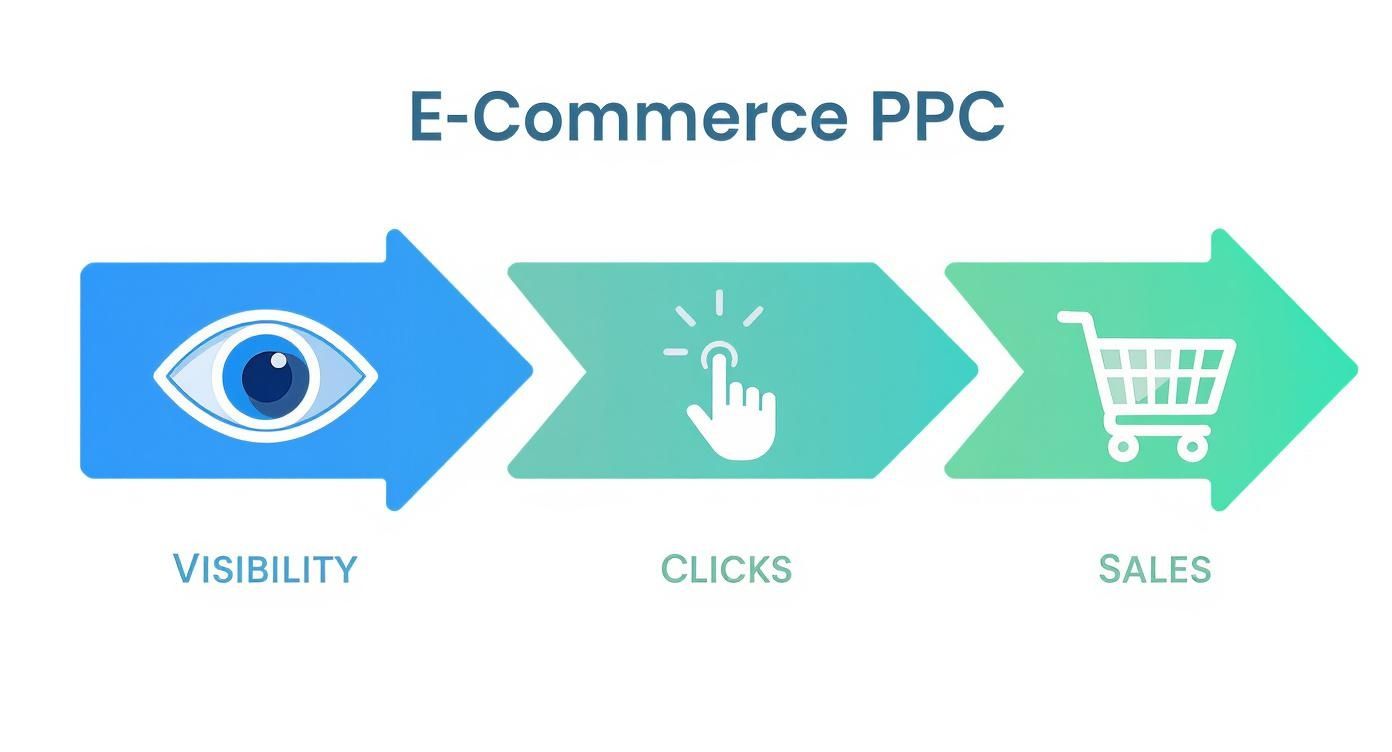
The key takeaway here is that every stage builds on the last. Without good visibility, you get no clicks. Without compelling ads to get those clicks, you get no sales. Simple as that.
Compelling Ad Copy and Creative (Ecommerce PPC Services)
Once you know which keywords you’re going after, the next job is to write an ad that makes people want to click. Your ad is your digital shop window – it has to be enticing. Winning ad copy is always clear, concise, and persuasive.
It must:
- Highlight a Unique Selling Proposition (USP): What makes your product a no-brainer? Free UK delivery? An award-winning design?
- Include a Strong Call-to-Action (CTA): Tell people exactly what to do next. “Shop Now,” “Buy Today,” or “Explore the Collection.”
- Match the User’s Intent: The ad’s message has to perfectly match what the user searched for. It needs to feel like a direct answer to their query.
On visual platforms like Google Shopping, the product image and the price are the real heroes. High-quality, professional photos are completely non-negotiable here.
A great ad does more than just announce a product; it solves the searcher’s immediate problem. It speaks directly to their need, offers a clear solution, and makes the decision to click an easy one.
The Crucial Role of Landing Pages
Getting the click is only half the battle. If that click takes someone to a confusing, slow, or badly designed product page, they’ll hit the back button without a second thought. This is where landing page optimisation comes in. A winning campaign makes sure the page a user lands on is a perfect continuation of the ad’s promise.
The landing page must load quickly, work flawlessly on mobile, and give the customer all the info they need – pricing, great images, clear descriptions – to make a decision. The path from the ad click to the checkout needs to be as smooth as possible.
Logical Campaign Structure and Product Feeds (Ecommerce PPC Services)
Finally, the behind-the-scenes organisation is what holds it all together. A logical campaign structure gives you better control over your budget, makes testing easier, and helps you see what’s really working. We often segment campaigns by product category, brand, or even by profit margin to make sure every penny of ad spend is working as hard as it can.
For retailers, the product feed is the absolute lifeblood of the campaign, especially for Shopping ads. This is a file containing all your product data – titles, prices, images, stock levels, you name it. A clean, well-optimised product feed is essential. An expert will constantly be tweaking this feed, optimising product titles with the right keywords and ensuring all the information is spot-on. You can get a better feel for how this works by checking out our insights on Google Shopping ads.
When all these components work together in harmony, you have the anatomy of a campaign that’s built not just for clicks, but for conversions and long-term growth.
Ecommerce PPC Services: Using Advanced Tech to Outsmart Competitors
Once you’ve nailed the basics, you’ll find that the best e commerce ppc services today act more like data science teams than old-school advertisers. It’s not just about picking keywords and writing ads anymore. To really pull ahead of the pack, you need to use advanced technology to be smarter, more predictive, and way more efficient than your competitors.
This is where the real magic happens. By embracing sophisticated tools and strategies, you can transform your campaigns from a list of manual chores into an automated, self-improving system that drives better results and a much healthier return on your investment.
Harnessing AI and Machine Learning for Bidding
Right at the cutting edge of modern PPC is the sheer power of Artificial Intelligence (AI) and machine learning. These systems are completely changing how bids are managed, leaving simple manual tweaks in the dust in favour of fully automated, real-time decisions. Think of it as having a super-fast analyst watching every single auction, 24/7, without ever needing a coffee break.
This tech crunches thousands of signals in a split second—time of day, user location, device, past browsing history—to predict how likely a click is to turn into a sale. It then automatically adjusts your bids, pushing harder for high-value shoppers and holding back on the less promising ones. You can get into the nitty-gritty of this tech in our detailed guide on Google Ads Smart Bidding.
The goal is simple: capture the most profitable clicks at the lowest possible cost. AI-powered bidding ensures your budget is spent with maximum efficiency, focusing every penny on the auctions that are most likely to convert into revenue.
This intelligent approach is quickly becoming the new normal. By 2025, for example, UK businesses will increasingly rely on AI-powered tools that use predictive analytics and real-time bid adjustments to maximise their return on ad spend (ROAS). These systems can even forecast how well a product will perform by analysing sales data and market trends, which is a massive advantage in fast-moving sectors like fashion and electronics.
Advanced Remarketing and Audience Segmentation (Ecommerce PPC Services)
You’ve almost certainly experienced advanced remarketing firsthand. You check out a pair of trainers on a website, leave without buying, and suddenly, ads for those exact trainers seem to follow you everywhere. That’s not a coincidence; it’s a seriously powerful strategy called dynamic remarketing.
This technique goes way beyond showing generic brand ads. It serves up dynamic ads to past visitors featuring the specific products they looked at, added to their basket, or just browsed. It’s an incredibly effective reminder that often gives people the final nudge they need to complete their purchase.
But we can get even cleverer with our targeting through sophisticated segmentation. This means creating custom audiences based on what people do on your site. For example:
- High-Value Customers: A segment of users who have spent over a certain amount, who you can then target with exclusive offers.
- Cart Abandoners: A specific audience of people who added items to their cart but didn’t check out. You can hit them with a gentle reminder or maybe a small discount to seal the deal.
- Recent Purchasers: An audience you might exclude from certain product campaigns to avoid wasting ad spend on people who just bought from you.
Finding New Customers with Lookalike Audiences
One of the most potent tools in the modern PPC arsenal is the ability to create lookalike audiences. This is where platforms like Google and Meta tap into their vast data to find new people who share key characteristics with your existing best customers.
You simply provide a source audience—like your email list of top spenders or a list of recent converters—and the platform’s algorithm gets to work. It analyses the demographics, interests, and online habits of your source list and then builds a brand new, much larger audience of users who “look like” them. This lets you expand your reach and find new, high-potential customers far more effectively than just shooting in the dark with broad targeting.
Ecommerce PPC Services: Measuring What Matters Most – Your ROI
It’s far too easy to get swept up in the excitement of seeing clicks and impressions soar. But while those numbers look great on a report, they don’t actually pay the bills. Clicks are just traffic; what really matters is revenue.
To get a true picture of how your e commerce ppc services are performing, you have to look past these vanity metrics. It’s time to focus on what directly impacts your bottom line. Think of it this way: you need to know not just how many people looked in your shop window, but how many walked in and actually bought something.
Key Metrics That Define Success
To really gauge how your campaigns are doing, you need to track the metrics that count. These Key Performance Indicators (KPIs) give you a clear, honest view of your profitability and how efficiently your campaigns are running.
Here are the three essential metrics every Ecommerce business owner should be obsessed with:
- Return on Ad Spend (ROAS): This is the big one—the ultimate measure of profitability. It tells you exactly how much revenue you’re making for every single pound you spend on ads. A high ROAS means your campaigns are a solid investment.
- Cost Per Acquisition (CPA): This metric reveals the average cost to win a new customer through your PPC ads. The lower your CPA, the more efficiently you’re acquiring customers, which directly pads out your profit margins.
- Conversion Rate: This is the percentage of people who click your ad and go on to make a purchase. A healthy conversion rate shows that your ads and landing pages are working in harmony to convince shoppers to buy.
Tracking these numbers isn’t optional. They are the language of Ecommerce success, allowing you to have meaningful, data-driven chats with your PPC provider about what’s working and what needs to change.
The goal of any Ecommerce PPC campaign isn’t just to spend a budget; it’s to invest it wisely for a measurable return. By focusing on ROAS and CPA, you ensure your advertising is a powerful growth driver, not just another business expense.
Calculating Your Return on Ad Spend
Working out your ROAS is much simpler than it sounds, and it gives you instant clarity on your campaign performance. It’s the most direct way to see if your ads are actually making you money.
The formula is wonderfully straightforward:
ROAS = Total Revenue from Ads / Total Ad Spend
Let’s put that into a real-world scenario. Imagine a UK-based online shop that sells handmade leather goods.
- They spend £1,000 on a Google Shopping campaign in a month.
- That same campaign generates £5,000 in total sales.
- The calculation is simply: £5,000 (Revenue) / £1,000 (Ad Spend) = 5.
This means their ROAS is 5x, or 500%. For every £1 they invested in PPC, they got £5 back. This simple sum turns an abstract ad spend figure into a crystal-clear performance indicator. If you want to dig deeper, our guide on how to calculate marketing ROI has you covered.
The power of PPC in the UK market is well-established. In a crowded space, a solid PPC campaign can boost brand awareness by as much as 80% and often converts 50% better than organic traffic. With 65% of consumers who click on product searches interacting with PPC ads, it’s clear these campaigns are brilliant at capturing people who are ready to buy.
Ultimately, measuring these core KPIs is what separates guessing from knowing. With proper conversion tracking in place, you can see exactly which ads, keywords, and products are driving your growth. This empowers you and your PPC partner to make smart decisions that scale your success.
Ecommerce PPC Services: How to Choose the Right PPC Partner
Picking an agency to handle your ad budget is a massive decision for any online business. Let’s be honest, the right partner can be a powerful engine for growth. The wrong one? They can burn through your cash with very little to show for it. You need to look past the slick sales pitches and get down to brass tacks: their experience, their process, and how they actually measure success.
Think of it like hiring a tradesperson for a specialist job at home. You wouldn’t get a general builder to rewire your entire house; you’d call in a certified electrician. It’s the same principle here. For your online store, you need a partner who lives and breathes the unique challenges of Ecommerce, not a jack-of-all-trades who runs ads for any business that comes along.
Key Questions to Ask Potential Agencies
Before you even think about signing a contract, you need to ask the right questions. This isn’t about trying to catch them out. It’s about making sure their approach is a perfect match for your business goals. Any confident, experienced agency will welcome this level of detail and give you clear, straight answers.
Here’s a practical checklist to guide your conversations:
- Do you specialise in Ecommerce? Ask them for case studies or examples of UK Ecommerce clients they’ve worked with, ideally in a sector similar to yours.
- How do you structure your campaigns? A solid answer will involve talking about segmenting campaigns by product category, brand, or even profit margin, instead of just lumping everything into one big bucket.
- What’s your approach to product feed management? This is absolutely critical for Google Shopping. They should be talking about optimising titles, attributes, and making sure the feed is in good health.
- What KPIs do you prioritise for Ecommerce clients? You want to hear answers that are all about the money—metrics like Return on Ad Spend (ROAS) and Cost Per Acquisition (CPA). Clicks and impressions are just vanity metrics.
- What does your reporting look like? Ask to see a sample report. It needs to be transparent and offer genuine insights you can act on, not just a confusing data dump.
Understanding Common Pricing Models
Agencies that offer e commerce ppc services usually work with a few common pricing structures. Getting your head around these will help you compare different agencies and find a model that fits your budget and where your business is at.
- Percentage of Ad Spend: This is the most common model you’ll see, typically ranging from 10-20% of what you spend on ads. It encourages the agency to scale up your campaigns, but it can get pricey as your budget balloons.
- Flat Monthly Retainer: Simple and straightforward. You pay a fixed fee each month, which makes your costs predictable and works well if your ad spend is fairly stable.
- Hybrid Model: This is often a mix of a smaller flat retainer plus a performance-based bonus, like a percentage of revenue growth or a reward for hitting specific ROAS targets.
A massive red flag to watch for is any agency that “guarantees” number one rankings or instant results. Reputable partners know that PPC success is a marathon, not a sprint. It’s all about testing, learning, and optimising over time; there are no magic wands.
Another warning sign is a lack of transparency. If an agency is cagey about who owns the ad account or won’t give you clear reports, it’s time to walk away. The right partner will feel like an extension of your own team, keeping communication lines open and building a relationship based on trust and shared success.
Got Questions About Ecommerce PPC? We’ve Got Answers
Stepping into the world of paid advertising can feel like a huge leap, especially when your hard-earned money is on the line. It’s completely normal to have questions. You want to feel confident you’re making the right move for your brand. Let’s tackle some of the most common queries we hear from UK business owners about professional e commerce ppc services, with straightforward answers to give you some clarity.
A big one we often hear is whether business owners can just manage PPC campaigns themselves. And while you certainly can, it’s a bit like deciding to do your own business accounting. You might get the basics down, but a professional brings a level of expertise, efficiency, and strategic insight that can save you a serious amount of time and money in the long run.
How Much Should I Budget for PPC?
This is the million-dollar question, isn’t it? But the answer is a lot more flexible than you might think. A realistic starting budget really hinges on how competitive your industry is and what you’re hoping to achieve right out of the gate. It’s not about throwing a massive pile of cash at it from day one, but investing enough to gather meaningful data.
For many small to medium-sized UK businesses, a good starting point for ad spend is often somewhere between £500 to £2,000 per month. This gives an agency enough breathing room to properly test different keywords, audiences, and ad creative.
Think of your initial budget as an investment in data. Those first couple of months are all about learning what works, finding the profitable pockets, and setting a baseline for your return on ad spend. Once you have that data, you can start scaling up with real confidence.
When Will I See Results?
While PPC is much quicker to deliver results than long-term strategies like SEO, it’s not an overnight magic wand. You’ll see initial data like clicks and impressions almost immediately, which is great. But tangible, profitable results take a little more time to cultivate.
Here’s a rough idea of what to expect:
- Month 1: This is the data-gathering and initial optimisation phase. The focus is on learning what your audience responds to and quickly cutting any spend that isn’t working.
- Months 2-3: Now we’re into performance improvement. Your campaigns should be gaining traction, and you’ll have a much clearer picture of your Cost Per Acquisition (CPA) and Return on Ad Spend (ROAS).
- Months 3-6: Time for scaling and growth. With a solid foundation built, the focus shifts to pumping up the successful campaigns and looking for new opportunities to expand.
Of course, this timeline can vary, but being patient in those early stages is absolutely crucial for building sustainable, long-term growth and profitability from your campaigns.
Ready to stop guessing and start growing? The experts at PPC Geeks create data-driven PPC strategies that deliver real, measurable results for UK Ecommerce brands. Get your free, in-depth audit today and discover how we can maximise your ROI. Find out more at https://ppcgeeks.co.uk/.