




Your Complete Guide to Ecommerce PPC Services: Ecommerce PPC services are specialised advertising campaigns built from the ground up to get your online store seen, drive the right kind of traffic, and—most importantly—turn those clicks into actual sales. For any business trying to make a name for itself in a packed online marketplace, these services are a direct line to getting noticed and growing revenue.
Guide to Ecommerce PPC Services: Why Your Online Store Needs a PPC Specialist
Running an online shop means you’re already a master juggler. You’ve got inventory, customer service, logistics… the list is endless. It’s tempting to think that a general marketing strategy can handle the advertising side of things, but that’s a fast track to wasted ad spend and missed sales. Ecommerce is its own unique beast, and advertising for it demands a specialist’s touch.
Think about it like this: you wouldn’t ask your GP to perform open-heart surgery. Both are doctors, sure, but their expertise is worlds apart. Ecommerce PPC is the high-stakes surgery for your business’s revenue, and you need an expert who knows the intricate anatomy of online retail inside and out.
The High Cost of a Generalist Approach
A one-size-fits-all strategy just doesn’t cut it for online stores. The challenges are completely different and require deep, specific knowledge. In fact, the UK ecommerce sector is bleeding money, losing an estimated £2.4 billion every year simply due to poorly managed PPC campaigns. This staggering figure often comes from agencies applying the same old tactics they use for service-based businesses to product-focused campaigns—a critical and very expensive mistake.
A generalist is likely to miss the details that make or break a retail campaign, such as:
- Product Feed Complexity: Juggling thousands of SKUs, each with its own titles, images, and attributes, is the bread and butter of ecommerce PPC.
- Hyper-Competitive Auctions: When you’re bidding on product-specific keywords, you’re not just competing; you’re fighting for shelf space in crowded digital aisles against retail giants.
- Margin-Aware Bidding: Every single bid has to be weighed against the product’s profit margin to make sure you’re actually making money. A specialist gets this instinctively.
Turning Wasted Spend into Profitable Growth
An ecommerce PPC specialist takes your advertising from being just another expense and turns it into a powerful growth engine. They have the specific, nuanced skills needed to navigate the tricky waters of platforms like Google Shopping and Performance Max, ensuring every pound spent is a direct investment in your bottom line. This is what separates a campaign that just ticks over from one that achieves scalable, profitable growth.
A true ecommerce PPC specialist doesn’t just drive traffic; they drive the right traffic. Their goal isn’t just clicks—it’s profitable sales, repeat customers, and a measurable return on ad spend that fuels your business’s long-term success.
Deciding between keeping it in-house or hiring a dedicated agency can feel like a tough call. But a specialist agency brings a wealth of experience from managing countless retail accounts, offering insights an internal team might take years to build on their own. For ambitious ecommerce brands, understanding the benefits of hiring a specialist PPC agency often makes the choice clear. Ultimately, partnering with an expert isn’t just a marketing move; it’s a foundational strategy for survival and dominance in today’s competitive market.
Guide to Ecommerce PPC Services: Mastering the Key Ecommerce Advertising Channels
A winning ecommerce PPC strategy isn’t about casting the widest net possible; it’s about precision fishing in the right ponds, at the right time. A specialist agency knows that each advertising channel is a unique tool with a specific job. Real success comes from knowing which tool to use and how to combine them into a seamless customer journey that moves shoppers from initial curiosity to a confident purchase.
Think of your multi-channel strategy like a well-organised toolkit. You wouldn’t use a sledgehammer to hang a picture frame, would you? In the same way, you wouldn’t use a brand-awareness campaign on Instagram to capture someone actively searching to buy a new laptop on Google. Expert ecommerce PPC services are all about matching the channel to the customer’s intent.
The diagram below maps out the typical journey for an online store, showing how specialist PPC services step in to solve the common hurdles retailers face.
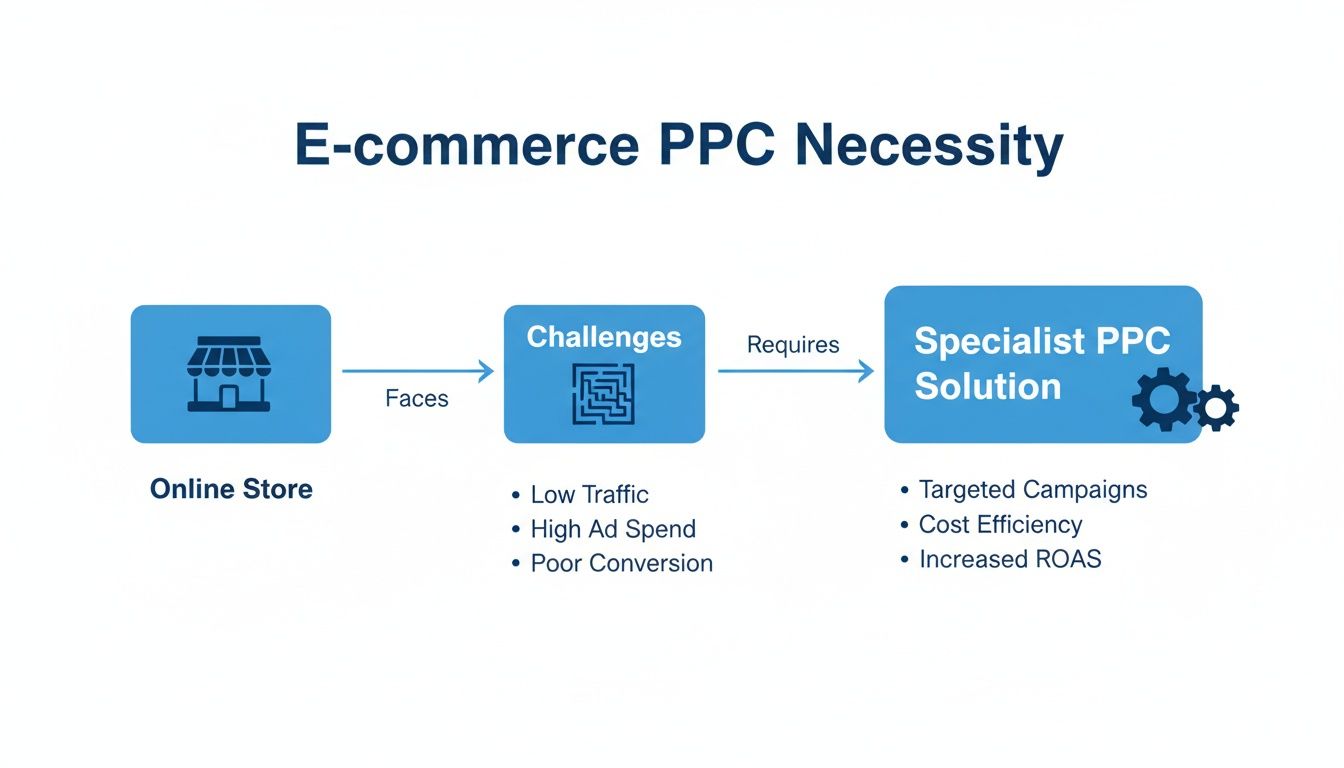
This visual journey makes it clear: moving from simply having an online shop to achieving scalable success means navigating some tricky challenges—challenges that demand a specialised solution.
To help you get a clearer picture of where each platform shines, here’s a quick comparison of the main channels for UK ecommerce businesses.
PPC Channel Comparison for UK Ecommerce Businesses
This table breaks down the most common PPC platforms, showing what they’re best used for, the mindset of their audience, and the types of products that really thrive on each one.
| Channel | Primary Use Case | Audience Intent | Ideal For |
|---|---|---|---|
| Google Ads | Capturing active demand | High (“I want to buy now”) | Most physical products, especially those with clear search demand like electronics, apparel, and home goods. |
| Amazon PPC | In-market visibility & sales | Very High (“I am on Amazon to buy”) | Products sold on the Amazon marketplace, from everyday items to niche goods. Essential for competing. |
| Meta Ads (Facebook/Instagram) | Creating new demand | Low-to-Mid (Discovery & Browsing) | Visually appealing products that spark impulse buys: fashion, beauty, home decor, unique gifts, and new gadgets. |
| Bing Ads | Reaching a different demographic | High (Similar to Google) | Products appealing to a slightly older, often more affluent demographic. Great for B2B or high-ticket items. |
Each channel plays a distinct role. While Google and Amazon are fantastic for grabbing customers who are ready to buy, Meta is your go-to for making people want what you sell, even if they didn’t know it a minute ago.
Google Ads: The High-Intent Marketplace (Guide to Ecommerce PPC Services)
Google is where people go when they have a problem to solve or a product they want to buy right now. This makes it the absolute cornerstone of most ecommerce PPC campaigns. The intent is sky-high, and the opportunity for immediate sales is huge.
Within the Google Ads ecosystem, a few key players do the heavy lifting for online retailers:
- Google Shopping Ads: These are the visual, product-focused listings you see right at the top of the search results. Think of them as your digital shopfront window, showcasing your products to customers who’ve already got their wallets out. They’re a must for any ecommerce business, and you can dive deeper into mastering Google Shopping Ads in our guide.
- Google Search Ads: These are the classic text-based ads that show up when users search for specific products, brands, or solutions. They’re perfect for targeting those very specific, long-tail keywords and answering direct customer queries, driving highly qualified traffic straight to your product pages.
- Performance Max (PMax): This is Google’s all-in-one, goal-based campaign type. It uses machine learning to find converting customers across all of Google’s channels—including YouTube, Display, Search, and Shopping—all from a single campaign. It’s designed to optimise relentlessly for your specific business goals.
A well-structured Google Ads strategy is simply non-negotiable. It’s the engine that captures active demand, putting your products directly in the path of shoppers who have already decided they want to buy something.
Amazon PPC: Dominating the World’s Largest Store
If you sell on Amazon, running PPC campaigns isn’t really an option—it’s essential for survival and growth. Amazon is a hyper-competitive battleground where paid placements often dictate who gets seen and who gets buried.
Unlike Google, where you’re driving traffic to your own website, Amazon PPC is all about winning the “buy box” and standing out on crowded search result pages within the platform itself. An agency that knows ecommerce will manage your Sponsored Products, Sponsored Brands, and Sponsored Display ads to make sure your products get in front of millions of ready-to-buy shoppers.
Meta Ads: Creating Demand on Social Platforms (Guide to Ecommerce PPC Services)
While Google is brilliant at capturing existing demand, platforms like Facebook and Instagram are where you create it. Meta Ads are the digital equivalent of a glossy magazine ad—they inspire desire and build a connection with your brand.
This is where you can reach potential customers who aren’t actively looking for your product but are very likely to be interested based on their demographics, hobbies, and online behaviour.
These platforms are incredibly powerful for:
- Discovery: Introducing your brand and products to new, highly-targeted audiences who’ve never heard of you.
- Remarketing: Gently reminding users who visited your site but didn’t buy about the lovely things they left behind.
- Building Community: Fostering brand loyalty through engaging visual content and creating a tribe of followers.
This channel has become even more vital with the explosion of mobile commerce. Smartphones have completely reshaped UK ecommerce, and they now dominate online shopping. By 2025, it’s estimated that 76% of all retail site visits in the UK will come from smartphones, and an incredible 72% of online orders will be completed on mobile. This shift means your social campaigns on platforms like Instagram must be perfectly tuned for the smaller screen.
Guide to Ecommerce PPC Services: What to Expect from Your PPC Agency Partner
When you’re sinking money into ecommerce PPC, vague promises of ‘more traffic’ just don’t cut it. A real partnership with an agency is built on tangible, concrete deliverables—the actual work that drives your bottom line. Knowing what to expect means you can hold your agency accountable and see exactly where your investment is going.
Think of it like hiring a builder. You wouldn’t just ask for ‘a house’ and hope for the best. You’d expect detailed blueprints, a schedule, and clear updates on everything from the foundations to the final lick of paint. Your PPC agency should operate with the same professional clarity, laying out a clear roadmap of actions and expected outcomes.
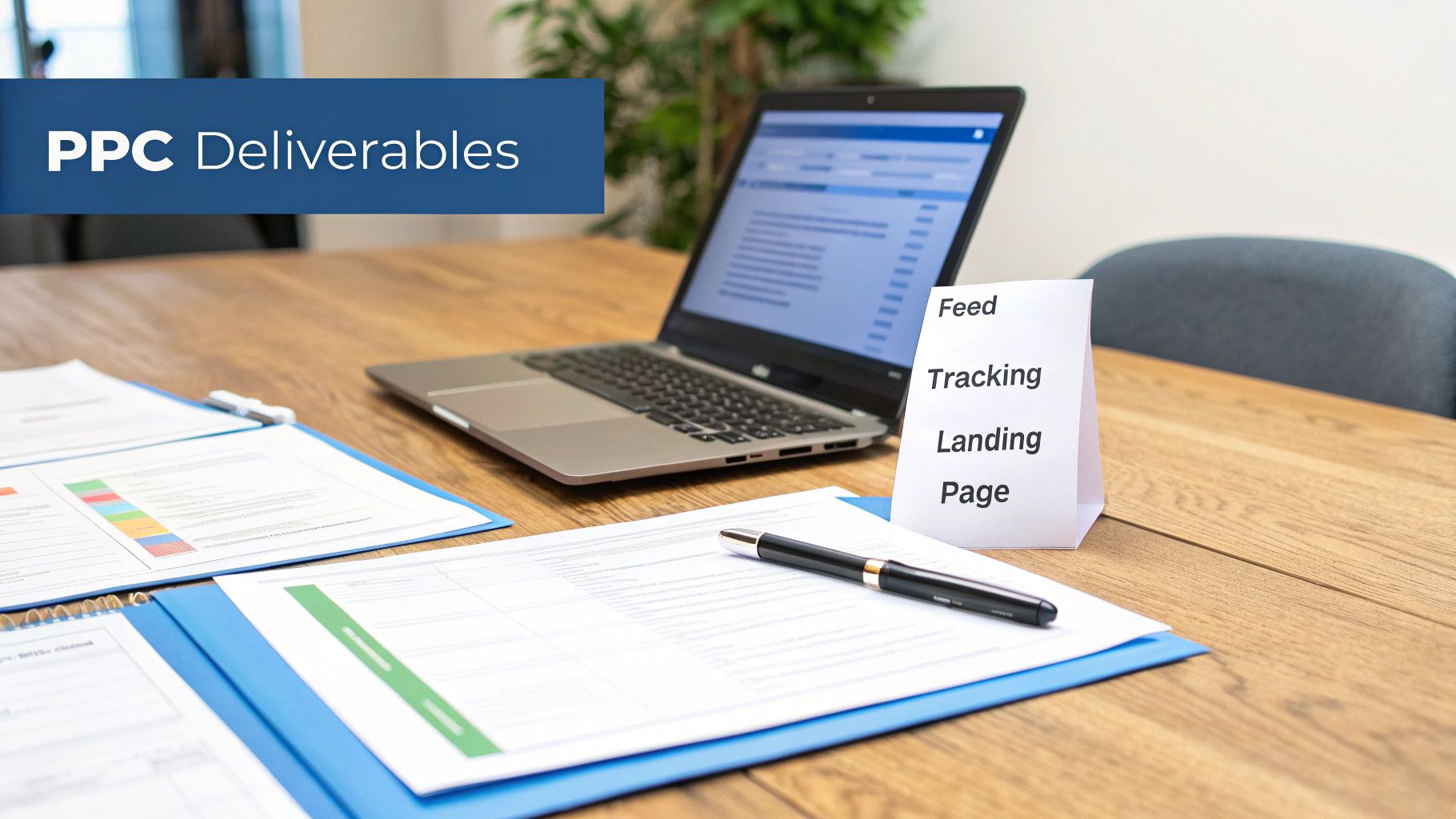
A top-tier agency doesn’t just tweak bids. They become a genuine extension of your marketing team, getting stuck into the mechanics of what makes your online store tick. This means focusing on several critical areas that go way beyond just launching a few campaigns.
Meticulous Product Feed Optimisation
Your product feed is the absolute foundation of any decent Google Shopping or Performance Max campaign. It’s the digital DNA of your entire product catalogue, feeding Google all the info it needs to match your items with keen buyers. A lazy or unoptimised feed is like having a shop with messy, unlabelled shelves—customers will just walk right past.
A specialist agency will treat your feed with the obsessive care it deserves. This isn’t a one-and-done setup; it’s a constant process of tweaking and refining.
- Title Enhancement: They’ll rewrite your product titles to cram in high-intent keywords, brand names, and crucial details (e.g., “Nike Air Max 90 Men’s Trainers Size 10 White“) to snag those super-specific, valuable searches.
- Image Quality Control: They’ll check that your product images are high-res, look professional, and meet all the platform rules. After all, the picture is often the first thing a shopper clocks.
- Attribute Enrichment: They will meticulously fill out every relevant attribute like colour, material, size, and GTINs. The richer the data, the better Google’s algorithm understands your products, leading to much more relevant ad placements.
Getting this level of detail right is the digital equivalent of creating a stunning window display for your best products. It directly boosts visibility, clicks, and, most importantly, sales.
Robust Conversion Tracking and Analytics (Guide to Ecommerce PPC Services)
If you can’t measure it, you can’t improve it. Simple as that. A core deliverable from any credible ecommerce PPC service is setting up rock-solid, accurate conversion tracking. Without it, you’re flying blind, throwing money at campaigns without knowing which ones are making you a profit and which are just burning cash.
A professional agency will insist on flawless tracking before a single penny of your ad spend is touched. They need to be able to track not just sales, but the actual revenue and profit generated, giving you a true picture of your return on ad spend (ROAS).
This is a technical job that involves a few key steps:
- Google Analytics 4 (GA4) Ecommerce Tracking: Setting up GA4 to properly record purchases, revenue, add-to-cart actions, and other vital user interactions on your website.
- Platform-Specific Pixels: Installing tracking tags for Google Ads, Meta Ads, and other channels. This is essential for tracking conversions and building powerful remarketing audiences to bring people back.
- Value-Based Bidding Setup: Configuring campaigns to understand the value of each conversion, not just the raw number. This tells the ad platforms to go after higher-revenue customers, not just more sales.
Strategic Landing Page Analysis and CRO
Driving traffic is only half the battle. If that hard-won traffic lands on a confusing, slow, or untrustworthy product page, the sale is dead in the water. While a PPC agency won’t typically redesign your whole website, a great partner will provide data-driven recommendations to improve your conversion rates.
They effectively become your conversion rate optimisation (CRO) consultant, digging into user behaviour to find the friction points stopping people from buying. They might suggest improvements to page load speed, mobile usability, call-to-action buttons, or your product descriptions. It’s a collaborative approach that ensures the high-quality traffic they send has the best possible chance of actually converting.
To dig deeper into this, you can explore our guide on what to expect from a top PPC agency in the UK.
Guide to Ecommerce PPC Services: Getting to Grips with Pricing and Measuring What Really Matters
Investing in ecommerce PPC services is a big step, so let’s talk about the money side of things. How much does it all cost, and more importantly, how do you know if it’s actually making you money? Nailing down the costs and returns is what separates a frustrating expense from a profitable partnership.
Agency pricing isn’t a simple one-size-fits-all deal. Most payment structures are designed to tie the agency’s success to yours, but each comes with its own quirks. Figuring them out now will help you pick the right model for your budget, where your business is at, and where you want it to go.
Common Agency Pricing Structures
When you start shopping around for a PPC partner, you’ll run into a few common ways they charge for their work. Each model strikes a different balance between risk, reward, and how predictable your monthly bill will be.
- Percentage of Ad Spend: This is probably the most common model you’ll see. The agency takes a cut of your monthly ad budget, usually somewhere between 10-20%. It’s straightforward and scales up or down with your investment. The only catch is that it can sometimes encourage agencies to simply spend more, rather than spending smarter.
- Flat Monthly Retainer: With this one, you pay a fixed fee every month, no matter what your ad spend is. This is brilliant for budgeting because your costs are completely predictable. It’s often a great fit for businesses that have stable, long-running campaigns.
- Hybrid Model (Retainer + % of Spend): This approach mixes the stability of a flat fee with a little performance-based incentive. An agency might charge a base retainer and then add a smaller percentage of your ad spend on top. It’s a balanced way to cover their time while also rewarding them for growth.
If you want to dive deeper into what goes into these costs, our guide on Google Ads agency pricing breaks down the UK market in much more detail.
Look Past the Vanity Metrics: How to Measure Real Success (Guide to Ecommerce PPC Services)
Knowing what you’re paying is one thing, but knowing what you’re getting back is the real game-changer. Success in ecommerce PPC isn’t about how many people saw your ad (impressions) or even how many clicked it. It’s all about profitable growth. To track that, you need to be laser-focused on the key performance indicators (KPIs) that directly fatten up your bottom line.
Forget the surface-level fluff and get down to what actually matters:
- Return on Ad Spend (ROAS): This is the Holy Grail. It tells you exactly how much money you’re making for every single pound you put into advertising.
- Customer Acquisition Cost (CAC): This metric tells you the total cost of winning over a new customer. Keeping an eye on CAC is vital for making sure your growth is sustainable and not just expensive.
- Lifetime Value (LTV): This KPI is about the long game. It estimates the total revenue you’ll make from a customer over their entire time with your brand. A healthy LTV means you can afford a higher CAC and still be wildly profitable.
Your goal isn’t just to make sales. It’s to make profitable sales from customers who are going to come back for more. Focusing on ROAS, CAC, and LTV ensures your PPC efforts are building a solid, sustainable business, not just creating a temporary blip in traffic.
How to Calculate and Actually Understand ROAS
Figuring out your ROAS is much simpler than it sounds, and it gives you an instant health check on your campaigns. It should be the first number you can reel off when someone asks how your ads are doing.
The formula is dead simple:
ROAS = (Total Revenue from Ads / Total Ad Spend) x 100
Let’s make it real. Imagine your online shoe shop spent £2,000 on Google Shopping ads last month. You hop into your analytics and see that those campaigns brought in £10,000 in sales.
Here’s the calculation:
(£10,000 / £2,000) x 100 = 500%
This means for every £1 you put in, you got £5 back in revenue. This one simple number gives you a powerful, data-backed way to talk performance with your agency and make smart decisions about where your budget will have the biggest impact.
Guide to Ecommerce PPC Services: How to Choose the Right Ecommerce PPC Agency
Picking an agency to handle your ecommerce PPC is a big deal. You’re not just hiring another supplier; you’re trusting a partner with your ad budget and, let’s be honest, your growth. To cut through all the sales noise and find a genuine specialist who feels like part of your team, you need a plan.
This isn’t about finding someone who promises you the moon. It’s about finding an expert crew with a solid track record, a transparent way of working, and the specific skills to win in the dog-eat-dog world of online retail. A great agency will feel like your own in-house PPC department, but with a much broader field of experience.
Ask for Relevant Case Studies and Verifiable Results
Any agency that knows its stuff will have a stack of success stories. But the keyword here is relevance. Don’t get distracted by flashy numbers from a totally different industry. You need to see proof that they get your market.
When you’re chatting with potential partners, get straight to the point:
- “Can you show me case studies from ecommerce businesses similar to mine in size and product category?” This proves they’ve walked this path before and understand your unique challenges.
- “What was the starting point for this client, and what specific strategies did you use to get these results?” This is a great way to see if they can explain a clear, logical strategy beyond just saying “we optimised their ads.”
- “Are these results verifiable? Can we have a quick chat with one of your current ecommerce clients?” A confident agency with happy clients won’t hesitate to set up a reference call.
A strong portfolio of relevant, proven results is your first green flag. It’s the difference between hiring a surgeon who’s done the operation a hundred times and one who’s just read the textbook.
Scrutinise Their Process and Transparency (Guide to Ecommerce PPC Services)
The best ecommerce PPC services are built on a foundation of straight talk and total transparency. If an agency starts hiding behind jargon or gives you vague, fluffy reports, that’s a massive red flag. You need to know exactly what they’re doing with your money and why.
A great PPC partnership is built on clarity. You should always know what’s being tested, what’s working, what isn’t, and what the plan is for the next month. If an agency makes you feel like you’re in the dark, it’s time to find the light switch.
This is especially true in the UK market, which is absolutely booming. Projections show there will be 62.1 million online shoppers by 2025, with online spending making up a huge 30.7% of all retail sales. With UK ecommerce revenue tipped to hit UK£115.49 billion by 2030, you need a transparent partner who can help you grab your piece of the pie. You can dive deeper into these UK ecommerce trends on searchhog.co.uk.
Identify Red Flags and Unrealistic Promises
Knowing what to avoid is just as important as knowing what to look for. Some agencies will promise you the world—instant, guaranteed results—which simply isn’t how PPC works. Be very wary of anyone selling a “secret formula” or promising number-one rankings overnight.
Here’s a quick checklist to help you compare potential agencies and make sure you’re asking the right questions.
Agency Evaluation Checklist (Guide to Ecommerce PPC Services)
| Evaluation Area | Key Question to Ask | Ideal Answer / Green Flag |
|---|---|---|
| Experience & Case Studies | “Can I see results from businesses in my niche and of a similar size?” | They provide 2-3 relevant case studies with clear before-and-after metrics. |
| Strategy & Onboarding | “What do the first 90 days look like? What’s your process?” | A structured plan covering audits, tracking setup, research, and campaign builds. |
| Transparency & Reporting | “How and what will you report on, and how often will we meet?” | Regular, customised reports focusing on business goals (ROAS, CPA) and weekly/bi-weekly calls. |
| Communication | “Who will be my main point of contact, and how available are they?” | A dedicated account manager who is responsive and easy to get hold of. |
| Team Expertise | “Are your team members certified? What’s their background?” | The team holds current Google, Microsoft, and Meta certifications with years of hands-on experience. |
| Commercials | “Is there a long-term contract? What happens if we need to part ways?” | Flexible terms (e.g., rolling 30-day contract after an initial period) and clear ownership of ad accounts. |
Making the right choice really boils down to doing your homework. Keep an eye out for these common warning signs as you go through your evaluation:
- Guaranteed ROAS: Nobody can guarantee a specific return on ad spend. Market conditions, your competition, and even the time of year all have a say. A good agency sets realistic targets based on solid data and experience.
- Lack of a Clear Onboarding Process: A professional outfit will have a structured plan for the first 30-90 days, covering everything from technical audits to strategy development.
- Vague Reporting: Reports full of vanity metrics like clicks and impressions—without tying them back to what actually matters, like sales and profit—are a sign of shallow work.
Use this framework as your playbook. It will help you find a true specialist who can work with you to build a profitable, scalable advertising machine.
Guide to Ecommerce PPC Services: Common Ecommerce PPC Mistakes and How to Avoid Them
Knowing what not to do in ecommerce PPC is often more valuable than knowing what to do. A single oversight can burn through your ad budget in a flash, leaving you with very little to show for it. Dodging these common pitfalls is the first step in protecting your investment and setting your campaigns up for real, profitable growth.

One of the most expensive mistakes is ignoring negative keywords. Imagine you sell premium leather boots. Without telling Google not to show your ads for terms like “cheap,” “repair,” or “used,” you’ll pay for clicks from bargain hunters or people needing services you don’t even offer. It’s like leaving the back door of your stockroom open – your budget just walks out.
A good ecommerce PPC service diligently builds and maintains a negative keyword list to shield your campaigns from these irrelevant searches. This simple filtering act ensures your ads are only shown to people with genuine buying intent and is fundamental to a healthy ROAS.
Using Low-Quality or Incomplete Product Data
Another massive pitfall is treating your product feed as an afterthought. Your feed is the very foundation of your Google Shopping and Performance Max campaigns. Submitting low-quality data is like sending a salesperson into a big meeting with messy, incomplete notes – they’re guaranteed to fail.
Vague product titles, blurry images, or missing details like size and colour will get your products buried by competitors who have their data perfectly organised.
Think of your product data as the digital DNA of your catalogue. The richer and more accurate it is, the better ad platforms can understand what you sell and match you with the perfect customers. Clean data isn’t a recommendation; it’s a prerequisite for success.
A specialist agency will meticulously optimise your feed, making sure every product title is packed with relevant keywords and every attribute is filled out. This attention to detail dramatically improves your visibility and click-through rates, making your products stand out in a seriously crowded marketplace.
Failing to Nurture Interested Shoppers
Finally, a huge misstep is not having a smart remarketing strategy. A staggering 97% of visitors who land on your site for the first time will leave without buying anything. Just letting them walk away is like watching a customer browse in your shop and then leave without ever asking if they need a hand.
But effective remarketing isn’t about stalking people across the internet with annoying ads. It’s about gently reminding them of the products they looked at, maybe sweetening the deal with a small discount or a note about low stock to create a bit of urgency.
A proper strategy can win back those lost sales:
- Segmented Audiences: Don’t treat everyone the same. Target users based on what they did, like abandoning a full shopping basket versus just glancing at a product page.
- Sequential Messaging: Tell a story over time with a series of different ads, rather than just showing the same one over and over again.
- Exclusion Lists: Be smart and stop showing ads to people who have already bought from you. This prevents ad fatigue and stops you from wasting money.
By sidestepping these common errors, you shift from simply spending money on ads to strategically investing in a system built for sustainable ecommerce growth.
Got Questions About Ecommerce PPC? We’ve Got Answers.
Deciding to bring in professional help for your ecommerce PPC is a big step, so it’s only natural to have a few questions rattling around. This is the part where we tackle the common queries we hear from business owners just like you, giving you the straightforward answers you need to feel confident about moving forward.
One of the first things everyone wants to know is how quickly they’ll see a return. While PPC can start sending traffic to your site almost the second it’s switched on, getting to a place of stable, profitable results takes a bit more time. Think of the first month as the foundation-laying phase – it’s all about setup, deep-dive research, and gathering that initial data. You can realistically expect to see consistent, positive returns within two to three months as campaigns are fine-tuned and we learn what really clicks with your customers.
How Much of My Time Will This Take Up?
It’s a common worry – that hiring an agency just means swapping one set of tasks for another. But a great partnership should do the exact opposite and actually free up your time. Your expertise is absolutely vital at the start, during the strategy sessions where you’ll share insights on your products, profit margins, and ideal customers. After that, though, your day-to-day involvement should be minimal.
Your main responsibilities will boil down to:
- Signing off on the overall strategy and budgets.
- Giving feedback on ad creative and messaging.
- Jumping on regular performance calls (usually weekly or bi-weekly) to stay in the loop.
The agency takes care of all the heavy lifting – the daily campaign management, constant optimisation, and detailed reporting. This lets you get back to what you do best: running your business.
How Does PPC Fit in with My SEO and Email Marketing? (Guide to Ecommerce PPC Services)
PPC doesn’t operate in a vacuum. It’s a crucial cog in your overall growth machine and works best when it’s fully integrated with your other marketing channels, especially SEO and email. When they all work together, you create a seamless experience that guides customers from discovery to loyalty.
Here’s a simple way to look at it:
- PPC + SEO: PPC gets you immediate visibility and digs up a goldmine of keyword data that can supercharge your long-term SEO strategy. While you’re patiently building those organic rankings, paid ads make sure you’re right at the top of the search results, capturing ready-to-buy customers you’d otherwise miss.
- PPC + Email: PPC is a fantastic tool for bringing new customers through the door. Once they’ve made that first purchase, your email marketing steps in to build the relationship, drive repeat business, and grow their lifetime value (LTV).
When you get the sync right, PPC is your powerful customer acquisition engine, SEO builds your long-term brand authority, and email marketing turns those one-time buyers into devoted fans. It’s a virtuous cycle of profitable, sustainable growth for your online store.
Understanding how these pieces slot together helps you see how professional ecommerce PPC services can be the catalyst that accelerates your entire business.
Ready to turn your ad spend into serious growth? The experts at PPC Geeks build data-driven campaigns that deliver real-world results. Get your free, in-depth PPC audit today!