




Marketing your IT business effectively comes down to having a sharp, modern digital strategy that’s actually built for the UK market. If you want to succeed, you need to focus on three core things: finding your ideal niche, getting in front of clients on high-intent channels like Google Ads, and consistently proving you can deliver real, tangible value. This guide is all about cutting through the noise and giving you a blueprint you can actually use.
How to Market Your IT Business: Laying the Foundation for Growth

The days of just listing your services and crossing your fingers are well and truly over. To make any sort of impact, your marketing needs to stop selling IT solutions and start positioning your business as an essential strategic partner. This is a subtle but powerful shift. It means you have to understand your client’s world so well that you can see their problems coming before they do.
For any UK-based IT provider, this is what sets you apart. Your marketing shouldn’t just be a megaphone shouting about what you do. It needs to show exactly how you solve specific, pressing problems for businesses right here in the UK. Get this right, and you’ll build the kind of trust and authority that turns you from just another vendor into a vital part of your client’s success story.
To give this some structure, let’s break down the essential components that every successful IT marketing plan needs.
Core Pillars of an Effective IT Marketing Strategy
| Marketing Pillar | Key Objective | Primary Channel Example |
|---|---|---|
| Audience Niche | Identify and deeply understand a specific client segment. | LinkedIn targeting for financial services firms. |
| High-Intent Channels | Be present where prospects are actively looking for solutions. | A focused Google Ads campaign for “IT support for law firms”. |
| Value Demonstration | Prove your expertise and the tangible results you deliver. | Detailed case studies showcasing client ROI. |
| Content Authority | Build trust by sharing valuable, problem-solving content. | Blog posts that answer common industry-specific tech questions. |
| Clear Conversion Path | Make it incredibly easy for leads to take the next step. | A prominent “Request a Consultation” form on your website. |
This table lays out the strategic bedrock. Now, let’s look at how potential clients move through the buying process.
The Modern IT Marketing Funnel (How to Market Your IT Business)
It helps to think about how you’ll guide potential clients on their journey. The marketing funnel for tech companies isn’t a straight line anymore; it’s a dynamic process where people will interact with your brand at multiple different points. Your job is to be there with something valuable at every stage.
- Awareness: This is the first “hello.” It might come from a targeted Google Ad for “cybersecurity solutions for accountants” or a genuinely helpful blog post they stumble upon when searching for “how to migrate to a cloud server.”
- Consideration: They know you exist and are now weighing up your expertise. This is where your case studies, detailed service pages, and client testimonials do the heavy lifting.
- Decision: They’re ready to make a call. A crystal-clear call-to-action, a simple contact process, and a compelling offer are what will get them over the line and turn that lead into a new client.
The heart of a successful campaign isn’t just reaching a big audience; it’s about connecting with the right audience with the right message at precisely the right time. Your entire strategy needs to be built on this principle.
Getting your head around these stages is fundamental. In the rest of this guide, we’ll get into the specific actions you need to take at each step. We’ll cover how to zero in on your ideal clients, pick the digital channels that give you the best return, and build campaigns that deliver results you can actually measure. This isn’t just theory; it’s a practical framework.
For a deeper dive into the mechanics of building a plan, our dedicated article on how to create a successful marketing strategy is a great next step. The following sections will give you the detailed strategies you need to put this blueprint into action and drive real, sustainable growth.
How to Market Your IT Business: Defining and Finding Your Ideal IT Client

Before you even think about spending a single pound on advertising, you’ve got to answer the most important question of all: who are you actually trying to reach?
Throwing out vague targets like “SMEs” or “local businesses” isn’t just a bit lazy—it’s a surefire way to burn through your marketing budget and end up with messaging that speaks to no one. To really make an impact, you need to get specific and truly understand your ideal client.
This is where detailed buyer personas come in. A buyer persona isn’t just a company profile; it’s a semi-fictional deep dive into your ideal customer, built from solid market research and real data on your best existing clients. You’re painting a picture of a real person.
Think about it. The IT challenges facing a finance director at a fast-growing fintech firm in Manchester are completely different from those of an operations manager at a logistics company in Birmingham. The finance director is probably losing sleep over data security and scalable cloud infrastructure. Meanwhile, the ops manager is focused on keeping warehouse systems online and getting new devices sorted efficiently.
Your marketing has to speak directly to their world, not just a generic business owner.
Crafting Detailed Buyer Personas
Building these personas means digging deep. Forget guesswork. You need to use real data and actual conversations to figure out what truly motivates and frustrates your target audience. This is the groundwork that makes every other marketing decision so much easier and more effective.
Start by nailing down these key characteristics:
- Industry Niche: Are you specialists for legal firms, healthcare providers, or manufacturing companies? Every sector has its own unique compliance rules, software needs, and operational quirks.
- Company Size: The IT support a 10-person startup needs is a world away from a 200-employee enterprise. Pinpoint your sweet spot, whether it’s by employee count or annual turnover.
- Job Title of Decision-Maker: Who actually signs the cheques? Is it the Head of IT, the CEO, the Finance Director, or an Office Manager wearing multiple hats?
- Technological Maturity: Are they tech pioneers, or are they still running on systems from the Stone Age? This tells you whether to position your services as a competitive edge or a much-needed reliability upgrade.
A well-defined persona is your North Star. It guides everything from your ad copy to your service offerings, ensuring you’re having a conversation that resonates with the people who will actually value and pay for your expertise.
Once you’ve got these basics down, you can flesh out the details. For a step-by-step guide, check out our post on how to create buyer personas. It’s packed with actionable tips and templates that will help you turn your marketing from a wide-net broadcast into a sharp, targeted conversation.
Uncovering Client Pain Points and Goals (How to Market Your IT Business)
With a clear persona in mind, it’s time to step into their shoes. What keeps them up at night? What are they trying to achieve professionally? Knowing the answers is the key to successfully marketing your IT business.
Ask yourself these kinds of questions:
- What daily frustrations are their current IT causing? (Think slow systems, constant downtime, or non-existent support).
- Which business goals are being blocked by their technology? (Maybe they can’t scale, their workflows are a mess, or they’re worried about security breaches).
- What does a ‘win’ look like for them? (Is it getting the whole team working seamlessly from home, achieving ISO 27001 certification, or cutting operational costs?).
Finding Your Audience in the Wild
Knowing who your clients are is one thing. Knowing where to find them online is the other half of the puzzle. This is where tools like LinkedIn Sales Navigator become incredibly useful. You can filter prospects by industry, company size, location, and job title to build incredibly specific lists.
Don’t forget to have a look at your competitors, either. Who are they working with? Check out their case studies and testimonials. This gives you a real-world map of businesses that are already investing in IT services like yours. The goal isn’t to steal their clients, but to understand the market and spot any gaps or underserved niches they might be missing.
How to Market Your IT Business: Choosing Your Digital Marketing Channels Wisely
Once you’ve figured out who you’re talking to, the next puzzle is where to actually have the conversation. Not all digital marketing channels are created equal, and this is especially true when you’re marketing an IT business to other businesses. The goal isn’t to be everywhere; it’s to show up in the right places, with the right budget, at precisely the right time.
Think of your marketing channels like a toolkit. You wouldn’t use a sledgehammer to fix a microchip. In the same way, the platform you use for building general brand awareness is completely different from the one you need for grabbing high-intent leads who are ready to buy right now. A balanced strategy is absolutely vital for sustainable growth.
The Power Trio of IT Marketing Channels
For most IT service providers, a winning strategy boils down to a powerful combination of three core channels. Each one plays a unique but complementary role in pulling in your ideal clients and moving them from just being aware of you to signing on the dotted line. Let’s break them down.
- Search Engine Optimisation (SEO): This is your long-term, organic growth engine. By creating genuinely valuable content and optimising your website, you attract businesses that are actively searching for solutions. Imagine a potential client googling “how to improve data security for a small law firm.” A well-optimised blog post that answers that exact question positions you as an expert and builds trust over time.
- Content Marketing: This is the fuel for your SEO fire and the bedrock of your authority. Content isn’t just about blogs. It includes detailed case studies, white papers, webinars, and in-depth guides that prove you know your stuff. It’s how you demonstrate you understand your client’s industry and nurture leads who aren’t quite ready to commit.
- Paid Search (PPC): This is your direct line to immediate, high-intent leads. When a finance director in London urgently searches “managed IT support for financial services,” you want your business to be the very first result they see. Channels like Google Ads and Microsoft Ads are non-negotiable for capturing this bottom-of-the-funnel demand. It’s hands down the fastest way to generate qualified leads.
The most effective marketing strategies don’t just pick one channel; they create a system where each one supports the others. Your insightful blog post (Content) gets found on Google (SEO), and you use paid ads (PPC) to retarget visitors who read it, reminding them of your expertise.
Why Paid Search Is a Non-Negotiable Starting Point (How to Market Your IT Business)
While SEO and content are brilliant for building a long-term foundation, paid advertising delivers something they simply can’t: speed and laser-focused precision. In a cut-throat market, you need a reliable way to get in front of decision-makers who have a problem and are looking for a solution today.
This is where the numbers really tell the story. In the UK, digital marketing spending has rocketed to £35.54 billion, making up a massive 44.5% of all advertising expenditure. For small and medium-sized businesses drowning in competition, ignoring PPC means missing out on a channel where 67% of B2B marketers swear by it for lead generation. This huge shift shows why IT businesses are perfectly placed to cash in on this digital goldmine. You can find more details about these digital marketing facts in the UK and see how to get ahead.
Expanding Your Reach with B2B Social Networking
Beyond the search engines, there’s one professional networking platform that stands head and shoulders above the rest for B2B marketing: LinkedIn. It’s the digital equivalent of the boardroom; it’s where your ideal clients—the CEOs, IT managers, and operations directors—are spending their time.
But using LinkedIn effectively isn’t about spamming connection requests. It’s all about strategic engagement.
- Share Your Content: Post your insightful articles and case studies to your company page and personal profiles to really show off your expertise.
- Targeted Advertising: Use LinkedIn Ads to run campaigns aimed at specific job titles, industries, and company sizes. This is perfect for promoting a webinar or a new service offering.
- Build Relationships: Get involved in relevant industry groups and comment thoughtfully on posts from potential clients. It’s about building a reputation as a helpful expert, not just another vendor.
By combining the immediate impact of PPC with the long-term authority-building of SEO and content, and layering on the networking power of LinkedIn, you create a robust, multi-channel strategy. This approach ensures you’re capturing demand today while building a solid pipeline for tomorrow.
How to Market Your IT Business: Building High-Impact Paid Advertising Campaigns
Organic growth is a fantastic long-term play, but let’s be honest—sometimes you need qualified leads right now. When speed is the name of the game, paid advertising is your most direct and powerful tool. A smartly run paid campaign lets you jump the queue, putting your IT business directly in front of decision-makers the moment they start searching for a solution. It’s all about precision and immediate impact.
We’re going to focus on Pay-Per-Click (PPC) here, specifically on platforms like Google Ads. Why? Because it’s all about intent. You’re not interrupting someone’s cat video; you’re providing the exact answer they’re actively looking for. For an IT business, this is gold. You connect with prospects who have already identified their problem and are ready to open their wallets to solve it.
This process flow shows how paid advertising (PPC) fits into a wider strategy, working alongside SEO and content to capture leads at different stages of their journey.
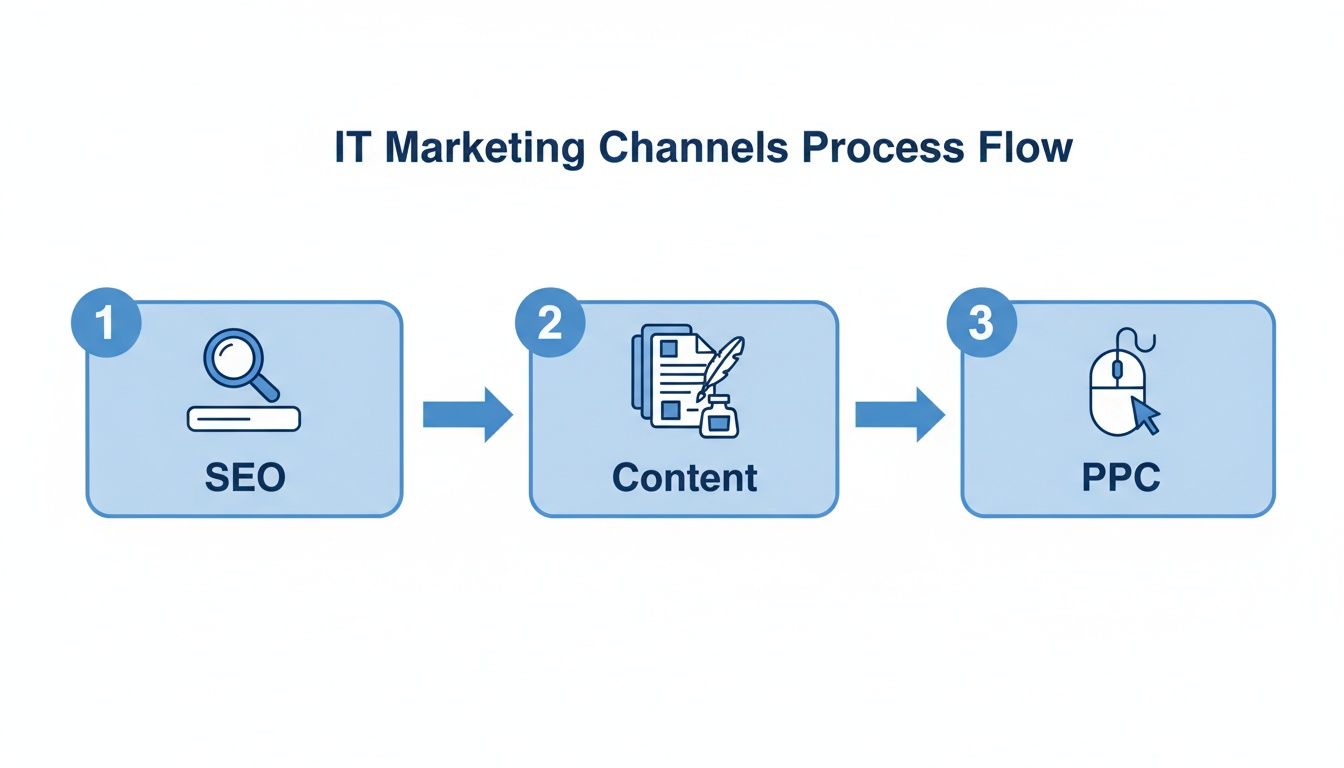
As you can see, while SEO builds your foundational visibility and content nurtures interest, PPC is the high-speed lane for converting that active demand into immediate business.
Mastering Keyword Selection and Ad Copy
The entire success of your campaign rests on choosing the right keywords. You have to get inside the head of your ideal client. They aren’t typing in vague terms; their searches are specific, loaded with commercial intent, and signal they’re ready to buy.
A generic keyword like “IT services” is a black hole for your budget—too broad and fiercely competitive. A far better approach is to target long-tail keywords like “managed IT services for law firms London” or “cybersecurity support for accountants.” These have less search volume, sure, but the conversion potential is through the roof because the intent is crystal clear.
Once your keywords are locked in, the ad copy needs to speak directly to your buyer persona’s pain points. If you’re targeting that finance director, a headline like “Secure Your Financial Data. Expert IT Support.” will grab their attention. The description should then back this up, mentioning things like compliance, reliability, and proactive monitoring to calm their specific anxieties.
Your ad is the first handshake. It needs to be firm, confident, and immediately relevant. Don’t just list what you do; state the problem you solve for the specific person you’re targeting.
Structuring Campaigns for Success (How to Market Your IT Business)
A messy Google Ads account is a fast track to wasting money. For the best results, your campaigns need a logical structure built around your specific services and target audiences. It’s all about creating tight, relevant groups.
Think about it like this:
- Campaign 1: Cybersecurity Services
- Ad Group A: Targeting Financial Firms (Keywords: “financial services cybersecurity UK,” “fintech data protection”)
- Ad Group B: Targeting Healthcare Providers (Keywords: “healthcare data compliance services,” “secure patient data solutions”)
- Campaign 2: Managed IT Support
- Ad Group A: Targeting SMEs in Manchester (Keywords: “IT support for small business Manchester,” “local IT company Manchester”)
- Ad Group B: Targeting Remote Workforce Solutions (Keywords: “remote IT support services,” “secure remote access IT”)
This granular setup lets you write hyper-specific ad copy for each group and send them to a landing page that’s perfectly tailored to their needs. A prospect looking for healthcare IT support should land on a page that screams patient data security, not generic business IT. This relevance is rewarded by Google with higher Quality Scores, which means you can actually pay less per click. For a deeper dive, our guide on B2B Google Ads success is packed with more advanced strategies.
A Look at Different PPC Campaign Priorities
Not all PPC campaigns are created equal. Depending on your immediate goals, you’ll want to prioritise different types of campaigns. Here’s a quick breakdown of how to think about it for different IT services.
PPC Campaign Priorities for IT Businesses
| Campaign Type | Primary Goal | Ideal for Which IT Service? |
|---|---|---|
| Search Campaigns | Lead Generation | Managed IT Services, Cybersecurity Consulting, Cloud Migration |
| Display Remarketing | Nurturing Leads | High-value services with long sales cycles, such as custom software development |
| Performance Max | Maximising Conversions | IT Hardware Sales, Standardised Software Subscriptions |
| Video Campaigns (YouTube) | Brand Awareness | Introducing a new cybersecurity solution or promoting your company’s expertise |
Choosing the right campaign type ensures your budget is working as hard as possible to achieve your specific business objectives, whether that’s getting the phone to ring today or building a pipeline for next quarter.
Leveraging Remarketing and Performance Max (How to Market Your IT Business)
Let’s face it: not every visitor converts on their first click. That’s perfectly normal, and it’s exactly where remarketing comes in. By setting up remarketing lists, you can show targeted follow-up ads to people who’ve already visited your site. It’s a gentle reminder that keeps your business top-of-mind while they weigh up their options.
On top of that, Google’s Performance Max campaigns are a seriously powerful tool. They use machine learning to find new customers across all of Google’s channels—Search, Display, YouTube, you name it—all from a single campaign. But there’s a catch: it needs high-quality assets (text, images, videos) and, most importantly, absolutely precise conversion tracking.
You have to know exactly which clicks are turning into leads. Without accurate tracking, you’re just flying blind, burning through your budget without knowing what’s actually working.
It’s surprising, but only 22% of UK marketing professionals currently use paid search in their strategies, even though it’s proven to drive sales. With 54% of businesses saying that increasing sales revenue is their top priority, this shows a massive opportunity. By mastering PPC, IT firms can gain a huge competitive edge while others are still sleeping on it.
How to Market Your IT Business: Measuring Success and Optimising for Growth
Launching your marketing campaign isn’t the finish line; it’s just the starting block. The real key to successfully marketing your IT business lies in what you do next. It’s about obsessive analysis and making smart, data-driven decisions to keep improving performance.
So many businesses get sidetracked by vanity metrics like clicks and impressions. And while those numbers might feel good, they don’t pay the bills. True success is found in the metrics that directly impact your bottom line and show you exactly what your marketing efforts are worth.
Focusing on Metrics That Matter
If you want to build a predictable growth engine, you need to shift your focus from surface-level data to the key performance indicators (KPIs) that reveal the true health of your campaigns. These are the numbers that tell you if you’re actually making money.
There are three core metrics every IT business owner should have practically tattooed on their brain:
- Cost Per Acquisition (CPA): This is the total cost of your marketing efforts divided by the number of new clients you’ve won. It tells you exactly how much it costs to acquire one paying customer, which is absolutely vital for budget planning.
- Customer Lifetime Value (CLV): This metric predicts the total revenue your business can expect from a single client account. Understanding your CLV helps you justify spending more on acquisition, especially if your clients stick with you for years.
- Return On Ad Spend (ROAS): For every pound you put into advertising, how much revenue do you get back? A ROAS of 4:1 means you’re generating £4 in revenue for every £1 spent. This is the ultimate measure of campaign profitability.
Tracking these numbers moves you from guessing to knowing. You stop hoping for results and start engineering them. For a more comprehensive look, our guide on key performance indicators for digital marketing provides an even deeper dive into the metrics you should be tracking.
Building Your Reporting Dashboard (How to Market Your IT Business)
Data is useless if you can’t see it clearly. A well-organised reporting dashboard is your mission control, pulling all your important metrics into one place. Tools like Google Looker Studio (what used to be Data Studio) are fantastic for this, allowing you to create customised, easy-to-read reports.
Your dashboard should give you a clear, at-a-glance view of your entire marketing funnel. It should visualise the journey from the first ad click all the way to a signed contract, helping you spot bottlenecks and opportunities instantly.
What should your dashboard include?
- Lead Volume: How many new enquiries are you generating per week or month?
- Lead Quality Score: Are these leads from your ideal client profile, or are they a poor fit?
- Conversion Rate: What percentage of website visitors are taking a desired action, like filling out a contact form?
- Cost Per Lead (CPL): How much does it cost to generate a single enquiry?
- Campaign Performance: A side-by-side comparison of your different campaigns (e.g., Cybersecurity vs. Managed Services) showing clicks, cost, and conversions.
A great dashboard doesn’t just present data; it tells a story. It should immediately answer the question, “Is our marketing working, and where can we improve?”
Interpreting Data and Taking Action
Once your data is organised, the real work begins. This is the optimisation loop: analyse, hypothesise, test, and repeat. You need to become a detective, constantly looking for clues in the numbers.
For example, you might notice your “Managed IT Services” campaign has a great click-through rate but a terrible conversion rate. This tells you the ad is compelling, but the landing page isn’t sealing the deal. Your next move? Test a new headline or a clearer call-to-action on that page.
Alternatively, you might find that leads from LinkedIn Ads have a much higher Customer Lifetime Value than those from Google Ads. This insight is pure gold. It tells you to reallocate more of your budget towards LinkedIn to attract more high-value clients.
This continuous process of refinement is what separates successful IT marketing from the rest. You use real-world data to fine-tune your messaging, perfect your targeting, and double down on what’s proven to work. It’s how you stop gambling with your marketing budget and start making strategic investments that deliver predictable, sustainable growth for your IT business.
Frequently Asked Questions About IT Marketing
Working out how to market your IT business can throw up a lot of questions, especially in the crowded UK market. Here are some quick, no-nonsense answers to the challenges we see IT business owners and marketing managers wrestling with all the time.
How Much Should an IT Business Spend on Marketing?
There’s no magic number here, but a solid rule of thumb is to set aside 5-10% of your annual revenue for your marketing budget. If you’re a brand-new business or you’re about to kick off a major growth push, you’ll probably need to be a bit more aggressive and aim for 12-15% to get that initial momentum.
But honestly, the percentage is less important than where the money actually goes. A better way to think about it is your Cost Per Acquisition (CPA). In simple terms, how much are you prepared to pay to land one new client?
Let’s say a standard managed services contract brings in a Customer Lifetime Value (CLV) of £15,000. You might decide you’re happy to spend up to £1,500 to win that business. That gives you a very healthy 10:1 return. This CPA-first approach makes your budget fluid and ties it directly to results, rather than some arbitrary figure you plucked out of the air.
What Is the Quickest Way to Get Leads?
Without a shadow of a doubt, a properly executed Paid Search (PPC) campaign on Google Ads is the fastest way to get your phone ringing. SEO and content marketing are absolutely vital for long-term, sustainable growth, but they’re a slow burn. They take time to build up steam.
PPC, on the other hand, puts your services right in front of potential clients at the exact moment they’re looking for help. Think about it: a business owner frantically searching for “emergency IT support in Leeds” has a problem right now. With PPC, you can be the first solution they see, often leading to a call within hours of your campaign going live.
The secret to PPC success isn’t just about switching the ads on. It’s about obsessive targeting of specific, high-intent keywords, writing ad copy that hits a nerve, and directing that traffic to a dedicated landing page that makes it ridiculously easy for them to get in touch.
Should I Focus on SEO or PPC First?
Ah, the classic chicken-and-egg dilemma. The real answer is that a winning strategy needs both. But where you start depends entirely on your immediate needs.
- Go with PPC first if: You need leads yesterday and you have a budget to put behind it. It gives you instant feedback and a ton of data you can use to sharpen your messaging and learn what your audience really cares about.
- Go with SEO first if: You have more time than cash and you’re playing the long game. SEO is a true investment. The work you do today compounds over time, building your authority and generating “free” organic traffic for years to come.
A smart move is to kick things off with a focused PPC campaign to get the lead flow started and gather some valuable keyword data. At the same time, start laying the foundations for your SEO by optimising your website and creating some cornerstone content. This way, you get the short-term wins while building a valuable asset for the future.
What Content Should an IT Business Create?
Your content needs to be relentlessly helpful. Stop writing about company news and start answering the specific questions your ideal clients are typing into Google. This is how you build trust and prove you know your stuff long before they ever pick up the phone.
Here are a few ideas that deliver real impact:
- Problem-Solving Blog Posts: Get specific. Don’t just write about GDPR; write an article like, “A 5-Step GDPR Compliance Checklist for UK Accountancy Firms.”
- Detailed Case Studies: Show, don’t just tell. Instead of saying you improved a client’s security, explain how you reduced their risk of a data breach by a specific percentage and what that meant for their bottom line.
- Industry-Specific Guides: Create a chunky, downloadable resource like “The Ultimate Guide to Cloud Migration for UK Manufacturing SMEs.” This positions you as the go-to expert and works brilliantly as a lead magnet.
The whole point of your content is to prove your expertise before a prospect even has a conversation with you.
How Do I Know if My Marketing Is Working?
You know it’s working when you can draw a straight line from your spending to actual business results. Forget vanity metrics like social media likes or website impressions. Focus on the numbers that actually pay the bills.
You should be tracking these core metrics like a hawk:
- Lead Volume: The raw number of qualified enquiries coming in.
- Cost Per Lead (CPL): How much you’re spending to generate each one of those leads.
- Lead-to-Client Conversion Rate: What percentage of those leads turn into paying customers?
- Return On Ad Spend (ROAS): For every £1 you put into advertising, how much revenue do you get back?
When you track these KPIs, you stop hoping for growth and start engineering it. You can see with crystal clarity which channels are delivering a return, allowing you to double down on what works and kill what doesn’t.
Ready to stop guessing and start getting real, measurable results from your paid advertising? The team at PPC Geeks specialises in creating high-impact PPC campaigns that drive qualified leads for IT businesses across the UK. Discover how we can help you achieve your growth goals.