




In the data-rich world of digital marketing, it’s easy to get lost in a sea of numbers. Likes, shares, and traffic figures are encouraging, but do they translate into tangible business growth? The real power lies in tracking the right metrics, not just the most obvious ones. Distinguishing between vanity metrics and impactful data is crucial for any business serious about its return on investment. This guide cuts through the noise to focus on the essential key performance indicators for digital marketing that every UK business must monitor. We’ll move beyond surface-level data to explore the metrics that directly impact your bottom line. Just as there are specific key performance indicators for schools to measure educational success, the business world has its own set of critical benchmarks for gauging marketing effectiveness.
For each KPI, we will provide clear definitions, formulas for accurate calculation, and actionable tips for improvement. Whether you’re an ecommerce brand aiming to boost sales or a B2B service focused on lead generation, mastering these indicators is the first step towards transforming your marketing spend from an expense into a powerful, predictable growth engine. Let’s dive into the metrics that will help you prove ROI and drive sustainable growth.
1. Key Performance Indicators for Digital Marketing: Cost Per Acquisition (CPA)
Cost Per Acquisition (CPA) is one of the most fundamental key performance indicators for digital marketing, measuring the total cost to gain one new paying customer through a specific campaign or channel. It moves beyond vanity metrics like clicks or impressions to provide a clear, bottom-line assessment of your marketing spend’s efficiency.
To calculate it, you simply divide the total cost of a marketing campaign by the number of new customers (acquisitions or conversions) it generated. This metric is essential for understanding profitability and ensuring your customer acquisition efforts are financially sustainable.
Why is CPA a crucial KPI?
CPA directly connects your marketing expenditure to revenue generation. By tracking it, you can pinpoint which channels deliver the most cost-effective customers, allowing you to reallocate your budget for maximum return on investment (ROI). It provides a clear, actionable number that informs strategic decisions about scaling campaigns, testing new channels, and optimising your overall marketing mix.
Key Insight: A low CPA isn’t always the goal. The ideal CPA must be considered in relation to your Customer Lifetime Value (LTV). A high CPA can be perfectly acceptable if it acquires a customer who will generate significant long-term revenue.
How to Implement and Track CPA
- Set Clear Goals: Before launching a campaign, define what constitutes an “acquisition”. This could be a completed sale, a signed contract, or a paid subscription.
- Include All Costs: Your CPA calculation should be comprehensive. Factor in not just ad spend but also creative development costs, software subscriptions, agency fees, and relevant staff time.
- Track by Channel: Use tracking tools like Google Analytics or platform-specific pixels to monitor CPA for each channel (e.g., Google Ads, Facebook Ads, content marketing). This reveals which sources are your most efficient. For example, Dollar Shave Club famously achieved a low CPA through viral video marketing, while HubSpot meticulously tracks CPA across its content, social, and paid channels to optimise its strategy.
This bar chart below illustrates average CPA benchmarks across different industries, highlighting how “good” CPA can vary dramatically.
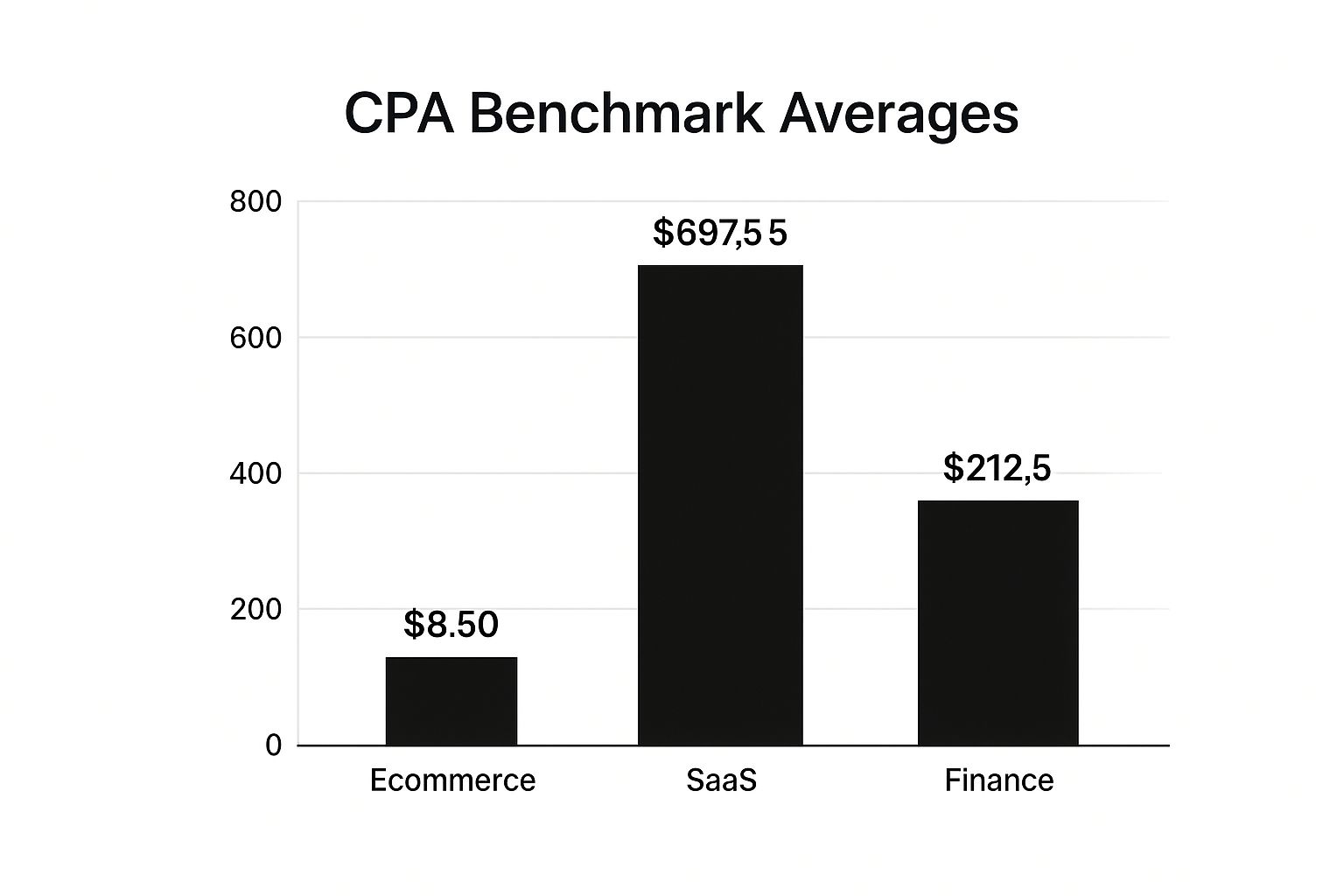
The chart demonstrates that a high CPA in a sector like SaaS is standard due to high LTV, whereas an Ecommerce brand would need a much lower figure to remain profitable on individual sales.
2. Return on Ad Spend (ROAS)
Return on Ad Spend (ROAS) is a critical performance indicator that directly measures the gross revenue generated for every pound spent on an advertising campaign. Unlike broader metrics, ROAS focuses exclusively on the effectiveness of paid advertising, making it indispensable for evaluating the profitability of channels like Google Ads and social media advertising.
To calculate it, you divide the total revenue generated from your ads by the total cost of those ads. This KPI offers a clear, immediate financial scorecard for your paid campaigns, showing which ones are fuelling growth and which are draining your budget.

Why is ROAS a crucial KPI? (Key Performance Indicators for Digital Marketing)
ROAS provides an unambiguous measure of advertising profitability, allowing you to make data-driven decisions on budget allocation. By monitoring ROAS, you can identify your most lucrative campaigns, audiences, and ad creatives, enabling you to scale what works and cut what doesn’t. It’s a vital metric for justifying marketing spend and demonstrating its direct contribution to the company’s bottom line. Understanding how to maximise return on ad spend is crucial for paid campaigns; you can delve deeper into effective Pay Per Click strategies to further refine your approach.
Key Insight: A “good” ROAS is not universal; it is entirely dependent on your business’s profit margins. A business with a 70% margin can thrive on a 3:1 ROAS, while a business with a 20% margin would lose money with the same result. Your ROAS target must be higher than your break-even point to be profitable.
How to Implement and Track ROAS
- Establish Profit-Based Targets: Before launching a campaign, calculate your break-even ROAS based on your profit margins. Set your target ROAS significantly above this figure to ensure actual profitability, not just revenue generation.
- Segment Your Analysis: Don’t just look at your overall ROAS. Analyse it by campaign, ad group, specific ad, keyword, and audience segment. This granular view reveals hidden opportunities for optimisation. For example, Warby Parker maintains a consistent 6:1 ROAS by meticulously tracking performance across high-intent keywords and specific lookalike audiences.
- Use Proper Attribution: Choose an attribution model that reflects your customer’s journey. A short attribution window might undervalue campaigns that influence future purchases. Testing different windows can give a more accurate picture of an ad’s long-term impact. Achieving high ROAS requires a sophisticated understanding of campaign mechanics. You can learn more about maximising your return on investment from experts.
3. Key Performance Indicators for Digital Marketing: Customer Lifetime Value (CLV)
Customer Lifetime Value (CLV or LTV) is a crucial predictive metric among the key performance indicators for digital marketing. It represents the total net profit a business can reasonably expect to generate from a single customer throughout their entire relationship. This forward-looking KPI shifts focus from short-term gains to long-term profitability and relationship health.

To calculate it, you multiply the average purchase value by the average purchase frequency and then by the average customer lifespan. This provides a powerful estimate of a customer’s total worth, guiding more strategic marketing and retention investments.
Why is CLV a crucial KPI?
CLV provides the strategic context for your acquisition spending. It helps you understand exactly how much you can afford to spend to acquire a new customer (your CPA) while remaining profitable. By focusing on CLV, businesses can justify investing more in acquiring high-value customers and prioritise retention strategies, which are often more cost-effective than constant acquisition.
Key Insight: The ratio of CLV to CPA is one of the most powerful indicators of a healthy, scalable business model. A commonly cited ideal ratio is 3:1, meaning a customer’s lifetime value is three times the cost to acquire them.
How to Implement and Track CLV
- Segment Your Customers: Don’t rely on a single, blended CLV. Calculate it for different customer segments, such as those acquired through specific channels (e.g., Google Ads vs. organic search) or those who buy certain product lines. For instance, Amazon knows that its Prime members have a significantly higher CLV, justifying the investment in the programme’s benefits.
- Focus on Retention Levers: Use CLV insights to boost its core components. Implement loyalty programmes to increase purchase frequency, use upselling and cross-selling tactics to raise average order value, and improve customer service to extend the customer lifespan.
- Utilise Cohort Analysis: Group customers by the month or quarter they made their first purchase (a cohort). Tracking the CLV of each cohort over time helps you see if your strategic changes are successfully increasing the value of new customers compared to previous ones. This analysis is a cornerstone for SaaS companies like HubSpot to refine their offerings and marketing.
4. Conversion Rate
Conversion Rate is a cornerstone metric that measures the percentage of users who complete a desired action out of the total number of visitors. This action, or “conversion,” could be anything from making a purchase to signing up for a newsletter or downloading a white paper. It is one of the most direct indicators of your website’s and marketing campaigns’ effectiveness at persuading users to take the next step.
To calculate it, you divide the number of conversions by the total number of visitors (or unique sessions) and multiply by 100 to get a percentage. This essential KPI moves beyond traffic volume to reveal how well you are turning prospects into leads or customers, making it fundamental for optimising the user journey.

Why is Conversion Rate a crucial KPI?
Conversion Rate directly measures the effectiveness of your landing pages, website design, and marketing copy. A high conversion rate means your messaging resonates with your audience and your user experience is seamless, leading to more sales, leads, or sign-ups from the same amount of traffic. Improving this metric is often more cost-effective than increasing ad spend, as it maximises the value of your existing visitors.
Key Insight: A “good” conversion rate is relative. An e-commerce site might aim for 2-3%, while a B2B lead generation form might see higher rates. The key is continuous improvement through testing and optimisation, not just chasing a universal benchmark.
How to Implement and Track Conversion Rate (Key Performance Indicators for Digital Marketing)
- Define Clear Conversion Goals: Be specific about what counts as a conversion for each campaign. Is it a form submission, a “request a demo” click, or a completed checkout? Set these up as goals in Google Analytics.
- Segment Your Data: Don’t just look at the overall rate. Analyse conversions by traffic source (Organic vs. Paid vs. Social), device type (Desktop vs. Mobile), and user demographic to uncover valuable insights about audience behaviour.
- Test and Optimise Relentlessly: Use A/B testing to experiment with different headlines, calls-to-action (CTAs), page layouts, and form fields. For instance, Obama’s 2012 campaign famously boosted email sign-up conversion rates from 8.26% to 11.6% simply by testing different CTA buttons and banner images. Similarly, Dropbox increased its homepage conversion rate to 3.9% by drastically simplifying its design and sign-up process.
- Analyse User Behaviour: Use tools like heat maps and session recordings to see where users are clicking, scrolling, and getting stuck. This qualitative data helps you identify and remove barriers to conversion.
For a deeper dive into improving this metric, you can learn more about Conversion Rate Optimisation on ppcgeeks.co.uk/.
5. Key Performance Indicators for Digital Marketing: Click-Through Rate (CTR)
Click-Through Rate (CTR) is a vital key performance indicator for digital marketing that measures the percentage of people who click on a specific link after seeing it. Whether viewed in a search engine result, a social media advert, or an email campaign, CTR serves as a primary gauge of your content’s relevance and appeal to its intended audience.
To calculate it, you divide the total number of clicks a link or advert receives by the total number of times it was shown (impressions), then multiply by 100 to get a percentage. This metric provides immediate feedback on how compelling your messaging, headlines, and visuals are.
Why is CTR a crucial KPI?
CTR is a powerful indicator of audience engagement and the effectiveness of your creative assets. A high CTR suggests that your content resonates with users, matching their intent and piquing their curiosity. Search engines like Google also use CTR as a quality signal, meaning a higher CTR can lead to better ad positions and a lower cost-per-click. It helps you A/B test creative elements and understand what drives action.
Key Insight: A high CTR is positive, but it must be analysed alongside other metrics like conversion rate. High clicks with low conversions could indicate a disconnect between your advert’s promise and your landing page‘s offer, a problem that needs urgent attention.
How to Implement and Track CTR
- Set Realistic Benchmarks: Understand that average CTR varies significantly by channel and industry. For instance, while the average CTR for Google Search ads is around 3.17%, it’s only 0.46% for display ads. Similarly, a brand like BuzzFeed might achieve a 2-5% CTR on social media, while Mailchimp reports an average email CTR of 2.62%.
- Write Compelling Copy: Your headlines and ad copy must be specific and align perfectly with user intent. Use strong, action-oriented calls-to-action (e.g., “Get Your Free Quote” instead of “Click Here”) to encourage engagement.
- Optimise Audience Targeting: Don’t waste impressions on irrelevant audiences. Use precise targeting to segment users based on demographics, interests, and behaviours. This ensures your message reaches those most likely to find it relevant and click. If you’d like a deeper understanding of this metric, you can learn more about mastering CTR.
6. Traffic-to-Lead Conversion Rate
The Traffic-to-Lead Conversion Rate measures the percentage of your website visitors who become qualified leads. This happens when a visitor provides their contact information, typically by filling out a form to download a resource, subscribe to a newsletter, or request a demo. This metric is a cornerstone of inbound marketing and is especially vital for B2B companies and businesses with longer sales cycles.
To calculate it, you divide the number of new leads generated by the total number of website visitors over a specific period, then multiply by 100 to get a percentage. This KPI moves beyond simple traffic analysis to gauge how effectively your website persuades anonymous visitors to identify themselves as potential customers.
Why is Traffic-to-Lead Conversion Rate a crucial KPI? (Key Performance Indicators for Digital Marketing)
This rate is one of the most important key performance indicators for digital marketing because it directly measures your website’s ability to fuel your sales pipeline. A high volume of traffic is meaningless if it doesn’t convert into tangible business opportunities. Tracking this rate helps you evaluate the effectiveness of your website’s content, calls-to-action (CTAs), and user experience in capturing interest and building your marketing database.
Key Insight: A high Traffic-to-Lead Conversion Rate is a strong indicator that your content is resonating with your target audience and that your value proposition is clear. It shows you are attracting the right traffic, not just any traffic.
How to Implement and Track Traffic-to-Lead Conversion Rate
- Set Up Conversion Goals: Use tools like Google Analytics or marketing automation platforms to define a “lead” conversion. This is usually triggered by a thank-you page visit after a form submission.
- Segment Your Analysis: Don’t just track the overall site rate. Analyse conversion rates by traffic source (e.g., organic search, social media, paid ads), landing page, and content offer. This reveals which channels and assets are your top performers.
- Optimise Conversion Points: Continuously test elements that influence conversions. For instance, HubSpot achieves a strong traffic-to-lead rate by offering a vast library of specific lead magnets for different buyer personas. Similarly, Marketo famously improved its rates by using progressive profiling on forms to reduce friction for returning visitors.
- Use Strategic CTAs: Implement well-placed CTAs, exit-intent pop-ups, and scroll-triggered boxes to present your offers at the most opportune moments without being intrusive. A/B testing the design, copy, and placement of these elements is essential for optimisation.
7. Key Performance Indicators for Digital Marketing: Email Open Rate
Email Open Rate is a core metric in email marketing, calculating the percentage of recipients who opened a specific email you sent. It serves as an immediate gauge of your campaign’s initial impact, directly reflecting the effectiveness of your subject line, sender reputation, and the level of trust you have built with your audience.
To calculate it, you divide the number of unique opens by the number of successfully delivered emails, then multiply by 100. Although evolving privacy features (like Apple’s Mail Privacy Protection) can affect accuracy, it remains one of the most important key performance indicators for digital marketing to assess list health and audience curiosity.
Why is Email Open Rate a crucial KPI?
This KPI provides a direct signal of your audience’s engagement and interest. A consistently high open rate indicates that your subscribers recognise your brand, trust your content, and are intrigued by your messaging. It is a vital early-funnel metric; if subscribers don’t open your emails, they can’t click on your links or convert. Tracking it helps you diagnose deliverability issues and optimise the very first touchpoint of your email campaign.
Key Insight: A high open rate is a sign of a healthy relationship with your audience. It proves your subject lines are compelling and that your subscribers genuinely want to hear from you, making it a foundational metric for nurturing leads and retaining customers.
How to Implement and Track Email Open Rate
- Segment Your Lists: Avoid a one-size-fits-all approach. Segment your audience based on past behaviour, demographics, or purchase history to send more relevant, targeted messages that subscribers are more likely to open.
- A/B Test Subject Lines: Continuously test different subject line styles. Experiment with length, personalisation (using the recipient’s name), emojis, and tone to discover what resonates most. For example, brands like Morning Brew built their empire on consistently high engagement driven by compelling, must-read subject lines.
- Optimise for Mobile: With most emails now opened on mobile devices, keep subject lines concise and impactful, ideally under 50 characters, to ensure they aren’t cut off on smaller screens.
- Maintain Consistency: Use a consistent and recognisable sender name and email address. This helps subscribers instantly identify your emails in a crowded inbox, building trust and encouraging opens over time. Charity: Water, for instance, achieves high open rates by combining a recognisable sender name with powerful, story-driven subject lines.
8. Social Media Engagement Rate
Social Media Engagement Rate is a crucial metric that measures the level of interaction your content receives relative to your audience size. It moves beyond follower counts to show how well your content resonates, calculating the percentage of your audience that actively engages through likes, comments, shares, and saves.
To calculate it, you divide the total number of engagements on a post by your total number of followers (or reach for that specific post) and multiply by 100 to get a percentage. This KPI is a vital indicator of content quality, audience health, and brand loyalty, making it one of the most important key performance indicators for digital marketing.
Why is Social Media Engagement Rate a crucial KPI? (Key Performance Indicators for Digital Marketing)
A high engagement rate signals to platform algorithms that your content is valuable, which can significantly boost your organic reach and visibility without additional ad spend. It demonstrates that you are building a genuine community, not just collecting passive followers. Tracking this metric helps you understand what content formats, topics, and tones drive meaningful connections, allowing you to refine your social media strategy for maximum impact.
Key Insight: Focus on the quality of engagement, not just the quantity. A thoughtful comment or a share is often more valuable than a simple ‘like’. High engagement shows you are fostering a two-way conversation, which is the cornerstone of building a strong online brand.
How to Implement and Track Social Media Engagement Rate
- Define Your Engagements: Be clear on what interactions matter most to you. For some, it might be shares to expand reach; for others, it could be comments to spark conversation. Track these specific actions.
- Establish a Benchmark: Use your platform’s native analytics (like Instagram Insights or Facebook Business Suite) to calculate your current average engagement rate. This provides a baseline to measure future efforts against. A comprehensive social media audit can help you establish these benchmarks.
- Track Consistently: Monitor your engagement rate on a weekly or monthly basis. Analyse top-performing posts to identify patterns. For instance, Wendy’s famously achieves high engagement through its unique, witty brand personality on Twitter, while National Geographic leverages stunning visuals to maintain consistently high interaction across platforms. Creating content that encourages participation, such as polls and questions, can also effectively boost these numbers.
Key Metrics Comparison of 8 Digital Marketing KPIs
| Metric | Implementation Complexity 🔄 | Resource Requirements ⚡ | Expected Outcomes 📊 | Ideal Use Cases 💡 | Key Advantages ⭐ |
|---|---|---|---|---|---|
| Cost Per Acquisition (CPA) | Moderate: requires tracking conversions across channels | Medium: needs campaign cost tracking and conversion data | Measures cost efficiency per customer acquired | Budget allocation, channel comparison, campaign optimisation | Direct cost-to-outcome correlation; easy calculation |
| Return on Ad Spend (ROAS) | Moderate: integrates revenue and ad spend data | Medium: real-time tracking with platform integration | Indicates ad profitability and ROI | Paid advertising effectiveness and budget decisions | Clear profitability indicator; platform integration |
| Customer Lifetime Value (CLV) | High: complex predictive calculations and data integration | High: requires historical customer and CRM data | Predicts total long-term revenue per customer | Strategic acquisition and retention planning | Long-term value insight; justifies acquisition spend |
| Conversion Rate | Low: simple percentage calculation from visitor data | Low: requires basic analytics setup | Shows effectiveness of converting visitors to customers | Website and funnel optimisation | Clear effectiveness indicator; supports A/B testing |
| Click-Through Rate (CTR) | Low: simple ratio of clicks to impressions | Low: basic tracking via ad platforms or email | Measures engagement and content relevance | Ad creative performance and audience targeting | Immediate feedback; impacts ad cost and placement |
| Traffic-to-Lead Conversion Rate | Moderate: tracking qualified leads from traffic | Medium: CRM and lead scoring integration | Measures website’s ability to generate qualified leads | B2B marketing, lead generation | Focus on lead quality; supports sales enablement |
| Email Open Rate | Low: tracking email opens via campaign software | Low: email marketing platform dependent | Indicates email deliverability and subject line effectiveness | Email marketing engagement | Quick subject line feedback; easy trend analysis |
| Social Media Engagement Rate | Moderate: requires collection of multiple interaction types | Medium: social media analytics tools | Measures audience interaction and content resonance | Content performance and community building | Measures quality of engagement; boosts organic reach |
From Data to Decisions: Making Your KPIs Work for You
Navigating the digital marketing landscape without clear key performance indicators is like sailing without a compass. The metrics we have explored are not just abstract numbers on a dashboard; they are the vital signs of your business’s online health, telling a story of what’s working, what isn’t, and where your greatest opportunities for growth lie.
We’ve moved beyond surface-level definitions to show how metrics like Cost Per Acquisition (CPA) and Return on Ad Spend (ROAS) directly tie your marketing spend to tangible revenue. We’ve seen how a high Click-Through Rate (CTR) isn’t just a vanity metric but a crucial indicator of ad relevance and audience alignment, which in turn impacts your Quality Score and ad costs. Similarly, understanding your Conversion Rate allows you to transform website traffic into measurable business outcomes, whether that’s a sale, a lead, or a sign-up.
The Interconnected Nature of KPIs (Key Performance Indicators for Digital Marketing)
The true power of using key performance indicators for digital marketing emerges when you stop viewing them in isolation. A strategic approach recognises their interconnectedness:
- Improving your Traffic-to-Lead Conversion Rate directly lowers your overall CPA.
- A deep understanding of your Customer Lifetime Value (CLV) empowers you to justify a higher initial CPA, knowing the long-term payoff is substantial.
- Strong Email Open Rates and Social Media Engagement are leading indicators of brand health, often translating into higher conversion rates and stronger customer loyalty down the line.
This holistic view transforms your marketing from a series of disconnected campaigns into a cohesive, optimised engine for growth. The goal is to build a culture of continuous improvement, where data isn’t just collected but is actively used to inform every strategic decision, from budget allocation to creative direction.
Putting Your Data into Action
Mastering these KPIs is the difference between simply doing digital marketing and succeeding at it. It allows you to move with confidence, armed with the evidence needed to scale what works and refine what doesn’t. You can answer critical business questions: “Are my Google Ads profitable?”, “Is our content resonating with our target audience?”, “Where should we invest our next marketing pound for the highest return?”.
For busy entrepreneurs, SMEs, and marketing managers, the challenge often lies not in understanding the importance of these metrics, but in finding the time and expertise to track, analyse, and act upon them effectively. This is where strategic partnership becomes a powerful lever for growth. Ultimately, the consistent measurement and optimisation of these key performance indicators for digital marketing is what separates thriving businesses from those that merely survive in the competitive digital space.
Are you ready to turn your marketing data into your most powerful asset? The team at PPC Geeks specialises in building data-driven strategies that focus on the KPIs that matter most to your bottom line. Contact PPC Geeks today for a free, no-obligation audit and discover how expert management can transform your performance and maximise your ROI.