




Proper keyword research for PPC isn’t just about pulling a list of terms from a tool. It’s the art of finding and dissecting the phrases real people use when they’re looking to buy, ensuring your paid ads hit a relevant, high-intent audience. It means going beyond basic lists to truly understand what a user wants, what your competitors are up to, and how to structure your campaigns. Get this right, and you’ll maximise your return on investment (ROI). Get it wrong, and you’re just burning cash.
Keyword Research for PPC: Setting the Stage for Profitable Keyword Research
Before you even dream of opening a keyword tool, the real groundwork for a killer pay-per-click campaign begins. This isn’t about guesswork; it’s about laying a strategic foundation so that every pound you spend has a clear purpose. Skipping this stage is like trying to build a house without blueprints—a surefire recipe for a costly mess.
So many businesses make the classic mistake of diving headfirst into bidding on broad, high-volume keywords, crossing their fingers for the best. This almost always ends in a drained budget and a lot of frustration. The truth is, successful keyword research for PPC is a methodical process. It starts with a crystal-clear picture of your business goals and finishes with a hand-picked list of keywords that perfectly aligns with them.
Audit and Define Your Campaign Goals
First things first, you need to look inward. If you’re already running PPC campaigns, it’s time for a proper audit. Dive into your search term reports and figure out which queries are actually driving conversions, and which are just eating up your budget with empty clicks. This historical data is a goldmine.
Next, get razor-sharp on your campaign goals. “Get more traffic” is not a goal; it’s a wish. You need to be specific.
Here are a few solid examples:
- Increase demo sign-ups for our SaaS platform by 20%.
- Generate 50 qualified phone leads per month for our plumbing services.
- Achieve a 5:1 return on ad spend (ROAS) for our new e-commerce shoe collection.
This focus ensures you aren’t just collecting keywords for the sake of it. You’re choosing terms that directly drive real business results. For a deeper dive into the mechanics, you can learn more about how Google Ads work and see how all these pieces connect.
Uncover Competitor Weaknesses (Keyword Research for PPC)
Once you’ve got your own house in order, it’s time to spy on the competition. A bit of clever analysis of what your competitors are bidding on can give you some incredible insights. You’ll spot the high-value keywords they’re targeting, but more importantly, you can find the gaps they’ve missed. Are there long-tail keywords or niche terms they’ve completely overlooked? This is where you can swoop in and gain an immediate edge.
This three-pronged foundation—auditing, goal-setting, and competitor analysis—is what sets you up for a winning campaign from day one.
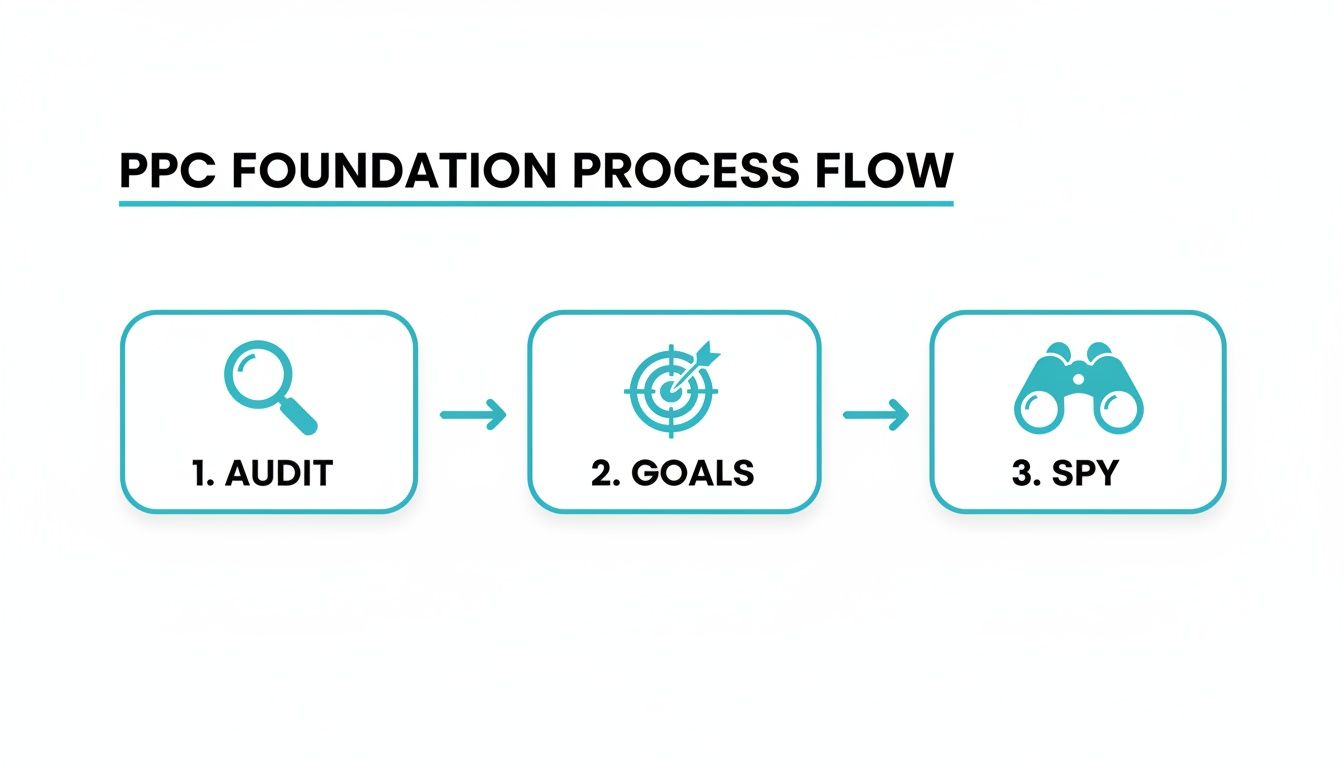
This simple flow shows that a successful PPC strategy is built on smart actions before you even pick your first keyword. Yet, it’s shocking how many businesses get this wrong. In fact, only 46% of UK businesses feel confident they are using the best keywords and account structures to maximise their PPC ROI. A methodical approach like this one is exactly what will put you ahead of the curve.
Keyword Research for PPC: How to Build Your High-Intent Keyword List
Alright, with the groundwork laid, it’s time to get into the nitty-gritty: finding the exact search terms your best customers are typing into Google. This is where the real magic happens, blending smart strategy with hard data.
Our goal isn’t just to gather a random list of keywords. We’re on a mission to build a powerful arsenal of phrases that scream intent – phrases that tell us someone is ready to buy, book, or pick up the phone. Forget basic brainstorming; this is a proven process for building a killer keyword list from scratch.
Starting with Your Seed Keywords
Every top-performing keyword list starts small, from a handful of “seed” keywords. Think of these as the core, foundational terms that describe what you do at a high level. They’re the starting blocks from which all your other keyword ideas will sprint.
I find it helps to group them into three main buckets:
- Product-based: These are the no-brainers. The direct descriptions of what you sell. Think “CRM software” or “handmade leather wallets“.
- Problem-based: This is about getting inside your customer’s head. What problem are they trying to solve? Keywords like “how to get more online reviews” or “emergency plumber near me” fit perfectly here.
- Branded: Don’t forget your own brand name and, crucially, your competitors’. A classic move is targeting terms like “Mailchimp alternatives“.
To pull these together, chat with your sales team. What language do customers actually use? Dive into your website’s internal search data. You’ll often find gold in there. Aim for a solid list of 10-20 seed keywords to get the ball rolling.
Expanding Your List with Keyword Tools (Keyword Research for PPC)
Once you’ve got your seeds, it’s time to let them grow. This is where keyword research tools become your best friend. Tools like Google’s Keyword Planner, Ahrefs, and Semrush will take your handful of terms and multiply them into hundreds, sometimes thousands, of related ideas. This is the heart of effective keyword research for PPC.
But hold on. Don’t just export that massive list and start chucking money at it. You need to sift through it with your campaign goals in mind, paying close attention to a few key stats for each term:
- Search Volume: How many people are searching for this each month?
- Cost-Per-Click (CPC): Roughly how much will one click cost you?
- Competition: How many other advertisers are fighting for this keyword?
Google Keyword Planner, for example, gives you a treasure trove of data. You’ll see average monthly searches, competition levels, and top-of-page bid estimates – all essential for budgeting and deciding where to focus first.
While the free tools are great, many paid options offer much deeper insights. For a full rundown, check out our guide on the best free keyword research tools to see which one is right for you.
Uncovering Long-Tail Keywords
Here’s a secret that separates the pros from the amateurs: the real profit is often hiding in long-tail keywords. These are longer, more specific search queries, usually three or more words.
Individually, their search volume is low. But collectively, they are pure gold. Why? Because they reveal a massively higher level of purchase intent.
Someone searching for “shoes” is just browsing. But a person searching for “buy size 10 black leather brogues online“? They know exactly what they want and have their wallet out.
Long-tail keywords are less competitive, which almost always means a lower CPC. This killer combination of high intent and lower cost makes them the cornerstone of any smart PPC keyword strategy. Your tools will find them, but it’s your job to actively hunt for them and give them priority.
A Real-World Example in Action (Keyword Research for PPC)
Let’s say you run a local plumbing business in Manchester. Your seed keywords might be pretty straightforward: “plumber Manchester” and “emergency plumber”.
By firing up a keyword tool, you quickly expand this and uncover a whole range of valuable long-tail keywords your competitors are probably sleeping on:
- “emergency boiler repair Chorlton” (High intent, geo-targeted)
- “cost to fix a leaking tap in Didsbury” (Problem-based, hints at cost-consciousness)
- “24-hour plumber south Manchester” (Urgent need, specific location)
By focusing your budget on these hyper-specific, high-intent terms, your plumbing business can attract red-hot leads for a fraction of the cost. It’s a far more effective approach than just throwing all your money at the broad, expensive, and highly competitive term “plumber”.
Keyword Research for PPC: Structuring Ad Groups for Peak Performance
So, you’ve got a fantastic list of high-intent keywords ready to go. Great start, but that’s genuinely only half the job done. Without a logical, organised structure, you’re just throwing spaghetti at the wall and hoping some of it sticks. This is where the real craft comes in: structuring your keywords into tightly themed ad groups. It’s non-negotiable for success.
Think of it like this: your keywords are the ingredients, but your ad group structure is the recipe. A messy recipe leads to a confusing, unappealing dish. But a great one? That creates a coherent, effective campaign that gives searchers exactly what they’re looking for. That’s the secret sauce of successful keyword research for PPC.
This step is absolutely critical because it directly feeds into your Quality Score. Google actively rewards advertisers who provide a relevant, seamless experience. When your keywords, ad copy, and landing page all sing from the same hymn sheet within an ad group, your Quality Score climbs. This means better ad positions and, crucially, lower costs per click.
The Logic Behind Tightly Themed Ad Groups
The core principle is beautifully simple: group keywords that share the same specific intent. This unlocks your ability to write hyper-relevant ad copy that speaks directly to what the searcher needs in that exact moment.
If someone types in “emergency boiler repair Chorlton,” they don’t want to see a generic ad about your company’s broad plumbing services. They need to see a headline that screams, “We offer emergency boiler repair in Chorlton, right now!”
Achieving that level of specificity is impossible if you just dump hundreds of keywords into one ad group. By creating small, focused groups, you can guarantee your message is always on point. This approach, often called Single Theme Ad Groups (STAGs), is a firm favourite, with 40% of PPC specialists preferring it for its sheer effectiveness.
Let’s walk through a real-world example for an online shoe retailer. Say you’ve pulled together a list of 200 keywords related to running shoes. The messy way is to chuck them all into one ad group. The strategic, profitable way is to segment them.
Initial Messy Keyword List (Sample):
- men’s running shoes
- women’s trail running shoes size 6
- best brooks running shoes
- buy nike running trainers online
- cheap running shoes for flat feet
- new balance fresh foam review
From this jumble, we can carve out a clean, high-performing structure.
Practical Ad Group Organisation (Keyword Research for PPC)
You’d organise these thematically into distinct ad groups, each with its own bespoke ad copy and a dedicated landing page.
- Ad Group 1: Men’s Running Shoes
"men's running shoes""running trainers for men""buy men's running trainers"
- Ad Group 2: Women’s Trail Running Shoes
"women's trail running shoes""off-road running shoes women""buy trail runners for women"
- Ad Group 3: Branded – Brooks
"brooks running shoes""best brooks running trainers""brooks glycerin 21 uk"
This granular structure means the ad copy for the “Brooks” ad group can shout about the brand’s unique selling points, while the “Women’s Trail” ad can highlight features like durability and grip. This is the kind of relevance that drives higher click-through rates and, ultimately, more conversions.
By organising keywords into tight, thematic ad groups, you create a direct line of relevance from the search query to the ad and finally to the landing page. This seamless user journey is precisely what Google’s algorithm is designed to reward.
Choosing the right keyword match type adds another powerful layer of control within this structure. Match types dictate how closely a user’s search must align with your keyword to trigger your ad. Getting your head around them is fundamental to managing your budget and reach effectively.
A Comparison of Keyword Match Type Strategies
Choosing the right match type gives you control over your ad spend and audience targeting. This table compares the main keyword match types, outlining their function, ideal use case, and potential risks.
| Match Type | How It Works | Best For | Potential Pitfall |
|---|---|---|---|
| Broad Match | Shows ads on searches related to your keyword, including synonyms and variations. | Maximising reach and discovering new keywords you hadn’t thought of. | Can trigger irrelevant searches, leading to significant wasted ad spend if not managed with negative keywords. |
| Phrase Match | Shows ads on searches that include the meaning of your keyword. | Balancing reach with control, targeting a relevant audience without being overly restrictive. | May still appear for some queries that are contextually close but not an exact fit for your offering. |
| Exact Match | Shows ads on searches that have the same meaning or intent as the keyword. | Targeting a very specific, high-intent audience with maximum control over ad spend. | Limits reach and can cause you to miss out on relevant, longer-tail search variations. |
A solid, battle-tested strategy is to begin with more restrictive match types, like exact and phrase match, for your core, high-intent keywords. This ensures your budget is initially spent on the most relevant traffic possible. As you gather data from your campaigns, you can then carefully test broad match keywords—always paired with a robust negative keyword list—to explore new opportunities without torching your budget.
Keyword Research for PPC: Using Negative Keywords to Eliminate Wasted Spend

Getting your ads in front of the right people is only half the battle. A truly powerful part of keyword research for PPC is actively stopping your ads from showing to the wrong people. This is exactly where negative keywords come in, acting as your campaign’s first line of defence against wasted ad spend.
Think of them as a bouncer for your budget. You want every click you pay for to come from a searcher who has a genuine shot at becoming a customer. Negative keywords are your way of telling Google, “Don’t show my ad for any search that includes this word.” Honestly, it’s one of the quickest and most direct ways to boost your campaign’s ROI.
But this isn’t a one-and-done task; it’s an ongoing discipline that mixes proactive planning with reactive, data-driven analysis.
Build a Proactive Negative List Before You Launch
Why wait for your budget to start leaking before you plug the holes? Before a new campaign even goes live, you can predict and block a huge number of irrelevant searches. These are usually universal modifiers that scream “no commercial intent”.
Just start by brainstorming words that are related to your industry but totally wrong for what you sell.
Common proactive negatives often fall into a few categories:
- Informational Qualifiers:
free,reviews,how to,DIY,tutorial - Employment-Related:
jobs,hiring,salary,careers,cv - Unrelated Product Types: If you sell premium leather shoes, you’d want to exclude terms like
cheap,discount, orsecond-handfrom the get-go.
By building this foundational list from day one, you immediately shield your budget from the most obvious money pits.
A robust negative keyword list acts as an insurance policy for your ad spend. It ensures your budget is channelled exclusively towards searchers who are genuinely interested in what you offer, dramatically improving lead quality and campaign efficiency.
Mine Your Search Terms Report for Hidden Gems (Keyword Research for PPC)
That proactive list is a great starting point, but the real gold is buried in your data. The Search Terms Report in Google Ads is, without a doubt, the most important tool for refining your targeting over time. It shows you the exact queries people typed into Google that triggered your ads.
Make reviewing this report a weekly ritual. You will always find search terms that are completely irrelevant to your offer. For a deeper dive into managing these effectively, our guide on negative keywords in Google Ads provides a detailed walkthrough.
Case Study: B2B SaaS Company Cuts Costs
Let’s look at a real-world example. A B2B SaaS company selling project management software was bidding on the phrase match keyword “project management tools”. After just two weeks, their Search Terms Report showed they were wasting significant spend on queries like:
free project management tools for studentsproject management tools course onlineproject management excel template
None of these searchers fit their target audience of paying business customers. By simply adding students, course, and template as negative keywords, they instantly stopped showing up for these irrelevant searches. Within a month, this simple, disciplined practice helped them cut their cost-per-lead by 30%.
Campaign vs Ad Group Level Negatives
Where you add your negatives really matters. You have two main options, and each serves a different strategic purpose.
- Campaign-Level Negatives: These are your broad exclusions that apply to every single ad group within that campaign. This is the perfect place for that universal negative list with terms like
freeorjobsthat you never, ever want to show up for. - Ad Group-Level Negatives: These are much more specific and are used to prevent your own ad groups from competing against each other (often called keyword cannibalisation). For instance, if you have one ad group for “men’s running shoes” and another for “men’s trail running shoes,” you’d add
trailas a negative to the first group. This forces Google to show the most relevant ad, improving your Quality Score and click-through rate.
Mastering negative keywords transforms your campaigns from a blunt instrument into a precision tool. It stops budget leaks, sharpens your targeting, and ultimately makes your money work a whole lot harder to attract the right kind of customers.
Keyword Research for PPC: Optimising and Forecasting for Long-Term Success
Think of your initial keyword research as the blueprint, not the finished building. A truly profitable PPC campaign isn’t a “set it and forget it” affair. It’s a living, breathing thing that needs constant attention and refinement, turning raw performance data into smart, actionable adjustments. This ongoing cycle of optimisation is what really separates the campaigns that deliver sustained growth from those that just fizzle out.
The great thing is, you don’t have to spend a single pound to get a decent idea of what to expect. Modern ad platforms have some powerful forecasting tools that can take your carefully chosen keyword list and spit out a tangible projection of its potential. This isn’t just about satisfying your own curiosity; it’s a vital strategic step.
Forecasting Potential Traffic and Costs
Jump into a tool like Google’s Keyword Planner, upload your keyword list, and you’ll get a wealth of estimated metrics. It’ll show you projected clicks, impressions, average cost-per-click (CPC), and total spend based on different bid levels. This is where your theoretical keyword list starts to look like a practical budget plan.
It helps you answer some critical questions before you even think about going live:
- Is the budget we’ve set actually realistic for the keywords we’re targeting?
- What sort of click volume can we honestly expect at our target CPC?
- Which of our keyword themes are likely to eat up most of the budget?
Having this data-driven foresight helps you set realistic targets and manage expectations with stakeholders. It also gives you a clear baseline to measure against once the campaign is running, acting as an early warning system if things aren’t going to plan.
Focusing on Metrics That Truly Matter (Keyword Research for PPC)
Once your campaigns are up and running, it’s incredibly easy to get swamped by a sea of data. Clicks and impressions might look great on a report, but they’re often just vanity metrics. Sure, they tell you people are seeing and clicking your ads, but they don’t tell you if those clicks are actually making you any money.
To make genuinely smart decisions, you need to zero in on the metrics that directly impact your bottom line.
The most successful PPC managers are absolutely ruthless in their focus on conversion-based metrics. They live and breathe Cost Per Acquisition (CPA), Conversion Rate, and Return On Ad Spend (ROAS) because these are the numbers that tell the real story of campaign profitability.
Keeping a close eye on these key performance indicators (KPIs) shows you exactly which keywords and ad groups are driving real business results. This clarity is essential for shifting your budget effectively—scaling up what works and mercilessly cutting what doesn’t. You can learn more about getting these bidding strategies right in our detailed guide on Google Ads Smart Bidding.
A Simple Framework for Continuous Testing
Optimisation is all about constant testing. You should always be running experiments to try and beat your current champion. A simple but incredibly powerful way to approach this is by A/B testing your ad copy against your core keyword themes.
Here’s a practical way to do it:
- Isolate One Variable: Take an ad group, duplicate your best-performing ad, and change just one thing—maybe the headline, for instance.
- Form a Hypothesis: Before you start, jot down what you think will happen. “I believe a headline focused on ‘Free Next-Day Delivery’ will get a higher click-through rate than our current ‘High-Quality Products’ headline.”
- Run the Test: Let both ads run at the same time until you have enough data to be confident in the result (usually a few hundred clicks is a good starting point).
- Analyse and Iterate: If your new ad wins, it becomes the new control, and you start again. If it loses, pause it and test something else.
This methodical approach ensures you’re constantly learning and improving. These small, incremental gains really add up over time and lead to significant performance boosts. This constant refinement is crucial in a market that’s always changing. For example, in the UK, keyword research for PPC shows ‘PPC agency‘ averaged just over 2,000 monthly searches in August 2024. But between 2019 and 2022, volumes swung wildly from a low of 423 to a high of 5,342—a perfect illustration of how quickly search behaviour can shift. Getting to grips with these PPC statistics and trends helps you keep your finger on the market’s pulse.
Common PPC Keyword Research Questions
Even with a solid plan, you’re bound to run into tricky questions when you’re in the trenches managing a PPC account. The world of keyword research for PPC is full of little details, and it’s easy to get bogged down. Let’s clear up some of the most common questions we hear from businesses trying to sharpen their strategy.
Getting these details right is what separates a campaign that just ticks over from one that genuinely smashes its targets. It’s often the difference between breaking even and being wildly profitable.
How Many Keywords Should I Have in an Ad Group?
This is the classic question, but the truth is, there’s no magic number. Instead of obsessing over quantity, your entire focus should be on relevance. The best practice today is building tightly themed ad groups where every single keyword shares the exact same intent. We often call this the Single Theme Ad Group (STAG) model.
For most ad groups, this naturally works out to somewhere between 5 and 20 keywords. If you find yourself chucking 50 or 100 keywords into one group, that’s a massive red flag. It tells you the theme is far too broad. A smaller, laser-focused group lets you write incredibly relevant ad copy that speaks directly to what the user searched for, which in turn boosts your Quality Score and click-through rate.
Here’s the golden rule: if you can’t write a single, highly specific ad that perfectly matches every keyword in the group, the group is too big. It’s time to break it down into smaller, more specific themes.
How Often Should I Be Updating My Keyword List?
Your keyword list isn’t something you set and forget. Think of it as a living, breathing part of your campaign that needs regular attention. How often you tweak it depends on your campaign’s age and budget, but here’s a solid schedule to start with:
- Weekly Check-in: Make it a non-negotiable habit to review your Search Terms Report every single week. This is your best source for finding and adding new negative keywords to plug the leaks and stop wasting money.
- Monthly Expansion: At least once a month, you should be actively hunting for new opportunities. Are there new search trends popping up? Have your competitors started bidding on new terms? Fire up your keyword tools and go exploring.
- Quarterly Pruning: Every three months, it’s time to do a proper performance review of your existing keywords. Be ruthless. Pause or get rid of the low-performers—anything with plenty of clicks but no conversions, or keywords with a stubbornly low Quality Score you just can’t seem to fix.
Sticking to a rhythm like this keeps your campaigns sharp, efficient, and in sync with how people are actually searching.
Should I Bid on My Own Brand Name?
In almost every case, the answer is a resounding yes. It might feel a bit strange to pay for clicks you’d probably get for free from your organic listing, but bidding on your own branded terms gives you some serious advantages.
First off, it gives you total control over the message at the very top of the search results page. You can send users to a specific, high-converting landing page, shout about your latest offer, or highlight key selling points. You control the narrative.
Secondly, it’s a brilliant defensive move. If you’re not bidding on your brand name, you can bet your competitors will be. Bidding on your own name protects your most valuable, high-intent traffic from being snatched away by rivals playing on your home turf. Clicks on these terms are usually dirt cheap, making it a ridiculously cost-effective way to secure your best customers.
Ready to stop guessing and start getting real results from your paid search campaigns? The experts at PPC Geeks can build a data-driven strategy that eliminates wasted spend and maximises your ROI. Get your free, in-depth PPC audit today.