




A successful lead acquisition strategy is simply your game plan for identifying, attracting, and converting potential customers into solid leads for your sales team. It’s a world away from just scooping up contact details. The real goal is to bring in people who are a genuinely good fit for your business and have a high chance of becoming happy, paying customers.
Lead Acquisition Strategy: Building Your Lead Acquisition Foundation
Before you even think about spending a penny on ads or drafting your first blog post, you need to lay some serious groundwork. A powerful lead acquisition strategy isn’t a mad dash for every possible enquiry; it’s about methodically attracting the right ones.
Honestly, this initial planning is the most important part of the whole process. It sets the course for every campaign you’ll run. I’ve seen too many businesses rush this stage, and it’s like building a house on sand – it’s just not going to hold up.
The very first step? Get your marketing and sales teams in the same room. Seriously. They need to agree on a single, universal definition of what a “qualified lead” actually is. Nailing this down early on stops that classic problem of marketing passing over leads that sales immediately rejects, saving everyone a massive amount of time and frustration down the line.
Define Your Ideal Customer Profile
Generic buyer personas are fine for beginners, but a proper Ideal Customer Profile (ICP) is where the real power lies. Think of an ICP as a hyper-detailed description of the perfect company you want to work with, not just a fictional person. The best way to build one is to analyse your best, most profitable, and most loyal customers you already have.
Look for the common threads that tie them together:
- Firmographics: What industry are they in? What’s their company size, both in employee numbers and annual revenue? Where are they based?
- Technographics: What software or technology are they already using? This can be a huge clue about their needs or how easily they could integrate your solution.
- Behavioural Traits: How did they originally find you? What did their buying journey look like? Crucially, what specific problems did you solve for them?
When you build an ICP based on real data, you stop guessing. You suddenly have a precise blueprint that informs your targeting, your messaging, and where you spend your time. Every decision can be checked against a simple question: “Will this appeal to our ICP?”
Map the Customer Journey (Lead Acquisition Strategy)
Once you know who you’re aiming for, the next piece of the puzzle is understanding how they buy. The customer journey is the entire research process someone goes through before they decide to purchase. Mapping this out helps you spot the critical moments where you can step in, offer value, and grab their attention.
A well-mapped customer journey shows you exactly what questions your prospects are asking at each stage. Your content and offers should be the answers to those questions, positioning you as a trusted guide rather than just another vendor.
For example, someone in the early “Awareness” stage is probably just Googling broad questions about a problem they’re having. A helpful blog post or an educational webinar is the perfect fit here. Further down the line, in the “Consideration” stage, they’ll be actively comparing solutions. This is where a detailed case study or a product comparison guide becomes incredibly valuable. A huge part of this is learning how to create a sales funnel that guides people through these stages smoothly.
Establish Key Performance Indicators
Finally, no foundation is complete without knowing what success looks like. Vague goals like “get more leads” lead to vague, uninspiring results. You need to set concrete Key Performance Indicators (KPIs) that tie directly back to business growth.
Here are a few essential KPIs you should be tracking from day one:
- Cost Per Acquisition (CPA): The total cost of your marketing efforts divided by the number of new customers it brought in. It’s the bottom-line cost of a sale.
- Lead-to-Customer Rate: The percentage of leads that actually convert into paying customers. If this number is low, you might have a problem with the quality of your leads or a bottleneck in your sales process.
- Customer Lifetime Value (CLV): The total revenue you can realistically expect from a single customer over the entire time they do business with you.
Tracking these metrics proves your efforts aren’t just creating noise; they’re directly contributing to the company’s bottom line. This data-driven approach is what allows you to justify your budget and make smart decisions about where to invest for the best returns.
Lead Acquisition Strategy: Choosing Your High-Impact Channels
Once you’ve nailed down who you’re targeting, the real question becomes where to find them. It’s a classic mistake to spread your budget and effort thinly across every platform imaginable. That’s a surefire way to get mediocre results. The goal isn’t to be everywhere; it’s to be exactly where your ideal customers are already looking for answers.
This isn’t about guesswork or jumping on the latest social media trend. It’s a deliberate process of finding, testing, and doubling down on the channels that give you the best return for your specific business. Get this right, and your message will land with the right people at the very moment they’re ready to listen.
Organic vs. Paid: A Realistic Look
Broadly speaking, your options fall into two camps: organic and paid. Organic channels, like Search Engine Optimisation (SEO) and content marketing, are about earning attention over the long haul. Paid channels, such as Pay-Per-Click (PPC) ads, are about buying that attention right now.
Neither is inherently “better” – they just solve different problems.
- Organic Channels (SEO & Content): Think of these as a long-term investment. It can take months to see real traffic from SEO, but the leads you get are often top-notch. Why? Because they found you while actively searching for a solution.
- Paid Channels (PPC & Social Ads): These give you speed and precision. You can switch on a Google Ads campaign and see traffic coming in within hours. It’s perfect for testing a new offer, driving people to a specific landing page, or targeting a very niche demographic.
Honestly, the strongest strategies almost always use a mix of both. You could run a PPC campaign for some quick wins and to learn which keywords actually convert, all while building your organic authority with quality blog content that will keep paying you back for years.
The most effective approach isn’t a battle of organic vs. paid, but a partnership between them. Use paid channels to accelerate learning and capture immediate demand, while organic builds your brand’s authority and creates a sustainable, long-term asset.
This combination is particularly powerful in the UK’s competitive B2B market. In fact, a huge 76% of UK marketers now use content marketing as a core part of their lead generation efforts, often amplifying that content with paid ads. If you’re curious, you can explore more insights on UK B2B lead generation.
A great lead magnet is often the bridge between your content and a new lead, as this visual shows.
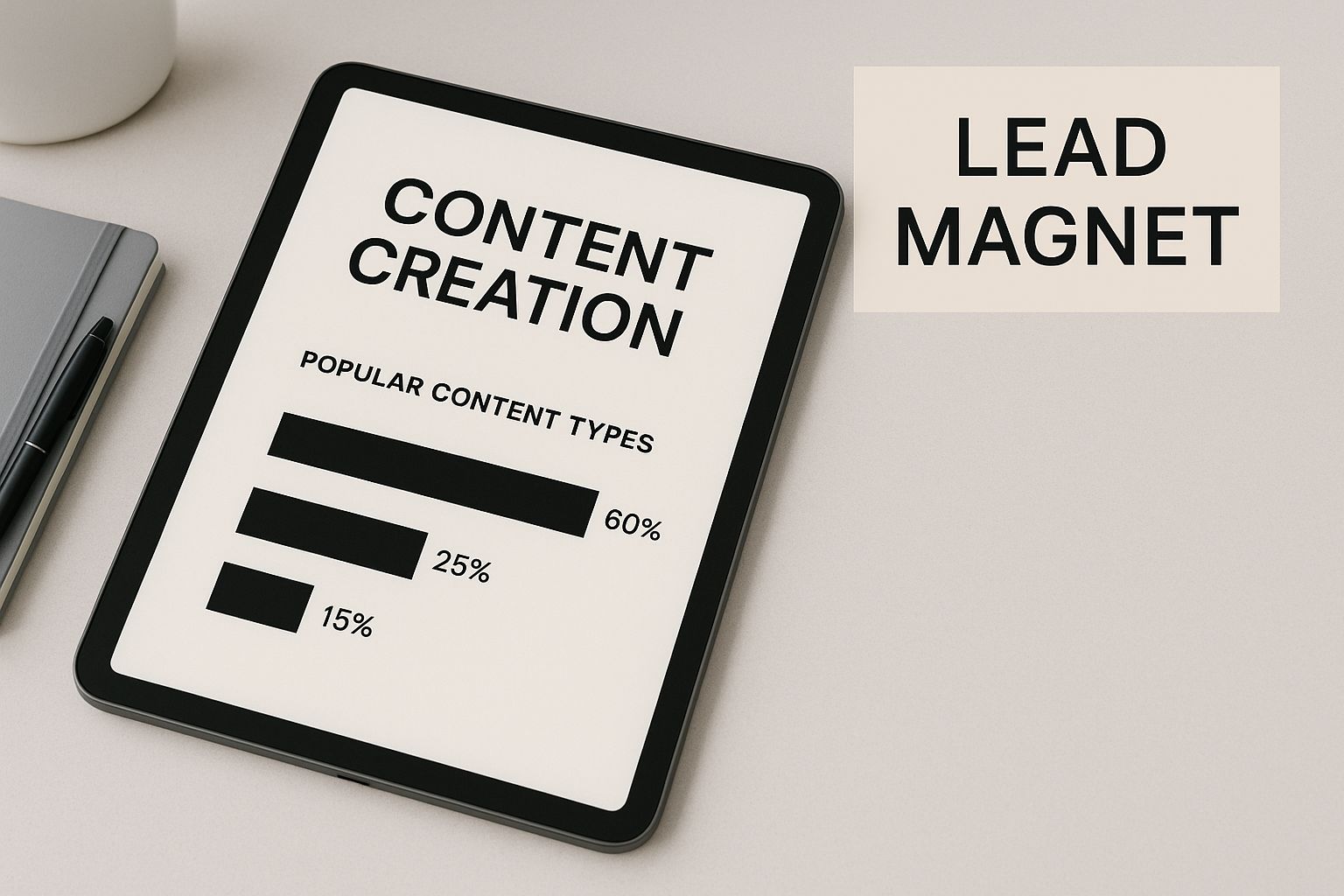
As you can see, the lead magnet sits right at the heart of your strategy—it’s the valuable exchange that turns a casual visitor into a known contact.
Comparing Lead Acquisition Channels (Lead Acquisition Strategy)
Choosing the right channels can feel overwhelming. To help, I’ve put together a simple table comparing some of the most common options for UK businesses, looking at typical costs and the kind of lead quality you can expect.
| Channel | Average Cost Per Lead | Typical Lead Quality | Best For |
|---|---|---|---|
| SEO | £5 – £50 | High | Building long-term, sustainable traffic and authority. Capturing high-intent searchers. |
| PPC (Google Ads) | £10 – £150+ | High | Capturing immediate demand from people actively searching for your solution. Testing offers quickly. |
| LinkedIn Ads | £40 – £200+ | Medium to High | Highly specific B2B targeting by job title, industry, and company size. |
| Content Marketing | £15 – £75 | High | Attracting and nurturing leads over time by providing genuine value and establishing expertise. |
| Email Marketing | < £5 | Very High | Nurturing existing leads and re-engaging past customers. The highest ROI channel. |
This is just a guide, of course. Your own costs and results will depend entirely on your industry, offer, and execution. The key is to see them not as separate tools, but as parts of a coordinated plan.
How to Pinpoint Your Priority Channels
Right, let’s move from theory to action. It’s time to do a bit of detective work. Where does your ideal customer actually spend their time online? Don’t just assume—go find out.
Your first port of call should be your existing customers. Just ask them! A quick chat or a simple survey asking how they found you and what blogs, social platforms, or forums they trust is pure gold.
Next, have a look at what your competitors are up to. Tools like Semrush or Ahrefs can show you where their traffic is coming from. Are they all-in on organic search, or are they pouring money into LinkedIn ads? This gives you massive clues about what’s already working in your niche. For example, if you sell compliance software to UK finance directors, you’re far more likely to find them on LinkedIn than on TikTok.
Finally, always consider the user’s frame of mind. The channel has to match their intent. Someone searching Google for “best accounting software for small business” is in buying mode and is a perfect target for a search ad. But someone scrolling their LinkedIn feed is in discovery mode, more open to an insightful article or a compelling case study. Your approach needs to reflect that difference.
Lead Acquisition Strategy: Crafting Offers That Actually Convert

You can pour money into the best channels, but if your message falls flat, you’re just paying to be ignored. Your offer, or lead magnet, is that crucial moment of exchange. It’s where a visitor weighs up whether giving you their email address is worth what you’re giving them in return.
Too many businesses get stuck on the generic “Download our eBook.” That’s not a strategy; it’s a default setting. To really nail lead acquisition, you need to create something so valuable and so specific to a prospect’s problem that they feel like they have to get their hands on it.
This isn’t about churning out more PDFs. It’s about creating resources that deliver immediate, tangible value. The best lead magnets solve a very specific, often urgent, problem for the exact person you want to talk to.
Going Beyond the Basic eBook
A genuinely high-converting offer doesn’t feel like a marketing ploy. It feels like a helpful tool, something that provides a quick win or a moment of clarity. Instead of another 50-page guide that’ll get saved to a desktop and forgotten, think about creating offers that are interactive, data-rich, or exclusive.
Here are a few ideas I’ve seen work incredibly well:
- Interactive Tools & Calculators: A “PPC Ad Spend ROI Calculator” or a “Website Grader” provides instant, personalised feedback. These are powerful because they give the user a bespoke answer based on their data, not generic advice.
- Industry Benchmark Reports: If you have access to unique data, package it. A “2024 UK Retail Holiday Season Performance Report” is infinitely more compelling for an e-commerce brand than another broad marketing guide they can find anywhere.
- Exclusive Webinar Access: Hosting a live event with a Q&A creates urgency and offers direct access to expertise. It’s a brilliant way to capture engaged leads who are actively looking for answers.
The common thread here is usefulness. Your offer should help someone do their job better, understand an issue more clearly, or make a smarter decision right now.
The secret to a high-converting offer isn’t its format; it’s the specificity of the problem it solves. An offer that solves a small, urgent problem for the right person will always outperform one that tries to solve a big, general problem for everyone.
Of course, a brilliant offer is only half the battle. To make sure it lands, exploring proven strategies to generate leads that convert is key to connecting your value proposition with a successful campaign.
Matching Your Offer to the Funnel Stage (Lead Acquisition Strategy)
Here’s where many strategies fall apart: using one offer for everyone. Your audience isn’t a monolith; people are at different stages of their buying journey. You need a mix of lead magnets designed for different levels of intent.
Let’s break down what that looks like in practice:
| Funnel Stage | Prospect’s Mindset | High-Converting Offer Example |
|---|---|---|
| Top of Funnel (ToFu) | “I have a problem, but I’m just starting to research it.” | A comprehensive blog post with an upgrade, like a “Beginner’s Checklist for Google Ads.” |
| Middle of Funnel (MoFu) | “I understand my problem and am now evaluating different solutions.” | A detailed case study showing how a similar company achieved specific results with your help. |
| Bottom of Funnel (BoFu) | “I’m ready to make a decision and need to choose a provider.” | A free, no-obligation PPC account audit or a personalised strategy session. |
As you can see, the offer becomes more specific and requires a higher commitment as the prospect gets closer to a decision. A visitor who’s just browsing isn’t ready for a sales call, but they’d probably love a helpful checklist. Matching the offer to their intent is fundamental.
Building a Persuasive Landing Page
Your offer could be world-class, but it’s dead in the water if the landing page doesn’t sell it. The page has one job and one job only: convince the visitor to convert. It has to be clear, compelling, and completely frictionless.
Every single element—from the headline that speaks to their pain point to the bullet points that spell out the benefits—needs to build trust and push them toward that button. Social proof, like testimonials or logos of companies you’ve worked with, is non-negotiable here.
And please, keep the form simple. Only ask for what you absolutely need. For a top-of-funnel checklist, an email address is usually enough. Every extra field you add is another reason for someone to give up and leave.
Lead Acquisition Strategy: Tweaking and Tuning – How to Really Grow Your Campaigns
Getting your campaign live is a great first step, but honestly, that’s where the real work begins. The most successful lead acquisition strategies I’ve seen aren’t born from one perfect launch. They’re forged through relentless testing, learning, and fine-tuning. This is how you turn those initial efforts into a reliable engine for growth.
Think of your first campaign as your best-educated guess. You’ve done your homework on your ideal customer and picked your channels, so you’ve got a solid hypothesis. Now, it’s time to let real-world data tell you if you were right—or, even better, show you where to improve. Managing this ongoing process is what separates the campaigns that fizzle out from the ones that deliver bigger and better returns over time.
Always Be Testing: The Power of A/B Splits
Guesswork is the arch-nemesis of a scalable lead strategy. You need to get into a mindset of systematic testing, and for that, A/B testing (or split testing) is your most valuable tool. It’s a simple concept: you create two slightly different versions of one thing—an ad, a landing page, an email—and show them to different segments of your audience to see which one gets better results.
The golden rule here is to only test one thing at a time. If you change the headline, the main image, and the call-to-action all in one go, you’ll never know which change actually moved the needle.
So, where should you start? Focus on the elements with the biggest potential impact:
- Ad Creative: Pit different images or videos against each other. Does a clean product shot work better than a shot of a happy customer using it? You’ll only know if you test.
- Landing Page Headlines: This is the first thing people see. Try framing the main benefit in a few different ways to see what resonates.
- Call-to-Action (CTA) Buttons: Experiment with the text. Does “Get Your Free Audit” pull more clicks than a simpler “Start Now”? Sometimes even changing the button colour can make a surprising difference.
- Email Subject Lines: You get one shot to earn that open. Test a direct, no-nonsense subject line against one that sparks a bit of curiosity.
By isolating these components and testing them methodically, you can make small, steady improvements. These little wins really compound over time, leading to significant gains. For those looking to really squeeze every drop of value from their ad spend, our guide on how to increase the ROI of your ads dives into more advanced techniques.
Getting Your Analytics and Tracking Right (Lead Acquisition Strategy)
You simply can’t optimise what you can’t measure. Before you spend a single pound, you have to be absolutely sure your tracking is set up perfectly. This usually means getting a tool like Google Analytics configured to track not just website traffic, but the specific conversion goals that matter to your campaign.
Remember, a “conversion” doesn’t always have to be a final sale. In a lead acquisition campaign, a conversion is whatever specific action you want the user to take next.
Set up distinct conversion goals for each key action in your funnel. This could be anything from a newsletter sign-up or a lead magnet download to a ‘contact us’ form submission. This gives you a crystal-clear view of what’s working at every single stage.
At the very least, you need to be keeping a close eye on:
- Conversion Rate: The percentage of visitors who actually complete your desired action. This is your number one indicator of how effective the campaign is.
- Cost Per Lead (CPL): Your total campaign spend divided by the number of leads you generated. This tells you exactly how much each new prospect is costing you.
- Click-Through Rate (CTR): The percentage of people who see your ad and are compelled to click it. A consistently low CTR is often a sign that your ad copy or your targeting is off the mark.
With this data in hand, you can move away from vague feelings about performance and start dealing with hard numbers that tell a clear story.
Turning Data into Smarter Decisions
Collecting the data is the easy part. The real skill is in reading between the lines and using those insights to make profitable decisions. This is where your strategy becomes a living, breathing thing. You have to be ready to act on what the numbers are telling you, even when they contradict what you thought would happen.
The scale of this is huge. Recent data shows that UK businesses generate around 1,877 leads per month on average, and 50% of marketers see lead generation as a top priority. With the average cost per lead across industries sitting at about £160, the financial incentive to manage your campaigns meticulously is enormous. You can discover more about these lead generation statistics to see just how much is at stake.
This is precisely why regular reviews are non-negotiable. Block out time every week to dig into your campaign dashboards. Look for the obvious winners and the clear losers.
- Double Down on What Works: If one particular ad has a CPL that’s half the campaign average, you’ve found a winner. Pause the ads that are dragging you down and put that budget behind your star performer.
- Cut Your Losses Quickly: Don’t get emotionally attached to a campaign that’s draining your budget. If a landing page has a dismal conversion rate after you’ve sent plenty of traffic its way, it’s time to either overhaul it based on your A/B test findings or just pause it.
- Look for Deeper Opportunities: Maybe you notice that leads from LinkedIn are converting into paying customers at a much higher rate than those from Facebook, even if the initial CPL is a bit higher. This is a crucial insight—it lets you shift focus from lead quantity to lead quality.
This constant cycle—launch, measure, iterate, repeat—is the true engine of growth. It makes sure your budget is always working as hard as it possibly can, pushing you towards a more efficient and profitable way to win new business.
Lead Acquisition Strategy: Turning Acquired Leads Into Customers
Getting a lead is a big win, but it’s not the end of the game. It’s just the beginning. The real magic happens in the next step: carefully turning that initial flicker of interest into a loyal, paying customer. If you don’t have a solid plan for this, even the best leads will go cold, and all that hard work and ad spend will have been for nothing.
This is where the handover from marketing to sales needs to be absolutely seamless. It’s a critical moment that relies on a smart mix of automation, clear priorities, and genuine teamwork. Nail this transition, and you’ll not only create a fantastic experience for your prospect but also see your conversion rates climb.
Prioritising with Lead Scoring
Let’s be honest, not all leads are created equal. Some people are ready to talk to sales right now, while others are just starting their research. The trick is knowing who’s who. That’s where lead scoring comes in. Think of it as a triage system for your sales team, helping them focus their precious time on the opportunities most likely to close.
Lead scoring is simply a system of assigning points to leads based on who they are and what they do. The higher the score, the more “sales-ready” they are. This usually boils down to two types of data:
- Demographic Scoring: This is all about how well a lead matches your Ideal Customer Profile (ICP). You award points for things like their job title, company size, industry, or location. For example, a “Marketing Director” at a 500-person tech firm in the UK would naturally score higher than an intern in a completely different sector.
- Behavioural Scoring: Here, you’re awarding points for their actions. Someone visiting your pricing page is a huge buying signal and should get a lot of points. Downloading a detailed case study shows far more intent than just reading a high-level blog post.
When you combine these scores, a clear picture emerges. Leads that hit a certain score—say, 100 points—are flagged as a Marketing Qualified Lead (MQL). This is the green light for them to be passed straight over to your sales team for an immediate follow-up.
Nurturing Leads with Automated Sequences (Lead Acquisition Strategy)
What about all those leads who aren’t quite ready for a sales call? Just letting them drift away is a huge mistake. In fact, research shows that companies who are great at lead nurturing generate 50% more sales-ready leads at a 33% lower cost. This is where automated email nurturing sequences become your best friend.
These aren’t just random email blasts. A proper nurturing sequence is a thoughtfully crafted series of emails designed to deliver real value, build trust, and gently guide a prospect along their journey.
Imagine someone downloads your beginner’s guide to Google Ads. A simple nurturing sequence might look like this:
- Email 1 (Immediate): Delivers the guide, says thank you, and keeps it simple.
- Email 2 (2 Days Later): Offers a related, more advanced piece of content, like a case study showing how a similar company smashed their goals with Google Ads.
- Email 3 (4 Days Later): Invites them to a webinar on common PPC mistakes to avoid.
Each email is helpful and directly relates to their original interest. You’re positioning your brand as a trusted expert long before you ever ask for a sale. This methodical approach is fundamental to increasing your conversion rate. It’s why so many agencies have developed proven strategies to turn clicks into conversions that lean heavily on this kind of thoughtful, automated follow-up.
Aligning Marketing and Sales with an SLA
The final, and arguably most important, piece of this puzzle is making sure your marketing and sales teams are on the same page. The friction between these two departments is an age-old problem in business, and it almost always leads to dropped leads and lost revenue. The best fix? A formal Service-Level Agreement (SLA).
An SLA is essentially a contract between your teams. It lays out exactly what each team commits to the other, removing any grey areas and making sure everyone is accountable for their role in bringing in revenue.
A good SLA needs to define a few key things:
- The exact definition of an MQL: What specific criteria (like a lead score or a particular action) must be met before marketing hands a lead over?
- Sales follow-up protocol: How quickly does the sales team have to contact a new MQL? Within an hour? Within 24 hours? Speed is everything.
- The lead recycling process: What happens if a lead isn’t ready to buy after that first chat? The SLA should clearly state how and when that lead gets passed back to marketing for more nurturing.
This kind of alignment creates a closed-loop system where no lead ever falls through the cracks. It transforms your process from a series of clunky handoffs into a single, smooth, revenue-generating machine.
Lead Acquisition Strategy: Measuring the ROI of Your Strategy

A lead acquisition strategy is only as good as the results it delivers. It’s one thing to keep the sales pipeline full, but quite another to prove its value in cold, hard cash. To make a compelling case for more budget and to figure out what’s really working, you have to look past the surface-level vanity metrics.
Clicks and impressions might look good in a report, but they don’t pay the bills. What the board and budget holders actually want to see is the return on investment (ROI). This means drawing a direct line from your marketing spend to the revenue it generates, and that requires a few essential, business-focused metrics.
Key Metrics That Actually Matter
To get a true picture of your strategy’s financial health, you need to get comfortable with a handful of core calculations. These are the numbers that shift the conversation from “we got 1,000 clicks” to “we generated £50,000 in new business from a £5,000 spend.”
Here’s what you should be tracking:
- Customer Acquisition Cost (CAC): Put simply, this is your total cost to land one new paying customer. You find it by dividing your total sales and marketing spend over a set period by the number of new customers you won in that same timeframe.
- Customer Lifetime Value (CLV): This is an estimate of the total revenue you can expect from a single customer over the entire course of their relationship with you. It’s a crucial metric for understanding the long-term impact of your acquisition efforts.
- Lead-to-Customer Conversion Rate: A straightforward percentage that tells you how many leads actually become paying customers. If this number is low, it could point to poor lead quality or a bottleneck in your sales process.
The real magic happens when you compare your CAC to your CLV. A healthy, sustainable business model typically aims for a CLV that is at least three times its CAC. If it costs you £1,000 to acquire a customer who will only ever spend £1,200 with you, that’s a red flag – your model isn’t built for long-term growth.
Calculating Your Customer Acquisition Cost (Lead Acquisition Strategy)
Let’s walk through a quick, practical example of how to calculate your CAC. Imagine that over the last quarter, your company’s lead generation costs looked like this:
| Expense Category | Amount Spent |
|---|---|
| Paid Ad Spend (Google & LinkedIn) | £10,000 |
| Marketing Software Subscriptions | £1,500 |
| Marketing Team Salaries (Portion) | £15,000 |
| Total Sales & Marketing Spend | £26,500 |
During that same quarter, all that hard work brought in 50 new customers.
The calculation is refreshingly simple: Total Spend / New Customers = CAC
So, for this example: £26,500 / 50 = £530. Your CAC for the quarter was £530 per customer. Knowing this number is the first step toward making smarter budget decisions and optimising your channels.
Building a Simple Attribution Model
Attribution is all about figuring out which marketing touchpoints get the credit for a conversion. Without it, you’re flying blind. Was it the SEO work, the PPC ad, or that email campaign that actually sealed the deal?
While you can get lost in complex multi-touch attribution models, you don’t need to overcomplicate things at the start.
First-Touch Attribution gives 100% of the credit to the very first channel a customer interacted with. It’s fantastic for seeing which channels are best at creating initial awareness and bringing people into your world.
Last-Touch Attribution gives all the credit to the final touchpoint before a conversion. This model is perfect for identifying which channels are most effective at closing the deal.
Most analytics platforms, including Google Analytics, default to a last-touch model, so it’s a great place to start. Dive into your conversion data and look for patterns. Which channels consistently show up as the final step before someone fills out a form? This gives you a clear indication of your strongest “closing” channels, helping you decide where to allocate more budget for immediate results. Getting this right is a fundamental part of mastering ROI in your paid advertising efforts.
Once you adopt this data-driven mindset, your role changes. You’re no longer just a marketer spending money; you’re a strategic growth partner, demonstrating a clear, measurable contribution to the company’s bottom line.
Answering Your Top Lead Acquisition Questions
When you’re deep in the weeds of building a lead acquisition strategy, certain questions always seem to pop up. Let’s tackle some of the most common ones I hear from clients, cutting through the noise to give you some straight answers.
How Long Until I Actually See Results?
This is always the million-dollar question, isn’t it? The honest answer is that it really boils down to the channels you’re using.
If you’re running a sharp, well-optimised paid search campaign, you could genuinely start seeing leads trickle in within a few days. The beauty of paid channels is that immediate feedback loop – you get traffic and data almost instantly.
On the other hand, organic strategies like SEO and content marketing are a marathon, not a sprint. You’re playing the long game here, building genuine authority and earning your spot at the top of the search results. This can often take a good 6-12 months to bear fruit, but the payoff is huge: a reliable stream of high-intent leads that keeps coming, even when you dial back the ad spend.
What’s a Realistic Starting Budget?
There’s no one-size-fits-all figure, but a good rule of thumb for many B2B companies is to earmark around 5-10% of their target revenue for lead acquisition. But honestly, the initial amount is less important than how you deploy it.
My advice? Start small and focused. Pick one or two channels where you feel the most potential lies and allocate a test budget you’re comfortable with. Then, watch your Cost Per Acquisition (CPA) like a hawk. Once you see a positive return, you’ll have the data and the confidence to scale things up.
The real aim isn’t to outspend your competitors; it’s to out-think them. Prove the model works on a small scale first. You earn the right to a bigger budget with solid performance data.
What’s the Difference Between Lead Acquisition and Demand Generation?
It’s easy to get these two mixed up, but the distinction is crucial for your strategy.
Think of demand generation as the top of your funnel. It’s the broader art of creating awareness and making people in your market realise they have a problem that you’re uniquely positioned to solve. It’s about warming up the audience and building interest from scratch.
Lead acquisition, then, is the specific action of capturing contact information from the people you’ve just warmed up. You generate the demand first, then you acquire the lead. You need both working in harmony for a healthy sales pipeline, and knowing how to calculate customer lifetime value is absolutely vital for measuring the long-term success of it all.
Ready to stop guessing and start growing? The team at PPC Geeks builds data-driven lead acquisition campaigns that deliver real results. Get in touch for a free, no-obligation audit of your current strategy. Learn more at: https://ppcgeeks.co.uk/


