




Guide to Modern Paid Search Analysis: Paid search analysis is really just the process of digging into your pay-per-click (PPC) data to figure out what’s working, what isn’t, and where the hidden opportunities are.
It’s about moving past the flashy, surface-level numbers and turning raw data into actionable insights that cut wasted spend and boost your return on investment.
Guide to Modern Paid Search Analysis: Building Your Paid Search Analysis Framework

Before you even think about opening a spreadsheet, you need a game plan. What does a successful analysis actually look like for your business? This isn’t about chasing vanity metrics like clicks and impressions; it’s about building a solid framework that connects every click and every penny spent back to real business results.
Without a clear plan, you’re just adrift in a sea of data.
A proper paid search analysis starts with defining clear, measurable objectives that are completely in sync with your company’s wider goals. Are you trying to drive more online sales? Generate better leads for the sales team? Or maybe just get your brand name out there in a new market? Each of these goals needs a totally different approach and a focus on different metrics.
Selecting Your Key Performance Indicators
Guide to Modern Paid Search Analysis: Once you know what you’re aiming for, you need to pick the Key Performance Indicators (KPIs) that will tell you the true story of your campaign’s health. Don’t get bogged down by every metric under the sun. Zero in on the ones that directly measure your main objective.
For an e-commerce brand obsessed with profitability, the holy grail is Return on Ad Spend (ROAS). It’s simple: how much revenue are you getting for every pound you put in? But if you’re a service business chasing leads, your world probably revolves around Cost Per Acquisition (CPA). That tells you exactly what it costs to land one new customer.
Here are a few essential KPIs that should be on your radar:
- Click-Through Rate (CTR): A great pulse check for ad relevance. Is your message actually hitting home with your audience?
- Conversion Rate: The percentage of clicks that turn into action. This tells you if your landing pages and offers are doing their job.
- Quality Score: Google’s own rating of your ads, keywords, and landing pages. A higher score means lower costs and better positions. It’s a big deal.
- Impression Share: Shows how often your ads are appearing versus how often they could have. It’s a great way to spot opportunities you’re missing due to budget or rank.
A classic mistake is treating all KPIs as equals. A sky-high CTR means nothing if those clicks aren’t converting. Your framework absolutely must prioritise the metrics that impact your bottom line, not just the ones that look good on a chart.
Choosing the Right Analysis Tools
With your goals and KPIs locked in, it’s time to pick your tools. Your paid search toolkit doesn’t need to be ridiculously complex, especially when you’re just getting started.
The native dashboards inside platforms like Google Ads and Microsoft Advertising are packed with information and are the perfect place to begin.
For a deeper dive, Google Analytics is non-negotiable. It helps you see what happens after the click, tracking how people behave on your site and tying conversions back to the campaigns that brought them there. As you grow, you might look into more advanced platforms, but the key is to start with tools that make it easy to track the KPIs you’ve chosen and report on the progress you’re making.
Guide to Modern Paid Search Analysis: Sourcing and Structuring Your Campaign Data
Your analysis is only ever as good as the data you feed it. To do any kind of meaningful paid search analysis, you’ve got to start with accurate information, and that means learning how to cut through the noise of countless metrics. It all begins with pulling the right data from platforms like Google Ads and Microsoft Advertising.
Forget exporting every single column available. That’s a one-way ticket to a headache. The real goal is to build a clean, centralised dataset that actually tells a story, and that means focusing on the essentials that tie directly back to your KPIs.
Pulling the Most Critical Data Points
Guide to Modern Paid Search Analysis: To build a solid foundation, you need a consistent set of metrics from your ad platforms. Think of these as the core ingredients that give you a complete picture of performance, moving you beyond just looking at simple clicks and spend.
Your essential data export should always include:
- Impressions and Cost: The absolute basics – how many people are seeing your ads and what you’re paying for it.
- Clicks and Click-Through Rate (CTR): This tells you how engaging and relevant your ads are.
- Conversions and Conversion Rate: The ultimate test. Are your campaigns actually driving results?
- Quality Score: A vital diagnostic from Google that has a direct impact on your costs and ad rank. Don’t ignore it.
- Impression Share (and Lost IS): This shows you how much of the available market you’re capturing and highlights missed opportunities due to budget constraints or poor ad rank.
Sticking to this focused list helps you avoid “analysis paralysis.” A jumbled spreadsheet is the enemy of clarity; a well-structured one is your best friend in this game.
Creating a Centralised Data Hub
Once you have your raw data, the next job is to get it organised. Fight the temptation to work straight from messy, one-off CSV files. Instead, create a central hub using a tool like Google Sheets or a more advanced data visualisation platform. This creates a single source of truth for everyone.
The goal is to establish a reliable, clean dataset that eliminates inconsistencies. When you trust your data, you can trust the conclusions you draw from it, which is the cornerstone of effective paid search analysis.
Start by structuring your data with clear columns and consistent date ranges. For example, you could have different tabs for each month, making it easy to spot trends over time. Getting comfortable with functions like VLOOKUP or pivot tables will help you merge data from different sources or summarise performance at the campaign or ad group level. A well-organised data hub is less of a chore and more of a strategic asset. If you’re looking to take this a step further, you can find more guidance in our comprehensive guide on how to audit PPC ads effectively.
It’s also worth remembering that the UK digital marketing scene is incredibly connected. What happens in social media advertising—a market set to hit £9.95 billion in 2025—often reflects the competitive pressures we see in paid search. As businesses ramp up their budgets everywhere, the need for sharp, data-driven analysis only gets more critical.
With mobile PPC spend expected to account for 66% of all digital ad spending by 2025 and Google search ad conversion rates averaging 6.69% in 2024, your ability to structure and analyse mobile performance data will be a key differentiator.
How to Make Sense of the Data and Find Real Insights

Alright, you’ve got your data organised. Now for the fun part. This is where you stop being a data collector and start being a data detective. You’re about to turn all those raw numbers into a story that tells you exactly what to do next.
The real magic isn’t in just reporting the numbers; it’s in digging deep to uncover the why behind them.
This means looking past the obvious stuff like clicks and impressions. You have to start questioning everything, connecting the dots between different metrics, and coming up with ideas about what’s actually driving your performance. It’s all about spotting patterns, investigating anything that looks odd, and turning a spreadsheet into your most powerful decision-making tool.
Guide to Modern Paid Search Analysis: Nail Your Keyword Analysis
Your keywords are the absolute foundation of your paid search campaigns. Getting this right is where you’ll find some of your biggest and quickest wins. The mission is simple: find the terms that are draining your budget and discover the hidden gems that deserve more of your cash.
Start by sorting your keywords by cost. Have a good look at the top spenders. Are they actually bringing in the sales? If a keyword is gobbling up a huge chunk of your budget but has a terrible conversion rate or a sky-high Cost Per Acquisition (CPA), that’s a massive red flag.
Next, you need to get into the Search Terms Report. Seriously, this is non-negotiable. This report shows you the exact search queries people typed into Google to trigger your ads. It’s an absolute goldmine.
- Discover Negative Keywords: You’ll often find your ads showing up for totally irrelevant searches. For instance, a company selling high-end “wooden dog beds” might discover they’re paying for clicks from people searching for “free wooden pallets for beds.” Adding “free” and “pallets” as negative keywords instantly plugs that leak in your budget.
- Find New Keyword Opportunities: The report will also uncover long-tail keywords with high intent that you hadn’t even thought of. A search for “hypoallergenic wooden dog bed for spaniels” shows someone who knows exactly what they want. That’s a perfect candidate to add as a new exact-match keyword.
The Search Terms Report is the single most powerful tool for sharpening your targeting. Making a habit of reviewing it and constantly building your negative keyword list is one of the highest-impact things you can do. It’s the difference between surgical precision and just spraying your budget and hoping for the best.
Figure Out What Your Ad Copy is Telling You
Your ad copy is the critical link between someone’s search and your website. Looking at how it performs tells you which messages are hitting the mark and which are completely missing it. And you’ve got to look beyond just the Click-Through Rate (CTR).
Look for themes in your best and worst ads. Do the ads that mention “Free UK Delivery” consistently do better than those that don’t? Do ads with a punchy Call-To-Action (CTA) like “Shop Now” have a higher conversion rate than ones with a softer CTA like “Learn More”?
Let’s take a real-world example. An online clothing shop is running two different ads for its summer dress collection:
- Ad A Headline: “Stylish Summer Dresses | New Collection Out Now”
- Ad B Headline: “5-Star Rated Summer Dresses | Free Next-Day Delivery”
Ad A might get a perfectly fine CTR. But a proper analysis shows that Ad B has a 30% higher conversion rate. The takeaway? For this audience, social proof (“5-Star Rated”) and a concrete benefit (“Free Next-Day Delivery”) are far more persuasive than just announcing a new line. This insight doesn’t just improve one ad; it shapes the entire messaging strategy from here on out. Dialling in this level of performance is crucial for maximising your Google Ads ROI, a topic we dig into more in our guide for UK brands.
Analyse What Happens After the Click
The journey doesn’t end when someone clicks your ad—it’s just getting started. A solid paid search analysis has to look at what happens after the click by examining landing page performance. A great CTR followed by a rubbish conversion rate usually signals a major disconnect between your ad and your landing page.
To get the full story, make sure your Google Ads account is linked to Google Analytics. Check metrics like Bounce Rate and Time on Page for your main landing pages. A high bounce rate is a huge clue that the page isn’t living up to the ad’s promise or that the user experience is poor.
For example, if your ad shouts about a “50% Off Sale,” the user needs to land on a page where the sale items are front and centre, not your generic homepage. If they have to go searching for the deal, they’re gone. Your analysis should confirm a smooth, consistent journey from keyword to ad to landing page. This is how you turn raw data into a clear plan for improvement.
Guide to Modern Paid Search Analysis: Turning Your Insights into Optimisation Actions
Right, you’ve done the heavy lifting and crunched the numbers. But here’s the thing: analysis is fascinating, but an insight without action is just a wasted opportunity. This is where your paid search analysis stops being a report and starts being a roadmap for genuine campaign improvements. It’s about creating a solid feedback loop where data directly fuels your next move.
The goal now is to translate what you’ve found into a clear, prioritised to-do list. This isn’t about making random tweaks and hoping for the best. It’s about making strategic adjustments based on the evidence you’ve just uncovered. We’ll look at how to shift your budget for maximum impact and fine-tune your bidding to really drive profitability.
Prioritising Your Optimisation Efforts
Guide to Modern Paid Search Analysis: After a deep dive, you’ll probably have a long list of things you could do. The key is knowing where to start. You need to zero in on the actions that will deliver the biggest bang for your buck with the least amount of effort.
A simple framework can really help you cut through the noise:
- High Impact, Low Effort: These are your quick wins. Think about adding high-performing search terms as new exact-match keywords or immediately pausing an ad group that’s haemorrhaging cash with zero conversions. Jump on these first.
- High Impact, High Effort: These are the bigger projects, like overhauling a key landing page or restructuring an entire campaign. They’re crucial, but they need proper planning.
- Low Impact, Low Effort: These are the small tweaks, like minor ad copy adjustments. Worth doing when you have a spare moment, but they shouldn’t take priority over bigger opportunities.
- Low Impact, High Effort: Avoid these like the plague. They gobble up valuable time for very little return.
This approach ensures you’re always working on the stuff that will actually move the needle, creating momentum and getting faster results.
Reallocating Your Budget Based on Performance
One of the most powerful things you can do is shift your budget from areas of waste to areas of opportunity. Your paid search analysis should have clearly signposted where your money is working hardest.
For instance, let’s say your analysis shows your campaign targeting “London” has a brilliant ROAS of 8:1, but the “Manchester” campaign is limping along at 2:1. The obvious next step is to pull some of that Manchester budget and pump it into the London campaign, fuelling your most profitable activity. This isn’t just about cutting costs; it’s about smart reinvestment.
Don’t be afraid to be decisive. If a keyword, ad group, or campaign consistently underperforms despite your best efforts, it’s often better to just pause it and redirect that spend to a proven winner. Holding onto poor performers out of hope is a common way to drain your budget.
Refining Your Bidding Strategies for Profitability
Your bidding strategy is a direct lever for profitability. A classic finding during analysis is that a campaign has a high CTR and lots of traffic but a disappointingly low ROAS. This often points to a bidding problem.
Imagine you run an e-commerce store selling artisan coffee. Your keyword “buy fresh roasted coffee beans” has a great conversion rate, but the Cost Per Acquisition (CPA) is sky-high, eating into your profit margin. Based on your analysis, you might decide to:
- Lower the Max CPC Bid: Gradually reduce your bid for that keyword. You want to bring the CPA down to a profitable level, even if it means sacrificing a bit of impression share.
- Switch to a Target ROAS Strategy: If you have enough conversion data, you can let Google’s automated bidding optimise for a specific return, such as aiming for £5 in revenue for every £1 spent.
The goal is to find that sweet spot where you’re capturing valuable clicks without overpaying for them. For a deeper dive, you might find our expert guide on how to improve Google Ads performance useful.
This infographic breaks down the core calculations—CTR, Conversion Rate, and CPA—that are the foundation of these optimisation decisions.
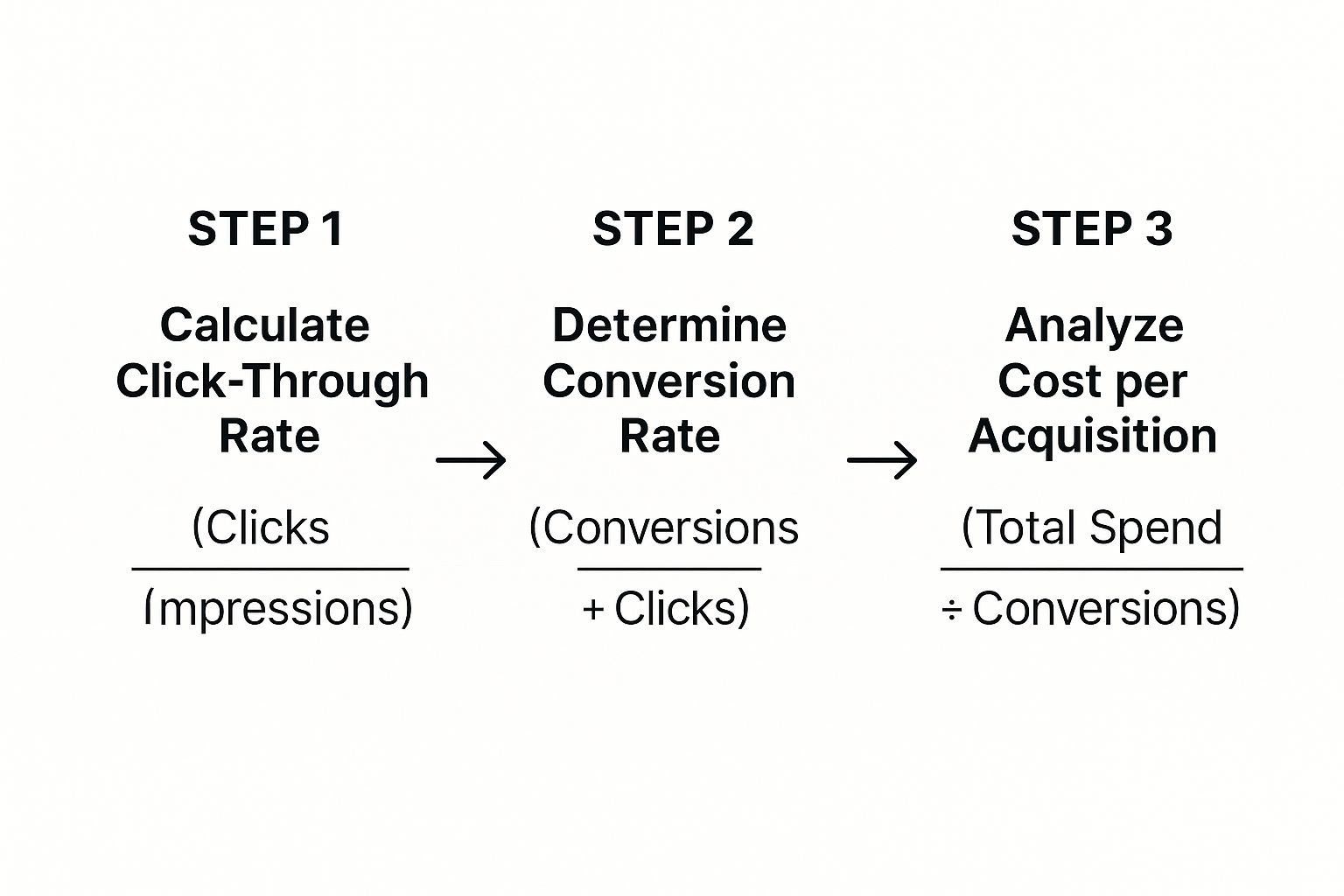
Getting your head around this flow is vital. A weakness in any single step, like a poor conversion rate on your landing page, will directly inflate your final cost per acquisition.
Building a Powerful Negative Keyword List
Guide to Modern Paid Search Analysis: Finally, let’s talk about the unsung hero of campaign optimisation: the negative keyword list. Your Search Terms Report has done the hard work of uncovering all the irrelevant queries that are wasting your money. Now, you have to act on it.
This is a continuous process, not a one-and-done task. Every irrelevant click is a small leak in your budget; over time, those leaks can sink a campaign. For example, a company selling premium software might find they’re paying for clicks from searches like “free software download”. Adding “free” as a negative keyword immediately plugs that hole.
By consistently turning your analytical insights into these kinds of targeted actions, you create a cycle of constant improvement that drives real, sustainable growth.
Taking Your Analysis to the Next Level with AI
To really pull ahead of the pack, you have to look beyond the standard reports and familiar metrics. This is where advanced paid search analysis and a smart dash of Artificial Intelligence (AI) come into play, giving you a serious competitive edge. Let’s get into how you can conduct a razor-sharp competitor analysis, actually understand the full customer journey, and see how AI is completely changing the game.
This shift towards deeper, more sophisticated analysis isn’t just a “nice to have” anymore; it’s essential. In the UK, digital advertising is absolutely booming, with revenue expected to soar past £40 billion by 2025. With 65% of UK businesses already in the paid search arena, the competition is getting fierce. It’s no surprise, then, that 94% of UK digital marketers are already using AI to get an edge, a trend retail leaders are banking on for future growth. You can dig into more of these trends from recent UK digital marketing data over at SearchHog.co.uk.
Guide to Modern Paid Search Analysis: Uncovering Competitor Strategies
A proper deep-dive into your competitors is about more than just seeing who else bids on your keywords. It’s about reverse-engineering their entire strategy to find the cracks and opportunities you can exploit. Modern tools are fantastic for this, letting you benchmark your own performance and spot those strategic gaps.
Start by asking the right questions about the competition:
- What keywords are they bidding on that you aren’t? This is a goldmine. It could reveal new product lines they’re testing or even customer segments you’ve completely missed.
- What’s their messaging and what offers are they pushing in their ad copy? Look for patterns. What calls-to-action do they repeat? What promotions seem to be their go-to? What are their unique selling points?
- Which landing pages are they sending all that traffic to? This is a direct window into their conversion strategy and what they think a good user experience looks like.
Answering these gives you a blueprint of what’s already working in your market. It allows you to adapt your own campaigns with tactics that are proven to work, rather than just throwing things at the wall and hoping they stick.
Demystifying Attribution Modelling
Honestly, most ad platforms do us a disservice by defaulting to “last-click attribution.” This model gives 100% of the credit for a sale to the very last ad a customer clicked. It’s a dangerously simplistic view of what is almost always a complex journey.
Think about it. A customer might see one of your display ads, click a generic search ad a few days later, and then finally convert a week after that through a branded search ad. Last-click completely ignores the crucial role of those first two touchpoints.
Moving beyond last-click is a non-negotiable part of advanced paid search analysis. By exploring models like linear, time-decay, or data-driven attribution, you get a much more realistic picture of how different channels and campaigns work together to land a conversion.
This simple shift in perspective can stop you from making a huge mistake, like pausing an “underperforming” top-of-funnel campaign that’s actually your primary source for introducing new customers who convert down the line. It ensures you value every single step of the journey, not just the final one.
The Growing Role of AI in Paid Search Analysis
Guide to Modern Paid Search Analysis: Artificial Intelligence isn’t some futuristic buzzword anymore; it’s a practical, hands-on tool that is reshaping how we all approach paid search. AI-powered platforms can sift through colossal amounts of data faster than any human ever could, spotting patterns and connections that would otherwise fly straight under the radar.
For marketing managers, this is a game-changer. It means:
- Automated Data Interpretation: AI can flag performance issues in real-time, like a sudden drop in Quality Score, and often suggest the likely causes before you even notice there’s a problem.
- Predictive Analytics: These tools can forecast campaign outcomes based on historical data, helping you make much smarter decisions about where to put your budget.
- Intelligent Recommendations: AI can serve up optimisation suggestions on a plate, from new keywords to try to smart bid adjustments. This frees you up to focus on high-level strategy instead of getting bogged down in manual, in-the-weeds tasks. A perfect example is how AI fuels Google Ads Smart Bidding strategies, which automatically optimises your bids for conversions in real-time.
Got Questions About Paid Search Analysis? We’ve Got Answers.

Even with the best plan in place, you’re always going to hit a few practical questions when you’re in the thick of paid search analysis. Getting straight answers to these common hurdles is the key to sharpening your process and feeling confident in the calls you make.
So, let’s jump into some of the most frequent queries we hear from marketing managers. This isn’t about theory; it’s about giving you straightforward advice you can run with today.
How Often Should I Be Doing a Deep Dive Analysis?
It’s incredibly tempting to obsessively check your core metrics every single day. The problem? You end up making knee-jerk reactions to normal, everyday wobbles in the data.
For a proper, comprehensive deep-dive, you should be doing this monthly. This gives you enough data to spot genuine trends and make smart, strategic decisions without getting bogged down in the daily noise.
Of course, there are a couple of exceptions:
- Big Spenders: If you’re managing a particularly hefty budget, running a deep dive every two weeks is a smart move.
- New Campaign Launches: For the first month of any new campaign, a weekly analysis is absolutely vital to get it pointing in the right direction fast.
Beyond that, make sure to schedule quarterly strategic reviews. This is your moment to zoom out, see how performance stacks up against your bigger business goals, and map out major changes for the next quarter. It’s the perfect rhythm for balancing close oversight with big-picture thinking.
Guide to Modern Paid Search Analysis: What’s the Single Biggest Mistake People Make in Paid Search Analysis?
Without a doubt, the most common pitfall is getting fixated on vanity metrics while completely ignoring what actually moves the needle for the business. It’s far too easy to get a buzz from a high Click-Through Rate (CTR) or a spike in impressions, but on their own, these numbers are pretty meaningless.
A sky-high CTR is totally useless if none of those clicks are turning into profitable customers.
The whole point of paid search analysis is to draw a straight line from your ad spend to your bottom line. Always, always anchor your work in business-focused metrics like Return on Ad Spend (ROAS) or Cost Per Acquisition (CPA). That’s how you know you’re driving real growth, not just traffic.
How Can I Analyse Performance When I’m on a Tiny Budget?
Guide to Modern Paid Search Analysis: When you’re working with a small budget, your analysis has to be ruthless. Every single penny counts, so your mission is to hunt down and eliminate every last bit of waste. Your focus needs to be laser-sharp on wringing every drop of value out of your limited spend.
Zero in on these critical areas:
- Keyword Performance: Live in your Search Terms Report. Be aggressive with your negative keyword list and cut any term that isn’t converting or has a CPA you can’t sustain.
- Ad Scheduling: Get stuck into your hourly and daily performance reports. Are you burning cash at 3 AM with zero conversions to show for it? Restrict your ads to run only during your most profitable windows.
- Geographic Targeting: It’s the same story for location. Analyse which cities or regions are delivering the goods, concentrate your budget there, and pause everything else.
You simply can’t afford to be sentimental with a tight budget. A focused analysis aimed at cutting waste is your most powerful weapon.
Feeling a bit lost in the data? The team at PPC Geeks can do the heavy lifting for you. We provide in-depth, free PPC audits to find hidden opportunities and plug the leaks in your ad spend. Find out how we can help you grow your business.