




What Is Marketing Mix Modeling: Marketing Mix Modeling, or MMM, is a statistical technique that helps you figure out how much each part of your marketing is actually contributing to your bottom line. Think of it as a master recipe analysis; it sifts through historical data to tell you the precise impact of each ‘ingredient’—from your TV ads to your social media spend—on your overall success.
Understanding Marketing Mix Modeling in Simple Terms

Imagine you’ve baked the perfect cake. You threw in a bunch of ingredients: flour, sugar, eggs, and some high-quality chocolate. You know the cake is delicious, but you can’t be sure exactly what made it so good. Was it the premium chocolate, or did you just nail the amount of sugar?
That’s where Marketing Mix Modeling comes in. It acts as the master recipe analysis for your business, using powerful statistical methods to untangle the complex web between your marketing efforts and your sales figures.
By digging into past performance, MMM shows you which channels are genuinely driving growth and which ones aren’t really pulling their weight. It gives you that panoramic view, helping you understand the combined effect of everything you’re doing.
This method looks at your entire ‘marketing mix’—all the different ways you promote your business—and weighs it against your key performance indicators, whether that’s revenue, sign-ups, or website conversions.
To make things clearer, let’s break down the core ideas behind MMM in a simple table.
Marketing Mix Modeling at a Glance
| Concept | Description |
|---|---|
| Holistic Analysis | Examines the impact of all marketing activities (online and offline) together. |
| Historical Data | Uses past performance data (typically 2-3 years) to find patterns and correlations. |
| Top-Down View | Looks at aggregated data rather than individual user actions, making it privacy-friendly. |
| Budget Optimisation | Provides insights to help you allocate your marketing budget for the best possible return. |
| Strategic Insight | Helps you understand the true ROI of each channel and make smarter, data-driven decisions. |
This overview gives you a snapshot of what MMM is all about: using a wide-angle lens to get a complete picture of your marketing performance.
A Top-Down Perspective
Unlike other measurement techniques that obsess over individual user clicks, MMM takes a ‘top-down’ or aggregated view. It doesn’t need to follow specific customers around the internet with tracking cookies.
Instead, it analyses broad datasets over a long period to spot correlations. For example, it might find that a 15% increase in your YouTube ad spend last quarter directly corresponded with a 5% uplift in total sales, even after accounting for things like seasonal demand.
This privacy-first approach is a huge reason why it’s making a major comeback. With user tracking becoming more and more restricted, MMM offers a reliable way to measure marketing effectiveness without compromising user privacy.
Beyond Digital Clicks
One of the biggest strengths of what is marketing mix modeling is its ability to measure both online and offline channels in one unified analysis. It can size up the impact of pretty much everything, including:
- Digital advertising (like Google Ads and social media campaigns)
- Traditional media (TV, radio, and print ads)
- Promotions and special discounts
- External factors like a competitor’s big launch or shifts in the economy
This holistic view is becoming absolutely critical for UK marketers, who are grappling with data fragmentation due to tough privacy laws and the end of third-party cookies. Since MMM relies on aggregated historical data, typically over two or three years, it can statistically pinpoint each channel’s contribution while respecting user privacy.
By seeing how all these different elements work in harmony (or don’t!), businesses can make much smarter, data-backed decisions on where to put their money for the maximum return. This is a fundamentally different approach to the more granular methods, which you can read about in our article explaining what is marketing attribution.
Why MMM Is a Must-Have for Today’s Marketers
In a world full of data privacy rules and walled-garden platforms like Google and Meta, figuring out what’s actually working in your marketing mix has become a massive headache. The old ways of measuring performance just don’t cut it anymore, making Marketing Mix Modelling less of a “nice-to-have” and more of an essential tool for getting a real grip on your spend.
For years, marketers were hooked on last-click attribution. This is the model that gives 100% of the credit for a sale to the very last ad a customer clicked. Simple, yes, but it paints a completely skewed picture of what’s driving your business.
This approach massively overvalues the digital channels that are easy to track, while giving zero credit to the powerful, long-term impact of brand building. Your billboard, your TV ad, or that big PR splash might have been what really sparked a customer’s interest, but last-click completely ignores them.
Seeing the Bigger Picture
This is exactly where MMM comes in. It offers a holistic, top-down view that works alongside the granular data from your digital campaigns. It doesn’t get lost in the weeds of individual clicks; instead, it looks at the entire marketing ecosystem to show you what’s truly driving growth.
Marketing Mix Modelling gives you a unified measurement framework. It finally lets you prove the value of every pound spent, whether it’s on a city-centre billboard or a hyper-targeted search ad. It connects the dots that other models can’t see.
This complete view gives leaders the confidence to make those big-budget decisions. Instead of just guessing the ROI of a podcast sponsorship, MMM gives you a statistical reason to believe in its contribution to sales, putting it on a level playing field with your digital ads.
A Privacy-First Answer for a Cookieless Future
The recent comeback of MMM is also a direct result of the changing privacy landscape. With tougher UK privacy laws and the slow death of third-party cookies, getting hold of detailed, user-level data is becoming nearly impossible. Platforms are turning into ‘walled gardens’, making it harder than ever to see how users behave across the web.
Here, MMM’s reliance on aggregated, historical business data becomes a huge plus. The ISBA points out that this method allows UK marketers to bring together different data sources without ever compromising user privacy. Plus, new technology is making these models quicker and cheaper than ever, allowing them to handle complex data from both online and offline channels with ease. You can dive deeper into these trends in the full analysis on MMM’s growing importance by ISBA.
By getting to grips with what marketing mix modelling is, you’re future-proofing your entire measurement strategy. You’re making sure you can keep optimising your spend and proving marketing’s value, no matter what changes are just around the corner.
The Key Ingredients of an Effective MMM (What Is Marketing Mix Modeling)

To really get your head around what is marketing mix modelling, you need to break it down into its core ingredients. Think of it like baking a cake. The final cake—your sales, conversions, or whatever you’re aiming for—is what statisticians call the dependent variable. It’s the big outcome you’re trying to influence.
Of course, the cake doesn’t bake itself. The ingredients you add and the temperature you set the oven to are your marketing activities. These are the independent variables, representing everything you actively control, from your weekly Google Ads spend to a flash sale you decide to run.
But other things can affect your cake that you have no control over. Maybe it’s a humid day, or your oven runs a bit hot. These are the control variables—external factors like seasonality, a rival’s big product launch, or even a shift in the economy. Your model has to account for these to give you the real story.
The Three Pillars of MMM Data
A solid model is always built on three types of data. Get any of these wrong, or miss one out, and your entire analysis will be skewed and ultimately, untrustworthy.
- Dependent Variable (The Outcome): This is your main business goal. It’s almost always a key performance indicator like total weekly sales revenue, the number of new sign-ups, or website conversions. It’s the “what” you’re trying to achieve.
- Independent Variables (Your Actions): This bucket holds all the levers you can pull as a business. We’re talking media spend for each channel, ad impressions, clicks, promotional schedules, and even things like changes to product pricing.
- Control Variables (External Forces): This category is for everything else that could nudge your results. Think competitor ad campaigns, seasonal rushes (like Christmas), bank holidays, and wider economic trends like consumer confidence.
What Is Marketing Mix Modeling: Nailing the data collection across these three pillars is the absolute foundation of any successful marketing mix model. You can get a better idea of which metrics to track by checking out our guide on the most important key performance indicators for digital marketing.
Think of it this way: Your model is only as smart as the data you feed it. Without accounting for a competitor’s huge sale last summer, your model might wrongly conclude that your own campaign underperformed, leading you to make a poor strategic decision.
By carefully sorting your data into these categories, MMM can cut through the noise. It isolates the true impact of your marketing, giving you the clarity you need to put your budget where it will work hardest.
Driving Real Business Growth with MMM Insights
Understanding the theory behind marketing mix modelling is one thing, but seeing it drive actual, tangible business results is something else entirely. A well-built MMM isn’t just a complicated stats project; it’s a strategic weapon that turns raw data into smarter decisions, predictable outcomes, and a much healthier bottom line.
Leading companies use the outputs from their MMM to finally move beyond guesswork and confidently fine-tune their marketing budgets. These insights pinpoint the exact moment when spending more on a channel stops delivering value and hits the law of diminishing returns. This gives marketing leaders the confidence to pull back from oversaturated channels and reinvest that cash into areas with untapped potential.
For example, a major UK retailer might discover through their model that their print catalogue campaigns—once thought to be a bit old-fashioned—are actually driving a huge amount of in-store footfall among a high-value demographic. That single insight justifies continued investment in a channel that gut instinct might have cut.
From Model Outputs to Smarter Decisions
The real power of MMM lies in its ability to simulate what could happen in the future. By running a few “what-if” scenarios, businesses can predict how different budget allocations will actually impact overall sales.
- Scenario Planning: You can model the likely outcome of shifting £200,000 from social media ads to connected TV, giving you a data-backed forecast before you commit a single pound.
- Optimising Timings: A consumer goods brand could use their MMM to figure out the most effective schedule for their TV ads, making sure they hit maximum impact during key buying seasons while avoiding waste.
- Justifying Spend: Crucially, these insights give you the evidence you need to justify marketing budgets in the boardroom. Instead of saying, “we think this will work,” you can say, “the model predicts this will generate a 15% uplift.”
A robust model completely changes the conversation around marketing. It stops being about a cost centre and starts being about a growth engine. It provides a clear, statistical link between your spend and revenue, making it infinitely easier to get buy-in for your big strategic moves.
This data-driven approach is already having a massive commercial impact here in the UK. Studies have shown that MMM helps automotive and retail businesses properly attribute sales uplift during promotional periods by analysing aggregated data from paid search, regional TV, and social media. In fact, UK marketers report that a good model can explain up to 80% of total sales variance, which allows for incredibly precise budget reallocation. You can find more insights about optimising media spend in the UK at Invoca.com.
By quantifying the contribution of every single channel, you can build a marketing machine that’s both more efficient and far more effective. To dig into this a bit more, check out our guide on how to calculate marketing ROI, which is the perfect next step after getting these kinds of insights from an MMM.
Your Step-by-Step Guide to Implementing MMM
What Is Marketing Mix Modeling: Jumping into Marketing Mix Modelling completely changes how you look at your budget. It’s a shift away from gut feelings and guesswork towards a strategy truly led by data. And while it might sound intimidating, the whole thing can be broken down into a clear, manageable roadmap.
This guide will walk you through the entire journey, giving you a proper framework to get you from the initial idea to powerful insights that actually drive growth. It’s less about just crunching numbers and more about asking the right questions to tell a compelling story with your data.
Stage 1: Define Your Core Business Questions
Before you even touch a single spreadsheet, you have to start with your objective. What’s the number one question you need an answer to? Are you trying to justify your marketing spend to the board? Figure out the optimal budget split for next year? Or maybe you just need to understand how a recent price change affected sales.
Defining your goals clearly is absolutely critical. This single step shapes the entire project, from the kind of data you’ll need to the insights you end up prioritising. Without a sharp question, you risk building a model that’s technically perfect but completely useless from a strategic point of view.
Stage 2: Gather and Clean Your Historical Data
This is often the most time-consuming part of the process, but it’s also the most important. A successful model is built on a foundation of clean, consistent, and complete data, and you’ll typically need at least two to three years of weekly performance figures to get started.
Think of your data collection checklist like this:
- Performance Metrics: This is your main outcome, like weekly sales revenue or the number of new customer sign-ups.
- Marketing Inputs: You’ll need granular data on spend and activity for every single channel. Think Google Ads clicks, TV ad schedules, and promotional calendars.
- External Factors: Don’t forget things outside of your control. This includes data on seasonality, competitor campaigns, economic news, and even public holidays that could sway your results.
Inconsistent or patchy data is the number one reason why these models fail. Taking your time here is a solid investment that ensures your results will be trustworthy.
Stage 3: Build and Validate the Model
Once your data is prepped and ready, the real statistical modelling can begin. This is where analysts use techniques like regression analysis to find the hidden relationships between your marketing activities and your business outcomes. The model essentially learns how each input, from social media spend to a bank holiday weekend, contributed to your bottom line.
A model without validation is just a hypothesis. The validation step is where you test the model against historical data it hasn’t seen before to make sure its predictions are accurate and reliable.
This graphic shows how the whole process flows from building the model to using it for smart optimisations.
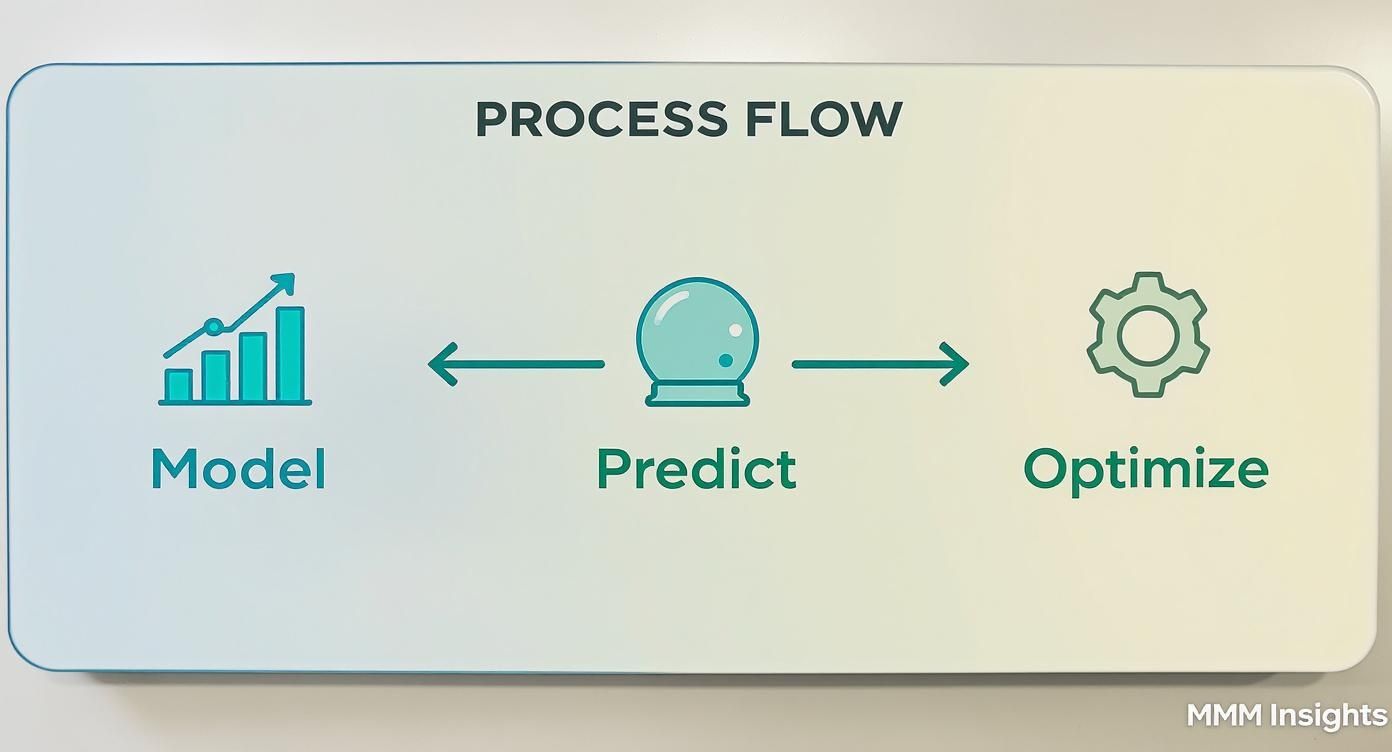
As you can see, it’s a journey from building a statistical model, using it to forecast outcomes, and finally, using those predictions to fine-tune your strategy.
Stage 4: Interpret and Activate Insights
The final, and arguably most important, step is to translate all the statistical jargon into a clear business story. The model might tell you that your podcast sponsorships have a surprisingly high ROI, or that your paid search campaigns are hitting a point of diminishing returns much sooner than you thought.
Your job is to turn these findings into real-world actions. That means communicating the story to stakeholders, running budget simulations to explore different “what-if” scenarios, and getting the buy-in you need to reallocate resources and drive proper change across the business.
Exploring Modern MMM Tools and Technologies
Marketing Mix Modelling isn’t the slow, expensive, once-a-year behemoth it used to be. Not anymore. The rise of new tech has completely flipped the script, making MMM a much nimbler and more accessible tool for businesses of all shapes and sizes.
We’ve seen a massive shift away from the old-school, clunky econometric models towards sleek, modern platforms powered by AI and machine learning. These new solutions spit out insights much faster, transforming MMM from a dusty annual report into a living, breathing tool for ongoing tactical tweaks.
Today’s market is full of powerful options. At one end, you’ve got game-changing open-source tools from the big tech players. At the other, you have polished enterprise platforms offering a fully managed experience.
The New Generation of MMM Solutions
This new ecosystem gives marketers more choice than ever before, and open-source solutions have been a huge part of making MMM available to the masses.
- Google’s Meridian: Launched as an open-source model, Meridian is Google’s answer to modern MMM. It’s designed to give advertisers a clearer picture of how channels like paid search really drive results, pulling in Google-specific data like search query volumes.
- Meta’s Robyn: Another hugely popular open-source tool, Robyn is built around automation and rapid iteration. It lets data scientists churn through thousands of models in no time, helping them pinpoint the most accurate and stable results without weeks of manual work.
These tools pack some serious punch and flexibility, but you’ll need some solid data science know-how to get them up and running effectively.
The real magic of modern MMM technology is its speed and accessibility. What once took a team of statisticians months to figure out can now be refreshed frequently, allowing for much more responsive and tactical budget shifts.
Alongside the open-source heroes, a new breed of sophisticated enterprise platforms has emerged. These offer a more user-friendly, software-as-a-service (SaaS) experience, often bundling the modelling with data integration and slick visualisations to simplify the whole process. They’re a fantastic choice for teams that don’t have a dedicated data scientist on standby.
While these platforms are different from more granular measurement options, getting a handle on the full spectrum of available marketing attribution tools helps you pick the right approach for your specific needs.
Comparing Modern Marketing Mix Modeling Approaches
Choosing the right MMM solution really depends on your team’s skills, budget, and how quickly you need answers. The landscape has options for just about everyone, from hands-on data science teams to marketing departments looking for a plug-and-play solution.
Here’s a quick breakdown of how the main approaches stack up for UK businesses:
| Approach | Typical Cost | Speed to Insight | Level of Customisation | Best For |
|---|---|---|---|---|
| Traditional Agency | £50,000 – £200,000+ per project | Months (often quarterly or annually) | High (but slow to change) | Large enterprises needing deep, infrequent strategic reviews. |
| Open-Source (e.g., Robyn, Meridian) | Low software cost, but requires in-house data science salary | Weeks to months for setup, then days for updates | Very High (completely adaptable) | Businesses with skilled data science teams wanting full control. |
| Enterprise SaaS Platform | £20,000 – £100,000+ annually | Days to weeks for setup, then near real-time | Medium (configurable within the platform) | Mid-to-large businesses without data scientists needing speed and usability. |
Ultimately, whether you go for an open-source tool that you can bend to your will or an enterprise platform that guides you through the process, the goal is the same: to get smarter about where your marketing budget is going and what it’s actually delivering.
Common Questions About What Is Marketing Mix Modeling
When you start digging into marketing measurement, a lot of questions come up. As we all look for solid, privacy-friendly ways to prove our worth, Marketing Mix Modelling (MMM) is a term you’ll hear more and more. Let’s clear the air and tackle some of the most common queries.
How Is MMM Different from Digital Attribution?
This is a big one. The easiest way to think about it is with an analogy: MMM is your telescope, and digital attribution is your microscope.
Attribution gives you a super-detailed, user-level view of online touchpoints. It’s the microscope for tactical tweaks. On the other hand, MMM provides a strategic, top-down perspective on all marketing efforts, including things like TV ads, billboards, and PR that attribution can’t see.
- Attribution (Microscope): This is all about tactical optimisation. It helps you answer questions like, “Which of these Facebook ad creatives is driving the most clicks?”
- MMM (Telescope): This focuses on the big picture and budget allocation. It helps you answer questions like, “Should we shift £100k from our TV budget into paid social next quarter?”
They aren’t rivals; they’re actually powerful partners. Using both gives you the full story of your marketing performance, from the highest-level strategic decisions right down to the nitty-gritty of daily campaign management.
How Much Historical Data Do I Need for an Effective Model?
This is a crucial question. As a general rule of thumb, you want at least two to three years of consistent historical data, typically collected weekly.
Why so much? Because a longer timeframe is essential for the model to work properly. It needs enough data to confidently spot things like seasonality and understand the long-term, delayed impact of brand-building campaigns.
A model built on just a few months of data is like trying to predict a whole year’s weather based on one week’s forecast—it’s going to be unstable and you just can’t trust the results.
Is MMM Only for Large Enterprises with Big Budgets?
Not anymore! It’s true that MMM used to be a hugely complex analysis, pretty much reserved for global brands with massive budgets and teams of data scientists.
But things have changed, and for the better. The rise of incredibly powerful open-source platforms, like Google’s Meridian and Meta’s Robyn, has completely opened up access to this methodology.
Today, plenty of mid-sized businesses have the data and tools they need to get started with MMM. It gives them a serious competitive edge in optimising their budgets without needing a huge enterprise-level investment.
At PPC Geeks, we live and breathe data-driven strategies that squeeze every last drop of value from your marketing ROI. If you’re ready to stop guessing and start optimising your budget with expert precision, see how our tailored PPC management services can help your business grow. Find out more at https://ppcgeeks.co.uk/.