




So, what exactly is “OpenAI ad management”? It’s simply the practice of using artificial intelligence models from OpenAI to create, automate, and ultimately optimise your pay-per-click (PPC) campaigns.
This signals a major change from the old days of manual campaign tweaks. We’re moving towards an AI-assisted, strategic approach. For UK SMEs, this is a chance to generate far better ad copy, automate tedious workflows, and get a real competitive edge. This guide is all about showing you how to put this tech into practice.
OpenAI Ad Management: The New Reality of PPC Management
If you feel like you’re struggling to keep up with the demands of modern PPC, you’re not alone. The days of relying purely on manual keyword research, endless bid adjustments, and constant A/B testing are numbered.
For ambitious UK SMEs and e-commerce retailers, the old methods are becoming a serious drag on resources and a barrier to growth. The sheer amount of data and the speed at which markets shift now outstrip what any human can effectively manage.
This is where a totally new approach comes in. AI, and specifically the technology from OpenAI, is causing a seismic shift in paid advertising. It’s moving the focus away from repetitive, soul-destroying tasks towards smart, data-informed strategy and creation. And no, this isn’t some far-off concept for massive corporations; it’s a practical toolkit you can start using today.
A Fundamental Shift in Strategy
Bringing OpenAI into your ad management means rethinking your entire workflow. Instead of spending hours brainstorming a few ad headlines, you can generate hundreds of variations in minutes. Each one can be tweaked for a specific audience segment or emotional trigger.
This shift frees you up to focus your expertise where it really matters: refining the best options and building a higher-level campaign strategy.
The impact of this technology is already being felt across the UK. The demand for AI services is reflected in OpenAI’s own local growth; its UK division saw assets rocket to £56.2 million, a huge leap from just £1.1 million the year before. Cash reserves have hit a cool £42.4 million. It’s clear this is where the market is heading.
To give you a clearer picture, here’s a quick comparison of the old way versus the new.
Traditional PPC vs OpenAI Ad Management At A Glance (OpenAI Ad Management)
| PPC Task | Traditional Approach | OpenAI-Powered Approach |
|---|---|---|
| Ad Copy Creation | Manual brainstorming, limited variations, slow testing cycles. | Generate hundreds of creative variations instantly, tailored to specific audience segments. |
| Keyword Research | Time-consuming manual analysis using various tools. | AI-driven analysis of search trends, competitor gaps, and long-tail opportunities. |
| Campaign Automation | Relies on basic rules and scripts within ad platforms. | Intelligent automation of bidding, budget allocation, and performance reporting based on real-time data. |
| Performance Analysis | Manual data crunching, often leading to delayed insights. | AI models process vast datasets to identify patterns and predict outcomes, enabling proactive strategy. |
| Strategic Focus | Bogged down in day-to-day operational tasks. | Frees up human expertise to focus on high-level strategy, creative direction, and market positioning. |
This table really highlights the jump from reactive, manual work to a proactive, strategic partnership with AI. It’s about working smarter, not harder.
What This Means for Your Business
By embracing OpenAI for your ad management, you’re creating a clear path to a competitive advantage. It’s not just about doing things faster; it’s about unlocking a level of creativity and performance that was simply out of reach before.
Here’s what you can expect:
- Superior Ad Creatives: Craft more compelling, relevant, and high-converting ad copy and extensions.
- Intelligent Automation: Automate routine tasks like performance reporting and keyword analysis.
- Smarter Decision-Making: Use AI to analyse trends and inform your budget allocation and bidding strategies.
The core idea is to transform your role from a campaign operator into a strategic director. You provide the goals, context, and brand voice; AI provides the scale and speed to execute your vision effectively.
This guide is designed to be your practical implementation plan. We’ll walk you through everything from prompt templates for UK-specific ad copy to automation scripts and compliance safeguards.
We’re setting you up for success in this new era of advertising. The future of search is deeply connected with AI, and now is the perfect time to get ahead. You can read more about OpenAI’s vision for AI-powered search in our detailed article.
OpenAI Ad Management: Generating Ad Copy That Actually Converts
Let’s get past the generic advice. The real power of using OpenAI in your PPC workflow isn’t just about speed; it’s about generating ad copy that genuinely connects with your audience and pushes them to act.
For UK ecommerce brands, this means crafting messages that click with local nuances. Think of a sustainable fashion retailer in Manchester or an artisan food seller based in London – their copy needs to speak to their specific crowd.
The goal here is to smash through the writer’s block that so often stalls a new campaign launch. Instead of agonising over a few headlines, you can pump out dozens of compelling variations. You can explore new emotional angles and even uncover unique selling points (USPs) you hadn’t thought of. It’s about creating a flood of ideas that you, the human expert, can then shape and perfect.
This isn’t about handing over control to a machine. It’s about giving your own creativity a massive boost. You bring the strategy, the brand voice, and the customer knowledge; OpenAI delivers the raw creative material at a scale that’s simply impossible for a human to match. This partnership lets you test more, learn faster, and ultimately, find the exact messages that bring in the sales.
Mastering the Art of the Prompt
Here’s the deal: the quality of the ad copy you get out is directly tied to the quality of your prompts. A lazy request like “write an ad for my shoe shop” will get you exactly what you deserve: generic, uninspired fluff.
Getting prompts right is a skill. It’s a mix of providing solid context, setting clear boundaries, and injecting a bit of creative direction to guide the AI toward the perfect result.
For any UK business, this means getting granular. Your prompts should be packed with detail about your target customer, your brand’s personality, and the unique benefits you’re offering. Think of it like briefing a new junior copywriter – they’re brilliant, but they know absolutely nothing about your business yet.
Your prompt needs to cover a few key things:
- Target Audience: Who are you actually talking to? Be descriptive. “Eco-conscious millennials in urban UK areas” is a world away from “young people.”
- Product/Service: What are you selling? List the key features, but more importantly, spell out the benefits for the customer.
- Brand Voice: How should the ad sound? Use punchy adjectives like “playful,” “professional,” “empathetic,” or “aspirational.”
- Desired Action: What’s the next step for the user? “Shop Now,” “Learn More,” “Get a Free Quote.”
- Constraints: Be specific. Mention character limits for headlines (30 characters) and descriptions (90 characters) to make sure the output is ready to use. For a deeper look at the basics, our guide on how to start using ChatGPT for your ads has more foundational tips.
Getting this level of detail right transforms the AI from a simple text-spinner into a powerful creative partner, tuned specifically to your brand.
For UK businesses just getting started, having a few go-to prompts can make all the difference. We’ve put together a simple table with some copy-and-paste templates to help you hit the ground running.
Copy-And-Paste Prompts For UK Ad Creatives (OpenAI Ad Management)
| Ad Component | Your Objective | Example Prompt Template |
|---|---|---|
| Headlines | Generate multiple, platform-ready headlines to A/B test different angles. | “Act as a senior PPC copywriter. Generate 10 unique Google Ads headlines (max 30 characters) for my [product/service]. Target [target audience] in the UK. Our brand voice is [adjective]. Focus on the benefit of [key benefit]. The call-to-action is ‘[CTA]’.” |
| Descriptions | Create compelling and detailed descriptions that expand on the headlines. | “Write 5 Google Ads descriptions (max 90 characters) for our [product/service]. The key selling points are [USP 1], [USP 2], and [USP 3]. We are targeting [target audience] who value [customer value]. The tone should be [adjective] and encouraging.” |
| Sitelink Extensions | Produce concise sitelink text to highlight key pages on your website. | “Generate 6 sitelink extension texts (max 25 characters) for a UK [your industry] brand. The links are: ‘About Us’, ‘New Arrivals’, ‘Delivery Info’, ‘Special Offers’, ‘Our Story’, ‘Contact Us’. Make them sound [adjective].” |
| Callout Extensions | List non-clickable benefits and features to add value to your ad. | “Create 8 callout extensions (max 25 characters) for my ecommerce store. Highlight these features: [feature 1], [feature 2], [feature 3], and [feature 4]. The tone should be punchy and direct.” |
These templates are a fantastic starting point. Tweak them with your specific details, and you’ll be amazed at the quality and variety of the copy you get back.
Real-World Prompts for UK Ecommerce
Let’s make this real. Imagine you run a London-based business selling gourmet cheese subscription boxes. Your audience values quality, sustainability, and loves supporting local producers.
Here’s a prompt that would actually work:
“Act as a senior PPC copywriter for a UK ecommerce brand. Generate 5 unique Google Ads headlines (max 30 characters) and 3 descriptions (max 90 characters) for a gourmet cheese subscription box. Our target audience is foodies in London aged 30-55 who value artisanal products and sustainable sourcing. Our brand voice is sophisticated yet approachable. Highlight our unique selling points: award-winning British cheeses, free carbon-neutral delivery, and pairing notes from a sommelier. The call-to-action is ‘Discover Your Box’.”
A detailed brief like this gives the AI everything it needs to know. The results will be far more relevant and powerful than anything from a generic request, giving you an excellent batch of copy to start testing. The UK’s blend of creative and tech talent has made it a key market for this technology, with OpenAI even designating it a marketing ‘centre of excellence’ to pilot new campaigns.
Refining AI Output for Brand Voice (OpenAI Ad Management)
Let’s be clear: the first draft from any AI tool is rarely the final version. The most important step is always the human touch at the end. Your job is to review the generated copy and polish it until it perfectly matches your brand’s unique voice.
Look for chances to inject more personality, tweak a phrase for better emotional punch, and make sure every word feels right. AI is fantastic at generating options, but your human intuition is what turns good copy into great copy.
Try working through this simple process:
- Generate Broadly: Use your detailed prompt to create a wide range of headlines and descriptions. Don’t hold back.
- Identify Themes: Start grouping the outputs. You might see themes emerge like value-focused, luxury-focused, or benefit-led copy.
- Select & Refine: Pick the strongest options from each theme and start editing. Ask yourself: Does this sound like us? Is the language compelling?
- Ensure Compliance: Last but not least, double-check that every claim is accurate and follows Google Ads policies. Avoid making wild claims like “the best cheese in London” unless you can actually prove it.
This structured approach ensures your workflow is not just faster, but also consistently on-brand, pumping out creatives that are both compliant and high-performing.
OpenAI Ad Management: Putting Your Campaign Workflows on Autopilot
Crafting brilliant ad copy is one thing. But the real game-changer with OpenAI is automating the mundane, time-sucking tasks that clog up your week and pull you away from genuine strategy.
This is your chance to win back the hours you lose pulling data, checking performance, and getting bogged down in repetitive analysis. Instead of drowning in spreadsheets, you can get an AI-powered assistant to do the heavy lifting. That frees you up to focus on what actually grows the business.
The secret sauce here is combining the OpenAI API with Google Ads Scripts. Now, if you’re not a developer, that might sound a bit daunting, but it’s surprisingly accessible. You’ll find plenty of ready-made scripts out there that only need a few minor tweaks to fit what you need.
From Manual Drudgery to Intelligent Automation
Think about your weekly routine. Are you manually checking keyword performance every few days? Do you spend hours trying to wrestle performance data into a simple summary for your team? These are prime candidates for automation.
An automated workflow can constantly keep an eye on your account for specific triggers. Imagine a keyword’s cost-per-acquisition (CPA) suddenly skyrockets – a script can flag that for you instantly. That’s the kind of proactive monitoring a human just can’t do 24/7, but a script handles it without breaking a sweat.
The aim is to build a system that works for you in the background. It’s like having a hyper-efficient junior team member who never sleeps, constantly checking performance and prepping insights so you can make smarter, faster decisions. This is the heart of effective OpenAI ad management; it’s all about building systems that scale.
Practical Automation with Google Ads Scripts (OpenAI Ad Management)
Let’s get into some real-world examples of what you can do. By hooking up the OpenAI API to a Google Ads Script, you can create some seriously powerful, custom automations that are built around your business goals.
Here are a few ideas to get you started:
- Automated Performance Summaries: Set up a script that pulls your weekly performance data, sends it over to the OpenAI API, and asks it to whip up a summary in plain English. It can highlight your wins, flag any underperforming campaigns, and point out areas needing a closer look – all delivered straight to your inbox first thing Monday morning.
- Dynamic Keyword Anomaly Detection: Have a script monitor your biggest spending keywords. If a keyword’s click-through rate (CTR) nosedives by more than 20% week-on-week, the script can automatically pause it and fire off an alert to you.
- Large-Scale Ad Copy A/B Testing: You can automate the creation and rollout of dozens of ad copy variations. A script can generate headlines and descriptions using the API, launch them in a controlled test, and then crunch the numbers to find the statistical winners, all with very little manual effort.
This diagram breaks down the simplified creative process you can put on autopilot.
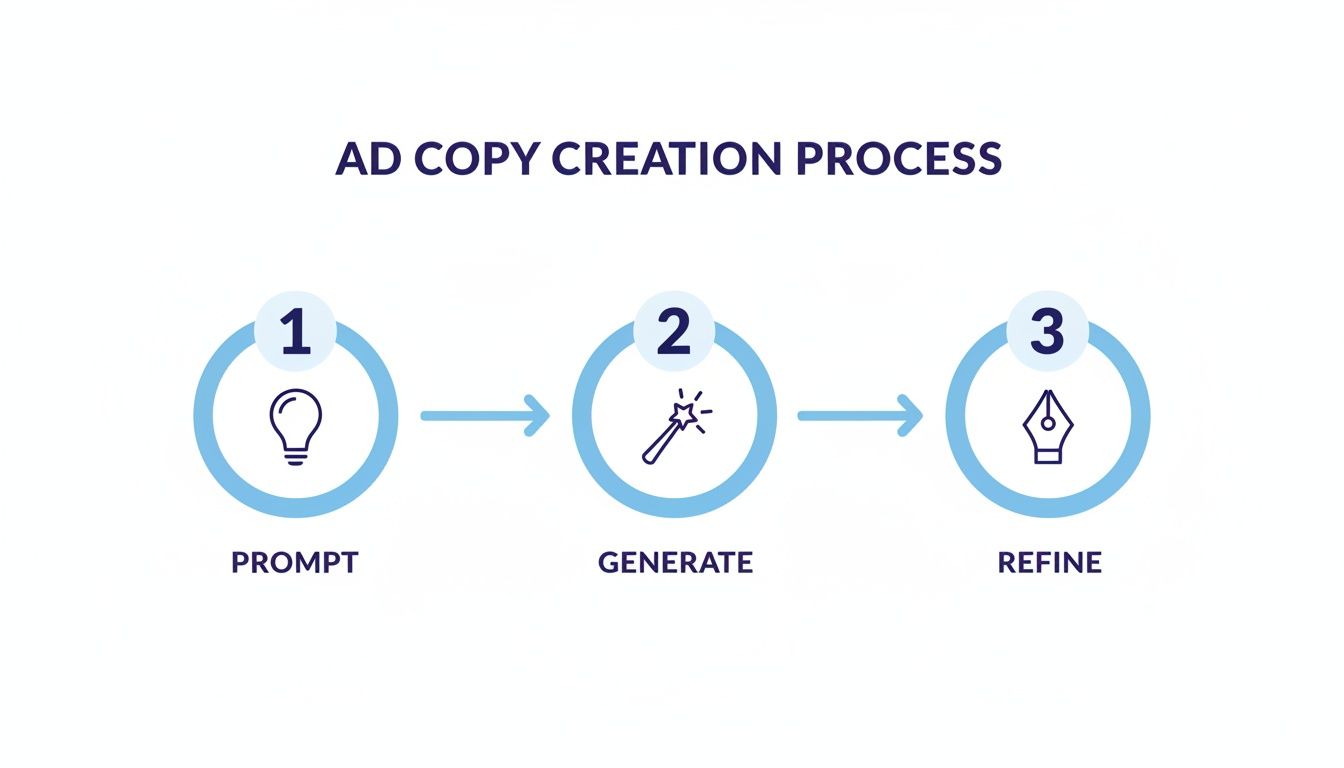
This workflow—moving from a strategic prompt to AI generation and a final human polish—is the blueprint for scalable and automated creative testing. For a deeper dive into these ideas, check out our comprehensive guide on ChatGPT ads management.
Managing API Costs Intelligently
One of the first questions people ask when they start looking at API automation is about the cost. It’s a fair concern, but the good news is that for most campaign management tasks, the costs are surprisingly low and completely manageable.
You just need to be strategic. You aren’t running complex models 24/7; you’re making specific, targeted API calls for particular jobs. Generating that weekly performance summary might only cost you a few pence.
Think of it this way: if a script saves you two hours of manual work each week, the API cost of a few pounds is an incredible return on investment. It’s about automating smartly, not excessively.
This cost-effectiveness is a huge part of what makes this tech so accessible for UK SMEs. The financial footprint of AI is growing fast, with OpenAI’s UK subsidiary assets ballooning to £56.2 million by December 2024—a massive leap from £1.1 million the year before. That growth, alongside a staff increase of 189%, shows just how much demand there is for efficient AI solutions.
The best way to keep costs under control is to start small. Implement one automation script, keep an eye on its API usage and cost in your OpenAI dashboard, and then scale up once you’re happy with the process and the value it’s delivering. It’s a measured approach that lets you innovate without risking your budget.
OpenAI Ad Management: Building an Intelligent Ad Testing Framework
Great advertising isn’t built on guesswork; it’s the result of methodical, relentless testing. Bringing OpenAI into your PPC workflow lets you build a testing framework that’s not just more sophisticated, but far more efficient than doing things the old way.
The classic A/B test on two headlines suddenly feels slow and incredibly limited. With AI in your corner, you can leap straight into full-scale multivariate testing. Imagine simultaneously trialling dozens of combinations of headlines, descriptions, and calls-to-action to find that perfect, high-converting mix.
This isn’t about testing for the sake of it. It’s about creating a structured process that gives you clear, actionable insights into what truly gets your customers to click and, more importantly, convert.
Forming Clear Testing Hypotheses
Before you even think about generating a single ad variation, your framework needs a solid foundation. That starts with a clear hypothesis. Think of a hypothesis as a simple, testable question that steers the entire experiment.
Without one, you’re just throwing spaghetti at the wall. A strong hypothesis gives your tests a real purpose and makes the results dead easy to interpret.
Let’s look at a few examples for a UK ecommerce store:
- Hypothesis 1: Will a benefit-led headline like “Sleep Better Tonight” outperform a question-based one like “Struggling to Sleep?” for our target audience?
- Hypothesis 2: Does ad copy that explicitly mentions “Free UK Delivery” in the description generate a higher click-through rate than copy that focuses purely on product quality?
- Hypothesis 3: Can an ad featuring a seasonal offer (e.g., “Summer Sale”) achieve a lower cost-per-acquisition than our standard evergreen ads?
A clear hypothesis turns a vague idea into a measurable experiment. It defines what you’re testing, why you’re testing it, and how you’ll measure success. This is the bedrock of intelligent OpenAI ad management.
Once your hypothesis is locked in, you can fire up OpenAI to generate a massive number of creative assets built specifically for that test. If you’re comparing benefit-led vs. question-based headlines, you can ask it for 50 of each in minutes. This gives you a rich pool of variants to fuel your experiment.
AI-Powered Analysis and Interpretation (OpenAI Ad Management)
Churning out ad variations is only half the battle. The real magic happens when you can quickly interpret the results and find the statistically significant winners. This is another area where AI can do the heavy lifting.
Instead of painstakingly exporting performance data into spreadsheets and squinting at the numbers to spot trends, you can use tools like the Advanced Data Analysis feature in ChatGPT. Just upload a CSV file of your campaign results and ask it a direct question: “Based on this data, which headline type had a statistically significant higher conversion rate?”
This simple, conversational query transforms hours of number-crunching into an instant insight, telling you exactly what your next strategic move should be. This rapid feedback loop is what separates a good testing framework from a great one. For those wanting to push the boundaries even further, exploring enhanced incrementality testing beyond A/B experiments can uncover much deeper ROI insights.
A Sample Quarterly Testing Roadmap
To put this into practice, here’s a sample roadmap for a fictional UK-based online retailer that sells handmade leather goods. This plan uses AI insights to methodically test, iterate, and improve performance over a single quarter.
Quarter 1 Testing Plan
| Month | Focus Area | Key Hypothesis to Test | AI’s Role |
|---|---|---|---|
| January | Headline Angles | A headline emphasising “durability” will have a higher CTR than one focused on “style”. | Generate 20+ headline variations for each angle (durability vs. style). |
| February | Offer & Promotion | A “15% Off Your First Order” offer will achieve a lower CPA than “Free Shipping”. | Create description and sitelink copy for both promotional offers to A/B test. |
| March | Landing Page Copy | A landing page with customer testimonials will convert better than one with just product features. | Generate persuasive testimonial-style copy blocks and refined feature lists for split testing. |
This kind of structured roadmap ensures you’re always testing something meaningful. It turns your ad account from a static set of campaigns into a dynamic learning environment that constantly improves with every new data point, all powered by the scale and speed of AI.
OpenAI Ad Management: Measuring Success and Staying Compliant in the UK
It’s easy to get carried away with innovation, but for any UK business, results and rules are what really count. Bringing OpenAI into your ad management is a massive step forward, but you have to prove its worth with hard numbers. And, crucially, everything it produces must operate within a strict legal framework. This is the essential reality check.
So, let’s get down to the two pillars every UK business has to nail: effective measurement and diligent compliance. First, we’ll pinpoint the key performance indicators (KPIs) that actually show the impact of your AI efforts. Then, we’ll walk through the local regulatory landscape to make sure your AI-generated content is accurate, transparent, and respects user privacy.
Get this dual focus right, and you can move forward with confidence, turning a powerful new tool into a sustainable and responsible engine for growth.
Proving the Value with the Right KPIs
When you start weaving AI into your workflow, your success metrics need to get a lot sharper. It’s no longer enough to look at overall account performance; you need to prove that AI-driven changes are directly causing a positive shift. Generic metrics just won’t cut it.
You need to be tracking KPIs that specifically reflect the efficiencies and creative boosts AI brings to the table. The goal here is to build a rock-solid business case showing that your investment in OpenAI ad management is delivering a measurable return.
Here are the core metrics you should be watching like a hawk:
- Cost Per Acquisition (CPA) Reduction: Are the AI-generated ad copy variations finding cheaper routes to conversion? If so, your cost to land each new customer should be dropping.
- Return on Ad Spend (ROAS) Improvement: By testing more creative angles at scale, are you actually increasing the revenue generated for every pound spent on ads?
- Click-Through Rate (CTR) Uplift: Does the AI copy grab attention more effectively? A higher percentage of clicks from impressions is a great early indicator.
- Time Saved on Campaign Tasks: This one is huge and often gets overlooked. Track the hours your team saves on repetitive jobs like copy creation or reporting, and put a value on that time. It all adds up.
By zeroing in on these specific KPIs, you move beyond vague feelings (“the ads just feel better”) to data-backed proof (“our CPA dropped by 15% since we started AI-driven copy testing”). This is the language that stakeholders and budget holders understand.
Navigating the UK Compliance Landscape (OpenAI Ad Management)
Using AI to generate public-facing ads in the UK comes with a serious duty of care. The output has to be legal, decent, honest, and truthful. You can’t just copy and paste from an AI and hope for the best. The final responsibility always, always rests with you, the advertiser.
For any UK business, two key regulatory bodies come into play: the Advertising Standards Authority (ASA) and the Information Commissioner’s Office (ICO), which enforces the General Data Protection Regulation (GDPR).
Your AI Content Compliance Checklist
Before a single piece of AI-generated ad copy goes live, it needs a rigorous check against UK standards. Human oversight is completely non-negotiable. This checklist is a practical framework for reviewing your AI content to ensure it meets the legal and ethical bars.
- Factual Accuracy Review:
- What to do: Verify every single claim, statistic, and product feature in the ad. AI models are known to “hallucinate” or simply make things up, which can land you in hot water for misleading advertising.
- Think about it: If the AI writes “Our product is made from 100% recycled materials,” you absolutely must confirm this is demonstrably true before it ever sees the light of day.
- Clarity and Transparency Check:
- What to do: Make sure the ad isn’t ambiguous and doesn’t leave out crucial information that could mislead a consumer. This is a core principle of the ASA’s CAP Code.
- Think about it: An ad for a subscription service has to be upfront about recurring payments. AI-generated copy might naturally focus on the shiny initial offer and gloss over the long-term commitment.
- GDPR and Privacy Safeguards:
- What to do: Confirm that no ad copy or targeting strategy uses personal data without explicit consent. You should never generate copy that makes assumptions based on an individual’s sensitive information.
- Think about it: An ad saying, “Struggling with your recent health diagnosis?” is a massive red flag. It implies you have knowledge of private data, which is a major GDPR breach.
By systematically running through these checks, you create a robust process that allows you to innovate safely. This responsible approach to OpenAI ad management protects your customers, builds trust in your brand, and keeps your campaigns firmly on the right side of UK law.
Your Questions About OpenAI Ad Management Answered
Jumping into any new tech throws up a few questions. And when it’s something as critical as your advertising, it’s only natural to have concerns about costs, control, and whether you’ll still sound like you.
We hear the same practical questions from UK business owners time and again. This section is all about giving you direct, no-nonsense answers to cut through the noise and tackle the common hurdles that might be holding you back.
Will AI-Generated Copy Hurt My Brand’s Voice?
This is probably the biggest fear we hear, and it’s a fair one. The short answer? Only if you let it.
The secret is to stop thinking of AI as your new copywriter and start treating it like a brilliant, incredibly fast junior partner. It doesn’t instinctively know your brand’s soul, but it’s fantastic at churning out raw material based on your precise directions.
You need to feed it a detailed style guide. This should include your specific tone of voice, core messages, words you love, and—just as important—words you’d never, ever use. A human expert (that’s you or your marketing manager) must always have the final say, polishing and signing off on every ad. This last step ensures every piece of copy is 100% on-brand before it sees the light of day.
Think of the AI as a tool for brainstorming at scale. It gives you the options; you provide the final creative judgement and brand alignment. It’s a partnership that enhances your unique brand identity, rather than replacing it.
Do I Need to Be a Coder to Automate My Ads?
Not at all. While you can get deep in the weeds with the OpenAI API if you have the coding skills, the ecosystem has moved on quickly. There’s now a whole host of third-party tools offering simple, no-code interfaces that plug OpenAI’s power directly into your Google Ads account, often with just a few clicks.
And for those who are a bit more adventurous, Google Ads has its own built-in script editor. You don’t even need to write code from scratch. You can find pre-written, commented code snippets online that you can simply copy, paste, and tweak for specific jobs. Automating a weekly performance report or flagging keywords with a low Quality Score is far more accessible than most people realise.
What Is the Real Cost of Using OpenAI for Ad Management?
It’s surprisingly affordable, and the costs are flexible. For a typical UK SME, it usually breaks down into two scenarios:
- For Generating Ad Copy: If you’re mainly using a tool like ChatGPT to brainstorm and write copy, a monthly user subscription might be all you need. This gives you a massive amount of creative firepower for a fixed, predictable cost.
- For Automation via API: When you start automating tasks using the API, you’re billed based on usage—basically, how much data you process. For most ad management jobs, like generating performance summaries or analysing keywords, these costs are often tiny. We’re talking a few pounds a month in many cases.
The bottom line? The cost is almost always a tiny fraction of the value of the manual hours it saves, making the return on investment huge.
Can OpenAI Help Me Find New Keywords and Audiences?
Absolutely. This is one of its hidden strengths. It’s an ideation powerhouse that can help you break out of your usual keyword ruts and uncover new pockets of customer intent you hadn’t even thought of.
For keywords, you can describe your product in detail and ask for:
- Long-tail keyword ideas that your competitors are likely ignoring.
- Related search concepts and different ways people might phrase their queries.
- Crucial negative keywords to add to your campaigns, which helps slash wasted spend.
When it comes to audiences, you can build out a detailed persona of your ideal customer. Based on that profile, OpenAI can suggest relevant in-market segments, affinity groups, and custom audiences available within platforms like Google Ads or Meta. It gives you a massive head start on structuring new campaigns and expanding your reach.
Ready to stop guessing and start growing with a data-driven PPC strategy? The team at PPC Geeks can build, manage, and optimise your campaigns to deliver real results. Get in touch with us today.