




Let’s get one thing straight right away: when we talk about “ChatGPT ad formats,” we’re not talking about some new, official ad placement you can buy inside the chatbot. That doesn’t exist.
Instead, think of it as a powerful new way of working. It’s a methodology where savvy marketers use ChatGPT as a creative co-pilot. The goal? To dream up, write, and scale ad copy and concepts for the platforms we already use every day—Google, Meta, and Microsoft. It’s all about the workflow, not a new ad network.
What Are ChatGPT Ad Formats
Imagine having a tireless creative assistant on your team, one that never runs out of ideas. That’s essentially what ChatGPT becomes in this context, and it’s completely changing how UK marketers build campaigns. Forget spending hours staring at a blank screen, trying to brainstorm the perfect headline. Now, you can generate dozens of high-quality headlines, descriptions, and creative angles in a matter of minutes.
This approach injects some serious efficiency and performance potential into your existing advertising. You’re still building the same ad formats you know inside and out, like Google Responsive Search Ads or Meta Carousel Ads. The real difference is how you create the content that fuels them.
By feeding ChatGPT the right prompts—think detailed audience personas, your specific brand voice, and clear campaign goals—you can produce a massive volume of creative assets, all ready to be A/B tested.
A New Approach to Creative Generation
The central idea here is to use AI as a force multiplier for your own creativity and strategic thinking. You’re still the campaign director calling the shots, but you now have a tool that can handle the most time-consuming parts of content creation almost instantly. This frees you up to spend more time on what really matters: strategy, analysis, and optimisation.
For any busy marketer or business owner, this method offers some game-changing advantages:
- Speed and Scale: Need ad copy for different audience segments or product features? You can generate hundreds of variations in a fraction of the time it would take even a seasoned copywriter.
- Enhanced Creativity: Feeling stuck in a creative rut? Ask ChatGPT to brainstorm unique angles, emotional hooks, or value propositions you might not have thought of on your own.
- Hyper-Personalisation: Quickly tweak ad copy for specific demographics, locations, or user behaviours. This makes your campaigns feel far more relevant and, ultimately, more effective.
By bringing AI into the creative process, marketers can shift from slow, manual iteration to rapid, automated ideation. This frees up strategic brainpower to focus on performance analysis and high-level campaign planning, rather than getting bogged down in the nitty-gritty of copywriting.
Ultimately, getting to grips with “ChatGPT ad formats” is about embracing a smarter way of working. It’s a strategic partnership between human expertise and artificial intelligence, built to produce better-performing ads, faster.
If you’re keen to learn more about the first steps, dive into our detailed guide on how to start with ChatGPT ads.
ChatGPT Ad Formats: Why AI-Powered Advertising Is a Game-Changer in the UK
The UK isn’t just dipping its toes into AI; it’s rapidly becoming the perfect breeding ground for AI-driven advertising to take off. This isn’t happening by chance. It’s the result of a powerful mix: massive digital ad spending, sky-high mobile use, and a public that now expects much smarter, more relevant ads.
For marketers on the ground, this is a huge opportunity. The old spray-and-pray approach to campaigns is well and truly over. Today’s customers expect you to know who they are and what they need, and AI tools like ChatGPT are the only way to deliver that level of personalisation at scale.
A Market Primed for Innovation
The sheer size of the UK’s digital advertising market tells you everything you need to know. Investment in digital ads recently rocketed to £38.07 billion, which makes up a staggering 80% of the country’s total ad spend. This isn’t just a number; it’s a clear signal of a mature, fiercely competitive market hungry for anything that offers a performance advantage. You can dig into the full report on UK digital trends from We Are Social.
Within that, social media advertising has become an absolute giant, now worth £9.02 billion. That growth is tied directly to how we all behave, especially on our phones.
Here’s a crucial statistic for advertisers: 61% of ChatGPT sessions in the UK happen on a mobile. This directly fuels the need for mobile-first ChatGPT ad formats. It forces us to think in short, snappy, and visually punchy creatives built for the small screen. The data is undeniable: the UK is a mobile-first nation where AI-assisted creativity is no longer a luxury, but a necessity.
Meeting Modern Consumer Demands (ChatGPT Ad Formats)
Beyond the market figures, there’s a deeper shift in what UK consumers want from brands. They’re savvier than ever and have zero patience for ads that feel generic or miss the mark. They want to feel like you get them, which means your ads have to be timely, genuinely useful, and aware of the context.
This is exactly where partnering with an AI advertising agency gives you a serious edge. Using AI to spot trends and churn out a wide range of creative ideas means businesses can finally produce campaigns that people actually connect with.
AI lets us move from shouting at a crowd to having a meaningful one-on-one conversation. It’s the shift from broad targeting to micro-segmentation, delivering bespoke messages that feel less like interruptions and more like helpful suggestions.
This is what makes AI-powered advertising so effective in the UK right now. It allows brands to take mountains of data and spin it into highly relevant ads that meet modern expectations. You’re not just reaching an audience; you’re connecting with them, building stronger relationships and, ultimately, driving better results. This isn’t some futuristic idea anymore—it’s a must-have for any brand serious about growing in the UK’s digital space.
ChatGPT Ad Formats: Generating High-Performance Search and Display Ads
Right, let’s move from theory to action. Using ChatGPT for your search and display campaigns on platforms like Google and Microsoft isn’t about throwing your strategy out the window. Think of it as a way to seriously ramp up your creative output and testing capabilities. It’s your new secret weapon for building better Responsive Search Ads (RSAs), fleshing out Performance Max asset groups, and even writing snappy display banner copy.
The real magic is in the prompting. You can’t just ask for “some ad headlines” and expect gold. You’ve got to feed the machine the right ingredients: a clear picture of your target audience, your campaign goals, and a solid description of your brand’s unique voice. When you give it that rich context, you’ll be amazed at the sheer volume of high-quality, on-brand assets it can spit back out.
This is how AI slots into the modern UK advertising workflow, turning ad spend into more effective, mobile-first campaigns that actually deliver.
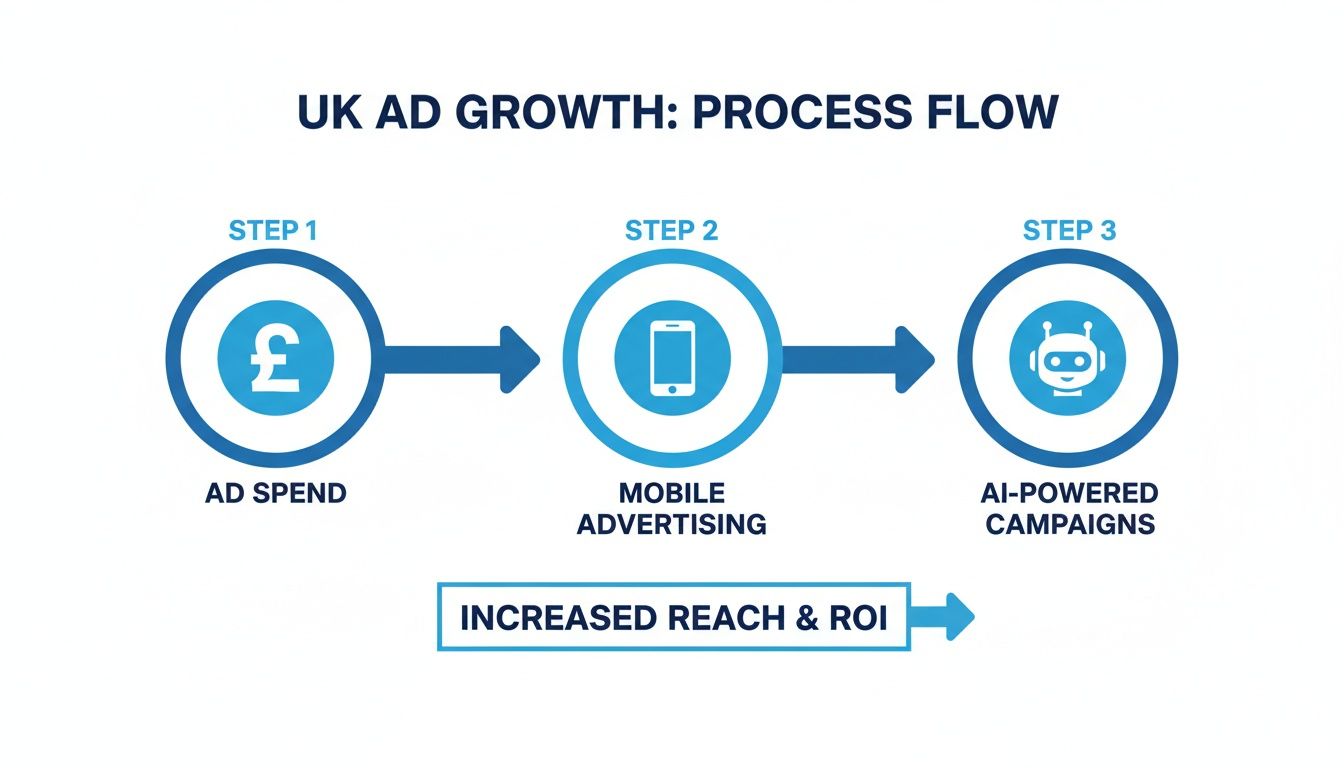
This flow from investment to AI-driven execution shows just how essential this tech is becoming for reaching people on the devices they use every day.
Crafting Assets for Responsive Search Ads
As you know, Responsive Search Ads need a good mix of headlines and descriptions so Google’s algorithm can work its magic and find the winning combinations. This is where ChatGPT is an absolute game-changer. It helps you quickly generate a full suite of assets that all stick to the same theme but explore different angles and hooks.
For instance, a PPC manager can generate variations that hit different notes:
- Logical: Highlighting features, specifications, and data-driven benefits.
- Emotional: Tapping into customer pain points, aspirations, and desires.
- Urgency-driven: Using strong calls-to-action that get people to act now.
By feeding it a prompt with your landing page URL, core keywords, and desired tone, you can get dozens of options back in seconds – all perfectly tailored to fit the character limits. This makes A/B testing variations across your ad groups incredibly efficient.
Powering Performance Max Campaigns (ChatGPT Ad Formats)
Performance Max campaigns are even hungrier for assets. They demand headlines, long headlines, descriptions, and fresh ideas for your image and video creative. Using AI to brainstorm these elements ensures you’re feeding the campaign enough creative fuel to perform at its best across all of Google’s channels.
A well-prompted AI can be like having a tireless brainstorming partner on your team. It can suggest creative concepts for display banners you might not have thought of, describe the ideal imagery, write concise banner copy, and generate powerful calls-to-action.
You could, for example, ask ChatGPT to act as a creative director and outline three distinct visual concepts for a display ad targeting homeowners in London. If you want to dive deeper into optimising your visual campaigns, it’s worth learning more about the Google Ads Display Network and its best practices.
A Practical Workflow for PPC Managers
To properly weave ChatGPT ad formats into your day-to-day, you need a repeatable process. Start by creating a master prompt template. This should include your brand guidelines, core value propositions, and even a list of negative keywords for topics you want to avoid.
From there, you can tweak it for each campaign:
- Define the Objective: Are you after leads, e-commerce sales, or brand awareness?
- Specify the Audience: Who are you talking to? Get specific (e.g., “tech-savvy entrepreneurs in Manchester”).
- Provide Key Inputs: Chuck in the primary keyword, landing page, and any special offers.
- Request Asset Types: Be crystal clear. Ask for the exact number of headlines, descriptions, and other assets you need.
This structured approach transforms ChatGPT from a simple text generator into a reliable and scalable production tool for all your search and display advertising efforts.
Now, let’s look at some practical prompts you can start using straight away.
Table: Sample ChatGPT Prompts for Google Ads (ChatGPT Ad Formats)
To give you a real-world starting point, here are some sample prompts designed to generate specific components for your Google Ads campaigns. Think of these as templates you can adapt with your own product details, audience insights, and brand voice.
| Ad Component | Example Prompt | Expected Output |
|---|---|---|
| RSA Headlines | Act as a PPC expert for a UK-based sustainable coffee brand. Generate 15 unique RSA headlines (under 30 characters) for a campaign targeting “ethically sourced coffee.” Include variations focused on flavour, free delivery, and our eco-friendly packaging. Tone: Friendly and passionate. | A list of 15 short, punchy headlines like “Taste the Difference,” “Ethical Beans, Free Delivery,” “Eco-Friendly Coffee Fix,” and “Your Morning Brew, Guilt-Free.” |
| RSA Descriptions | For the same coffee brand, write 4 distinct RSA descriptions (under 90 characters). The first should highlight our Fairtrade certification. The second should create urgency around a limited-time 20% off offer. The third should focus on our subscription service. The fourth should address coffee connoisseurs. | Four distinct descriptions, each with a clear angle, such as: “Sip with confidence. Our beans are 100% Fairtrade certified for a better-tasting, ethical brew.” or “Don’t miss out! Get 20% off our award-winning blends for a limited time. Order yours today.” |
| PMax Image Ideas | I need creative ideas for a Performance Max campaign image asset group. Our product is a premium, all-weather dog jacket sold in the UK. Act as a creative director and describe 5 distinct lifestyle images. Focus on scenarios like rainy walks in the Peak District, city strolls in London, and playing on a muddy field. | A list of 5 detailed image descriptions, e.g., “1. A golden retriever joyfully shaking off water in a lush green field, wearing our bright red jacket. The background is slightly misty, conveying a classic British day.” |
| PMax CTAs | Generate 5 short, compelling Calls-to-Action (under 25 characters) for a Performance Max campaign selling online therapy sessions in the UK. The audience is young professionals feeling overwhelmed. The tone should be supportive and discreet. | A list of concise and empathetic CTAs like “Talk Today,” “Find Your Calm,” “Start Your Journey,” “Book a Session,” and “Get Support.” |
Using prompts like these saves an incredible amount of time and helps ensure you’re providing Google’s algorithms with a diverse set of high-quality assets to test. Just remember to always review and refine the output to make sure it’s a perfect fit for your brand.
ChatGPT Ad Formats: Crafting Engaging Social Media Ad Creatives
When we move from search engines over to social media platforms like Meta (Facebook and Instagram) or LinkedIn, the game completely changes. People aren’t actively hunting for a solution; they’re scrolling through their feeds looking for connection, a bit of entertainment, or maybe some professional insights.
This means your ads can’t just show up – they have to earn their place on the screen. This is where ChatGPT can become your creative partner, going way beyond just churning out copy.
Instead of simply asking for a headline, you can get ChatGPT to brainstorm entire campaign concepts. Think bigger: snappy primary copy, thumb-stopping hooks, and compelling Calls-to-Action (CTAs) that feel like they actually belong on the platform. But the real magic happens when you use it to shape your visual strategy.
From Text Prompts to Visual Concepts
One of the best ways to use ChatGPT ad formats for social media is by generating detailed visual ideas. You can push past basic text prompts and ask it to act as a scriptwriter or an art director, giving your design team or video producer a solid creative blueprint to run with.
This is a massive help when you’re creating the dynamic ad formats that really work on social feeds.
- Video Ad Scripts: Prompt it to write a punchy 30-second video script for an Instagram Reel, making sure to ask for scene descriptions, on-screen text overlays, and voiceover narration.
- Carousel Ad Storyboards: Ask it to outline a 5-slide carousel ad that tells a compelling story, with a clear beginning, middle, and end. Each slide should build on the last to keep people swiping.
- Interactive Poll Ideas: Get it to generate some fun and engaging Instagram Story poll ideas that cleverly link back to your product’s benefits, getting users to actively interact with your ad.
Think of ChatGPT as your tireless brainstorming partner. It can provide the raw creative material—the scripts, the scene descriptions, the narrative arcs—that you and your team can then refine and bring to life visually.
Using it this way ensures your visuals and your copy are perfectly in sync right from the get-go.
Tailoring Copy for Social Platforms
Every social platform has its own vibe and unwritten rules. An ad that crushes it on LinkedIn will almost certainly fall flat on Instagram. ChatGPT is brilliant for adapting your core message for each specific platform, making sure your tone and style always hit the right note.
The demand for high-quality, AI-assisted ad copy is still going strong in the UK. We can see from research into ChatGPT usage that its application for marketing copywriting is constantly in flux, showing a sustained need for this kind of content. With UK social ad spend hitting a massive £9.02 billion and mobile dominating with 61% of sessions, being able to quickly produce mobile-first, personalised creative is no longer a ‘nice-to-have’—it’s essential.
For many UK marketers, ChatGPT is fast becoming the go-to tool for sparking content strategies that truly connect on these platforms. You can dig into these trends by exploring the latest ChatGPT usage statistics.
To get the best results, you need to be specific with your prompts. For instance, you could ask for “three professional and insightful ad copy variations for a LinkedIn campaign targeting HR managers,” and then immediately follow up with a request for “three witty and relatable ad copy variations for an Instagram campaign targeting young professionals.” This simple tweak in your prompt can radically change the output, giving you perfectly tailored copy that boosts engagement and drives much better results.
ChatGPT Ad Formats: Using AI to Optimise Your Ad Performance
Getting your first set of AI-generated creatives is a massive win, but that’s really just the starting line. The true game-changer is what comes next: creating a feedback loop. This is where you shift ChatGPT from being a creative assistant into a sharp analytical partner. It’s how you really start to refine your campaigns and unlock better performance over time.
Instead of just staring at dashboards full of metrics, you can actually start having a conversation with your data. By feeding your campaign performance numbers back into ChatGPT, you can begin to uncover the why behind your results. This simple step turns raw data into insights you can act on immediately.
Analysing Performance Data with AI
Imagine you’ve run a campaign for a few weeks. You’ve got solid numbers on click-through rates (CTR) and conversions for different headlines. Now, it’s time to move beyond basic A/B testing and into deeper pattern recognition. A well-crafted prompt is your key to unlocking this.
You can literally copy and paste your best and worst-performing ad copy straight into the chat, along with the stats for each. Then, ask ChatGPT to put on its data analyst hat.
For example, you could prompt it with something like: “Here are my top 5 best-performing headlines and their CTRs, alongside my 5 worst-performing ones. Analyse the common themes, emotional triggers, and value propositions in the winning group. Based on this, generate five new hypotheses for what really connects with my audience.”
This is a brilliant way to spot subtle patterns you might have otherwise missed. Maybe all your winning ads ask a question, or perhaps they focus on a specific benefit like “convenience” over “price.” ChatGPT is incredibly good at picking up on these trends, helping you double down on what’s proven to work.
Using AI for performance analysis is like having an on-demand strategist. It helps you move from simply knowing what worked to understanding why it worked, creating a smarter foundation for your next round of ads.
Uncovering New Opportunities and Segments
This feedback loop doesn’t just make your existing ads better; it can point you in entirely new strategic directions for your campaigns.
- Audience Identification: If copy focused on “eco-friendly materials” consistently beats every other angle, ChatGPT might suggest targeting an audience segment interested in sustainability. Suddenly, you have a data-backed reason to build a completely new audience.
- Sentiment Analysis: You can also paste comments from your social media ads into ChatGPT and ask for a sentiment analysis. This gives you a real-time pulse on how your audience feels about your brand and messaging, highlighting potential issues or positive themes you should amplify.
By building this analytical step into your workflow, you completely change how you manage your ChatGPT ad formats. The AI doesn’t just build your initial assets; it actively helps you make them smarter and more effective with every single campaign cycle. This continuous loop of creation, measurement, and analysis is what really drives sustained growth and better results.
Keeping Your Brand Safe with AI-Generated Content
Using AI to churn out ad creative at lightning speed is a massive advantage, but it comes with a responsibility you simply can’t ignore: protecting your brand. The best way to think about it is to treat AI like a hyper-enthusiastic junior copywriter. It’s fast, it’s full of ideas, but it absolutely needs a senior eye on its work before anything goes public.
Every single piece of content AI spits out must be checked – and checked again – by a real person. This isn’t just a box-ticking exercise; it’s your first and best line of defence against the classic AI blunders. Without this crucial step, you’re gambling with factual errors (what the industry calls ‘hallucinations’), accidentally baking bias into your messaging, or just pumping out bland, generic copy that completely robs your brand of its personality. The aim is to innovate with your eyes open, not to sacrifice your hard-earned reputation for a bit of speed.
A Checklist for Human Oversight (ChatGPT Ad Formats)
Before any AI-assisted ad sees the light of day, it needs to pass a proper human inspection. This ensures every asset you create actually strengthens your brand, rather than chipping away at it. Your review process should hit several key points to maintain quality and stay on the right side of UK advertising standards, like those set by the ASA.
Here’s what your pre-launch checklist should cover:
- Fact-Checking: Is every single claim, statistic, and product detail verifiably true?
- Compliance Review: Does the ad copy stick to all the relevant UK advertising codes and the platform’s own rules?
- Tone of Voice Alignment: Does it actually sound like you? Is the language, humour, and personality a perfect match for your established brand voice?
- Bias Detection: Is the language inclusive? Is it free from any unintentional demographic or cultural biases that could cause offence?
This process is even more critical when you consider who’s using these tools. Recent stats show that 20% of UK internet users are on ChatGPT. That number jumps to 30% in London and a massive 57% among 15-25 year olds. Trying to target these very different groups without careful oversight is a huge risk, making brand safety your top priority. For a deeper look into these UK demographic trends, it’s worth checking out the analysis from TDMP.
Human oversight is the critical firewall between AI’s raw output and your brand’s reputation. It transforms a potentially risky tool into a scalable, safe, and effective asset for creating high-performing ChatGPT ad formats.
Ultimately, getting this right ensures that all your AI-generated work, including any moves into areas like ChatGPT sponsored content, becomes a genuine asset rather than a ticking time bomb.
Frequently Asked Questions
Jumping into AI-assisted advertising can feel like stepping into a whole new world, and it’s only natural to have a few questions. We get it. Here are some straightforward answers to the queries we hear most often from marketers using ChatGPT for their campaigns.
Can ChatGPT Create Visual Ads?
Not on its own, no. Think of ChatGPT as the creative director or the scriptwriter, not the graphic designer. It’s brilliant at generating detailed concepts, shot-by-shot video scripts, and compelling descriptions for visuals.
For instance, you could ask it to map out a five-slide carousel ad for Instagram, complete with a narrative arc. You’d then take the text prompts it generates over to an AI image tool like DALL-E or Midjourney to create the actual graphics. ChatGPT sets the stage; other tools build the set.
Is It Safe to Input Confidential Data?
You absolutely need to be careful here. Never, ever input sensitive customer details, campaign secrets, or personally identifiable information into the free, public version of ChatGPT.
For any real business use, especially when you’re dealing with sensitive campaign data, you should be looking at enterprise-grade solutions. The paid tiers often come with much stronger privacy features and clear guarantees that your company’s data won’t be used to train the public AI model.
How Can I Maintain My Brand Voice?
This is a big one, and it really comes down to two key things: smart prompting and having a human in the loop.
The trick is to ‘train’ ChatGPT with every single prompt. Feed it examples of your best-performing copy and spell out your brand voice guidelines—like ‘professional but witty’ or ‘supportive and reassuring’—every time you ask for something.
At the end of the day, an AI-generated draft is just that—a draft. A human editor always needs to give it a final review and polish to make sure it’s a perfect match for your brand identity before it ever sees the light of day.
Ready to unlock the full potential of your ad campaigns with expert management? The team at PPC Geeks uses data-driven strategies to increase traffic, leads, and sales while maximising your budget. Learn more and get your free PPC audit today.