




Welcome to the new era of advertising. It’s one where artificial intelligence isn’t just a buzzword; it’s your core competitive advantage. This guide isn’t about some new, shiny OpenAI ad services product. Instead, we’re going to break down how you can weave its powerful technology right into your existing advertising workflow, turning it into the engine that drives your PPC campaigns.
OpenAI Ad Services: The New Era of AI-Powered Advertising
Let’s be honest, the conversation around digital marketing has completely changed. For years, success was all about painstaking manual keyword research, endless A/B testing, and creative direction based on a gut feeling. While those skills are still vital, a massive new player has joined the game: artificial intelligence. More specifically, the models coming out of OpenAI are rewriting the rulebook for how UK businesses tackle paid advertising.
Think of OpenAI’s tech less like a ready-made advertising platform and more like a box of incredibly sharp, intelligent tools. These tools—the same kind that power ChatGPT—can be put to work at almost every stage of a campaign. They don’t replace the strategist in the driver’s seat. They supercharge them, turning tedious, time-sucking tasks into golden opportunities for deep insight and creativity. This guide is all about pulling back the curtain and showing you how this technology works in the real world, with practical applications for UK SMEs and marketing agencies.
Why This Matters for UK Businesses
AI adoption in the UK isn’t some far-off trend; it’s happening right now, under our noses. The country has shot up the ranks to become a global leader in putting this tech to use. In fact, OpenAI’s presence has grown so fast that the UK is now one of the top three countries in the world for both paying ChatGPT subscribers and API developers. We’re talking about an ecosystem with one million paying business customers and three million developers globally. That tells you just how embedded this technology already is in the professional world.
What does that mean for you? It means your competitors are almost certainly figuring out how AI can give them an edge. From generating ad copy that’s hyper-relevant to analysing customer sentiment on a massive scale, the possibilities are huge.
The real magic of bringing OpenAI into your ad strategy is its knack for chewing through mountains of information and spitting out fresh ideas. This frees up your team to stop drowning in repetitive manual work and start focusing on high-level strategy and making the big decisions.
What You Will Learn in This Guide (OpenAI Ad Services)
We’ve designed this guide to be a practical roadmap, not a fluffy, theoretical chat. We’re going to cut through the jargon and give you actionable steps and clear examples. You’ll discover how to:
- Completely reshape your workflow: See exactly how to use OpenAI for ad copy generation, audience analysis, and automating routine tasks.
- Integrate with the platforms you already use: Learn how to plug AI capabilities directly into your Google Ads and Meta campaigns.
- Measure real, tangible results: Get to grips with calculating the actual ROI from your AI-powered advertising efforts.
- Stay on the right side of the rules: Navigate the risks and compliance requirements for using AI in advertising here in the UK.
The integration of AI into paid search is a massive shift. For a bit more context on how the entire industry is being reshaped, you might want to read our guide on ads in AI Overviews and the new era of search advertising. By the time you’ve finished this article, you’ll have a crystal-clear understanding of how to use OpenAI to build smarter, more efficient, and more effective advertising campaigns.
OpenAI Ad Services: Putting AI to Work in Your PPC Campaigns
Right, let’s get down to brass tacks. It’s one thing to talk about what AI can do, but it’s another to see how it actually slots into your day-to-day PPC work. For UK businesses, using OpenAI ad services isn’t about jumping on a bandwagon; it’s about making the entire paid advertising process smarter and more efficient. Think of this tech as a seriously capable co-pilot, there to enhance your own strategy, not take over the controls.
Let’s break down four key areas where you can get immediate, real-world value: cooking up brilliant ad copy, digging deep into audience insights, expanding your keyword lists, and automating the boring stuff. Each one turns a slow, manual job into a chance to be more creative and effective.
Generating Compelling Ad Copy and Creatives
One of the quickest wins is blasting through creative blocks. We’ve all been there, staring at a blank screen trying to find a new angle. With AI, you can generate dozens of ad variations in minutes. It’s like having a brainstorming partner who’s had way too much coffee and never runs out of steam.
For example, you can drop in your product details and a customer persona, then ask for ten different headlines for a Google Ads campaign. You can even tell it to focus on specific emotional hooks – urgency, trust, exclusivity, you name it.
This is an absolute game-changer for A/B testing. Instead of painstakingly writing a couple of versions, you can produce a whole suite of different angles to test. This helps you find the message that actually connects with your audience much, much faster.
Uncovering Deep Audience Insights (OpenAI Ad Services)
OpenAI models are brilliant at sifting through mountains of text, and that’s a massive opportunity for understanding your customers better. You can throw thousands of customer reviews, social media comments, or support tickets at it and ask it to pull out the common themes, pain points, and what people really want.
Imagine you’re running a UK-based sustainable fashion brand. You feed all your customer reviews into an AI model and discover that while people like your designs, what they really rave about is the durability of the fabric. Suddenly, you’ve got a powerful new selling point that you hadn’t been shouting about in your ads.
This is how you turn fuzzy, qualitative feedback into solid, quantitative insights. You stop guessing and start building your ad messages around the exact words and feelings of your real customers, which builds incredible trust.
Expanding Your Keyword Research Horizons
Your standard keyword tools are great, but they tend to keep you in the same sandbox of existing search data. AI helps you think outside the box. It can brainstorm semantically related keywords, long-tail phrases, and even whole topic ideas you might never have stumbled upon.
Try this: ask the AI to act like a potential customer and list every question they’d have before buying your service. This simple prompt can unearth a treasure trove of intent-driven keywords that show someone is ready to convert.
- Broadening Scope: Uncover niche, long-tail keywords that have less competition but much higher conversion potential.
- Understanding Intent: Group keywords by user intent (informational, transactional, navigational) to structure your campaigns more logically.
- Ad Group Ideation: Quickly whip up tightly themed ad groups based on these keyword clusters, giving your Quality Score a healthy boost.
The proof is in the pudding. Since late 2022, OpenAI’s UK assets have exploded from £1.1 million to over £56 million, and its local team has grown fivefold. This isn’t just corporate growth; it shows how hungry UK businesses are to apply this tech to real-world problems like campaign optimisation.
Automating Repetitive Campaign Tasks (OpenAI Ad Services)
Finally, let’s talk automation. While you’re not going to let AI run your entire account just yet, it can definitely take the tedious, repetitive jobs off your plate. Think about tasks like writing ad descriptions, generating weekly performance summaries, or even drafting scripts for video ads.
For instance, you could set up a simple workflow where you paste in your weekly performance data and ask an AI model to summarise the key shifts, flag the worst-performing assets, and suggest a few optimisation ideas. This frees up your team to focus on the big-picture strategy instead of drowning in spreadsheets.
To get a broader sense of how intelligent systems are reshaping paid search, have a look at our detailed guide on the role of machine learning in PPC. By weaving AI into these four areas, you shift your PPC workflow from a series of manual chores into a smarter, data-driven operation.
To really see how this plays out, let’s look at how AI transforms each part of the campaign process.
OpenAI Use Cases Across the PPC Campaign Lifecycle
| Campaign Stage | Traditional Method | AI-Enhanced Method (OpenAI) |
|---|---|---|
| Strategy & Planning | Manual market research, brainstorming sessions, competitor analysis using standard tools. | Analysing large datasets of customer reviews and social media to identify audience pain points. Generating customer personas and messaging angles. |
| Keyword Research | Using tools like Ahrefs or SEMrush to find keywords based on search volume and competition. | Generating long-tail keywords, question-based queries, and semantic clusters that traditional tools might miss. |
| Ad Creation | Manually writing a few ad copy variations for A/B testing. Sourcing or creating images/videos separately. | Generating dozens of ad headlines, descriptions, and creative concepts in minutes. Drafting scripts for video ads. |
| Audience Targeting | Building audiences based on demographics, interests, and remarketing lists within the ad platform. | Discovering nuanced audience segments by analysing unstructured text data to find shared interests and motivations. |
| Campaign Launch | Manually structuring campaigns and ad groups based on keyword themes. | Quickly creating tightly themed ad groups based on AI-generated semantic keyword clusters, improving initial Quality Score. |
| Optimisation | Manually reviewing performance data, identifying trends, and making bid adjustments or copy changes. | Automating performance summaries to highlight key trends and suggest optimisation actions. Rapidly creating new ad copy to test. |
| Reporting | Pulling data from ad platforms and manually compiling it into weekly or monthly reports with written commentary. | Generating natural-language summaries of complex performance data, explaining wins, losses, and next steps automatically. |
As you can see, AI isn’t here to take over the job. It’s here to make every stage of the job faster, more insightful, and ultimately, more effective.
OpenAI Ad Services: Integrating OpenAI with Your Ad Platforms
Getting OpenAI’s powerful tools to talk to your ad platforms is much simpler than it sounds. For UK SMEs, this isn’t about learning to code overnight. It’s about picking an approach that fits your team’s skills and campaign goals, so you can start using these OpenAI ad services right away.
You’ve got two main routes to choose from: a hands-on manual approach or a more slick, automated one. Neither is better than the other; it all comes down to what you actually need.
The Manual Workflow: An Accessible Starting Point
The most straightforward way to get going is with a manual workflow. No technical setup needed. Think of it like having an expert creative consultant on call 24/7. You use a tool like ChatGPT to brainstorm, write, and polish your ad assets, then simply copy and paste them into your ad platform. Simple.
This method is perfect for getting your feet wet, experimenting, and running smaller campaigns. It’s incredibly flexible and keeps you firmly in the driver’s seat, making sure every piece of AI-generated content gets a proper human review before it ever sees the light of day. For most businesses, this is the ideal place to start.
The Automated Workflow: Scaling Up with APIs (OpenAI Ad Services)
When you’re ready to operate on a bigger scale, an automated workflow using the OpenAI API is the logical next step. An API (Application Programming Interface) is just a bridge that lets different pieces of software communicate with each other. This opens up a world of possibilities for creating assets, analysing data, and even generating reports automatically.
You don’t need to be a coding wizard to make this work. Many third-party marketing tools now have OpenAI integrations baked right in, handling all the techy stuff for you. And if you’re a bit more technically confident, simple scripts can automate those repetitive tasks that eat up hours every month. It’s also worth keeping an eye on developments like the latest features in the Google Ads API, which can unlock new automation opportunities that work beautifully with AI.
Integrating with Google Ads and Performance Max
Using OpenAI with Google Ads, particularly with Performance Max (PMax), can massively improve the quality and sheer variety of your creative assets. A common headache with PMax is the constant need to feed it enough high-quality, distinct assets to do its job properly.
Here’s a practical checklist to get you started:
- Asset Group Ideation: Give OpenAI your landing page URL and target audience info. Ask it to generate five different themes for your asset groups, each hitting on a unique customer pain point or benefit.
- Headline and Description Generation: For each theme, ask for a complete set of assets: 5 headlines (30 characters), 5 long headlines (90 characters), and 5 descriptions (90 characters).
- Image Prompts: Get it to generate descriptive prompts for an image AI (like DALL-E) to create unique visuals for every asset group. This keeps your creative consistent and on-brand.
By front-loading your PMax campaigns with a rich variety of AI-generated assets, you give Google’s own machine learning more to test. This often speeds up the learning phase and gets you to better performance, faster.
Crafting Persona-Driven Meta Ad Copy (OpenAI Ad Services)
On platforms like Facebook and Instagram, success is all about creating copy that connects on a personal level. This is where OpenAI really shines. It helps you move beyond bland, generic messaging and write ads that speak directly to specific segments of your audience.
Here’s a simple way to put it into practice:
- Develop Detailed Personas: First, ask the AI to flesh out a detailed customer persona. Something like: “Create a persona for a 35-year-old eco-conscious mum in Manchester who values product durability.”
- Generate Emotion-Led Copy: Use this persona as your guide. Prompt the AI: “Write three Facebook ad primary texts for this persona, focusing on the emotional relief of finding a long-lasting, sustainable product for her family.”
- Create Scroll-Stopping Hooks: Finally, ask for ten different opening lines or questions designed to grab this specific persona’s attention as they scroll through a busy feed.
This approach ensures your ad copy isn’t just well-written; it’s psychologically tuned in to the very people you want to reach. By using these simple, platform-specific workflows, any UK business can start weaving the power of OpenAI into their campaigns, turning a complex technology into a practical, everyday tool for growth.
OpenAI Ad Services: Measuring the ROI of Your AI Ad Strategy
Adopting any new tool really comes down to one simple question: is it actually worth it? When it comes to weaving OpenAI into your advertising, the answer can’t be a vague “it feels more efficient.” You need cold, hard data.
Proving the value of your AI ad strategy means getting past the gut feelings and zeroing in on the real-world impact on your bottom line. This isn’t just about justifying a subscription fee; it’s about understanding how smarter, faster creative work translates into measurable financial wins. The good news is, the impact is directly visible in the KPIs you’re already watching every day.
Pinpointing AI’s Impact on Your KPIs
While AI can touch almost every part of your workflow, its most direct influence is on the metrics tied to your ad creative’s quality and relevance. When you use OpenAI to generate more compelling, targeted, and varied ad copy, you should expect to see a positive shift in a few core areas.
These are the main metrics to keep a close eye on:
- Click-Through Rate (CTR): Better ad copy that truly resonates with your audience naturally gets more clicks. AI helps you test more angles, much faster, to find the messages that really land.
- Conversion Rate: More relevant ads bring better-qualified traffic to your landing pages. This means the visitors who do click are far more likely to take the action you want, whether that’s making a purchase or filling out a form.
- Cost Per Acquisition (CPA): As your CTR and Conversion Rate improve, your CPA should start to drop. Platforms like Google reward high-quality, relevant ads with better placements at a lower cost, making each conversion that little bit cheaper.
- Return on Ad Spend (ROAS): This is the big one. By lowering your CPA and increasing the volume or value of your conversions, your overall ROAS will climb, proving a direct return on your advertising budget.
To get a clearer picture of how these metrics are influenced, it’s helpful to track them methodically.
Key Metrics for Measuring AI Impact on PPC Campaigns (OpenAI Ad Services)
| Metric | How AI Influences It | Target Improvement (Example) |
|---|---|---|
| Click-Through Rate (CTR) | Generates more engaging and relevant ad copy that grabs attention. | +10% to 25% |
| Conversion Rate | Produces copy that better aligns with user intent, leading to more qualified traffic. | +5% to 15% |
| Cost Per Acquisition (CPA) | Improved ad quality and relevance often lead to lower ad costs from the platform. | -10% to 20% |
| Return on Ad Spend (ROAS) | The combined effect of higher conversions and lower costs directly boosts ROAS. | +15% to 30% |
| Time Spent on Copywriting | Automates the generation of ad variations, freeing up team time for strategy. | -40% to 60% |
Watching these numbers shift after bringing AI into your workflow will give you a concrete way to measure its success beyond just anecdotal feedback.
A Simple Framework for Calculating AI ROI
To truly get to grips with the return on your investment, you need to balance the costs against the gains. This includes both performance improvements and the time you save—an often-overlooked but massive benefit.
A straightforward way to look at it is by calculating the net gain. We cover this in much more detail in our complete guide on how to calculate marketing ROI, which is packed with detailed formulas and examples. At its core, you’re weighing the cost of the AI tools against the value they generate.
ROI Calculation = [(Financial Gain from AI – Cost of AI Tools) / Cost of AI Tools] x 100
Remember, financial gain isn’t just about more revenue. It also includes the value of the hours your team gets back from manual tasks like brainstorming and copywriting. If AI saves a team member five hours a week, that’s five hours they can now spend on high-level strategy—a very real, very valuable financial benefit.
Case Study: A UK E-commerce Retailer (OpenAI Ad Services)
Let’s walk through a hypothetical example. Picture a UK-based online furniture store whose ad performance has gone a bit stale. They decide to use OpenAI ad services to completely overhaul their Google Ads copy.
They start by using it to analyse hundreds of customer reviews, quickly identifying that “durability” and “easy assembly” are huge selling points they’d been under-promoting. Armed with this insight, they generate dozens of new ad variations focused on these themes and launch a series of A/B tests.
Within a single quarter, they see these results:
- Their average CTR increases by 15% because the new ads speak directly to what their customers actually care about.
- Their CPA drops by 10% as their improved ad relevance earns them a better Quality Score from Google.
By combining the financial impact of more efficient ad spend with the hours saved on manual copywriting, the business can clearly demonstrate a positive ROI. This not only justifies their investment in the AI tools but also solidifies a new, smarter way of managing their campaigns going forward.
Staying on the Right Side of the Rules: UK Compliance and Risks
Jumping into OpenAI’s ad services is exciting, but it comes with a new set of responsibilities. For any UK business, moving fast with AI has to be balanced with moving smart. Getting your head around compliance, brand safety, and data privacy isn’t just a chore to tick off a list; it’s fundamental to building a lasting business and keeping your customers’ trust.
The main challenge is simple: you have to treat AI-generated content with the same scrutiny you’d apply to anything your team creates. From staying compliant with GDPR to keeping your brand’s voice consistent, you absolutely must be proactive about managing risks. That means putting a real human at the heart of your AI workflow.
Upholding GDPR and Data Privacy
If you’re using AI to dig into customer data for audience insights, data protection has to be front and centre. Shovelling personally identifiable information (PII) into any third-party tool without clear consent isn’t just bad practice—it’s a serious breach of GDPR.
The solution is to anonymise all your data before it goes anywhere near the AI. This means stripping out names, emails, addresses, and anything else that could point back to a specific person. Think of it like giving the AI the recipe (customer feedback) without the personal packaging (their identity).
This focus on data security is becoming a massive deal. In fact, OpenAI product usage in the UK shot up fourfold in the last year alone. This prompted the company to offer UK customers local data storage options to help them stay compliant. A recent report highlighted how this helps businesses handle data safely while still getting the benefits of AI, which you can read more about in this analysis of OpenAI’s growth in the UK.
Safeguarding Your Brand Voice and Accuracy (OpenAI Ad Services)
An AI model has no idea about your brand’s history, its values, or its unique personality. If you just let it run wild, it can churn out bland, generic copy that completely misses the mark. Even worse, it can sometimes just make things up—a problem known as “hallucination.”
The golden rule for using AI in your ads is straightforward: Never trust, always verify. Every single claim, stat, or product feature the AI comes up with must be double-checked by an expert on your team before it ever sees the light of day.
To keep your brand sounding like your brand, feed the AI clear guidelines. Give it examples of your tone of voice and a list of words you love and words you hate. Treat it like a junior copywriter who needs a solid brief to get the job done right.
Your UK Compliance and Risk Checklist
To keep your ad accounts safe and stay on the right side of platform rules (like those from Google and Meta on AI content), build these checks into your process:
- Human Review is a Must: Every single bit of AI-generated ad copy, from a tiny headline to a full description, must be reviewed and signed off by a person before it goes live. No exceptions.
- Anonymise All Customer Data: Before you let AI analyse your audience data, scrub it clean of all personal info to comply with GDPR.
- Fact-Check Every Single Claim: Verify any stat, product detail, or benefit the AI suggests against your own official sources.
- Check for Unconscious Bias: Look over your ad copy to make sure it’s inclusive and doesn’t accidentally lean on outdated or harmful stereotypes.
- Disclose AI Use When Needed: Keep up with platform policies on disclosing AI-generated content, especially if you’re in a sensitive industry.
Follow these steps, and you’ll be in a great position to use OpenAI’s ad tools to get ahead, all while protecting your brand and your customers.
OpenAI Ad Services: Your AI Implementation Roadmap and Checklist
Right, let’s move from theory to action. Getting started with OpenAI in your advertising doesn’t mean you have to rip up your current workflow and start again. Far from it. Think of it as a gradual process, where you build up your skills and confidence in small, manageable steps.
This roadmap is designed specifically for UK SMEs and agencies like yours. We’ll break the journey down into three clear phases. It’s a practical plan to ease AI into your day-to-day, making sure you see real results at every stage without getting bogged down.
Phase 1: Experimentation
This first phase is all about dipping your toes in the water. It’s low-risk exploration and learning. The goal here is simple: get your team comfortable using AI tools in a hands-on, controlled way. No complex integrations, just pure discovery.
Your main focus should be on manual tasks like generating ad copy and brainstorming creative ideas. Get your team to fire up a tool like ChatGPT to knock out ad variations, come up with new campaign angles, or play around with different tones of voice. This builds crucial foundational skills and shows immediate value by smashing through creative blocks.
- Action Steps:
- Get your team to generate five distinct headline variations for a live Google Ads campaign using an AI tool.
- Use AI to sift through a small batch of customer reviews, pulling out key themes and pain points.
- Run the AI-generated copy against your best human-written ads to see if you get an initial performance lift.
Phase 2: Integration
Once your team has a feel for the basics, it’s time to weave AI a bit more deeply into your process. This phase is about using third-party tools that already have OpenAI built-in, or perhaps experimenting with simple scripts to connect the API to your existing workflows.
Here, you start to bridge the gap between manual graft and genuine automation. You might use a PPC management platform that includes an AI copy generator, or run a simple script that pulls performance data and asks an AI model for optimisation ideas. This is where you begin to see proper efficiency gains.
The diagram below shows the core compliance workflow that needs to be at the heart of every phase. You absolutely must keep Data Privacy, Brand Voice, and Human Review front and centre.
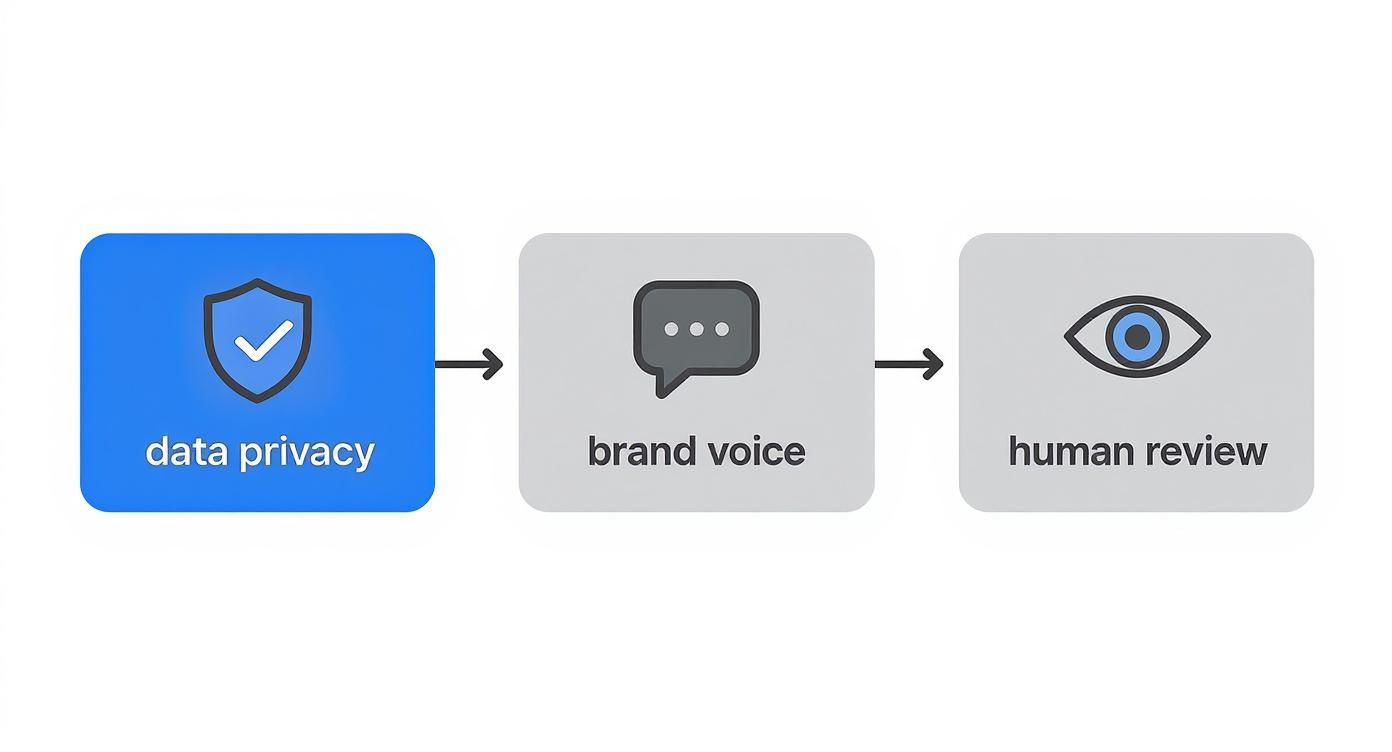
This process makes it clear that human oversight isn’t just a final checkbox; it’s a constant feedback loop that guarantees quality and keeps you safe.
Phase 3: Automation
The final phase is where you unlock serious scale. This is about building more advanced API workflows to automate the repetitive, high-volume stuff. This stage is best for larger agencies or businesses juggling dozens of accounts where doing everything by hand becomes a major bottleneck.
Good examples include setting up systems that automatically generate performance reports with plain-English summaries, or creating workflows that build out entire ad asset groups for a new product launch from a single prompt. This is the point where AI stops being a helpful assistant and becomes a core part of how you operate.
Your AI in PPC Audit Checklist:
Before you dive in, take stock of where you are now. It’ll help you spot the biggest opportunities.
- Current Workflow: Where do we waste the most time in our current PPC process? (e.g., writing copy, pulling reports).
- Team Skills: Honestly, what’s our team’s comfort level with AI tools? (Beginner, Intermediate, Advanced).
- Data Readiness: Is our customer feedback and performance data actually organised and ready to be analysed?
- Tool Stack: Do any of our existing marketing tools have AI integrations we could just switch on?
- Success Metrics: What specific KPIs (CTR, CPA) are we going to track to prove this is actually working?
Answering these questions gives you a clear starting point and sets the benchmarks you’ll need to measure your progress as you move through each phase.
Burning Questions About OpenAI Ad Services
When you start mixing AI into your advertising, it’s only natural for a few questions to pop up. Let’s tackle some of the most common ones we hear from UK marketers who are thinking about using OpenAI’s tools for their campaigns.
Is This Just the Same as the AI in Google or Facebook Ads?
That’s a great question, and the short answer is no, not at all.
Think of it like this: the AI inside platforms like Google Ads and Meta is like a highly skilled sous chef. It’s an absolute wizard at optimising bids, tweaking placements, and finding audiences inside its own kitchen (the ad platform).
OpenAI ad services, on the other hand, are more like your master recipe developer. It’s the creative force you turn to before you even start cooking. You use it to come up with the core ingredients—the ad copy, the creative ideas, the audience insights—which you then pass on to the platform’s sous chef to execute perfectly. They work together, they don’t compete.
How Secure Is My Business Data with OpenAI?
Data security is, quite rightly, a huge deal, especially with GDPR watching over everything we do in the UK. When you use OpenAI’s API for business, your data is not used to train their public models. That’s a massive difference from the free, public version of ChatGPT.
For sensitive jobs like sifting through customer feedback, the best practice is always to anonymise your data first. This just means stripping out any personal details (names, emails, etc.) before you feed it in. You get all the juicy insights without putting customer data at risk.
This way, you get the strategic upper hand without ever compromising on privacy or compliance.
Can AI Just Run My Ad Campaigns for Me?
Not a chance. At least, not yet—and honestly, that’s a good thing. AI is a powerhouse for the heavy lifting, like churning through data or generating hundreds of ad variations, but it has zero strategic awareness, brand intuition, or real-world business sense.
It can’t grasp your quarterly targets, the subtle nuances of your brand’s voice, or the fact your biggest competitor just launched a massive sale. The real magic happens when you create a human-AI partnership.
- You set the strategy: You provide the ‘why’ behind the campaign.
- AI delivers the scale: It handles the ‘what’ – the creative options and data crunching.
- You give the final sign-off: You ensure everything is on-brand, accurate, and high-quality.
At the end of the day, your expertise is what steers the ship. The goal of using OpenAI ad services isn’t to replace the marketer; it’s to give them a serious upgrade.
Ready to see how a data-driven, expert-led strategy can transform your PPC results? The team at PPC Geeks combines years of experience with smart technology to deliver campaigns that perform. Get your free, in-depth PPC audit today and discover your biggest opportunities for growth.