




Performance marketing companies are agencies that live and breathe one simple rule: you only pay for measurable results. Think sales, leads, or even just a click. This isn’t your traditional advertising model where you pay upfront and hope for the best. Instead, every single pound of your marketing budget is tied directly to a tangible business outcome.
What Does Performance Marketing Actually Mean for Your Business?

It’s a familiar story for many UK businesses. You pour a chunk of your budget into a marketing campaign, it runs for a few weeks, and you’re left with a report full of fuzzy metrics like “impressions” or “reach.” But did it actually make the phone ring or drive sales? It’s often impossible to tell.
This is exactly the problem performance marketing was built to solve.
You stop paying for the potential to reach customers and start paying for the actual action they take. It’s a massive shift in mindset, moving away from vague brand awareness towards a direct, provable return on investment (ROI). This focus on pure accountability is why partnering with specialist performance marketing companies has become a game-changer for any SME or ecommerce brand that’s serious about growth.
Tying Every Pound to a Result (Performance Marketing Companies)
The whole principle is incredibly simple but powerful. Your marketing activity is measured against specific actions you’ve agreed on beforehand. This draws a crystal-clear line between what you spend and what you earn, killing the guesswork that plagues so many other campaigns.
Here’s how that looks in the real world:
- You run an ecommerce store: You might pay an agency a slice of each sale they generate through their Google Shopping ads. If they don’t sell anything, you don’t pay. Simple as that.
- You’re a B2B service: You could agree to pay for every qualified lead that fills out a form from one of their LinkedIn campaigns.
- You have a mobile app: Your deal might be to pay for every single user who installs your app after clicking on a paid social ad.
This results-first approach is catching on fast. The UK digital ad market is set to grow at a compound annual rate of 15.1% through 2030, a surge driven by businesses piling investment into channels that can prove their worth.
The real beauty of performance marketing is its clarity. It forces an honest conversation about what success actually looks like for your business and holds both you and your agency partner accountable for hitting those goals.
Moving Beyond Vague Metrics
Ultimately, working with performance marketing companies means you stop throwing money at fuzzy metrics and start funding real, measurable growth. It’s about making every marketing decision with data, tweaking campaigns based on what genuinely works, and building a predictable engine to bring in new customers.
If you want to get into the nitty-gritty, have a look at our full guide on what is performance marketing for a deeper breakdown.
Performance Marketing Companies: The Services That Drive Real Growth
When you start looking into performance marketing companies, you’ll quickly find their services aren’t a simple, off-the-shelf package. A top-tier agency doesn’t just “run ads”; they build an interconnected system designed to capture demand, spark interest, and relentlessly chase better results. Getting your head around these core services is the first step to figuring out what your business actually needs to scale up.
While the exact mix will always depend on your specific goals, there are a few heavy hitters that form the backbone of nearly every successful performance marketing strategy. Think of these as the engines that turn your budget into real-world outcomes like leads and sales.
Paid Search or Pay Per Click (PPC)
Paid search, or PPC as it’s more commonly known, is usually the first thing that springs to mind. This is all about putting your business in front of potential customers on platforms like Google or Bing at the very moment they’re searching for something you sell. It’s a high-intent channel, which means you’re tapping into a stream of people who are already looking to buy or make an enquiry.
But a winning PPC strategy is so much more than just throwing money at keywords. It involves deep keyword research, writing ad copy that actually gets clicked, meticulous campaign structures, and optimising your landing pages to turn those clicks into customers. A real expert will be obsessed with metrics like Cost Per Acquisition (CPA) and Return on Ad Spend (ROAS), not just clicks. They know that anyone can drive traffic; the real skill is in driving profitable traffic. If you want to dig deeper into this, our guide details proven strategies a PPC agency uses to turn clicks into conversions.
Paid Social Media Advertising (Performance Marketing Companies)
If PPC is about capturing existing demand, paid social is all about creating it. Using powerful platforms like Meta (for Facebook and Instagram), LinkedIn, and TikTok, agencies can target specific demographics, interests, and behaviours with pinpoint accuracy. This is a dream for ecommerce brands wanting to show off their products visually or B2B companies trying to get in front of specific job titles in a particular industry.
The secret sauce here is a blend of standout creative and smart audience segmentation. A great paid social campaign uses eye-catching visuals, constantly tests different ad formats (think video, carousels, and stories), and never stops refining audiences based on what the data is telling them. The aim is to stop someone’s scroll with something so relevant it feels like a genuine discovery, not just another ad.
Affiliate and Partnership Marketing
Affiliate marketing is as pure as performance marketing gets. You pay partners—the ‘affiliates’—a commission for every sale or lead they send your way. It’s a straight-up “payment for results” model. These partners can be anyone from influential bloggers and YouTubers to coupon sites and trusted industry publications.
A good agency will manage this entire ecosystem for you. They’ll hunt down and recruit the right affiliates, arm them with tracking links and creative assets, and handle all the commission payments. It’s a fantastic, low-risk way to broaden your reach and build brand credibility through third-party endorsements without spending a penny upfront.
Conversion Rate Optimisation (CRO) (Performance Marketing Companies)
Getting traffic to your website is only half the job. If all those hard-won visitors land on your site and then leave without doing anything, your ad spend is just money down the drain. This is where Conversion Rate Optimisation (CRO) steps in. It’s the methodical process of improving your website and landing pages to get more visitors to convert.
It’s a classic mistake: pouring more and more money into ads while ignoring a “leaky bucket” of a website. Think about it—even a tiny lift in your conversion rate, say from 2% to 3%, delivers a 50% increase in leads or sales from the exact same amount of traffic.
CRO is a mix of data analysis, user behaviour research, A/B testing, and user experience (UX) design. An agency will use specialist tools to see exactly how people are interacting with your site. From there, they’ll test changes to everything from headlines and calls-to-action to page layouts and checkout forms to find the winning combination that drives the best results. This service is all about making sure you squeeze every last drop of value out of every single visitor.
To help you see how these services fit together, here’s a quick breakdown of what they do and how they’re measured.
Core Services Offered by Performance Marketing Companies
| Service | Primary Goal | Common Channels | Key KPIs to Track |
|---|---|---|---|
| Paid Search (PPC) | Capture high-intent demand from users actively searching for a solution. | Google, Bing, DuckDuckGo | Return on Ad Spend (ROAS), Cost Per Acquisition (CPA), Quality Score |
| Paid Social | Create new demand and build brand awareness with highly targeted audiences. | Meta (Facebook, Instagram), LinkedIn, TikTok, Pinterest | Cost Per Lead (CPL), Engagement Rate, Reach, Ad Frequency |
| Affiliate Marketing | Scale reach and sales through a network of commission-based partners. | Publisher websites, blogs, cashback sites, influencer channels | Cost Per Sale (CPS), Affiliate Conversion Rate, Revenue Growth |
| CRO | Maximise the value of existing traffic by improving the website conversion rate. | Your website, landing pages, mobile app | Conversion Rate, Bounce Rate, A/B Test Win Rate, Revenue Per Visitor |
Ultimately, the right mix of services will depend on your business, your audience, and your budget. A good agency won’t just sell you a service; they’ll work with you to build the right strategy to hit your growth targets.
Performance Marketing Companies: How to Vet and Choose the Right Agency Partner
Picking an agency partner is one of the biggest marketing decisions you’ll make. It’s not just about finding someone who can run a few ads; you’re handing over a piece of your business’s future to a team you need to trust.
Get it wrong, and you’re looking at wasted budgets and months of going nowhere. Get it right, and that partnership can become a serious engine for growth.
Kicking off your search on various platforms to find marketing agencies is a decent start. But the real work begins when you need to see past the slick sales pitches and figure out what a potential partner can actually deliver. That means doing your homework and asking the tough questions that get to the heart of their skills.
The UK agency scene is fierce. The demand for clear, measurable ROI has fuelled a boom in performance marketing. Right now, there are over 3,400 performance-focused agencies in the UK, all fighting for a slice of an industry worth around £12.3 billion and growing by nearly 22% a year. This competition is great for you—it means there are plenty of top-notch specialists out there. You just need a solid process to find the right one.
Look for Proven Industry Specialisation
A “one-size-fits-all” agency is rarely a perfect fit for anyone. You want to find performance marketing companies that have a proper track record in your industry, whether that’s B2B software, D2C fashion, or local services. An agency that already gets the quirks of your market, your customer’s journey, and who you’re up against will get things moving much faster and deliver better results from day one.
Don’t be shy about asking direct questions about their experience:
- Have you worked with ecommerce brands with a similar average order value to ours?
- Can you show us results you’ve achieved for other B2B lead generation clients in the tech space?
- What are the unique challenges you’ve seen when marketing products in our niche?
An agency with real expertise will have solid, confident answers ready to go. Their experience means they won’t be learning the ropes with your money.
My key takeaway here? Prioritise relevance over size. A smaller, specialist agency with deep experience in your sector is almost always a better bet than a huge, generalist agency that has only dabbled in your market.
Scrutinise Case Studies and Testimonials (Performance Marketing Companies)
Case studies are an agency’s portfolio, but they can be smoke and mirrors if you don’t know what to look for. Go beyond the vague success stories and dig into the details. A transparent case study should offer much more than just a big percentage increase.
It needs context. What was the starting point? What was the client’s actual ad spend? How long did it take to get these results? A 300% increase in leads sounds amazing, but it’s less impressive if they started from just two leads a month. For more on this, our guide on how to choose a digital marketing agency has a comprehensive checklist.
You should also look for genuine client testimonials. Even better, ask if you can speak to a current or former client. A great agency with happy partners will be more than willing to connect you. It’s your chance to get an honest take on their communication, reporting, and strategic thinking.
A huge part of your decision comes down to matching their skills with your main goal, which for most businesses is either generating leads or driving sales.
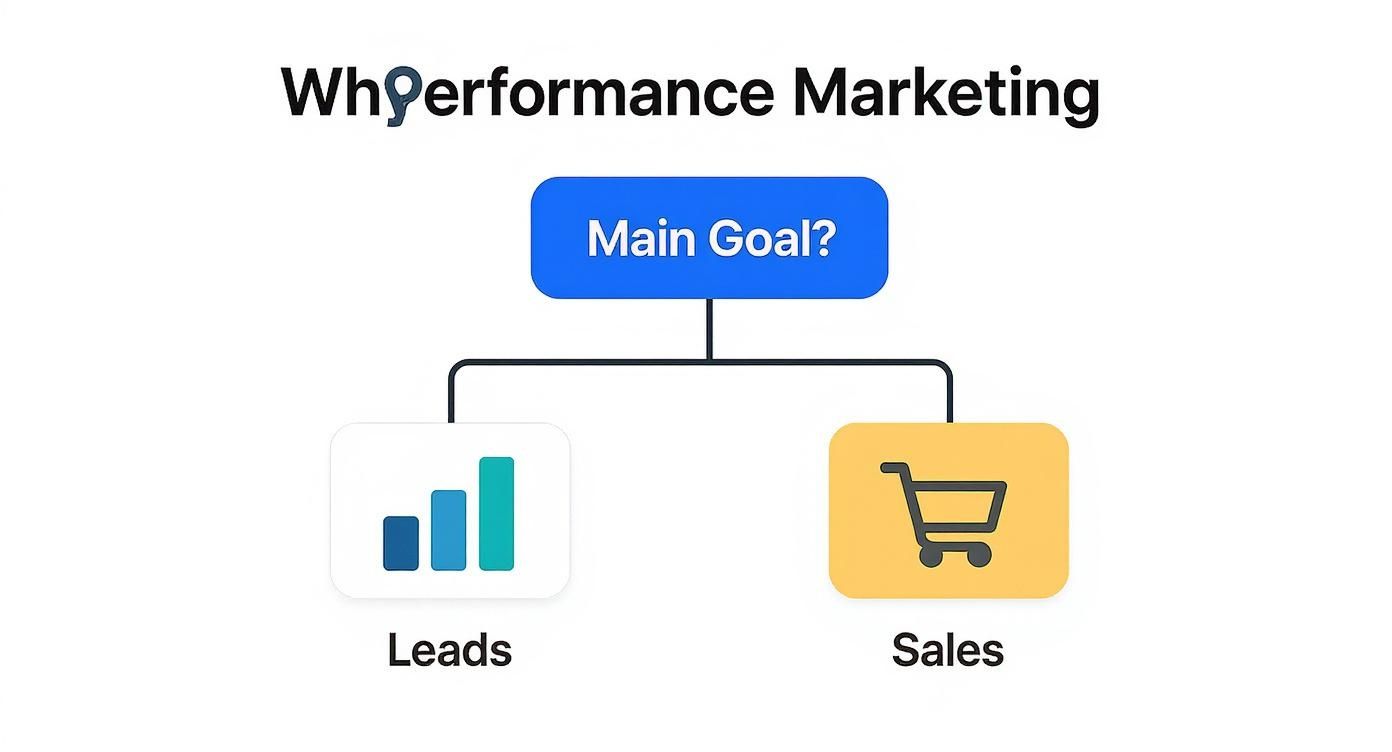
This flowchart shows the two main paths in performance marketing. Use it to clarify whether your focus is on lead generation or direct ecommerce sales before you even start talking to agencies.
Assess Cultural Fit and Communication
This is the human element. It often gets overlooked, but it can make or break a partnership. You’re going to be working closely with this team, so you need to actually get on with them and share a similar way of communicating.
Think about how you like to work. Do you need weekly deep-dive calls and detailed reports, or are you happy with a monthly summary so they can just get on with it? Pay close attention to how responsive, clear, and willing to listen they are during the vetting process.
Questions to consider during your initial talks:
- Who will be my day-to-day point of contact?
- What’s your standard format and frequency for reporting?
- How do you handle disagreements or campaigns that aren’t performing?
Their answers will tell you a lot about their processes and how much they value their client relationships. Finding a partner who communicates in a way that works for you will save you countless headaches down the line. Remember, you’re not just hiring a supplier; you’re building an extension of your own marketing team.
Performance Marketing Companies: Understanding Agency Pricing and True ROI

Before you sign on the dotted line with any agency, you absolutely have to get your head around the numbers. The money side of things can feel a bit murky at first, but most performance marketing companies use one of a few common pricing structures.
Getting to grips with these isn’t just about finding the cheapest option. It’s about finding the right fit for your budget and your growth ambitions. Each model has its own quirks, suiting different types of businesses and stages of growth. Let’s break them down so you can walk into negotiations with confidence.
Common Agency Pricing Models
You’ll almost certainly come across these three structures when you start talking to agencies.
- Percentage of Ad Spend: This is a classic. The agency takes a cut of what you spend on ads each month, usually somewhere between 10-20%. It’s straightforward and scales up as you do. The only catch? You need to be sure the agency is focused on making your budget work harder, not just getting you to spend more.
- Fixed Monthly Retainer: Simple and predictable. You pay a set fee every month for an agreed list of services. This is brilliant for budgeting and works well for long-term, strategic partnerships. The crucial part here is nailing down that scope of work from the start to make sure you’re getting what you pay for.
- Performance-Based Fees: This is performance marketing in its purest form. The agency only gets paid when they deliver specific results—like a percentage of the sales they generate or a flat fee for every qualified lead. It’s low-risk for you and keeps the agency laser-focused on what matters. Just be aware that if a campaign absolutely smashes it, this model can end up being more expensive.
Lots of agencies are now offering hybrid models, which blend a smaller retainer with a performance bonus. This can be a great middle ground, giving the agency some stability while keeping them hungry for results. For a deeper dive, check out our complete guide on Google Ads agency pricing, where we unpack these models in more detail.
Connecting Cost to Genuine Value (Performance Marketing Companies)
An agency’s fee is just one number. The real question is whether their work is actually making you money. To figure that out, you need to look past the flashy “vanity metrics” and zero in on the figures that hit your bottom line.
Forget about clicks and impressions for a moment. Real value is about profit. This is where you need to hold any agency accountable, and for a UK SME or ecommerce brand, there are two numbers that are non-negotiable.
Return on Ad Spend (ROAS)
This is the big one for any paid ad campaign. It tells you exactly how much revenue you’re making for every single pound you put into advertising.
The formula couldn’t be simpler: ROAS = Total Revenue from Ads / Total Ad Spend. So, a ROAS of 4:1 means for every £1 you spend, you’re bringing in £4 of revenue. What you should be aiming for all comes down to your profit margins.
Customer Acquisition Cost (CAC)
This metric tells you what it costs, on average, to win a new customer through your marketing. It’s the ultimate health check for how sustainable your growth is.
To work it out, just use this: CAC = Total Marketing Costs (including agency fees) / Number of New Customers Acquired. The golden rule is to keep your CAC well below the lifetime value (LTV) of your customers.
A huge part of choosing the right agency is seeing how they talk about these metrics. If you want to build your confidence in this area, getting a solid handle on measuring marketing ROI is a must. It gives you the power to properly evaluate proposals, negotiate a fair deal, and make sure any performance marketing company you hire is genuinely committed to driving profitable growth for your business.
Performance Marketing Companies: Key Questions to Ask Before You Hire

The success of your partnership with an agency hinges entirely on the quality of the questions you ask before you sign on the dotted line. To find the right fit, you have to go deeper than the standard, “What are your fees?” The real goal is to get a feel for their strategic thinking, how they handle data, and what they’re like to actually work with.
Think of these questions as diagnostic tools. They’re designed to slice through the polished sales pitch and reveal how an agency really operates under pressure. The answers will show you whether you’re talking to a simple service provider or a genuine strategic partner who’ll feel like an extension of your own team.
The UK’s digital marketing scene is massive, with agencies on track to pull in £20.4 billion in revenue by 2025. That growth means you’ve got a huge pool of agencies to choose from, but it also means you need to be sharp. Asking the right questions is your best way to navigate this crowded market. You can explore more on this in these digital agency growth statistics on capsulecrm.com.
Probing Their Strategic Approach
First up, you need to get inside their head and see how they think. A great agency doesn’t just tick boxes; they build and constantly refine a solid strategy. Their initial plan for you says everything about how much homework they’ve done on your business.
So, ask them this directly: “Walk me through your proposed plan for our first 90 days.”
A top-tier agency won’t give you a vague, fluffy answer. They’ll have a proper, structured outline ready, probably broken down into phases:
- Month 1: Discovery and Setup. This should be all about technical audits, getting pixels and tracking in place, deep-diving into your audience, and seeing what your competitors are up to. They need to learn your business inside and out before they even think about spending your money.
- Month 2: Testing and Learning. In this phase, they should be talking about launching initial campaigns with controlled budgets. The goal isn’t massive profit just yet; it’s about gathering data. They’ll be testing different ad creatives, audience segments, and landing pages to see what actually works.
- Month 3: Optimisation and Scaling. Armed with data from the previous month, they should have a clear plan to pour fuel on the fire for what’s working and ruthlessly cut what isn’t.
This one question is brilliant at separating the real strategists from the order-takers. If their answer is just “we’ll start running some ads,” that’s a massive red flag.
Gauging Their Resilience and Adaptability (Performance Marketing Companies)
Let’s be honest, performance marketing is never a smooth, straight line to success. Campaigns will underperform, platforms will change their algorithms overnight, and what worked last week can completely bomb this week. You need a partner who can take a punch, be honest about it, and adapt quickly.
To see how they handle the rough patches, ask a question that requires a bit of vulnerability: “Tell me about a campaign that failed and what you learned from it.”
An agency that claims they’ve never had a campaign fail is either brand new or not being honest. Failure is an inevitable—and incredibly valuable—part of the game. What truly matters is how they react to it.
Their answer should show you they have a process for diagnosing problems, a culture of taking ownership instead of making excuses, and a structured way of applying those lessons to future campaigns. It’s a huge indicator of their maturity and problem-solving chops.
You should also follow that up with: “How do you stay ahead of and adapt to constant platform algorithm changes?” This is crucial. A strong agency will talk about continuous team training, attending industry events, and even having direct contacts with reps at Google or Meta.
Clarifying Communication and Reporting
Finally, you need to nail down exactly how you’ll work together day-to-day. So many agency-client relationships go sour because of mismatched expectations around communication and reporting. Getting this crystal clear from the start will save you a world of headaches later on.
Here are a few essential questions to get the ball rolling:
- Who will be our main point of contact, and what’s their seniority? You need to know if you’re getting a seasoned strategist or a junior account manager who’s just passing on messages.
- What does your standard reporting look like, and how often will we get it? Don’t be afraid to ask for a sample report. It should be focused on the KPIs that actually matter to your bottom line, not just vanity metrics like impressions.
- How do you handle client feedback or strategic disagreements? This question peels back the curtain on their approach to collaboration. The best partners welcome your input and see the relationship as a true partnership.
Asking these kinds of probing questions turns the hiring process from a simple shopping trip into a proper strategic assessment. It ensures you find a partner who has not just the technical skills, but the strategic mind and collaborative spirit to drive real, sustainable growth for your business.
A Few Final Questions Before You Sign
Even after all the research, shortlisting, and calls, a few practical questions always pop up right before you’re ready to sign on the dotted line. It’s a big decision, and it’s completely normal to have some last-minute thoughts about the day-to-day reality of working with an agency.
Let’s cut through the noise and tackle these head-on. No jargon, just straight answers to give you that final bit of clarity.
How Much Should a UK Business Expect to Pay?
This is the big one, isn’t it? The honest answer is: it really does vary. But to give you a solid idea, most UK-based SMEs can expect a monthly retainer for management fees to be somewhere between £1,500 and £3,000. Remember, that’s separate from your actual ad spend. Some agencies prefer a fee based on 10-20% of your monthly ad spend, which is another common model.
But here’s the crucial bit: the cheapest option is almost never the best value. You’ve got to shift your focus from the upfront cost to the return you’re getting. An agency charging £2,500 a month that delivers a 5x Return on Ad Spend (ROAS) is a far smarter investment than a £1,500-a-month agency that only scrapes a 1.5x return. Always, always get a crystal-clear breakdown of their pricing and what’s included before you commit.
What’s the Real Difference Between a Performance and a Digital Agency?
The lines can feel a bit blurry sometimes, but the main difference comes down to focus and payment. A generalist digital marketing agency often casts a wide net, covering everything from organic social media and content creation to brand awareness campaigns. Their success is often measured with ‘softer’ metrics like follower growth or post engagement.
On the other hand, performance marketing companies are laser-focused on actions that directly make you money. Their entire world revolves around hard data—sales, qualified leads, form fills, app installs. And, most importantly, their pay is often directly tied to hitting those numbers. This makes them incredibly accountable for delivering a tangible, profitable return. Think of them as the specialists you bring in to turn clicks into cash.
How Long Until We See Real Results?
Patience is a virtue here. While you’ll start seeing initial data trickle in within the first few days of a campaign going live, you need to give it a solid 90-day period to see properly optimised results. Anyone promising you a massive overnight success story is likely selling you a fantasy. Real, sustainable growth is built methodically.
Here’s what a realistic timeline looks like:
- Month One: This is all about setup, research, and testing. It involves sorting out the technical bits (like tracking pixels), digging into audience research, and launching initial campaigns to gather that all-important baseline data.
- Months Two and Three: Now it’s all about optimisation and scaling. The agency will be deep in the data from month one, cutting what isn’t working and pouring more fuel on the strategies that are, improving efficiency and scaling up the wins.
That first phase is an investment in learning. Don’t rush it. The real, profitable growth is born from the insights you gain in that crucial first quarter.
How Involved Does My Team Need to Be?
The best agency relationships are true partnerships, not a “set it and forget it” deal. While the agency will be in the trenches managing the day-to-day, your team’s input is absolutely vital. You’re the experts on your own business, after all.
You should expect to be in regular meetings, probably weekly or bi-weekly, to go over performance and plan the next steps. Your team will need to feed the agency crucial info on things like:
- Upcoming product launches or sales promotions.
- Customer feedback and common questions.
- Shifts in your industry or what competitors are up to.
- Your business’s profit margins—this helps them set realistic targets.
Think of your new agency as a highly specialised extension of your own marketing team. The more you collaborate and share, the better the results will be. Open, honest communication is the fuel that powers a high-performing partnership.
Ready to partner with a team that delivers measurable growth and a clear ROI? The experts at PPC Geeks create data-driven PPC campaigns that align directly with your business goals. Get your free, in-depth audit today and discover how we can minimise wasted spend and scale your success. Learn more and get started.