




PPC campaign optimisation isn’t just a one-off task; it’s the constant, ongoing process of tweaking and refining your paid ad campaigns to squeeze every last drop of performance out of them and maximise your return on investment (ROI). It’s all about making smart, data-driven adjustments to everything—from your keywords and bids to your ad copy and landing pages.
When you get it right, you stop just spending money and start investing it to hit your real business goals.
PPC Campaign Optimisation: Building a Foundation for Profitable Campaigns
Before you even think about touching a single bid or keyword, the real work begins. You need to build a rock-solid foundation. I’ve seen countless campaigns fail, not because of poor keyword choices, but because they lacked clear direction and reliable data from day one.
Vague goals like “getting more traffic” are a recipe for disaster. Why? Because they offer no real way to measure what success actually looks like, and you’ll end up burning through your ad spend with nothing to show for it.
Proper optimisation demands a shift in mindset. Forget the vanity metrics and start focusing on tangible business outcomes. What does a ‘win’ actually look like for your business?
- For an ecommerce store: Are you trying to bump up the average order value, or is the main goal to shift a higher volume of a specific product line?
- For a B2B service provider: Is it all about getting more demo requests from qualified leads, or are you trying to grow your email newsletter with a valuable whitepaper?
Defining these objectives with crystal clarity is the absolute first step. It’s what transforms your PPC efforts from a cost centre into a predictable growth engine.
Why Flawless Conversion Tracking is Non-Negotiable
Once your goals are locked in, the next piece of the puzzle is ensuring your conversion tracking is completely accurate. Think of it as the nervous system of your entire PPC operation. If it’s broken, every single decision you make is based on faulty intelligence.
Imagine your Google Ads account tells you a campaign is unprofitable, so you hit pause. What you don’t realise is that your tracking was broken and failed to capture any phone call leads. You’ve just shut down your most profitable channel by mistake.
Believe me, this scenario is frighteningly common. A thorough audit of your tracking setup is essential. You need to be 100% sure you’re capturing every valuable action a user can take, not just the obvious ones. This includes things like:
- Form submissions
- Phone calls (from ads and the website)
- Ecommerce transactions
- Views of key pages (like your pricing page)
- PDF or resource downloads
Without accurate data, you are flying blind. Solid conversion tracking provides the reliable feedback loop needed to make smart, data-driven decisions that lead to genuine growth and improved profitability.
This foundational work isn’t the most glamorous part of running PPC campaigns, but it is without a doubt the most important. Get this right, and you can confidently identify what’s working, cut what isn’t, and systematically scale your successes.
For a deeper dive into what you should be measuring, you can learn more about key performance indicators for digital marketing in our detailed guide.
PPC Campaign Optimisation: Conducting a Ruthless PPC Account Audit
A frank and honest account audit is the quickest way to plug budget leaks and uncover hidden pockets of opportunity. Forget getting lost in endless spreadsheets; what really drives a campaign forward is a practical, systematic review of your account’s health. This isn’t about surface-level tweaks. It’s about digging deep to find and fix the root causes of underperformance.
Often, the first place to look is the account structure itself. A disorganised or bloated structure is one of the most common—and costly—mistakes I see. It leads directly to poor ad relevance, which tanks your Quality Score and forces you to pay more for every single click.
It all boils down to your core strategy. This visual guide breaks down the foundational three-step process: defining goals, setting up tracking, and then analysing the data that comes in.
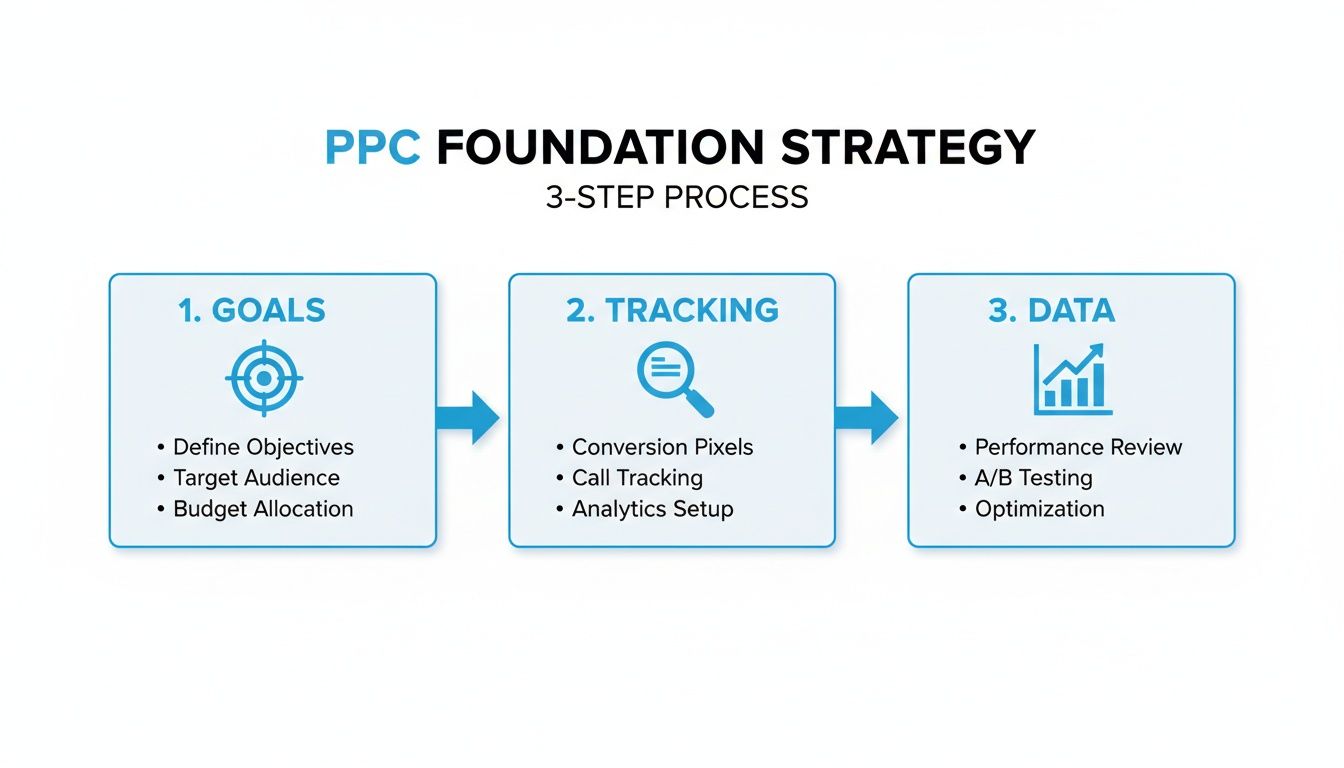
This simple flow is a powerful reminder that without clear objectives and reliable data, any optimisation efforts are just pure guesswork.
Deconstructing Your Campaign Structure
Think of your campaigns as filing cabinets and your ad groups as the folders inside. Simple, right? If a campaign is labelled “Men’s Shoes,” you wouldn’t just stuff folders for “women’s trainers” and “children’s boots” inside. It sounds obvious, but this is exactly what happens in messy PPC accounts, leading to irrelevant ads and heaps of wasted spend.
Your audit needs to look at this organisation with a critical eye.
- Logical Campaign Grouping: Are your campaigns organised logically? Think product categories, service lines, locations, or even user intent. A campaign for “emergency plumbing services” should be completely separate from one for “bathroom renovations.”
- Tightly-Knit Ad Groups: Inside each campaign, does every ad group contain a small, highly-related set of keywords? An ad group for “leather Chelsea boots” should only contain keywords directly related to that specific product. Nothing more.
- Keyword to Ad Relevance: Does the ad copy in each ad group speak directly to the keywords it contains? If someone searches for “size 10 brown brogues,” they need to see an ad about exactly that, not a generic “men’s shoes” message.
A well-organised account isn’t just for neatness; it’s absolutely fundamental to performance. It ensures the most relevant ad shows up for every search, which is what platforms like Google reward with higher rankings and lower costs. For a more detailed walkthrough, you can dig deeper with our ultimate guide to conducting a comprehensive Google Ads audit.
Mastering Keyword Intent and Negatives (PPC Campaign Optimisation)
Let’s be clear: not all keywords are created equal. A crucial part of any real audit is separating the high-intent, commercial keywords from the budget-draining informational ones. Someone searching for “buy running trainers online” is infinitely more valuable than someone searching for “how to clean running trainers.” Your audit has to identify and properly segment these different levels of intent.
This is also where your negative keyword list becomes your campaign’s most valuable player. It’s the security guard for your budget, actively blocking your ads from showing for irrelevant searches that do nothing but eat up your cash.
A robust negative keyword list is one of the single most effective levers for improving ROI. Every irrelevant click it prevents is money saved that can be reallocated to keywords that actually convert.
During your audit, you need to be living in your Search Query Report. Look for recurring themes of irrelevant searches that are triggering your ads.
- Competitor Names: Are you showing up for searches of competing brands? Unless that’s a specific strategic choice, add them as negatives.
- Informational Terms: Words like “how to,” “free,” “reviews,” or “jobs” almost always signal non-commercial intent. Block them.
- Unrelated Products: If you sell premium leather goods, terms like “cheap” or “faux leather” have no place triggering your ads and should be on your negative list immediately.
Building this list isn’t a one-and-done job. It’s an ongoing process of refinement that continuously improves the quality of your traffic and protects your ad spend. This is the kind of meticulous detail that separates the pros from the amateurs in PPC.
PPC Campaign Optimisation: Putting AI and Smart Bidding to Work for You
If you’re still manually tweaking bids click-by-click, you’re bringing a knife to a gunfight. You’re up against algorithms making thousands of calculations in the time it takes you to sip your morning coffee. This is where Smart Bidding and AI come in, turning PPC campaign optimisation from a tedious chore into a serious strategic advantage.
These systems, baked right into platforms like Google Ads and Microsoft Ads, take the mystery out of bidding by automating it around your specific goals. They crunch an insane amount of data in real-time for every single auction—a feat no human could ever hope to pull off.
How Smart Bidding Actually Works
Let’s make this real. Imagine a UK-based online shop that sells bespoke leather jackets. A potential customer searches “men’s brown leather jacket” late on a Tuesday night from their phone in Manchester. In that split second, the AI is assessing dozens of signals.
- What device are they on?
- What time is it?
- Where are they located?
- What’s their past browsing behaviour looked like?
- Which specific product are they most likely after?
Based on that complex web of data, the system predicts how likely that click is to turn into a sale. It then places a precise, competitive bid for that one auction, all in a fraction of a second. That’s the power you get when you step away from manual guesswork.
Choosing the Right Automated Strategy (PPC Campaign Optimisation)
Not all smart bidding strategies are built the same; picking the right one is all about your business objectives. Getting this right is fundamental to successful PPC campaign optimisation.
- Maximise Conversions: This strategy just goes for it, trying to get you the most conversions possible within your set budget. It’s a brilliant starting point if you’re focused on volume, like drumming up leads for a service business.
- Target CPA (Cost Per Acquisition): With this one, you tell the system exactly how much you’re willing to shell out for one conversion. It then works to get as many conversions as it can at or below that target cost. Perfect for businesses that know what a lead is worth to them.
- Target ROAS (Return On Ad Spend): For ecommerce, this is the holy grail. You set a target return for every pound spent (say, £5 in revenue for every £1 of ad spend), and the AI optimises your bids to hit that target.
The crucial bit is aligning the strategy with the financial reality of your business. If you don’t know what a new customer is worth, you can’t give the AI the right instructions.
The machine is only as smart as the data you feed it. Your first job is to ensure it gets clean, accurate, and plentiful conversion data. Without it, even the most powerful AI is just flying blind.
In the UK, AI-driven bidding is already delivering massive wins for advertisers who’ve made the switch. A Marin Software study found that UK advertisers using AI for bid management saw a staggering 25% increase in ROI compared to those sticking with manual methods. The financial incentive is clear.
Feeding the Algorithm for Peak Performance
To really unleash the power of these systems, you need to give them the right fuel. The algorithm thrives on a steady diet of conversion data to learn what works. Typically, Google suggests you have at least 30 conversions in the last 30 days before you flick the switch to a Target CPA or Target ROAS strategy.
If you’re not there yet, don’t sweat it. You can start with Maximise Conversions, which has a lower data requirement, and use it to build up your conversion history. The aim is to gather enough performance data so the AI gets a crystal-clear picture of what your ideal customer looks like.
Moving from manual control to automated intelligence is a huge leap in modernising your ad accounts. For a proper deep dive into these powerful tools, check out our detailed guide on Google Ads Smart Bidding. By letting the machines handle the heavy lifting, you free yourself up to focus on the bigger picture—strategy, ad creative, and landing pages—the uniquely human stuff that AI can’t replace.
PPC Campaign Optimisation: Optimising for People, Not Just Platforms
It’s incredibly easy to get lost in the technical weeds of PPC optimisation. You find yourself endlessly tweaking bids, chasing algorithms, and refining keywords. But it’s crucial to remember that behind every single click, search, and conversion is a real person trying to solve a real problem.
The moment you shift your focus from simply pleasing the platform to genuinely connecting with the person on the other side of the screen is when good campaigns become great ones.

This human-centric approach turns your advertising from a cold transaction into a meaningful interaction. It’s all about proving you understand your audience’s needs and have the perfect solution ready for them. That’s how you turn anonymous clicks into loyal, paying customers.
Crafting Ad Copy That Actually Connects
Think of your ad copy as your first handshake. If it’s generic and stuffed with features, it’s unlikely to inspire anyone to act. Your copy needs to speak directly to the user’s immediate pain points and motivations. What problem are they trying to solve right now?
Let’s say someone is searching for “noise-cancelling headphones for open office”. A generic ad listing technical specs like “Bluetooth 5.0 and 20-hour battery” falls flat compared to one that speaks to their reality: “Finally focus in a noisy office. Reclaim your concentration with headphones that silence distractions.” See the difference?
To nail this, you need to focus on:
- Benefits over Features: Don’t just list what your product does. Explain how it makes the customer’s life better.
- Emotional Triggers: Use words that tap into their desires or frustrations. Think “effortless,” “guaranteed,” or “finally.”
- A Clear Call to Action (CTA): Tell them exactly what to do next. “Shop Now,” “Get a Free Quote,” or “Download Your Guide.”
This small shift in perspective ensures your message resonates on a human level, earning you more than just a click—it earns you genuine consideration.
The Post-Click Experience Matters Most (PPC Campaign Optimisation)
Getting the click is only half the battle. If your landing page doesn’t deliver on the promise your ad just made, you’ve wasted your money. A disjointed experience—where the ad promises one thing and the page delivers another—is a guaranteed way to lose a potential customer.
Landing page optimisation is all about creating a seamless, frictionless journey from the ad right through to the conversion. Every single element on the page should guide the user toward taking that one desired action.
The single biggest mistake in PPC is sending highly targeted traffic to a generic, unfocused homepage. Your landing page should be a direct continuation of the conversation started by your ad.
This means getting a few key elements perfectly aligned:
- Message Match: The headline on your landing page must closely mirror the headline of your ad.
- Visual Consistency: Use similar imagery and branding. This creates a sense of familiarity and builds immediate trust.
- Simplicity: Get rid of all unnecessary distractions. If the goal is a form fill, make the form the hero of the page, not some tiny element buried at the bottom.
The Power of Personalisation and Segmentation
Truly effective PPC involves delivering messages that feel personal and relevant. By segmenting your audiences, you can ditch the one-size-fits-all approach and speak to different user groups with real precision.
This is especially powerful in remarketing. Instead of just showing a generic ad to everyone who has visited your site, you can create specific, targeted lists. For example, show one ad to users who abandoned their shopping basket and a completely different one to those who only viewed a specific product category.
Personalisation is no longer a “nice-to-have” in UK PPC campaigns—it’s a proven driver of higher engagement. In fact, data shows that personalised ads can generate 87% more revenue for e-commerce businesses and can be nearly twice as effective when combined with transparent data practices. You can discover more about the latest trends in PPC strategy and how they impact results.
By segmenting and personalising, you show your audience that you’re paying attention to their needs. And in this game, that’s how you build the trust needed to close the sale.
PPC Campaign Optimisation: Advanced Strategies for Scaling Your Wins
Once your campaigns are consistently hitting their targets and delivering a solid return, the conversation shifts from just managing profitability to actively scaling it. This is where the real growth kicks in. Moving beyond the basic tweaks means it’s time to embrace more advanced tactics that create a repeatable, data-backed engine for expansion.
This stage of PPC campaign optimisation is all about taking what works and multiplying its impact, but without watering down your results. It calls for a disciplined approach to testing, a deeper understanding of what each platform is truly capable of, and the strategic vision to expand your reach intelligently.
Mastering Performance Max and Shopping Feeds
For any ecommerce business, Google’s Performance Max (PMax) campaigns have become a central pillar of any serious scaling strategy. PMax uses machine learning to find customers across all of Google’s channels – from YouTube and Display to Search and Shopping. But treating it as a “set it and forget it” tool is a massive, and costly, mistake.
True PMax optimisation lies in the quality of the inputs you feed the machine.
- Asset Groups: Don’t just dump all your products into one generic asset group. That’s the fast track to mediocre results. Segment them logically by product category, brand, or even by profit margin. This lets you tailor your ad copy, images, and videos to be far more relevant to specific audiences.
- Audience Signals: You have to give the algorithm rich, high-quality audience signals to work with. This means uploading your best-performing customer lists, creating detailed segments of your website visitors, and building out custom audiences. The better the initial data, the faster the AI learns who your ideal customer really is.
- Product Feed Health: Your Shopping feed is the absolute backbone of your ecommerce PPC efforts. A poorly optimised feed will cripple your performance, no matter how clever your campaign setup is. You need to relentlessly focus on enriching your product data.
A detailed, keyword-rich product title and a comprehensive description aren’t just for show—they are critical data points that Google’s algorithm uses to match your products to relevant searches. Don’t be lazy with your feed; it’s one of the most powerful levers you have for growth.
To really get under the bonnet of this powerful campaign type, check out our deep-dive guide on scaling a B2C brand with Performance Max. It gives you the full playbook for making these campaigns work for you.
Expanding Your Reach to New Platforms (PPC Campaign Optimisation)
While Google might be the biggest player on the pitch, it’s not the only game in town. Platforms like Microsoft Advertising (formerly Bing Ads) often represent a significant, untapped opportunity for growth. The audience on Microsoft’s network is often a bit older, more affluent, and tends to have higher desktop usage—a seriously valuable demographic for many businesses.
Because it’s a less crowded marketplace, you can frequently find yourself with:
- Lower Cost-Per-Click (CPC): Less competition almost always translates to paying less for each click. Simple as that.
- Higher Click-Through-Rates (CTR): Your ads have a much better chance of standing out, which naturally leads to better engagement.
- Stronger Conversion Rates: You might just find that the specific audience on Microsoft’s network converts at a higher rate for your particular products or services.
The best part? Microsoft Advertising has a simple import tool that lets you bring your successful Google Ads campaigns straight over. With a few platform-specific tweaks, you can be up and running on a new, high-value channel in a remarkably short amount of time.
To help you decide which platforms to prioritise, here’s a quick look at where your optimisation efforts should be focused for each of the major players.
Platform-Specific Optimisation Tactics
A comparative look at key optimisation levers across major PPC platforms for targeted campaign improvements.
| Platform | Primary Optimisation Focus | Key Metric to Watch | Common Mistake to Avoid |
|---|---|---|---|
| Google Ads | Keyword relevance & Quality Score | Conversion Rate / ROAS | Ignoring negative keywords & match types. |
| Microsoft Ads | Audience demographics & device targeting | Cost Per Acquisition (CPA) | A simple ‘copy and paste’ from Google without tailoring. |
| Meta (Facebook/Insta) | Creative & audience segmentation | Cost Per Result / ROAS | Using overly broad audiences for too long. |
| Shopping / PMax | Product feed data quality & asset groups | Return On Ad Spend (ROAS) | A ‘set it and forget it’ mindset. |
This table highlights that while the goals are often similar, the path to success on each platform has its own nuances. What works wonders on Google might fall flat on Meta without the right creative approach.
Building a Structured Testing Framework (PPC Campaign Optimisation)
Scaling your budget without a robust testing framework isn’t a strategy—it’s just gambling. To grow responsibly, you have to adopt an “always be testing” mentality. This means moving beyond random A/B tests and creating a structured system to continuously improve every single component of your campaigns.
Your framework needs to be organised and methodical, focusing on one variable at a time to get clean, actionable data.
| Component to Test | Example Test Scenario | Key Metric to Monitor |
|---|---|---|
| Ad Copy | Testing a benefits-led headline (“Reclaim Your Focus”) vs. a feature-led one (“Noise-Cancelling Headphones”). | Click-Through-Rate (CTR) & Conversion Rate |
| Landing Pages | Testing a short-form landing page with a single CTA against a long-form page with more detail and social proof. | Conversion Rate & Cost Per Acquisition (CPA) |
| Audiences | Testing a broad “in-market” audience against a more niche “custom intent” audience built around competitor URLs. | Return On Ad Spend (ROAS) & Lead Quality |
| Bidding Strategy | Testing Target CPA against Maximise Conversion Value to see which drives better profitability for your business model. | ROAS & Overall Profitability |
By systematically testing and documenting your results, you build an invaluable library of insights about what truly resonates with your audience. This data-driven approach removes the guesswork and ensures that as you increase your ad spend, you’re investing in proven strategies, not just crossing your fingers and hoping for the best. This is the very cornerstone of sustainable, long-term PPC campaign optimisation and growth.
Got Questions About PPC? We’ve Got Answers
Diving into the world of pay-per-click can feel like you’re learning a new language, and it’s only natural for questions to bubble up as you start fine-tuning your strategy. Getting straight, no-nonsense answers is the key to making smarter decisions that don’t just protect your budget but actually grow your bottom line. Let’s tackle some of the most common questions we hear from business owners and marketers trying to get their PPC campaigns firing on all cylinders.
Whether you’re just getting your feet wet or you’re trying to figure out why your established campaigns have hit a wall, this should clear a few things up. We’ll cover everything from how long you really need to wait for results to figuring out when it’s time to tag in the pros.
How Long Does It Really Take to See Results from PPC?
Ah, the million-dollar question. And the honest-to-goodness answer is: it depends. You can often spot some early wins, like a better Click-Through Rate (CTR) from fresh ad copy, within a week or two. But seeing that meaningful, stable lift in conversions and a healthier Return On Ad Spend (ROAS) takes a bit more patience.
Think of a brand-new account as being in a “learning phase.” This isn’t just jargon; the ad platforms are genuinely gathering data to figure out who your best customers are and how they behave. This period can last anywhere from 30 to 90 days.
- The First Few Weeks (1-4): This is all about laying the groundwork. You’re adding negative keywords, testing a few ad variations, and double-checking that your conversion tracking is absolutely watertight. You’ll see data coming in, but it’s way too early to make any big calls.
- The First Month (Weeks 4-8): By now, you’ve got enough data to start making some properly informed decisions. You can see which keywords are duds, which ads are resonating, and which audiences are actually converting. This is where the real optimisation work kicks off.
- Three Months In: After about 90 days, the fog should have cleared. You’ll have a solid baseline for your performance and can clearly see how the tweaks you’ve been making are impacting your most important business metrics.
Seriously, patience is your best friend here. Making knee-jerk reactions based on a few days of data is probably the most common (and most expensive) mistake you can make in PPC.
Can I Just Let AI Manage Everything for Me?
While AI and automated bidding are absolute game-changers, they aren’t a “set it and forget it” solution. You can’t just hand over the keys and expect magic. AI is brilliant at number crunching on a scale no human ever could—making thousands of tiny bid adjustments in real-time. It’s a powerhouse.
But what AI lacks is your strategic brain and creative spark.
Think of AI as your incredibly skilled pilot. It can fly the plane with astonishing precision and efficiency. But you’re the navigator who sets the destination. The AI can perfect the flight path, but it still needs a human to tell it where to go and why.
That human touch is still non-negotiable for:
- Setting the Strategy: Deciding what a “conversion” actually means to your business and setting realistic targets for your cost-per-acquisition or ROAS.
- Creative Genius: Writing ad copy that grabs attention or designing visuals that connect with people on an emotional level. AI can generate text, but it can’t replicate true human insight.
- Reading the Room: Understanding that a sudden dip in performance might be due to a competitor’s sale or a change in market trends, not a flaw in your campaign setup.
The sweet spot is always a blend of machine-learning precision and human-led strategy. That’s how you get the best results, period.
When Should I Think About Hiring a PPC Agency?
Plenty of businesses manage their own PPC campaigns very successfully, especially when they’re starting out. But there are some tell-tale signs that it might be time to bring in a specialist agency.
Does any of this sound familiar?
- Your Spend is Going Up, But Sales Aren’t: You’re pouring more money in, but the leads or sales are flatlining, and you’re completely stumped as to why.
- You’ve Hit a Performance Plateau: Things were going great, but now they’ve stalled. You know there are more advanced tactics out there, but you’re not sure which ones will actually move the needle for you.
- You Just Don’t Have the Time: As a business owner or a busy marketing manager, you simply don’t have the hours in the week to dedicate to the nitty-gritty of proper PPC campaign optimisation.
- You Feel Totally Overwhelmed: The platforms change constantly. New features, new campaign types, new rules… trying to keep up feels like a full-time job in itself.
Bringing in an agency isn’t admitting defeat. It’s a strategic move to plug into expert knowledge, accelerate your growth, and make sure every pound you spend is working as hard as it possibly can.
If you’re at a point where managing your campaigns is becoming a major time-sink or you’re just not seeing the ROI you need, an expert eye can make all the difference. The team at PPC Geeks offers a free, in-depth PPC audit that pinpoints exactly where your biggest opportunities are hiding. Get your free PPC audit today and let our award-winning UK team show you how to squeeze more value from your ad spend.