




When you hear about SEO PPC services, you’re hearing about a unified marketing strategy. It’s about blending the slow-burn, authority-building power of Search Engine Optimisation (SEO) with the instant, laser-focused visibility you get from Pay-Per-Click (PPC) ads. By bringing them together, your brand doesn’t just show up in search results—it dominates them, capturing customers at every single stage of their journey and making sure every penny of your marketing spend works harder.
SEO PPC Services: Uniting SEO and PPC for Maximum Impact
Think of your marketing like a high-performance vehicle with two specialised engines. SEO is your endurance engine. It’s the methodical, behind-the-scenes work that builds momentum over time, generating a steady stream of long-term organic traffic. It’s all about earning trust with search engines, creating a digital asset that grows in value and steadily lowers your customer acquisition costs for years.
PPC, on the other hand, is the turbo-boost. It gives you immediate speed and pinpoint accuracy right when you need it. With PPC, you can rocket your brand to the top of the search results instantly, targeting specific customers with surgical precision and gathering a goldmine of performance data in real-time.
Creating a Marketing Flywheel
Running these two engines separately will get you decent results. But when you fuse them together with a cohesive seo ppc services strategy, you create something much more powerful: a marketing flywheel. Each rotation builds on the last, accelerating your results faster and more efficiently.
This unified approach stops you from thinking of SEO and PPC as rivals fighting for budget. Instead, they become a single, synergistic force. The insights you get from one directly feed the success of the other, creating a cycle of non-stop improvement.
An integrated strategy allows you to completely dominate the search engine results pages (SERPs). By appearing in both the paid and organic listings, you don’t just double your visibility—you build massive brand credibility and trust with potential customers.
For small and medium-sized businesses (SMEs) and ecommerce brands across the UK, this synergy is the real key to unlocking growth. It turns your marketing from a bunch of disconnected tactics into a smart, cohesive system built for maximum impact. If you want to dig deeper into what sets these two apart, you can explore our detailed comparison of SEO vs SEM.
The Power of a Unified Approach (SEO PPC Services)
A truly successful integrated strategy isn’t just about running two campaigns at the same time; it’s about making them work together intelligently. Let’s break down the tangible benefits.
First, let’s look at how their distinct roles come together.
SEO vs PPC: A Quick Comparison of Their Roles
| Attribute | SEO (Search Engine Optimisation) | PPC (Pay-Per-Click) |
|---|---|---|
| Primary Goal | Build long-term organic visibility and authority. | Drive immediate, targeted traffic and leads. |
| Speed to Results | Slower; typically takes months to see significant impact. | Instant; campaigns can drive traffic within hours. |
| Cost Model | No direct media cost, but requires investment in expertise, content, and time. | Pay for each click or impression; direct media spend. |
| SERP Position | Earned organic listings below the paid ads. | Top-of-page paid ad placements. |
| Sustainability | Results are durable and can last long after active work stops. | Traffic stops the moment you stop paying. |
| Data & Insights | Provides deep insights into user behaviour and search trends over time. | Offers rapid feedback on keyword performance, ad copy, and conversions. |
This table shows they aren’t competitors; they’re partners. One builds the foundation while the other seizes immediate opportunities.
Here’s what that partnership delivers:
- Total SERP Dominance: Owning both the top paid ad spot and the top organic listing for your most important keywords cements your brand as the undeniable market leader.
- Data-Driven Decisions: PPC campaigns give you immediate, hard data on which keywords actually convert. You can then use this intelligence to prioritise your long-term SEO content strategy, saving you a huge amount of time and money.
- Enhanced Remarketing: Use SEO to attract visitors organically with helpful content. Then, use PPC remarketing to bring those same visitors back to your site with targeted offers, massively increasing your conversion rates.
- Improved ROI: By making each channel smarter and more efficient, the combined return on your investment is far greater than what either could ever achieve on its own.
SEO PPC Services: Building Your SEO Foundation for Long-Term Growth
If PPC is the turbo boost for your marketing, then SEO is the powerful, reliable engine that keeps your brand moving forward, day in and day out. It’s the absolute bedrock of your online presence—a long-term investment that builds a stellar reputation with search engines and pays dividends for years to come.
Think of it like this: you’re building a valuable digital asset for your business. One that appreciates over time, generating a steady stream of organic traffic and consistently driving down your customer acquisition costs.
This isn’t about chasing short-term loopholes or trying to “hack” Google. Real, effective SEO is a methodical craft built on three core pillars: technical optimisation, on-page content, and authority building. Get these right, and you’ll have a website that search engines don’t just understand but are genuinely eager to show to their users. For any UK brand serious about lasting success, it’s non-negotiable.
Understanding Your Customer’s Language
First things first, you need to get your keyword research sorted. This is so much more than just pulling together a list of popular search terms; it’s about learning to speak your customer’s language fluently. You need to get inside their heads and find the exact words and phrases they’re typing into Google when they need the solutions you provide.
Proper keyword research uncovers the full spectrum of user intent:
- Informational Keywords: The questions people ask when they’re just starting to research a problem (e.g., “how to improve garden drainage”).
- Navigational Keywords: What they type when they’re trying to find a specific brand or site (e.g., “PPC Geeks contact”).
- Commercial Keywords: The queries that signal someone is weighing up their options and getting ready to spend money (e.g., “best waterproof walking boots UK”).
- Transactional Keywords: High-intent phrases from people with their wallets out, ready to buy now (e.g., “buy nike air max size 9”).
By mapping these different types of keywords to the customer journey, you can create content that meets people at the perfect moment, gently guiding them from initial curiosity all the way to a final purchase.
Creating Content That Serves and Ranks (SEO PPC Services)
With your keywords mapped out, the next step is on-page SEO. This is all about creating genuinely useful content that directly answers your customers’ biggest questions. Your website pages, your blog posts, your guides—they all need to be the single best resource a user could possibly find for their search query.
That means focusing on delivering real value, not just clumsily stuffing keywords onto a page. A well-optimised page has a crystal-clear structure, page titles that grab attention, and meta descriptions that make people want to click.
SEO, at its core, is all about user experience. Google’s number one mission is to give its users the most relevant, helpful results possible. When you align your content with that goal, you’re not just optimising for an algorithm—you’re optimising for your future customers.
And this is where an integrated seo ppc services strategy really shines. The data from your PPC campaigns can tell you exactly which search terms are leading to conversions, allowing you to double down on your SEO efforts for topics you already know have commercial value.
Earning Trust and Authority
The final piece of the puzzle is off-page SEO, which mainly revolves around authority building (often called link building). In the online world, a link from another credible website to yours is like a professional referral or a vote of confidence. It’s a massive signal to search engines that your content is trustworthy and worth paying attention to.
Put it this way: if a well-respected industry blog links to your guide on garden drainage, Google sees that as a powerful endorsement. This earned trust gives your entire website a major authority boost, helping all your pages rank higher for their target keywords.
Authority isn’t built overnight; it’s the result of consistently creating brilliant content and building genuine relationships. For any business that wants to build a strong online footprint, learning how to increase website traffic through these core SEO principles is the key to sustainable, long-term growth.
SEO PPC Services: Tapping into PPC for Instant Visibility and Hard Data
If SEO is the long game—carefully building a beautiful, welcoming home that people will eventually find—then Pay-Per-Click (PPC) is the express lift that takes your ideal customers straight to the penthouse suite. It’s like hitting the nitro button on your marketing, getting you to the very top of the search results the second you launch a campaign. In a world where you need leads and sales today, not six months from now, that kind of speed is a massive advantage.
With platforms like Google Ads, you’re essentially bidding for the best ad spots for specific search terms. This puts your brand front and centre, grabbing the attention of people who are actively looking for what you sell. It’s a direct, powerful way to drive incredibly relevant traffic right when it matters most.
The Speed and Precision of Paid Search
The absolute killer feature of PPC is its immediacy. An SEO strategy takes time to mature and deliver results, but a well-built PPC campaign can start funnelling traffic, leads, and sales within just a few hours. That rapid feedback is priceless, whether you’re testing a new product, pushing a seasonal offer, or breaking into a new market.
But it’s not just about speed; it’s also about control. You’re not just blindly buying traffic. You’re buying access to highly specific groups of people based on the keywords they use, their location, their demographics, and even their past online behaviour. This level of precision means your budget is spent reaching the people most likely to actually become customers.
The real magic of PPC isn’t just how fast it works. It’s that it doubles as a live market research lab. Every click, impression, and conversion is a piece of data, giving you instant feedback on which messages connect with your audience and what keywords actually make the phone ring.
This intelligence-gathering is precisely where PPC becomes an indispensable partner to SEO. The insights you get from paid campaigns can be fed directly into your long-term organic strategy, creating a powerful feedback loop that speeds everything up.
Essential PPC Campaign Types for Growth (SEO PPC Services)
A smart paid search strategy isn’t one-size-fits-all. It uses a mix of campaign types to engage customers at different points in their journey. A proper integrated seo ppc services approach always involves picking the right tool for the job.
- Search Ads: These are the classic text ads you see at the top of Google. They’re brilliant for capturing intent, getting you in front of people who are actively searching for a solution you provide.
- Shopping Campaigns: An absolute must for any ecommerce brand. These are the visual ads showing product images, prices, and reviews right in the search results. They cut down the steps from search to purchase in a big way.
- Performance Max (PMax): This is Google’s all-in-one campaign type. It uses machine learning to find new customers across every single one of Google’s channels—YouTube, Display, Search, Discover, Gmail, and Maps—all from one campaign.
By blending these formats, you create a complete digital presence that guides customers from their first search all the way through to their final purchase. To get a better handle on measuring all of this, our guide on conducting a paid search analysis is a great place to start.
Fuelling Your Strategy with Real-Time Data
The UK advertising market proves just how dominant paid search has become. It recently smashed records, hitting a massive £42.6 billion in total ad spend. Of that, search advertising alone made up £16.9 billion. To put that in perspective, two out of every five pounds spent on advertising in the UK goes straight to platforms like Google and Bing. For small businesses with tight budgets, this highlights why PPC is no longer optional. It delivers immediate results, with average click-through rates hitting 7.37% and conversion rates around 6.96%—a world away from SEO’s typical 3-6 month warm-up period. You can read more about these UK advertising statistics on Whitehat-seo.co.uk.
This huge investment is driven by one thing: data. PPC gives you an immediate, measurable answer to the biggest question in marketing: “What’s working right now?” You get real-time feedback on:
- Keyword Performance: See which search terms are driving actual sales and enquiries, not just clicks.
- Ad Copy Effectiveness: Test different headlines and descriptions to find the exact message that makes people want to click.
- Conversion Rates: See how well your landing pages are turning visitors into customers and pinpoint where you can improve.
- Audience Behaviour: Learn who your best customers are, where they live, and what devices they’re using to find you.
This kind of actionable data is gold dust. It takes the guesswork out of your marketing, allowing you to make sharp, informed decisions that improve not just your paid campaigns, but your entire digital strategy—especially your long-term SEO work.
The Integrated Strategy: How SEO and PPC Work Together
This is where the real magic happens. It’s time to stop thinking of SEO and PPC as separate line items on your budget and start treating them as a single, powerful marketing engine. An integrated strategy is all about getting your two most important channels to talk to each other constantly, creating a feedback loop where each one makes the other smarter, faster, and more effective.
Think about it like this: you could use a PPC campaign to quickly test the conversion potential of ten different keywords. Instead of spending months building out SEO content around a term you think will work, you can spend a small amount to find out which ones actually drive sales. That’s the power of bringing these two disciplines together.
Creating a Powerful Data Feedback Loop
At the heart of any successful SEO and PPC integration is the flow of data between the two channels. PPC acts as your rapid intelligence-gathering squad, while SEO is your long-term ground force. The immediate, granular data you get from paid campaigns provides invaluable insights that directly inform your organic strategy, taking the guesswork out of the equation and speeding up your results.
Here are a few practical tactics that show this synergy in action:
- Keyword Discovery: Your PPC campaigns will inevitably unearth new, high-converting “long-tail” keywords you might have missed during your initial SEO research. You can then create targeted blog posts or service pages for these terms to capture that organic traffic for free.
- Ad Copy Optimisation: Run tests on different headlines and descriptions in your PPC ads to see which messages truly resonate with your audience. The winning ad copy can then be repurposed for your SEO meta descriptions and page titles, which can dramatically improve your organic click-through rates.
- Landing Page Testing: Use PPC traffic to A/B test different versions of a landing page. Once you find the layout, copy, and call-to-action that converts best, you can roll that winning design out across your key organic pages, lifting performance across the board.
This continuous cycle of testing, learning, and applying insights across both channels creates a flywheel effect. Your paid campaigns become more efficient because they’re supported by a strong organic presence, and your SEO efforts become more targeted because they’re guided by real-world conversion data.
The image below breaks down the core benefits PPC brings to the partnership, highlighting its ability to drive immediate traffic, deliver hyper-targeted ads, and generate actionable data you can use right away.
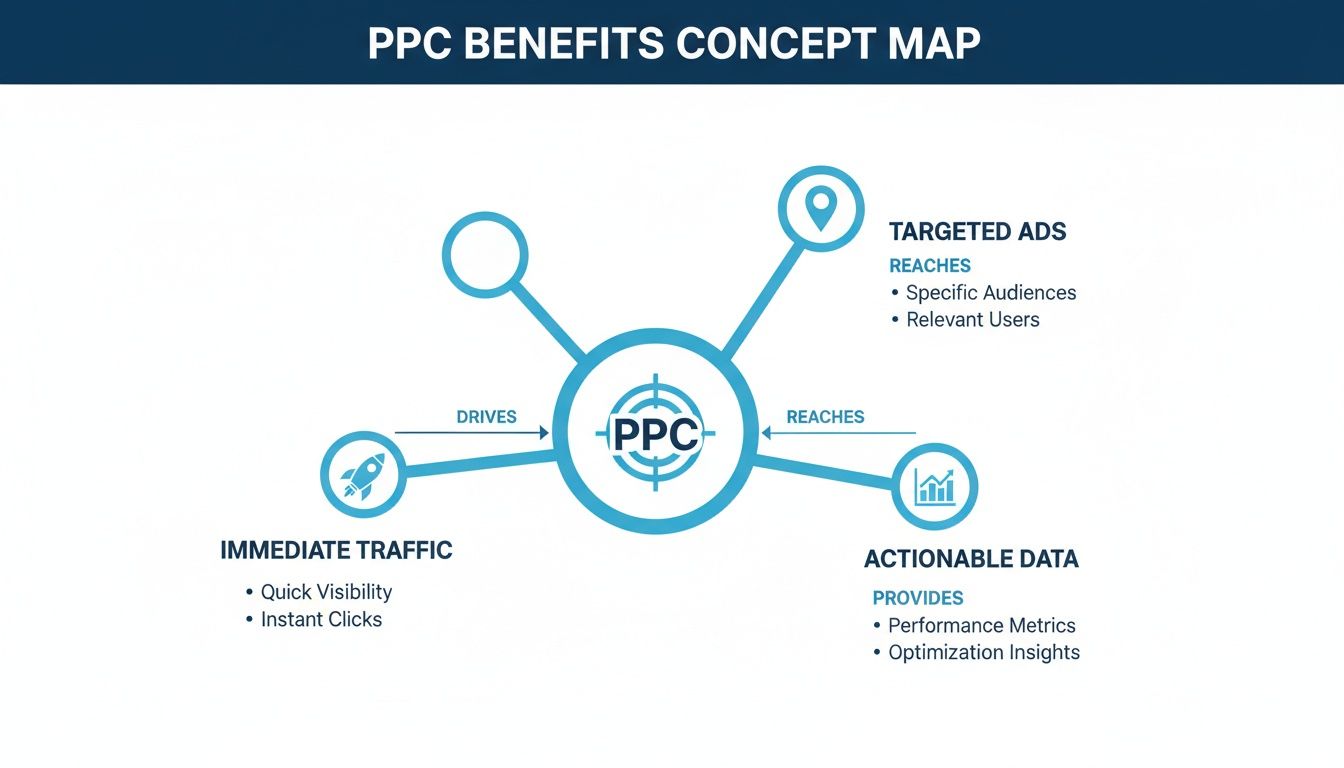
This really shows how PPC can act as a catalyst for growth, providing the speed and insights needed to make your entire marketing strategy more agile and effective.
Actionable SEO and PPC Integration Tactics (SEO PPC Services)
To bring this all together, here’s a table outlining some of the most effective ways to make your SEO and PPC efforts work in harmony. This isn’t just about sharing data; it’s about creating a true feedback loop where actions in one channel have a direct, positive impact on the other.
| Integration Tactic | How PPC Helps SEO | How SEO Helps PPC |
|---|---|---|
| Shared Keyword Data | Quickly identifies high-converting keywords to target with long-term organic content, saving months of guesswork. | Provides a list of high-ranking organic keywords that can be used to create cost-effective, high-performing paid campaigns. |
| Ad Copy & Meta Description Testing | A/B tests headlines and descriptions to find the most compelling messaging, which can then be used to improve organic CTR. | SEO content provides inspiration for ad copy, ensuring messaging is consistent and addresses user pain points effectively. |
| Landing Page Optimisation | Drives targeted traffic to test different page layouts and CTAs, allowing you to find the highest-converting design to apply to key organic pages. | Strong organic landing pages with high Quality Scores can lead to lower cost-per-click (CPC) and better ad positions in PPC. |
| Audience Insights & Remarketing | Captures valuable first-party audience data (e.g., demographics, interests) that can inform SEO content strategy and personas. | Organic visitors can be added to remarketing lists, allowing PPC to re-engage warm leads who aren’t ready to convert yet. |
| SERP Dominance | Secures a top-of-page ad spot while SEO works on ranking, ensuring immediate visibility for crucial commercial terms. | A strong organic presence builds brand authority and trust, which can increase the click-through rate on your paid ads. |
These tactics aren’t just theoretical; they are practical, battle-tested strategies that we use every day to drive better results for our clients. By implementing even a few of these, you’ll start to see the powerful compounding effect of an integrated approach.
Dominating the Search Results Page
One of the most powerful visual benefits of an integrated strategy is total SERP (Search Engine Results Page) domination. When a potential customer searches for one of your most valuable keywords, you don’t just want to show up once. You want to own the page.
Having both a top-ranking paid ad and a strong organic listing for the same term builds immense brand credibility. It sends a powerful signal to the user that your company is the leading authority in that space, which significantly increases their trust and their likelihood of clicking on one of your links.
This dual presence is absolutely critical in competitive markets. UK marketing professionals rank Paid Search as a top priority, with 56% considering it ‘very important’ to their strategies. For e-commerce brands, these hybrid SEO-PPC strategies can boost conversions by up to 30%. While it’s true that 94% of clicks in the UK go to organic results, PPC is essential for filling competitive gaps and capturing immediate interest. A well-run agency can deliver a combined click share of 49% by mastering both channels. You can explore more of these fascinating UK digital marketing statistics from LOCALiQ.
Advanced Integration Tactics for Maximum ROI (SEO PPC Services)
Beyond sharing keyword data and ad copy, a truly sophisticated SEO and PPC service uses audience data to create a seamless customer journey. This is where you get into smart remarketing and personalised experiences.
For example, a visitor might first find your brand through an organic search for an informational query, like “how to choose the right running shoes.” They land on your helpful blog post (thanks, SEO!), but they aren’t ready to buy yet and leave the site.
With an integrated strategy, that’s not a lost opportunity. It’s just the beginning.
- Tag and Segment: You can tag this user as someone who has shown a clear interest in running shoes.
- Strategic Remarketing: Later, as they browse other websites or watch videos on YouTube, you can serve them highly relevant display or video ads (PPC) showcasing your latest running shoe models.
- Guide Them Back: These ads can guide them directly back to a specific product page, turning that initial organic interest into a final sale.
This tactic connects the dots between a user’s initial research and their final purchase decision. It ensures your brand stays top-of-mind throughout their entire journey, maximising the return on every single pound you spend on marketing.
SEO PPC Services: Choosing the Right Integrated Marketing Partner in the UK
Picking the right agency is one of the biggest calls you’ll make for your business. This isn’t just about hiring a supplier; it’s about finding a genuine strategic partner who gets your vision and has the chops to make it happen. For any UK business, that means finding someone who understands the quirks and nuances of our local market.
It’s easy to feel a bit lost in the process, but if you go in armed with the right questions and a clear idea of what you’re looking for, you’ll find an agency that feels like a true extension of your own team. The aim is to find a partner who is open with their reporting, clear about their strategy, and genuinely invested in seeing you grow.
Key Questions to Ask Potential Agencies
Before you even think about signing a contract, you need to dig deeper than the slick sales pitch. A great agency won’t just tolerate tough questions—they’ll welcome them and give you straight, confident answers. How they respond tells you everything about their experience, their process, and whether they’ll be a good fit for your company culture.
Here are a few essential questions to get the conversation rolling:
- Integrated Experience: Can you walk me through some real examples of how you’ve run integrated SEO and PPC campaigns for a business like mine?
- Attribution Model: How do you handle attribution? Talk me through how you measure the combined impact when both SEO and PPC contribute to a single conversion.
- Industry Knowledge: What’s your experience in my sector? Do you have a handle on our typical customer journey and the competitive pressures we face?
- Team Structure: Who exactly will be working on our account? Can we meet the specialists who will be in the trenches managing our campaigns day-to-day?
These questions are designed to cut through the fluff and get to the heart of how an agency really works. For an even more detailed checklist, our guide on how to choose a digital marketing agency has plenty more valuable pointers.
Understanding Agency Pricing Models (SEO PPC Services)
Let’s demystify agency fees, because getting this right is a huge part of making an informed choice. Most agencies in the UK will structure their pricing for seo ppc services in one of three ways, each designed for different needs.
- Monthly Retainer: This is the most common setup for ongoing work. You pay a fixed fee every month for a set scope of services, which gives you predictable costs and means your campaigns are constantly being optimised.
- Project-Based Fee: Perfect for specific, one-off jobs like a technical SEO audit, building a new landing page, or setting up a PPC account from scratch. You pay a single, agreed price for a very clearly defined deliverable.
- Performance-Based Pricing: With this model, the agency’s fee is tied directly to the results they get for you—think a percentage of ad spend or a set fee for every lead they generate. It means their success is directly linked to yours.
Any agency worth its salt will be completely transparent about its pricing. They should be able to clearly explain what’s included, what might cost extra, and how their fees deliver real value.
The Power of a Free Audit
Before you commit to a long-term relationship, a free, no-strings-attached audit of your existing accounts is an incredibly valuable first step. This isn’t just a sales gimmick; it’s a diagnostic tool that lets a potential partner show you what they can do and prove their value from day one.
A proper audit should give you actionable insights, highlighting where you’re wasting money in your PPC account and spotting the big opportunities in your SEO strategy. It’s your chance to see how they think, how they analyse data, and how they communicate. This initial collaboration is the best way to see if you click before signing on the dotted line.
The UK’s PPC and SEO software market is absolutely booming—it’s expected to hit £8.25 billion by 2030 with a 13.5% compound annual growth rate, a surge driven mostly by SMEs. This shows just how vital the right tools—and the experts who know how to use them—are for success. With 56% of UK marketers now making Local SEO a priority alongside PPC, an agency’s ability to knit these strategies together is more important than ever. You can dive deeper into the growth of the UK SEO software market on Grandviewresearch.com.
Common Questions About SEO and PPC Services
Dipping your toes into the world of integrated digital marketing can bring up a lot of questions. To make a confident decision about where to put your budget and what to expect, you need clear, straightforward answers. This section tackles the most common queries UK business owners have when thinking about combined seo ppc services, helping you navigate your options with clarity.
If I Have a Small Budget, Which Should I Start With: SEO or PPC?
This is one of the biggest questions we get, and the truth is, the right answer depends entirely on what your business needs right now. There’s no single correct choice; it’s all about aligning your investment with your most urgent goals.
Think of it this way: PPC is like buying fruit from the market. It’s fast, targeted, and solves an immediate problem. If you need to generate leads or sales today—maybe to test a new product, prove a business idea, or drive traffic for a big seasonal sale—then PPC is your best bet. Its speed gives you instant visibility and priceless data on what’s working.
SEO, on the other hand, is like planting a fruit tree. It takes patience, consistent care, and a bit of upfront effort. But once it matures, it becomes a sustainable, long-term asset that produces fruit year after year, cutting down your future costs and reliance on paid ads.
For most small businesses, the best solution is actually a mix of both:
- Start with a modest PPC budget to get traffic flowing, test out keywords, and bring in some immediate revenue.
- At the same time, invest in foundational SEO work, like a technical audit and creating core content.
This way, the crucial lessons you learn from your paid campaigns make your SEO efforts smarter and more efficient from day one. You get the instant win from PPC while building a powerful organic presence for the future.
How Long Does It Take to See Results From Integrated SEO PPC Services?
Understanding the timeline for results is key to managing expectations and knowing what success looks like. With an integrated strategy, you’ll see outcomes at two different speeds, which is actually one of its biggest strengths.
PPC results are almost immediate. Once your campaigns are properly set up and switched on, you can start seeing traffic, clicks, and even conversions within days, sometimes just hours. This is the main perk of paid search—it delivers a rapid, predictable stream of potential customers.
SEO is a marathon, not a sprint. It typically takes a good three to six months of consistent, quality work to see real movement in your organic rankings and traffic. More significant, business-changing results often start showing up after six to twelve months. That’s because you’re methodically building trust and authority with search engines, and that’s a gradual process.
The beauty of an integrated strategy is that it gives you the best of both worlds. You get the immediate feedback and lead flow from PPC, which can fund your marketing efforts while the long-term, compounding value of SEO is being built in the background.
A skilled agency will always set clear, realistic expectations for both short-term PPC wins and long-term SEO milestones, so you know exactly what value is being delivered at every stage.
How Do You Measure the ROI of a Combined SEO and PPC Strategy?
Measuring the return on investment (ROI) of a combined strategy means looking beyond individual channel metrics. The modern way to do it is to focus on the entire customer journey, recognising that SEO and PPC often work together to land a single conversion. Just giving credit to the “last click” often tells a misleading story.
A sharp agency uses advanced analytics and attribution models to understand these complex interactions. For example, a customer’s journey might look like this:
- Discovery (SEO): They first find your brand by clicking an organic search result for a helpful blog post. They have a read but aren’t ready to buy yet.
- Re-engagement (PPC): A few days later, they see one of your remarketing ads on another website, reminding them of your brand and showing off a specific product.
- Conversion (Direct): They then type your website address directly into their browser and make a purchase.
In a simplistic, last-click model, “Direct” traffic gets all the credit. But in reality, both your SEO content and your PPC ad were essential steps that guided the customer to the sale.
To measure the true ROI, we focus on blended metrics:
- Blended Cost-Per-Acquisition (CPA): This calculates the total cost of acquiring a customer across both SEO and PPC, giving you a much more accurate picture of your overall marketing efficiency.
- Multi-Channel Funnel Analysis: This tracks how different channels assist each other on the path to conversion, revealing the true collaborative value of your strategy.
- Customer Lifetime Value (LTV): By understanding how customers acquired through different paths behave over time, you can see which journeys create the most valuable long-term relationships.
- Total SERP Dominance: This measures the percentage of first-page real estate you own for your most important keywords, combining paid and organic listings to track your overall market authority.
By focusing on these more holistic KPIs, you get a far more accurate and meaningful understanding of the powerful ROI that a truly integrated seo ppc services strategy delivers.
Ready to see how a unified strategy can transform your business? At PPC Geeks, we specialise in creating data-driven SEO and PPC campaigns that work together to maximise your growth. Get your free, in-depth proposal today and discover your untapped potential.
Find out more at https://ppcgeeks.co.uk/.