




To get the most out of ChatGPT for your ads, you need to stop thinking of it as just a tool and start treating it like a strategic assistant. It all begins before you even think about writing a prompt. You need to nail down your campaign goals, get crystal clear on your UK audience, and lay out your brand voice. This prep work is what turns generic AI waffle into ad copy that actually converts.
Start ChatGPT Ads: Setting the Stage for AI-Powered Advertising
Jumping into AI for advertising without a plan is like hiring a junior copywriter and just telling them to “write some ads.” You wouldn’t do it. The potential is massive, but without a solid brief, the output will be bland and totally off the mark.
To move from just messing around with ChatGPT to building a proper professional workflow, you have to treat it like a capable, but very literal, member of your team. It needs specific instructions to do its best work. This strategic groundwork is what separates the marketers who get lucky once in a while from those who build a repeatable, scalable process for creating winning campaigns.
The magic isn’t really in the tool itself; it’s in the quality of the information you feed it.
Your AI-Powered Ad Creation Workflow
Here’s a quick look at the stages you should follow to properly integrate ChatGPT into your ad creation process. Think of it as your pre-flight checklist.
| Stage | Core Objective | Practical Task |
|---|---|---|
| Strategy & Goals | Define what success looks like. | Is this about driving sales, getting leads, or just making noise? Pinpoint your primary objective. |
| Audience Deep Dive | Know who you’re talking to. | Go beyond ‘males, 25-40’. What are their real pain points? What language do they use? |
| Brand Voice Definition | Establish your personality. | Are you formal and corporate, or chatty and informal? Gather examples of your best copy. |
| Prompt Engineering | Give clear, detailed instructions. | Combine your goals, audience insights, and brand voice into a comprehensive brief for the AI. |
| Generation & Refinement | Create and iterate. | Generate initial copy, then work with the AI to tweak, improve, and create variations. |
| Review & Launch | Apply the human touch. | A human expert must always review the final copy for nuance, compliance, and impact before it goes live. |
Following a structured workflow like this ensures you’re guiding the AI, not just hoping for the best.
The Foundation of Every Successful AI Campaign (Start ChatGPT Ads)
Before you can dream up the perfect prompt, you need to get the core components of your campaign locked down. These elements act as guardrails, making sure the AI’s creative output is perfectly aligned with what your business actually needs to achieve. A solid brief is non-negotiable.
Here’s the essential groundwork you absolutely must cover:
- Define Clear Campaign Goals: What’s the number one thing you need this campaign to do? Is it direct online sales, lead generation for a service, or building brand awareness in a new city? Your goal shapes the tone, the call-to-action, and the entire message.
- Understand Your UK Audience: Go deeper than basic demographics. What are their specific frustrations? What slang or cultural references will actually land with them? An ad targeting finance professionals in Manchester needs to sound completely different from one aimed at students in Bristol.
- Prepare Brand Voice Guidelines: How does your brand speak? Are you authoritative and professional, or are you the friendly, informal expert? Give ChatGPT examples of your existing copy, a list of words to use (and definitely ones to avoid), and a clear rundown of your brand’s personality.
This simple flow chart shows how these foundational pieces fit together to give your AI-powered ads a strong start.
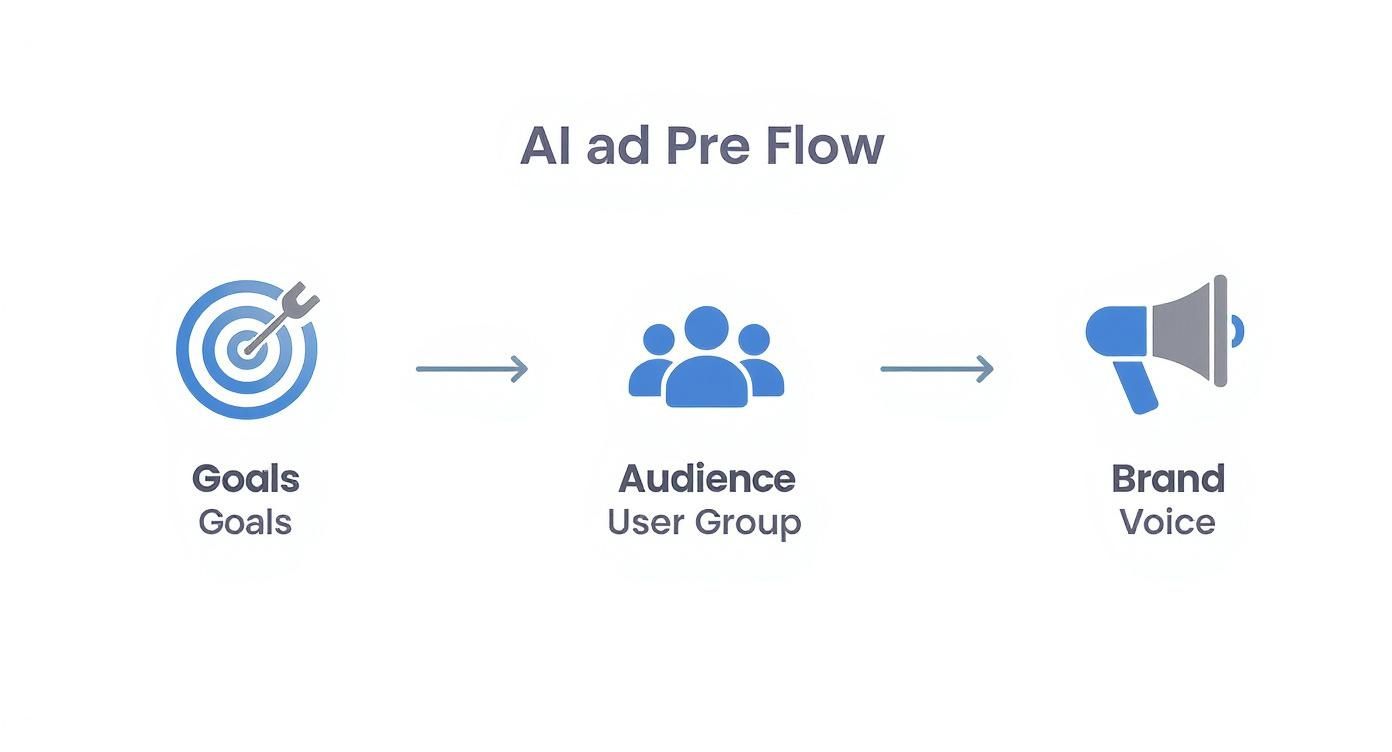
As you can see, the brand voice is the final filter. Everything—your goals, your audience insights—needs to pass through it to ensure you sound like you.
Navigating the UK Adoption Curve
While AI tools are popping up everywhere, their adoption in UK workplaces has been a bit more cautious compared to global trends. Research shows that while 70% of UK respondents have used AI in their daily lives, this is a fair bit behind the global average of 82%. This points to a market that’s equal parts excited and healthily sceptical.
This cautious approach is actually a huge opportunity. By mastering a structured, professional workflow for creating ads with AI, you can get a serious competitive edge over rivals who are still just dabbling. We’re at a critical moment in the evolution of search advertising, and you can learn more about it in our guide on ads in AI Overviews and the new era of search advertising.
Start ChatGPT Ads: Crafting Prompts for High-Converting Ad Copy
The difference between getting generic, unusable text from ChatGPT and genuinely high-performing ad copy comes down to one thing: the quality of your prompt. A lazy, one-sentence request will get you a lazy, one-sentence answer. If you want to start generating ads that actually convert, you have to stop asking simple questions and start giving strategic commands.
Think about it. You wouldn’t walk up to a junior copywriter and just say, “write an ad for our shoes.” You’d give them the target audience, the unique selling points, the brand voice, and maybe even show them a few ads that have worked well before. You need to give ChatGPT that same level of detail.
The R.A.C.E. Framework for Better Prompts
To make this process repeatable and consistently effective, we use a simple framework called R.A.C.E. It’s a straightforward way to make sure you give ChatGPT all the crucial information it needs to deliver exceptional copy.
- Role: Tell ChatGPT who it should be. A witty copywriter for a Gen Z brand? A formal B2B marketing expert? A friendly local business owner? Setting the role frames the entire response.
- Action: Be precise about what you want it to do. “Write 5 Google Ads headlines,” “Generate 3 variations of Facebook ad body copy,” or “Suggest 10 powerful calls-to-action.”
- Context: This is where the magic happens. Give it all the background detail: your product or service, your UK target audience (e.g., “busy mums in Manchester”), their biggest pain points, your key benefits, and any special offers you’re running.
- Example: Provide a sample of your brand’s voice or an ad that performed really well in the past. This gives the AI a clear style guide to follow, ensuring the tone is spot on.
Using this framework turns a vague wish into a clear, actionable brief that the AI can actually work with.
Just look at the difference. A lazy prompt is: “Write an ad for our London plumbing service.” But a R.A.C.E. prompt is: “Act as an expert UK copywriter. Write 3 Google Ads descriptions for an emergency plumbing service in London called ‘Capital Drains’. Our target audience is stressed-out homeowners with a burst pipe or blocked drain. Focus on our 24/7 availability and ‘no call-out fee’ promise. The tone needs to be reassuring and professional.” The second prompt will win, every single time.
Practical Prompt Templates for UK Ads (Start ChatGPT Ads)
Let’s put this into practice. Feel free to adapt these templates for your own campaigns to get a running start.
For Google Ads Headlines (Focused on Benefits):
“Act as a direct-response copywriter. My product is [product name], a [product description]. The target audience is [describe UK audience]. Generate 10 Google Ads headlines under 30 characters. Each headline must highlight a key benefit like [benefit 1], [benefit 2], or [benefit 3]. Use UK English spelling.”
For Meta Ad Copy (Story-Driven):
“Assume the role of a social media advertising specialist. Write a Facebook ad for [product/service]. The goal is to drive clicks to our landing page. The audience is [describe audience and interests]. Write a short, engaging story about how our product solves [customer pain point]. End with a clear call-to-action. Our brand voice is [e.g., friendly, witty, authoritative].”
Getting good at this is a process of trial and error. To see the kind of outputs you can get, it’s worth exploring these ChatGPT ad examples for more inspiration. Keep refining your prompts based on what the AI gives you, and soon you’ll have a workflow that produces brilliant ad copy, time after time.
Start ChatGPT Ads: Teaming Up with AI to Brainstorm Ad Creative
Powerful advertising is about more than just slick copy; your visuals need to land with the same punch. While ChatGPT can’t fire up Photoshop and design your images, it’s a phenomenal partner for brainstorming the concepts behind them. It’s time to move beyond simple copy generation and start using it as a creative director’s assistant to fuel your visual strategy.
Think of the AI as a springboard for ideas. Instead of just asking for another headline, you can prompt it for the visual metaphors that bring those headlines to life. It’s all about turning an abstract benefit into a tangible, scroll-stopping visual.
Generating Visual and Video Concepts
Let’s say you’re advertising a complex piece of B2B software. Trying to explain its benefits with text alone can be a bit dry, can’t it? This is where you can start a proper creative dialogue with your AI partner to cook up some compelling visual ideas.
Give a prompt like this a go:
“Act as a creative director for a UK tech brand. Our software automates invoicing for small businesses, saving them around 10 hours a month. Suggest 5 distinct visual concepts for a Meta ad campaign. For each concept, describe the static image and a 15-second video idea.”
This kind of prompt really pushes ChatGPT beyond just stringing words together and into the world of visual storytelling. It might spit back concepts like a business owner literally chucking a clock in the bin, or a split-screen showing a chaotic, paper-strewn desk on one side and a serene, organised one on the other.
Structuring A/B Testing Ideas (Start ChatGPT Ads)
One of the best ways to use AI is to systematically generate variations for your A/B tests. We know that effective multi-format campaigns rely on testing different creative angles, and this is where AI can save you hours of head-scratching. In fact, data from Microsoft Advertising shows that UK campaigns combining different ad formats can achieve up to 64% more reach among converters.
To get your testing plan in order, you could prompt it like this:
- Angle 1 (The Problem): “Generate three image ideas that visually represent the frustration of manual invoicing for a UK small business owner.”
- Angle 2 (The Solution): “Now, suggest three contrasting image ideas that show the relief and freedom our software provides.”
- Angle 3 (The Aspiration): “Finally, give me three concepts showing what a business owner can do with the extra time they’ve saved.”
This structured approach quickly gives you three distinct creative pillars for your campaign. Suddenly, you’ve got multiple visual ideas ready to hand over to your design team. You’re not just creating one-off ads; you’re building a solid testing framework from the ground up.
The Human-in-the-Loop Process
Remember, the AI’s role here is to generate possibilities, not the final product. The raw output is just your starting point. The most critical step is the human-in-the-loop review, where your market knowledge and brand intuition take centre stage.
Take the concepts the AI gives you, filter them through your brand guidelines, and start refining. Does the visual of a business owner lounging on a beach feel authentic for your UK audience, or would a scene in a bustling local café land better? This is where your expertise turns a decent idea into a winning creative that feels both fresh and true to your brand.
Start ChatGPT Ads: Using AI to Build Smarter PPC Campaigns
Let’s be honest, manually structuring a pay-per-click (PPC) campaign can be a real grind. The painstaking work of sorting hundreds, sometimes thousands, of keywords into tightly themed ad groups and then writing unique, relevant copy for each one is enough to make anyone’s eyes glaze over. This is exactly where you can start using ChatGPT for your ads, transforming a time-consuming chore into a much more streamlined, strategic process.
Instead of staring at a spreadsheet for hours, you can just feed a raw keyword list directly to the AI. Ask it to act as an expert PPC strategist and organise those keywords into logical ad groups based on user intent. This simple step doesn’t just save you hours of tedious work; it lays the foundation for a more organised, higher-performing campaign right from the start.
From Keyword Lists to Campaign Blueprints
Imagine you’re building a Google Ads campaign for a local plumbing service based in Bristol. Your initial keyword research might give you a jumbled list of terms like “emergency plumber Bristol,” “leaky tap repair,” “boiler service cost,” and “fix blocked drain.”
Traditionally, you’d have to group these manually. The new way? Prompt ChatGPT.
“Act as a UK Google Ads specialist. Here is a list of keywords for a Bristol-based plumbing company. Please organise them into tightly themed ad groups.”
The AI will intelligently cluster them for you, creating distinct groups like “Emergency Services,” “Tap & Leak Repairs,” and “Boiler Maintenance.” This instantly gives you a clean campaign structure that helps improve your account’s relevance and Quality Score – a crucial element for success. A well-organised structure also pairs perfectly with automated strategies, which you can learn more about in our guide on how Google Ads Smart Bidding works.
Once your ad groups are sorted, the next step is just as simple. You can ask ChatGPT to draft relevant headlines and descriptions tailored specifically for each group, making sure your ad copy speaks directly to what the searcher needs.
Building Ad Copy at Scale (Start ChatGPT Ads)
Now, let’s take that “Emergency Services” ad group. The keywords are specific and high-intent, so the ad copy needs to match that energy.
You can use a follow-up prompt:
“For the ‘Emergency Services’ ad group containing keywords like ’emergency plumber Bristol’ and ’24/7 plumber,’ write 3 responsive search ad headlines and 2 descriptions. Emphasise our 24/7 availability and no call-out fee. The tone should be urgent yet reassuring.”
This kind of prompt gives ChatGPT everything it needs to generate highly relevant copy that lines up perfectly with user intent. You’re moving from a generic, one-size-fits-all approach to a highly targeted one, which is essential for boosting click-through rates (CTR) and conversions.
Interestingly, this mirrors how people in the UK are already using AI. Recent surveys show that 32% of UK AI users turn to these tools for customer support and 14% for product recommendations, often using them to refine professional work and communications. You can read more about these insights into ChatGPT usage habits.
This methodical approach ensures that every part of your campaign, from the keywords to the copy, is tightly aligned. The result is a more effective campaign architecture that’s not only faster to build but also far easier to manage and optimise over time.
Start ChatGPT Ads: Testing and Measuring Your AI-Generated Ads
Getting your AI-assisted campaign live is a great feeling, but the real work starts now. This is the point where data takes over from intuition. When you start using ChatGPT for ads, you’re not just launching some copy; you’re launching a series of educated guesses—hypotheses—and you absolutely must treat them that way.
The brilliant thing about using AI is the sheer volume of quality variations you can churn out. It’s the perfect fuel for a solid A/B testing plan. Instead of spending hours writing two versions of an ad, you can generate ten, each with a slightly different emotional hook or call-to-action. This lets you run more detailed and impactful tests right from day one.

Prioritising Your A/B Tests
With so many variables to test, it’s easy to get lost. So, where do you start? My advice is to focus on the elements that deliver the biggest bang for your buck first. Don’t get bogged down testing minor description changes if your headline is falling flat.
Here’s a practical testing hierarchy I’ve found works well:
- Headlines and Hooks: This is your first impression, so make it count. Test different benefit-led headlines against more problem-focused ones to see what grabs attention.
- Calls-to-Action (CTAs): Play around with urgency (“Shop Now, Sale Ends Today”) versus value (“Get Your Free Quote”). The difference in performance can be surprising.
- Ad Body Copy: Once you have a winning headline and CTA combo, you can start testing long-form storytelling copy against concise, bullet-pointed features.
- Visuals: Put the AI-generated concepts head-to-head. Does an image showing the customer’s problem resonate more than one showing the solution?
When you’re looking at the results, you have to look beyond a single metric. A high Click-Through Rate (CTR) is great, but it’s useless if the Conversion Rate is zero. You need the full picture to understand what’s really working. For a deeper dive, our guide on how to measure advertising effectiveness gives you a solid framework for tracking the metrics that actually matter.
Creating a Powerful AI Feedback Loop (Start ChatGPT Ads)
This is where the process gets really interesting and dynamic. The performance data from your live campaigns is the most valuable input you can give ChatGPT for the next round of creative. Don’t just look at the numbers and make manual tweaks yourself—feed the data back into the AI.
Imagine dropping this prompt into the chat: “Here are the performance metrics for my last three Google Ads. Headline A had a 5.2% CTR but a low conversion rate. Headline B had a lower CTR but a better CPA. Based on this data and our goal of maximising leads, generate five new headlines that combine the high-click appeal of A with a stronger conversion-focused message.”
This simple step creates a powerful feedback loop. You’re no longer just using AI to create; you’re using it to analyse and optimise based on real-world results.
By feeding performance data back into your prompts, you effectively teach the AI what resonates with your specific audience. This leads to smarter, more effective ad variations with each cycle. This iterative process—create, measure, refine—is the secret to achieving continuous, data-driven growth in your campaigns.
Common Questions About Using ChatGPT for Ads
Diving into AI for creating your ad campaigns is bound to bring up a few questions. As more UK marketers start using these tools, we see the same concerns popping up again and again. Let’s tackle the big ones head-on so you can start using ChatGPT for your ads with complete confidence.
One of the biggest fears we hear is that the output will sound robotic and just… bland. It’s a fair point, but luckily, it’s completely avoidable.
The magic is all in the prompt. A lazy, one-line input is always going to give you a generic, uninspired output. But when you feed ChatGPT detailed prompts specifying your brand voice, customer personas, unique selling points, and even show it examples of your best-performing ads, you’re guiding it to create copy that feels like it came straight from your team. Always think of that first AI draft as exactly that—a solid starting point for a savvy marketer to polish up, adding that final human spark.
Will I Get Penalised for Using AI Content? (Start ChatGPT Ads)
There’s a common myth floating around that platforms like Google or Meta will somehow punish advertisers for using AI-generated content. As it stands, that’s simply not true.
Neither platform has a policy against using AI to write ad copy. What they care about is the final ad itself. Is it accurate? Is it transparent? Does it follow all of their advertising rules? That’s what matters, regardless of whether a human or an AI wrote the first draft. At the end of the day, you, the advertiser, are responsible for what goes live.
So, fact-check everything. Make sure your ads meet all the platform standards and never, ever cut corners on quality. Think of AI as your creative assistant, not a free pass on compliance.
Does AI Make PPC Managers Obsolete?
Not a chance. In fact, it does the opposite—it makes the role even more strategic. AI is brilliant at handling the grunt work, like churning out dozens of copy variations, which frees up the human PPC manager to focus on what really matters: high-level strategy.
Your job shifts from being a copy-writing machine to an ‘AI strategist’. Your expertise is now channelled into:
- Crafting the perfect prompts that get you on-brand results.
- Curating the best AI suggestions and adding the finishing touches.
- Analysing performance data with a sharp, strategic eye.
- Making the tough calls on budget, targeting, and overall campaign direction.
AI takes care of the ‘what’, freeing you up to focus on the ‘why’ and ‘what’s next’. Your strategic brain becomes more valuable than ever. It’s not about being replaced; it’s about being upgraded.
Ready to stop guessing and start getting real results from your PPC campaigns? The team at PPC Geeks combines decades of experience with a data-driven approach to build, manage, and optimise campaigns that deliver measurable growth. Get your free, in-depth PPC audit today and discover how much more you could be achieving.