




Targeting in advertising is all about getting your message in front of the right people—those most likely to be interested in what you’re selling. Instead of shouting into the void and hoping someone listens, it’s about focusing your efforts (and your budget) on a specific slice of the market. This makes your ad spend smarter, more efficient, and a whole lot more effective.
What Is Targeting in Advertising and Why It Matters

Picture this: you’re trying to sell bespoke suits at a music festival. You might get a few curious looks, but let’s be honest, most people there aren’t your target market. Now, imagine setting up a pop-up shop right outside a top corporate law firm during their lunch break. The difference is night and day.
That’s targeting in advertising in a nutshell. It’s the art and science of finding the right people, at the right time, with the right message. For small and medium-sized businesses here in the UK, getting this right isn’t just a nice-to-have; it’s absolutely fundamental to growth.
Moving Beyond Traditional Advertising
Not too long ago, advertising was a bit of a scattergun affair. Think billboards on the M1 or a big splashy ad in a national newspaper. These methods cast a huge net, hoping to snag a tiny percentage of the people who see them. It was the marketing equivalent of shouting into a packed stadium and hoping a potential customer hears you.
Digital advertising changed the game completely. Instead of broadcasting to the masses, we can now zero in on the specific individuals who match our ideal customer profile. This shift has massive implications for your business, transforming advertising from a vague expense into a measurable investment.
By focusing your budget only on users who show a high probability of converting, effective targeting directly increases your Return on Ad Spend (ROAS) and minimises wasted expenditure.
The Core Benefits for Your Business (Targeting in Advertising)
So, why should a busy marketing manager or SME owner care so much about precise targeting? Because the benefits hit your bottom line directly.
- Maximised Budget Efficiency: You stop wasting money on people who will never buy from you. Every pound is put to work on audiences with real potential, making your budget go much further.
- Increased Conversion Rates: When an ad is actually relevant to someone’s needs or interests, they’re far more likely to click, engage, and ultimately become a customer. It’s that simple.
- Improved Customer Engagement: Ads that speak to a user’s specific problems or desires feel less like ads and more like helpful solutions. This builds a much stronger connection and fosters real brand loyalty.
- Clearer Performance Insights: Targeting lets you test different audience groups against each other. This gives you crystal-clear data on who your most profitable customers are and the best way to reach them.
Ultimately, great targeting means you can stop shouting into the void and start having meaningful, profitable conversations with the people who are already looking for you.
Targeting in Advertising: Understanding the Core Types of Audience Targeting
Think of effective ad targeting like good detective work. It’s not one single action, but a mix of different skills and clues that help you build a crystal-clear picture of your ideal customer. You start with a broad list of suspects and, clue by clue, narrow it down to a precise profile.
Let’s unpack the essential tools in your advertising toolkit. By understanding these core methods, you can stop guessing and start making smart, data-driven decisions that connect your message with the people who are genuinely waiting to hear it.
Demographic Targeting: The Who
The most straightforward place to start is with demographics. This is the basic, factual information you’d find on a census form—objective, quantifiable traits that help you sketch out your audience.
While it might sound basic, this layer is fundamental for almost any campaign. It immediately filters out huge swathes of the population who simply aren’t a good fit. For example, a UK-based firm offering retirement planning would instantly use age demographics to focus on people over 40, making their ad spend more efficient from the get-go.
Key demographic segments include:
- Age: Essential for products geared towards specific life stages, like university courses or retirement homes.
- Gender: Useful for brands in fashion, cosmetics, or health that cater mostly to one gender.
- Location: Critical for local businesses like a café in Manchester or a nationwide brand running regional promotions.
- Income Level: Lets luxury brands or budget-friendly services focus on audiences with the right purchasing power.
- Education or Occupation: Perfect for B2B services or specialised consumer products.
Psychographic Targeting in Advertising: The Why
If demographics tell you who your customers are, psychographics tell you why they make certain choices. This is where you get into the more nuanced, human side of things, focusing on what drives people from the inside.
It groups people based on their attitudes, values, interests, and lifestyles. This is how you connect on an emotional level. For instance, a sustainable fashion brand in Bristol could target users interested in environmentalism and ethical living, no matter their age or income. This creates a much stronger bond because the ad speaks to the user’s core beliefs.
Psychographic targeting lets your brand move beyond just selling a product. You start sharing a story that resonates with your audience’s worldview, building loyalty that lasts far longer than a single transaction.
Behavioural Targeting: The What
Behavioural targeting is all about action. It focuses on what people have actually done online—their digital footprint. This method is incredibly powerful because it’s based on proven intent, not just assumptions. You’re targeting people who have already shown they’re interested.
This is the tech behind those ads that seem to follow you around the internet. A classic example is retargeting. If a customer visits your ecommerce store, adds a pair of trainers to their basket but leaves without buying, behavioural targeting lets you show them an ad for those exact trainers on another website an hour later. It’s a direct, punchy, and highly effective reminder.
Other behavioural signals include:
- Past Purchases: Targeting someone who previously bought running shoes with ads for new running apparel.
- Website Clicks: Showing ads to users who’ve read specific blog posts or visited certain product pages.
- App Usage: Reaching people based on the apps they use most frequently.
The precision of this approach is a key driver of growth in the UK’s digital ad market. Programmatic ad spend, which leans heavily on behavioural data, is projected to fuel a 15.4% compound annual growth rate in the sector. By 2025, this tech is expected to be behind over 80% of total ad investment at £38.07 billion, with social media platforms alone hitting £9.02 billion, all driven by this sharp audience segmentation.
Contextual Targeting: The Where
Finally, contextual targeting flips the focus from the person to the environment. Instead of targeting a specific user, you target specific places online where your ideal customer is likely to be. The logic is beautifully simple: place your ad in a relevant context.
If you sell high-end kitchen equipment, it makes perfect sense to place your ad on a popular food blog or next to a YouTube video of a professional chef. The person viewing that content is already in the right frame of mind, making them much more receptive to your message. With the decline of third-party cookies, contextual targeting is having a major comeback as a privacy-friendly yet highly effective strategy.
To see how all these strategies fit together, check out our in-depth guide to what audience targeting is and how it all works.
To help you decide which approach to start with, here’s a quick-glance table breaking down each method and its best use case.
Key Targeting Types and When to Use Them (Targeting in Advertising)
This table acts as a handy cheat sheet. Match your business goal to the right targeting type to get your campaigns off to a flying start.
| Targeting Type | What It Is | Best For (Business Goal) |
|---|---|---|
| Demographic | Targeting based on objective traits like age, location, gender, and income. | Broad Awareness: Reaching a large, defined group of people for the first time. Ideal for products with a clear demographic profile. |
| Psychographic | Targeting based on values, interests, attitudes, and lifestyle choices. | Building Brand Connection: Creating an emotional link with audiences who share your brand’s values. Great for brand loyalty. |
| Behavioural | Targeting based on past online actions, like purchases, clicks, or website visits. | Driving Conversions: Re-engaging users who have already shown interest. Perfect for retargeting and closing sales. |
| Contextual | Placing ads on websites or content relevant to your product or service. | Reaching In-Market Audiences: Capturing attention when users are actively engaged with a relevant topic. Excellent for privacy-first strategies. |
Ultimately, the most powerful campaigns don’t just pick one method and stick with it. They layer these approaches, using demographics to build a foundation, psychographics to add personality, behaviour to pinpoint intent, and context to deliver the message at just the right moment.
Targeting in Advertising: Applying Targeting Strategies on Major Ad Platforms
Knowing the different types of targeting is one thing. Actually putting them to work on the big ad platforms where your customers hang out? That’s the real game. Each platform has its own personality and strengths, a bit like a specialist tool in a toolbox.
Mastering targeting in advertising means knowing which tool to pull out for which job. A strategy that absolutely smashes it on Google Ads might completely flop on Meta’s platforms. This section is your hands-on guide to rolling out targeted campaigns on the channels that truly matter for UK businesses.
Google Ads and Microsoft Ads: Capturing Active Intent
Think of Google and Microsoft (Bing) as platforms driven by one thing: search. Their immense power comes from capturing people who are actively looking for something right now. The main tool here is keyword targeting, a pure form of contextual targeting. You’re bidding on the exact phrases your ideal customer is typing in, putting your ad right in their line of sight at the moment they need you most.
A plumber in Leeds, for example, would be all over keywords like “emergency plumber Leeds” or “leaky tap repair.” It’s a direct answer to a very clear problem.
But it doesn’t stop with keywords. These platforms let you layer on some seriously powerful audience targeting:
- In-Market Audiences: These are users Google has flagged as actively researching or planning to buy products or services just like yours.
- Affinity Audiences: This is about reaching people based on their long-term passions and interests, much like classic psychographic targeting.
- Remarketing Lists for Search Ads (RLSA): This lets you show your ads only to people who have already visited your website when they search again on Google. It’s a killer tactic.
A B2B consultancy, for instance, could use Microsoft Ads to tap into its LinkedIn data integration. This allows them to target users by their specific job function or industry, getting their message directly in front of key decision-makers. This makes search platforms the go-to for lead generation and direct sales, where the customer already knows they have a problem to solve.
This decision tree can help you match your campaign goals to the right targeting strategy.
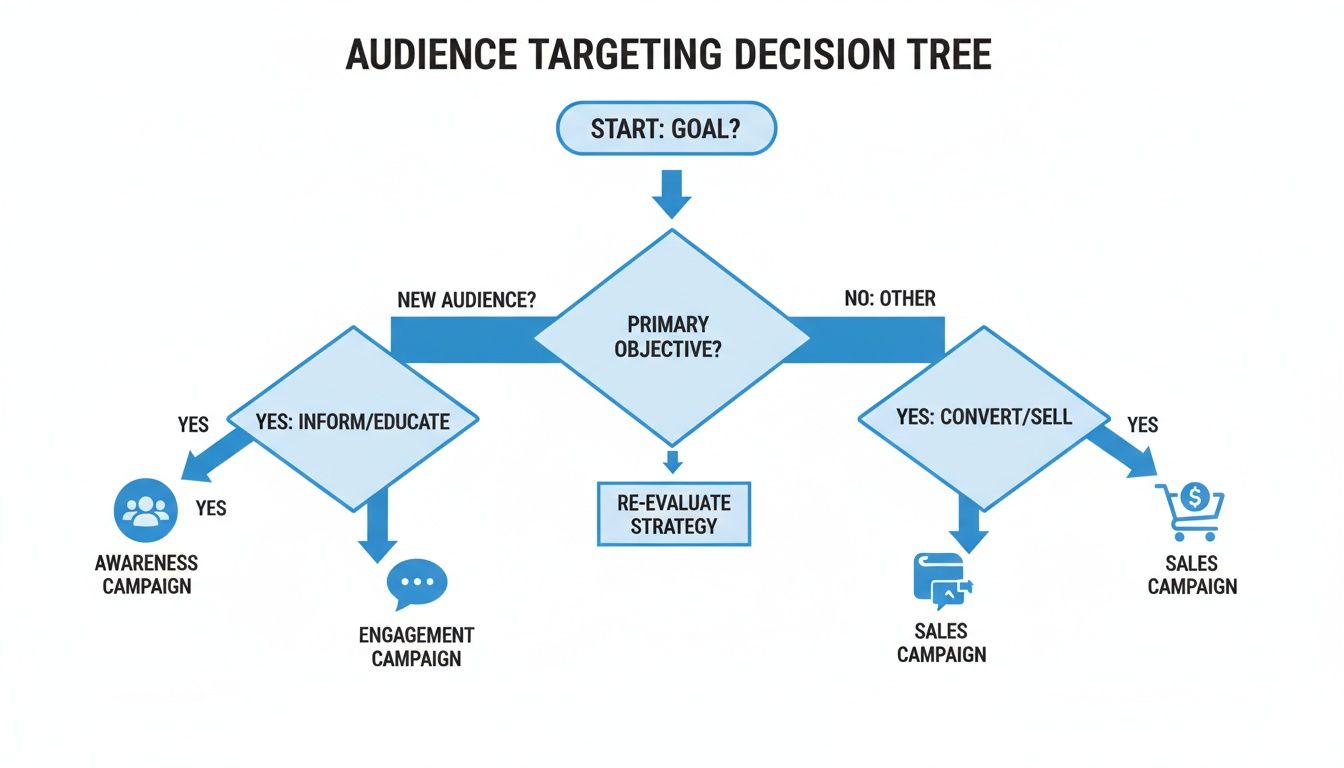
As you can see, for direct sales, behavioural and contextual methods are often your most direct path. For broader awareness goals, however, demographic and psychographic targeting is usually a better fit.
Meta (Facebook and Instagram): Building Audiences From Scratch (Targeting in Advertising)
Meta’s world is the polar opposite of search engines. People on Facebook and Instagram aren’t actively hunting for products; they’re there to connect with friends, catch up on news, and scroll through content. This makes Meta the undisputed king of demographic and psychographic targeting. You can build astoundingly detailed audiences based on interests, life events, behaviours, and personal connections.
Imagine you run an online vegan café. You could target people in your local area who’ve shown an interest in “plant-based diets” and “sustainability,” and who also happen to follow famous vegan chefs. It’s the perfect way to build brand awareness and create demand where it didn’t even exist before.
Meta’s real magic lies in showing the right person the right product before they even knew they wanted it. It’s a powerhouse for impulse buys and brand storytelling.
Some of Meta’s most potent features include:
- Core Audiences: Build your target profile from the ground up using demographics, location, interests, and behaviours.
- Custom Audiences: Upload your own data, like a list of customer emails, to retarget people you already have a relationship with.
- Lookalike Audiences: This is a game-changer. Meta analyses your best customers and then finds brand new people who share similar characteristics, allowing you to scale your business effectively.
For a proper deep dive, our comprehensive guide offers advanced techniques for targeting audiences on Facebook.
Amazon Ads: Winning at the Point of Sale
Amazon is a completely different beast—a unique hybrid of a search engine and a marketplace. This means every single action taken on the platform is dripping with commercial intent. Targeting here is laser-focused on one thing: selling products, right now.
There are two main plays on Amazon:
- Sponsored Products (Keyword Targeting): This works a lot like Google. You bid on the keywords shoppers use to find products. If you sell yoga mats, you target “non-slip yoga mat.” Simple and effective.
- Sponsored Display (Product Targeting): This lets you put your ads on your competitors’ product pages or target shoppers who have looked at similar items. It’s the digital equivalent of getting your product on the shelf right next to the market leader.
If you’re an ecommerce brand, you simply have to be on Amazon. It cuts through the awareness stage and goes straight for the conversion, engaging customers when their wallets are already out.
This focus on shopper data is now being mirrored across the wider retail media landscape. Digital retail media ad spending in the UK has exploded to an estimated £3.4 billion, powered by data from loyalty schemes like Tesco’s Clubcard, which covers a staggering 22 million households. This allows brands to target based on actual purchase history, slashing wasted ad spend.
How to Measure and Optimise Your Targeting in Advertising
Launching a beautifully targeted ad campaign isn’t the finish line; it’s the starting pistol. The real work kicks off the moment data starts trickling in. This is where you get to turn raw numbers into smarter decisions, making sure every pound of your budget is pulling its weight.
Think of it like tuning a guitar. You can’t just assume it’s in key. You have to pluck a string, listen carefully, and make tiny adjustments until it sounds just right. In advertising, your metrics are the feedback telling you which strings to tighten and which to loosen.
Decoding Your Key Performance Indicators
To figure out if your targeting is actually hitting the mark, you need to speak the language of data. A few key metrics act as a direct report card on how well you’re reaching the right people. Getting your head around them is non-negotiable.
Here are the essentials you need to keep a close eye on:
- Click-Through Rate (CTR): This is simply the percentage of people who saw your ad and were compelled enough to click it. A high CTR usually means your ad creative and message are resonating with your chosen audience.
- Cost Per Acquisition (CPA): This is the bottom-line cost to get one new customer. An effective targeting strategy should drive a low, sustainable CPA, proving you’re reaching people who are actually ready to buy.
- Return On Ad Spend (ROAS): The ultimate measure of profitability, ROAS tells you how much money you’re making for every pound you spend. Strong targeting has a direct, and very positive, impact on ROAS.
These numbers don’t live in a vacuum, though. A brilliant CTR with a terrible ROAS might mean you’re attracting the right crowd, but your landing page or offer is letting you down. That’s why you need the full picture. For a deeper dive, check out our detailed guide on how to effectively measure advertising effectiveness.
Actionable Tactics for Optimisation (Targeting in Advertising)
Once you understand what the numbers are telling you, it’s time to act. Optimisation isn’t a one-off task; it’s an ongoing process of making calculated tweaks to get better results. It’s all about constantly sharpening your aim based on real-world feedback.
True optimisation isn’t about making drastic, sweeping changes. It’s about a series of small, informed adjustments that compound over time to deliver significant results.
Here are three powerful tactics you can put into action straight away.
Refine Your Audience with A/B Testing
Never, ever assume your first guess at an audience is the best one. A/B testing, or split testing, is your secret weapon for discovering who your most profitable customers really are.
It’s simple: you run two identical ads to two slightly different audiences at the same time to see which one performs better. For instance, you could test:
- Audience A: People aged 25-34 interested in “sustainable fashion.”
- Audience B: People aged 25-34 interested in “ethical shopping.”
Let it run for a bit, then check the data. If Audience B delivered a 20% lower CPA, you know exactly where to push more of your budget. This data-driven approach takes the guesswork out of the equation and lets your customers tell you who they are.
Use Exclusions and Negative Keywords (Targeting in Advertising)
Knowing who not to target is just as important as knowing who to target. This is where exclusions and negative keywords become your best friends. They act as a filter, stopping you from wasting money on clicks that will never convert.
If you sell high-end, premium leather shoes, you’d add words like “cheap” and “discount” as negative keywords in your Google Ads campaign. This stops your ads from showing up for bargain hunters who were never going to buy from you anyway. You can do the same on social media, excluding demographic groups or interests that have proven to be dead ends.
Sharpen Your Lookalike Audiences
Lookalike audiences on platforms like Meta are fantastic for finding new customers, but they need to be handled with care. A classic mistake is creating a lookalike from a really broad source, like “all website visitors.” This often creates a fuzzy, low-quality audience.
Instead, build your lookalikes from your most valuable customer segments. Use a source list of people who have bought from you multiple times or those with a high lifetime value. This gives the platform’s algorithm a much clearer signal, resulting in a higher-quality list of prospects. Always start with a tight 1% lookalike for maximum precision, and only broaden out to 2-5% once you’ve proven the concept works.
Navigating Data Privacy and the Future of Targeting in Advertising
Let’s be honest, the ground is shifting under our feet in the world of digital advertising. With big regulations like GDPR now the norm and Google slowly waving goodbye to third-party cookies, the old playbook for targeting in advertising is basically being torn up. For a lot of business owners, this feels pretty daunting.
But this isn’t the end of effective advertising. Not even close. What we’re actually seeing is a much-needed shift towards a more transparent, trust-based way of doing things. The big idea is simple: advertising works best when it respects people’s privacy. This change is forcing us all back to smarter, more fundamental strategies that actually build genuine relationships with customers.
It’s all about quality over quantity now, focusing on data you’ve gathered with a clear “yes” from your audience and reaching them in the right places at the right time.
The Rise of First-Party Data
In this new privacy-first landscape, your most powerful asset is your own first-party data. This is the information you collect directly from your audience, with their explicit permission. It’s the absolute gold standard because it’s accurate, relevant, and built on a foundation of trust.
Think about what you already have:
- Your email newsletter list: These are people who have actively chosen to hear from you.
- Customer purchase history: All that juicy data in your CRM showing what people buy and when they buy it.
- Website behaviour: Analytics that show you which pages your logged-in users are browsing.
By focusing on your first-party data, you’re not just ticking a compliance box; you’re building a marketing engine powered by your most engaged and loyal customers. This data is unique to you, and it gives you an incredible competitive edge.
The Comeback of Contextual Targeting
As tracking individuals across the web gets trickier, contextual targeting is making a huge comeback. Instead of obsessing over who the user is, this method focuses on where they are online. The logic is beautifully simple: place your ads in environments where your ideal customers are already hanging out.
For example, if you sell premium coffee beans, you’d place ads on a popular blog all about home brewing. The audience is already qualified because what they’re doing in that moment screams “I’m interested in coffee!” It’s effective, it respects privacy, and it aligns your brand with content your audience already loves and trusts.
This approach has always been a powerhouse in search advertising. In 2023, search ads pulled in a massive £14.7 billion in investment here in the UK, purely because they tap directly into what someone wants right now. We know that personalised targeting can boost revenues by 50-65%, and with total UK ad spend projected to hit £45.4 billion, adapting to these privacy shifts is simply essential for growth. You can get more details on the UK’s advertising landscape insights on statista.com.
Adapting to a Cookieless Future
The big platforms aren’t just sitting back and watching. Google is busy developing its Privacy Sandbox, a collection of tools designed to deliver relevant ads without creepy cross-site tracking. These new technologies will group users into interest-based cohorts, allowing for effective targeting without compromising anyone’s personal identity. It’s a complex topic, but you can get a better handle on how these automated systems work in our guide to programmatic advertising.
Leaning into these changes isn’t just a defensive play; it’s smart business. When you prioritise privacy, you build stronger customer trust. And in the long run, trust is the only foundation for sustainable growth.
Common Targeting Mistakes and How to Avoid Them
Even the most seasoned marketing pros can slip up on the basics of ad targeting. These missteps often seem small, but they can bleed a budget dry and leave you with painfully disappointing results. Getting your head around these common pitfalls is the first step to building campaigns that actually work.
Think of it like setting the coordinates for a long voyage. A tiny error at the start can leave you miles off course by the end. The same is true for targeting in advertising; small mistakes compound over time, leading to wasted spend and a whole lot of missed opportunities. Let’s look at the most common blunders and how you can steer clear of them.
Mistake 1: Going Far Too Broad
It’s a tempting thought, isn’t it? Cast a massive net to catch as many fish as possible. In advertising, this means targeting a huge, undefined audience and just hoping for the best. The reality? You end up burning through your budget showing ads for specialist hiking gear to people who live in a city centre and have never climbed anything steeper than their stairs.
This approach doesn’t just dilute your message; it absolutely tanks your return on ad spend.
What to Do Instead:
- Layer Your Targeting: Don’t just stop at a core demographic. Add specific interests or behaviours on top. Instead of targeting all men aged 25-50, target men in that age bracket who have also shown an interest in outdoor adventure brands and live near national parks.
- Get Specific with Keywords: On search platforms, avoid broad, single-word keywords like the plague. Focus on long-tail keywords that signal real intent, like “waterproof hiking boots for wide feet” instead of just “boots.”
Mistake 2: Being Excessively Narrow
The opposite mistake is just as damaging. By carving out an audience so specific and niche, you risk having almost no one to show your ads to. Your targeting might be perfect on paper, but if the audience size is only a few hundred people, your campaign will never gather enough data to optimise and will struggle to achieve any meaningful scale.
You’ve essentially created the perfect ad for an empty room.
An overly restrictive audience doesn’t just limit your reach—it drives up costs. When you’re competing for a tiny pool of users, your cost-per-click can skyrocket, making your campaign unprofitable before it even gets off the ground.
What to Do Instead:
- Check Audience Size Estimates: Every major platform gives you an estimated audience size as you build your targeting. Keep an eye on it. Use this as a sanity check to ensure your audience is substantial enough to be effective.
- Start with a Core Niche, then Expand: Kick off with your hyper-specific audience, but create a second, slightly broader ad group to test alongside it. For example, run your “vegan marathon runners” group, but also test a broader “marathon runners” group to see if you can hit a lower CPA at scale.
Mistake 3: Ignoring Exclusions
Forgetting to use negative keywords and audience exclusions is like throwing a party and inviting absolutely everyone—without realising some guests are guaranteed to cause trouble. You end up paying for clicks from people who are actively looking for something you don’t offer.
A luxury car brand paying for clicks from users searching for “cheap second-hand car parts” is a classic example of just throwing money away.
What to Do Instead:
- Build a Negative Keyword List: Before you launch any search campaign, brainstorm all the terms that signal the wrong type of customer. Think “free,” “jobs,” “DIY,” or competitor brand names you don’t want your ads showing up for.
- Exclude Past Converters from Prospecting Campaigns: If someone has already bought your product, you probably shouldn’t be showing them the same introductory offer ad again. Exclude your existing customer list from your top-of-funnel campaigns to focus your budget on acquiring genuinely new leads.
Frequently Asked Questions About Targeting in Advertising
Even with the best strategy in place, it’s completely normal to have a few lingering questions about the nitty-gritty of advertising targeting. We get it. This section tackles the most common queries we hear from UK business owners, giving you quick, straight-to-the-point answers to build your confidence.
Think of this as your go-to guide for those last few uncertainties before you dive in.
How Much Should I Spend to Find the Right Audience?
There’s no magic number here. For a UK SME, a smart move is to start with a modest test budget. Use it to experiment with two or three different audience segments—maybe one based on interests and another on demographics, for example. Let these tests run for at least a couple of weeks to get enough meaningful data.
The goal at the start is learning, not instant profit. An agency can help you structure these tests to find your most profitable audience without burning through cash. Your first investment should be in data, not guesswork. Once you’ve identified a winning audience, you can start scaling your budget with real confidence.
What Is the Difference Between Targeting and Remarketing?
Let’s break it down with a simple analogy. Think of targeting as your effort to find brand new people who might be interested in what you sell. It’s like handing out flyers in a neighbourhood where you know your ideal customers live. You’re reaching out based on who they are and what they’re into.
Remarketing, on the other hand, is all about talking to people who have already visited your website but left without buying anything. You’re showing them a specific reminder ad—perhaps with a tempting offer—to nudge them back to your site. Targeting is for finding new customers; remarketing is for bringing back the ones who got away.
Targeting finds new faces in the crowd; remarketing brings familiar faces back to your door. Both are crucial for a healthy sales funnel, but they solve different problems at different stages of the customer journey.
Can I Use Ad Targeting Without a Large Customer List?
Absolutely. While having your own big list of customer data is a huge plus, it’s definitely not a requirement to get started. Platforms like Google and Meta have incredibly powerful built-in targeting options that don’t need any of your existing data.
You can jump straight in with some highly effective methods:
- Contextual Targeting: Placing your ads on websites or next to content that’s relevant to your product.
- Interest Targeting: Reaching people based on the hobbies and passions they’ve shown online.
- Keyword Targeting: Getting in front of users at the exact moment they’re actively searching for what you offer.
What’s more, you can create ‘lookalike audiences’ from even a small list of your current customers. This is where the platform’s algorithm finds entirely new people who share similar characteristics with your best customers, giving you a powerful way to scale your reach without needing a massive database from day one.
Ready to stop guessing and start reaching your most profitable customers with precision? The expert team at PPC Geeks builds data-driven campaigns that cut wasted spend and deliver measurable results. Get your free, in-depth PPC audit today and discover your true advertising potential.