




The biggest PPC mistakes UK building product manufacturers make almost always boil down to one thing: a massive disconnect between generic advertising tactics and the uniquely complex sales cycle of the construction industry.
These errors range from chasing the wrong keywords and building flimsy landing pages to a complete failure to track the conversions that actually matter, like technical data sheet downloads or sample requests. The result? Many campaigns feel like pouring money into a leaky bucket, racking up clicks but failing to secure valuable specifications or land new trade accounts.
Why Most Manufacturer PPC Campaigns Underperform

For many UK building product manufacturers, pay-per-click advertising holds the promise of a direct line to architects, specifiers, and contractors. Yet, the reality is often a world away from that, with campaigns draining budgets while delivering next to nothing. This isn't because PPC is broken; it's because the strategy is often fundamentally flawed from the get-go.
Imagine a master craftsman trying to do a precision job with a cheap, ill-fitting tool from a DIY shed. The effort is there, the intent is right, but the result is always going to be frustratingly subpar. This is the perfect analogy for what happens when you apply a one-size-fits-all B2C advertising approach to the highly specialised B2B construction world.
The Disconnect Between Ad Spend and Industry Nuance
The UK construction market runs on long project timelines, technical specifications, and a whole committee of decision-makers. A simple click on an ad rarely, if ever, leads to an immediate sale. The real value is getting your product into the specification process right at the start. Unfortunately, most PPC campaigns are built on a foundation of critical errors that stop this from ever happening.
These common but costly mistakes include:
- Ignoring Market Signals: Failing to adjust bids and budgets in line with UK construction output data and economic forecasts.
- Poor Keyword Targeting: Wasting money on broad, expensive keywords that attract weekend DIYers instead of qualified industry professionals.
- Weak Conversion Tracking: Measuring vanity metrics instead of actions that show real commercial intent, like BIM file downloads or CPD webinar registrations.
The ultimate goal of a manufacturer's PPC campaign is not just to generate traffic. It's to become an indispensable resource for the professionals who specify, purchase, and install building products. A successful campaign builds a pipeline, not just a click report.
Throughout this guide, we’ll unpack each of these mistakes in detail. More importantly, we'll give you practical, UK-specific fixes to help you transform your PPC efforts from a budget leak into a powerful engine for generating specifications and driving real growth. Understanding why generic PPC agencies don't work for building product businesses is the first step towards building a strategy that actually delivers.
Ignoring Critical UK Construction Market Signals
Running a PPC campaign that’s completely detached from what’s happening in the UK construction market is like a skipper ignoring the weather forecast. You’re basically steering your budget straight into a storm, hoping for the best.
This is, without a doubt, one of the biggest and most expensive mistakes building product manufacturers make. They fail to connect their ad spend to the cold, hard economic reality of the sector. This "set and forget" mentality burns through cash with terrifying speed.
Imagine you kicked off a campaign when industry confidence was sky-high, bidding aggressively on keywords for new housing developments. But then the market contracts. If your bids stay the same, you're paying peak prices to reach a rapidly shrinking pool of active buyers. That’s not bad luck; it’s a failure to read the room.
Syncing Your Bids With Economic Realities
Your PPC strategy can’t exist in a bubble. It has to be a living, breathing thing that reacts to the pressures and opportunities popping up across the UK construction landscape. Things like material costs, labour shortages, and shifting government policy have a direct knock-on effect on project timelines and what gets specified.
A smarter approach means treating key economic indicators not as background noise, but as direct commands for managing your campaigns. When you do this, you stop just buying clicks and start making properly informed investments based on real-world demand.
A market-aware PPC strategy doesn't just save you money during a downturn; it helps you pounce on growth opportunities faster than your competitors. It's about spending smarter, not just spending less.
Many manufacturers are making catastrophic errors by not factoring in these UK-specific conditions. For instance, while the construction sector's output price inflation was 2.7% year-on-year, the cost of materials has historically shot up much faster, squeezing profit margins for everyone in the supply chain. With that kind of pressure, you simply can't afford an inefficient PPC campaign.
To make matters worse, the Construction Products Association's Purchasing Managers Index (PMI) has been stuck below the crucial 50-point growth mark for ten months straight—the longest contraction since the 2008-09 financial crisis. This is a dramatic U-turn from the confidence we saw before the Autumn Budget, when the PMI was flying high at 57.2 points. You can dig into the full UK construction sector report to see how these numbers are really hitting home.
From Reactive Spending to Proactive Strategy
To sidestep this common pitfall, you need a straightforward way to monitor these indicators and turn them into actual PPC actions. This isn't about becoming an economist overnight. It's about being a sharp marketer who gets the world their customers live in.
It’s surprisingly simple to start aligning your PPC moves with what the market is telling you. The table below breaks down what some of these signals mean and exactly what you should do about them.
Aligning PPC Actions With UK Construction Indicators
| Market Indicator | What It Means For You | Your Corrective PPC Action |
|---|---|---|
| Falling PMI Scores | A clear sign of contracting activity and lower confidence among purchasing managers. Demand for new materials is about to soften. | Pull back bids on expensive, top-of-funnel keywords. Funnel that budget into remarketing to nurture the leads you already have. |
| Rising Material Costs | Contractors and specifiers might put projects on hold or hunt for cheaper alternatives, shrinking your pool of immediate buyers. | Switch your ad copy to focus on value, durability, and long-term ROI. Target keywords around "cost-effective building solutions." |
| Increased Construction Output | The market is growing, with more active projects. Demand for your products should rise, but so will the competition for keywords. | Carefully increase bids on your proven, high-performing keywords. Look at expanding campaigns to target new, emerging project types. |
| Housing Starts Decline | A dip in the residential sector means fewer chances for products specified in new home builds. | Pause or slash the budgets for your residential-focused campaigns. Reallocate that spend to target commercial or renovation sectors instead. |
Just by checking in on these signals—even once a month—you can turn your PPC management from a guessing game into a calculated strategy. This protects your budget when things get tight and lets you invest intelligently when the market opens up, making sure every single pound you spend is working as hard as it possibly can.
Using Generic Keywords That Attract The Wrong Audience
Throwing money at overly broad keywords is like casting a fishing net with holes a mile wide. You might feel like you’re covering a lot of ground, but every valuable fish will swim right through. This is one of the most common—and expensive—PPC mistakes UK building product manufacturers make, burning through thousands on clicks from people who will never specify or buy their products.
When you bid on a generic term like ‘roofing supplies’, you're not just competing with other manufacturers. You're jumping into a bidding war against everyone from national merchants to local DIY shops. Worse still, you're paying for clicks from homeowners planning a weekend shed repair, not architects finalising specs for a multi-million-pound commercial project. The intent just isn't there.
Specifiers speak a different language. It's precise and technical. They aren't searching for 'insulation'; they're looking for 'BBA certified PIR insulation boards for flat roofs' or 'acoustic insulation for party walls'. Your keyword strategy has to mirror this professional language to pull in the right people and push away the wrong ones.
The Problem With One-Size-Fits-All Keywords
A massive failing in manufacturer PPC is the complete lack of audience segmentation. An architect has a wildly different set of needs to a contractor, and your campaigns need to reflect that. The architect is after technical data sheets, BIM files, and performance specs. The contractor? They need to find a local stockist, check an installation guide, or simply confirm product availability.
If your ad for a highly-engineered cladding system clicks through to a generic homepage, you've failed both of them. The architect gets frustrated by the lack of technical detail, and the contractor can't find the practical info they need. This gaping disconnect between keyword, ad, and landing page is where budgets go to die.
Paying for a click is easy. Paying for a click from the right person, who is shown the right information at the right time, is the entire art of effective B2B PPC. Every irrelevant click from DIY traffic is not just wasted spend—it’s a missed opportunity to reach a genuine specifier.
The concept map below shows how aligning your campaign metrics with a clear, targeted strategy drives real business outcomes.
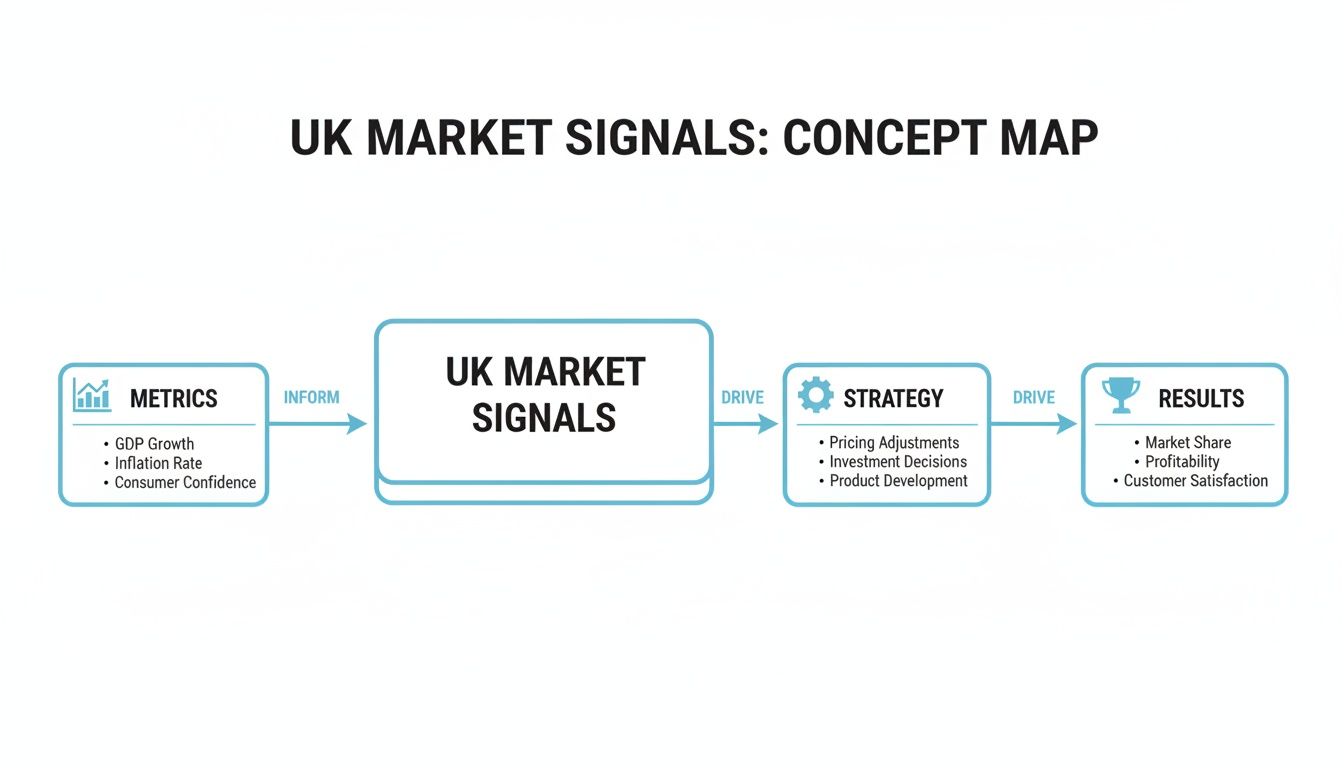
It boils down to a simple truth: a targeted strategy, informed by the right data, is the only way to achieve meaningful results like increased specifications or new trade accounts.
Building a High-Precision Keyword Strategy
To fix this mess, you have to build your campaigns around the specific intent of your target professional personas. This isn't about just finding a few more keywords; it's a multi-layered approach that goes way beyond the basics.
Here’s how you can shift from a generic, scattergun approach to a precision-targeted strategy:
- Segment Campaigns by Audience: Create separate campaigns and ad groups for architects, engineers, contractors, and any other key decision-makers. This is non-negotiable. It allows you to tailor your ad copy and landing pages specifically to what each of them needs to see.
- Use Long-Tail Technical Keywords: Go deep. Focus on the longer, more specific phrases that professionals actually use in their day-to-day work. Forget 'bricks'; start targeting 'engineering bricks class A BS EN 771-1' or 'handmade brick slips for interior walls'.
- Implement an Aggressive Negative Keyword List: This is your most powerful tool for filtering out tyre-kickers. Your list should be packed with terms like 'cheap', 'DIY', 'how to', 'job', 'reviews', and 'course'. Proactively blocking these searches is crucial, and you can learn more about building a bulletproof list of negative keywords for Google Ads to protect your budget.
- Leverage Audience Targeting: Use Google Ads' audience features to layer on extra intelligence. You can target users based on their industry (Construction), job function (Engineering), or even create custom audiences based on people who have visited competitor or industry body websites.
Let’s look at what this looks like in practice. It’s night and day.
| Generic (Weak) Strategy | Precision (Strong) Strategy |
|---|---|
Keyword: flooring |
Keyword: commercial vinyl safety flooring BS 7976-2 |
| Ad Headline: Quality Flooring Supplies UK | Ad Headline: R10 Slip-Resistant Vinyl – Data Sheets |
| Landing Page: Homepage | Landing Page: Technical product page with downloads |
| Target Audience: Everyone in the UK | Target Audience: In-market for commercial building materials |
This strategic shift means your budget is now laser-focused on attracting high-value professionals who are actively involved in specifying and buying building products. You'll immediately see an improvement in the quality of your traffic and the potential ROI of your entire campaign.
Relying On PPC While Neglecting Organic SEO
Picture this: You have the option to rent a house or buy one. Renting gets you a roof over your head tomorrow – it's fast and solves an immediate problem. But every rent cheque you write disappears, building zero long-term value. Buying a house is slower, sure, but every mortgage payment builds equity, creating a valuable asset that works for you 24/7.
That’s the difference between PPC and SEO. Treating Pay-Per-Click as your only digital channel is like choosing to rent forever. It’s easily one of the biggest strategic mistakes UK building product manufacturers make. While PPC is a fantastic tool for getting in front of people right now, ignoring organic search means you're willfully turning your back on the vast majority of your potential market. It’s a costly decision that leaves sustainable, long-term growth completely off the table.
The True Cost of Ignoring Organic Search
The numbers don't lie, and they paint a pretty stark picture. UK building product manufacturers constantly funnel huge budgets into paid ads, overlooking the very channel their audience trusts and uses the most. Let’s get straight to it: research shows organic search results hoover up an incredible 94% of all search clicks. That leaves paid ads fighting over the leftover 6%.
It gets worse. When you look at similar B2B sectors, SEO delivers an average ROI of 702%, making PPC's average of 155% look tiny in comparison.
And what about lead quality? It’s not even close. Leads from organic search convert at a very healthy 14.6%, whereas PPC leads limp across the finish line at just 1.7%. By betting the farm on paid ads, manufacturers aren't just getting a smaller piece of the pie; they're getting a slice that's far less likely to turn into actual business. If you want to dig deeper, you can explore more on the SEO vs PPC performance gap and see the full scale of the imbalance.
Focusing solely on PPC is like meticulously setting up a stall at a market but placing it in a quiet back alley. You might get a few passers-by, but you’re missing the bustling main square where 94% of your customers are actually shopping.
This just doesn’t add up. It means manufacturers are paying a premium to capture a tiny fraction of the market's attention, while competitors who invest in SEO are building a powerful, permanent presence exactly where high-intent specifiers are looking for answers.
How SEO Makes Your PPC Campaigns Better
Here’s the thing, though: SEO and PPC aren't rivals. They're a power couple. A solid organic foundation doesn’t just bring in its own high-quality traffic; it actively makes your paid campaigns cheaper and more effective.
Google's whole game is about rewarding websites that give users a great experience and relevant content. When your website is properly optimised for search, your landing pages are naturally a better match for the keywords you're bidding on in your PPC campaigns. This directly boosts your Quality Score – Google's rating of your ads, keywords, and landing pages.
A higher Quality Score is your ticket to a better deal from Google. It rewards you with:
- Lower Cost-Per-Click (CPC): You simply pay less for each click than a competitor with a lower score.
- Higher Ad Positions: Your ads are more likely to show up at the top of the page, even if you’re not the highest bidder.
- Increased Ad Visibility: You get invited to more ad auctions, meaning your ads are shown more often.
In short, every pound you put into SEO pays you back twice. It strengthens your organic presence while making your paid advertising budget work much, much harder.
Creating a Symbiotic PPC and SEO Strategy
The real magic happens when you stop treating these channels like they're in different departments and start integrating them. Use the data from one to make the other smarter, and you'll dominate the search results page and maximise your marketing budget.
Here’s how you can build a joined-up strategy that actually works:
- Use PPC Keyword Data to Fuel SEO: Your Google Ads account is a goldmine. Find the paid keywords that are driving real-world conversions—like technical data sheet downloads or sample requests—and make them top priorities for your organic content strategy.
- Test Ad Copy with PPC Before SEO: Why spend weeks creating a piece of content without knowing if the headline will land? Use PPC to A/B test different headlines and value propositions quickly. See what messaging resonates most with architects or contractors, then use the winning formula for your on-page SEO titles and meta descriptions.
- Leverage Organic Traffic for PPC Remarketing: This is a killer tactic. Build powerful remarketing lists from your organic traffic. For instance, create an audience of everyone who visited a specific product page via organic search, and then serve them hyper-targeted ads on platforms like LinkedIn to stay top-of-mind.
- Dominate the SERP with Both: When you rank organically and appear in the top ad spot for a crucial keyword, you build immense authority and trust. This "own the page" approach massively increases your total click-through rate, pushing competitors down and capturing traffic you’d otherwise miss.
Failing To Track The Conversions That Actually Matter
Not tracking the right conversions in your PPC campaigns is like flying a multi-million-pound cargo plane without any instruments. You’re burning a hell of a lot of fuel and making a ton of noise, but you have absolutely no idea if you’re heading towards your destination or just flying in circles over the sea.
This is, without a doubt, one of the most damaging and common PPC mistakes UK building product manufacturers make. So many businesses fall into the trap of measuring success by vanity metrics like clicks or impressions. Sure, those numbers might look impressive in a report, but they tell you nothing about whether your ad spend is actually influencing a specification or securing a new trade account.
For a manufacturer, the valuable 'conversion' is almost never a simple online sale. The real wins, the ones that build the order book, happen much earlier in the project lifecycle. We're talking about those critical interactions that signal genuine commercial intent from an architect, specifier, or contractor.
Distinguishing Macro and Micro Conversions
To get a true picture of your PPC performance, you have to track the actions that actually move the needle. This means looking beyond basic 'contact us' form fills and zeroing in on the specific, high-value engagements that define the B2B buying journey in the construction industry.
We can split these into two key categories:
- Macro Conversions: These are the big-ticket items. The actions directly tied to sales opportunities and high-value leads. They represent a significant step forward in the specification or procurement process.
- Micro Conversions: These are the smaller, yet still vital, signals of engagement. They show that a professional is actively researching your products and, crucially, trusts your brand as an authoritative source of information.
For building product manufacturers, tracking a single BIM file download is infinitely more valuable than tracking a thousand clicks. The download shows a specifier is actively designing your product into a project; the clicks just show you're spending money.
Measuring both is essential. Macro conversions show you the immediate ROI, while micro conversions help you understand your brand's influence and build powerful remarketing audiences to nurture future leads.
Essential Conversion Tracking For Building Product Manufacturers
Let's break down the conversions that truly matter for your business. Setting these up as goals in Google Analytics and importing them into Google Ads is non-negotiable if you want your campaigns to succeed. Here’s a look at the key actions you should be tracking.
| Conversion Type | Audience | Business Value | Tracking Method |
|---|---|---|---|
| BIM/CAD File Download | Architects & Specifiers | High – Your product is being integrated directly into project plans. | Event Tracking on Download Button |
| Technical Data Sheet Download | Architects & Contractors | High – Signals deep product evaluation for specification. | Event Tracking on Download Link |
| 'Find a Stockist' Search | Contractors & Installers | Medium – Shows immediate intent to purchase and locate product. | Event Tracking on Search Submission |
| CPD Registration | Architects & Specifiers | High – A powerful lead generation tool and brand-building activity. | Goal Tracking on Thank You Page |
| Sample Request Form | Specifiers & Clients | High – A direct request indicating a project is moving forward. | Goal Tracking on Form Submission |
Tracking these conversions gives you a much clearer, more relevant picture of campaign performance, allowing you to optimise your budget towards the activities that actually generate specifications and sales.
Closing the Loop with Offline Tracking
The journey doesn't stop with an online click. A click on a Google Ad might lead to a phone call with your technical sales team. That call could then result in a new credit account being opened a month later. If you aren't tracking this, you're missing a massive piece of the ROI puzzle.
This is where offline conversion tracking becomes so important. By connecting your phone system and CRM to Google Ads, you can finally attribute offline sales activities back to the initial online ad click. You can learn more about how to set this up by exploring our guide on how trade suppliers should track PPC ROI. This closes the loop completely, giving you a crystal-clear, accurate view of how your digital ad spend is generating real-world revenue.
Creating Landing Pages That Frustrate Specifiers
Think of your PPC ad as a pristine shop window. It looks fantastic and gets people through the door. But if that door opens into a messy, disorganised storeroom, they'll turn right back around. A brilliant ad leading to a poor landing page is exactly like that – a huge letdown where expensive clicks go to die.
This all comes down to a lack of message match. It's a simple idea, but it's vital: the promise you make in your ad must be delivered the second someone lands on your page. If an architect clicks your ad for "BBA Certified Acoustic Flooring Underlay," they'd better land on a page about that specific underlay, not your generic flooring homepage. Anything less breaks their trust and torches your budget.
This mistake gets even worse when manufacturers ignore what’s happening in the real world. Total construction output is only expected to grow by 1.1% this year, and private housing saw new work drop by 5.1% last year. If you're still bidding aggressively on keywords for a slowing market, you're just paying more for clicks that won't convert. For a closer look, you can check out the latest UK construction and building materials commentary.
Designing Landing Pages for Your Audience
Architects and contractors are not the same, so why would you send them to the same landing page? A one-size-fits-all approach is a guaranteed way to annoy everyone. You have to segment.
For an architect or specifier, the page needs to be a technical information hub. They're there to see if your product meets their project's spec. Give them what they want, fast: data sheets, performance stats, and certifications.
For a contractor or installer, it's all about the practical stuff. They need installation guides, where to buy it, and what it works with. Burying this info under marketing fluff is the quickest way to lose them.
A great manufacturer landing page is less of a sales pitch and more of a well-organised technical library. It should empower the professional, answer their questions instantly, and make their job easier.
When you tailor the experience like this, every click has a much better chance of turning into a specification or a purchase order.
An Essential Landing Page Checklist
To stop frustrating your professional audience, every landing page you create needs to tick a few fundamental boxes. Think of this as your quality check before you spend a single penny on a new campaign. For a more detailed guide, our article on building a powerful lead generation landing page goes into much greater depth.
Run through this before you go live:
- Crystal-Clear Headline: Does the headline match the ad copy perfectly?
- Obvious Call-to-Action (CTA): Is it dead simple to know what to do next (e.g., "Download CAD File," "Request a Sample")?
- Easy Access to Technical Data: Can someone find data sheets, BIM files, and spec guides in one or two clicks?
- Prominent Trust Signals: Are your certifications like BBA, BREEAM, or CE marking easy to spot?
- Mobile-First Design: Does the page work flawlessly on a phone for professionals on-site?
- Minimalist Form Fields: Are you only asking for the absolute essentials on your forms?
- Fast Page Load Speed: Does the page load in under three seconds? If not, you're losing people.
Your PPC Questions Answered
When you're a UK building product manufacturer, stepping into the world of PPC throws up a lot of questions. It's not like typical e-commerce, and the usual advice doesn't always apply. We get it. Here are some straight answers to the questions we hear most often.
How Much Should a Manufacturer Budget For PPC?
There's no single magic number here. Your budget depends on your ambitions, how competitive your product keywords are, and where in the UK you're targeting. Instead of plucking a figure out of thin air, it’s much smarter to work backwards. Figure out the lifetime value of a new trade account or a successful specification. Once you have that, you can decide what you're willing to pay to get that lead (your Cost Per Acquisition, or CPA).
As a realistic starting point, a small to medium-sized UK manufacturer should probably be looking at somewhere between £1,500 and £5,000 per month. This gives you enough budget to gather meaningful data and make smart decisions without taking a massive initial risk. The trick is to see it as a measurable investment, not just another line on the expense sheet.
How Long Until We See Results From PPC?
You’ll see traffic and clicks almost straight away, but real business results take a bit longer. One of the biggest mistakes we see building product manufacturers make is expecting instant sales orders. Your game is about getting specified and building relationships with the trade, which is a much longer play than selling a widget online.
Here’s a more realistic timeline:
- Initial Data (Months 1-2): You'll start seeing clicks, impressions, and maybe some early micro-conversions like brochure or data sheet downloads. Think of this as the learning phase.
- Meaningful Leads (Months 3-6): Once we've had time to optimise the campaigns, you should see a solid, steady flow of high-value leads like sample requests and quote forms coming in.
- Measurable ROI (Months 6-12+): This is where the patience pays off. Tying a PPC lead to a closed, specified project takes time. That’s why tracking offline conversions is absolutely essential to see the true financial return.
In manufacturer PPC, patience is your superpower. The sales cycle is long. Your campaigns need time to collect data, get dialled in, and influence decisions that won't appear on a balance sheet for months.
Can We Just Target Architects With Our Ads?
Yes, you can get incredibly close, but it’s not as simple as flipping a switch. You can't target by job title directly on Google Search, but you can use a clever, layered strategy to achieve the same result. It's all about using highly technical, specific keywords that only an architect or specifier would ever dream of searching for.
You then combine this with smart audience targeting. Even better, platforms like LinkedIn let you target users directly by their job title, industry, and even the company they work for. A killer strategy is to use Google Ads to capture that initial search, then use LinkedIn remarketing to stay in front of the specific professionals who visited your site. This makes sure every penny of your budget is focused on the decision-makers who really matter.
At PPC Geeks, we specialise in building data-driven PPC strategies that sidestep these common pitfalls and deliver real, measurable results for UK manufacturers. It’s time to stop wasting your budget and start building your specification pipeline. Get your free, in-depth PPC audit today.