




A lead generation landing page is a standalone web page laser-focused on one thing: capturing a visitor’s contact details to turn them into a solid business lead.
Think of it this way: your main website is a bit like a sprawling department store, full of different aisles, products, and distractions. A landing page, on the other hand, is a specialist boutique with a single, irresistible offer on display.
Why a Lead Generation Landing Page Is Your Best Sales Tool

One of the most common—and costly—mistakes I see businesses make is sending traffic from a paid ad or an email campaign straight to their homepage. It feels like the logical thing to do, but it’s a conversion killer.
A homepage is built for exploration. It has navigation menus, links to different products, company info, a blog… it’s trying to be all things to all people. When it comes to getting a specific action, it just doesn’t cut it.
A dedicated lead generation landing page changes the game entirely by stripping away all those distractions. Its only job is to persuade a visitor to take one very specific action, whether that’s downloading an ebook or signing up for a webinar. This singular focus is its superpower.
The Power of a Single Goal
Imagine a potential customer clicks on your ad for a “Free SEO Checklist.” If they land on a page that’s only about that checklist, the path forward is crystal clear and completely frictionless. There’s no guesswork.
This streamlined experience massively boosts the chances of conversion because you’re speaking directly to one person’s specific need with one clear solution.
And the numbers back this up. In the UK, well-crafted lead generation landing pages see an impressive average conversion rate of around 11.9%. What’s more, tailoring the call to action can lift conversions by another 42%, which just shows how vital customisation is. If you want to dive deeper into the data, this analysis of landing page statistics is a great resource.
A homepage asks a visitor, “So, what would you like to do?” A landing page tells them, “Here is exactly what you should do next.” That simple shift in purpose is the key to getting a real return on your marketing spend.
From Interest to Action (Lead Generation Landing Page)
Ultimately, a purpose-built landing page is about turning casual interest into tangible action. By removing all the exit routes and presenting a compelling, value-packed offer, you guide visitors exactly where you want them to go: becoming qualified leads for your business.
This isn’t just a “nice-to-have” marketing tactic. For anyone serious about capturing high-quality leads and getting measurable results from their ad spend, it’s absolutely essential.
Before we dive into building one, let’s quickly clear up any confusion between a homepage and a landing page. They serve very different purposes, and knowing the difference is fundamental.
Homepage vs Landing Page Key Differences
Here’s a quick comparison table to highlight the fundamental differences in purpose, structure, and performance.
| Attribute | Homepage | Lead Generation Landing Page |
|---|---|---|
| Primary Goal | General exploration, brand introduction, navigation. | Capture a lead by getting the visitor to take one specific action. |
| Navigation | Full website navigation menu is present. | No navigation menu or external links to distract the visitor. |
| Number of CTAs | Multiple calls to action (e.g., “Learn More,” “Contact Us,” “View Products”). | A single, focused call to action (e.g., “Download Now,” “Get Your Quote”). |
| Content Focus | Broad overview of the entire company, products, and services. | Highly specific content that matches the ad and supports the single offer. |
| Target Audience | A wide, general audience. | A very specific audience segment targeted by a particular campaign. |
| Success Metric | Time on page, bounce rate, pages per visit. | Conversion rate (the percentage of visitors who complete the form). |
As you can see, they are two completely different tools designed for different jobs. Using a homepage when you need a landing page is like trying to use a screwdriver to hammer in a nail—it just doesn’t work effectively.
Lead Generation Landing Page: Nailing Your Strategy Before You Build
Jumping straight into a page builder without a solid plan is like starting a road trip without a map. A high-converting lead generation landing page isn’t born from slick design alone; it’s built on a foundation of smart strategy. You absolutely have to lay the groundwork before you even think about colours and fonts.
This upfront thinking is what separates the landing pages that consistently pull in quality leads from the ones that just look pretty.
It all boils down to one simple question: what is the single, most important action you want a visitor to take? This isn’t a trick question. The answer needs to be razor-sharp. Are you trying to get them to download an ebook, book a demo, or sign up for a newsletter? Pick one.
Trying to hit multiple targets with one page is a recipe for confusion and inaction. A page that asks a visitor to “Download Our Guide” and also “Follow Us on Social Media” will fail at both. Your page must have one job, and one job only.
This single objective becomes your North Star, guiding every single decision you make about the page’s copy, design, and overall structure.
Get Inside Your Audience’s Head
Once your goal is crystal clear, you need to get to know the person you’re talking to. And I don’t mean generic personas like “Marketing Manager, age 30-45.” That’s not nearly enough. You’ve got to dig into the specifics of their daily frustrations and what they truly want.
What’s the real pain point your offer actually solves? For instance, don’t just think “they need more leads.” Go deeper. Maybe they’re frustrated because the leads they’re currently getting are poor quality, wasting the sales team’s precious time. Your copy should speak directly to that specific pain, using the kind of language they’d use themselves.
- Listen to sales calls: What are the most common questions and objections that keep cropping up? This is gold dust.
- Read online reviews: Scour forums and review sites for your product (or your competitors’) to find the exact words people use to describe their problems.
- Survey your existing customers: Simply ask them what tipped the scales and made them choose you.
This research isn’t just busy work. It’s the raw material for writing compelling headlines and copy that makes your visitors feel like you’ve read their minds.
Analyse Competitors to Find Your Angle (Lead Generation Landing Page)
Next up, have a good nosey at what your competitors are doing. The goal here isn’t to copy their landing pages—far from it. You’re on the hunt for gaps and opportunities. Is their messaging a bit bland and generic? Are they just listing features instead of hammering home the benefits?
Maybe a competitor offers a “Comprehensive Guide to SEO,” but your research shows that the audience is totally overwhelmed and just wants a “5-Minute SEO Checklist for Beginners.” Bingo. That’s your angle. By spotting what others aren’t saying, you can position your offer as the unique, must-have solution.
Craft an Irresistible Lead Magnet
Finally, your entire strategy hangs on the quality of your offer, or what we call a lead magnet. This is the valuable thing you give away in exchange for a visitor’s contact details. It needs to be so compelling that handing over an email address feels like a brilliant deal, not a chore.
A great lead magnet solves a specific problem, and it does it quickly. We’re talking checklists, templates, short video courses, or exclusive discounts. The key is high perceived value and instant gratification. This is often the entire focus of what’s known as a squeeze page, which is a hyper-focused type of landing page designed purely for this purpose. You can explore a detailed breakdown of what a squeeze page is to see how that specialised approach works.
By defining your goal, deeply understanding your audience, sizing up the competition, and creating a must-have offer, you build a powerful strategic framework. This ensures that when you finally do start building, every element works together towards that one clear objective: turning a visitor into a valuable lead.
Lead Generation Landing Page: Anatomy of a Page That Converts Visitors

A high-converting lead generation landing page isn’t just a jumble of text and images thrown together. It’s a meticulously engineered machine. Every single element has a specific job to do, and they all need to work together to guide someone from casual browser to confirmed lead.
Think of it like an orchestra. Each instrument plays its own part, but it’s the harmony that creates a powerful, moving piece. If one element is off-key—a weak headline, a confusing form, a slow-loading image—the entire performance falls flat.
Nailing this anatomy means getting inside the head of your visitor and understanding the psychology behind each component.
The Irresistible Headline and Sub-headline
Your headline is your first, and arguably most important, handshake. You’ve got about three seconds to grab a visitor’s attention and prove they’ve landed in the right place. It absolutely must scream benefits, not features.
For instance, “Our AI-Powered SEO Software” is a feature. “Rank Higher on Google and Triple Your Traffic” is a result. One describes what you sell; the other describes what your customer desperately wants. See the difference?
The sub-headline is your crucial wingman. It builds on the headline’s promise, adding a bit more detail or a hook that pulls the reader down the page. This is your chance to expand on that core benefit without making the main headline clunky.
Crafting Persuasive and Scannable Copy (Lead Generation Landing Page)
Once you’ve hooked them with the headline, your body copy has to deliver. The golden rule here? Clarity over cleverness. Ditch the jargon and corporate fluff. Write like you’re talking to a real person.
Your copy needs to be laser-focused on solving the visitor’s problem. Use short sentences and even shorter paragraphs. People don’t read landing pages, especially on mobile—they scan. Make it easy for them.
- Bullet Points: Great for breaking down complex benefits into easy-to-digest snippets.
- Bold Text: Make key takeaways and important phrases pop.
- White Space: Give your text room to breathe. It makes the page feel less intimidating and easier to read.
This structured approach gets your message across fast, keeping your visitor engaged and moving them towards that all-important button.
A landing page isn’t the place for your company’s life story. Every word must serve the single purpose of the page: to persuade the visitor that your offer is the solution they’ve been looking for and is worth exchanging their details for.
Using Visuals That Connect Emotionally
Images and videos are so much more than page decoration. They create an emotional connection and can communicate value far quicker than text alone. A generic stock photo of people smiling in a boardroom is useless. A video testimonial from an actual customer or a sharp, high-quality image of your product in action? That builds instant trust.
Your main visual should be the hero of the page, supporting the headline’s promise. It needs to show the desired outcome or reflect your target audience, helping visitors picture themselves finding success with your offer.
Don’t forget performance. In the UK, a page that loads in around 2.4 seconds can see a conversion rate of nearly 1.9%, but that number plummets as load times creep up. Optimising your images isn’t optional; it’s essential for keeping your page fast and your visitors happy.
The Frictionless Lead Capture Form (Lead Generation Landing Page)
The form is the final hurdle. This is where so many potential leads bail because of unnecessary friction. The goal is to make filling it out feel completely effortless and non-threatening.
Only ask for what you absolutely need. If it’s an ebook download, an email address is probably enough. Every extra field you add—phone number, company size, job title—dramatically increases the chance they’ll just give up.
Finally, your Call to Action (CTA) button has to be impossible to miss. Use a contrasting colour that makes it stand out from the rest of the page and use action-oriented text. Forget a passive word like “Submit.” Try something that reinforces the value, like “Get Your Free Checklist” or “Start My Free Trial.” These fundamentals are a crucial part of our wider guide on landing page best practices.
Lead Generation Landing Page: Building Unshakable Trust with Visitors
A slick design might get someone to look, but it’s trust that gets you their email address. Let’s be honest, every single person who lands on your page is a little bit sceptical. Your job is to break down that wall of doubt, piece by piece, until signing up feels like a safe, logical, and frankly, smart decision.
This is about much more than just a good-looking page. It’s about strategically placing signals that scream, “This is a legitimate, trustworthy business that can actually solve my problem.” Without these crucial elements, even the most incredible offer will fall flat.
Harness the Power of Social Proof
People are herd animals. It’s just how we’re wired. When a visitor sees that other people—people just like them—have already had a great experience with you, their anxiety plummets. That’s social proof in action, and it’s one of the most persuasive tools you have.
But don’t just splash random testimonials all over the page and hope for the best. You need to be clever about it.
- Compelling Testimonials: Put a powerful, benefit-focused quote right next to your call-to-action. If you can find a testimonial that crushes a common objection before it even pops into your visitor’s head, that’s pure gold.
- Recognisable Client Logos: If you’re in the B2B space, showing logos of well-known clients is an instant credibility booster. This works wonders “above the fold” where first impressions are made.
- Case Study Highlights: Forget linking to a long, boring case study. Just pull out one jaw-dropping statistic like, “Helped them increase leads by 312% in 60 days” and make it impossible to miss.
Social proof is a shortcut for the brain. It tells a visitor, “Look, don’t just take our word for it—see all these other people who made this exact choice and were thrilled they did.” It’s borrowed credibility, and it works instantly.
Think about it: would you rather eat at a restaurant buzzing with happy diners or one that’s completely empty? Your lead generation landing page needs to feel like that busy restaurant.
Display Clear Trust Signals (Lead Generation Landing Page)
Beyond what other people say about you, there are small but mighty symbols you can add to your page that quietly chip away at a visitor’s anxiety. These are the nuts and bolts of online credibility.
These signals tell visitors you take their security and privacy seriously. Not having them can be a massive red flag, causing people to bail at the very last second.
Here’s what you absolutely must have:
- Security Badges: You’re using SSL, right? (You absolutely should be.) Show a security seal or a little lock icon near your form. It’s a simple visual cue that tells people their data is encrypted and safe.
- Privacy Policy Link: A discreet link to your privacy policy under the form is a sign of transparency. It shows you have clear rules for handling their data and you’re not going to sell it or spam them into oblivion.
- Transparent Contact Details: Including a physical address or phone number makes your business feel real and accountable. It proves you’re not just some faceless entity hiding on the internet.
Proactively Address Objections
The final piece of the trust puzzle is using your copy to get ahead of the doubts swirling in your visitor’s mind. What are the top two or three reasons someone might hesitate? Is it the time commitment? The cost? Worrying it won’t work for them?
Tackle those objections head-on. A short FAQ section near the bottom of the page or even just a few carefully chosen words can make all the difference. For instance, if you’re offering a free trial, adding a simple line like, “No credit card required. Cancel anytime” immediately removes a huge point of friction.
By weaving together powerful social proof, clear trust signals, and copy that pre-empts doubt, you create an environment where converting feels easy. You turn your landing page from a sales pitch into a trusted resource, making it so much simpler for a visitor to say “yes.”
Lead Generation Landing Page: Using Data to Drive More Conversions

Hitting ‘publish’ on your new landing page feels great, but it’s not the finish line. Far from it—it’s the starting block. A slick-looking page that you never analyse is just a missed opportunity, a shot in the dark. To get a real return on your efforts, you need to treat your landing page like a living, breathing asset that gets better over time.
This is where you stop guessing and start building a deliberate system for improvement. By digging into user behaviour, you can make informed tweaks that methodically bump up your conversion rates. It’s the difference between just hoping for leads and engineering a predictable machine that generates them.
The idea is simple: listen to what your visitors are telling you with their actions. Every click, scroll, and form entry—or lack thereof—is a nugget of feedback. Your job is to gather it, figure out what it means, and use it to make your page work even harder.
Understanding User Behaviour with Analytics
Before you can fix anything, you have to see what’s actually happening on your page. Getting your analytics set up is non-negotiable. Tools like Google Analytics or even simpler software like Hotjar for heatmaps will show you exactly how people are interacting with your layout.
Are they scrolling right past your most important message? Do they hover over the call-to-action button but never click? Where in the form do they give up and leave? These aren’t just interesting tidbits; they’re diagnostic tools pointing straight to the friction points on your page.
Focus on the metrics that actually matter for lead generation. Sure, big traffic numbers are nice for the ego, but they don’t pay the bills. The real gold is in these key performance indicators:
- Conversion Rate: This is your North Star. It’s the percentage of visitors who actually fill out your form and become a lead.
- Form Abandonment Rate: What percentage of people start filling out the form but don’t finish? If this is high, your form is probably too long, too complicated, or asking for sensitive info too early.
- Bounce Rate: The percentage of visitors who land on your page and leave without doing anything. A high bounce rate can be a red flag that your ad message doesn’t match what they see on the page.
Introducing Practical A/B Testing (Lead Generation Landing Page)
Once your analytics start showing you where the problems are, A/B testing helps you figure out why and how to fix them. Also known as split testing, it’s just a straightforward comparison between two versions of a page to see which one performs better. You show version A to 50% of your traffic and version B to the other 50%, then see which one gets more conversions. Simple as that.
The golden rule of effective A/B testing is to change only one element at a time. If you change the headline, the button colour, and the hero image all at once, you’ll have no clue which change actually moved the needle.
Start with tests that have the potential for the biggest impact. Don’t get lost in the weeds testing fifty shades of blue for your CTA button. Focus on the big-ticket items that really influence a visitor’s decision. For a deeper dive, our guide on 12 powerful landing page tests has some brilliant starting points.
A/B Testing Ideas for Your Landing Page
To get the ball rolling, here are a few practical ideas for elements to test on your lead generation landing page. Remember, every test needs a clear hypothesis—a simple “if I change X, then Y will happen because…” statement.
| Element to Test | Variation A (Control) | Variation B (Test Idea) | Hypothesis |
|---|---|---|---|
| Headline | “Our Award-Winning SEO Software” | “Increase Your Website Traffic in 30 Days” | A benefit-driven headline will resonate more strongly with the user’s goal and increase conversions. |
| CTA Button Text | “Submit” | “Get Your Free SEO Audit“ | Using specific, value-oriented text on the CTA button will clarify the offer and encourage more clicks. |
| Hero Image | Stock photo of an office | Video testimonial from a happy client | A genuine video testimonial will build more trust and emotional connection than a generic stock image. |
| Form Length | 5 fields (Name, Email, Phone, Company, Role) | 2 fields (Name, Email) | Reducing the number of form fields will decrease friction and lead to a higher form completion rate. |
This methodical approach is what turns your landing page from a static brochure into a dynamic conversion tool. By constantly watching the data, testing your assumptions, and learning from the results, you create a powerful feedback loop. Your page doesn’t just launch well—it evolves to become more effective and more profitable with every single visitor.
Lead Generation Landing Page: Scaling Your Success for Maximum Impact
Getting one high-performing lead generation landing page over the line is a brilliant achievement. But the real growth engine kicks in when you turn that one-off win into a scalable system. Don’t think of your landing page as a single asset; see it as a repeatable template you can use to capture hyper-targeted leads across all your campaigns.
The core idea here is to ditch the one-size-fits-all approach for good. A visitor who clicks an ad for “small business accounting software” should land on a page with a headline and hero image that speaks directly to them. That experience needs to be completely different from what someone sees after clicking an ad for “enterprise financial forecasting tools.”
By creating unique, dedicated landing pages for different ad groups, keywords, or audience segments, you achieve perfect message match. This is what dramatically boosts relevance and, ultimately, your conversion rates.
Multiply Your Pages, Multiply Your Leads
It might sound like a lot of extra work, but the data on this is crystal clear. UK businesses that build out their portfolio of landing pages see a massive increase in lead flow. Research has shown that companies with over 40 landing pages generate a staggering 500% more leads than those with fewer than 10. Why? Because proper segmentation allows you to speak directly to diverse customer needs with pinpoint accuracy.
This quick decision tree gives you a simple framework for figuring out where to focus your optimisation efforts when you’re managing multiple pages at once.
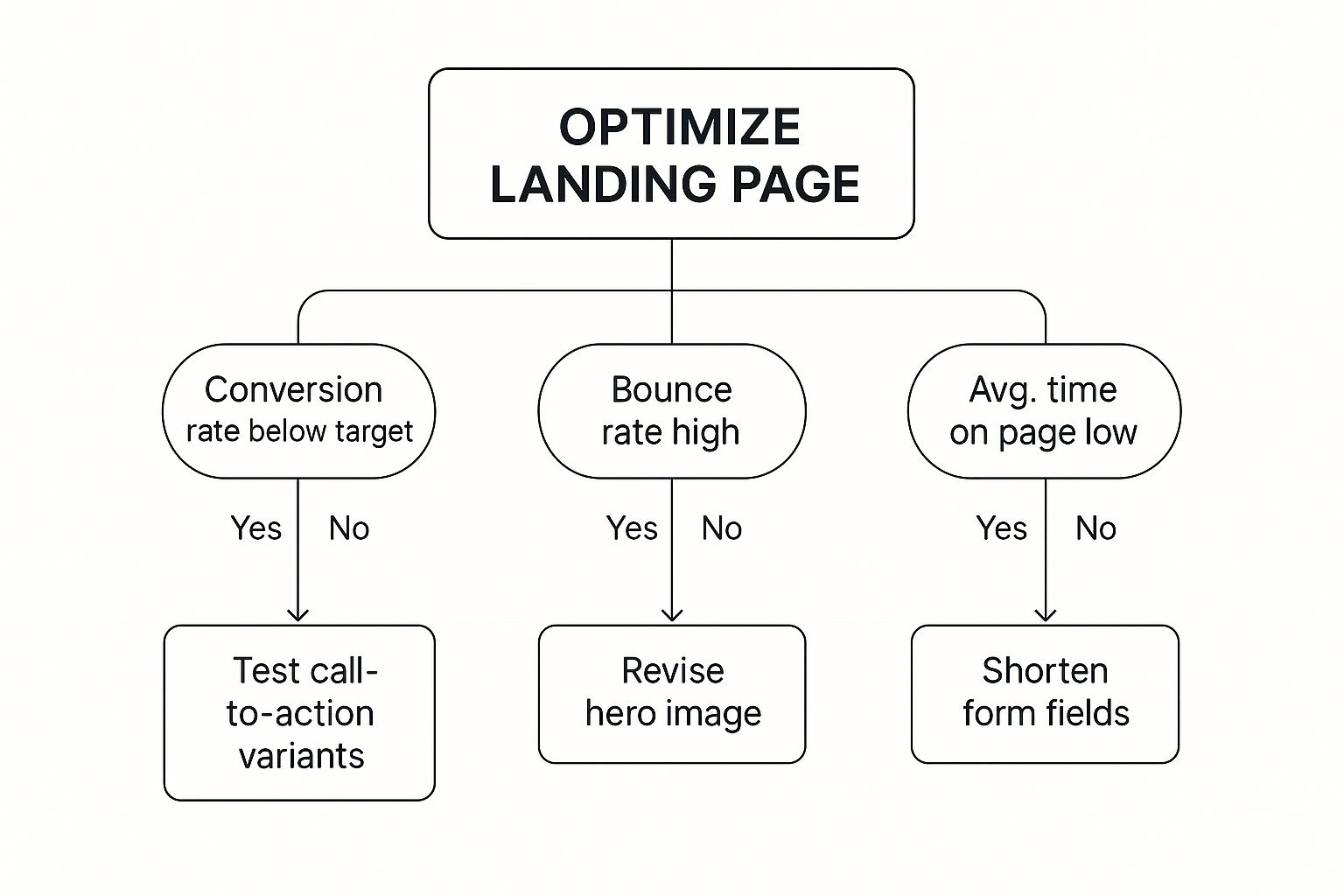
As you can see, the infographic shows how specific performance metrics can point you straight to the page elements that need attention, helping you prioritise your optimisation tasks much more efficiently.
Work Smarter with Dynamic Text
Now, creating dozens of pages from scratch is nobody’s idea of a good time, and it’s certainly not efficient. A much smarter way to scale your efforts is by using Dynamic Text Replacement (DTR). This clever technique allows you to automatically personalise elements like headlines based on the exact search term or ad a visitor clicked.
For example, your headline could dynamically change to “The Best PPC Agency for Plumbers” or “The Best PPC Agency for Solicitors” depending on what the user searched for. This creates an instantly seamless and relevant experience without you having to build and manage hundreds of individual pages.
By transforming your successful landing page into a repeatable framework, you stop chasing one-off wins and start building a predictable lead generation machine. This is how you ensure every pound of your ad spend is working as hard as possible.
This approach doesn’t just improve your conversion rates; it also has a positive knock-on effect on your Quality Score in platforms like Google Ads. Ultimately, scaling your landing pages is all about building a system that delivers a consistently personalised experience, which is key to getting a handle on and improving your cost per lead calculations.
Your Top Lead Generation Landing Page Questions, Answered
When you’re deep in the process of building a lead generation landing page, a few questions always seem to pop up. Trust me, I’ve seen them all. Getting these details right is often what separates a page that’s a lead-capturing machine from one that just… sits there.
Let’s clear up some of the most common queries I hear, so you can build your page with confidence.
How Many Form Fields Should I Actually Use?
The short answer? As few as humanly possible. The golden rule is to only ask for what you absolutely need right now.
If you’re offering a top-of-funnel asset, like a free ebook or a checklist, keep the friction low. An email address is often all you need to get the conversation started. For a more bottom-of-funnel request, like a sales demo, you’ve earned the right to ask for more. This is where you can gather details to help qualify the lead—think company size, job role, or their biggest challenge. Whatever you do, always be testing to find that sweet spot.
Should I Keep My Website’s Navigation Links on the Page?
In almost every scenario, that’s a hard no. A lead generation landing page is a specialist, not a generalist. It has one job to do, and that’s to get a conversion.
Navigation menus, footers, and social media links are just exit signs pointing visitors away from your goal. They’re distractions. By removing them, you create a focused, contained experience that guides the user’s attention straight to your offer and the call to action. That’s exactly where you want them.
One of the quickest wins for boosting conversions is simply removing the main site navigation. You’re creating a tunnel, not a maze, and the only way out is through your form.
What’s a “Good” Landing Page Conversion Rate Anyway?
This is the million-dollar question, isn’t it? While UK-wide averages sit around a very respectable 11.9%, a ‘good’ rate is completely relative. It all depends on your industry, your specific offer, and where your traffic is coming from. The finance sector, for example, might see rates closer to 15%, whereas a creative agency could be thrilled with 8%.
Ultimately, the only benchmark that matters is your own. A good conversion rate is one that you’re actively trying to beat month after month. Consistent A/B testing and optimisation are your best friends here.
Ready to build a landing page that doesn’t just look the part but actually delivers a steady stream of high-quality leads? The team at PPC Geeks lives and breathes this stuff. We specialise in creating and optimising landing pages that become the powerhouse of successful PPC campaigns. Let’s work together to turn more of your clicks into customers. Find out how we can help at https://ppcgeeks.co.uk/.